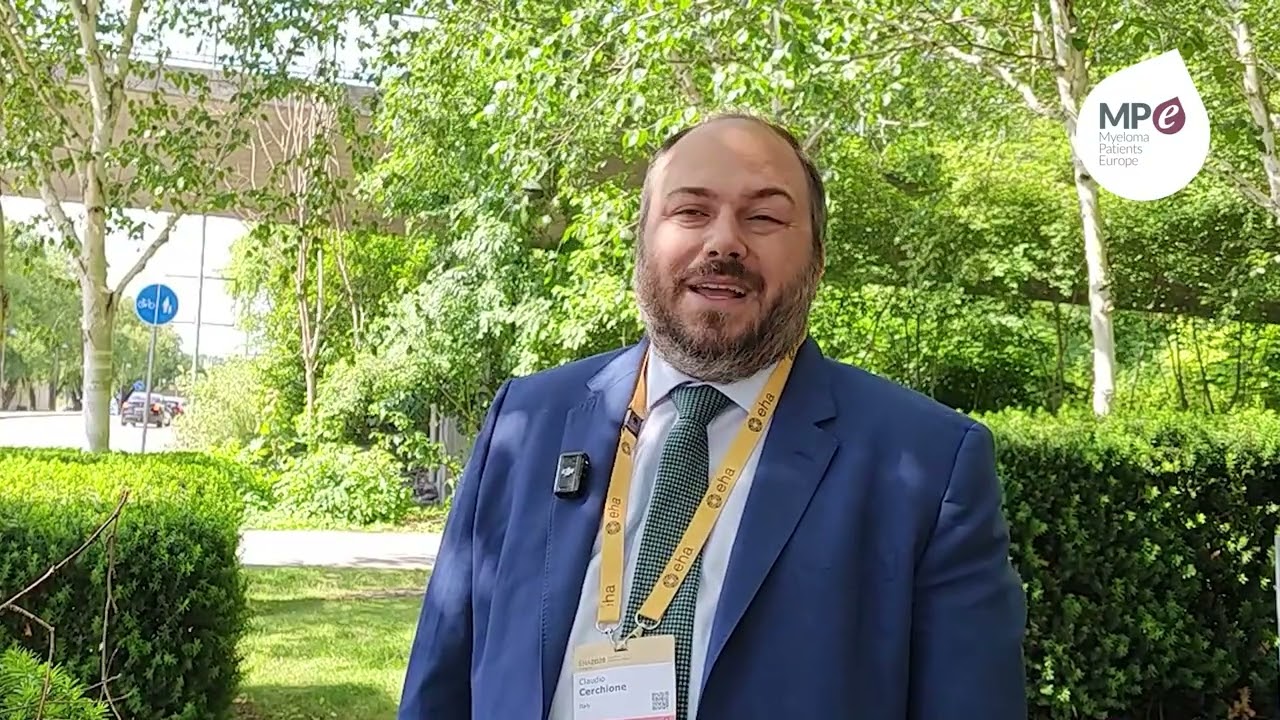
Video summary
The 2016 Stockholm EHA conference highlighted significant advancements in multiple myeloma management, particularly regarding the shift toward preventive strategies for smoldering myeloma and the increasing role of novel immunotherapies. Data from studies like VMN 45 demonstrated that daratumumab monotherapy could achieve deep responses and sustained minimal residual disease (MRD) negativity, offering a potential path to curing smoldering myeloma. In the frontline setting, backbone therapies incorporating daratumumab and isatuximab have shown enhanced activity, with isatuximab standing out as a major innovation due to its subcutaneous administration method. This approach allows patients to receive the drug via a simple abdominal injection rather than long intravenous infusions, significantly improving convenience, safety, and quality of life while maintaining excellent patient-reported outcomes in both relapsed/refractory and frontline contexts.
Beyond immunotherapies, the presentation emphasized the transformative impact of bispecific antibodies like linvoseltamab, which deliver incredibly fast and deep responses with impressive duration of response (DOR). The field is also witnessing the emergence of new CAR-T cell therapies, including novel mechanisms such as arlo-cel and in vivo CAR-T, which hold great promise for future clinical practice. Additionally, mazingnomide has emerged as a highly manageable oral agent that shows incredible synergy with carfilzomib-dexamethasone, demonstrating superior progression-free survival compared to standard control arms in successful trials. For patients who are not yet eligible for these advanced immunotherapies, alternative options such as selinexor-based regimens and melphalufen provide effective bridging strategies to prepare them for eventual treatment with novel agents.
The conference also underscored the importance of quadruplet therapies, with the combination of talquetamab, pomalidomide, daratumumab, and dexamethasone representing one of the most significant novelties presented at ASH. This regimen showed remarkable superiority over standard triplet combinations in key trials, offering a powerful option for many patients. The discussion further explored the potential of exploring new combinations involving bispecific antibodies to expand treatment horizons. These developments reflect a broader trend toward more aggressive and effective regimens designed to maximize response depth and duration, ultimately aiming to improve long-term outcomes for those with high-risk disease.
Ultimately, the consensus from these highlights is that achieving MRD negativity should be considered the true endpoint for drug approval and daily clinical practice. Deep responses are closely correlated with symptom relief and an exceptional quality of life, while also holding the potential for curing patients in the future. This pursuit represents the highest aspiration for myeloma researchers, clinicians, caregivers, and patients alike, who continue to fight against this disease every day. The integration of these novel therapies, improved administration methods, and rigorous endpoints marks a pivotal era in multiple myeloma care, offering renewed hope and tangible progress toward better survival and quality of life for all affected individuals.
Read the full video transcript
[music]
>> The actual 2016 Stockholm we have seen
incredible novelties starting from
smoldering myeloma. The idea of making a
preventive treatment with also novel
immunotherapies becoming really
important that we have seen the data of
VMN 45 with daratumumab monotherapy
brilliant results in terms of deepness
of response and in terms also of the
idea of potentially curing a smoldering
myeloma because we aim to obtain MRD
negativity sustained MRD negativity. In
frontline setting we are seeing how much
the backbones daratumumab and isatuximab
are increasing their activities and I
think that OBI is a fantastic novelty
because we can inject isatuximab inside
a little button that we push on the
abdomen of our patients. It is really
smart, really fast, really safe.
Patients reported outcomes are
incredible with this opportunity tested
in relapsed refractory setting in Iraq
and in ZAL with pomidex or with the
carfilzomib dex but we can switch as
soon as possible. It has been recently
FDA and EMA approved. All the patients
that are doing isatuximab will stop to
have a long intravenous infusions and
will switch to subcutaneous infusion.
This is amazing. I think that taking
care of the quality of life is becoming
more and more important. OBI is I think
a tool that will help a lot of patients.
In terms of other opportunities
linvoseltamab is more than a promise is
an incredible fast really deep response
bi-specific antibodies with amazing D3.
I think that we will help many patients
with that. This is
we have the data of linker studies and
we are going also to anticipate it in
frontline setting and also in low
intermediate and high risk smoldering
myeloma where some trials are ongoing.
We have also new forms of CAR-T, new
mechanism of action such as arlo-cel and
also in vivo CAR-T. They are promises I
think that we will need as soon as
possible in our daily practice. Let's
not forget that we have many other
option and I think between the main
novelties presented in the ASH, we have
a mazingnomide is a new cell mode that
in combination with the carfilzomib
dexamethasone in successful two clinical
trial has shown incredible superiority
toward control arm KD. 18 months of
progression free survival but in general
I think the capability to
have a great synergy with the
carfilzomib and being an oral drug is
very manageable and I think that we need
in our daily practice. Moreover, we have
seen that for patients that are in this
moment are not eligible for new
immunotherapies, we can switch them to
selinexor based treatment. Selinexor BD
is an option. Melphlufen is another
option. Also for bridging patient to the
immunotherapies and we have seen also
incredible data with the new quadruplet
with the talquetamab monumental three.
Talquetamab pomalidomide daradex
amethasone compared with daradex,
darapondex and darapondex, I think that
is one of the most important novelties
that we have seen here. Quadruplets are
for many patients. We are going to
explore many new combination with the
bi-specific antibodies. Let's not forget
that the ASH we have seen how much MRD
should be the real end point for
approving drugs but in general that we
have to aim in our daily practice
because you want a deep response. Deep
response correlates with the lacking of
symptom with a wonderful quality of life
and the potentially in a future
perspective with the cure of our
patients. And I think that this is the
best wish that we give every day to
patients, to caregivers, and also to
myeloma researchers that every day fight
against this disease.
>> [music]