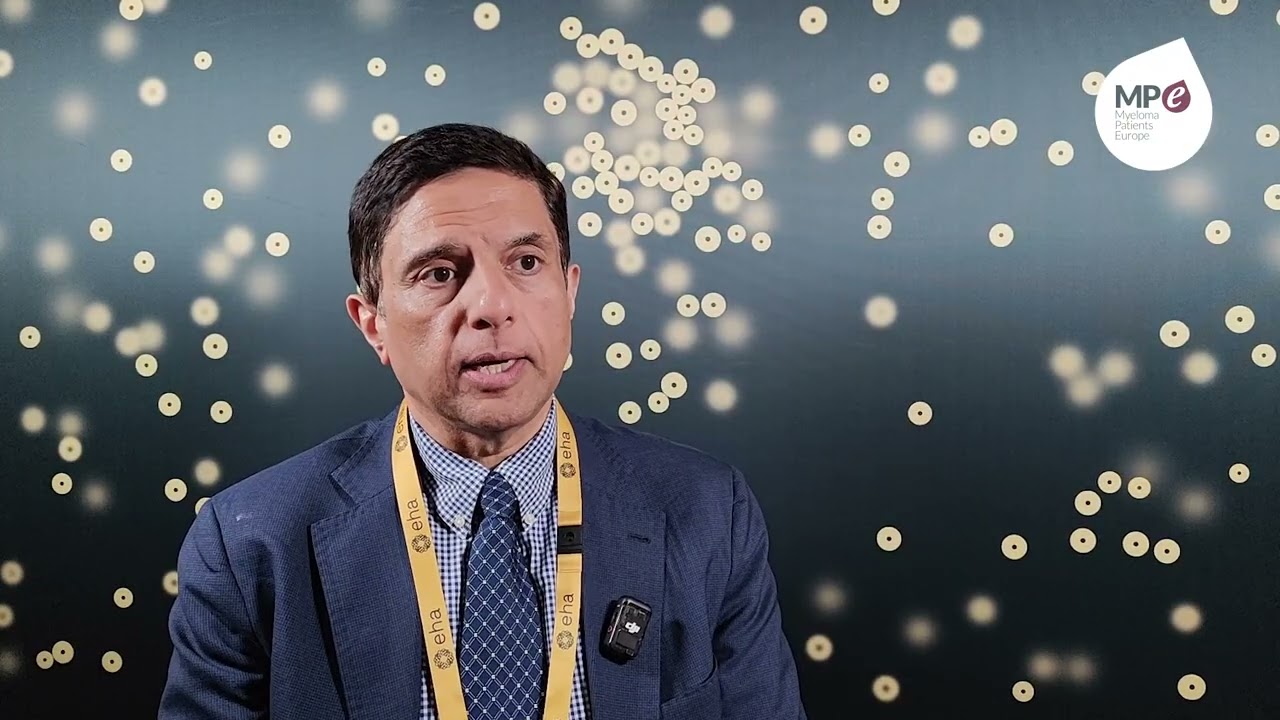
EHA 2026 | Linker-AL2 study: linvoseltamab monotherapy in relapsed or refractory AL amyloidosis
Watch on YouTubeVideo summary
The video discusses linvoseltamab, a novel bispecific monoclonal antibody designed to treat relapsed or refractory AL amyloidosis by targeting the underlying plasma cells that produce harmful proteins. Unlike traditional chemotherapy, this biologic drug functions by binding simultaneously to two different targets: one arm attaches to the plasma cell while the other binds to an immune T cell. This dual-action mechanism brings the T cell directly next to the plasma cell and sends a signal to activate it, effectively instructing the immune system to destroy the diseased cells that generate amyloid-forming light chains.
In early safety studies involving the first twenty patients, the treatment demonstrated an excellent safety profile with no severe toxicities that would hinder further research. While minor side effects such as infections were observed, they were generally low-grade and easily manageable. The most significant finding was the drug's ability to induce a rapid and profound reduction in light chain protein levels in the blood; typically, these levels normalized within two weeks of starting treatment and became almost undetectable by the third week. This speed and depth of response represent a major improvement over previous therapies, offering patients a critical opportunity to immediately halt the production of amyloid precursors.
The administration protocol involves an initial intravenous infusion for the first two doses, followed by subcutaneous injections under the skin, usually in the abdomen. The dosing schedule begins with weekly injections for eight weeks and transitions to monthly doses thereafter, with treatment typically continuing for twelve months but potentially extending up to two years if necessary. These results from the early phase study highlight linvoseltamab as a highly tolerated option that achieves deeper responses than almost any other chemotherapy used in amyloidosis, marking a transformative potential for patients suffering from light chain amyloidosis.
Looking ahead, the research is moving from this safety-focused phase one trial to a phase two trial aimed at evaluating the drug's effectiveness in a larger patient population. Recruitment for this next stage is expected to be completed over the coming year or two, with results intended to support regulatory licensing for patients who have relapsed or refractory disease. Additionally, there are hopes to eventually study the medication in newly diagnosed patients, further expanding its role as a leading treatment option that combines safety, rapid action, and deep efficacy to improve outcomes for those with AL amyloidosis.
Read the full video transcript
[music]
>> So then we set them up is a monoclonal
antibody. It's a protein that binds to
plasma cells. It's a bispecific
antibody, which means that it binds to
two different things.
It has got one arm which binds to the
plasma cell. It's got a second arm which
binds to an immune cell called T cell.
The T cell binding arm, the immune cell
binding arm also has a little signal
which tells the T cell to become active
and gives it a signal to kill the plasma
cell.
So it really mediates the immune cell to
come right next to the plasma cell and
then tells the immune cell kill this
plasma cell. So that's really what this
antibody is meant to do.
This antibody is uh given initially as
an intravenous infusion as a drip for
the first two doses.
And then after that it's given as a
subcutaneous injection under the skin
usually in the tummy.
Uh it's given once weekly for the first
8 weeks and then it's given once a month
thereafter and in this trial we did
usually 12 months of treatment with a
potential
to extend it to 2 years if it was
necessary.
So the LINKER-MM1 trial is investigating
uh linvoseltamab as a treatment for the
plasma cell that produced amyloid
forming protein is investigating as a
treatment for the plasma cell dyscrasia
that that underlies systemic
amyloidosis.
This drug is intended to kill the plasma
cells with a view to reducing the
amyloidogenic light chain protein in the
blood.
And certainly in this trial what we were
able to show and this was a very early
phase study, which means that we were
looking mainly at the safety of this
drug uh to show that we can deliver it
safely to patients and certainly in the
first 20 patients that were treated and
in the abstract that we presented
we saw no toxicities or side effects
that would limit us from studying this
drug further.
Uh
we saw some uh some toxicities like
infection, but generally they were
fairly low grade and they were very very
manageable.
Uh what we saw in a striking way was
that we were measuring these uh the
light chain protein amyloid forming
protein in the blood for all of these
patients every week when we started the
treatment
and we saw a very dramatic reduction in
the light chain protein. So, typically
by second week, so 14 days after the
drug was given, so after the first two
doses,
almost every patient had normalized
their light chain protein and typically
by the third week the light chains were
almost undetectable.
And that is a very critical finding for
amyloid patients where we really want a
deep and a rapid response and this this
drug achieves both.
And the responses that we're seeing with
lenalidomide are much much faster than
responses we've seen almost with any
other drug
um apart from other similar drugs that
have been studied in amyloidosis. So,
this really is a treatment which has a
potential to transform patients
with light chain amyloidosis where we
immediately want to stop the production
of the amyloid precursor protein, the
light chains.
So, these results represent a huge
advance for patients with AL
amyloidosis. This [music] is a biologic
drug, it's not a chemotherapy, it's a
monoclonal antibody, it's incredibly
well tolerated
and we see very fast and very rapid
responses. We see deeper responses than
what almost every other chemotherapy
that we've used in amyloidosis. So, it
does represent a huge advance for
treatment of light chain amyloidosis.
Now, this was a phase one trial, which
means we were looking at safety. We are
now studying this drug in a phase two
trial where we're actually looking at
effectiveness
with a view that the phase two will lead
to this drug being licensed in patients
with relapse refractory amyloidosis.
>> [music]
>> So, the phase two trial will complete
its recruitment over the coming 1 to 2
years. And once those results are
analyzed, they will be presented to the
regulatory authorities with a view to
licensing. And we're also hoping that we
will be able to study this drug in
patients with newly diagnosed light
chain amyloidosis.
>> [music]