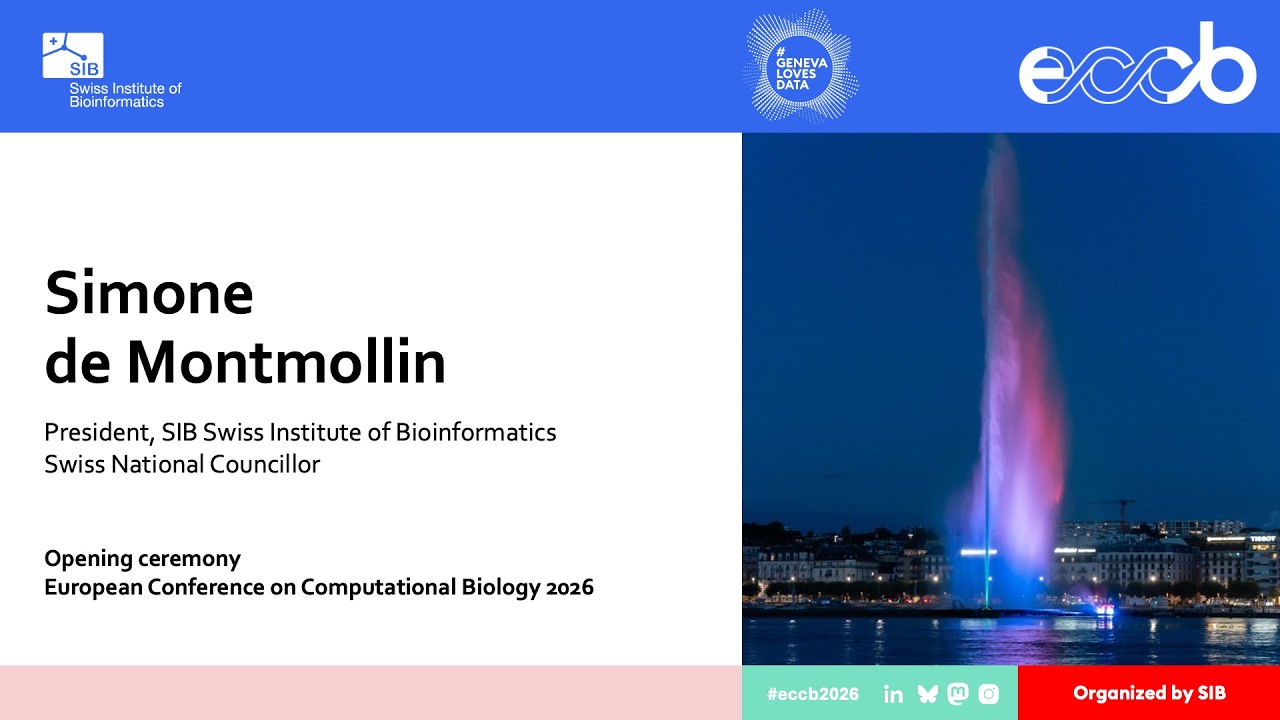
ECCB 2026 – Simone de Montmollin - President, SIB, Swiss National Councillor
Watch on YouTubeVideo summary
Simone de Montmollin, serving as President of the Swiss Innovation Board and a National Councillor, welcomed attendees to the 25th European Conference on Computational Biology in Geneva, emphasizing the city's unique role as a hub where science, cooperation, and global openness converge. She highlighted that Geneva is more than just a host city; it is a place where international organizations like the WHO and CERN transform knowledge into action while fostering trust across borders through dialogue and negotiation. The event underscores the conviction behind the "Geneva loves data" initiative, which aims to move data science beyond laboratory walls and make biological and biomedical data accessible to everyone, including secondary school students, thereby ensuring the next generation understands both the technologies they use and the responsibilities they entail.
The speech addresses the twin challenges facing society, such as aging populations, emerging pathogens, biodiversity loss, food system pressures, and the rapid development of artificial intelligence, noting that while science is essential for addressing these issues, it cannot replace democratic decision-making. De Montmollin argued that democracy relies on reliable knowledge to distinguish evidence from assertions and genuine progress from mere promises, especially in an era of disinformation where scientific integrity forms part of democracy's infrastructure. She further explained that data has become a matter of sovereignty, security, and credibility, defining sovereignty as the ability to act without withdrawing from cooperation, security as the protection of sensitive information during crises, and credibility as the traceability of public decisions and AI systems to trusted evidence.
Defining high-quality datasets, she questioned whether they are accurate, secure, documented, interoperable, verifiable, representative, open where possible, and protected where necessary, asserting that quality is not a final label but a continuous stewardship involving long-term preservation rather than just collection and curation. The presentation stresses that innovation must serve the purpose of improving health, protecting the environment, and upholding human dignity, raising critical questions about what we should build with data and for whose benefit rather than simply focusing on increased computing power. To achieve this, a robust framework is required that safeguards rights without hindering research, supported by sustainable infrastructure and skilled personnel to ensure data remains reliable over time.
In conclusion, the necessity of harmonization across borders was emphasized as data increasingly crosses international lines, requiring standards and rules that individual projects or nations cannot establish alone. Institutions like SIB are presented as vital resources offering expertise and continuity that solitary efforts cannot match, positioning Geneva uniquely as a global center for trusted scientific data where science, policy, and international cooperation shape rules worthy of public trust. De Montmollin closed by expressing hope that the conference would not only advance science but also strengthen the truth and trust upon which its impact depends, wishing everyone an inspiring event and a wonderful stay in Geneva before thanking the audience for their attention.
Read the full video transcript
As president of a CBI, it's an honor to
welcome you to Geneva for this 25th
European Conference on computational
biology and a pleasure to see this
international scientific community
gathered here for the first time.
Because Geneva loves data, Geneva is not
simply a host city, it's a place where
science, cooperation, and openness to
the world come together.
Here, states negotiate across their
differences. International organizations
turn knowledge into action and
institutions such as WHO, CERN, United
Nation, our universities, and hospitals
connect research, policy, and society.
Here standards are discussed and trust
is built across borders,
making Geneva the right place for our
conversation today.
Geneva loves data is therefore more than
the name of a public program. It
expresses a conviction.
Data science must not remain confined to
laboratories.
Through the Data Terium exhibition,
online outdoors, and here at the CCG,
biological and biomedical data are made
accessible to everyone, including the
many secondary schools classes that have
already visited it.
The next generation should not only use
data-driven technologies, but understand
the evidence behind them and the
responsibilities they entail.
Our society faces inter-twin challenges,
among which aging, emerging pathogens,
biodiversity loss, pressure on food
system, and rapidly developing
intelligence, artificial intelligence.
Each will require science.
But science cannot make democratic
choices for us. Yet, democracy cannot
make sound choice without science.
Reliable knowledge help us distinguish
evidence from assertions, uncertainty
from manipulation,
and genuine progress from mere promise.
In an age of disinformation,
this is part of the infrastructure
of democracy itself.
As a member of Swiss Parliament, I see
another dimension.
Data are now a matter of sovereignty,
security, and credibility.
Sovereignty is the capacity to
understand, decide, and act without
withdrawing from cooperation.
Security protects sensitive information
while keeping vital data and expertise
available in crisis.
And credibility allows public decisions,
scientific results, and AI systems to be
traced to trusted evidence.
So, what makes a high-quality data set?
Is it accurate, secure, documented,
interoperable, verifiable, and
representative?
Open where possible, protected where
necessary.
Can it be responsibly used and remain
intelligible 10 years from now?
Probably all of these in different
measures. One thing is certain, however,
quality is not a label applied at the
end. It's a change of stewardship from
collection and curation to long-term
preservation.
We must also ask what the technology is
for. More computing power does not
automatically mean more progress.
Innovation has meaning when it improves
health, protects our environment, and
upholds human dignity.
The question, therefore, is not only
what we can build with data, but what we
should build and for whose benefit.
This requires a framework that protects
rights without paralyzing research,
sustainable infrastructure, and skilled
people who ensure that data remain
reliable.
Institutions such as SAB provide a
trusted resource, expertise, and
continuity that individual projects or
country cannot ensure alone.
As data cross borders, standards and
rules must follow.
And harmonization has never been more
necessary.
In this end, Geneva is uniquely placed
to become a global hub for trusted
scientific data, where science, policy,
and international cooperation
shape rules worthy of public trust. This
is the spirit of Geneva, building trust
across borders through dialogue.
This week, you will advance science.
Together,
may we also strengthen the truth the
trust on which its impact depends.
I wish you an inspiring conference and a
wonderful stay in Geneva. Thank you for
your attention.
>> [applause]