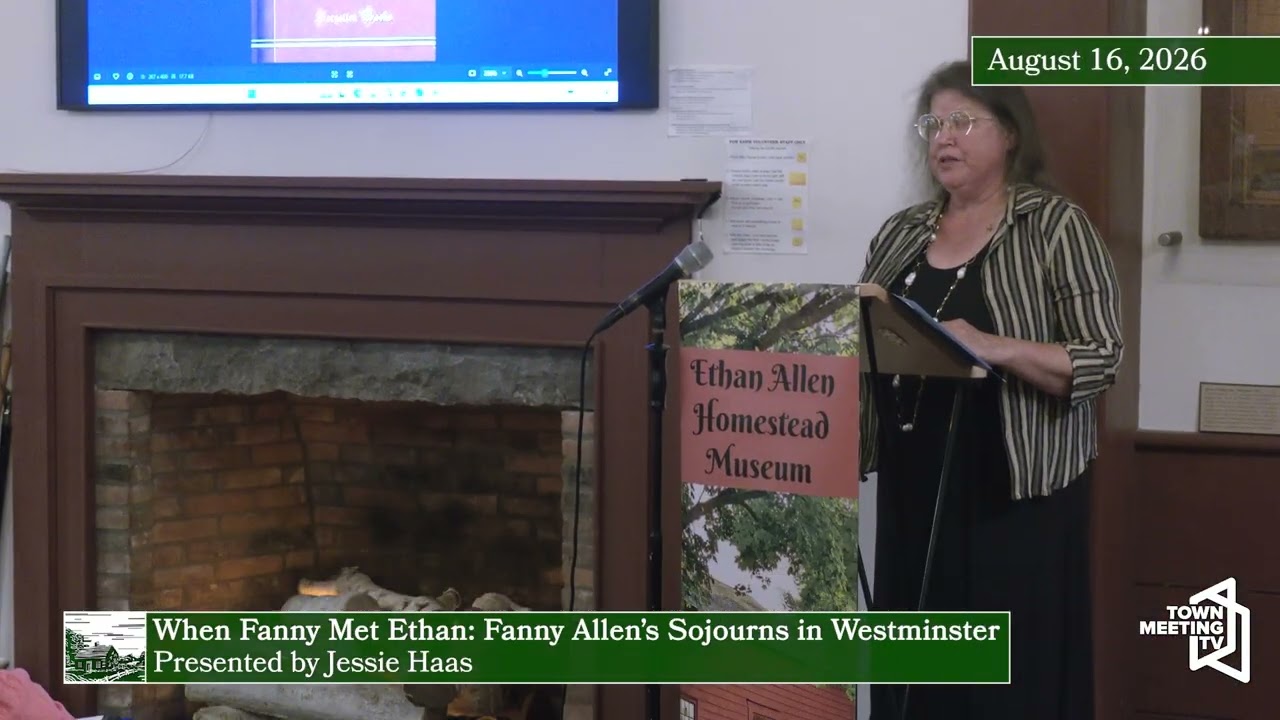
EAH Enrichment Program: When Fanny Met Ethan - Fanny Allen’s Sojourns in Westminster
Watch on YouTubeVideo summary
Emory Gerlock, the weekend manager at the Ethan Allen Homestead, opens the program by highlighting upcoming events such as lectures on indigenous history and reenactments for Vermont Archaeology Day before introducing Executive Director Angie Grove and the day's speaker, Jesse Hos. Hos, a Westminster native who grew up in a house built by historian Benjamin Hall's great-uncle, shares her journey from reading historical novels about horses to publishing 43 books that blend equine themes with local history. Her research into the town's past led to the discovery that Fanny Allen lived merely 100 feet from the courthouse during the Westminster Massacre of 1775, a revelation that inspired her novel *Dearest Blood* and spearheaded the 250th anniversary commemoration, which resulted in a Vermont State Legislature resolution honoring the event.
Hos's talk, titled "When Fanny Met Ethan," explores Westminster as Fanny Allen's home during three critical periods of her life: living next to the courthouse at age fifteen during the massacre, fleeing to New York in 1776 where she was forced into an unwanted marriage, and returning in 1783 as a widow seeking her stepfather's confiscated land. The narrative delves into the town's complex social fabric, where families with opposing political views—such as radical revolutionaries like the Wrights, moderates like the Holtons, and fervent Loyalists like the Nortons—lived as neighbors and even intermarried. Fanny herself arrived in 1771 with her stepfather, Irish Loyalist lawyer Korean Brush, who had secured thousands of acres despite rumors that she was an illegitimate child born to a British captain; while the town initially welcomed their wealth, Brush's rudeness and political maneuvering eventually alienated him.
Following the Revolutionary War, Fanny and her stepmother Margaret faced a difficult legal landscape as commissioners sold their confiscated Tory lands without compensation, yet they found crucial support from local figures including John Norton, Steven Bradley, and Ethan Allen. Hos argues that although financial restitution for the land was unlikely due to market conditions and legal hurdles, Fanny's relationship with Ethan Allen, which blossomed into marriage in the winter of 1781, was driven by love rather than property recovery. After Ethan's death in 1789, Fanny returned with their children, married Dr. Jabez Penman in 1793, and eventually moved to northern Vermont following the death of Senator Stephen Row Bradley's wife, marking the end of her sojourns in Westminster where she later cared for her stepmother before passing away in Burlington.
Read the full video transcript
Hi everybody. My name is Emory Gerlock
and I am the weekend manager here at the
museum. I'm going to tell you all a
little bit more about our upcoming
events before we get the program
started. So our next lecture series is
on September 17th from 2 to 3 p.m. on
capturing indigenous history through 3D
scanning by Chief Don Stevens. Our next
reenactment event is September 26th from
11:00 a.m. to 2 p.m. and it is central
around Vermont Archaeology Day with a
home and hearth reenactment and a mini
archaeology dig. Our annual summer
fundraiser is August 19th. It's called
Cruising Through Time and it's a private
cruise on Lake Champlain for homestead
supporters. There are only a few seats
left and you can buy your tickets at the
front desk after the talk. Our homestead
programs on the road include on August
17th, Angie Grove, our homestead
director, will present on Vermont's
revolution for Monton Historical Society
at Monton Town Hall. And this is free to
attend. As well as on August 28th
through September 6th, you can see our
Green Mountain Boys display in the
Vermont State Building in partnership
with the Sons of the Union Veterans of
the Civil War. You can see our flax
production program on the road on August
30th at the Wooki Fiberf Fair and on
September 19th at the Old Stone Houses
fall fiberf fair. You can support these
programs with a membership or a donation
at the front desk after the
presentation. We'd also like to thank
our sponsors for this event. Richard and
Linda Smark, Mnt Bank, and Northfield
Savings Bank. Thank you to [applause]
Thank you to CCTV for recording today
and thank you to Margaret Rushlo as well
for the refreshments. I am now going to
introduce Andy Angie Grove who is our
executive director. Thank you all.
[applause]
>> Thanks Emory. Okay, [snorts]
lots of fun events coming up so I hope
you get to come to some of them. Um,
okay. So I am here to introduce our
speaker today who is become a friend of
mine over the last couple of years um
because we have a mutual friend who
lived in the 18th century [laughter] and
that um we're going to learn about
today. So [snorts] um Jesse Hos grew up
in Westminster, Vermont in a house that
was built by Benjamin Hall's historian
Benjamin Hall's great uncle on a farm
that was first settled by a minute man
who fought at Bunker Hill. So, a lot of
connections to history right at Jesse's
youth. As a child, she was lured into
the love of history because historical
novels frequently had horses on the
covers. And if you don't know anything
about Jesse, you should know that she
loves horses. [snorts] She studied
English and history at Welssley. And she
sold her first novel, which was a
children's horse story, of course. Um,
she sold that first novel a month before
she even graduated college. That was
back in 1981. [snorts]
uh horses and history account for most
of her 43 published books. She has also
written two histories of the town of
Westminster, um including
[clears throat] Revolutionary
Westminster, which covers the period
from settlement to statehood.
We're good. Thanks.
>> [clears throat]
>> And it was while researching this
history in Westminster that Jesse
learned about Fanny Allen, uh, who was
living only 100 feet away from the
courthouse during the Westminster
massacre. Uh, Fanny and her stepmother
Margaret encountered the sheriff's posy.
They lived through the massacre and uh,
Jesse has studied all of that. Um,
little known facts from that event occur
in Jesse's novel, Dearest Blood, which
we do sell in the gift shop, and she is
here, so you might as well get an
autographed copy um after this
presentation. Uh, Jesse Hos is president
of the Westminster Historical Society.
No surprise after all that research. And
she spearheaded the 250th anniversary
commemoration of the Westminster
massacre. And in 2025,
that effort included drafting a
resolution that was passed by the
Vermont State Legislature, which
described the massacre in only 330
words, which Jesse has told me she
considers her greatest writing
achievement. [laughter]
When she's not writing and doing
historical research, she lives in an
off-grid cabin with her husband, Michael
J. Dailyaly. So, please help me welcome
Jesse Hos.
Thanks, Angie. And yeah, it's been uh
fun to connect here with Ethan Allen
Homestead. And um I I love being here
and
u thanks for inviting me. So the title
of my talk is When Fanny Met Ethan, but
I could have titled it where Fanny Met
Ethan. The focus is on my hometown of
Westminster,
which was her home for three pivotal
periods of her life. In 1775, she was 15
when she was living next door to the
courthouse during the Westminster
massacre.
In the aftermath, the family fled to New
York where Fanny was forced into an
unwelcome marriage. In seven in 1783,
she returned as a young widow seeking to
recover her stepfather's confiscated
land and met Ethan Allen, who had the
same lawyer she did and his own strong
interest in confiscated Tory lands.
After Ethan's death in 1789, she
returned to Westminster with their
children. And there in 1793, she married
Dr. Jabis Penman among whose patience
was US Senator Steven Row Bradley's wife
in 1803 following his wife's death
Bradley named Penman to a lucrative post
which sent the family back to northern
Vermont. So Westminster was Fenny's
launching pad the longtime home of her
stepmother and a place where she was
remembered as a woman of wit and spirit.
So, a major source that I'll be
referring to is Benjamin Hall's history
of Eastern Vermont where which I almost
feel I have a family connection to. This
is published in 1858. And Hall was 22
years old and newly graduated from
Harvard when he came to Westminster,
which was his father's hometown, and
started work on his history. He was 168
years closer to the revolution than we
are and was able to interview
participants of the massacre and
children of the participants. He also
delve deep into the official records of
five states. And when you check his
work, you find the documents say what he
says they do. But his book should also
be understood as oral history and as
local history.
In the course of my research, I came
across a clipping from a small no local
newspaper that ran a weekly history
column. It reprinted a story from an
1895 article in the Vermont Phoenix, a
Brattleboro newspaper. And that article
quoted an 1805 newspaper story whose
source was Mrs. Francis Penman, the
former Fanny Allen.
It was the first time I had any idea
that Fanny Allen, our Fanny, was in
Westminster at the time of the massacre.
I included the story in Revolutionary
Westminster, but I didn't fully believe
it. Later, I changed my mind, which I'll
get into, and the historical conjunction
is the basis of my novel, Dearest Blood.
So, I come at this material now from two
viewpoints. Historical, what we know,
and fictional, what we can imagine.
Westminster is a Connecticut valley town
between Rockingham and Putney with a
landscape created over 11,000 years ago
by the draining of glacial lake
Hitchcock. This left fertil fertile lake
bottom soil laid out in a series of
table lands along the banks of the
Connecticut. And you can easily see this
as you drive on I 91. Westminster
Village occupies a plateau above the
river with farmland on the flats below
and to the north. There was a
Paleoindian presence starting 13,000
years ago. At the time of European
contact, the Abenaki occupied the area
with a concentrated settlement called
Squaki at what is now Northfield,
Massachusetts.
Following European contact,
Squaki experienced plagues in which 90%
of the inhabitants died. An attack by
the Mohawks drew the remnant drove the
drove the remnant, I'm sorry, north to
Canada.
So now the upper Connecticut Valley was
a settller's dream. Empty of Indians,
enormous, fertile, flat fields in which
you literally cannot find a rock if you
want one, and the river with easy access
and trade routes.
And yeah, Squawk might be gone, but the
wars with the French and their Indian
allies made the place far too dangerous.
For decades, Massachusetts was
overcrowded. The government was under
pressure to find new territory for
settlement. And at that time,
Massachusetts considered that it had
title to a large swath of the land that
is now Vermont.
In one of the pauses in the long war,
the general assembly ordered a survey of
land from Rumford to the Great Falls and
laid out 28 six mile square townships.
In 1735, Westminster was chartered as
township number one, granted to citizens
of Taton and nearby towns as
compensation for their service in the
war.
The new proprietors surveyed the town,
and eventually three men came up and
built a gate, a boat landing, a little
short section of road, and two cabins.
And then they found out they weren't in
Massachusetts anymore. In 1740, the
boundary with New Hampshire was settled.
New Hampshire considered that it went
all the way west quite into the nebulous
west and the the Massachusetts line fell
south of Westminster. So the risk was
just too much and the settlers gave up.
11 years later, another batch tried
again. And instead of solitary men this
time, these were family groups who
formed a little community, eight adults,
a dozen kids from teenagers to infants.
In 1753, New Hampshire granted a charter
and uh named named the town Westminster.
But in 1753, war broke out again, and
the town emptied for the next five
years. Only in 1758 did a few young men
begin sifting back to take up
homesteads. In 1760, which is the year
Fanny was born, the fall of Montreal and
the final defeat of France, open the
floodgates.
New settlers came flocking in, mostly
from Massachusetts, a few from
Connecticut. They were all young and
middle-aged couples with a lot of kids.
So, it was a very youthful place. If you
happen to remember growing up at the
tail end of the baby boom, it was like
that. Elders were rare. There were even
10 years later, there were only eight
men over 60 in the whole town of
Westminster. And it was a place full of
cousins. Many of the families had
already extensively intermarried before
they arrived. [snorts] So people came,
you know, adult pe adult couples came
with their siblings, their in-laws, you
know, all the little cousins. So the in
even in a strange place there were many
familiar faces.
But with all this homogeneity, political
beliefs differed widely. And one good
example is a set of farms down on the
flats settled by soldiers who' scouted
the location while canoeing up river to
reinforce fort number four.
Azeriah and Midad Wright were double
third cousins of Ethan Allen. Samuel
Wright married Elizabeth Bert in 1653
and their greatgrandsons were Azeriah
and Midad Wright. Samuel's little
brother Judah married Elizabeth's little
sister Mercy and their great-grandsons
were Ethan and his brothers.
In a town where almost every man was a
former soldier, Azeriah Wright stood out
as a man fully adapted to frontier life
and fighting. Hall says he was an Ethan
Allen on a smaller scale. He was bold,
rough, independent, outspoken, quote,
with a singular recklessness of
character.
He was a church member in good standing,
but he loathed the second minister,
Joseph Bullan, and would tweak his nose
or cuff him whenever they met. And so
the church tried to excommunicate him.
Wright prevented this by bringing his
musket to church and aiming it at the
minister when he started to read the
language
and then uh aiming it at deacon when the
minister handed off the document to the
deacon. So he stayed in church. He
became an increasingly radical wig
through the 1760s.
His brother Midad was more mildmannered,
some would say more sane, and favored
New York government and was a moderate
wig.
John Norton
of ScotsIrish descent was a fervent
loyalist. He ran this inn which was
called the Tory Tavern
and fellow soldier Joel Holton stayed
out of politics completely. So these
four lived on farms next door to each
other. Midad Wright married one of Joel
Holton's sisters and John Norton married
another one. So that put Westminster's
most radical revolutionary and its most
prominent Tory in the same family. So
luckily Thanksgiving dinners were not a
thing yet. [laughter]
The families built a large log cabin
schoolhouse to educate all the little
cousins, maintained their friendship,
which is saying a lot for Azeriah
Wright, and pulled in opposite
directions politically.
So through the 1760s, Westminster grew
by leaps and bounds and changed its
locality once again. In uh 1764, the
king declared the western banks of the
Connecticut of the river Connecticut to
be the boundary line between New York
and New Hampshire. In Westminster, this
didn't change much of anything. Nobody
was trying to take anybody's land. And
whatever the map might say, this was New
England. It was entirely settled by New
Englanders.
New York then created Cumberland County
encompassing present Windham Windsor and
parts of Orange County to give residents
better access to the legal system. The
new county seat was in Chester which was
the home of the influential Chandler
family. John was county clerk. Thomas
was chief justice. It had a rudimentary
courthouse and a jail so sketchy that
incarceration was pretty much voluntary.
You could just like push up the ceiling
and get out of the cell. In 1768,
unrest led the British to declare
Massachusetts in a state of insurrection
and to quarter two British regiments in
Boston. This set the clock ticking on
the Boston Massacre, the Boston Tea
Party, the Massachusetts Farmers
Rebellion, and the Westminster Massacre.
In Westminster, Azariah Wright responded
by forming a pure wig, essentially
private militia. He drilled them at his
farm just down the road from the Tory
Tavern. There were 37 members, including
Captain Wright, and they called
themselves the Liberty Boys. Many of
these men were related. There were three
Averils, three Fippens, and one Rand.
All connected by marriage. Three Crooks,
three Burks, three IDEs, three
Robinsons.
This militia was quite separate from the
normal town militia, and it was a big
time commitment as Wright just drilled
them avidly.
In 1771,
Westminster's first ever Yorkers moved
to town.
This is Korean brush, an Irish Tory
lawyer, very well connected in
government circles.
His wife Margaret
um said to have been a widow Montazan
and a girl named Francis said to be her
daughter. As you all doubtless know,
Fanny probably wasn't Margaret's
daughter. And if she had a claim to a
surname, it should have been Montrasaur,
not Montean.
She was the daughter of Margaret's
15-year-old sister, Anna, and her
seducer,
British Army Captain John Montrasaur.
Maybe
Fanny and Margaret were women of
mystery. Some people believe Fanny was
Margaret's daughter. What people
believed in the 1850s was that Margaret
was never legally married to Korean
brush at all but was living with him so
she could continue to draw the pension
she was entitled to as the fictional
officer's widow. So which she would have
forfeited if she had married again. She
did marry Korean brush out of the Albany
home of General Bradock. So it seems
unlikely. But I think it goes to show
that people sensed something smoky about
this setup. even if they didn't know
exactly what it was.
Nope. I want to go back.
Fanny was a pretty poshl looking little
girl as painted here in her silk gown.
But you can see how young and gawky she
was with her big head and long arms.
This portrait and the one of Margaret
were painted just before they moved to
Westminster.
You can read a lot into that face or
nothing. To me, she looks sad and
guarded. And she had reason. Everything
had just changed. And she may have been
the reason why. The story handed down
through the family of Elizabeth Norman,
who was Korean Brush's daughter from his
first marriage, was that the Brush
family exodus occurred because Fanny had
begun to come out in society, and her
presence was embarrassing to her natural
father.
So, come out in society. She was 11. But
that gown isn't the kind of thing a girl
would have worn to study or putter
around in the garden. And you know,
where did she wear it? What parties and
gatherings would a girl that age have
attended? Margaret was certainly out in
society.
Was she claiming to have been a widow
Montazanne as she did in Westminster or
a widow montasaur?
In either case, it was embarrassing.
Captain John Matrasaur was handsome,
popular, a brilliant military engineer,
and had another Francis Montasaur's
feelings to consider, his beautiful and
wealthy wife. So, according to the
Norman family history, Korean Brush was
awarded thousands of acres of land. And
this is a map of Westminster excluding
the village lots with Korean brush's
name written all up and down the the
lots of you know the 100 acre lots and
the west range. Um so thou 6,000 acres
of land in Westminster and was told by
the governor to take his embarrassing
family elsewhere.
So, what would Fann's state of mind have
been when she arrived in Westminster?
She's 11 years old, which is an awkward
age. She's illegitimate. She's been
she's living under an assumed name and a
false backstory. Her family's been sent
into exile because of her. She was 11
years old. I'm sure that's how she would
have thought of it. She came from a
multicultural city to a little log cabin
village in a town of less than 500
people. She left behind everyone she
knew, her beloved New York garden and a
world of wealth and luxury to come to
this place where most people rel were
related and everyone agreed to a set of
social norms that were strange to her.
She was rich, at least on paper.
Everyone else was poor. Her family owned
the only private house with glass
windows in the entire town. They had a
clock that chimed. They had oil
paintings of themselves hanging on their
walls. Nobody here even pronounced her
name right. She was FA, not Fanny. Like
Hannah or Anna. Every other girl in New
England was called Anna. And that sounds
right to our ears. But Fanna and Salah
don't. Um, and Bill doesn't either, but
that was what was commonly used in
Westminster. sometimes spelled B E L A
which made me wonder, wow, what's the
eur Eastern European connection here but
um so William Zar Bradley the
congressman was called bilazar as a
child usually run together into a single
word so in Fann's position I think I
would have curled up like a cutworm for
the next 20 years she emerged an
outwardly confident
sharp tonged witty and spirited young
woman even at who even at 15 was
prepared to state her opinion. At least
that is how she was remembered in
Westminster and how she remembered her
girlhood self 30 years later.
The brushes were new and exotic and were
at first welcome to Westminster.
According to Hall, quote, "Mr. Brush was
feasted by the inhabitants from house to
house. The display which he affected in
his dress contrasted with the simple
garb of the villagers, and for some time
pomp and parade availed to conceal the
defects of character. But as vulgarity
of mind became apparent, and novelty of
appearance ceased to attract, Mr. Brush
found, in spite of his aosted
attainments as a man of large
information, and his pretensions to
gentility, that his only friends were a
few high- toned and arrogant loyalists.
End quote.
Other memories of brush from New York
political circles paint him as rude,
uncou ugly, a quote stupid fellow. But
he also seems to have been an extremely
useful man in New York politics. An
excellent writer and orator in a rather
Floridaid style and absolutely loyal to
his political masters. Though greatly
despised in hindsight, he wielded and
benefited from extensive political
influence. and he seems to have been a
good stepfather. Um the you know the
tangible evidence that is left is his
will in which he divided everything that
he thought he had equally between his
daughter in Ireland, his stepdaughter
here and his wife. Um so I think he
cared about Fanny. Um it was a family.
So what did family think Fanny think and
feel as she watched him go through this
process of making and losing friends in
his new town? Unfortunately, we have no
idea. And nor do we know if she and
Margaret made friends. In dearest blood,
I did give Fanny a friend, a fellow
outsider, but someone from Massachusetts
who had already witnessed the kind of
unrest that was coming. But the truth
is, we don't know.
In the novel, I also gave her a horse
because it's me. It was my book. But I
had some reasons. We know that she had a
Joseph, which is a riding habit, in
1784. She mentioned it when replying to
Ethan Allen's proposal. By then, she'd
come down in the world, and I imagine
she might have been wearing clothes from
an earlier, more prosperous time. If she
did have a horse, it could have been a
good one. Korean Brush served in the
assembly with James Delansancy who had a
racing stable in the Bowery and it was a
stolen Delansancy stallion who sired
figure the founder of the Vermont Morgan
breed. Korean brush believed in putting
on a good show. And so in my novel, a
beautiful mayor of the wild air strain
descended from this horse whistle
jacket. And a beautiful green riding
Joseph like this made their way up from
New York to Westminster.
But that's fiction. What we know is that
Korean brush rapidly changed the
political situation in Cumberland
County. Chester is the ge was was the
geographic but not the population center
of the county. So that meant a long trip
for most people on terrible roads with
no good in to stay at and this miserable
little courthouse made of tacman attack
poles
besides Korean brush lived in
Westminster.
In February he contrived to get county
clerk John Chandler removed and himself
appointed. Two days later, a petition
requesting that the courts be moved to
Westminster was read to the New York
Assembly. A bill allowing the county to
vote was passed a month a month later.
Westminster still had a 1760 New
Hampshire charter. This would not do for
the Shire town of a New York county. So,
two days after giving Cumberland County
the chance to vote, New York issued
Westminster a charter. In May, surprise,
the county supervisors chose Westminster
as the Shire town and voted to build a
courthouse and jail just a few hundred
yards from Korean Brush's house on the
edge of the plateau looking down on the
upper street.
And just just to confuse everybody in
Westminster at that time,
the street down below that you can see
is the northern most part of the street
and is called the upper street. Up here
and the high on the higher part is
called the lower street and which has I
think contributed to the fact that when
you're in Westminster Village I almost
everybody gets confused about which is
north and south. We're just like upper
lower. We we don't. So, it was an
imposing new courouses compared to the
one in Chester with a courtroom, two
bedrooms, two jail rooms, and it
actually had a tap room. So, when court
was in session, it functioned rather
like a tavern.
Now, Brush and his cronies maneuvered to
have the sheriff removed, and he put in
a fellow Irishman, William Patterson, in
his place.
Cumberland County citizens including
Korean brush wrote to gen governor try
requesting the right right to
representation in the New York assembly.
They got permission to elect two
representatives. Lo and behold Korean
brush is one of those elected and this
puts him back in New York at the center
of power and Fanny and Margaret remained
in Westminster.
Brussia's first act in the assembly was
to draft and help pass the Bloody Act,
which was the anti- riot law aimed at
Ethan Allen and the Green Mountain Boys.
In response, on May 19th, 1774, Ethan
Allen wrote a letter to Brush and his
fellow representative Samuel Wells, in
which he called them land jockeyies,
which is a classic pot calling the
kettle black. and in a postcript he
which he directed to brush personally
this is kind of a masterpiece of of that
of the period
PS [clears throat] Mr. brush. Sir, as
testimony of gratitude for the many
unmmerited kindnesses and services you
have done us the last sessions at New
York, etc., etc., We intend shortly
visiting your abode, where we hope to
have the honor of presenting you with
the beach seal, which we beg your kind
acceptance of as a mark of the high
esteem we have of your person, and as a
token of our appribation for the eminent
exertions you displayed of your
abilities in bringing about the salutoy
act of the 9th of March last, we have
the honor to be yours sincerely, the
Green Mountain Boys.
And as you probably all know, the beach
seal was a severe flogging.
So, did Fanny ever see this letter,
which is um was among her father's
papers um threatening him in their home,
and did the family discuss it? Again, we
don't know, but it is one way she could
have had early contact with Ethan Allen.
She may have also had glimpses of him as
he passed through Westminster.
He was a friend of the Tory Tavern
owner, John Norton, and he probably had
business to discuss with his cousin
Azariah Wright, who they were both in
the patriotic militia business.
Uh, and more so as time went on. In
1774, Parliament closed the Port of
Boston and took over elective government
in Massachusetts in response to the
Boston Tea Party.
Town meetings were limited to once a
year, and all judges and representatives
were appointed by the crown. This led to
great upheaval in uh Massachusetts,
which
may seem like a long way from up here,
but is very close to us down in
Westminster. In August and September,
enormous crowds of farmers armed only
with sticks closed the courts in
Worcester, Great Barington, Plymouth,
Conquered, Northampton, Springfield, and
Taton.
In W. In Worcester alone, there were
five or six thousand men on the street.
the actions were deliberately
nonviolent,
uh, which was a directive from Joseph
Warren because you could get the death
penalty for taking part in riots,
especially if you had a firearm.
In response, the Continental Congress
met in Philadelphia and passed a trade
embargo against Great Britain
known as the Articles of Association.
The fourth article stated plainly that
the colonies resolved to have no trade,
commerce, dealings, or intercourse
whatsoever with any colony or province
in North America that did not accept the
association. It promised to hold the
violators of the association quote as
unworthy of the rights of freemen and as
enimical to the liberties of their
country.
In Fann's backyard on the very same day
the articles of association passed,
Cumberland County towns met in the first
Westminster Convention. It came about
due to government duplicity. In May, the
leader of the New York Committee of
Correspondents, which was a patriot
organization,
had written to the Cumberland County
Supervisors asking what local sentiments
were about what was happening in
Massachusetts. The supervisors
suppressed the letter, but somehow there
were certainly spies in both camps.
Somehow word got out. So Azariah Wright
and his fellow radical who taught at the
school right across the road went to the
next meeting and asked just casually
quote whether any papers had been
received which ought to be laid before
the several towns of the county. The
supervisors fessed up and sent a copy of
the letter to each town and a county
convention was called to decide what
action to take. The Westminster
convention of October 19-20
1774 was the first held in Vermont to
oppose the pressure from Great Britain.
After deliberation, Cumberland County
towns passed a resolution condemning the
recent acts of Parliament as arbitrary
and saying, quote, "Be it right or
wrong, we resolve to assist the people
of Boston in defense of their liberties
to the utmost of our abilities." They
went on, "As true and loyal subjects of
our gracious sovereign, King George III
of Great Britain, we shall spend our
lives and fortunes in his service, that
as we will defend our king while he
reigns over us, and wish his reign may
be long and glorious, so we will defend
our just rights as British subjects
against every power that shall attempt
to deprive us of them, while breath is
in our nostrils and blood in our veins."
In November, in responding to the
articles of association, which they
hadn't heard about yet, the towns met
again in Westminster and voted to quote,
"religiously adhere adhere to the
association's provisions."
The trade embargo went into effect in 17
in December 1774, but in early 1775,
the New York Assembly rejected it with
Korean Brush, of course, voting with the
majority.
So now we had a situation. Cumberland
County had voted to support the AR
embargo. New York had not. Local
government was in the hands of Yorkers.
According to a summary of events written
up for a wig committee of investigation
just a few days after the massacre.
Quote, "Our [snorts] men in office would
say that they did like the resolutions
of the Continental Congress and they
ought to be strictly adhered to until
our general assembly voted against them.
Then they said that this would do for
the Bay Province, but it was childish
for us to pay any regard to them. Some
of our court would boldly say that the
king had a just right to make the
revenue acts, for he had a supreme
power, and he that said otherwise was
guilty of high treason, and they did
hope that they would be executed
accordingly.
Executed. They were talking about their
neighbors.
The wigs further wrote that quote the
people were of opinion that such men
were not suitable to rule over them. And
as the general assembly of this province
would not aced
to any power from or under them, they
would be guilty of the breach of the
14th article of that association and may
be justly dealt with accordingly by all
America.
So the good people of said county
thought it was time to look to
themselves, and they thought it was
dangerous to trust their lives and
fortunes in the hands of such enemies to
American liberty, but more particularly
unreasonable that there should be any
court held, since thereby we must aced
to what our general assembly had done,
and not acceeding to what the whole
continent had recommended, and that all
America would break off all dealings and
commerce with us, and bring us into a
state of slavery at once. Therefore, in
duty to God, ourselves and posterity, we
thought ourselves under the strongest
obligation to resist and to oppose all
authority that would not aced to the
resolves of the Continental Congress.
But knowing that many of our court were
men that neither feared nor regarded
men, we thought that it was most prudent
to go and persuade the judges to stay at
home.
So they feared violence at the hands of
their government and they wanted to
avoid the risk of bloodshed. To that
end, on Friday, March 10th, 40 quote,
"good, true men, wigs from Rockingham,
visited Judge Chandler at his home to
dissuade him from attending court." He
gave them a mixed answer. Said he
thought it would be a good idea not to
hold court, but there was a case of
murder he had to try and then they'd all
go home.
Quote, "One of the committee told him
that the sheriff would raise a number
with arms and there would be bloodshed."
End quote. Chandler said he would give
quote his word in honor that there
should not be any arms brought against
us. And they all agreed to meet at the
court in Westminster on Monday the 13th.
The following Monday,
as soon as the wigs left, Chandler sent
messages to the other members of the
court and they made plans to occupy the
courthouse before the Wigs could arrive.
The Wigs found out almost immediately.
Somehow they were on their phones. Um,
they were on horses on in March and
god-awful roads, but somehow everybody
found out everything the exact same day.
And so [clears throat] now it turned
into a race. Each side's trying to get
to the courthouse first. Uh, Sheriff
Patterson violated the Sabbath laws and
spent Sunday rounding up a posi and
started off from Brattleboro on Monday
morning. Many of his group carried
firearms. The wigs gathered at Azeriah
Wright's farmhouse.
There were about a hundred of them by
midafternoon, and they were all unarmed.
In fact, there was a man carrying a
sword who tried to join a group of wigs
marching toward Westminster and they
sent him home. They gathered at Wright's
farm. They took up, let's see, we went
to go back on that one. They took up
sticks from his wood pile. And here we
have Israel Proanche of the Vermont
250th Commission carrying his stick in
our commemoration last year on the site
of the old courthouse. Uh, so they took
sticks, marched up courthouse hill, and
went inside the building about 4:00 p.m.
And literally 20 minutes later, the posi
arrived. The sheriff read the riot act.
Now the wigs were under legal obligation
to disperse or they could face lethal
consequences. They didn't budge and
there were lots of profane back and
forthings and threats um which the
children of Westminster have enjoyed
reenacting for many years in the plays.
This is sanctioned swearing um and this
I I don't know if this will enlarge a
view. This is the S Daughters of the
American Revolution monu um monument of
on the site of the of the courthouse in
Westminster.
So following
during this standoff as it's in
gathering darkness, Fanny and Margaret
had a conversation with the posi
and it seems likely [sighs]
and I don't know when you look at that
woman Margaret to me she looks like a
dangerous woman. Um, if you like put
your hand up and cover like so you can't
see the dress and the the neck frill and
you would think that you're looking at a
you know an officer in a wig who a very
dangerous man who'd have a sword out and
run it through you and I that was
Margaret
>> so [laughter]
could yes I it looks exactly like a hand
grenade so it seems likely that the
officials went to the Brush home which
was just a few steps away from where
they were gathered and it was a place
all of them would have been familiar
with the home of their absent leader
Korean Brush. They might have been
hoping for refreshments and what they
got instead was a talking to. According
to what Fanny told the reporter,
Margaret quote told them that if the
judges were not women in men's clothes,
they would give the order to drive the
rebels out of the courthouse at once and
bring the leaders to trial for treason.
that they had authority and arms and had
only to contend with traitors who would
run at the sound of their own voices.
Her daughter, Francis Monttoan,
told her that she thought they had a
just cause. Does this give us Fanny
again? That she thought they had a just
cause and to remember that there were
Green Mountain Boys on the other side of
the mountains and that Ethan Allen would
come to assist them. Her mother answered
that she should not be more surprised to
see her sneaking after Ethan Allen than
she was at that and told the others that
the girl was crazy and Sheriff Patterson
that the king expected him to do his
duty.
So, did this really happen? When I wrote
Revolutionary Westminster, I assumed
that it was a, you know, invented after
the fact that the widow of Ethan Allen
might well have wanted the story to go
that way and that surely Fanny and
Margaret would have been in New York
with Korean brush. But I've come to
realize that wasn't the cultural norm.
The wives and children stayed home while
the men went to the assembly or the
Asises. And furthermore, it seems like
Leanny and Margaret weren't particularly
welcome in New York. And also there's
sworn testimony from a witness to the
massacre
um in which the the deponent speaks of
being in the brush home on March 14th.
It seems unlikely he would have been
there if no one was at home. Um also
Fanny said it happened and I don't see
why she should not be believed.
So what happened next was tragic. Judge
Chandler arrived. Azeriah Wright
reminded him of his promise that nobody
would be armed. Chandler said it was
none of his doing and promised to disarm
the posi. He did not. He promised the
wigs could stay in the courthouse
overnight unmolested.
Also a lie. Following a supper at the
Tory Tavern consisting largely of rum,
the posi marched up to the door just
before midnight. Here I'll give the
words of Ruben Jones writing for the
wake committee. A few days later,
the sentry at the door spied some men
with guns and he gave the word to man
the doors and the walk was crowded.
Immediately the sheriff and his company
marched up fast within about 10 rods of
the door. And then the word was given,
"Take aim and then fire." Three fired
immediately. The word fire was repeated.
God damn you fire. Send them to hell.
was most or all of the words that were
to be heard for some time.
Fanny and Margaret would have easily
heard those shouts and shots being
practically next door. The moon was
nearly full, so they may well have seen
the fighting as the unarmed men on the
steps were mowed down. The protesters
fought back with their clubs and then
fled out all four doors of the
courthouse.
and Jones again. There were several men
wounded, one was shot with four bullets,
one of which went through his brain, of
which wound he died the next day. Then
they rushed in with their guns, swords,
and clubs, and did most cruy mammic
several more, and took some that were
not wounded, and those that were, and
crowded them all into close prison
together, and told them that they should
all be in hell before the next night,
and that they did wish there were 40
more in the same case with that dying
man. When they put him into prison, they
took and dragged him as one would a dog
and would mock him as he lay gasping and
make sport for themselves of his dying
motions.
That laughter would also been audible at
the nearby brush house. The sheriff,
judges, and court officials remained in
the courthouse overnight while they
drank and caroused. William French, a
young farmer from Brattleboro, died.
Daniel H. Hotton and another man lay
gravely wounded.
Azerai Wright was a dangerous and
aggressive man, but he was no fool.
There was no attempt to retake the
courthouse that night. Instead, couriers
rode in all directions, and the next
morning, Fanny would have seen men
beginning to gather in Westminster's one
street, singly and in large groups from
all the surrounding towns and from
across the river in New Hampshire. Now,
they were armed. The crowd swelled to
400 or more over the course of the day.
The sound of so many angry men in this
usually quiet place must have been
terrifying. They threatened to fire into
the courthouse and kill everyone inside
or to set it ablaze. The threats grew so
severe that Captain Benjamin Bellows Jr.
who was the leader of the New Hampshire
contingent formed up around the
courthouse to prevent further violence.
He later fought in the Revolutionary War
and was a committed patriot. But he said
later in life there was nothing he was
prouder of than his action on March 14th
in Westminster.
For Fanny and Margaret, the emotions
must have been intense. The men upstairs
in the courthouse were their friends and
political allies. They were the cavalry
that had ridden to [clears throat] the
rescue and now needed rescuing
themselves. The men downstairs in the
cells, some of them were their neighbors
of the last four years. And so were the
men outside just outside their door. But
they were also their political enemies.
And there were so very many of them. How
could this end accepted more bloodshed?
But about 4 in the afternoon, two wigs
went inside the courthouse and suggested
that the court officials surrender.
We don't know who they were, but since
one of them heranged the court officials
extensively, the name Azeriah Wright
does spring to mind. In any case, the
officials looked out at a sea of furious
armed men and must have felt they had no
choice. They could only rely on whatever
guarantee of safety those two wigs were
offering. So they surrendered. After
much discussion about what to do with
them, the wigs packed them into the same
cells where French had died and his
comrades bled. And that was the end of
New York government in Cumberland
County.
Men kept arriving the next day with more
threats of violence against the
prisoners. And Fann's prediction was
half right. Some 50 Green Mountain boys
did come, but under Robert Cochran, not
Ethan Allen. The boys took no part in
the action. Everything was settled
before they arrived. Roving parties
captured every county official except
the coroner and put them in the cells.
An inquest was held over French's body,
and he was buried with a salute fired
over his grave. The cemetery easily seen
out of Fanny and Margaret's windows. The
brush house was never harmed or
threatened as far as anyone reported,
even though it was enemy headquarters
for the court party. At some point in
the next few days, Fanny and Margaret
crossed the river to a friend's home in
New Hampshire and from there went to New
York. And I've often wondered what they
took with them, what that packing up was
like. Probably they took away their
portraits as those were in family hands
until they were donated to Fort
Ticonderoga.
probably some of Korean Brush's legal
papers, maybe Fann's guitar. She had one
a few late years later. But they left
behind so much of what made their life
comfortable and luxurious. You know,
their glassear, china, pewtor furniture.
When we next see them, they're living in
lodgings and fannies dusting a cracked
decanter. So they came down on the world
and the contents of the house were
scattered. Hall wrote that Brush's law
books quote bearing on their fly leaves
his name in the round full autograph are
still to be found in some of the houses
which border the Connecticut and the old
clock whose strokes fell on the ear of
the jovial Tory at midnight oftener than
at morning is still preserved and
continues to mark with accuracy the
fleeting hours as it has done for the
past hundred years. I would so love to
find that clock or to even to know whose
house it marked the fleeting hours in.
But Hall was very discreet about that.
So we do we don't know. So the New York
Assembly voted money to put down the
rebellion. General Gage gathered arms
and put them on a ship bound for New
York. And we don't know what would have
happened next. If the army or the New
York militia marched on Cumberland
County, the countryside would have risen
from miles around. But before anything
like that could happen, Lexington and
conquered happened and everything
changed.
Fann's life in New York is beyond my
scope and not much is known about it.
She was married at 15 and she said wept
the whole day of her wedding. soon fell
pregnant, was soon widowed, soon lost
her infant son and then her stepfather.
Soon lost the property he'd left her in
his will. Soon came back only eight
years later.
And I've often wondered what that
implies about Westminster or about Fanny
and Margaret. They'd witnessed
terrifying events in Westminster.
They knew full well how hated Korean
Brush was in Vermont. He was banned from
the state after his death. [laughter]
So they were the enemy, but they came
back, two women alone. Margaret had
married another Irish loyalist, Patrick
Wall, but he'd gone to Canada trying to
recover his own property. They did have
a friend here in John Norton, who
welcomed them. Oh, let's see. We want to
go on past Steven for a minute. who
welcomed them back into the old Tory
Tavern in that complex neighborhood that
still included Azeriah Wright. There was
a new neighbor just across the road,
a rising young lawyer named Steven Ro
Bradley who had built a large house just
opposite the Tory Tavern. Bradley had
come to Westminster because the court
was there, Korean Brushes Court. He was
a patriot who fought in Connecticut
during the war, but he was a great
friend of John Norton's
They had another friend and client who
was very interested in confiscated Tory
land, Ethan Allen.
The Westminster Fanny and Margaret
returned to was the same and different.
People were still pouring in.
Thanks to Steven Bradley, there was a
printing press in town, Vermont's first.
Spooner and Green printed government
pamphlets, laws, and Vermont's first
newspaper, the Vermont Gazette or Green
Mountain Post Boy. [snorts] So Vermont
politicians like Ethan Allen visited
Westminster to put political pamphlets
into production.
In 1781,
um Spooner and Green printed Vermont's
[clears throat] first paper currency.
And in June, the press generated
Vermont's first counterfeit case when an
apprentice and a printer's boy forged
the official signatures.
The town had only been lightly marked by
war. Just one Westminster man spent the
whole war in the Continental Army, but
27 did fight during the Saratoga
campaign and one was killed there.
Vermont had declared its independence
from New York, right here in the
courthouse. But New York didn't accept
that. So there was a sort of double
government. Vermont and New York both
made appointments, but all the personnel
were local.
In other towns, it wasn't that safe
being a loyalist in Vermont at the end
of the war. Judge Wells and County Clerk
Sam Gail had fled to Canada, as did many
others. Even people who changed sides
and became patriots, like Judge Thomas
Chandler,
had their sins held against them. But
John Norton, openly a Tory and well
known as a supporter of New York,
somehow remained a popular citizen. That
may have been the factor that made Fanny
and Margaret feel safe to return and
look into their property situation.
It was a mess. Many neighbors had just
grabbed land in a very ad hoc manner.
And then there were two commissioners
who were supposed to sell off the land
in a more official way. But that was the
point. They sold it. Money changed
hands. Titles changed hands. Margaret
and Fanny didn't have money to buy the
land back. And besides, they've they
thought it was theirs. Nobody was going
to give it to them. John Norton had
bought some brush land. Steven Ro
Bradley had bought some. and he now
became Fanny's and Margaret's lawyer.
After living for a time in the Tory
Tavern, Fanny and Margaret moved uh
let's see, moved
now. Now,
well, aren't we going in a circle? There
we are. [clears throat] Moved across the
road into a couple of rooms in Bradley's
house. Bradley was married and father to
a two-year-old named William Zar
Bradley. Bilazar. But I've often thought
if they'd ever been single at the same
time, Fanny and Steven Bradley would
have made a great couple. Be that as it
may, living at Steven Bradley's house,
it was inevitable that Fanny would meet
me Ethan Allen. And I wonder if she was
apprehensive about that.
Anyone who's read Allen's narrative of
his captivity knows how bitterly he
hated Tories at that time.
>> It's likely Fanny read that book. It was
a bestseller, but several years had
passed and you know based on our own
recent experience with the COVID
epidemic. It seems to me likely that for
most people the big changes had already
been metabolized. The war was over. The
Americans had won. Time to get on with
life. So certainly these people from
different sides of the war, Ethan Allen,
John Norton, Steven Ro Bradley were
happy to belly up to the bar together
and pick the carcass of Steve K and
Brush's estate.
So how and when and where exactly did
Fanny meet Ethan? It's frustrating that
we simply don't know. He had lost his
first wife early in the year to
tuberculosis
after a long illness and who knows what
shape he was in emotionally. Mary
Brownson's never gotten great press, but
there's no evidence to suggest they
didn't love each other. She supposedly
had a sharp tongue and seems like Ethan
liked that. He was not afraid of strong
women. But with Mary's death, he was
more free to travel. At some point, both
Vermont militia and private business
would have brought him over to
Westminster to consult or instruct
Bradley on various matters. At some
point, he found himself face to face
with a stepdaughter of his old enemy.
He was 22 years older than she was. He
had a daughter almost her age, but still
he was just 45.
And I have to say that now seems
relatively young to me.
He was active, fit, an outdoorsman, an
intellectual rebel, and a man of great
importance. And not just in his own
view. She was 23, attractive, I imagine,
fashionably dressed in comparison with
the frontier women around her. She had a
lively mind. He liked bold women, and
she was able to hold her own with a
strong man.
Hall makes a lot of statements about
their romance that can't be verified,
but yet can't be fully discounted either
given his access to local and family
lore. At the same time, Fanny moved to
Westminster again. His grandfather, L.
Hall, had just moved there to set up as
a lawyer. He would have known them. He
would have known Fanny and Ethan. And um
although Benjamin Hall never met his
grandfather, the stories could have been
passed down through his grandmother, a
woman who also was married at age 15 and
who Benjamin Hall certainly knew. The
other source is in all likelihood
Williams R. Bradley, who was a toddler
at the time of Ethan and Fann's
marriage. And for this reason, u the the
story is often regarded as suspect. And
I get that Williams R. Bradley was a
remarkable intellect. But even he kind
of observed all this as a two-year-old.
But what I think is forgotten is the
long family friendship between Fanny and
the Bradley's, between Ethan Allen and
the Bradley's, and between Jabus Penman
and the Bradley's. William didn't just
know Fanny when she was when he was two.
He knew her again when he was a teenager
all the way through at least 1803.
And I can easily imagine he was a
friendly and loquacious guy. He was
living his own great romance. I can
imagine him asking Fanny, "So, what drew
you to Ethan Allen? What was that like?"
So taking it all with a grain of salt,
Hall describes an acquaintance that
quote ripened into a warm but for a time
singularly intermittent friendship,
pleased with the originalities of his
view and conversation, flattered at her
own ability to arrest the attention of a
man whom all feared but whom few loved,
and imagining that she should find more
sympathy in the companionship of his
strong, active nature than in the
society of those by whom she was
surrounded. Mrs. Buchanan found herself
on some occasions irresistibly attracted
towards him. At other times his rough
manners would render him equally
repulsive to her.
All their friends could see what was
going on, and John Norton, a good friend
to both, was trying to promote the match
when he said to her, "Fanny, if you
marry General Allen, you'll be the queen
of a new state." "Yes," she replied. "If
I should marry the devil, I would be the
queen of hell."
>> [laughter]
>> And this this was a little shocking to
Hall who was after all a Victorian and
he kind of hastens the softness of go by
one who knew her well. She is said to
have been a fascinating woman endowed
with an ease of manner which she had
acquired with the polite society of that
day in which she had been brought up
possessed of a refined taste and many
accomplishments and on most occasions
soft and gentle in her ways and speech.
The aversion with which she occasionally
regarded General Allen disappeared at
length in the stronger admiration which
he entertained for him.
And so one cold winter morning, General
Allen pulled up at General Bradley's
front gate with his sleigh, horses, and
driver. The court session was about to
start, and all the judges were at
breakfast. Invited to join them, Allan
answered that he had breakfasted at
Norton's and would just step into Mrs.
Wall's apartment and see the ladies. He
found Fanny in a morning gown standing
on a chair to rearrange some items on
the top shelf of a china closet. She
held up a cracked decanter and made a
joke about it. Ethan laughed and then
said, "If we are to be married, now is
the time, for I am on my way to
Arlington."
So, I wonder, had he proposed before?
Was this a pre-arranged plan that they
were just executing? Or was he nervous
maybe and rushing his fences? If the
latter, Fannie's answer was masterfully
cool and calming.
Very well, she said, descending from the
chair, but give me time to put on my
Joseph.
They walked into the next room and asked
Chief Justice Moses Robinson to marry
them immediately.
Uh, that the justices were all in town
for the court session. So, all the all
Vermont bigwigs were there. Ethan made
it sound like he [clears throat] was
willing to forego the ceremony. For
myself, I have no great opinion of such
formality. And from what I can discover,
he says she thinks as little of it as I
do, and I don't know why he thought
that. Um, [laughter]
Judge Robinson urged him to slow down
and asked if he had given it serious
consideration,
>> which is one of the things that makes me
think it, you know, it was a lightning
quick romance.
Certainly, he said, but looking at
Fanny, I don't think it requires much
consideration.
and after which flattering remark they
were married. Allan bought briefly when
he was asked if pro he promised to live
with Fanny quote agreeable to the law of
God. But looking out the window he found
his loophole. Quote the law of God is
written in the great book of nature.
Yes, go on. And they did go on putting
Fann's trunk and guitar case into the
sleigh and heading off across the
mountains. There are plenty of
interpretations of the attraction
between Fanny and Ethan that center on
that land, Korean Brush's land. Did he
marry her because she was an aerys? I
doubt it. Nobody knew better than Ethan
Allen. That you could have titled to
thousands of acres and still be poor if
there was any if if there was nobody
around who could afford to buy it. Did
she marry him because she thought he'd
be able to get the land back for her? I
doubt that, too. She already had one of
the best lawyers in Vermont and he
couldn't do it. Absent a diary, and I
predict the homestead will discover one
on or around April 1st, one of these
years, [laughter]
we can't know, but I think it was love.
They appeared to have lived happily
together, as far as we can tell. They
had some babies and Ethan did a lot less
roaming until that winter night in 1789
when he went out to sled some hayome and
Fanny was widowed again.
Again she returned to Westminster after
their third child was born and took
shelter with Margaret and Patrick Wall.
The house was the old one she had lived
in as a girl just down the street from
the old courthouse. New Fain was now the
county seat and Westminster was trying
to figure out what to do with its once
great claim to fame. At that time they
were using it as a school. One of the
kids who studied there was little Daniel
Hall who would be the father of the
historian Benjamin Hall.
Westminster wasn't frontier anymore.
Instead of one little shelf of goods in
the front room of Reverend Bullan's
house, there were now three whole
stores.
The villagers had made a covenant to
pipe water down from a spring up the
hill through pine logs and the so-called
hydrostatic society that they formed
became the aqueduct society which
operates today uh with village
households sharing the cost to pipe down
water into the sistns in their cellar.
So modern life fully modern life had
arrived. The meeting house got glass
windows and a bell. Steven Ro Bradley
gave the bell. Vermont was a state and
Steven Bradley helped make that happen.
He was now a US senator, had been
widowed and had recently remarried.
In 1793
at age 33, Fanny also married again. Her
new husband was Dr. Jabus Penman. And
this is a f a photo. Yes, this is a
portrait of him in older life, but he
was four years younger than Fanny. He's
usually described as being of
Burlington, but he was in Westminster at
this time and was doctor for Steven
Bradley's family. He and Fanny lived in
what's still known as the Penman House
on a high hill overlooking Westminster
Village and st soon had children of
their own. And this house is actually
the only building in Westminster assort
associated with Fanny that's still
there. I I took um members of the
homestead on a tour of invisible
Westminster last fall so we could see
all the places where the buildings
aren't there anymore. And we were
generously given a chance to tour inside
the Penman House as well. So they they
were raising uh Fanny and Ethan's
children. They had children of their
own. They soon made the acquaintance of
Elizabeth Norman, Korean Brush's
daughter from Ireland, who came to
Westminster to take up the quest for
those lands. Uh Ethan Allen had been
occupied with that for quite a while
until Margaret Wall requested that he
turn it over to John Norton. Norton had
no luck. Mrs. Norman bought out Fanny's
and Margaret's interest and moved to New
York State, hoping that the New York
lands might be easier to come by. But
all the states had confiscated Tory land
and nobody ever proved able to untangle
the affair.
Hall described Mrs. Norman as a lady of
fine manners, dignified department, and
in every respect and ornament to her
sex. She enjoyed in early life the
advantages of a good education and never
failed to receive that regard and
attention to which her merits entitled
her. So she was a lady. Fanny was a
lady. She was only two years older than
Fanny. And it would certainly be
fascinating to know what their meeting
was like. They they were so they seemed
so alike. It doesn't mean they
necessarily liked each other. Uh but it
it does um make me wonder. We can be
sure the Penmans stayed in Westminster
for several years from a letter Jabzis
wrote to Senator Steven Bradley in 1801.
Mrs. Bradley had been ill since spring.
Different doctors had tried different
remedies with no success, and she was
under Panaman's care again. He was
unable to offer much more than the
promise that quote, "no attention or
exertion of mine shall be wanting at any
time or season to make her as happy and
comfortable as possible in the nature of
things," which is not exactly a
confidence inspiring turn of phrase. He
goes on to ask Bradley to update him if
he learns anything new about the
treatment of quote the complaint which
was tuberculosis.
He had only calaml which is a purgative
made of mercury and chlorine along with
opium and decoctions of med medicinal
bark and the the description of her
sufferings is is really harrowing. Poor
Gracia Bradley died that year, leaving
three young children. And it seems
likely that purgative treatments would
have hastened her death. But they were
standard at the time. And Steven Bradley
was grateful. In 1802, he was elected
president prom of the US Senate and was
one of the most powerful men in the
country. Along with passing the 12th
amendment, which led to the present
system of presidential and vice
presidential running mates, he used his
power to reward his friends. In March
1803, he named his late wife's doctor to
the most lucrative federal post in
Vermont, collector of customs. The
Penmans mortgaged their Rocky Hill farm
to post the substantial bond required of
the collector of customs. Steven Bradley
bought that farm from them in 1811.
It appears that Fanny was in Westminster
once more. These, by the way, are thrown
in at random. They're in the the
earrings worn by Fanny. Garnet and brass
and are in the collection of the Vermont
Historical Society. I couldn't figure
out where to fit them in, but uh she she
wore them. There they are. So, it
appears that Fanny was in Westminster at
least once more. Um, Margaret died in
early 1805,
the same year that Fanny gave their
massacre story to a Brattleboro
reporter. So, presumably Fanny came down
to from Burlington to nurse Margaret
through her final illness.
And we have no suggest suggestion, no
evidence that she ever came back again.
I do wonder how she remembered
Westminster. Three times her life took a
turn there, which sent her out into the
wider world and into a marriage.
Most of her supposed wealth was there,
firmly in the grasp of others that may
have left a bad taste, but probably she
was just busy with kids and grandkids
and gardens.
And that's what I would say. And um I'm
happy to take questions if we still have
time.
[applause]
>> We do have time for questions. So please
raise your hand if you have a question.
>> Okay.
>> Um you mentioned, if I understood it, uh
Fanny Ethan was never able to get Fanny
and Margaret back their land.
>> Yep. Yes. Now, the question was, could
um did Ethan ever get Fanny and Margaret
back their land? No. Um we still see
letters after well after Fanny and Ethan
married a letter to Steven Ro Bradley in
which Ethan talks about having been
asked to turn the whole quest over to
John Norton that Mrs. wall had asked and
then we know that Elizabeth Norman came
back, came and bought them out, you
know, so they did get something for it.
Whatever Elizabeth Norman paid, that
was, as far as I can tell, all they ever
got from from that bequest of the land.
>> Yes.
>> If women can't inherit property, then
why did Mrs. Norman come from Ireland
over here to try and get land that
supposedly she couldn't inherit it
anyway.
>> Well, people certainly seem to think
they could inherit it. Um, so I I have
to say you the question is could
if women couldn't inherit, how
how could they think they could inherit?
And they certainly seemed to think they
could inherit. But I that's a question
that takes me beyond my area of
expertise. Um, Stephen Ro Bradley seems
to have put some effort in to try and
get them to inherit. So, um, yeah, I the
qu the answer is I don't know.
>> Yes.
Were the men who perpetrated the
Westminster massacre ever held
accountable?
The question is, were the men who
perpetrated the massacre ever held
accountable? Well, they were they were
sent to jail in Northampton. Um, they
were then transported to New York and
they was since the inquest had had found
that William French was murdered and
several of them were named, they were
sent to New York.
Uh and but the with the outbreak of the
war everything became very confused and
so they they were not um they did not
pay a price and in fact some of them
seem to have been rewarded and they were
turning in their like their expenses to
to the government of New York. I mean,
there's a there's a bill from for the
from the sheriff for
>> for the um you know, the the bar bill at
the Tory Tavern for the four gallons of
rum that you know that Patterson had
paid for and wanted to be a reimburseed
for the four gallons of rum. And the
people the the man who claimed to have
shot William French came home in a a
handsome new coat that everybody thought
he had been given as a reward. So, so
no, they did not pay the price. That man
died insane, so maybe he paid a price,
[laughter] but but it wasn't a
government that imposed the price on it.
>> It might have been. [laughter]
>> Yes.
>> Another question. The portraits of Fanny
and Margaret. Um I've always wondered if
um some of them some of that was
enhanced. to know portrait painters came
often with backgrounds already painted
in like the beautiful backgrounds on
those portraits and at least I I look at
fannies more than I look at Margaret's
but you know the bird in the hand the
gorgeous silk dress I mean they had some
wealth but I wonder if that was
exaggerated in the painting
>> well I think it could well have been I
mean certainly the backgrounds are
probably generic um Fanny seems seems
like the kind of girl who might well
have had a pet bird. You know, she loved
nature and flowers and things like that.
Um,
and and the I think that what's likely
to have been real was the clothing. I
mean, that portraits in those days were
very carefully portraits of clothing as
well as of faces and and the detail. you
know, when you when people want to know
about the clothing, they're able to zoom
in on on those portraits and find, you
know, exact exact detail. So, I think
the dresses are real. I'm not, you know,
I'm not going to claim the bird or the
little hand grenade, you know. I I I
don't know about that, but I believe in
those dresses, and I believe in those
faces. I believe I believe in that
dangerous look on Margaret's face and
and that that look on Fann's face. Um I
I believe in those. Yes.
>> I might even help you out there. I used
to be a dosen at the Wister Art Museum.
That was a
>> the the symbolism of having flowers and
a bird, small birds or uh lambs,
you know, was a symbol of youth and
purity,
>> innocence. Yes.
>> European paintings as well from
Europeans anyway. So,
>> right.
>> Didn't mean she owned a bird. They would
have put one in there anyway.
>> Right. So, it's symbolic. It's symbolic.
It's symbolic.
>> Yeah, that makes sense to me. And and
also probably having a portrait that
resembled portraits that people had in
Europe was symbolic of we are very
important people and and you know, look
at us with paintings of ourselves on our
walls.
>> Copying others,
>> copying others to artist.
>> Absolutely.
>> Jesse, will you be around for more
questions and will you be sticking
around for a few minutes?
>> Sure. Yes. So, I just um we are we are
out of time. So, I want to thank
everyone for coming today. Um and Jesse
is going to stick around so you can grab
her for more questions.
>> Absolutely.
>> Before you get up, a few announcements,
but we do have Jesse's book, Dearest
Blood, available in the gift shop. And
nicely, Jesse might
>> Yes, I would.
>> And it's a great historical novel just
full of research about Fanny's life. And
additionally, we have membership forms
at the front desk. If you're not yet a
member of the homestead, it really helps
us to have your membership. And there's
also donations on the door if you're
able to help our nonprofit programming.
Very appreciate it. Could you please
help me in one more time?