Video summary
The video presents an overview of the second version of a study conducted by the Illinois P20 Network and the Dual Credit Think Tank regarding weighted grades in dual credit courses, following up on initial research from four years ago. The primary goal of this update is to examine how high school districts weight their grade point averages for early college coursework, specifically focusing on whether these courses are treated as advanced or accelerated classes similar to AP or honors sections. The presenters emphasize that dual credit relies fundamentally on partnership between secondary schools and post-secondary institutions, asserting that well-implemented programs create a win-win scenario for students, organizations, and communities by ensuring better preparation for higher education and careers. They note that while topics like teacher credentialing and funding often dominate statewide discussions, the grading system remains a critical local issue that reflects educational values and impacts student transitions.
Data from the updated survey reveals significant diversity among the participating districts, covering a wide range of socioeconomic statuses, English language learner populations, and district types, including both secondary and unit districts. A key finding is that nearly 17% of districts do not use weighted grades at all, while over 83% do, with about two-thirds weighting academic core and CTE courses identically. The study highlights a notable trend where secondary districts are more likely to weight dual credit courses heavily compared to unit districts, which often manage a broader scope from early childhood education through career readiness. Additionally, the research found no predictive correlation between district funding levels, teacher qualifications, or student demographics and how rigorously dual credit courses are weighted, suggesting that financial resources alone do not dictate grading policies in this context.
Despite the passage of time since the first study, the overall landscape of weighted grading has remained relatively stable, with about 59% of districts now weighting core academic dual credit classes as advanced or accelerated, a slight increase from previous figures. However, policy changes have been slower to materialize than anticipated, with only 25% of districts reporting changes to their policies since 2022. The presenters also address practical inconsistencies in course labeling and transcript formatting, noting that many districts struggle with inconsistent titles for dual credit and AP courses. To address this, the study recommends adopting standardized naming conventions and including IAI course codes on transcripts to ensure clarity for students, counselors, and post-secondary institutions, thereby facilitating smoother transitions and accurate credit recognition.
The video concludes with a strong recommendation that remains unchanged from the previous study: all early college coursework should be weighted consistently as advanced or accelerated classes to reflect post-secondary levels of performance. The presenters suggest using NASP accreditation standards as a gold benchmark for these practices, advocating for consistent course titles and formatting across high schools and community colleges. They encourage districts to initiate conversations about these grading policies immediately so that necessary updates can be implemented during the upcoming summer catalog revisions. Ultimately, the study aims to foster equity and access by ensuring that all students, regardless of their district's resources or type, have equal opportunities to benefit from rigorous dual credit experiences while preparing for successful transitions into higher education.
Read the full video transcript
Alrighty, we are going to get started.
Uh, it's so great to have so many of you
with us today. My name is Jason Klene.
I'm the senior director of learning
partnerships at Northern Illinois
University. Uh, where among the things I
do is facilitate the Illinois P20
Network and we're really glad to have
you. Um, this is an overview of the
second version of this study related to
weighted grades and dual credit about
four years after the first one. We'll
talk about that in a minute. And so, as
we get started today, uh, I want to kick
it over to Micah Kennedy from IICE.
Micah,
>> good afternoon everybody. um excited to
be here and partner with um Jason and
the P20 network and the dual credit
think tank to deliver this information.
Um wanted to give a quick shout out to
so um has been around for over a decade
now and we've been working on growing
and helping and supporting the dual
credit network throughout the entire
state. So whether you are a secondary
partner or a post-secondary partner, we
um are working to really support all of
you throughout this dual credit journey.
So we host monthly webinars. Um we
partner with great people such as Jason
and other organizations in order to
provide content. One of those things
that we also do every year is called a
dual credit summit. We do um our ILE
summit in the springtime.
In the past, uh, it had a nominal fee to
it and then we increased our, uh, fees
for joining ILUP and then we took the
registration away for this because it
was all-inclusive. We have now taken
away all fees to join ILUP. So, we want
everybody to enjoy in everything that
has to offer, all the webinars, all the
resources. So, if you're interested in
joining ILUP, you can go to our website.
I'll put it in the chat. Um, and you'll
be able to
that sucks
if I actually spelled it correctly. Um,
if you go to the website, uh, when you
get there, it'll be a landing page, uh,
where you can just put in your
information and then we'll get you added
to our list serve. That way you can get
access. And then the other thing is the
summit. We have our summit coming up on
March 13th. Every year, every other year
we flip-flop it. So, um, this year we're
doing it in the middle of the state and
then on off years we do it at the on the
north and south ends of the state to
accommodate everybody. So, we're going
to be at H Heartland Community College
on March 13th um, right in the heart of
Illinois, Bloomington Normal. And I'm
going to put a link in here to uh, the
registration that is the link to the
registration form for the summit. Uh
again, since we did take away all uh
fees related to LSU, we are going back
to charging a nominal fee for this. It
is $45.
Um and we are excited to have uh Rosio
del Castillo uh being our keynote. Uh
the focus on this is going to be equity
and access. So if you are interested in
uh putting together presentation during
the uh for the summit as well, let us
know. uh we still have some spots open
for um breakout sessions as well, but
again really trying to focus on the
equity and access components of dual
credit. So which leads us directly into
what we have to talk about today. So
without further ado, I'll turn it back
over to Jason. Thank you.
>> Awesome. Thank you so much, Micah. And
again, we're so glad to have everybody.
So, first of all, from an Illinois P20
Network perspective, we just want to
call out the fact that dual credit is by
by definition uh dual and it requires
real partnership between school
districts and post-secondary
institutions. It literally cannot happen
if two sides or both sides are not
working together. And so, we do believe
that when dual credit is well
implemented, it's a really a win-winwin.
a win for the students most importantly
um also for organizations on both end
and ultimately for communities as more
students are more wellprepared hopefully
for both uh their post-secary educations
moving forward as well as for careers
with really intentional and aligned dual
credit. So with that as the backdrop,
this is kind of an important question we
thought and [clears throat] previously
four years ago when we did the study, we
didn't talk about this out loud. So we
wanted to call this out this time
because obviously weighted grading is
not the topic that typically dominates
statewide dual credit conversations.
Instead, we're arguing about teacher
credentiing or discussing
um who gets to make which decisions
about things like textbooks, talking
about money uh related to dual credit.
But but here's the reason we we know
this is important and it comes up
frequently in our our work locally
within regions around the state. it
it'll come up through those
conversations among teachers and
post-secondary instructors as they're
talking together. Um it'll come up often
when we're talking to counselors or
advisors at both levels and and weighted
grades. That's obviously part of the
equation of course selection for
students and families. Um in general, we
all know this as educators. What we
measure and how we measure it speaks to
our actual values. whether or not we
want to admit that sometimes. Um so, so
grade point average is part of that.
Often times that's talked about in the
context of standardized testing, but
here we think that applies. And then we
think that this also um is just one
factor but a good symbol of kind of that
that whole system around not just
transferability but the transition from
secondary to postsecary. And so it's an
interesting thing to look at because of
that and and then maybe start diving
into other uh elements of that
transition from high school to
post-secary to careers. So
[clears throat] that's why we've taken
another look at weighted grading. And
specifically, it was while we were doing
work in in one region and we were
talking about some transitions with
weighted grading since the last study in
a neighboring region. And um the folks
in in the region we were working in at
the time said, "Oh, I wonder if that's
changed. I wonder how that looks now."
We immediately said, "Ah, we should
restudy that. We'll do that." This
survey is a little different than the
survey we gave four years ago. So the
survey we gave four years ago was
literally we called it a one question
survey. It was really two questions. Um
and so at the time though what we said
is we wanted to learn about this but
these were our three caveats. We weren't
promoting grades or GPA. We definitely
weren't promoting weighted grade point
averages, but we were acknowledging that
given that everybody gives traditional
grades and awards uh weighted grades and
has GPA as a result, we thought it was
worth studying. So, this is not to
suggest that when we get to the
recommendations at the end that we're
saying to a school that might be
standardsbased or competency based, oh,
you should abandon that and go to a
traditional grading system. That is not
what we're saying at all. So when we did
this last time, we had 56 responses from
around the state after we had cleaned up
the data and those were our us uh usable
responses and it represented almost a
third of high school students in the
state. You can see we had a really wide
range of districts. Um and this was
based on numbers of 9th through 12th
graders, as few as 150 and as many as
almost 12,000. Um, and there was the the
average. Um, again, looking at at these
numbers, really diverse school districts
from a district with only 3% of students
being low income to a district with 81%
of students being categorized as coming
from low-income families. Uh, in terms
of English lang language learners, we
had a district with zero uh% of students
as English language learners and another
district that almost four and 10 were.
So again, a very diverse data set. Um we
had a private school last time, maybe a
couple, and then uh the majority of
respondents last time were secondary
districts. So this was the one question.
Now the second question on the survey
was what district are you from? And that
was how we were able to bring in all
that other data for analysis. And so
this was literally though the simple
question we asked. And this newest
survey, as many of you know, having
taken it, was a more complex survey.
Still only about a dozen questions, but
now we were really able to to go after
some different and additional things.
So, we're not going to walk through all
of these, excuse me, all of these uh
responses from last time. These are the
slides that were in there last time and
and we'll be sharing this out as a
followup. But a couple key things we
wanted to acknowledge while we'll just
click through a few slides.
Approximately 52%
at that time four years ago said they
waited dual credit the same as either AP
or honors classes. And for this we said
honors classes were a heavier waiting
than regular classes but maybe a lower
rating than AP classes. And so together
we called those advanced or accelerated
classes.
Um, so we're not going to again look at
all of these factors in detail. One
thing we did do last time is pull in a
bunch of other data. And we found that
none of that other data was predictive
four years ago of how school districts
were waiting um their grade point
averages with regards to dual credit,
advanced placement, etc.
We did make a recommendation four years
ago and the recommendation was if you
have weighted classes, we recommend that
all early college coursework should be
weighted the same and it should be
weighted as advanced or accelerated
coursework. Um, one of the things we've
seen, we've seen a couple regions since
then that we know about that have have
taken this study, have had
conversations, have seen school boards
make changes to how their grades have
been weighted, um, and have had some
really interesting conversations across
those regions.
>> [clears throat]
>> So one of the reasons at that time or
the list of reasons I should say at that
time that we suggested behind our
recommendation were was this list that's
teacher credentiing is at least as
rigorous if not more rigorous for dual
credit coursework. Um dual credit
courses have different opportunities for
depth and breath particularly in
comparison to where one's uh knowledge
and skills in the course is judged by a
a less than half day test at the end of
the course versus your performance
throughout the course and the ability
locally with the community college the
post-secary institution talk about what
highquality performance really looks
like and how we get there. um the dual
credit courses uh may be more likely
often are more likely to be actually
transferable to uh students post-secary
paths. Um, and so the the the
ability of dual credit courses across
both gened and and career and technical
education courses to help us move away
from an outdated model of um academic
courses and CTE courses being two
separate paths and one being um more
important or beneficial than the other
and acknowledging there's there's
benefits to both those paths and frankly
all students should probably have a mix
of both those paths. Um and and it
shouldn't be separate and then um
allowing all students to equally learn
and benefit from being engaged in early
college coursework while still in high
school and ready to transition smoothly
into post-secary to perform at that high
level expected um in in their
post-secary environments. So, we redid
the survey version two. [clears throat]
This time we got 63 responses. We would
say that geographically these were as
diverse as version one. We did have more
um central Illinois school districts
represented in this survey. Um now this
time the total number of all Illinois
high school students represented while
the number of districts went up the
percentage of high school students went
down. still almost a quarter of high
school students who are represented in
the survey by their districts. Um the
fewest number of high school students in
a district was down to 86. Um the most
high school students in a district was
up to over 12,000 and uh we saw the mean
go down. So we had more smaller
districts um participate this time than
last time. Again, we can see that very
diverse responses. So, our percentage of
lowincome students went from 5% to 82%.
Um, our percentage of students with IEPs
from 9 to 22%.
One of the things we looked at this time
was evidence-based funding adequacy to
see if maybe school finance made a
difference in some of these outcomes. We
have widely varying um district funding
levels with the lowest only being at 60%
66% of adequacy and the highest being at
168% of the amount of money that the
state calculation has determined they
need to successfully fund the education
of their students. And this time we we
again pulled in teachers with master's
degrees that percentage at the at the
district level
um because that has a big impact on your
ability to deliver dual credit
coursework.
So when we look at how the districts
played out by EBF tier and we know EBF
tier gets confusing for people. Tier
four means you have the most money. Tier
one means you have the least money. Um,
and we saw a pretty pretty wide spread
of districts across the four tiers.
Though at the same time, we had twice as
many respondents in tier 1 as we did in
tier 4.
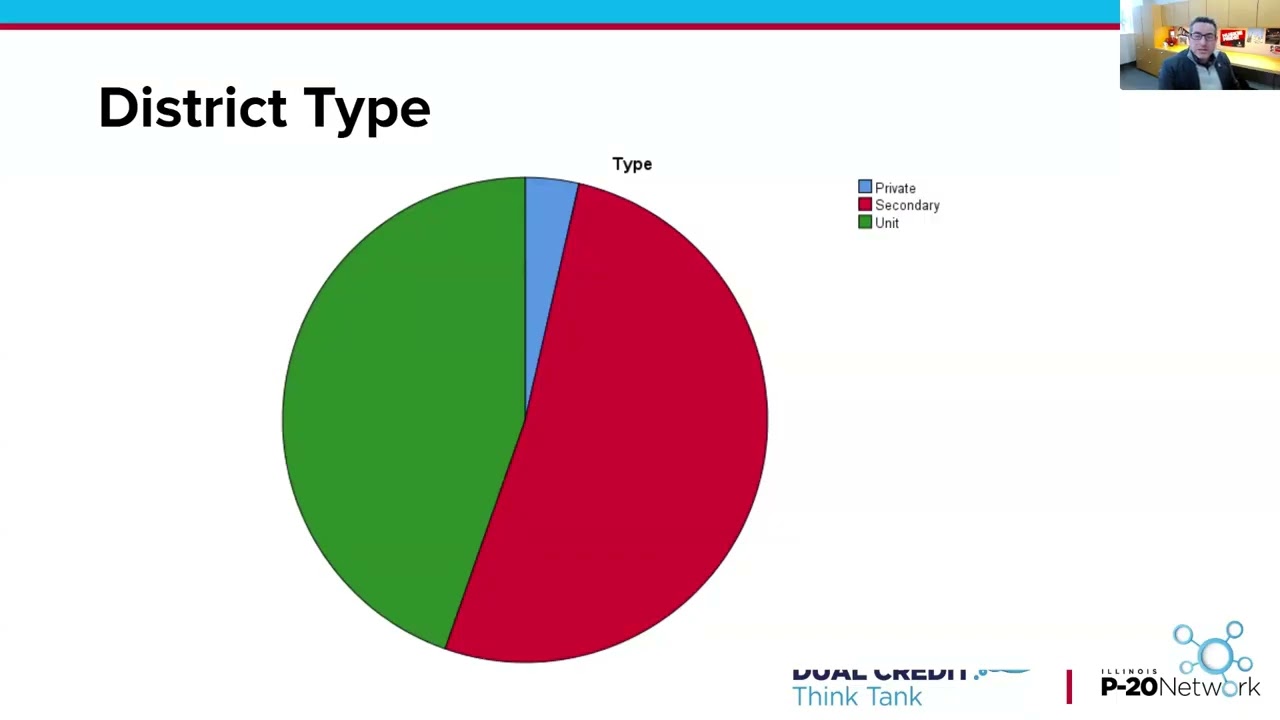
Uh, district type, we had 5% of our
districts not identified, but now very
different set of responses unit to
secondary compared to when we did this
survey four years ago. Only about a
fourth of our our school districts
responding were high school districts.
the rest were unit districts.
So, looking at whether or not districts
have weighted grades, this was actually
a little bit of a surprise to me that
almost a fifth of our districts, nearly
17%
said they do not have weighted grades.
Um, unsurprisingly to me, at least over
83% do have weighted grades.
Um, then we asked if if academic core
academic and career and technical
education courses are weighted the same.
[clears throat]
And um nearly twothirds said yes. Um but
over a third said no, they are not
weighted the same.
We asked about the high school GPA
scale. Thought this would be a useful
thing just for other high schools to be
aware of. Over the last 30 years, we've
seen a pretty big transition to the
four-point scale consistently. And we
see that here. Over nine and 10
districts are using the four-point
scale.
Now, this is where we get into the
exciting bits that you're really here
for. So, how are people waiting their
dual credit courses? Now, again, we
consistently looked at these both gened
core academic classes and then
separately CTE or pathway courses. Now,
we didn't ask people to put courses in
which bucket. So, different respondents
may have put certain classes in their
head in one bucket or the other.
computer science for example. I don't
really know. We didn't ask about that.
But just to give you the general idea.
So um this is how it it lays out. We've
got over a quarter um who are who are
waiting their core academic gened
classes the same as as regular classes.
And then we've got uh a
prepoundonderance of them that are are
waiting them 40% the same as uh AP
classes for example. Another uh almost
13% waiting them um as same as honors
classes but lower than AP classes. And
interestingly uh we've got over 3%
saying no dual credit is weighted the
highest uh of all.
[cough] When we look at the CTE pathway
courses, we see a big mix again, but now
things really start to settle in in a
couple categories. So, while in the in
the last one, 40%
were waiting dual credit gened classes
the same as AP classes, here dual credit
CTE classes, 40% are rated the same as
regular classes.
35% or nearly 35%
uh of CTE dual credit courses are being
weighted the same as AP courses.
So how is this compared to four years
ago?
Again, we didn't ask exactly the same
question in exactly the same way, but it
was pretty similar. So, in 2022, this
graph was already up earlier, 52%
weighted dual credit. Um, the same as
some type of advanced or accelerated
waiting.
This time, that's up to 59%.
Across the four categories. So, we are
seeing more districts uh based on this
sample waiting dual credit as an
advanced or accelerated waiting than we
were four years ago. Not a huge amount
more, but more. When we look at the CTE
and pathway courses, which we saw just a
moment ago, um 49%
are waiting at dual credit the same as
advanced or accelerated classes.
We can't compare that directly to 2022.
So, this the results are pretty similar
to 2022. Overall, there hasn't been a
big shift, but we did go ahead and ask
some additional questions.
And as you're listening, if you have
questions, please go ahead and feel free
to drop those in the chat. You'll also
be able to come off mute in just a
little bit. Um, so some other things we
looked at. How many districts have
reviewed their policies since 2022? And
the split here is almost 50/50. Um, 51%
have not, 49% said they have. Now, how
many districts have changed their
policies since 2022? 3/4s have not and
only 25% have. So, this was a surprise
to me because for me, it felt like I was
always in conversation over the past few
years with this district or that
district looking at making that policy
change. Now, of course, that's the bias
inherent in my job. of course I'm more
likely to have conversations with
districts who are really thinking about
making those changes and that's why
they're reaching out to have those
conversations. And so this was a good
level set there um for us to consider.
Also, this will make for a good
discussion in the doc class I'm teaching
where we're spending most of the
semester talking about our implicit
biases that we bring to whatever we're
studying. So, we asked a new set of
questions as well about transcripts. And
again, these are the this is the kind of
topic that we don't spend a ton of time
on in these big statewide conversations,
but it comes up frequently at the local
or regional level. And and we get to
hear about it through talking with our
community college partners who are
leading dual credit work in their
regions. We hear about it from
counselors, sometimes from
administrators.
So, we asked about labeling dual credit
and AP courses. We've seen in work we've
been able to do alongside districts,
districts that within their own district
are inconsistent about how they label
courses. Some courses have nothing in
the title, others say DC, some say AP,
some don't. Um, it it can be real real
all over the place. So, we asked about
does your district clearly label dual
credit and AP classes with text in the
title on transcripts and in your student
information system? And so, over half of
districts said yes, both dual credit and
AP courses are labeled. Over a third of
districts in the third column here said
AP courses are are labeled and that
implies but dual credit courses are not.
um only a handful of districts said only
dual credit courses or or neither. Um so
kind of interesting to consider and a
pretty easy process to go through at
this time of year still for next year to
clean up course titles uh before you
commit your schedules sometime in the
spring or summer for next school year.
We [clears throat] also asked this
question
and that's do you label your course your
courses with IIAi course codes? Now let
me say here the IAI course code should
not be critical for post-secary
enrollment and for students to get
credit for that course because it should
be the community college the postsecary
transcript that the postsecary
institution is using to give credit for
that course. But we are in complex
systems filled with human beings. And so
one of the things we wonder about is is
it helpful and we don't really know this
answer to make sure that um that people
are seeing the same course codes from
the high school transcript and the
post-secary transcript. Um and so here
we would we asked about are you labeling
with the II course code? And so, uh, I
was actually very surprised that nearly
10% said yes for all I AI courses. Um,
and and another almost 4% said for some
I AI courses. So, 13% of respondents are
actually doing this to some degree
already, which was not something I was
aware of. Now, 87% of of respondents
said exactly what I would have expected,
which is, "No, we're not. We're not
doing that." And Amanda, we'll come back
to your question in the chat. Thanks for
dropping that in. So, comparing district
types.
Um, last time we looked at secondary
versus unit. So, looking at that here,
um, we can see that
secondary districts, uh, nearly 70% over
twothirds of of secondary districts who
responded are waiting dual credit
courses as either the same as AP or
honors. Um, so that's a pretty high
percentage and that's for the core
academic or gened. For the CTE pathway
among secondary districts, that
percentage is lower, but it's still
pretty high. And particularly when we
include the higher than regular, but
lower than honors or AP, so some
separate category. Um so again about
2thirds of secondary districts in CTE
with CTE dual credit courses are
weighting those more heavily than
regular classes.
Now when we look to unit districts um we
see this drop and shift with a lot more
variance in how they're waiting them. um
still a fairly high percentage um over
half when you add up the first four
categories here on the left um but
nevertheless it's a lower percentage
than secondary districts and we'll
comment on that in one second. In the
CTE pathway we see that same thing. the
percentages drop um they drop fairly
significantly from um from the gened and
certainly in comparison to the
secondary. Now this difference between
secondary and unit districts is a
pattern we saw four years ago as well
and it's a pattern that kind of makes
sense. In a unit district, we've got
administrators worrying about all kinds
of of things, right? From early
childhood to elementary literacy to our
focus on career and college readiness,
college and career pathway endorsements,
dual credit work. In a secondary
district,
there's a hyperfocus on those secondary
topics. And so it's not unsurprising and
it's not a criticism of unit districts
that this is like this. At the same
time, we've now seen this pattern in two
surveys. So for unit districts, there is
this opportunity to say, "Huh, are we
paying attention to this or how can we
leverage
uh nearby secondary districts that we
might have a relationship with to really
understand what they're doing in these
spaces to kind of not that you have to
mirror exactly what they're doing, but
at least to stay on track with what some
of those topics are that are being
considered in secondary districts. What
we don't know and might be very worthy
of study is how does this look again in
other areas. So like if we compared
elementary districts to unit districts
and so unit districts we know also
probably have a whole bunch of
advantages when it comes to something
like the pace framework implementation.
So again a lot to study for those of you
who might be interested in pursuing your
doctorates. Lots of great topics here in
our our setup and structure of school
districts across the state of Illinois.
So, we also looked at EBF tier because
again, if you're in tier 4, you have
more money to work with based on your
student needs than do tier one
districts. And so, are you spending that
money on time, energy, people that might
result in some different decisions on
topics like this? We can't answer that
directly, but we can start to get a hint
towards that based on what comes out
here. And so, this is a lot of data. I'm
not going to walk through it all in
great detail, but we see here's the tier
one districts core academic gened
classes. Pretty wide distribution here.
Um though we see
57 58% in the two categories to the
left. um over 60% are weighting it as
advanced accel accelerated courses
higher than regular courses. Um at the
looking at the CTE, these numbers go
down significantly among tier 1
districts with the majority of them
waiting CTE or pathway dual credit the
same as regular courses. When we look at
tier 2, um, things spread out a little
bit more in some different ways on the
core academic gened side and also on the
CTE side. Again, kind of interesting.
When we look at tier three, now things
are starting to fall into fewer
categories. You'll remember we had fewer
respondents in tier three and tier four.
Um, but we still had a chunk of
respondents in each.
And so
[clears throat] we've got some less
variation here on the core academic and
gened side and we've got some more
variation on the CTE and pathway side.
And then when we get to our tier four
districts, uh we see 62.5% of them are
waiting dual credit and AP the same and
then 37 and a half have said other. And
so that tells us that it's some more
complicated waiting differences with um
some some classes being weighted one
way, others being weighted another way.
We know that from the comments as well.
But then here on the CTE side, we see
that same percentage. And so that's
that's an interesting question that
would require further study. Uh what
we're not saying here is oh having more
money means you are more likely to
weight them both and both uh both
similarly and both the same as AP
classes. Um there's there's more work
that would need to be done across a
bigger sample. Um but certainly there's
some data here that would suggest that
that would be an interesting study to
understand what's happening in these
districts. And for example, would more
money help tier one and tier 2 districts
look like this if this is an outcome
that we really want to have.
So some interesting notes.
One district described something in
detail. We thought this would be
interesting to share out that they've
got some criteria they use to determine
uh how their dual credit courses are
weighted. So one is um first does the
college equivalent class is it is it
worth at least three credit hours. So if
the equivalent class at their community
college is one credit hour that is not
going to get weighted um heavily like an
AP class would. But if it's three credit
hours it might. The second criteria is
their 1.1 classes um are given AP
waiting and their 1.2 classes are given
honors waiting. So again, it's it's kind
of an interesting they've they've
obviously thought this through, had some
discussions, and then as new classes
come on the books, come into their
course catalog, they can match them up
against these criteria in that district
and say, "This is what we're doing. This
is why we're doing it." And it can kind
of just happen relatively automatically.
Some other interesting notes that we
thought people that would be attending
today might want to know about. There
are a number of school districts that
are offering different weights,
including no waiting for different dual
credit courses. Um, so that is not
uncommon and that's probably something
to know and the district we just showed
that example from is is an example of
that. The other thing is there are um a
fair number of school districts and
community colleges that are offering
dual credit for advanced placement
courses that have said this AP class
matches up to this class. we offer at
the community college and so we can
offer dual credit in that advanced
placement class and that's not something
that in the conversations I've been a
part of is something that's often talked
about seemed relevant to highlight for
people here again we're not recommending
or not recommending that so we did do
some higher level statistical tests with
this and like we found four years ago we
found that there was no predictive
pattern of looking at other data. So
having more teachers with master's
degrees does not affect the likelihood
of waiting dual credit classes more like
AP classes or not. For example, um
having more money, same thing. having uh
more students from low-income households
also not affecting um these outcomes in
terms of how people are waiting dual
credit classes for either core academic
or CTE pathway courses. So we had
thought some of those things might be
indicators kind of leading indicators.
They're not uh based on this data set.
Now we've given you a lot of ideas for
future research. We've got more. Um, do
perceptions of dual credit coursework uh
from students, families, teachers vary
based on how GPA are weighted? Um,
that's an interesting question. That
might also be a little chicken and egg
question there. Um, what impact, if any,
do various GPA wait uh waiting
approaches for dual credit coursework
have on course selection from students?
Um, this is something I've had
conversations about with people. um that
we haven't been able to study yet. What
impact, if any, do GPA waiting
approaches have on admissions for
post-secondary institutions for
students, if any? And then is there any
impact of various GPA approaches to
postsecary student success? Obviously,
it would be really interesting to be
able to follow groups of students into
their post-secary environments and see
if any of these things have an impact on
their post-secary success one way or the
other. We don't know the answer to that.
We do have some recommendations.
Um, so our recommendation from 2022 is
unchanged. If you have weighted classes,
our recommendation is that all early
college credit coursework should be
weighted the same and as advanced
accelerated and including an especially
advanced placement and international
balora coursework. And we think it
should reflect a post-secary level of
performance um if you are waiting it
that way. And we think that's kind of
inherent to what dual credit is intended
to be all about and where the critical
collaboration between post-secondary
institutions and school districts takes
place.
We want to lean in here to the NASP
accreditation.
Um so NASP is the gold standard the NEP
accreditation for how dual credit should
be working. And one of the things would
we we would offer from our perspective
is even [clears throat] keeping in mind
the accreditation can help regional
conversations
uh with what they're focusing on how
giving specific uh topics to reflect on
as regional groups with both the
post-secary institution and the school
districts. And so we think NASEP
accreditation, whether you're pursuing
it or not, whether you've earned it or
not, has some value to look at as that
gold standard and to work from for our
local conversations.
And so here, um, we know that NASP
accreditation suggests that you use the
same titles in the high school as the
postsecary institution uses. And we're
then also going and and making
suggestions to use consistent
formatting.
um related to the early college credit
course types. So you can see the
examples here, biology, advanced
placement, principles of biology, dual
credit. Um there there isn't going to be
uh a counselor, a teacher, a parent, a
student, being unclear about which which
course you're going to be in. Now again,
if you're offering a AP course that is
also a dual credit course, that that's
an outlier that starts to get more
complicated here. And then we're
suggesting where there is an II course,
including the II code for that course as
another way of ensuring that we're
communicating on both um the community
college side and the school district
side. Hey, this is this I AI course um
because that helps our students. And so
that recommendation looks like this. And
again, making this change is a pretty uh
easy to implement change on the school
district side. um that doesn't take a
lot of time or energy and could still be
done
as late as now or even in the coming
months for next school year or if it
required course catalog changes etc. Now
is the time to have those conversations
so that when you're updating course
cataloges late summer, early fall,
you're ready to do that um because
you've had those conversations this
spring. So, some stuff to think about
there.