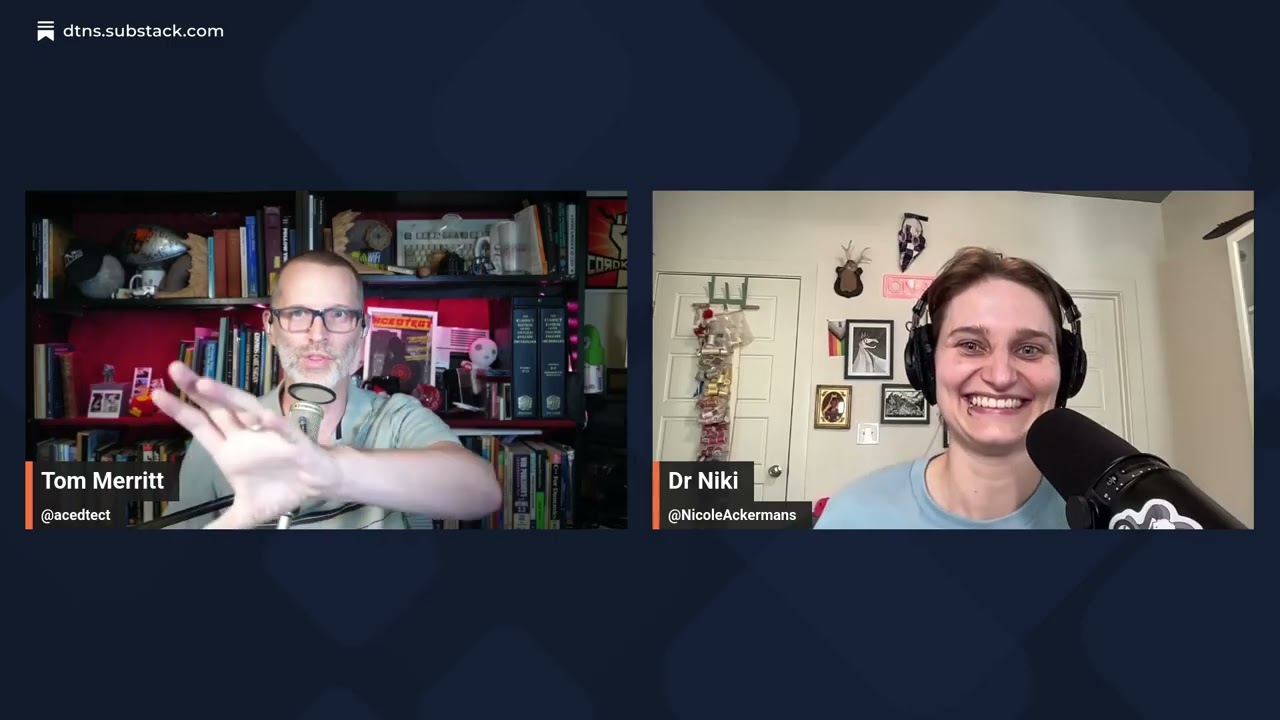
Video summary
Host Tom returns from an extensive trip across multiple time zones, including a journey back to Japan after more than 24 hours in transit, and notably reports having no jet lag whatsoever. He attributes his success largely to the recommendations of Dr. Nikki and her endorsement of the Time Shifter app, prompting him to investigate whether this result was merely self-hypnosis or grounded in actual science. The host shares that he initially researched various travel tips like compression socks and masks but found repeated mentions of the app on forums like Reddit. After using its free trial for a trip where it worked exceptionally well compared to his previous European travels, he decided to commit fully to the regimen before flying back from Japan, ultimately feeling completely refreshed upon arrival despite not following every single instruction perfectly due to real-world constraints like walking dogs or driving with eyes closed while wearing sunglasses.
The core science behind the app revolves around manipulating light exposure and circadian rhythms rather than just counting hours in a new time zone. The host explains that our eyeballs contain specialized cells in the retina sensitive specifically to blue light at 480 nanometers, which act as sensors for the brain's hypothalamus, particularly the suprachiasmatic nucleus (SCN). This biological clock regulates hormones like melatonin and body temperature across almost every organ. The app functions by calculating precise times when users should seek bright sunlight or artificial blue light to shift their internal clock forward or backward, while also advising on caffeine intake to maintain alertness without disrupting sleep quality later in the day, noting that coffee acts as an adenosine blocker rather than a true circadian regulator.
To optimize these biological signals, Time Shifter provides simple, actionable alerts for when to wear sunglasses to block light during specific morning hours or step outside into direct sunlight at other times, even suggesting using phone screens as bright light sources if natural sun is unavailable. The host highlights that the app also guides users on melatonin usage, recommending it only for a few days after arrival in a new time zone to help recalibrate sleep expectations without long-term reliance, which has not been extensively studied. A key feature praised by both hosts is the gradual shift strategy built into the algorithm, encouraging users to adjust their bedtime slightly earlier each day leading up to travel and wake up progressively later upon return, allowing the brain to adapt smoothly rather than facing a sudden jolt that causes severe fatigue.
Ultimately, the effectiveness of Time Shifter stems from its foundation in decades of sleep research conducted by Dr. Steven Lachley, a prominent scientist who originally developed similar protocols for astronauts traveling to space stations where time zones do not exist on Earth. The app simplifies complex biological data into an easy-to-follow interface that reduces mental burden and ensures users align their behaviors with well-established patterns rather than guessing or relying solely on willpower. While acknowledging minor limitations like the inability to account perfectly for unpredictable daily events, the hosts conclude that the tool successfully combines hard science with user-friendly notifications, making it a highly recommended resource for anyone looking to beat jet lag without needing advanced technology beyond what is available in their pocket today.
Read the full video transcript
[music]
Welcome to the Daily Tech News Show
weekend edition. Gratefully provided to
you and thanks for your support of this
show. We go into topics a little indepth
and I just got back from a lot of travel
across a lot of time zones. Uh, and I am
not jet-lagged even though I'm just more
than 24 hours after having traveled to
Japan from Japal back from Japan. And
it's thanks uh in large part to Dr.
Nikki uh and her recommendation of the
Timeshifter app. Uh so I thought why
don't we sit down with Dr. Nikki and
talk about this app uh and and figure
out why it might work. Is it just my
imagination? Did I hypnotize myself into
not having jet lag? Is there science
behind it?
>> I just talked you through it. Really?
>> Where did you hear about this? Because
you recommended it to me and then I
mentioned it to Eileen and she's like,
"Oh, I have a friend uh who lives in
Canada and she has to travel to China
because she has family there all the
time." Uh and she swears by it. She's
like, "I never get jet lag because I use
time shifter."
>> Yeah. So back in 2023, I had a
conference in Australia and it was my
first trip to Australia and I needed to
like the day after I got there speak at
the conference. So I was like I need to
optimize as much as possible so I don't
get jet lag. And I looked up like all
the sometimes I you know for a
researcher sometimes I research a little
too much but I did a deep dive. I think
it was probably on Reddit or something
but it was like yeah wear the
compression socks do the mask blah blah
blah and a lot of people recommended
this app over and over. So, I was like,
it can't hurt, you know, it's just an
app. And uh you can get the first free
the first few uses for free, which is
how you get me is to make me not pay for
the app. [laughter] I'm so cheap.
>> Well, yeah. And it worked super well.
And so, I've just recommended to
everyone after that.
>> You get one trip, round trip for free,
then you have to pay for it
>> per email.
>> And so, Well, yeah, exactly. Uh, as long
as they don't know it's new, you can get
a second one for free. Um, and I saw
that and I was like, you know what? I'm
not going to use it for Europe. I'll
just I'll just look at what they say to
do and kind of follow it. And I did that
and maybe it helped a little, but I was
pretty I was still I still had jet lag.
>> I went to Japan, which is much farther
much much bigger time zone shift. And I
was like, "All right, I'm going to burn
my free one on this email address. I'm
going to try it out. I'm going to see
how it works." Uh, and I did. And I
wasn't able to follow it 100%.
>> But there's so much you can do.
>> Mostly worked.
>> Like it's also relatively easy to
follow. It's not making you do back
flips or anything.
>> Yeah. And in fact, I have some tips on
which parts to pay the most attention
to.
>> Uh based on my own experience. Uh but
let's actually do our due diligence
here. you looked into this app to find
out like is just is this just one of
those things where because the app is
telling you to do certain things you you
you know convince yourself you don't
have jet lag or is there actual is there
actually something behind it? What did
you find out?
>> Yeah. And and another reason why I kind
of stuck with this is I travel to Europe
a lot to visit my family and the the
sanity that you gain by not having a
week of jet lag is so it's such a big
difference that it's like important. But
yeah, so I I looked into this and like
is it an AI? Is it whatever? So, first I
kind of did some digging. The founder is
Dr. Steven Lachley and I looked at his
Google Scholar page and he is a very
active researcher in sleep science and
has done a lot of work. Um, a lot of
this app focuses on light uh and
circadium rhythm and he has a lot of
like foundational work in that field. So
this is not just like a guy who started
a startup like he's
>> he didn't just call himself doctor. He's
literally
>> a huge deal [laughter]
>> one of the foremost research scientists
in the field. It sounds like
>> he's a huge it seems like he's a huge
deal. You know I I can't speak to his
character. I just looked at his page but
um and he initially developed this to
assist astronauts on their flight to the
ISS and help them synchronize with the
crew's sleep schedule abroad. And
>> now I will say that's a nice gimmick.
Like makes it nice to sell an app, but
it looks like they're also still using
this for NASA missions. So
>> I I I feel like that's a pretty good
confidence. You know,
>> that's an even more complicated system
to deal with because you're not just
going to a new time zone. You're
>> doss. You don't have a time zone
anymore. You're just making up a time
zone when you're
>> outside of Earth. I mean, that's way
more complicated than Japan.
>> Yeah. Yeah. Um, but basically the main
component of this app is just how much
timed light exposure do you need to
shift your circadian clock. So planning
when you're going to see light, like
literally with your eyeballs, whether
that's the sun or artificial light, uh,
specifically blue light or or if you've
ever done light therapy, just like
really bright light into your face or
avoid light. So either be in the dark or
like Tom on DTNS, wear two pairs of
sunglasses or use red light in a dark
room. And also it can give you
suggestions of when to add in caffeine
to help you out or melatonin to slow you
down. So this is it. Another thing about
this app, it's so simple. It's
>> you just one interface. I love that
about an app. It's it's beautiful also
and extremely simple.
>> There's basically three things to keep
track of. Caffeine, which by the way, if
you can tell it like I don't use
caffeine and it'll be like okay great,
then we won't give you the caffeine
advice. um caffeine, sleep, and light
exposure. And the melatonin comes in as
part of this the sleep category.
>> Yeah. And you mentioned like when your
flight takes off and you give it like
the flight information and then how
it'll calculate all that for you and
when you need to do each step.
Basically,
>> the the one criticism I will have of it
is it doesn't yet do a good job taking
into account reality. Like you know when
it it like knows when your flight is and
it's like great start sleeping the
minute you get on the flight. I'm like,
"That's not going to happen. No one's
going to go to sleep." Like, maybe a few
people can can get away with that. I
have actually known a few people who've
been able to get away with that, but
most people won't. Or like,
>> you got the mindset,
>> you know, stay in the dark for the this
hour this morning. I'm like, "No, I have
to like walk my dog, right?" Yeah. Or
you're driving to the airport. So, um
they they are very forgiving in the
instructions of saying like if you can't
do exactly this, do as much as you can.
>> Drive with your eyes closed. [laughter]
>> Yeah. Cuz the more Yeah. I don't think
they say that. But the, you know, if
you're driving with sunglasses on,
you're still safely driving, but you're
at least limiting your exposure. So,
they're you know, they understand that
you won't be able to do as much, but the
more you do, the better it gets. And it
really does uh hinge on the light
exposure. I can almost feel it when I'm
going through it. Like, yeah, this is
helping. Like stepping out into the
sunlight really is helping. Why
>> is light so important for the circadian
rhythm, which is what we're trying to
change? Because your circadian rhythm
tells your body like, "Oh, it's morning.
Oh, it's night." And you're trying to
change that. Why does light change that?
>> So, this is also once again biology 101.
So, I we teach this in the neuroscience
class. So, I am well verssed in. Yay. I
get to do my my job on DTNS. So, okay,
our eyeballs are light sensors for our
brain. Um, in the retina, we have
certain cells that can detect light uh
at a very specific wavelength, which is
480 nanometers on the light spectrum.
Tom, what color is 480 nanometers if you
had to take a guess?
>> Blue.
>> Yeah, it's blue. That's the whole blue
light phone thing comes from.
>> I didn't know, but I guessed if blue is
the one we have to try to like avoid
when we're in the dark, then that must
be the blue one. Okay. educated guess.
>> So these cells can detect basically blue
wavelength and these are the cells
responsible uh for telling you whether
it's day or night and then they send
this information to a central area of
the brain and this area will regulate
time throughout the rest of the body. So
in blind people this doesn't work and
they have difficulties with circadian
rhythm.
>> Yeah, that makes sense because they're
not getting that signal.
>> There you go. So this uh small area that
regulates your whole body is in the
hypothalamus. That's important because
the hypothalamus is kind of the
regulator for a lot of things in the
body and it's called the super kaismatic
nucleus but CN for short. It's a cool
name. It always makes me think of like
Superman.
>> Yeah, [laughter] I am super kaismatic.
>> But it just means above the the crossing
of Yeah. Um but all of our cells also on
top of this receive signals from certain
genes that we're going to call clock
genes. They have other names but that's
fine. And these all know that there is
an internal clock a length of our
internal clock that is somewhere between
23 and 25 hours. So without seeing light
like if you're blind you will have a
circadian rhythm but it actually will
delay itself over time and um they've
done tests with this where they just put
people in a cave for like a year and
then they they think that there's been
less days at labs than there have and
they're basically think daytime is night
time. They have this cycle that
continues 23 25 hours, but it's not at
the right daytime. And that's how the
eyes help coordinate that.
>> I was reading on the time shifter site
itself that the difference can account
for people being morning people or night
people because it's when your when your
circadian rhythm resets, you know,
affects whether you naturally like to
get up or naturally like to stay up.
>> Which one are you, by the way? I grew up
being a night person, but somehow
shifted to morning person. So I I I've
been a morning person since for the past
20 years now.
>> Yeah. I've always been morning. I mean,
you know, less when you're a teenager,
but nowadays 6 a.m. is the, you know,
plus I'm a bird watcher, so I got to be
>> Oh, yeah. You got to get up early then
[laughter]
>> with the worms and all that. Okay. But
anyway, so we've got our rhythm and the
the SCN is going to take this
information from your eyes and from
these genes and se send the signal all
throughout the rest of your body. And
this is why it's important it's in the
hypothalamus because that is where all
of your hormones get dumped into the
bloodstream and then tell everything
else. And I mean literally almost every
organ uses a circadian rhythm. So this
includes things like core body
temperature, right? This gets lower when
you're asleep. Hunger, that's why you're
hungry when you wake up. um alertness,
being able to be awake in the morning or
being sleepy and all kinds of other
functions. Even your heart has its own
circadian rhythm.
>> And so without this kind of
synchronization, all of your body
functions might stay on this 24-hour
cycle but be a little bit out of sync.
And basically that's jet lag.
>> So
>> yeah,
>> basically your internal circadian rhythm
doesn't match the external light cycle
and then all your organs get a bit
confused and sleepy.
>> Yeah. Yeah. And that causes that makes a
lot of sense especially because if
you're let's say you're a person with a
23-hour
cycle the SCN the super kayazmatic
nucleus nucleus is occasionally going
like we need to reset your we need to
move your minute hand a little you're
you're a little off
>> it's the leap year of the brain
>> and then your heart and your lungs and
your all the rest of you is looking at
all of that and and saying oh it's time
to time to relax time to go to sleep
time to lower the body temperature time
to raise the the body temperature. Um,
we talked about the fact that caffeine
is part of what time shifter uh tells
you to do or not to do. In fact, I was
surprised that it actually tells you
like, no, keep taking caffeine. Not in
great amounts, [laughter] but you know,
for the for maybe six or seven hours,
you need to regularly be getting a
little bit of caffeine. Um, I imagine
somebody's like, "Yeah, why not just do
that? Why not wait? You get up in the
morning when you're at the new time zone
and you just chug some coffee. Yeah,
>> why not do that?
>> So, biologically, coffee can keep you
awake. And as you've drank coffee, you
kind of know the feeling like you're
awake, but you're not quite all the way
there. And that's because it's not as
helpful as light for regulating and
shifting your circadian rhythm. It'll
wake you up or it'll keep you from
feeling sleepy, but it can't help really
shift that.
>> The SCN isn't paying attention to your
caffeine is basically,
>> no, not as much. And that's because
caffeine works in a bit of a different
way. Um, it acts as a blocker. So you
have a certain receptor in your brain
cell synapses where you once your cells
get tired they release a chemical called
adenazine and this builds up to a
certain amount and when it's at a
certain amount your body's like oh I'm
sleepy basically
>> okay
>> caffeine blocks the cells from receiving
that chemical. So it still builds up it
just doesn't go into the receptor
because the caffeine's there instead. So
it just like closes the door on a
denazine. It's like you're not here
[laughter] and and just like it's still
accumulating but it's like not there.
Right.
>> Is that why you have a coffee crash? Cuz
you have so much adenosine but
>> so the coffee eventually wears off and
the adenosine then connects to all the
receptor and it's like bam go [laughter]
to bed.
>> Y
>> [snorts]
>> um and so this works for a while and
like you said after a while it crashes
and that's because caffeine has a
half-life. It's a molecule that degrades
eventually. So, the quote from the Time
Shifter website is if you have 100
milligrams of caffeine at 10:00 a.m.,
that's like two cups of coffee, you
still maybe have 50 milligrams in your
system at 3 p.m., 25 ms at 8:00 p.m.,
and maybe 12 at 10 p.m., which is enough
to disrupt your sleep that night.
>> So, you can use it if you're trying to
stay up later or so on. Um, but, you
know, eventually it does go away. So,
that's kind of the biology of coffee.
>> And I think I I I said this on a live
stream earlier this week. Uh even if
you're like the kind of person who's
like, "No, I can drink caffe coffee and
go right to sleep, the quality of your
sleep won't be the same, even if you can
sleep, right?"
>> Yeah. And it depends on the person
because people with, for example,
dopamine disorder actually aren't
affected by this, but we don't know why.
Like people with ADHD, caffeine actually
does make them sleepy, but it's but we
don't know why. [laughter]
>> But we can't get into that right now.
>> Yeah. But it's it's it's also unexpected
behavior. So it's it's I I guess what
I'm trying to say is like sure maybe you
drink coffee and can go right to sleep
and maybe you can do that on time
shifter and it's fine. You can try it
and see
>> but it's probably going to affect you in
some way. So what this is saying is like
if you really want to be sure that it's
not affecting you
>> take it at this time. Don't take it at
this time.
>> Time shifter is just trying to optimize
everything you can do to help yourself
>> and it's not even doing anything. It's
just saying like here's what I recommend
like do this it might help and here just
lining what do you call that expression
like aligning all the stars. [laughter]
>> Yeah the stars are in alignment that
kind of thing. Yeah.
>> The the other thing that I have used to
help with jet lag and it really has
helped me u because my doctor
recommended it was melatonin and my
doctor said uh take it in the evening
you know when you're about to go to
sleep for the first 3 days after you're
in the new time zone. Um, and it won't
cure your jet lag, but it will help you
reset your body's expectation because
your body generates melatonin. Like, how
does that track with what they're
saying, what the science says here?
>> So, similarly to caffeine, it's not as
helpful as light, but melatonin is a
hormone, so it can act on the scen.
>> And basically, your body would normally
when you're getting sleepy dump out a
bunch of melatonin into your
bloodstream, and then it basically lets
your brain know to start going to sleep.
If you take it a bit earlier than you
usually would,
>> it's you're just faking that response
basically.
>> And the same if you take it a bit later,
like your body already put some out and
now you're adding a bit more to make you
sleepy later. So, you're supplementing
your body's own production and helping
to recalibrate this clock, which is
which is helpful. I will make a note
that long-term melatonin use has not
been studied. So, just be careful with
that.
>> Yeah, [snorts] that that's a good point.
Um I my doctor never said keep taking
it. Uh if if we were talking about like
I'm having trouble sleeping, she
recommended something else.
>> She didn't she didn't say take melatonin
for that. She was like melatonin's good
for 3 days on a trip.
We don't know uh you know what's after
that. But but for a small amount of use,
she felt it was safe.
>> Uh and I didn't realize that actually
the SCN sees that as a signal of like oh
melatonin's in the system. So yeah.
>> Okay. So you have this app that was
developed by somebody who has studied
and even helped shape uh the science
around this and is saying uh uh here's
here's when you should get light, here's
when you should avoid light, here's when
the light should be bright, here's when
you can have caffeine and probably
should have caffeine. Here's when you
need to stop melatonin right before you
go to bed so that it mimics the natural
body release that you would have if you
were normally sleepy. Mhm.
>> I know all of that and I'm still
surprised how well this worked. Why does
this work so well?
>> I think the reason it works so well is
because it's based on really wellstudied
patterns. We know a lot about sleep and
we've been studying sleep for decades
and we know how the circadian rhythm
works really really well. Uh I mean
we've known this since like before maybe
the 20s and so just like taking all that
making it into a formula that again is
generic for the general population.
there's only so much you can do and also
making it so simple for you to follow.
Like I get yes, you can follow every
instruction, but it just sends you a
little alert that's like, hey, put some
sunglasses on. And it it also relieves
this kind of um mental burden also like
I don't have to think about this. This
is going to help me, you know, with my
jet leg. And so it takes that hard
science and makes it really digestible
and really easy to follow and basically
eases you into that shift. Um also, I
don't know if you mentioned this, it
makes you start a few days before your
flight. Yes.
>> Um, and it'll you'll go to bed an hour
earlier, 2 days before, and then two
hours earlier. And that's also that kind
of gradual shift is really helpful for
your brain. Um, it's your brain's way
better at gradual shifts than very quick
shifts which give you jet lag.
>> Yeah. I I think uh I focused the most on
the light because I I I I could I read
that that was the most important and I
could feel that it was the most
important. Um, but I did try to shift
the the awake times. In fact, the day of
my departure, my departure was like at
4:00 p.m. in the afternoon on the way
back from Japan. It told me to get up at
4:00 a.m. And I was like, I don't know,
buddy. Like, like, is this for real? For
real? It's like, get up at 4:00 a.m. and
see bright light. And I'm like, how am I
going to do that? How am I going to get
first of all, do I want to get up at
4:00 a.m.? Like, and then I looked at
it. And I'm like, well, it's having me
sleep twice
>> because I'm flying, you know, for 12
hours. So, uh, I'm getting up at 4:00
a.m., then I'm sleeping on the plane and
then I'm sleeping that night. So, I'm
like, "All right, it this might help me
sleep on the plane." Seeing the bright
light at 4:00 a.m. when the sun wasn't
up, uh, and also when you have a wife
that isn't doing this and doesn't want
to be woken up, uh, that was tricky. I
ended up going into the bathroom,
closing the door, and it had a really
bright overhead light.
>> Yeah.
>> So, I did that until the sun came up.
Then, I went like a crazy person and hid
behind the blackout curtains on the
other side of the window so that I was
getting the full sunlight on me, but it
wasn't going into the rest of the room.
>> Uh, and I felt silly. I felt ridiculous
especially when I'm sitting in the
bathroom just you know like I'm not
sitting on the toilet but but still I
pulled a chair in there. I'm like I'm
hiding in the bathroom. I'm hiding
behind the curtains.
>> I I came back at 11:00 a.m. yesterday
and right now I don't feel like I have
jet lag at all.
>> And it's such a good feeling. Yeah.
>> It's such a good feeling.
>> I I have like given my life over to the
app. Like even sometimes if I'm doing
like a 2 three hour shift if I'm just
doing it US time zones I'll do it
because I get so affected by bad sleep
and it's usually for work and I need to
get up in the morning and like give a
talk or something
>> and I'll be like yeah I'll I'll go to
bed you know 2 hours early the night
before and and it it really helped has
helped me and I know we're doing so much
free advertisement for this app but yeah
we're not paid it makes sense like it's
very simple and logical and yeah we
could do it on paper on our own but like
the app just tells you what to do and
it's also free so like Yeah, you you
could probably get some kind of large
language model to simulate something
like this and it probably would come
close.
>> Use a lot more electricity though.
>> Done. Well, there's that too, right? Um,
this is done by the science. Uh, and it
makes it easy. I think that that makes
it worth paying for is like I'm going to
tell you when I'm leaving, when I
normally sleep, whether I drink coffee
or not, whether I'm cool taking
melatonin or not, and then you're going
to make a graph
>> and it's just going to tell you like
during these times do this. During these
times, don't do this. There are times
when it doesn't matter what you do, you
know, and you can you're free to do
whatever you want. Uh, and it will also
give you close-ups on that. So like when
you you can look at the whole day or
even the whole trip or you can go zoom
in on like what's happening right now.
But yeah, the notifications are the
best. It's like in 15 minutes stop drink
stop taking caffeine
>> which is a big reminder for me cuz I
will not necessarily drink coffee in the
afternoon but I might have chocolate or
something like that.
>> Oh good point. Yeah. I also saw and I
don't know I haven't tried this but I
saw that they have a patent while I was
going through the the publications for
they have a patent to make the
notification show up on your smartwatch.
I don't know if it's in place yet.
>> Um, but uh you get that little
notification like on the watch face.
>> Yeah. No, I got a I got a uh a watch
notification on Apple Watch. But isn't
that just the I don't know if that's the
patent.
>> I think you might be able to install
like the app into your watch somehow.
Well, I don't know if I'm like blowing
their cover, but it's a it's [laughter]
a public patent. I don't know.
>> Yeah. Yeah. Yeah.
>> It's a patent for the watch face
specifically. So, I don't know.
>> I see. It's probably for the display.
Yeah. Cuz a patent a patent wouldn't be
necessary to just push notifications.
That's a function of of the operating
system. But I love snooping on people's
>> patents. Yeah. Yeah. In the way it
displays them. They might have a patent
on the way you can display the graph uh
on your smartwatch.
>> I think it was something like that. I'm
going to Europe in a month and I will
100% be using this and not have to think
about anything. And I worry I'm going to
a marriage a wedding right after and I
won't hopefully won't be jetlined.
>> Yeah. Uh the the other thing to note is
like when you're doing the bright light,
as I mentioned earlier, it didn't have
to be the sun. It just has to be bright
light. Sun's better,
>> but any bright light helps.
>> It's that blue wavelength really.
>> And when you're trying to be in the
dark, like this morning. So this morning
on my recovery day, cuz it's a few days
before, a few days after, uh, it said,
"Don't look at the light from 6:00 a.m.
Get up. Get up at 6:00 a.m., but don't
look at the light. Then at 7:00 a.m. you
need bright light." [laughter]
>> And I'm like, "Okay, at this point, I
trust this thing. It sounds crazy."
>> Whatever you say. So, at 6:00 a.m., from
6:00 to 6:30, I was just in the bed in
the dark, uh, you know, doing okay, uh,
listening to an audio book. Then at
6:30, I had to take the dog out cuz the
dog isn't using time shifter. Uh, and so
I'm like outside with my sunglasses on
and like trying to be in the bushes
where it's dark and like it helps. It
still helps even if you can't be 100%
dark, making the effort to like just
just wear some wraparound sunglasses. I
think
>> when you think about it biologically,
you're just reducing that stimulus input
into those receptors in your eyes. So,
and it's telling you,
>> yeah, this is weaker light, so it must
not be the middle of the day. And and I
think I mentioned this earlier, but
during the during the middle of the day,
I started to feel a little like, yeah,
I'm a little tired. I just walked
outside into the bright sunlight, and it
kind of revived me. It like star
directly at the sun.
>> Stare directly at the sun. You're right.
Good point. And this is funny cuz it'll
it'll encourage you to like look at the
bright blue light from your phone, which
we usually don't hear
>> dur when you need the light. Yeah. You
want to look at that light and that's
another way in the evening
>> to get the bright light if you don't if
you don't have the sun out.
>> Yeah.
>> Um Yeah. Yeah. It's uh also you have to
remember like if you have glasses that
filter out uh blue light normally to
help you, you need to take those off
>> when you're when you need the bright
light because this isn't about your
skin.
This is about your eyes getting the
light as as Dr. Nikki explained to us.
Yeah.
>> Five stars from both of us. Five.
>> I think so too.
>> The fact that I'm not sitting here going
like Nikki, I don't know my own name. I
just got back from that long flight.
Like that should be testament uh enough.
Uh again, the app, if you haven't heard
us say it a million times, is called
Time Shifter. Uh it's available in the
App Store. You can go check it out uh
and see what you think of it. Uh before
we get out of here though, uh if you
haven't listened to Dr. Nikki's latest
new podcast with Wente Dao, you need to
do it now.
>> Yeah, we may not cure your jet leg, but
we'll do something for your brain.
Whether you love it or you hate it, we
have a new show coming out or it's out
now. Uh it's by women in STEM. It's for
everyone. We talk about stuff that we
love about science and technology and
stuff that's silly and girly and fun.
And so just go have a listen. It's
technical tea. It's uh find us on
technical tea.show. We're going to do a
show a month. We'll take listener
feedback. We're really excited. You
could tell in the
>> No, it's the these two have been so
excited in planning this and trying to
make sure it works well and just having
fun talking about the topics and you're
both super smart in technology and
science uh which comes through as well.
So, uh people definitely need to check
it out. It's called
>> And I don't know if you noticed.
>> T
>> technical T. And Tom's our executive
barista.
>> This is what we've named you. [laughter]
>> I didn't know that either.
>> Yeah, we were like, what is Tom? And we
just came up with a name. So, that's a
little spoiler for you guys.
>> Anytime you need coffee, I am I
[laughter] am there.
>> Or tea.
>> Yeah. Oh, I guess it would be tea. Duh.
Yeah. Tea barista. That makes sense.
>> Yeah. I I am the uh the barista that
brews your tea. Anytime you want, let me
know.
>> Well, thank you uh Dr. Nikki, as always,
very much for the recommendation of
Timeshifter, uh, and for helping us
understand this as well. Appreciate it.
Uh, thank you everybody for supporting
the show at patreon.com/dtns.
We'll be back with regular news episodes
on Monday. Until then, have a great
weekend. Talk to you soon.
[music]
The DTNS family of podcasts [music]
helping each other understand.
>> Diamond Club hopes you have enjoyed this
broker. [laughter]