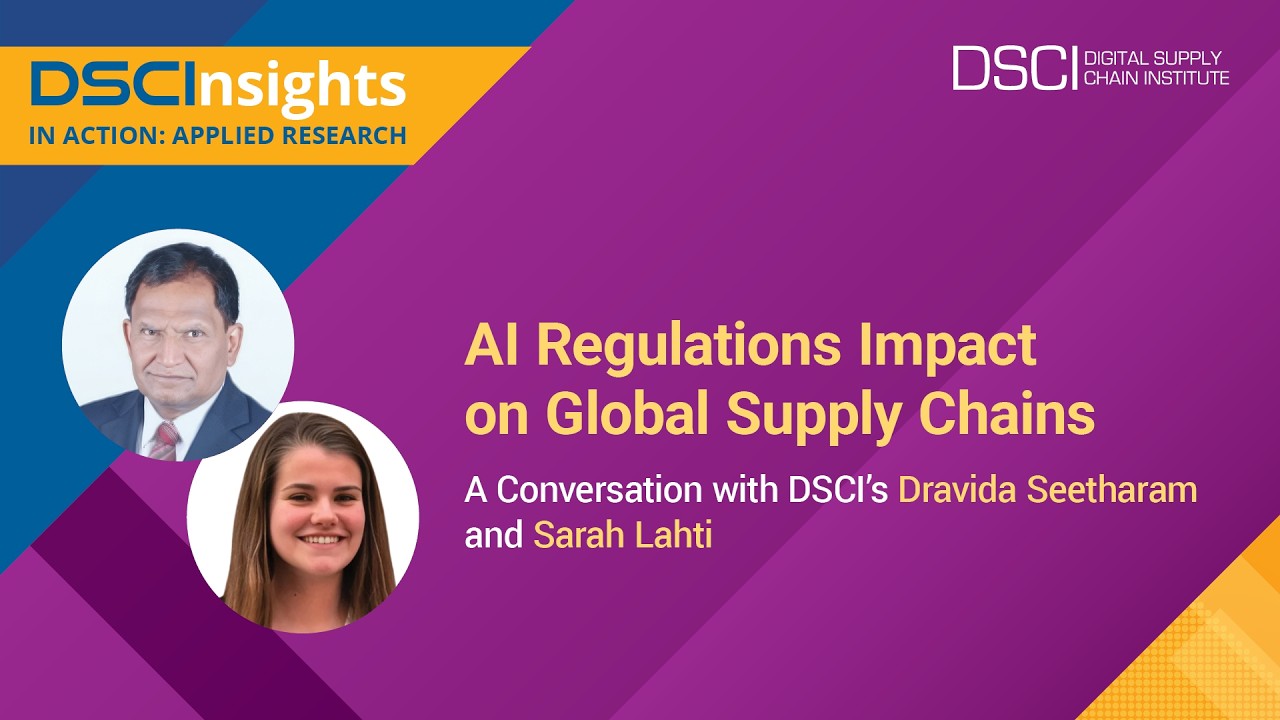
DSCInsights in Action: AI Regulations Impact on Global Supply Chains
Watch on YouTubeVideo summary
The discussion highlights that AI regulation has evolved from a mere legal concern into a core operational issue for global supply chains, fundamentally affecting daily activities such as data usage, storage locations, processing methods, and interactions with third-party suppliers. A primary mistake organizations are making is treating compliance as an afterthought rather than integrating it strategically from the outset; waiting until deployment to address these requirements often leads to costly system redesigns, delayed rollouts, and potential non-compliance penalties. Furthermore, viewing regulatory adherence solely as the responsibility of the legal department limits organizational success, whereas top-performing companies treat AI governance as a business capability that is built into their operating model from day one, allowing them to transform compliance challenges into sources of competitive advantage.
A significant challenge emerging in this landscape is the growing asymmetry between highly regulated regions and more flexible, innovation-oriented markets, which forces multinational corporations to navigate conflicting realities simultaneously. Companies must learn to balance operations across these polarized environments by conducting pilots in permissive jurisdictions while maintaining strict adherence to rigid frameworks elsewhere. To manage this complexity effectively, supply chain leaders are advised to adopt a modular technical architecture that allows for a common global AI foundation with adaptable features tailored to specific geographical regulations. This approach prevents the need for costly ground-up redesigns when entering new markets and ensures that organizations can scale their technology strategies without being hindered by divergent local laws.
To prepare for an evolving regulatory environment where certainty is non-existent, supply chain executives should take three practical steps immediately: establishing cross-functional governance teams involving legal, procurement, risk, and operations; building foundational capabilities such as robust documentation, traceability systems, and monitoring tools; and cultivating a culture where employees understand how regulations impact their specific roles. The ultimate goal for these organizations is to harmonize rapid innovation with necessary oversight and risk control, acknowledging that this balance will require continuous adjustment over the coming years rather than being solved quickly. As technology accelerates and new applications emerge, companies must remain willing to experiment across different geographies without fear of failure, ensuring they can scale responsibly while adapting their strategies as global regulations continue to mature alongside technological advancements.
Read the full video transcript
Welcome to the next episode of Digital
Supply Chain Institute insights in the
in action. In today's episode, we are
talking about AI regulation. Now, not
talking just through a perspective of
high-level ideas or you know what's
going on, we have a tangible thing which
has been produced by Digital Supply
Chain Institute and it's an article
which really points out the
AI regulation framework and on the other
side how it's cut across supply chain.
So, my guests today are Sarah Latif and
Darinda Shataram who are members of DSCI
team and both of them co-authors of the
article. And what we wanted to do is
drive you through the key learnings
cutting across various different
industries and continents related to AI
regulation. So, DS, Sarah, welcome.
>> Thank you. Thank you.
>> Excited to be here.
>> Let's start first with you, Sarah, and
let's, you know, build on what I gave as
an introduction. You know, the article
points out that the AI regulation is no
longer just a legal issue, right? It's a
core operational issue for supply chain.
So, from what you have learned, uh
what are the the biggest mistakes
organizations are making and uh what
they still
treat like compliance as a Do they still
treat compliance as a reactive function
instead of the strategic business
capability? How they balance these
things?
>> Yeah, thank you, Marco. So, I think
there's two big mistakes that companies
are making when treating compliance as
an afterthought rather than designing it
into the solution at the beginning. So,
AI regulations now impact all aspects of
how a supply chain operates from day to
day. So, they influence what data can be
used, where it can be stored, how it's
processed, what level of human insight
is required, and even how
supply chains work with their third
parties, and you know, such as their
suppliers and partners.
So, waiting until deployment to consider
these requirements often times will
result in companies spending more time
and more resources redesigning systems,
um requires them to delay rollouts, and
often times even facing for
non-compliance.
So, those that factor in compliance from
the start, they'll save money, they'll
save time, uh they'll save resources,
and even create a competitive advantage
for themselves compared to those that
have to then backtrack and try to adjust
to become compliant.
And then another mistake um is reading
compliance only as the responsibility of
the legal department or team. As AI
systems become more advanced, they
impact a variety of different functions
within one supply chain. Um and the
organizations that are the most
successful are those that view it as a
business capability. Um so, they'll
build it into their operating model from
day one, and then work together to stay
up up to date on the latest laws and
regulations.
Um so, the strongest organizations
really will shift their mindset from how
do we comply to how do we build a
competitive advantage while being
compliant?
>> Thank you, Sarah. And I think this
brings us, you know, like every time we
look into a broader context like you did
here, it we always need to connect it
with, you know, where it brings things
to the to to the growth. And this leads
me to the second question which I would
like to pose to you, DS. You describe
a growing competitive asymmetry between
highly regulated regions and more
flexible
innovation-oriented regions, right? And
we know that the world is divided in
these two. So, how do you see this
divide the supply chains and reshaping
global competition over the next few
years, especially in multinational
companies. Because these things should
be aligned and the growth should be
built around it, but again, you have two
different realities.
>> Marco, thank you for asking the very
important question.
The focus is on where you operate and
what can you do with the AI.
As the paper described, there are two
sets of
frameworks. One very rigid, very highly
regulated.
Other side, we have the flexible and
then innovative framework.
So,
it depends upon how the company operates
in these both these environments.
So, some of these things, some of the
organizations are trying to write do
pilots in, you know, permissive
governments and permissive frameworks,
actually.
So, the challenge for these supply chain
companies would be how they would be
able to balance out, you know, how they
operate in the highly regulated market
with respect to the, you know, flexible
market. So, this is the
lesson that these are they would learn
as you as they go start implementing
their, you know, frame their solutions
in these environments.
>> Thank you. Yes, and I think building on
on that again, like when when you need
to connect things horizontally and
having the same organization two
different uh
uh polarities, if we can put it that
way. That that that leads into uh a
thinking of the synergy and how it can
how things can be modular. So, Sarah,
question for you. One of the points as
well in the article is actually a need
for modularity, right? Adaptable
technical architecture. So, what does
that look like in practice? I think it
it's a high-level conclusion, which is
important, but for supply chain leader
who is trying to scale AI across
multiple countries with conflicting
regulations. How do you proceed?
>> Right. So, I think it's all about
designing AI systems with flexibility in
mind from the get-go. Historically,
organizations tried to build one global
technology solution and then implement
it worldwide,
which is now becoming increasingly
difficult and inefficient as there's
different regulations for different
geographical regions. So, a modular
architecture would then allow an
organization to maintain a common AI
foundation while having those kind of
adaptable features that will allow them
to apply their to meet compliance that
ranges in different geographies. So, for
example, a company would have, let's
say, a certain forecasting engine
globally, but apply different governance
structures to it depending upon where
they're actually operating.
And so, from a leadership perspective,
it's really about building adaptability
into an organization's technology
strategy, so they don't have to
redesign,
you know, from the ground up
depending upon the regulations of the
market they're operating in.
>> And the
combining all the all the three
questions, we always like to
wrap up
with the practical steps. And I think,
you know, it's always great to bring the
learnings to say which direction the
practical application can go, but on the
other side, it always resonates with
people with, you know, what's the first
step I can do.
So, DS, a question for you to wrap wrap
up the conversation is, you know, you
emphasized that balancing rapid AI
innovation with governance and risk
control, which are two important pillars
for having successful AI strategy, what
right? What are the practical first
steps supply chain executives should
take today to prepare their organization
for the future of global AI regulation?
>> Again, thank you for asking me to sum
this up, Marco.
There is no
a space for something called regulatory
certainty.
You know, regulations are evolving.
If you followed the news last couple of
weeks, you know, US government has
released a new set of
regulatory guidelines on as far as the
AI is concerned.
So, as this
regulatory structures are evolving
around the globe,
three things need to consider for a
supply from from point of view from
supply chain point of view.
One, governance need to be a
cross-functional.
That is, technology cannot be the only
pillar of
in this case.
Legal, procurement, risk, you know,
operations, all the
departments in an organization need to
get involved in this understanding this
AI governance or AI regulation.
Number two, you need to build
foundational capabilities, you know,
things like documentation, traceability,
monitoring systems, you know, and the
typical what you have for any
certification process you have to you
need to build in the organization.
Third, of course, is the talent, you
know, people should understand what this
governance means, what this regulation
means to
her or his job as I think. So, it's a
very important to build this sort of a
culture in the organization to
understand
what AI regulation means, how it affects
him or him at the
at the job. Yeah. So, the goal is the
organization can innovate, you know,
scale responsibility, and adjust as a
regulatory environment proceeds. Like I
said, you know, there is always a
challenge between a oversight and
innovation. That's the struggle that has
to go through for a long time to come.
Thank you for the asking this question,
Marco.
>> Thank you very much, DS, and thank you,
Sarah. I think this It a very productive
conversation. On the other side, I do
know that uh
this work will be continuing because uh
we can only say that uh the AI
regulatory side is super important, but
it's still evolving. And it's evolving
alongside the innovation. And I think
what company what what you have shared
with us has been very valuable because
the key thing is that we can say that
this is an ongoing process. It won't be
finished in next few months. It will be
definitely building up over the years as
far as technology accelerates. And on
the other side, as far as we find more
applications which are valuable for
supply chain transformation. So, the key
notions are keep on experimenting.
Keep on following where the regulations
are in different capacities and areas
and geographies you are present. And uh
do not be afraid to innovate. And with
this, I think we can uh close this
conversation and say uh I would like to
thank two of you again for joining us. I
would like to thank our followers for uh
being with us. And we keep the promise
that once you come up with the next
phase
uh
let's say uh engagement and learnings
from the AI regulatory field in next 6
to 8 months, we'll definitely reconvene
back and uh build up to our followers
where the things are going. So, once
again, thank you very much. And this was
another episode of Digital Supply Chain
Institute Insights in Action. And we'll
come back to you with more interesting
topics to assess.
Yeah.