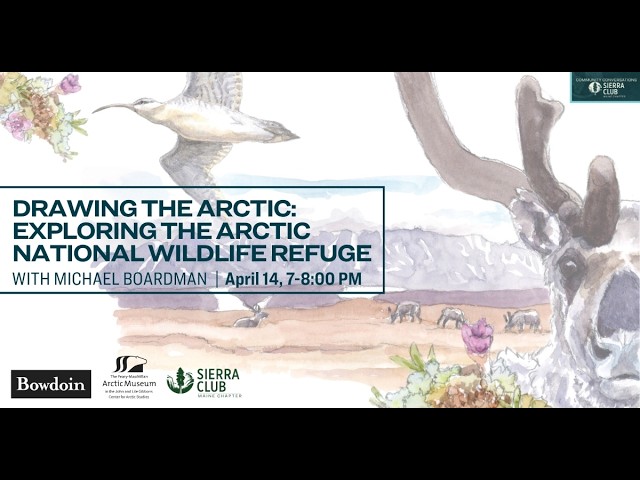
Drawing the Arctic: Exploring the Arctic National Wildlife Refuge with Michael Boardman
Watch on YouTubeVideo summary
Wildlife artist Michael Boardman shares insights from his 2019 residency at the Arctic National Wildlife Refuge in Alaska, a remote coastal plain accessible only by small plane and defined by harsh conditions like permafrost and strong winds. During this two-week stay hosted by Bowden College and other organizations, Boardman transitioned from creating t-shirts to field sketching, immersing himself in an environment where phenology—the timing of insect hatches—is critical for feeding migratory shorebirds such as tundra swans, red knots, and endangered buff-breasted sandpipers. The area serves as a vital breeding ground for these global travelers, while mammal life includes lemmings whose population cycles dictate predator numbers, caribou that undertake the longest land migration of up to 3,000 miles annually, and unique ecological interactions like female caribou shedding antlers in winter to fertilize soil for plants that feed calves.
The ecosystem of the refuge is further shaped by specific species dynamics and environmental threats, including the presence of snowy owls during lemming bust cycles, Arctic foxes competing with red foxes, and predators like golden eagles and peregrine falcons, though wolves and bears are largely absent from this isolated plain. Boardman highlights the impact of climate change, specifically "shrubification," where warming temperatures allow willows to overgrow smaller plants, altering habitats, alongside challenges faced by muskoxen during ice storms that prevent them from foraging under snow. Despite evidence that existing wells in Prudhoe Bay are dry, the threat of oil and gas development remains a pressing issue, with Boardman noting that conservation efforts often rely on emotional advocacy rather than just scientific data to counter potential lease sales mandated by future legislation.
Boardman's presentation also touches upon the deep historical significance of the land for Indigenous peoples like the Gwich'in and Inupiat, who depend on caribou for their culture and subsistence, as well as ancient artifacts found in the region. While he acknowledges a lack of direct collaboration with these communities during his visits, he aims to respectfully bridge their traditional stories with modern scientific findings, such as the remarkable journey of wolverines tracked by late biologist Shiloh Schulty who migrated thousands of miles to South America and returned annually. The daily life at the research station involves graduate students monitoring shorebird nests with cameras and heat sensors, while armed guards protect against brown bears and polar bears, though grizzlies have never been sighted in this specific coastal area.
In conclusion, Boardman advocates strongly for the preservation of the Arctic National Wildlife Refuge, emphasizing that its immense biological value far outweighs any underground resources and urging audience action to protect it from development. He plans to publish a book combining his detailed field sketches with scientific data to further support the cause, noting that previous lease sales failed to generate interest despite political mandates. His message underscores the bipartisan support for bird migration facts among figures like Angus King and Susan Collins, yet stresses that safeguarding this unique wilderness requires continued public engagement and emotional connection to ensure the survival of its diverse wildlife and cultural heritage.
Read the full video transcript
real
>> well.
>> I just see Bowden and a black screen.
I'm the one that started recording and
stopped it because we could always cut
it off, but I won't start it till we
start the program.
>> You're in charge of that.
>> My name is Genevie Leo. I'm the curator
of the Perry McMillan Art Museum. And
I'm not gonna talk at you. I'm just here
to welcome you and to welcome Michael to
campus and Jane. Um, and Jane is going
to do all the introductions and I just
would
>> This is the microphone.
James going to do all the introduction
um and then we'll have questions time
for questions afterwards. So welcome to
all of you in the room and welcome to
the people on Zoom and our prayers to
you not right after the talk but in the
coming weeks to come and visit the art
museum. We do have some nice birds in
our new exhibit not too it is delicious.
Birds are delicious
among other things. Thank you again.
Thank you so much for having us here
tonight and thank you for the
introduction. Um, hi everyone. My name
is Jane Brekie. I'm the director of
Sierra Club Maine. Oh, is that better?
>> Okay, great. Um, I'm not wonderful with
technology, so we'll just roll go with
the flow here. Um, a couple just
housekeeping things for people on Zoom
right now. Hopefully you can hear us.
Currin, our chapter coordinator is on
the Zoom. She is the person that can see
um any question answer issues that
you're having, sound issues. So, let her
know in the chat and then she can let
you know and try to figure it out.
>> Now,
I um we may need to have people mute
themselves throughout the talk, but you
can send her a message through Zoom and
she can let us know what's happening.
Uh, let's see. So, thank you all again
for coming out tonight. We love having
in-person talks. We love that we can
also have people on Zoom. There's bound
to be some kind of technical issue, but
we'll push through. Um, I would love to
introduce Michael. Michael, thank you so
much for coming. Um, Michael Borman is a
wildlife and watercolor artist based in
North Yarmouth, Maine. His artistic
practice includes many hours of field
sketching and direct observation, taking
notes and renewing a sense of wonder
about the natural world. In 2019, field
artist Michael Borman was selected by
the US Fish and Wildlife Service to be
the artist and residence for Arctic
National Wildlife Refuge in northeastern
Alaska. The two-week project was based
on the coastal plains of the refuge,
studying and sketching migratory birds
that come from all corners of the world
to use the unique tundra habitat to nest
and raise young. Michael fell in love
with the unique natural history of the
Arctic and has returned many times to
record the interactions of wildlife,
botney, and climate. Through his nature
journals, he will offer a view of the
endangered coastal plane, the life that
congregates there, and the stories of
migratory birds who connect us all to
the refuge. I'm very excited for this
talk. Um, I just wanted to give uh
briefly some information from Sierra
Club National in terms of actions that
we can do with the Arctic uh refuge.
Right now just pointing out that the
wildlife rich coastal plane is the
biological heart of the Arctic refuge.
Twice already the Arctic refuge has been
up for bids for oil and gas development.
And twice have these lease sales failed
to generate any significant interest.
The real value of the Arctic refuge is
not its resources underground but the
rich wildlife that supports sustainable
communities in Alaska. Arctic oil cannot
solve today's energy crisis. Even under
optimistic timelines, Arctic refuge oil
would not reach the market for more than
a decade. Using a current geopolitical
conflict to justify Arctic drilling is
misleading and irrelevant to real energy
needs. Um, unfortunately, we are
expecting to see a lease sale in the
Arctic refuge before the 4th of July as
required by the reconciliation bill
passed in 2025. The main delegation all
voted against that bill. So, if you want
to call and email your delegation to
thank them for their vote in 2025 and
tell them to stand up for the Arctic in
the future, that is always helpful. Um,
in order to impact the lease sale, we
are suggesting people use our social
media to tag oil companies and ask them
to stay out of the Arctic refuge. Keep
in mind, we shouldn't write messages
that are threatening threatening of
their reputation. Rather, tell them it's
risky business and not worth that
ecological value. Um, if you would like
more information about this, let us
know. We will follow up this talk with a
email with a toolkit. So, if you want
more information, you'll get it that
way. And um, Ashley, who is our uh,
organizer and myself are always happy to
take a phone call, email. We don't turn
down any opportunity to talk to anybody
and answer questions. So, please always
feel free to reach out to us. With all
of that said, thank you for your
patience. I'm gonna pass this over to
Michael.
Got to get the microphone thing figured
out. All right, there we go. Thank you
for the introduction and thank you for
um Main Sierra Club and the Art Museum
for having me in Bowden College. It's
really a pleasure to be here. I'm
counting and I'm seeing if there's more
Bowden professors than students in this
room.
So, I had an amazing experience. I got
to go to a place that I'd only dreamed
about for 20 some odd years as a young
environmentalist caring about this
magical land that we hadn't quite
screwed up yet. Um,
and
it was a slow process getting there. I
was a a t-shirt artist. I still have a
t-shirt business. I cobble together a
bunch of different things to make a
living as a creative person. I do
illustrations. I do paintings, I do
t-shirts and everything else. Um,
but I started um exploring the idea of
field sketching, drawing outside. That
led me to the artist residency scenario
where you you sort of go to my all my
artist residencies have been in
wilderness areas. I started going to
Baxter State Park and being the artist
residence there. Um, Acadia, Hog Island,
Ottabon, then Bremen, which is a
fantastic place. And eventually I got
artist residency in Glacier Bay, Alaska,
which is where I proposed to my wife
about 30 something years ago. Um,
luckily she said yes.
Um, and that really opened up Alaska for
me and it was suddenly this amazing
place. And there's a series of
residencies called Voices of the
Wilderness that bring artists or writers
or musicians or creative people and
connect them with science and sort of
activities that are um that pro protect
the um wildlands of Alaska. And there's
national parks, national forests, and
national wildlife refugees that are all
part of this this group that sign up for
an artist. The artist the bunch of
artists apply. They pick the one that
that matches their mission the best.
It's a it's a fantastic
um residency program and one that I went
to Glacier Bay with and also one that
brought me to Arctic National Wild
Refuge.
Why is that not advancing?
Our
first technical difficulty. What the
>> Is it?
>> No, it's the one he hit me.
>> All right.
>> Can you try the keyboard?
>> There we go. I'm just
a bummer.
Um, field sketching is an is an
adventure in
in nature. Um, I, you know, I was always
interested in in being a wildlife
biologist and being a a Jane Goodall or
a George Showler out there in the
wilderness, like studying and taking
notes and and seeing all these cool
creatures. But I, as I got into college,
I was heavily in the art scene and um, I
couldn't face statistics or any real
college math. So, that was out for me.
Um, but luckily through the art um
the art path, I've managed to weasle my
way into being a a pseudo scientist and
to be able to follow along with some
cool expeditions. I find some cool stuff
on my own. This was a great experience
trying to draw a spruce grass that
eventually jumped on my lap. It was he
was my worst critic, as you can tell. He
sort of got that. Um he uh crawled up on
my shoulder then hopped on my head and
then flew off and did that like three
times in a row. Very hard to draw when a
bird is on your head. But um field
sketching for me is like attaching to
place and and sort of absorbing all that
information that's coming out of you in
the wild and be able to observe wildlife
and watch behavior and take notes about
it and take little drawings and sit and
be in a certain space for a certain
amount of time. without other stuff
going on. It's a it's a meditative focus
thing. Um, and you sort of if you're
doing it well, you let go of that inner
critic about how it's supposed to look
and you just flow with drawing outside.
And I really I'm a big proponent of
field sketching in any way, shape, or
form. Um, I teach it um here and there
and it's a great way to connect to
nature. I think these days we all need
to connect to nature as much as
possible.
Next one. Why am I going backwards? All
right, there we go. Um, and Marty Mirie
were instrumental in starting Arctic
National Wildlife Refuge and getting the
land preserved in the 50s. Um, they
fought non-stop,
did all kinds of advocating for um,
creating a wilderness area in the
northern northeast tip of Alaska. Um
they led an expedition with George
Showler and um Brit Keel and a couple
other um famous Alaskan
um educators
to sort of study the area and see what
the what the wilderness
connections were and what the animals
were um what the biological communities
look like. Um if you don't know these
guys, they are um he was one of the
first person to study caribou. They're
great conservationists. They started the
wilderness society. Um, and Olas Murray
wrote the Peterson Guide to Tracking.
But I love this quote. You can't
overlook the importance of wild country
as a source of inspiration. Um, which we
give expression, writing, poetry,
drawing, painting, mountaineering, and
just being there. That's the for me
that's the um that sums up the artist
and residency experience where you're in
you're immersed in an environment that
is completely transformative at least
for me
here. Let's let's find this on the map
here. Arctic National Wildlife Refuge,
the very northeastern corner of Alaska.
I'm going to guess that my clicker
doesn't work either.
This thing doesn't
All right. Well,
um 19 million acres. This is the size.
It shows South Carolina here, but it's
the size of the state of Ma just about.
Um this huge protected area. um Olas and
Marty Murray sectioned off a fairly good
portion of it in the 50s, but then Jimmy
Carter with the Alaska National Lands
Claim Act in 1980
um secured the rest of it and made it
this huge reserve. Um, unfortunately the
green area, the Arctic coastal plane
was fought over and fought over and
because Prudo Bay had just struck oil in
the 80s, um, they were they wanted to
hold on to the possibility of oil rights
in this place. Um, one other thing I'm
going to point out on this on this map,
um, you see this little anagram, Anoir,
ANWR, which is how most politicians and
most oil companies refer to this land.
It's a national wildlife refuge. It's
not an anagram. Um, when people say
Anoir, they're sort of buying into the
erasing the fact that this is our land.
It's not it's, you know, it's a refuge
for all of us. It's not this anagram
that the oil companies use to to sort of
take that away. So, I just point that
out. Um,
so the coastal plane got put in this
limbo for a long, long time until the
Trumpet, you know, back and forth
fighting. The Bush administration was
just ready to start selling leases in
the coastal plane and the oil spill at
Vald happened and then that the
political will to do that completely
disappeared. Um but unfortunately in 20
2017 the Trump administration managed to
sneak it into a tax bill. Um and they
had two lease sales for Arctic Refuge.
Both were complete failures. We'll talk
more about that a little bit.
So my re my residency
brought me to the Canning River Bird
Camp, which is right in the heart of the
coastal plane, right in that green area.
Um I will point this out with my finger.
There it is, right at the edge of the
Bowford Sea. It's an amazing landscape
and I can describe it to you and I can
tell you all about it, but happily Fish
and Wildlife Service made this nice
video while I was here. So, let's watch
this and get a little intro into where
I'm going.
So that's the video I watched when it
happened that day.
>> Yeah, I can understand how that can.
>> So two things happened in 2019 besides
getting this artist residency for Artic
National Wild Refuge. I finished the
year-long course as a main master
naturalist
um and learned all these different
connections between plants and animals
and fungi and just it was it's a
year-long course in all things nature
based in Maine. Um and it was really
amazing. It opened my eyes to a lot of
stuff I hadn't before. And the other
thing that happened is that I went from
dipping my toe into being a burer to
jumping full force as a murderer into
the swamp of carrying binoculars at all
times and driving away.
So when the Fish and Wildlife Service
emailed me and said, "We'd like to
accept you for being an artist residence
this year in our at in the refuge." Um,
and they said, "Well, we're going to
bring you out to this remote camp in the
middle of nowhere with a whole bunch of
ornithologists and you'd be studying
breeding birds that migrate and nest in
this tundra location." I was like,
"Okay,
that sounds just right." Um, so it was
just, yeah, it was line all the cards
lined up perfectly for me to be uh um
doing this amazing cool event. Um so we
land on the on the um tundra,
walk to camp and it's a beautiful
gorgeous day. I immediately sit on this
little hill like right outside of camp
and start drawing the Brooks Range in
the background sketching. We were on a
fork of the Canning River which runs
it's the uh western part of our National
Wild Refuge. Um and there was Pacific
Loon floating right by one of the
sketching. It was that was really cool.
Um, and here is our camp with solar
powered bear fence.
Doesn't look very sturdy, does it?
That's my tent, the black and orange
one, right by the bear fence.
I'm guessing that I was the most uh
expendable member of the team. So,
that's the tent I got. But the view was
awesome. I wake up every morning and see
tundra swans and other birds swimming
down the river and hear all the bird
noises. It's really fantastic.
>> My um pilot, it was just me and a a
pilot, a US Fish and Wild Service pilot
in a small Cessna 180 that flew 300
miles from uh Fairbanks through the
Brooks Range to this camp on the coastal
plane. And just as we were landing, he
said, "You know, it's a land of detail.
Just get down and really absorb and see
the smallalness of everything." And
really the liipuchian aspect of this
place that for nine months of the year
is covered in snow
- 40 -70 sometimes wind blowing off the
Bowford Sea. No plant can grow higher
than this for most of the coastal plane
because it's so harsh. So there's this
whole world that happens in this tiny
little
active layer of about seven to a foot
seven inches to a foot or something and
underneath that perafrost.
So it's really fascinating to see all
these little plants.
These are some of my these some my
plants became characters for me that I
would that I would see constantly day
after day. One of my favorites was a
woolly blasphy
little plant that looks like an alien
coming out of the ground when it first
grows. It's got these funny purple
tender tendrils with these spikes on it
and it's got this fuzz and the plant
grows out of the fuzz and becomes this
huge flowering spire that the caribou
love to eat. It's like their favorite
thing. Um, and the other cool plant is
an Arctic poppy. I love this plant
because it makes a little cup
and follows the sun. We're in the Arctic
in June. The sun does not set. It goes
like this. It dips down the horizon and
comes back up again. And this flower
follows the sun around all day long. And
because it's got a little cup and it's
following the sun, it's a little solar
heat. And flies come in and land in this
little cup to warm up because they're
cold bloodooded. They got to have a
little little heat to go. Um and they
end up pollinating the plant.
>> They fly in there, pollinate, go on to
the next one.
Wild stuff.
Numbers of insects were there too. These
huge clunking bumblebees that would fly
around. They're like probably an inch
and a half or more long. wolf, spiders,
lychans, moss, all this cool little
stuff. I really got absorbed in this
little world. But that's not what I was
there for.
If you look carefully, you can see the
the shortbird nest on the corner. Um,
this little li little fuchian world
supports um a great migration of birds
that fly from all over all corners of
the world to come to Arctic National
Wild Refuge to breed in a specific
local.
And our job was to find as many nests as
we could find and mark them, follow them
throughout the season to see if they had
hatched or not. But we couldn't go back
and forth all the time because we we'd
sort of leave scent marks and and trails
and stuff. So what they do is I don't
sorry we would would walk through what
what is a giant wetland complex.
Basically
um the geology of the Arctic is such
that there's pingos and holes and
different ridges that form as things
freeze and um thaw and those fill with
water in the spring. So, it's a huge web
which is hugely attractive to all these
birds and very tricky to survey and walk
through as a as a scientist or a pretend
scientist even.
So, it's a lot of lot of miles and
waiters trumping through a muck with
perafrost underneath.
But when we found a nest, we'd uh weigh
the eggs to see how um far along they
were. They let the artists actually do
that, which I was pretty psyched about.
And then if it was a um certain nest
that was situated right, we'd put a
camera on it, a game cam, which um if
you look at the
attachments on that, it's lag bolted
into the Tundra perafrost.
The Fish and Wildlife Service was nice
enough to loan me some pictures to show
you what this game can cam might have
caught to see how much fun it is to be a
bird on the Arctic tundra trying to
raise its chicks.
The lag bolts. The lag bolts are there
just for the wind to protect or
>> just to keep the camera upright and so
other animals don't mess with it or
Yeah, wind is a huge factor.
>> There's that guy.
Lots of traffic moving through.
Then there's this guy. It's bad enough
that you're stealing the egg, but what
are you doing in that NASCA?
What a jerk.
>> And field sketching all the while.
This is a video they took of me doing a
couple tundra swans. You can see how
fast I have to work.
but very tricky to draw those birds that
are uh that are like cobras on bowling
balls with their necks swirling around
and it's not a bird I'd ever drawn
before. So, it was a was a challenge,
but it was fun. And that's just sort of
a brief like with my field sketches,
I'll get as much as I can while I'm in
the wild. Um it might be gestures like
this, it might be a little more. or I
might even if it's something sticking
around long enough, I might be able to
get my watercolors out and do a little
little color stuff. But then I'll focus
in and I'll also take pictures and then
the pictures will inform a finished
sketch where I want to go in and really
look at the um anatomy of how
something's put together and where the,
you know, and compare how I did the deal
sketch drawing versus the photograph and
kind of do it back and forth with that.
So that's kind of my process of this
whole thing.
One thing that was really amazing about
the Arctic tundra um especially the
coastal plane with all these birds there
is constant bird noise and because
there's no um sun no time they're
calling constantly
but more you know as the sun dips down
they quiet down a little bit but then as
it starts picking up they go off. So,
I'm going to um run through this little
video that is bird songs from the Arctic
with uh with some of my sketches, birds
that I'm not going to talk about. I will
talk about other birds, but um and the
only one that lines up with the actual
call is this first one,
which you might recognize if you've been
in the ocean in Maine at all this
winter.
Tundra swans build these huge mounds
that are nests that they sit on.
long spur.
So my mom made sandpaper.
Imagine being in this place where the
only noise you hear is wind and birds.
It's just fantastic. No planes, no
trucks, no motorized vehicles of any
kind
and flies.
So now I'm going to do a little indepth
about several bird species that I find
fascinating. Um, the Arctic plane is
really good habitat for shore birds. Um,
and shorebirds are a pretty wide array
of species, including woodcocks that are
calling around here right now. Um, but a
lot of birds that are attached to the
ocean are attached to waterways in some
way or form. And these are both red and
rednecks.
And they are so attached to the ocean
that they only come to land to breed in
this one spot in in Arctic tundra. Um
the rest of the year they're floating
around deep in the ocean, swimming
around um mats of seaweed and they have
this great little feeding strategy they
do where they they sit in a circle and
they spin around and create a gyro with
their feet. So the water brings up
invertebrates and other things from the
bottom of the of the water and they pick
them off one by one
>> which is really cool. The other cool
thing about um battle ropes is as they
breed um the female finds a male she
likes. She breeds with him. She lays
some eggs and then she takes off and he
is the sole provider for the eggs and
the young as they hatch. So he is in
charge of sitting on the eggs and she
may go out and mate with another male
and start another egg.
>> Excuse me. Could you put your microphone
up higher? I'm missing most of it.
>> Sorry.
>> Thank you.
did it off here. Is that better?
>> Technical difficulties. All right. How's
that?
>> That's good.
>> I'll start I'll sort of bend my neck a
little bit.
>> It looks fairly ridiculous.
>> So, red redneck battle ropes.
Oh, wrong way.
Um, another bird that I really enjoyed
seeing and I wasn't really aware of is
the pectoral sandpiper. It's a bird of
um, grassy plains and farm fields when
it's not up in the Arctic tundra. Um,
but the males grow this huge
sort of dark feathered
pouch in front of their chest and when
they fly they puff it up. They're like
the Arnold Schwarzenegger of the bird
world. But they've got this big pouch.
And they fly from South America all the
way to the Arctic, thousands of miles to
find a bait. And they get up to the
Arctic and they do what's called a
lecting behavior where they all sort of
find a spot and start displaying. And
their display is puffing out their chest
and flying around in circles and making
this crazy sound that sounds like a UFO
flying. And uh I will do the sound for
you because I can.
Sounds like this.
They zoom around making this.
I'll be here all night. Grab the
um and hopefully they attract a mate.
What happens with pectoral sandpipers,
like many shortbirds, um, these guys, 70
75% of the males that make it all the
way up to the tundra failed to breed,
can't even attract a mate for some
reason.
>> I don't know why this reminds me of high
school, but
there's another amazing shorebird called
buff breasted sandpiper.
And this bird is pretty, you know, basic
brown shorebird. Also sort of a a sod
piper that likes farm fields and and
plains, but it's got iridescent wings
underneath it iridescent feathers
underneath its wings. So it'll put its
wing up in the air when the light gets
low as the sun starts dipping towards
the horizon and wave it around and that
iridescent white feathers on the wing
grab that sunlight and they spread it.
They shoot it throughout the entire um
Arctic tundra so they can be seen for a
long distance and they'll flutter up and
then they'll wave their wings and
they'll come back and wave their wing
again hopefully to attract a bait.
Here comes one now.
And if a male is lucky enough to attract
mate, he starts this hittering display
where he raises his wings and makes this
tittering call that I'm not going to do
because
um and hopefully something will happen.
So, he's got two two females here.
But like in many things, females can be
fickle and sometimes your best display
is just not good enough and you're left
all liars.
This reminds me of college.
But fortunately, um, one male somewhere
was successful because we found a buff
breasted sandpiper nest. They're a
endangered bird in the um just in
general their their population is very
low and dropping. So um it was it was
good and hopeful to find a nest of these
birds.
>> Well, it says actual size down here.
>> Yeah, in my sketchbook it's actual size.
They're tiny. They're like the nest the
eggs are probably an inch and a half.
Pressed sandpaper might be a little bit
bigger. Um I'd have to look. I didn't
bring my sketchbook, but actually if you
look at some of the sketches on the
wall, you can see there are some actual
size nest things on there. Um, and it's
a wetland.
There's so many water birds, loons,
ducks, geese.
I'm not going to talk too much about
them because I love the shore birds, but
I do the red throat is pretty amazing.
And I like this picture because the
reflection really came out. Another
bird I really like was the golden
plubber, American golden plubber, which
is just this beautiful artic bird. It's
got this golden cap and golden feathers
on its back. It's got amazing pattern.
Um
has these cryptic cryptic nests. You can
see this painting I've done of the
shorebird eggs with the with the young.
Once they hatch, they have these like
greenish yellow feathers that match
almost exactly the spagnum moss that
grows around their nest. So they can
they can completely disappear.
>> And it's another favorite bird of mine
because as it migrates from Arctic
refuge south um their migration path
takes them through the northeast
including me.
So these birds they have certain
requirements that they meet that they
get in the Arctic refuge. They've got
24-hour daylight to feed when they need
to feed. They've got
undisturbed habitat
and they have a food source that's
readily and constantly available there.
Guess what it is?
>> For those of you who uh think there's no
use for mosquitoes, mosquitoes feed a
lot of birds, especially the larvae as
they're they're picking up. that the
birds are very um lined up with the
timing of when green up happens in the
Arctic and when all these insects spring
to life.
>> Um and they've got to be there at just
the right time and the chicks have to
hatch at just the right time for all the
mosquitoes to come out so they have a
possible source of food.
>> So phenology is really important in the
article. Phenology is the the study of
what the timing of when natural events
happen.
We'll move on to some mammals now. And
we're going to start small. We're going
to start Greenland and brown lemmings.
These guys
have a boom and bust cycle. And they um
they live in that subnivian layer. In
fact, they spend all winter building
tunnels just above the perafrost
from place to place um stashing food.
Um, and they're very susceptible to
changes in climate because of that
because they're living in this thin
layer. They they can't migrate. They're
they're there all winter. So, when we
when the Arctic has a rain event with a
lot of ice and snow and that stuff melts
and the snow cushion layer above the
lemings start to cave in and ice up, it
it can kill entire populations.
And when that happens, these guys go
hungry.
>> Are they lemmings that jump off the
cliff? And
>> that's a total myth.
>> That's So just a quick aside, I'm pretty
sure the Disney um when they in the
whenever that was in the 70s, they like
tossed a bunch of lemmings off a cliff
and filmed it. So like they're all good.
But there's a lot of lemmings. There's a
lot of lemmings around and it's possible
that some might accidentally fall into a
hole or something, but yeah, that's
that's a total that's a total.
Um, but one thing I was really excited
about because this is my favorite bird.
I know I said you're not supposed to
have a favorite, but this is the one I
really like. Um, and the year before I
went to the Arctic, there were seven
snowy owl nests in the in the territory,
the two-mile square territory of where
the bird
study was going on. So, I thought for
sure I'm going to see a snowy owl there.
It'll be great. But like I said, the
lemming, they're there because it was a
boom lemming cycle and there were a lot
of lemmings around. And then the next
year was a bust cycle. So
>> I got to see pellets and feathers and
study
>> skulls around um the hill. Snowy owls
like the tonger swans like to sort of
nest on a hill. So I got to see all
these these this evidence of snowy owls
nesting. But the only snowy owl that
showed up was the day I left about two
hours after I flew out. They sent me a
picture of the Oh yeah, snowy owl showed
up at the camp for like five minutes
then flew away. So, I sketched it
anyways. That's all right. It was close
enough,
>> but it did inspire this painting, which
that zoom thing is really killing it.
But,
um,
this sort of idea of the tundra melting
into the Arctic Ocean and animals
hanging on and trying to make do with
this changing climate um, and trying to
collect as many lemings as they can for
nesting. Um, so that this paint is
called artic. It's hang.
So what happens with the lemmings is
when there aren't a lot of lemmings, um,
the other predators that eat a lot of
lemmings end up moving to birds. And the
other the other option for food is
shorebird eggs and goose eggs and and
all the other nestlings. Um, so this is
an Arctic fox
taking it taking an egg like we saw
earlier. He was running around. I think
this this may have been a stash egg from
the previous year even that he found in
a in a hole. Um, and while the bird
study was going on, they were also
studying the Arctic foxes to see what
they were bringing for food. They had a
den that they had game cam on. So they
they um
watched this Arctic fox, male and
female. Um, that's the male
enjoying the um embraces of childhood.
And so they had a um game cam on this as
well. So I've got a video of the fox
den. That's pretty interesting. I'd like
to show you.
So that's not a fox. Who can tell me
what that animal is?
>> Honey.
>> It's a wolverine.
So, he knows there's kids in there and
he is determined to try to dig them out.
And that's the male trying to keep the
wolverine at bay.
You can see
>> as that uh as that fox bit the Wolverine
in the butt, the Wolverine took off and
actually those kids survived. the fox
was able to hold that wolverine off and
and have those kids leave the den. And
beyond that, I don't know. But so maybe
our jerk fox wasn't such a jerk after
all.
And now we're going to follow into our
mammal um story with
this is not the cow that was in our
front yard a couple weeks ago. True
story. Mhm.
>> Um, but another animal who has hoofs and
kind of the the signature animal of
Arctic National Wildlife Refuge, the
northern caribou and the porcupine
caribou herd. It's the herd that lives
in Arctic National Wildlife Refuge.
Varies from 100,000 to 200,000 depending
on
bunch of different circumstances.
Um, they need the coastal plane to
breed. It's their one spot that they can
come to that has like the birds has all
the requirements they need. It's a big
flat area.
It's far away from the mountains where
all the other predators breed. Wolves,
grizzly bears, and golden eagles. The
three major predators of caribou all
need big rocky structures to build dens
and to have places to raise their young.
So the caribou go to this spot. It's
close to the Arctic Ocean. So have as
they have their um calves, they can go
catch breezes from the aros and keep
those mosquitoes and bot flies and what
whatnot off of them.
And another really cool thing about
caribou, there's a baby caribou there.
Um the males have these huge antlers.
They grow them all summer long. They go
through the rut in the fall, fight over
who gets to mate, and then they drop
their antlers in the fall. But the
females hang on to their antlers.
The female antlers stay on. They have
smaller antlers and their antlers stay
on through the winter. So if you think
about reindeers caribou in the winter
with antlers,
Santa's reindeer are all females.
>> But even cooler than that,
the females hold on to these antlers
until they get to the place where
they're going to have their calves. The
general area is where their antlers fall
off. And what happens is those antlers
that are loaded with calcium, fall off
onto the tundra, and then rodents and
other creatures chew up that tasty
calcium. They poop all over the tundra.
The plants absorb that calcium, grow up
in. So the first plants that the both
the caribou cows and the mom are eating
are loaded with calcium that feed
the calf so they can have extra
nutrients to grow fast to head on to the
next place.
And this is some of the tussex cotton
grass is one of their favorite foods
this time of year. That's one of the
foods that really absorbs that calcium
well.
And cotton grass is is everywhere. It's
not just in the Alaskan Arctic, but it
makes these lovely tusks that if you're
trying to walk across them, it's like
trying to walk across bowling balls.
Um, we were there. There were there were
several dozen caribou in camp and around
camp, big males. There was some leftover
caribou from the year before. Um, it was
just amazing to see and sort of inspired
this painting. that we saw at first I
saw a couple then we saw a couple dozen
and then as um the season progressed I
wasn't here for the whole thing but I it
was a couple hundred and then it was a
couple thousand and they also after they
have calves and after they sort of
spread out and get the calves ready to
walk they all amass together in this
huge um formation called the postcing
aggregation and they head off in the
fall into the mountains they have the
longest migration of any land animal in
the world. One caribou if he had a if he
was tracking his steps could walk 3,000
miles in a year.
It's amazing. And not only that, but
these animals are also essential food
for the glitch and aabaskan Indians who
live in Arctic Village and around the
edges of the refuge. Um
they rely and have for generations on
these caribou as a source of food and a
source of you know cultural identity
really
>> and without you know think about what
this coastal plane will be like this
thin area between the mountains of about
20 miles if it's loaded with
infrastructure.
So, we're going to follow the caribou
and we're going to follow this guy, too.
This is a parag falcon who landed in
camp. There are not many predators on
the coastal plane. Um, like I said, it's
far from the mountains, but this guy
popped up and landed on the outhouse,
which the
rest of the crew is really psyched that
I sketched a picture of the outhouse.
But as he flies south, which is where
we're going towards the Brooks Range
Mountains, um we're going to follow him
along and get a little uh taste of what
the mountains are like. It's important
when you're hiking in the mountains
to bring a compatriot who is willing to
carry your stuff. This is my son Elliot.
He's got the
scope and the tripod in the back of his
backpack.
He was very uh helpful and and helped me
explore the mountains for being both a
good buddy to hang out with and someone
to carry stuff.
>> The first the first bent of the
mountains we're going to run into here
is um large canine tracks
that are this arctic wolf that we saw
the first day we landed in this um river
valley we were in popped up. There's
just something about looking at the eyes
of a wolf that is just
all inspiring. Takes your breath away.
He watched us for a little while. I got
I had him in the scope. I got to do a
little bit of sketching and then he just
sort of trotted off. Just one single
wolf, maybe a disperser from a pack. It
was hard to tell, but it was really
intense experience for me. Something
I've always wanted to see.
Golden eagles also inhabit the mountains
and golden gold eagles um especially
younger golden eagles will prey on
caribou calves. They'll fly at them and
grab them with their claws and scratch
them. They can't kill them, but if they
wound them, the caribou calf will
eventually die and then they'll be able
to to eat this carrying or they could
possibly chase them off the cliffs.
This is a tarant. This is not a
predator. This is a prey.
There were a ton of tarmaggan
all around
um the area we were at that year. And
when there's lots of tarmaggan, there's
lot of another animal that I'm going to
lead up to. Um this is just a little bit
a little shot of my field sketch journal
and my kid a little bit my little
pallet. I should have brought it. I
actually didn't bring but I should have.
Um, but the bird on that field sketch
journal and the bird I'm sketching there
in the middle of the Arctic tund or
Arctic mountains at the Brooks Range is
a gear falcon. Gear falcon is like a
giant Arctic carbine falcon. Big
dramatic bird. They come in either they
can either be gray um dark brown or
bright white. And there was a nest near
where I was. So, we got to sort of
observe the nest and draw the chicks.
And I'll show you some of that
as the chicks are sort of
just starting to pull their feathers,
get going,
they they lay their eggs in um I can't
remember the word, one after the other.
So there's the the first one that
hatches is bigger and then a couple days
later the next one will hatch and a
couple days later the next one will
hatch. I monitor paraban falcons for the
state of Maine as a volunteer. So seeing
these falcons in the Arctic was a real
treat.
They're sort of cute little birds.
Um the mountains were just amazing. Um,
this is
a little video of me drawing these
awesome thousand foot hills. There's a
few mosquitoes flying for flying
foreground.
Um, and the really cool thing about the
Brooks Range is that at one
ocean was a big shallow sea and the
wonders of geology.
Um, so there's all this history involved
with these mountains as you look at
them.
Just layers of of
millions and millions of years.
And also really cool little plants. We
did that hike up to the mountain. There
were 50 or 60 different little wild
flowers that were all blooming at the
same time. It was really cool.
But it's really cool because um as you
look in the rivereds, there's fossils
everywhere.
Signs that this place has been, you
know, the history of of the Arctic has
been going on for millions and millions
of years. Um, and then on the upper part
of this slide, also slightly cut off by
the Zoom banner, um, are little pieces
of chapped
by somebody
thousands of years ago. They were just
sitting on a little hillic and that
really brought the idea of this place
um, not only is a wondrous place for us,
but it's a it's been a wondrous place
for thousands of years for people.
people have been here studying, hunting
and living living on the office this
land for ages. Um, our national life,
which is one of the places that wasn't
covered by ice during the ply
and this is a bone scraper that our
guide found that showed us. Um, it's a
whale rib and it's got little marks on
it. Who knows how old it is. It was
Yeah, it was really wild to find this
tool just for a hide scraper made out of
a whale rip.
You just think about the history of that
stuff and you hold it in your hands.
And then there's the history of what's
happening now. Um last year I got a
fellowship to go to the um Tulic Field
Station which is run by the University
of Alaska and it's an artic station that
they set up. People come from all over
the world to do climate change research
based on the Arctic habitat.
So, it's really lucky for me to be here
and to be involved
peripherally with incredible science
going on. Um, and a lot of this the
science that interested me was the study
of phenology and the study how of how
plants grow and what happens when it's
warmer a lot and certain they they set
out all these plots and then they have
one that has more nutrients in it than
one that has more nutrients and is
warmer than one that has less snow
cover. They do all these studies about
how that affects the plant communities
in the Arctic and then the plant
communities
um affect the animal communities which
affect the entire Arctic.
So it's really interesting. Um
it was end up being a lot of what they
call shrubbia
which is all these shrubs that grow. as
the as there's more nutrients, the
little flowers
aren't overly affected, but the shrubs
that get bigger and bigger are. So, the
shrubs eventually grow up and the
willows and stuff and overgrow the the
smaller plants and it becomes more of a
monoulture because with all the um
nutrients, these heartier willow plants
can can take over.
>> That's my friend Ruby. Um, she was doing
a lot of the plant phology stuff and she
likes this photo because she's holding a
a batula birch seedling in her hand
which is about
2 in or 3 in tall and she estimates that
that burst a birch seedling is the same
age as her entire plot behind her which
she's been doing for eight years.
And there's when the willows grow, there
is one animal that uh that is able to
take advantage of that and it's these
guys.
Those are muskox.
>> Another really cool one to see on
you can see there's a couple babies.
There's I think four or five babies that
are kind of behind them.
Here's my sketch. As we were sketching
them and watching them, eventually the
one of the older males sort of snorted
and then all the babies ran behind them
and all the adults lined up in a line
with their heads down. I was like,
"Okay, I think it's time to go."
But I mentioned the um the freeze and
thaw. Muskoxin don't migrate like the
caribou do. They they move around, but
they don't really leave the Arctic
coastal plane. The caribou head towards
boreal forests. The muskox have to sort
of tough it out. They've got lots of
layers. Um, but they need to be able to
scrape food out of the snow. They've got
this big heads and they've got sharp
hoofs that they sort of scrape out and
and move stuff. When we get when the
Arctic gets an icing event like we get
in Maine where there's an ice storm and
everything freezes up, they can't access
that food anymore and the muskox and
population of the Arctic is in trouble
because of that.
This is a wimble. I'm going to talk a
little bit about a friend of mine,
Shiloh Schulty, who is a bird biologist
who I met at the Arctic research camp
who was from Kenok. I was kind of
surprised. There was a fellow Mater um
and he was this great guy. He has done a
huge amount of work studying wimbrals in
the Arctic refuge in the Arctic coastal
plane. and he found he's works for a man
um worked for manment and he managed to
tag these windmills a pair a mated pair
on a nest and put radio tags on them and
track how their migration went and it
was really mindblowing that these two
wimbers the male flew down through
eastern Canada and across the eastern
flyway to South America and the female
went west down the west coast to
California, flew to another place in
South America, and then they flew back
and met each other the next year in the
exact same spot.
Um,
Shiloh was um, unfortunately killed in a
helicopter accident last year. Um, and I
had talked to him right before I went up
to the Arctic about doing some Wimberl
um,
planning and and pre pre-looking around
the Tulic area. And he said, "Yeah,
that'd be great. I want to do a project
there." Um, and although he was gone, I
really wanted to sort of find there and
see what was going on. And and sure
enough, behind the station, a few miles
behind the station, there was a breeding
pair of wimbrals. Um, and I could hear
them from a distance, and I was sitting
on a hill like drawing plants, um,
focusing on the little the little
things, and I heard the wind coming
closer and closer, and I was sitting
there. It flew right around me twice,
did these two big circles, and then took
off down towards probably where its nest
was. And I was like, I really felt that
that was Shiloh.
There's lots of magic that happens in
the tundra.
>> There's lots of bad stuff that happens
in the tundra, too. Um,
this is Prudo Bay. This is what the
tundra might the Arctic refuge coastal
plane might look like if the Trump
administration has their way.
Um it was talked about in the beginning
of the talk a little bit that you know
there's a possibility of oil there in
the Arctic refuge but nobody knows for
sure. They there was one test well dug
in 1980
and nothing really came of it. It was
secret for a long time and it's recently
just came out that that well was dry.
There was nothing there. But still
there's this big push to develop this
and and to
erase this area
and turn it into something obscene.
>> This is one of my heroes, George
Showler. This was also the uh screen
saver on my computer for three years
before I got the
>> the artist residency artic refuge. And
for me, it speaks to how my art can
help the situation. You know, it's about
pulling in motion. You can do the best
science in the world, but unless emotion
is involved, it's not really relevant.
Conservation is based on emotion. It
comes from the heart. One should never
forget that. And if you don't know
George Shaller, you should look him up.
He's the preeminent wildlife biologist
in the world. He's 90 something now.
Still alive.
So, taking George's um message to heart
and my experiences in the Arctic and
thanks to heart to Alaska Wilderness
League, um I was flown down to
Washington DC last year to do some um
advocating for protecting the refuge.
And it was mentioned before that all our
representatives voted correctly to
protect the Arctic National Wildlife
Refuge. And I can't take credit for
that, but I'm hoping that maybe some
little bit of something came through.
Um, Angus King said, "I'm on your side.
You don't need to you don't need to
lobby me for this." Which is great. Um,
and Susan Collins was very polite. Had
no idea that birds migrate from all
corners of the world to our natural life
refuge. So, if that one fact stuck with
her, then I think I did some I did super
good.
And there's the magic of that place
where all these animals come to this one
special place to to raise their young.
The fact that they migrate from all over
really captures my imagination.
>> Was that super actual?
>> That's an actuality. It was um uh I was
crossing a river and there were black
belly plugers. I turned them into golden
plers because they're prettier to look
at, I think.
That's the artistic license part.
>> But there was a whole string of caribou
behind them and I was walking through. I
didn't know where where to point my
camera. I was like, "This is like
crazy."
>> Um, and for Fish and Wildlife Service, I
designed this map that shows the
migratory ver paths of a dozen different
species that that breed in the Arctic.
You can see they go through almost all
50 states of the US. A bunch go up into
Russia. Um, there's a bird that flies
all the way to there's one that goes to
New Zealand. There's one that goes to
Africa to the savannah. It's they they
spread all over and they come to this
one spot. It's pretty amazing. That map
is is over on the corner if you want a
better look at it.
>> So, one more amazing thing about birds,
and I'm going to shut up about birds.
Um, when the shorebird parents hatch
their babies and raise and and get them
out of the egg, they they're precocial.
They're pretty much as soon as they're
out of the egg, they're moving around,
picking up chicks, picking up bugs,
doing their thing.
Pretty soon after that, all the parents
leave. Parents head on their migration
south. leave the chicks to themselves
for to bulk up on food and find things
to eat and figure out how to get back to
South America or Central America.
>> And I had one experience that I'll that
I'll share with my wife. Um
in New Brunswick on the Bay of Fundy is
one place where tons of these
semi-polited sandpapers which have all
breed all um grown up in the Arctic.
These are all juveniles that have flown
down in a mass group trying to figure
out how to get
to their next migration stop and they
stop. They all come to
numerous stop numerous places along the
east coast but the Bay of Fundy is a
major one for semi-palated sandpipers.
This is tens of thousands of juvenile
sandpapers
just flying around. There's probably a
merlin or a paragan falcon chasing them
around. But they come one place to bulk
up with as much food as they can before
they fly
4,000 miles, 5,000 miles, 6,000 miles
down the coast of um to South America.
It's just amazing how they figure that
out without any parental supervision or
anything. It's just mindblowing.
So, all right, I have a spiel.
This is the stick the landing spiel. So
get my paper out. See it. Even need to
get my glasses out. This is
everybody can hear. Um, so what can art
do to protect artic refuge? I've been
incredibly lucky to visit and fall in
love with a place that began in my mind
as an ideal. A place where humanity has
not indelibly altered the systems of
nature. A landscape grand enough to
support all the original wild
inhabitants. where hundreds of thousands
of caribou and millions of birds can
make their way undisturbed by roads,
structures, development.
I hope that we as a species can muster
the will to save one landscape that
functions perfectly well without us and
has for millennia.
Hopefully, you're all aware how fragile
and dangered the Arctic is. Actions by
the current administration will set the
stage and demolish this landscape either
directly drill baby drill or indirectly
through climate change and impacts from
resource extraction. People need to care
about what happens up here to know the
intricate web that keeps blooming
flowers, laying eggs and creating bouncy
baby muskoxin that nurtures the caribou
population that continues to support the
subsistence lifestyle of Witch and
Anupia peoples.
Will you all be able to come visit here?
Not likely, but you may see birds that
have used the tundra to raise their
young. And perhaps you'll dream of these
few wild places that we haven't tainted
with greed. Arctic refuge is a landscape
where we can test our values to keep one
small part of the world as it was before
we industrialized our lives. I hope my
sketches can help tell the story of this
place to inspire folks to care and take
action for all the values that be that
could be found here for science, for
recreation, for inspiration, and for
hope.
San Wise GMG said, "There's some good in
this world, Mr. Froto. It's worth
fighting for.
Thank you. Thank you." Um, these are
organizations that you can follow to see
more about what you can do with Art
Refuge. Sierra Club has some great
resources.
And I would be remiss if I didn't put a
plug in for my Instagram, my art, and my
t-shirt business, which I still run
called Coyote Graphics. Um, and this is
a cool caribou art t-shirt that I happen
to be wearing right now. Product
placement is important.
So, thank you all for coming and I would
love to field any questions.
>> Yeah.
>> So, this will turn on in 10 seconds.
not work. Oh, there we go.
>> Okay. So, I'm going to try to take two
questions from you all and then one from
people on Zoom. As I stated earlier,
technology is not my strength. So, we'll
see what happens. We'll do our best. But
you are are welcome to pass this around
and throw this, they tell me as well, or
I can hand deliver it if there's too too
much distance. So, I see one hand
already. I'm going to bring this over to
you and then we'll go from there.
>> I was check.
>> I was wondering.
>> Thank you.
>> Are you able to tell me a little bit
more about your day-to-day life when you
were staying at the Arctic Wildlife
Refuge and other people you were there
with?
>> Sure. Um
when I first flew there um the pilots
were telling me the the main leads for
the bird study were all in Fairbanks
still. So it was all grad students that
I was there with um and grad students
from all over the place. several from
Alaska and um several from like US and
and I think one person from abroad too
even um and they applied to get this
position through Fish and Wilder Service
I'm sure. Um and our dayto-day was we
would go out we we'd sleep in those
tents. There was a weather port that we
ate in that was had um some cook stoves,
heat a small propane heater um chairs
and stuff and there was a twomile square
study area with plots and then we'd pick
a plot and we'd search that plot for
two hours for four people. So, what
whatever that breaks out to, if there
was two of us, then it would be, you
know, four hours for the two people
trying to find as many nests as we
could. Um, and some nests got just
marked as nests on a map. Some nests got
the um game cams. Some got a little heat
sensor tag underneath them that would
would go off at a certain interval when
eggs hatched versus when they were
eating by eat by something. So it's all
trying to study the um success of of
shorebirds on the tundra to see to get a
baseline for that because if development
happens that will change and how that
how drastic that changes is important.
So um and we do that we come back have
lunch do that again have dinner go out
do it again.
Yeah, often times those in bed, excuse
me, by maybe one or something trying to
follow 20-year-olds around. I'm not a
string chicken anymore. So,
definitely got my steps into
>> Yeah.
>> You want to you want to see if you can
just give it to
>> Thank you. Um, so fun to hear about your
talk. There's a lot of ology that I have
heard before. I really appreciate I
really appreciate learning it. Um I'm
curious if either at Tulic or on the
coastal plane you had the artist and
residence program or the scientific
programs had much collaboration with the
Gwen people because I know a lot of
organizations and the Genon steering
committee are at the front of this fight
to protect their homelands.
>> Exactly. That was kind of the miss
that's been the missing piece for my
trips to the Ark these these past few
times I've gone. I haven't been able to
go to Arc Village and actually talk to
people. Um
Fish and Wilder Service does sort of
reach out with them. Um but I wasn't
involved with what they were doing
there. So that's kind of the next step
in my process is to make that try to
make that connection that it's not an
easy connection to make as a as a old
white guy to say and yeah I want to be
able to to tell their story respectfully
and and
hear how they um
do their subsistence lifestyle and how
important these resources and animals
are to them in their culture. But I
don't want to be
>> Yeah, it's tricky. I I've got some I've
got some people working on it. So, it's
it's trying to figure out how what what
I can offer them that would be of value.
So, it's not just me taking their stuff.
You know,
>> thank you.
>> Good question.
>> I don't have any Zoom Zoom questions
yet, so we can keep going here.
Oh, uh, that was my part of my question,
but
continue. Uh, I would suggest you take
native studies, which I've done, and
take the Wabanaki Reach Ally train here
in Maine
>> on a Saturday. And I noticed you're
walking around like we would walk around
here in Maine with gear,
>> no gloves or anything. I was like
weather we've had here in April.
And are you continually going back every
year to to continue the project?
>> I go back as much as I can afford.
um in the foothills. So the weathers
were more controlled. So it's a little
less crazy than that. But yeah, I it's a
lot of gear. We bring a lot of different
layers and then take them off and put
them on constantly.
>> Almost like here.
>> Yeah, exactly. that thank you for that
um comment about the Minaki thing
because I've been looking at that.
Appreciate that.
>> My quick question about your
semi-pomated Oh, sorry.
>> Um quick question about the semi-pomated
sand pipers in the Bay of Fundy. Yeah.
>> When did you film that?
>> That was the third week of August.
>> No, but what year?
>> This year.
>> Last year. Last year. I'm impressed. I
haven't seen numbers like that in May of
Fundy in four decades.
>> I So I missed by a day. Um I think we
saw 40,000. There was 80,000 the day
before.
>> My friend Charles Dun was there filming
and that's what they estimated.
>> Super encouraging.
>> Yeah, it's a it's a moving target for
sure.
>> I think behind you.
>> Thank you so much. Very inspiring,
fascinating presentation.
>> Oh, thank you. I was wondering if you
look familiar. It does coyote graphics
go to the common ground fair.
>> Well, yes.
>> Okay. Okay. That's where I remember you
from. Okay. Lovely presentation. Um but
as a first year at college, very
interested in doing some research in the
Arctic. Um do you know of any good um
organizations to look out for or places
to start as someone curious to get
involved in the Arctic?
>> That is a really good question. That may
be a good question for the boat museum
as well as for me. Um, I know Fish and
Wildlife Service sadly has been child
blocked and they're not doing this bird
research anymore. There was I think a
couple years ago was the sort of closed
off the they were going to close it off
anyways, but there's there's very few
people in even in the office now doing
stuff. So, that's not encouraging. But
um
off the top of my head, I'm not coming
up with anything, but if you want to
scroll your name on my mailing list and
write artic stuff, I will. Yeah, I'll
send you some some connections as best I
can.
>> I'm glad you're you're excited about it
because we need young people who are
interested in this fight and interested
in this awesome ecology.
>> Thank you.
>> And come see me.
>> This is a Zoom question. Um, sorry to
everyone on Zoom. We cannot figure out
how to see you on our end. Um, Sam
Landry asks, "If there was anything
different that you wish you did on your
trip or something that you wish you did
that you didn't have the opportunity to
do."
>> Oo, that's a good question. There are
So, there are several sort of
outstanding things that I haven't seen
and sketched yet that I want to
experience. My my plan is to take all
these field sketches and to take my
stories and to connect them with some of
the science of um my science friends, my
professor friends and and biologist
friends and make a book of field
sketches about Arctic Refuge
>> and use it as a tool for advocating for
this place
>> um in the middle of sort of writing it
and getting ready to try to um submit to
some publishers. So, but there are
having something like that that's going
to be something that speaks to this
place. There's some things I got to do.
I I need to go see the caribou migration
and be in the middle of it and see a lot
of caribou. That's on my list. Seeing a
snowy owl nest would be awesome.
Spending time with the witchin is
probably the top thing that I want to
do. Um, and they do, too, if I can
figure that out. I don't have as many
connections there. Um,
and to tell you the truth, every time I
go there, something new and awesome
happens that I had no idea that I was
even interested in until I was like till
it happened and I was like, "Oh, cool."
I had no idea I was going to be drawing
plants all summer long last summer at
Tulink, but it was just Yeah, it was
just really fascinating. So, and it it's
a it's a landscape with not a ton of
biodiversity, but just enough to get a
handle on and just enough to keep
inspiring.
>> Awesome. Thank you for that. Okay, we
can go back to audience.
>> And notice many of the researchers
carrying guns and I assume that's for
polar bears
>> actually.
>> Did you see them? And
>> okay, that's
>> not for polar bears. Very good question.
Uh, more for brown bears than polar
bears. Polar bears are a possibility.
Um, grizzlies are more likely there. Um,
I have not seen a grizzly in Alaska yet
in all the times I've gone there. The
outhouse had a big clump of hair where
one had scratched on it early in the
season. That's as close as I've gotten
to a Christmas. Um, but I have seen
polar bears not in Arctic Refuge, but in
Talic, um, a little bit farther north
and west Barrow. um where I've gone to
do some bird um festival and stuff and
they they regularly have polar bears
that come from along the sea ice in town
and eat leftover whale carcass stuff
that the whalers put out. So, it's
pretty amazing to see.
But yeah, there's got to be with the
fish and wild service, we had to be out
with somebody with a gun at all times
when we were away from camp.
Thank you for your presentation. This is
a question, but I would like to draw a
parallel between the experience that you
saw in this artic refuge and how you
brought it back to the politicians and
your experience to that of the Artemis
crew looking down at our blue planet and
saying we have to save this planet in
the same light as you are saying we have
to save this art of refuge. Thank you.
Thank you for that insight. That was
fantastic. Really appreciate that.
>> Anybody else?
>> I'm happy to
ask another one.
>> Did you seen any red foxes up there?
Because I was on the cobell a few years
back and they were saying that the artic
foxes are kind of or yeah they're kind
of being out competed by the red fox.
>> You were asking the best questions a
gold star for you. Um in 2022 when I was
there so I ended up going to the bird
camp twice in 2019 and then co and then
um they said we'd love to have you back
sometime. So 2022 came around say hey
what are you doing? Um, so they invited
me back and that we saw a red fox on the
coastal plane which no one had ever seen
before.
>> Um, farther south in the foothills and
mountains, there's lots of red foxes,
but the fact that they're sort of
pushing, they out compete and they
actually hunt and kill the Arctic foxes,
too. So,
>> good question.
Well, I'm happy to answer questions off
mic too. Um,
as we me
over so you guys can get the heck out of
here too if you want. It's all fine.
Well, thank you all for coming. I really
appreciate engageful audience.
>> Are any of your uh drawings for sale by
any chance?
>> They are. In fact,
>> I haven't put the price tag out yet, but
the little sketch