Video summary
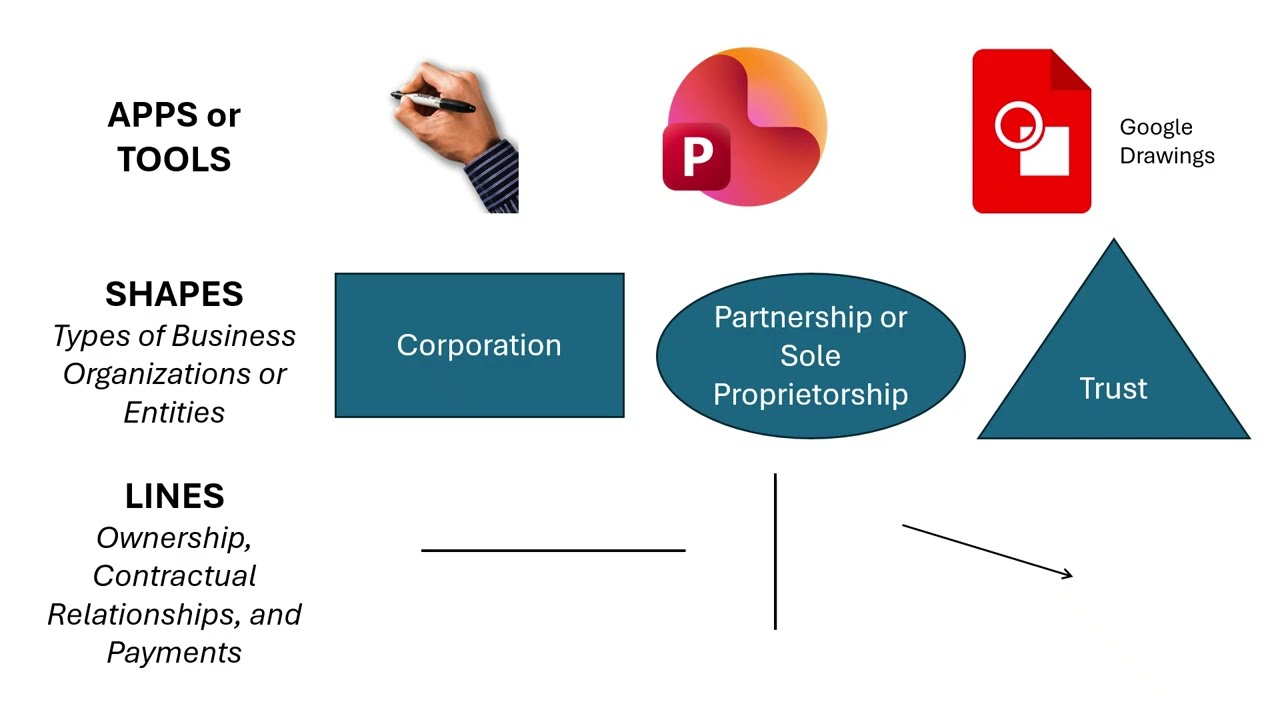
This tutorial introduces viewers to the essential tools and conventions required for creating clear business structure diagrams, emphasizing that while digital applications like Microsoft PowerPoint and Google Drawings are effective options, sketching by hand on paper or a whiteboard remains an intuitive starting point. The core of the lesson focuses on using specific geometric shapes to represent different types of legal entities: rectangles denote corporations, ovals signify unincorporated organizations such as partnerships or sole proprietorships, and triangles indicate trusts. These visual symbols are connected by lines that illustrate various relationships between them, including ownership interests, contractual agreements, or payment flows from one entity to another.
To construct a comprehensive diagram, the presenter explains how to map out owners above their respective shapes and assets below them, using ABC Corp as an example of a corporation with three shareholders holding specific percentages of common stock. The tutorial further details that corporate assets can include tangible items like premises and equipment found on a balance sheet, intangible assets such as intellectual property, or even ownership stakes in subsidiary corporations. A practical scenario is then presented where ABC Corp leases an office building owned by XYZ General Partnership; this relationship is visually represented by drawing a line between the two entities to signify the contract and adding an arrow pointing from the corporation to the partnership to indicate the direction of rental payments.
The video expands its scope to cover other specialized business structures, starting with Limited Partnerships (LPs), which feature at least one general partner alongside limited partners who have restricted liability but no management authority. It then addresses Limited Liability Partnerships (LLPs), noting that these are specifically designed for professional practices like law firms or accounting agencies where all partners enjoy limited liability protection regardless of their role in the firm's operations. Finally, the tutorial concludes by defining a trust structure, which consists of a trustee who manages the assets and one or more beneficiaries who hold an equitable interest in those same assets, completing the overview of how to visually represent diverse organizational forms within a single diagrammatic framework.
Read the full video transcript
Hello, this is Wayan Chow and this is a
quick tutorial on drawing business
structure diagrams.
Let's first look at the apps or tools
that we'll need to draw our business
diagrams. The most intuitive and easiest
one to use would be drawing it by hand
with a marker, pen, or pencil on paper
or on a whiteboard. In terms of computer
applications, uh, Microsoft PowerPoint
or Google Drawings are are apps that
I've used before and I would recommend.
They're both intuitive and easy to use,
especially for what we're doing here,
which is just drawing simple shapes and
lines. In terms of those shapes, we're
going to use shapes to indicate the
specific types of business organizations
or entities that you'll be that you want
to represent on your diagram. A
corporation is typically represented by
a rectangle. Unincorporated entities
like partnerships or sole
proprietorships are usually represented
by an ellipse or what we could also call
an oval. And a trust is usually
represented by a triangle.
On the diagram, we'll have lines in
between these different shapes. Those
lines could represent a number of
different things. They could be an
ownership interest, a contractual
relationship, or the making of payments
from one entity to another.
Let's now do a business structure
diagram involving two business
organizations, ABC Corp and XYZ General
Partnership. Typically on a business
structure diagram, we will we would also
indicate the owners and the assets. The
owners are usually indicated above the
shapes and the assets are indicated
below.
In this instance, ABC Corp has three
shareholders. Shareholder A, B, and C.
And we can also put in more detail about
the shareholding of each of these
shareholders. So we have shareholder A
owning 60% of the common shares of ABC
Corp. and shareholders B and C each own
20% of those common shares. In terms of
assets, ABC Corp has premises, cash,
ARs, equipment, and IP. So assets can
include anything that is showing on the
balance sheet as an asset for ABC Corp.
What we could also have an asset as ABC
Corp. is ownership of another entity. So
in this case, ABC Corp. owns a
subsidiary corporation. So that means
ABC Corp. owns some or all the shares of
the subsidiary corporation.
With regard to XY Z general partnership,
the owners are general partners. General
partners X, Y, and Zed. And XY Z general
partnership owns an asset, a specific
asset, which is an office building. And
let's say we want ABC Corp. to lease
that office building from XYZ General
Partnership. We can show that lease
relationship as a contract by putting a
line between ABC Corp. And XY Z general
partnership. We can also show the
payment of rent, the rental payments
from the corporation to the general
partnership by putting an arrow from the
corporation to the general partnership.
Let's now give examples of other types
of business organizations
for XY limited partnership. That's an
example of an LP or limited partnership.
So the owners of an LP are two different
types of partners. We have at least one
partner who is considered a general
partner and in this instance we have two
limited partners X and Y. And below that
XY limited partnership, we would show
the assets that are owned by the limited
partnership.
For XY Z limited liability partnership
or LLP,
we would have we would have partners. In
this case, we have three partners,
partners X, Y, and Zed. And
specifically, an LLP is used or is
available only to professionals.
Typically, for example, lawyers and
accountants would would would operate
their practice through an LLP.
The final one is a trust. A trust would
would have a trustee and one or more
beneficiaries and the trust would own
would own assets.