Video summary
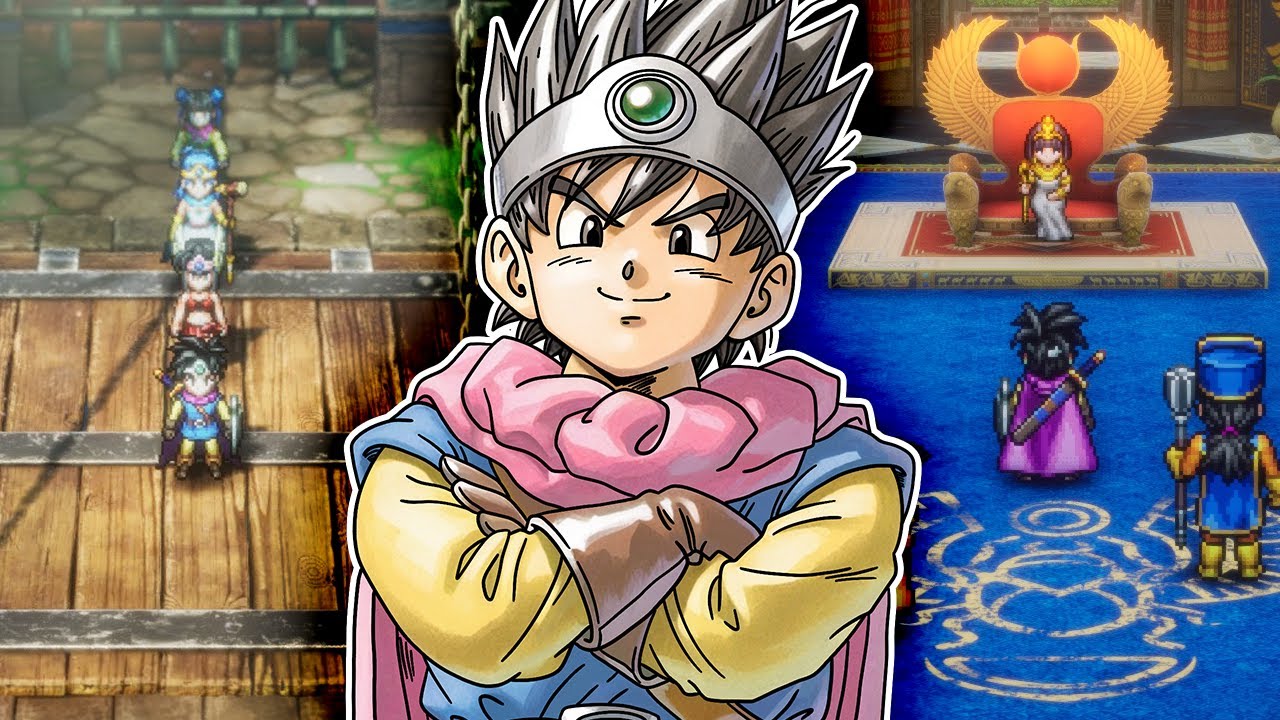
Dragon Quest III stands as an iconic title that defined Japanese fantasy and established the foundation for countless role-playing games to follow. Released in 1988, the game is celebrated for its unique style and a narrative centered on a personal journey where players assume the role of a teenager from the isolated nation of Aliahan. The story follows the protagonist's quest to defeat the arch-fiend Baramos and avenge their father, who disappeared years prior while exploring the wider world. Although the plot is simple, it serves as a backdrop for the player to carve out their own legend, emphasizing individual choice and discovery over complex storytelling.
The game's world is its true star, offering a globe-trotting adventure modeled after real-world geography with distinct cultures, dialects, and architectures in every region. Players can explore this open world in any order, encountering everything from lazy kings and racist elves to talking horses and friendly pirates, all while navigating mysteries hidden within forgotten ruins and abandoned watchtowers. This nonlinear design relies on the player's investigative instincts rather than explicit direction, creating a cohesive experience where subtle hints guide the way. The core gameplay involves leading a custom-built party of adventurers through turn-based combat against a vast array of foes, utilizing a deep class system that allows characters to evolve into hybrid roles at level 20 to tackle increasingly difficult challenges.
A unique aspect of Dragon Quest III is the ability to fully customize every member of the party, including their names, genders, and classes, which fosters infinite replayability and diverse playstyles. However, this freedom comes with a notable downside: the party members are completely mute and lack personal dialogue, requiring players to project their own personalities onto them through imagination. Despite this limitation and some criticisms regarding later remakes that introduced easier difficulty settings, intrusive map markers, and an inflated economy with excessive free loot, the original game's design remains unmatched. The latest HD-2D remake enhances the experience with new content and refined mechanics, but it still retains the spirit of a game that prioritizes freedom and exploration above all else.
Ultimately, Dragon Quest III remains a special entry in the series that has inspired players for decades with its sense of mystery and adventure. It successfully balances ambitious game design with a world that feels lived-in and historically rich, allowing players to craft their own path to victory without being overly constrained by the developers' hand-holding. While modern iterations have attempted to improve upon the original, they often struggle to replicate the specific charm and challenge of the 1988 classic. Until another game emerges with this same level of freedom and depth, Dragon Quest III will continue to serve as a benchmark for open-world RPGs, proving that its legacy has endured long after its initial release.
Read the full video transcript
Dragon Quest 3. This was it. The game
that made Dragon Quest popular. Since it
release in 1988, it has proven to be an
iconic and highly regarded entry in the
series. With the game's unique style and
world practically defining Japanese
fantasy and influencing countless other
RPGs to come. When I first played DQ3, I
was really impressed by how much of a
personal journey it was. [music] In this
game, you play as a spikyhaired,
capewearing teenager from the land of
Aliahan, [music] a great nation cut off
from a larger world. Years before the
events of the game, your father Ortega
leaves you as a child, not to buy a pack
of cigarettes, but to explore the world
in an effort to defeat the arch fiend
Baramos, only to disappear, never to be
heard from again. So, the whole game is
about following in his footsteps to
succeed where he failed. Your journey
begins by leaving town and venturing
into the greater world, traveling far
and wide to various villages and [music]
kingdoms, solving any problems that come
your way. And along your journey, you
meet various people Ortega helped,
learning more about the kind of man he
was. I really like Dragon Quest 3's
story. It isn't complicated. It's
actually very simple and easy to digest.
You're given one goal: defeat the arch
fiend and avenge your father. And to do
this, you're tasked with hatching a
giant chicken. Yeah, seriously. The
story may not seem like much, but the
game's narrative is more about carving
out your own legend and the unique path
you take to get to the end. So, in
essence, the player creates the story
themselves with the world you're thrown
into serving as a backdrop for the
events to come. And the world of DQ3 is
truly the star here. Dragon Quest 3 is a
globe trotting adventure with the game
world being modeled directly off our own
world, featuring a host of different
cultures being represented in the game's
various regions that all have their own
unique customs and dialects. Along your
journey, you meet lazy kings, racist
elves, talking horses, and friendly
pirates, to name a few. I especially
like the town full of white Indians.
>> Listen to my tale of awful, awful war.
>> This game really plays with this whole
idea. Every kingdom is represented by
playful stereotypes. Like when you go to
America, this is literally the first
thing you run into. Yeah, even Japan,
where the game was made, has people
walking around in kimonos and talking in
haik coups. No one was spared. Every
town and kingdom is uniquely modeled,
each with its own distinct architecture.
It really gives each region of this
world a sort of ancient livedin history,
telling a story that you can only
experience by looking closely at
background details. And you can visit
each of these locations in any order you
want. Dragon Quest 3 is one of the
earliest examples of a true nonlinear
openw world adventure game, allowing you
to travel the world in any direction you
want and tackle all the games objectives
in [music] any order. And what I really
love about Dragon Quest 3's world is how
cohesive and well-designed it is. I
always felt like I had a good idea of
where I was going. Characters you
encounter give you subtle hints of what
to do and where to go next, and you can
use the recall feature to remember any
important dialogue you hear. The game
relies on the player's investigative
instinct and sense of discovery to
figure things out. And when you do
manage to solve a problem on your own,
it feels incredibly rewarding. In order
to reach Baramos, who is definitely the
final boss, you need to collect the six
legendary orbs that are scattered across
the world, hidden in different places.
And finding the orbs will often require
figuring out a puzzle or just beating
down a boss at the end of a dungeon.
This world is host to all manner of
mystery and forgotten ruins, from
abandoned watchtowers to weathering
caves. And they each feature a myriad of
monsters to battle, which brings us to
the core gameplay of Dragon Quest 3. You
see, this is a fantasy game where you
can do things that you can't do in real
life. My greatest dream has always been
to fight a gorilla with my bare hands,
and you can do that here. Just like the
rest of the series, DQ3 is a very
standard turn-based RPG where you lead a
band of adventurers across a harsh
landscape, diving in dungeons and duking
it out against squads of expressive and
colorful foes. In this game, you face
off against bandits, trolls, mummies,
you name it. The game throws a huge
variety of encounters at you, and you
fight these foes with some help from
your trusty party members that you
create yourself. And this is the most
unique aspect of DQ3. You see, most
Dragon Quest games feature pre-made
characters with their own backstory and
personality. But here, you customize
everything about your team, their name,
gender, and best of all, their class.
Dragon Quest 3's ambitious class system
is remarkably deep and well-designed.
You can choose from a number of
different classes that each have their
own unique strengths and [music]
weaknesses. This includes warriors,
thieves, mages, and more. And they each
have their own unique stats, abilities,
and equipment. Further adding to the
complexity is the class changing system
where you can eventually change a
character's class at level 20, having
their stats, but keeping all their
abilities and spells, making for a
hybrid class. Mastering a system is
essential because the bosses and
monsters you encounter get more and more
challenging the further you get into the
game. So, it's all about finding that
right balance to craft the ultimate
team. And this makes for a game with
potentially infinite replay-ability and
so many different play [music] styles.
And I should also mention that this
system comes with one big downside being
that none of your party members have
personalities or talk to you. They're
all pretty much mute, which means you
have to project personas onto them with
your imagination, which requires too
much thinking for me. And I'm
disappointed that they never even tried
to rectify this in one of the many
remakes I've done over the years. Which
brings us to that topic. Dragon Quest 3
is an insanely ambitious RPG with an
emphasis on freedom and every facet of
its game design. From its exploration to
its character building mechanics, they
just got so much right the first time.
And even now, decades later, they are
still finding ways to enhance the
experience. [music] The game's legacy
has endured over the years with many
remakes being made, and the latest
version, Dragon Quest 3 HD2D remake, is
definitely the one you want to play.
This remake builds off of everything
that came before, refining nearly every
facet of the gameplay, from the menus to
the combat. And not only that, the game
also adds tons of new content to the
overall experience, including new
abilities, items, customization, and it
even adds story elements that enhance
the original game's narrative while also
connecting the game to other Dragon
Quest entries. This remake is a loving
tribute to longtime fans of the series,
fully realizing a lot of ideas that the
original version couldn't. And sure, it
isn't perfect. For one, I don't like how
much easier it is compared to the
original. I don't care if it's optional.
Why are there flashing yellow markers on
the map telling you exactly where to go?
Who made this? Ubisoft? Also, the amount
of free loot they littered across the
game world pretty much destroys entire
in-game economy. And then you have some
of the character designs that don't
exactly adapt the original game's vision
quite as well. You couldn't imagine my
disappointment at this pathetic [music]
excuse for a swimsuit. But despite those
few setbacks, this is still probably the
best version of the game. The good far
outweighs the bad. Regardless of which
version you play, Dragon Quest 3 is a
really special game. It brings players
to a world full of mystery and adventure
where you carve out your own legend, and
we haven't had another game quite like
this since. I hope one day we see
another Dragon Quest game with this
level of freedom. But until then, DQ3
will still inspire players for many
years to come. If you enjoyed this look
at Dragon Quest 3, you should definitely
check out this video right here. I think
you'll definitely enjoy it. I'll see you
there.