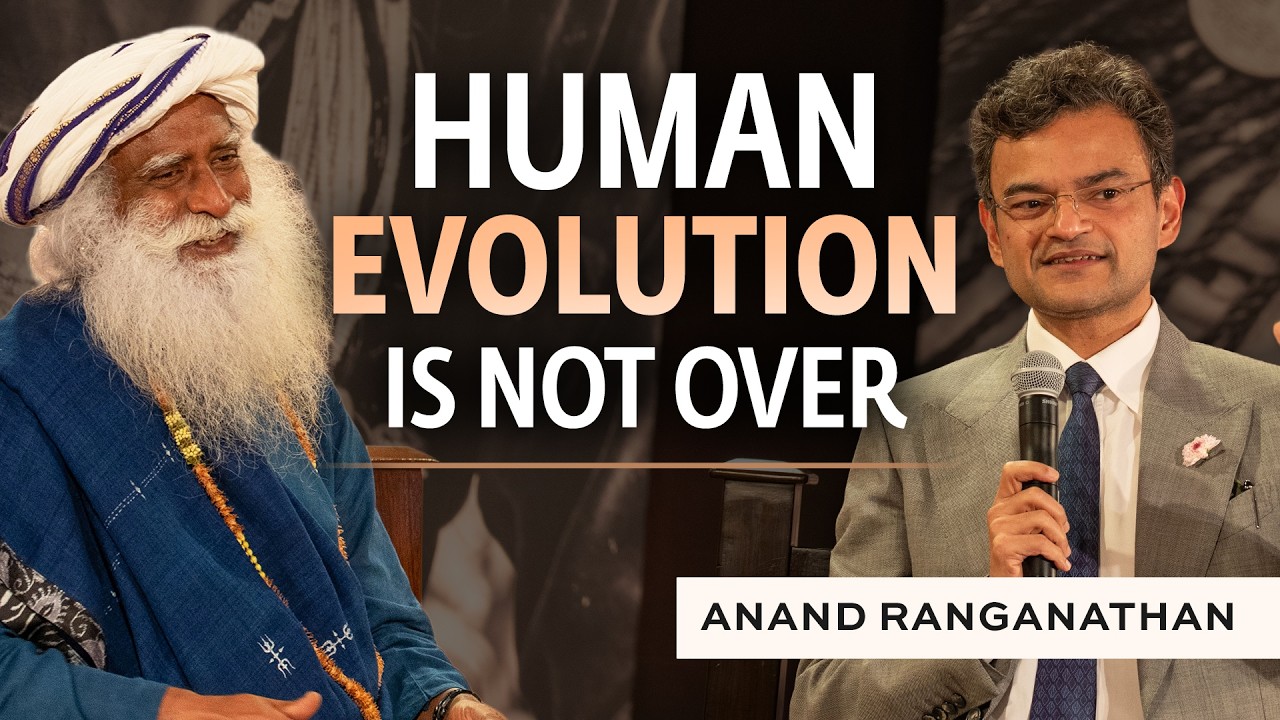
Dr. Anand Ranganathan’s Hard-Hitting Questions for Sadhguru on Science & Spirituality
Watch on YouTubeVideo summary
In this dialogue, Dr. Anand Ranganathan challenges Sadhguru on the nature of public expectation versus self-reflection, particularly regarding political figures like Prime Minister Modi, while exploring the distinction between intellect and intelligence. Sadhguru posits that human intelligence often lacks the perceptual stability required to handle complex truths, leading to suffering and even suicide, whereas true intelligence is perception-driven rather than merely data-driven. He attributes foundational mathematical concepts like zero to ancient sages rather than modern universities and critiques contemporary science for destroying life forms without understanding their interconnectedness. Furthermore, he redefines "disappearing faces" not as biological extinction but as the loss of traditional, uneducated ways of living caused by compulsory schooling and intellectual contamination, emphasizing that humans are unique beings meant to know how to be, unlike other species whose evolution is limited by planetary conditions.
The conversation extends to the challenges facing the next generation, where parents and politicians often prioritize societal conformity over nurturing independent thought due to fear or a reluctance to do the "dirty work" of raising critical thinkers. Sadhguru critiques the degeneration of politics into something filthy rather than viewing it as a process for creating common threads that benefit everyone, while also addressing the impact of artificial intelligence on professions. He compares AI's disruption to historical shifts like gantries replacing port workers, noting that while machines reduce physical labor and risks, they threaten jobs unless humans adapt flexibly; however, he warns against a purely Darwinian view where farming becomes unattractive to youth solely due to low economic returns compared to other fields.
Sadhguru further elaborates on the concept of "disappearing minds," advocating for experiencing life directly rather than storing it through labels or data, arguing that naming things hinders true experience and that wealth derived from others' misfortune is a sickness rather than joy. He asserts that true richness lies in profound experience rather than possessions, reminding everyone that they were once born into humble circumstances regardless of current social status. Ultimately, he urges society to invest time in perception and direct experience instead of mere expression, concluding that life's possibilities remain immense for anyone who lets go of comparative thinking, allowing them to realize their potential beyond the constraints of their social position.
Read the full video transcript
I would like to keep this
a political. So, my first question
concerns Prime Minister Modi.
>> That's as a political as it can get.
>> Why do we ask questions?
>> A question
uh is a tool to dig deeper and you are
in a privileged position
that you can't be wrong because the
question can't be wrong. You're like a
newspaper.
>> Whose resignation are you asking for?
>> Let me be blunt. You are an outlier.
There is only one Sadhguru.
So, you are an issue here.
>> I am.
>> In a in a mental institution, only the
doctor is sick.
>> In the last 3 years,
answers are on our fingertips, not just
knowledge through AI. What's the point
of an exam?
>> Then why are you asking so many
questions?
>> The point I was making was
isn't intellect also overrated?
>> Let's separate intelligence and
intellect.
>> Right.
>> Intellect is a data-driven process.
Intelligence is simply
perception-driven.
>> Yeah.
>> Uh
Correct. Intellectual is a kind of an
abuse in today's parlance.
>> edit this part? He's a professor.
>> that I see intelligence
as a tool
for survival.
>> For survival, you don't need all this
intellect. The worms and the insects and
the birds survive without any fuss. This
an evolutionary lapse
that intelligence and awareness
developed. Perception did not develop.
But, if you're willing, you can develop
your perception.
>> You have this
wonderful perception of our yogis, of
our ancestors.
>> They didn't invent any of the things
that you're living in. Not true.
Who gave you the zero?
>> Right.
>> You think math happened in a university?
No.
It happened among the sages.
I want you to just do your calculations
with a Roman
numerical. Please try.
>> Good evening, friends. It's uh not just
a pleasure, but an express honor to be
sharing the stage with Sadhguru Ji, and
um
uh I would like to thank the organizers,
uh the entire team, Kavitha Ji,
especially Sadhguru Ji, um
for not knowing that I'm always invited
only once to any gathering.
Um unless he writes another book. Um
um
No, but uh thank you so much. It's It's
an absolute honor
and an opportunity uh for me to um ask
questions that I do not know the answers
of, Sadhguru Ji, and I think that's
that's very important. Uh not just for
the amazing book uh that I have perused
through, that you have written. Um
It is not just an expression of
um as the title suggests, Disappearing
Faces.
It is also an expression of
um
disappearing India.
Disappearing world.
And I where I come from,
um there is always a dichotomy.
Should we or should we not worry about
things that disappear? So, I've I've
kind of packed uh a lot of what we have
for the next hour or so with questions
that I myself do not know the answers
of, and in expectations that I would be
um
uh
you know, uh not taught but
my hand held by you and taken to
a place where I would get to know the
answers. So thank you so much for this
great opportunity.
And of course I
would like to keep this
a political. So my first question
concerns prime
First question concerns Prime Minister
Modi.
No but seriously
>> a political as it can get.
>> I haven't even come to Rahul Gandhi yet.
I was wondering about this Sadhguru ji
when I was coming here.
That people listen to Prime Minister
Modi and all politicians in fact not
just him.
Because they want to know what is in his
mind. In fact sometimes quite literally
so his monkey bath. We want to know what
what does he stand for his policies what
is going on what is sticking inside.
And people want to or people listen to
you
to want to know what is in their minds.
And I thought this was very interesting.
And I think
that set me thinking. Are you ever
burdened by the expectations
of
people wanting to know
what is in their minds through you. In
other words, they have set you out as a
medium
to communicate
with whosoever it may be but they want
to learn more about themselves as
opposed to
hearing a politician and wanting to know
more about him. Does that ever burden
you?
>> Why would what is in somebody else's
mind burden me?
Why would it?
It's not scientific, Anand.
What is in my mind should burden me?
What is in their mind, why will it
burden me?
And I'm an empty space.
So, I don't know what is burden.
So,
people ask questions because you
repeatedly twice you said
you'll ask questions for which you don't
know answers. Isn't that the point of a
question?
Question is a tool to don't dig a little
deeper.
Question is not a tool to show how smart
I am.
Question is to know something. We know
something, we want to know something
more.
Question is a tool. Intellectually, if
you go question is the only tool you
have. What else do you have?
Whether it's science or philosophy or
whatever nonsense, question is the only
tool you have, isn't it? Whether you
articulate the question or not, is the
question mark which is the basis of all
science and spirituality, isn't it so?
So, people ask questions
because their perception is in bits and
pieces.
It's not homogeneous.
They know life in pieces.
Their parents said something, their
priest said something, their pundit said
something, their book said something,
and society said a thousand things.
Of course, social media said a million
things.
So, in all this, even if you have a
billion pieces, still it's not a whole.
It never becomes a whole.
So, they ask questions out of the sense
of incompleteness.
Because human beings are like
a collage of things.
How much ever pieces you add, it never
becomes a full picture.
Because nobody has found all the pieces.
If you go by pieces, let's let's say the
physical existence if you take it.
You are a scientist, but there are
physicists and others who delve into
other aspects very deeply.
Either you take men of science
or men of God as they claim,
neither men of science nor men of God
know
where this creation begins, where it
ends, where the cosmos begins, where it
ends. Nobody knows.
So, how will you have all the pieces?
There's simply no chance.
But,
it's like
this is a childish affair going on which
is considered
religious or philosophical or
ideological.
This is I give you a a million piece
jigsaw.
You put seven things together and you
say, "Wow, this is an elephant."
It's a million piece jigsaw. You got
only seven.
With that, you don't come to a
conclusion.
So, questions are endlessly coming up.
And it's an Indian trait to ask
questions.
Because
we have
you know
10,000 years of practice of asking
questions.
You know, any
there are no commandments. They're only
questions, debates endlessly.
Even if the so-called divine entities
come in front of you,
he never gets to give you a commandment,
only questions.
Endless number of questions. We were
cuz this is about this region. We were
trekking in Nepal in towards Hilsa from
Simikot, a spectacular terrain.
Someone, I don't know if it's in our
bus.
There's a there's a bunch of Nepali
guests here
to their land that we have
largely the Nepal, some parts of it is
Tibet.
So,
uh there's a small guest house somebody
built there. So, we were more than It's
a small group of people, about 50 of us.
So, we packed into that little building
because uh we needed some shelter.
In the evening, we're having one
satsang. One Indian person who lives in
the United States wants to ask a
question.
He starts asking a question.
The question
goes on and on for 8 minutes.
There are
nearly 25 26 nationalities there. Their
eyeballs are rolling by then
because they're trying to figure out
what is the question.
Then I said I stopped him and said,
"Please don't get bewildered. This is an
Indian question."
We practiced 10,000 years of practice.
We have asking all kinds of questions
that nobody ever thought of in any part
of the world. All kinds of questions.
So, he's just doing that and I
simplified the question to
simple thing which was 8 minutes.
Then when I talked about this
questioning business in India, then one
Chinese lady raised her hand and said,
"What?"
"Sadguru, I worked in United Nations for
27 years. Even there, only Indians asked
questions."
So,
a question
uh is a tool to dig deeper and you're in
a privileged position
that you can't be wrong because a
question can't be wrong. Only an answer
can be wrong, isn't it?
So, look at the advantage you have.
You're like a neat paper.
You can't be wrong, you know.
This
>> Whose resignation are you asking for?
But uh thank you for that. That was the
correct answer.
But uh
I want to go a little bit deeper before
we come to the book itself um cuz that I
think that uh sparked a flurry of
questions that I want to come to, but
here, what is this maddening urge
for
a living species called humans
to ask questions, to see and seek
rationale
in things?
It's not there in E. coli.
It's not there in many animals.
For example, you see an eclipse
and you go about your daily business.
But humans saw an eclipse and they
wondered, how did that happen?
And it's very interesting that it it
2,000 years ago a Greek figured out that
the distance
between the Earth and the Moon
and it's
um
kind of
coordination with the the diameter of
the the planet and the the moon itself
and the placement of it is what results
in eclipse. So, they've they
rationalized
a celestial event.
Why do humans need to do that? Do they
gain any evolutionary advantage compared
to E. coli or a dog or a bull or a
snake? Why do we ask questions?
>> So, human beings ask questions because
there is an intelligence for which they
don't have an appropriate perception
levels.
The intelligence that they have, for
which they don't have enough perception
to accommodate that intelligence.
According to the DNA scientists,
they say that
the difference between a human being
and a chimpanzee in terms of DNA terms
is only 1.23%.
1.23% is not a passing mark, isn't it?
I'm asking you as a professor, so it's
not a passing mark.
So, only 1.23%
is the difference between us and the
chimpanzee physiologically.
But in terms of intelligence and and
awareness, we are worlds apart.
So, we have an intelligence for which we
don't have a stable enough platform.
This is the basis of yogic science. How
to create a stable enough platform so
that your intelligence works seamlessly
and never against you. When I say never
against you, today it's become a fashion
to say I'm stressed, I'm burnt out, I'm
this and that.
Whether you're stressed or you're
anxious or you're depressed or whatever,
any kind of unpleasantness, essentially
it means your intelligence has turned
against you.
If you don't know how to use your two
fingers and you start plucking your
eyeballs,
that looks ridiculous, but that's
exactly what's happening. With your own
thought and emotion, you poke yourself
to death. Every day people are doing it.
People are even going to a point,
unfortunately, even to commit suicide.
All right? Taking our own life.
When I say taking our own life, it's not
that somebody dies, everybody dies one
day, every day somebody dies, that is
not the real issue. The issue is the
level of suffering which which leads you
to that place where you go beyond your
instinct of survival. What is most
precious to every life, whether it's an
ant or human being, is its life. To go
beyond that threshold, you must reach
such a level of suffering which is
unbearable.
But that suffering is essentially caused
by your own intelligence. If you had the
brain of an earthworm, you would never
commit suicide. Nor would you be
stressed.
And you would be eco-friendly.
Also, I'm saying. So, this is a problem.
We have an intelligence for which we
don't have stable enough base. What we
could perceive if we had the perception,
now is all turning into questions.
Another aspect of this questioning is
our evolution, human evolution, has
reached a place. Our cerebral cortex has
expanded to a point
where
See, suppose I put you in a 5 by 5 cage.
You will feel horrible being imprisoned.
Tomorrow, we will release you into a 10
by 10 cage. You will feel wonderful for
24 hours. Again, we'll imprison.
Next day, we'll release you into 100 by
100 cage. You will feel great for a
week, maybe.
It doesn't matter where I set the
boundary. Something within you does not
like boundaries because there is
something within you always longing to
be boundless. But you have no means to
get there. The only means that you have
is your intelligence. Because your
perception has not expanded to that
level, you ask questions thinking it'll
break a boundary.
Not always it does break a boundary, but
at least it scratches the boundary.
>> That immediately brings me to two
points, Sadhguru. One,
uh when you talk about
suffering being a cause for suicide, as
you mentioned.
Um
and the other is
about intelligence, our intelligence
leading us to it.
Uh
the fact also is that
everything that we see around us, the
world around us,
all the inventions, everything,
most of them are not
older than three or 400 years.
So, remarkably on the evolutionary time
scale, all the organisms
were roughly
leading their lives
like they were supposed to. Um that
itself is a contentious phrase that I've
used. Um
for about 90-95% of
13 million years of the existence of the
universe. So, when you say intelligence,
uh
I think the exponential jump of
intelligence that we believe separates
us from, let's say, a chimpanzee,
are the things that we believe are
intelligent are only
brought by a few amongst our fraternity
in the last 2-300 years.
Other than that, we've been very similar
on the time scale.
>> 2-300 years?
>> Let's say 1,000 years, 2-2,000 years.
>> No, much more.
>> Uh I'm talking about electricity. I'm
talking of, you know, all the inventions
that we use currently.
>> No, no. See,
they're not the only most intelligent
things. We learned to manage fire. It's
a tremendously intelligent thing to do.
We came up with a wheel.
Not a small thing.
We learned how to cook our food, not a
small thing.
But we also learned how to fight a war.
A big thing, but unfortunate thing.
>> Amongst ourselves.
>> Uh
but see, it's all among ourselves, the
same species.
There are some Nepalese, they may be
Denisovans. Uh Uh, you know, there's a
sister species. Some of them are a
little bit just check your ears. If your
ear is stuck to the face, that means you
have a little bit of maybe a few
percentage points of
Denisovans.
Uh.
So, otherwise, they're all Homo sapiens,
whether they're white, black, yellow,
brown, whatever they are.
All right?
So, it's always among ourselves. Who
else can we fight with?
But, we're not fighting only among
ourselves. We are also killing every
other creature endlessly.
That
their their populations have seriously
depleted. People, you know, recently I
was somewhere in a ecological thing.
Everybody's talking about fires in
California, fires in Europe, in Greece,
and whatever.
So, see, every news channel is talking
about, "Oh, 10 homes were burned."
It's a terrible thing for the people
whose homes were burned, I understand.
I'm not trying to depreciate that.
But, you're never thinking of trillions
of organisms, insects, birds, animals
burned because you have no sense of
life.
You have information. You have no life.
That's why these faces are important.
They have no information. They are just
all life. They may look remote to you,
but they're all life. They know their
life very well.
They may not know other technologies and
stuff, but they know life.
But,
the important thing to understand, if
you know life, you would know
without all those species, we cannot
live.
Without us, they would flourish.
This planet will flourish without you
and me, I'm saying.
But, without them, you cannot survive
here.
But, we are always thinking as if we are
the be-all.
And anyway, you are the expert, you must
tell me when the human species came and
what happened. They're saying some
150,000 years ago or a million years
ago, whatever it is. But, we are a
recent happening.
But, because of our intelligence, our
ability to use intelligence, and because
of that we have the ability to use
tools, we have become a dominant
species.
This dominance has come without
necessary perception.
If we perceive life as is, we would know
these things. We don't need bits and
pieces of scientific information.
We would know by experience how life
upon this planet is so homogeneous
that our very bodies are over 60%
microorganisms. We can't just imagine
that we are something dropped from
heaven kind of stuff.
And the religions of the world have
added to this rubbish and made it like
God-given stuff that you all came
somewhere. All the creatures came from
the earth, you came from heaven.
If you came from heaven, why don't you
go? That's what all the other creatures
are saying.
Really.
If you listen,
every tree, every insect, every bird is
saying, "If you guys came from heaven,
why don't you, please, get there?"
Because
we are senseless species we have become.
We have power, we have capabilities, we
have possibilities, but we are a
terrible possibility right now unless we
change our tact, which is far away.
All right. So, the important thing is
questions and questions are arising in
human mind because we've not figured
anything fully.
With all the scientific development that
we have, we still do not know a single
atom in its entirety. We know how to use
it. We know how to fuse it. We know how
to break it. We know how to make a bomb
out of it. But, we don't know what it is
yet.
So, we have intelligence without the
necessary perceptional match up.
So, questions are losing all the time
out of every pore of human body.
>> Hence the question, uh we have the
intelligence
why haven't it why haven't we figured
out the right way of using it?
Isn't there a contradiction there?
>> There is no contradiction. As I said
See,
>> Is is that Sorry to interrupt. Is that
true that every invention
>> taking Darwin's name.
All right, let me say this. Darwin, I'm
I'm dumbing it down to simplistic.
Darwin said something like this.
A goat could have become a giraffe
over a million years' time.
Evolution.
A pig could have become an elephant over
5 or 10 million years' time.
But, a monkey became a man rather too
quickly.
Yes.
Too quickly.
So, that is all this an avenue
evolutionary lapse
that intelligence and awareness
developed, perception did not develop.
But, if you're willing, you can develop
your perception.
The main USP of this civilization is
that
that this civilization is about
enhancing your perception.
Our sages and yogis and mystics sat with
eyes closed. You think because they were
idiots?
They didn't go to the university. They
didn't uh you know, build an industry.
They didn't make money. They sat with
eyes closed most of their lives because
they're striving to enhance the
perception because they know that's
where the lapse is.
>> So, Sadhguru ji, that is exactly the
point. You have this
wonderful perception of our yogis, of
our ancestors.
They didn't invent any of the things
that you're living in.
>> Not true.
>> What did they invent? I mean, I talk of
the modern gadgets, the modern
instruments.
>> gave you the zero?
>> Right.
>> Almost everything you have is because of
the math.
>> Yes.
>> Who gave you the math?
>> Uh I'm talking of a very
>> You think math happened in a university?
>> No.
>> It happened among the sages.
Only those who could see
in their in their experience, in their
perception, they saw that everything
comes from nothing.
And everything goes back to nothing.
Only they could conceive
something like shunya or a zero.
Without of that, your math has grown. I
want you to just do your calculations
with a Roman
numerical. Please try.
There's a beautiful story.
When
Gautama was to get married, the Buddha,
he got married, you know.
Yashodhara is a princess.
Those days,
one thing they wanted to check was,
"My daughter came to me and said she
wants to marry somebody."
I didn't ask, "What's his profession?
What family is he?
How much money does he make?" I asked
him, "Is he intelligent?"
She said, "Yes."
I said, "How intelligent?"
"At least twice of me." She said that.
I said, "Good. If you think he's more
intelligent than you, all right with me.
Whatever nonsense he is, if he's got the
brains, we'll do the rest."
If that is not there, then what to do?
So, Gautama was to get married.
Yashodhara's father asked,
"What can you do?
You're the son of a small kingdom, you
know, king.
Little kingdom.
What can you do?"
Gautama said,
"I can count up to the power of 53."
He said, "Really?" And he counted.
"What can you do with these numbers?" he
said.
He said, "I can count every grain of
sand on the banks of Ganga
across
1,000 miles."
Then he said, "What else can you do?"
He said, "I can count up to the power of
632."
"What can you do with that?" he said. He
said, "I can count every star in the
cosmos with that."
He gave his daughter to
So, I'm saying,
it is not they sit sat there and did
nothing. It's just that they were
conscious enough as to what should be
done and what should not be done. See,
today,
let's let's face this.
If this world gets destroyed,
it is mainly destroyed because of modern
science and the tools of modern science,
unfortunately.
Though it has given us immense benefits,
but it is going to be destroyed by the
same tools, isn't it?
If you're genuinely wise,
you must only do what is needed.
There are uh
There is a temple in in South in
Karnataka, Annapoorneshwari Temple.
Tejaswi is here.
Yeah, in Hornadu.
Here there are inscriptions.
So, somebody told me, "Sadhguru, there
are inscriptions you should read." I'm
talking about 40 45 years ago. I went
there to read the inscriptions. It's in
Hale Kannada, so I took somebody to read
that because it's ancient Kannada, it's
difficult to read.
Here it says
you can fly an airplane with solid
mercury fuel.
But if you fly this, the ether will get
disturbed. If ether gets disturbed,
human minds will become unstable. So, we
should not do it.
And then in another place it says you
can put a small hole into the earth and
fresh sweet water will come.
But if you do this, all the other
species will suffer and then suffering
will come to us. So, we should not do
it.
Bore wells and flight.
I'm saying you think they're fools?
They're wise.
So,
today we become childish science.
Anything we can do, we will do. Even if
it destroys our life tomorrow morning,
we will do it because we can do it.
>> And is it Sadhguru because we've
kind of forgotten
uh that the
ability to survive
does not require each and every
instrument or tool
that either we have
or we want.
What I mean is
that I see intelligence
as a tool
for survival
and millions of species are surviving
along with us
who do not have that tool
or do not have neurons that present that
tool. E. coli being one example, you
yourself mentioned correctly that our
uh
being is made up of 100 trillion
>> I didn't say being, body.
>> Our body, yes, that's right. That's
right, yes. Correct. So, uh
if it is just a tool to survive,
why is it more necessary than
an E. coli's survival who's able to
survive as good if not better than us?
>> See, first of all, the question is
starting from a wrong assumption that
it's a tool for survival.
For survival, you don't need all this
intellect.
>> Right.
>> Because
the worms and the insects and the birds
survive without any fuss.
If you really look at your survival
process, what is it that you're doing?
You're not doing anything different from
what other creatures are doing.
You are born just the same way as as a
grasshopper is born, nothing different
about your birth. You may think
something you have done.
Nothing. It's the same thing.
It's just that they're born simply, you
are born with a lot of fuss from all
kinds of idiots around you.
Yes.
So, then you grow up, big fuss.
I earn my own living, big big fuss.
All of them do the same thing without
effort.
Not without effort, without fuss.
Then we may reproduce.
They also reproduce without fuss.
We reproduce with too much fuss.
And we die with too much fuss.
They simply die.
So, I'm saying when it comes to
survival,
they're far more efficient than you.
So, what? In terms of intelligence, you
are not more intelligent than them. You
have an intellect. That means you have a
silly little data center here.
I'm saying silly little data center
because now major data centers have come
up. Compared to that, we are silly
little data centers.
>> We need less water.
>> Huh?
>> We need less water.
>> Not true.
For the volume of information you carry,
you you're consuming more water than
them.
They They carry trillion times more
information, so they need more water.
The volume of information we carry, we
are consuming more water actually.
Because they are stable in one place, we
move around and do things.
So, and also the tantrums cost a lot of
water.
So,
the important thing is our intellect
gathers a certain amount of data and
tries to process it and find expression
to it in so many different ways.
I'm not trying to belittle human
intellect. All I'm saying is
it is not necessary for your survival.
Survival can be done just by
observation. This is what these faces
represent. Look at that face. Is there
any intellect in that? No. It just knows
what's around. It knows how to survive.
You may think that's a crude existence.
It is not.
Because most people even in this society
are not doing anything intellectually
fantastic as far as I can see. I don't
know if I'm missing the point.
They're just surviving with great
difficulty.
To pass a day, they're struggling.
See, day is something which will pass by
itself.
Hello?
You You don't have to do anything about
the day. The day will pass by itself.
The life is also like that.
You will never see This is not a
university or a school.
You shall never fail. Everybody will
pass.
Hello?
See, you can't have a more blessed life.
Whatever you do or you don't do, you
will pass.
Great, isn't it? This is like a
government school.
Everybody will pass.
No need to fail.
There's no such thing No such thing as
failure. Only thing is
you must know how to handle your limbs
and your faculties, including your
intellect, which is also one of the
faculties. If you know how to handle
them,
you do the best in the atmospheres that
you are.
But, right now they've gotten into such
a mess.
Their own intellect
is entangled.
See, people are not suffering something
else. They're suffering suffering their
own intellect, isn't it?
And hence,
>> again, the question.
Um intelligence, I believe, is overrated
because we've come to the conclusion
that every species, living species, is
able to survive
>> Very well.
>> with or without intelligence.
>> No, no, it's not that they lack
intelligence. Let's separate
intelligence and intellect.
>> Right.
>> Intellect is a data-driven process.
Intelligence is simply
perception-driven.
>> Yeah. Um correct. You're right. Uh the
The point I was making was
isn't intellect also overrated?
>> Terribly.
>> Isn't it?
We don't need to be intellectual. I
mean, I
Intellectual is a kind of an abuse in
today's parlance.
>> edit this part. He's a professor.
>> Yeah, I don't want to lose my job.
>> That's why I'm saying.
>> In fact, I'm from JNU, so I can only
lose my job by presidential order, so
that's
>> I didn't know that.
>> After an illegal dharna.
Lots of dufflis.
>> I didn't know there was so much security
in JNU.
>> But, Sadhguru ji, the
Here I come at last to the the book and
the connecting question.
Uh let me take you back to 4 billion
years ago.
Uh the things that were reproduced in
1953 by Stanley Miller in his experiment
where he recreated the early earth.
And
by having three or four elements and
water and voltage discharge, he was able
to see that the primordial life forms
were
or elements building blocks were formed.
Nucleic acids, amino acids,
uh whether it be reducing atmosphere or
neutral or oxidizing atmosphere.
And then, let me progress further to
Jack Szostak and his protocell
that showed in hydrothermal vents when
these building blocks came together,
they formed a primitive cell
that was not able to reproduce through
genetic information inside it that got
trapped, but through a Donnan effect of
uh basically uh
simple give and take of molecules that
went inside freely.
And then, let me progress further
to William Stemmer and his sexual PCR
that showed that you could actually gain
advantage and survive a million times
more stress
if you were to accumulate the helpful
mutations in your DNA.
And then finally, let me progress to the
genome sequencing that showed that our
housekeeping genes of the most primitive
cell to the human cell
have exactly those three or 4,000
proteins that every living being cell
has.
When you look at that, and you look at
the progress of life forms, Sadhguru ji,
you are absolutely right. It is to do
with survival. Species have survived.
Some have the perception, intellect,
intelligence, some not.
Uh
and then I
saw your book
talking about disappearing faces.
When you look at desolate lands and
scattered existence.
The fact of the matter is that
there are millions of species, {quote}
and {unquote} faces, that are
disappearing and appearing.
Does it actually worry you that humans
are disappearing? Do you Do you uh
Are you anxious about losing a life
form, or is it just a progression from
the building blocks that created life on
Earth to whatever might end it?
>> You talking about environmental loss, or
>> Uh
>> This life, the loss of life.
Disappearance. Does that worry you?
>> See, when we say disappearing faces, it
doesn't mean these people are going to
die or you know, become extinct.
Actually, they're going to thrive better
because most of their children are going
to schools. Nepal has managed to build
even though simple schools. Even in the
remotest places, there are schools. I've
visited many of them.
Children are fully bursting, but their
faces are different. They don't look
like this anymore because they have
intellectual input.
So, this is a different kind of
disappearance, which is happening all
the time.
And uh today,
you know, certain uh
people who claim they are a certain
generation are almost claiming a species
rating.
You know
You know what I'm saying.
They think they're a different species.
I'm saying everyone who is alive on this
planet right now is one generation, as
per me.
As it is, we have enough
segments in humanity in terms of race,
religion, caste, creed, and nonsense,
nationality, and so many things.
Now, even
if you're born 10 years after me, you're
another generation. Another claims 3
years after you, another generation. All
the alphabets used up and now back to
alpha.
Where are we going?
So, desperation to be something which
you're not.
Unfortunate I'm saying this.
I could be get out. It's okay. I like to
sit in one place. If they get out of me,
I close my eyes and sit. It's no big
deal for me.
But, the important thing is
this is a era going away.
And it is so starkly visible there that
there is one picture I think you have
chosen that picture of a little girl, a
colored picture. She's a school going
girl.
She's just visiting her grandmother's
place for a festival. She's dressed in
the traditional clothes, but you can see
she's she's bursting with joy, but it's
different from these faces.
Distinctly, because she's going to
school and she's getting a certain
information. This is the difference when
you have only sensory input.
The land that you live on, the terrain
and your
your own self becomes kind of matching,
because that's what you're imbibing.
The shape of things that you see impacts
you.
And when you don't have any information,
this mountain is this is the name, this
is the height, this is the rubbish, all
kinds of information. You don't have any
of those things. All you know is what
you see. Slowly that becomes a part of
you.
There are significant spiritual examples
like this. People who have lived with
certain masters,
they have become like them, facially,
you know, just incredible.
They've become just like the other
person over a period of time, simply
because they're just looking looking,
completely imbibing that person, nothing
else. So, this is what these faces are.
These are bound to disappear because we
don't want to spare anybody from the
contamination of education.
We want to make sure everybody is
educated. I remained uncontaminated. Do
I look uneducated or not?
It's It's a qualification. It's not
easy. When I go and stand in the line in
the immigration lines when I used to
stand in US they ask, "Can you speak
English?"
Because I look that uneducated. And it's
not easy.
Not easy to stay uneducated because from
the first day you was born you're born
every idiot around you he wants to teach
you something that's not worked in their
life.
Yes.
Everybody wants to teach you something
and it's not worked for them. If you
look at their faces you can see it's not
worked for them. Maybe they've survived,
maybe they made money, maybe they
progressed in the society. But from
their childhood to now if you look at
them they're much less joyful. In my
understanding that means it's not worked
for them. They were five if they're that
happy by the time they're 30 they should
be ecstatic.
If that didn't happen it didn't work.
So what is not worked they want to
impart.
So this is the problem. Right now this
is not something we can avoid it'll
inevitably happen.
>> But here is what I have come to a
conclusion Sadhguru ji you are a
problem.
>> I am.
>> In this world.
You actually are.
>> Yes, I am.
>> And I'll tell you why.
I see humans as when I have a culture
and I plate it on an agar plate and I
put it in the oven
after 16 hours I see colonies forming.
That's what we are.
Humans have formed colonies. We've
either colonized other human
settlements, destroyed them
or we've colonized other life forms. We
are colonies.
Uh
and when you say that uh
all of us, including I mean our parents
and we as parents, we want to teach and
imbibe all those values that we believe
are important for
a human being to survive in this
environment.
And then you come along
and then you say, "Well, I will not only
survive, I will thrive in this
environment without having all those
qualities that you believe are necessary
in your environment."
>> Yes.
>> So, you are an issue here.
>> I am.
Yes.
>> You are the problem.
>> In a in a mental institution, only the
doctor is sick.
Finally, we are reaching somewhere.
Everybody else is As I said, I'm always
invited only once to a gathering. So,
no, no. Everybody else is fine, isn't
it? This happens.
>> So, there is a clash
>> Can I tell you an incident, please?
>> Please.
>> A bishop went to a mental institution in
United States because he wanted to
harvest some crazy souls.
So, he went there and he had a properly
prepared 1-hour long sermon. He had it
ready.
And he took permission and went. There
were around 200 people, just like this
hall.
And he stood up at the podium and
started reading and speaking.
He kept looking, not one person was
listening.
There was only one guy here in this
empty chair. I don't want to point at
anybody.
It's reserved for him.
There was only one guy who was intently
looking at the bishop and listening to
every word that he said. No one was
listening. Everybody was busy with their
own stuff.
After he finished 1 hour, he had it
because he doesn't know how to stop in
between, you know. So, prepared thing.
He finished and there was a doctor was
standing at the door just to keep things
in order.
And as soon as the sermon was over, this
guy stood up and he left.
When he went near the door, he spoke to
the doctor something and he left.
Then others were just busy with their
own thing. They don't know when the
sermon started, when it ended. They're
going on with their stuff.
So, the bishop came down and went to the
doctor and asked, "See, of all the
people, that was the only guy who was
listening to me intently.
And he came and said something to you.
What is it?"
So, the doctor said, "No, he asked uh
why am I in and why is he out?"
It happens like this.
>> But I
I want to scratch a little bit more
about this thing about why you are
Sadhguru ji an outlier.
Um and it's terribly vexing and I'll
tell you why because we've formed a
society, we formed a set of rules.
And we believe every society believes
that they have the ideal rules for their
survival and thriving.
And we are forcing people to conform to
that. And then you talked about earlier
about humans always fighting with not
just amongst themselves, with other life
forms, always fighting.
It is this clash of adaptability. We
believe that if somebody does not have
those values, he he or she will not be
able to adapt to our environment. Hence,
the need for degree, for schooling, a
type of schooling, learning a type of
language, doing a job, doing a vocation.
You do none of that.
No.
And you are an outlier.
So,
I don't want to ask you how you've
survived amongst us,
but
>> I thrive.
>> Now, here here is the million-dollar
question. If I Why is the question
connected to dollars? We're trying to
de-dollarize.
It's still the international currency.
But here here here is the question. If I
were to take a little bit of your blood
and clone you,
would a thousand Sadhguru's be able to
survive in this environment?
>> They won't come like that.
>> No?
>> Because
see,
you are a human being.
But because of your science, you're
going on saying from E. coli to you,
everything is same, this is same, that
is same.
We're misunderstanding what is a human
being.
We did not refer to big animal like an
elephant as elephant being.
We did not call a powerful
creature like tiger as a tiger being.
Nor did we say
a pretty grasshopper as a grasshopper
being.
Of course, cockroaches are different. I
don't want to touch that.
But all the other creatures, we did not
call them as beings. Only this is a
human being.
Because
you're supposed to know how to be.
How far the society has gone from that
definition of a being?
Anything but a being, isn't it?
So,
you're supposed to be a being.
That possibility is there.
Can I take you back 15,000 years ago?
Because you're going away before billion
years and all. Can I go 15,000?
Because see, this is the advantage of
being a man of science in modern world.
You can say whatever.
If you say yesterday night I flew, I
went to Mars and came back, they will
all say, "Wow."
If a Yogi says, "I saw the Mars. That's
not how it is. This is how it is." They
say, "What does he know? Does he have a
spacecraft? Did he go there?" All this.
Okay, so I'll go only 15,000. Because
this iconography proof for what I'm
speaking.
Over 15,000 years ago,
seven people gathered around Adi Yogi
for the first exposition of yoga.
After Adi Yogi expounded many things,
he said, these guys asked,
but you know,
150 years ago, your Darwin, Charles
Darwin,
because you keep taking his name.
150 years ago, it's 152 years now,
that he defined this, I mean, expo-
an exposition of this evolutionary
theory, which is a fantastic work.
This is one of the biggest things that
impressed me when I was just 16 years of
age.
So,
but 15,000 years ago,
Adi Yogi spoke about evolution.
You know about the avatars that Indian
you know, the Hindu civilization talks
about,
that the first life was a Matsya
Avatara. That means it was in water. The
second one is a amphibious life.
You know, Kurma Avatara.
Then they jump to mammals. They
jump all the small things and jump to
mammals. So, the first one was a boar.
And the next one was a half man, half
animal. Next one was a dwarfed man. Next
one was a full-grown man, but unstable
and volatile, Parashurama. Next came
Rama, stable, peaceful.
Next one came a very loving man. Next
one came a meditative man. Next one is
supposed to be a mystical man. So, this
is not about individual people as we
think. It is different stages of
evolution upon the planet.
So, he spoke about all this. So, they
asked,
"Why can't we evolve further now? Why
can't we grow something else? Why can't
we make this brain bigger? Why can't we
do something?"
So, he said,
"See, right now, the way the planetary
system is organized,
the distance between, you said some
Greek guy came up with the distance
between the Earth and the Moon. Well
before that, they spoke spoke about
distance between the Earth and the Moon
precisely as we measure it today. And
they also said that every year it is
moon is moving away about an inch and a
half from the planet.
So, they calculated and said
approximately
in 28,000 years, this calculation was
made maybe about 3,700 or 800 years ago.
In 28,000 years time,
the moon will go so far away from the
planet that it will start impacting the
reproductive process of a
human Homo sapien female.
That means she will become incapable of
bearing children.
So, it will not die with a bang, not
with fire, not with ice as people
describe. Slowly, our ability to
reproduce will start decreasing. And
then, of course, they have to come to
the test tube making whatever. But that
will also die out after some time, after
a few generations. And this is how human
race will go out." He spoke. So, they
said, "Why can't we evolve?"
They said, "You cannot evolve
from where you are if the planetary
positions remain the same. If some
drastic change happens
with our relationship with the sun and
the other planets, other seven planets
that he spoke about, if that happens,
it's possible that you could physically
evolve to another level. But, you can
consciously evolve limitlessly.
So, this conscious evolution is
available to us with the intelligence
invested in us, we are supposed to
initially ask questions, be confused
about it as children. But, by the time
you are eight, actually you have enough
intelligence to figure these things out
if nobody messes with you. If your
parents have the wisdom not to tell you
where God lives, if the parents have the
wisdom not to tell all the god damn lies
that their parents told them, if parents
have the sincerity to say this has
worked for me, this has not worked for
me in my life,
by the time you are eight, you have the
intelligence to start figuring out where
the solution is. If you don't make it,
wait, if you're a
at eight, if you're a slow starter, by
16, 100% you have the intelligence.
But, most people don't make it there
because by then they have so much input,
all kinds of rubbish input, they think
is sacred because any god damn thing
that's printed is supposed to be sacred.
For a long time it's been like that.
>> Sadhguru ji, you're right in the sense
that the input has been put in there.
Sorry for uh forgetting what the
appropriate phrase would be. But, I
think it's a lot to do with cowardice as
well. I think we, I speak for myself as
a parent, was kind of scared that if I
do not make my child conform to what the
society has told me is the proper chart
or course of education, then getting a
job, I will not be nurturing himself or
preparing himself for the world we live
in.
You know, uh not I Sorry to say this.
>> No, I'm saying the next
>> the next generation
>> There is this one Sadhguru. There aren't
very many.
>> next generation is supposed to create a
new world, not live in the same goddamn
old world.
>> But, where is that next generation
that's created?
>> Because parents won't allow it.
>> Exactly.
Our politicians won't allow it.
>> I don't blame it on them. Okay. We are a
democracy. It's one of us who stood up
there.
>> Right.
Yeah.
So, I
>> It's a democratic process. They didn't
drop upon us. We elected them. They were
just one of us. We put them up because
we are not willing to do the dirty work.
We want somebody else to do it for us.
>> Yeah.
Comes with conditions.
>> Conditions?
>> Well, I mean, the politicians would say,
"Well, you're asking me to do the dirty
work. I put these conditions."
>> It is a fact, isn't it?
See, today in the in this country at
least,
if somebody says he's doing politics,
not as a profession. Let's say, in your
family or in your office, somebody says
he's doing politics, this does not mean
he's making policy for your university.
It means he's doing something dirty.
Politics means there are policy makers
who make structures so that it works for
everybody. Because each one of us are
different kind of creatures, some kind
of common thread so that it works for
maximum number of people, if not all the
people.
That's what they're supposed to do. But,
see how we would, you know, degenerated
that word itself into something filthy.
Politics means something ugly they're
doing. They're not doing anything
pretty.
>> Yes, but Sadhguru, I'm I'm not just a
bit jealous of you.
I'm jeal- I'm kind of Now, I'm thrusting
this question on you because you you
live a very exalted existence. You want
nothing.
You have nothing. You are at peace.
>> Because I know I will go with nothing.
>> Right.
>> You don't know.
>> Uh
fact of the matter is that, you know,
where you stay, traffic jams are caused
by gazelles and squirrels and snakes.
And I just 5 km ride, it took me 1 and
1/2 hours because traffic jams are
caused by
car in front of me that says Gujjar.
Or you know, that
that says last warning.
>> He's getting into trouble.
>> No.
I'm just saying we are living in a
society that has
>> the Gujjars.
>> No, I mean, no no offense. Absolutely no
offense.
Uh
I see myself as an Ethiopian, so
>> What? No, was it a tractor or was it a
>> I don't know.
>> car?
>> It was rocks, r o w x.
Uh but the fact of the matter is uh
you are living an exalted existence.
Uh
No, none of us
uh afford is the wrong word. You've
chosen where you stay.
Let me be blunt. You are an outlier.
There is only one Sadhguru.
>> You can say whatever you want, but I'm
telling you
I've These days it's a little better
because I'm flying much more these days.
Otherwise,
I've spent more than half my life on the
roads of India and rest of the world.
I've driven across the world
both for work and otherwise.
Even today, I I ride because getting a
four-wheel drive you know, four-wheel
car through traffic is difficult. I
ride.
>> But you always go back to your
>> What?
>> your environment, don't you?
>> See, that's what
>> found anything better than where you
stay?
>> No, I've I always make sure I'm in the
best possible place. Why not?
Because I'm setting up the center not
for myself. If you come to Tennessee in
United States, we have the most
spectacular land that you can see,
23,000 acres.
Here, if you come Velliangiri Hills,
every time I drive in, I wonder why the
hell do I ever travel, because this is
the most beautiful place that you can go
to. So is it in Bangalore, so is it
everywhere, but
you must understand to set up something.
See, if I build a center in the city,
tomorrow morning, it'll be full.
But, to set up a center like this,
35 years. Our lives are gone there.
All the volunteers who came to me at the
age of 18, 20, today they're all in 50s.
Their entire life has gone into making
that place beautiful and livable and
attractive for people to come and
experience that place.
So, I'm saying, if you want something,
there is a price to pay.
You don't want to price of
pay the price, live in an apartment in a
city, it's up to you. I think it's like
a bird's cage.
But,
it's a choice.
>> You know, think about 5 by 5 cubical, 10
by 10, it's so appropriate for city city
dwellers, you know, it's really got me
thinking. So, um
I think we have time for one more
uh inquisition, if I may,
for my own benefit, especially when you
talked about the younger generation,
without labeling them with some of the
alphabets.
But, you know, we are truly, Sadhguru
ji, at an inflection point. And I the
way I've structured this question is
like this.
Um
in the last 3,000 years,
knowledge for us was a privilege.
Uh only those who could have access to a
library or a scripture or
uh were wealthy enough to visit a place
could gain that knowledge, till about
1990.
In the last 30 years,
knowledge was on our fingertips. Most,
you can say, 15, 20% of the knowledge,
immense knowledge.
But, in the last 3 years
answers are on our fingertips, not just
knowledge, through AI.
>> Then why are you asking so many
questions?
>> I was just coming to that.
>> Brilliant.
>> This is where intellect has trumped over
anything else. Absolutely right. But um
Uh
the the the question was should we be
more worried about disappearing minds
than disappearing faces?
What are we to do when the combined
human achievements intellect over the
last 3 4,000 years has given us this AI,
this pool from which we can easily draw?
For example, what's the What's the point
of an exam? I am not I have an extra
organ.
>> I never went there. I missed many
examinations because I never saw the
point.
>> Yes.
You were always ahead of us, but what I
meant was we now have an extra organ
which is a phone with an AI, Grok or
something. Why should we be ashamed of
it?
>> you're even copying questions.
Your students copy answers.
>> Yes.
Yes.
So, disappearing minds is a problem for
you. What are we to do?
>> No. See uh
No, I have stopped going there, but this
started about 7 8 years ago. They
started inviting me to all kinds of AI
conferences.
I was wondering why they inviting me in
St. Petersburg, or in Los Angeles, here
there, all kinds of places they're
inviting me for AI conference.
Then I asked these guys, "Why me?
I'm natural.
I'm not artificial. Why are you inviting
me for an artificial intelligence
thing?"
So, they said
you know, this is a very well-known
professor. I don't want to name him.
He said, "We are all worried
that what will happen to our
professions, not just me personally, but
our very profession.
The teaching profession will go away.
But we see that you are not bothered
about it.
I said I am always waiting when will I
become unemployed.
That's the best thing that can happen to
you.
So this is like this. This I've said
this many times, but let me repeat this.
This happened
I don't know if you're too young to know
about Dattatray Samant.
>> Yeah, yes.
>> You heard of him?
>> Yeah, of course.
>> So in 1971-72,
Dattatray Samant caused a massive
disruption in Mumbai.
Because the port employees, the coolies,
went on strike. Why they went on strike
is
because they installed the first gantry.
At that time, the largest
seafaring vessels were 125
to 130,000
tons. Today, most of the vessels are
over quarter million.
But those vessels, they were taking 26
to 28 days to unload.
Human beings going with, you know,
carrying sacks and emptying things.
Well, the famous they made, you know,
the Mumbai cinema made movies about
that, about and this and that.
Then the gantry came. The gantry
unloaded a ship in 24 hours.
So the coolies went on strike. Dattatray
Samant took the organization of that.
The simple logic was we grew our muscles
and we're making a living out of
carrying these bags,
unloading a ship in 26-28 days. You
bring this machine and it unloads in 24
hours. What are we supposed to do?
>> Yes.
>> Where are those guys now, I'm asking.
Probably they're IT engineers now.
Because they're again talking the same
language. What should we do now? AI is
coming. God damn it, it's the same
thing.
The machine came. Aren't you happy that
you don't have to dig the streets? The
machine will dig it quickly.
Aren't you Have you seen what it is, you
know, I always wondered somehow it was
true at that time that wherever in India
tarmac roads were happening, you know,
highways were happening.
Putting
these bitumen roads is not easy. It's
hot. And it falls on your body. They're
not properly geared up. There's no full
on gloves and thing and all. It falls on
your body. It burns your skin. I have
seen many people coming with those
injuries, all this stuff. But wherever
you went, these tarmac road making
people were either Tamils or Biharis.
The only two tough breeds
who could do this. Nobody else wants to
do that job.
Today machines have come. Nobody's
burning themselves up. You sit on a
thing and it dumps, it does everything,
it mixes all the thing. Otherwise they
were actually physically mixing this
bitumen. It's such a dangerous job.
Everybody's hands are burned, their legs
are burned, you know. And in that toxic
this thing, people die early,
everything.
Even the Himalayan roads, the B BRO, is
it?
Or the BRO?
Yeah. Even the BRO roads, when I
whenever I see tarmac being laid, if I'm
driving or riding, I stop and talk to
them.
Because I see without them you won't be
riding.
Hello?
You will not be driving. I always made
sure I stopped and had a chat with them.
Always it's Tamil people or Biharis.
So today machines have come. Aren't we
glad that human beings don't have to go
through this? They've all graduated to
become IT
software. But now that's going to go
away. Again, you're crying the same
story.
I didn't learn to do something else.
>> So, sorry to bring Darwin one last time.
It It proves the adaptability to a
changing environment very beautifully.
So, people tens of thousands of workers
who were in the board as you said,
they've
you know, they realized they need to be
flexible in what they do to earn a
living. They have shifted that. Is
India? I don't know.
>> No, I don't think you can change your
profession can be described in Darwinian
terms.
That is a different level of a goat
becomes a giraffe. That is
>> I I was drawing a a parallel with
you know, if I'm a farmer and tomorrow I
I can't do farming, then I would shift
to you know, some other profession.
>> most of them have in their previous
generations, most of them were farmers
probably. Isn't it? Their parents at
least their grandparents were farmers
somewhere. Today they are all doing
something else.
But still they all eat.
They shouldn't forget this. So, I must
remind them. We have done certain
surveys as a part of our Kaveri calling
and save soil moments.
We find at least in southern southern
India in Karnataka and Tamil Nadu
not even 2% of the farmers want their
children to become farmers.
All right?
So, I want you to think in another 25
years when this generation passes
who is going to feed you?
Unless we make farming
economically very strong, unless a
farmer can earn as much as a professor
or a doctor or an engineer or a lawyer,
unless he earns that much
>> and politician.
Not that much.
>> You have something against this
profession.
Yeah, I I always think it's very
courageous for a young person to take to
politics.
Leave the people who have just inherited
it. But others who start from scratch
and go into it, it takes a certain level
of courage.
And I would say
a certain sense of sacrifice.
Because you don't know whether he
doesn't know whether he will make it or
not. Okay?
He doesn't know whether he'll get
elected or not. He doesn't know whether
he'll become a minister or not. He
doesn't know whether he'll become chief
minister, prime minister, whatever that
he's aspiring that he may be dreaming
of.
He doesn't know nothing.
And today, your profession, you need
presidential intervention
to get you out. But
if the guys lose the election tomorrow
morning, today they are the minister,
tomorrow morning is nothing.
How many people are willing to take that
risk?
Well, some of them might have brought
terrible reputation for that profession,
unfortunately.
But that is not the case.
And above all, it's
horribly irresponsible of all of us
that we hand over the country to people
who we think are rogues and sit back and
make give commentary.
This is not right.
If we think they are rogues, we must
take up the job, isn't it? Hello?
If you think you have the integrity, you
must take up the job or no?
So, many of them are not corrupt as far
as I know because I have mixed with
various types of politicians. Many of
them are simply innocent of integrity.
Really?
You You were serious, so you did not You
meant to.
Because they don't know what it is.
Really, I'm telling you. I'm not joking.
Genuinely, they do not know what it is
because they've grown up like that. See,
to get elected he He go to his mama and
ask for money. He had to go to his
chacha and ask for some support. He has
to go to his relative far off relative
and ask something. He has to local dada
to ask him something.
Then he got elected. Suddenly he can
kick all of them in the face and say I'm
full integrity?
No, he has to fulfill all those
promises.
So we have created a system by the time
he comes reasonably to power,
he has so much encumbrance. The very
system, the society, not even the
government system, the very social
structure creates such a level of
encumbrance.
See, somebody gets elected, he's your
friend.
First thing is you think, "Ah, can you
give me one site?"
"My site I need, you know, I site.
My daughter needs medical seat. Can you
do it?"
Uh
because corruption is not the thing,
it's a culture. Corruption is not a
crime in this country. It's a culture.
It takes a lot of integrity to go
against that and stay free from that. It
takes enormous sacrifice. You I don't
want to talk about my own story. You
don't know what all we are put through
just to stay straight.
You understand? It takes We are not
asking for any favors just to exist
without yielding to certain things.
It takes a lot. Every day, every day.
You understand?
>> So Sadhguru, final question.
>> One more?
>> Do you see yourself as Bhishma Pitama?
>> That guy was a bloody fool. I'm not that
kind.
That guy sits here when a woman is
disrobed in public, that guy sits here
and thinks he's doing a great thing. I'm
not that kind of guy.
>> No, I I didn't mean that particular
aspect of it.
>> that defines the man.
Morally crippled.
I'm saying, let me put it in the right
sense.
Crippled by your own morality.
Too much morals. No life sense.
You don't need any moral to understand
that a helpless woman is being
done something
for whatever reasons, for whatever
vengeance they carry against somebody.
Uh
This doesn't take any morality. You
don't need to read Vedas or know uh 10
Commandments to know this is wrong.
Hello?
Why are you making him that kind of
character?
>> Agreed.
What I meant was you're on a bed
watching the world go by.
>> What? You want me to be on the bed of
arrows?
This guy has no good intention for me.
Tell me, ask me one nice question last.
>> I
I had a list of all the nice questions
and I haven't asked a single one of
them.
This is perhaps the only book launch in
the world where we haven't discussed
We've discussed 1 and 1/2 hours and not
discussed the book at all.
But it's been an absolute pleasure and a
joy, Sadhguru. I've learned so much.
And I hope the audience forgive me for
trespassing on your intelligence and
intellect with silly questions, but I I
really wanted to understand more from
Sadhguru, hence I asked those questions.
So I I would like to thank all of you
and Sadhguru ji for giving me this
opportunity.
Thank you so much.
>> Thank you, Saptrishi, for sharing not
just those stories, but a lot more about
life and
intellect.
>> we were supposed to talk about these
people.
>> Yes.
So I would like to request Sadhguru if
you'd like to share a few words about
the disappearing faces.
Just a few words. We've got the images,
but we'd like to hear from you.
>> As I said, I'll never be invited again,
so please don't.
>> Not for this book. We will invite you
again because
you seem to be having questions and
slowly
you're delivering them very slowly. We
will give you an opportunity to ask any
kind of question
about the people.
Uh
as I said, they're unique faces on the
planet. Just look at them.
The way they are.
And uh
you know, everybody when they go to
Himalayas, Himalayas have been
photographed and photographed endlessly.
From the age of 19, for 27 years I
trekked in the Indian part of Himalayas
every year.
Mostly alone, but last 6-7 years I took
people with me.
Uh last time I went was 2004 or five, I
don't remember exactly. When I went
there,
I saw the peaks that I had known. I I'm
somebody, you know, I know all the trees
and birds and animals among which I
live.
But I've never tried to name them
zoological names, botanical names. I
just remember them the way they are.
I have a
video in my head that I see. Even now I
can see anything, but I don't know the
names. People ask me, "Sadhguru, what
species is this? What" I don't care what
it is. These are all names we're
imposing on other creatures.
Which is unnecessary. Maybe for the sake
of study and understanding somebody
needs it.
But
for experiencing life you don't need
those names. In fact, you cannot
experience it the moment you give names
to everything.
So, the same with human beings.
I just remember the faces most of the
time. I don't even care what their names
are. If I look at you, I know I've seen
this face. But, I don't care what your
name is. What does it matter? I'll tap
you and ask, "Hey, what's your name?"
Because
uh
you know, I'm
I'm shameless.
It's a huge
It's a huge achievement, you know.
People ask me, "Sadhguru, where did you
learn to sing?" I said, "I never
learned." Because I'm shameless, I can
sing anywhere.
Because I don't care what you think
about it. If I feel like it, I will
sing.
You don't like it, you can say it. I
have no problem.
So, when I looked at these faces,
these are the faces which are closest to
me.
Because they have no sense of all those
things. They're just there.
I'm not trying to idealize them. They
have their own little problems in their
own societies. Tiny little problems
which are major problems for them.
You know, whether you think Delhi has a
lot of politics, a little village has
more politics than New Delhi, you know.
There's so much there going on in their
own tiny little lives.
But, there is something about them
which is so much like the terrain. This
is
I have loved the terrain of this this
part of the world.
Everywhere, I would say.
And when I crisscrossed India on my
motorcycle, I didn't go to any
particular place. I simply rode. I still
remember the
faces that I saw, I interacted with, and
the land that I saw. I remember small
outcrops of rocks, a certain tree which
was standing in a crooked way. If I ride
into the Himalayas today, I just ride
like blind.
People say, "How do you go like this?"
Because I know every bend, every curve,
every mountain. I don't remember them as
this and that. I just know like a video,
it runs in my mind.
Because I never named them. This is an
important thing you need to understand.
Instead of focusing on experiencing
life, you're trying to store life.
Now, of course,
See, she's taking me.
It's all right. All right. Shoot. Shoot.
Shoot. It's okay.
Because you want to store life.
Store it and take Store it and take it
where? I'm asking.
Even the things that you have stored,
you can't take it anywhere.
Where will you store it and take it?
You can only experience it.
Because
how rich your life is
is not in terms of what you have.
It is in terms of how profoundly you
experienced it. That's all there is in
human life.
There is nothing else you carry with
you. Every moment of your life, the only
thing you carry is how profound is your
life in experience.
How many things I know, how many things
I possess, how much I possess in my
pocket,
that is not nothing. You know, it is it
is only valuable
when there are people who have less than
you,
unfortunately.
So, there is no joy in that. That is a
sickness that you enjoy other people's
failures. They have done worse than you
in life.
See, you have a billion dollar. I must
tell you this.
I was just about to launch Save Soil
movement.
It was not to be done in United States,
but I was trying to rev up the social
media and media before I come to London
and ride to India.
So, in one of these events morning, I'm
sitting and
one young man running around like his
tail is on fire.
I look at him and say, "Hey, what are
you up?"
He says, "Sadhguru, I want to make 1
billion dollars. I want to make 1
billion dollars."
I said, "Only 1 billion? You come
tomorrow, I'll give you."
"Really, Sadhguru?" I said, "Yeah, you
come tomorrow, I'll give you 1 billion."
There were eight of his friends sitting
in this line. They were sitting quietly.
I said, "See these eight guys who come
with you,
I'm going to give all of them 10 billion
each."
"Why Sadhguru, they get 10 billion, I
get 1 million?" Hey, idiot, just now you
said your life's ambition is only 1
billion.
Now, the moment they get 10 billion,
you're already miserable. You neither
you got it nor they got it.
So, I'm saying this kind of meaningless
life is going on because what you
possess is meaningful only if others
don't have it.
If everybody has 1 billion,
you will feel poor.
You'll feel pedestrian.
So, this whole thing about enjoying
other people's misfortune should stop.
Must stop because this is not joy. This
is sickness.
If you leave this, then this life has so
much to offer. If you just leave this,
how can I be better than somebody? If
you just leave that one thing
in your life,
this life is an immense possibility.
Wherever the hell you are, whatever your
position is in the society, still it's
an immense possibility for everybody.
See, we are thinking, "But if I'm born
in a slum." Hey, if you came here 500
years ago, everybody was living in a
slum.
You think they were never happy?
Hello?
You think your great great grandfather
was never happy because he lived in a
hut?
He was fine, isn't it? He lived a full
life.
So, life is not full because you have a
car or a home or a
diamonds hanging around your neck. No.
Life is rich only because your
experience of life is rich.
For that, you need to focus more on
perception, but today's generation is
totally dedicated to expression, though
they don't have much to say.
It's very important we invest a certain
amount of time and energy for perception
and experience. Then if it's something
worthwhile, let's express. Nothing
worthwhile, let's sit.
Thank you very much.
>> Thank you Sadhguru. Thank you Dr.
Ranganathan.