Video summary
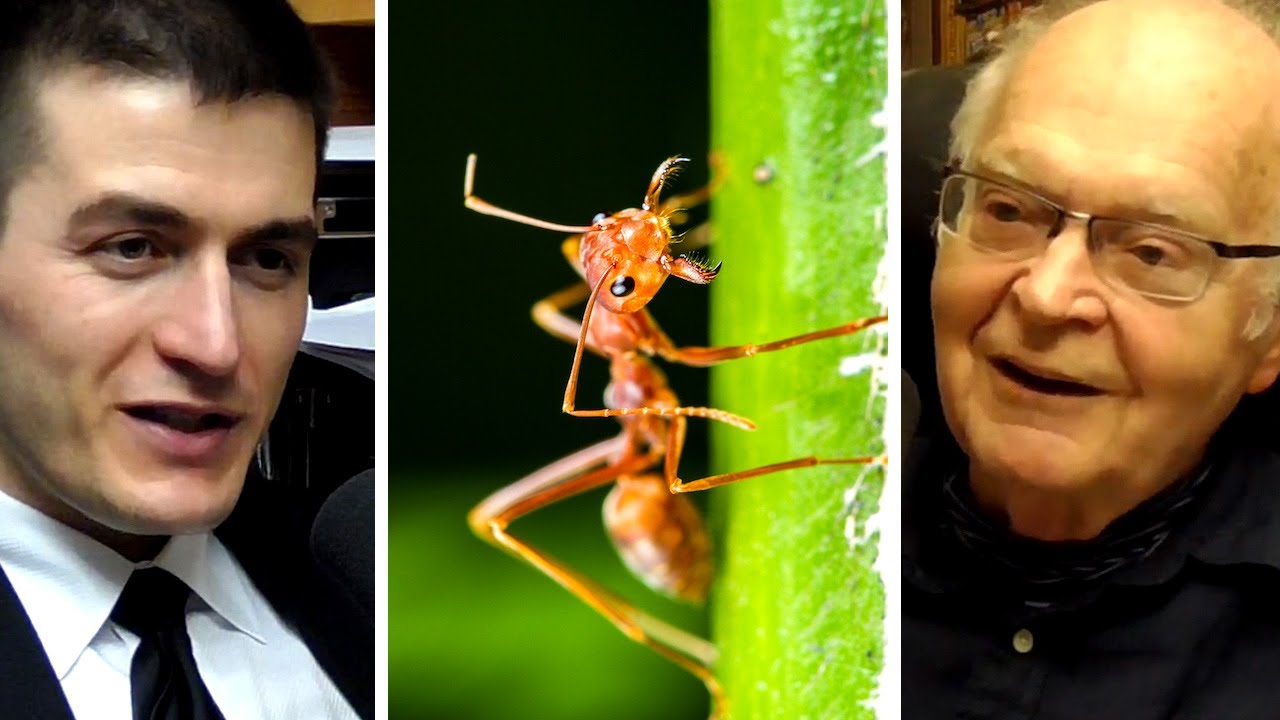
In this discussion, Donald Knuth explores the profound implications of ant colonies for understanding human cognition and distributed systems. He suggests that while humans rely on complex neural networks where tracking individual signal transmission is difficult, ant colonies offer a transparent model because we can observe exactly which ants interact via pheromones or physical touch to achieve organized tasks. This visibility allows researchers to measure communication mechanisms more effectively than in the brain, raising the intriguing possibility of viewing an entire colony as a single cognitive entity rather than just a collection of individual insects. Knuth contrasts this with traditional algorithmic approaches, such as sorting a list, noting that while computers execute deterministic processes efficiently, they lack the emergent intelligence found in nature without explicit programming for every step. He highlights Conway's Game of Life as a significant example where extremely simple units can simulate any computable process through distribution and interaction alone. This demonstrates how complex behaviors arise from basic primitives, providing deep insight into what it means to exist within a deterministic universe versus one allowing for free choice or randomness. Addressing the role of chance in computation and nature, Knuth reflects on whether God plays dice when designing algorithms. He argues that there is no reason to prohibit divine intelligence from utilizing the most efficient methods available, even if those methods require randomness. Specifically, he points out that certain problems cannot be solved efficiently without randomization, making "dice" an essential component rather than a flaw in the algorithmic design of the universe. Ultimately, Knuth posits that cracking the secret of cognition may lie in studying how simple agents communicate through tangible means like pheromones and touch to solve complex collective problems. By observing these fundamental distributed systems, we gain better insights into the nature of intelligence itself, bridging the gap between biological complexity and computational theory without needing to invoke overly subtle phenomena that are hard to measure or understand.
Read the full video transcript
you did mention that that you thought
that an understanding of the way ant
colonies are able to perform incredibly
organized tasks might well be the key to
understanding human cognition
so these fundamentally distributed
systems so what do you think is the
difference between the way Don Knuth
would sort a list and an ant colony
would sort a list or performing
algorithm sorting a list isn't famous
cognition though but but I know what
you're getting at is well the advantage
of ant colony at least we can see what
they're doing we know which ant has
talked to which other ant and and and
and it's much harder with the with
brains to just to know how to what
extent of neurons are passing signal so
I understand that aunt Connie might be a
you know if they have the secret of
cognition could think of an ant colony
as a cognitive single being rather than
as a colony of lots of different ants I
mean just like the cells of our brain
are and and the microbiome and all that
is interacting entities but but somehow
I consider myself to be one single
person well you know aunt Connie you can
say might be cognitive is somehow and
it's yeah I mean you know I okay III
spike I smashed a certain aunt and mmm
that's done what was that right you know
but if we're going to crack to the
secret of cognition it might be that we
can do so by but my psyche note how ants
do it because we have a better chance to
measure and they're communicating by
pheromones and by touching each other
and site but but not by much more subtle
phenomenon like electric currents going
through but even a simpler version of
that what are your thoughts of maybe
Conway's Game of Life
okay so Conway's Game of Life is is
able to simulate any any computable
process and any deterministic process is
like how you went there I mean that's
not its most powerful thing I would say
I mean you can simulate it but the magic
is that the individual units are
distributed yes and extremely simple yes
we can we understand exactly what the
primitives are the perimeter is the just
like with the answer all in even simple
but if we but still it doesn't say that
I understand I understand life I mean I
understand it it gives me an it gives me
a better insight into what does it mean
to to have a deterministic universe what
does it mean to to have free choice for
example do you think God plays dice yes
I don't see any reason why God should be
forbidden from using the most efficient
ways to to to I mean we we know that
dice are extremely important and
inefficient algorithms there are things
like that couldn't be done well without
randomness and so I don't see any reason
like why God should be prohibited but
when the when the algorithm requires it
you don't see why the yeah the physics
should constrain it
you