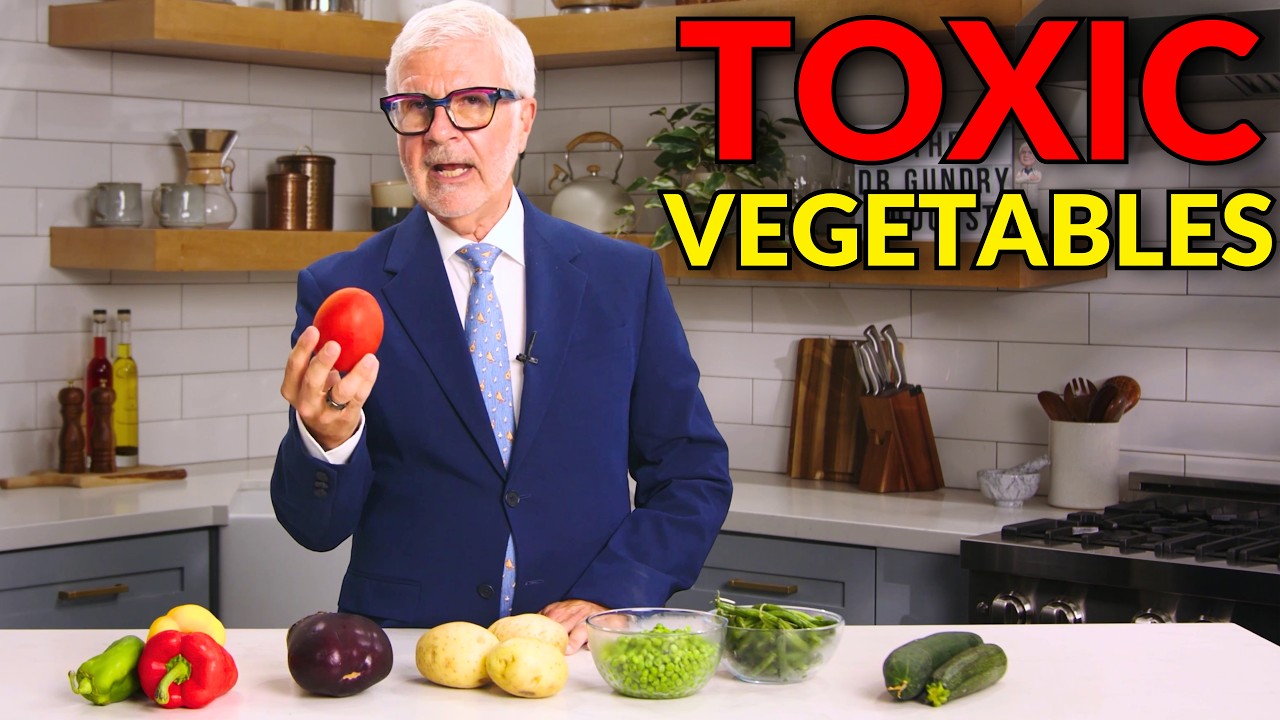
Don't Be Mad... 5 Toxic Vegetables Dr. Gundry Thinks You Should Stop Eating Now!
Watch on YouTubeVideo summary
Dr. Gundry challenges the common belief that all vegetables are inherently healthy, arguing instead that five specific types can be toxic to gut health due to their high lectin content. Lectins are defensive proteins found in plants designed to prevent them from being eaten by creating microscopic holes in the intestinal wall, which allows bacteria and toxins to leak into the bloodstream and cause inflammation. The first vegetable identified is the tomato, historically known as the "poison apple" in Europe because of its nightshade family origins; Dr. Gundry notes that lectins are concentrated in the skin and seeds, suggesting that peeling and seeding tomatoes, as was traditionally done by Italian grandmothers, is essential for safety.
The discussion continues with other members of the nightshade family, including peppers, eggplants, white potatoes, and green beans, all of which pose similar risks due to their lectin profiles. Peppers contain capsaicin, a spicy compound that acts as a warning signal to mammals like humans but not to birds, which can safely digest them; while traditional methods like charring or fermenting can reduce toxicity, modern processed forms often retain harmful levels. Eggplants are highlighted for having the highest solanine content among nightshades, a compound originally evolved to kill insects, making them particularly difficult to detoxify. White potatoes are also flagged as dangerous because they spike blood sugar faster than table sugar and contain significant lectins in their skins, whereas sweet potatoes and yams belong to different families and are considered safe alternatives.
Finally, the transcript addresses legumes like green beans and peas, which are essentially seed pods packed with high levels of lectins that can cause digestive issues if undercooked. Dr. Gundry explains that while pea protein is popular in health foods, standard isolates still contain lectins unless they are specifically hydrolyzed or isolated to remove them. The video concludes with the gourd family, including cucumbers and zucchini, which also harbor lectins that cooking does not eliminate; however, fermentation can destroy these toxins. Dr. Gundry advises viewers to either peel and seed these vegetables thoroughly, ensure pickles are truly fermented rather than just brined, or remove them from their diet entirely to protect their gut health.
Read the full video transcript
Five vegetables that are toxic for your
gut. All right, I want to get back to
the basics today because we've all been
taught that if it's a veggie, then it
most definitely deserves a spot on your
plate, right? Well, not so fast. There
are actually veggies out there that can
straight up destroy your gut health,
especially if you eat them frequently.
So, let's talk about five of the worst
ones out there. Tomatoes. Now, Europeans
called it the poison apple and actually
wouldn't touch it for 200 years. Now,
why is that? Well, it's part of the
nightshade family. So, lectins are
primarily in the skin and the seeds. So,
if you're going to use them, do like my
mother did and peel and deceed it like
an Italian nona would do as well. And
until I went to college, I never had a
tomato that hadn't been peeled and
deeded because she was taught by her
mother that these are dangerous. So, how
does it destroy gut health specifically?
Well, remember lectins are part of the
plant defense system against being
eaten. Most plants do not want you to
eat them or their babies. So they
develop defensive proteins that are
called lectins. Now there are many other
defensive proteins in plants like
oxalates for example, but lectins in
specific are capable of causing little
microscopic holes in the wall of your
gut.
So what? When those holes occur,
bacteria leak through, lectins leak
through, and you get inflammation
both in the wall of your gut, but also
in you. And if an animal does not feel
good, if an animal is not thriving, the
animal figures out that this particular
food it shouldn't eat. The plant wins,
the animal wins, and everybody's happy
until humans arrive. When we eat these
things, we take ant acids, we take pain
relievers, we take anti-dopressants,
all because the plant is trying to get
our attention and we don't listen. All
right, another nightshade family,
peppers. Whether it's a regular pepper,
a bell pepper, a jalapeno pepper,
they're all again part of the nightshade
family. Now, I might add that everything
that you see here up until the last one
are new world plants. Now, why is that
important? All of us here in the United
States are not from America. were either
European, African, or Asian. Yes, Native
Americans were here much longer. So,
none of us up until 500 years ago were
ever exposed to a North or South
American plant. So, we've had a very
small time period to understand and get
used to these new compounds. So all of
these peppers are also part of the
nightshade. Now capsaken, that really
hot flavor is actually a warning shot to
you that you shouldn't eat these things.
And quite frankly, we're the only animal
that would take a second bite out of a
jalapeno pepper for good reason. Bird
peppers are called bird peppers because
birds cannot taste that spice. And birds
would be extremely useful to carry a
small pepper, spread the seeds around,
and that's why birds are very good for
peppers. Now, paprika and can are
usually ground whole, skin, seeds, and
everything. However, Hungarian paprika
is a fermented food. And interestingly
enough, for instance, the southwest
American Indians who lived on peppers
always charred their peppers, peeled
them, and then deeded them before they
either ate them or ground them into
chili powder. So they knew how to handle
what was a gut destroying mischief
maker. And again, why do these affect
us? Because of the lectins that they
contain primarily in the peel and the
seeds.
All right. What about eggplant?
It's also a nightshade and it has the
highest solid.
Now, soline is actually how the plant
kills insects, which was plant's first
predator. So, all of these defense
mechanisms were designed to keep insects
from bothering them. An eggplant is
essentially basically peeling seeds. So,
this one I can't save. So, it really
does not have a place in our diet. Okay.
Well, why how about white potatoes?
Well, white potatoes are also a
nightshade from the Americas, originally
from Peru.
Now, this one was really, you'd never
suspect this lowly potato as being
number one, a nightshade, but it's
mischievous. So, potatoes will actually
spike your blood sugar faster than table
sugar.
Can you detoxify it? Well, yes and no. A
lot of the lectins are in the peel. So,
peeling it will diminish the lectins.
You can certainly pressure cook it, and
a lot of my patients do. You can also
cook it, then chill it, and then reheat
it, which will actually lower the amount
of mischievous sugar in it. You'll make
resistant starches. On the other hand,
sweet potatoes, yams, and a purple sweet
potato are totally different families of
potatoes. They do not have these
mischief makers. So, do me a favor. Just
exchange your white potatoes for a yam,
a sweet potato, or a purple sweet
potato, and leave those off to the side
as well.
All right. Now, when I was a kid, my
parents almost every day tried to get my
sister and I to eat green beans and
peas, and we would play a game of trying
to hide them so that we could get
dessert. And we really didn't like them.
Looking back, there was a really good
reason because these are part of the
legume family, beans and legumes. And
even a green bean is just a container
for
the seeds. And we don't think much about
it, but a green bean is a seed pot. And
the problem with these are these are
some of the highest lectin containing
foods that there are. So just because
the seeds are hiding doesn't mean
they're good for you. And if you
undercook them, you're going to have
even more lectins. So, what can you do
about it? Well, you can pressure cook
your peas. You can pressure cook your
green beans, but quite frankly, they
aren't very tasty. Now, I know many of
you go, "Oh, but wait a minute. Pa
protein pa proteins in everything, and
pea protein is is a wonderful healthy
plant protein." Unfortunately, pea
protein has lectins. But here's the good
news. As I wrote about in my book, Gut
Check, if you hydrayze or isolate Pa
protein or soy protein, the lectins are
removed. So if you see P protein, it
better say P protein isolate or P
protein hydraicate.
then it's safe. But unless you pressure
cook these guys, these are not health
foods. They contain lectins. All right.
How about the gourd family? Cucumbers
and zucchini. Now, cucumbers were
originally from Persia. Zucchini is
actually from America, the Americas. So
in Europe we usually see cucumbers
peeled and deeded
and squashes are often peeled and
deeded. Why? Because they also contain
lectins and cooking them does not get
rid of it. Putting it in zucchini bread
makes one of the worst lectin bombs
there is. If you ferment a cucumber,
you will destroy the lectins. But almost
all of our pickles are not fermented
anymore. So if you thinking, oh, a
pickle is fermented, make sure you read
the label and it's got to say fermented,
not brined.
Same problem here. These are loaded with
lectins and unless you know how to
handle them and detoxify them, these are
some of the worst foods that you
probably got in your refrigerator right
now. And it's best to detoxify them by
peeling and deeding them or
moving them out of your kitchen. That's
it for today. See you next week.