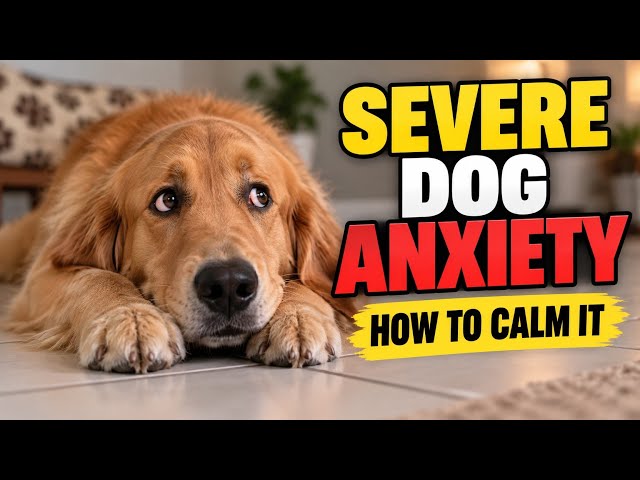
Dog Anxiety Training: How to Calm a Severely Anxious Dog
Watch on YouTubeVideo summary
The video addresses severe dog anxiety by challenging conventional wisdom that relies solely on positive reinforcement like treats and toys for deep-seated behavioral issues. The speaker argues that for dogs suffering from extreme panic, constant pacing, and inability to relax, these standard methods are ineffective because the animal's emotional state is too overwhelming to process rewards or entertainment. Instead, the core solution presented is the application of appropriate physical pressure, which mimics natural canine social dynamics where dogs use physical interaction to stabilize each other rather than relying on food-based manipulation. The speaker emphasizes that understanding the genetic and instinctual makeup of dogs reveals that they are physical species that require mental engagement through boundaries and consequences, not just superficial tricks like sitting or staying for treats.
To demonstrate this method, the video presents a case study of a Golden Retriever who spins incessantly, paces constantly, urinates frequently due to overactive nerves, and suffers from panic attacks when left alone. The training process involves placing the dog in a room with a closed door while allowing it to try to escape, thereby creating a specific problem for the dog to solve: how to cross the threshold without being physically corrected. When the dog attempts to push through the doorway, the trainer applies gentle pressure using a collar tap, which serves as a "pacifier" rather than a punishment tool. This physical touch combined with the mental barrier forces the anxious dog to stop its frantic spinning and engage its brain to think about the boundary, effectively slowing down its nervous system and shifting it from an emotional state of chaos to a thinking state of calm.
As the training progresses, the video shows the dramatic transformation of the dog as it learns to accept the boundary and eventually lay down to relax for the first time in years. The speaker explains that once the dog understands it cannot freely escape the room without facing the physical correction, its mind stops racing with options for flight, allowing it to settle completely. Even when another dog is seen entering and leaving the room freely, the anxious dog does not attempt to follow, demonstrating a newfound ability to let go of obsession and remain passive. This mental discipline prevents the physiological issues associated with anxiety, such as loss of bladder control, because the nervous system is no longer in a state of constant high-alert motion that pushes out waste.
The conclusion of the video reinforces that this approach is not about abuse but about aligning human training methods with the natural psychology of the dog species to resolve cases that often lead to medication or euthanasia. The speaker clarifies that while he uses positive tools like clickers and treats for other behaviors, they are insufficient for curing severe fear and anxiety, which requires the specific combination of mental problem-solving and physical soothing through pressure. By teaching dogs to think clearly about their environment and providing a mechanism to relax their nerves through controlled physical interaction, owners can restore their pets' ability to be alone without distress, ending the cycle of chaos and allowing the dog to finally enjoy a peaceful life.
Read the full video transcript
All right. Today
we're going to talk about
fixing dog anxiety very quickly.
In this video, I'm going to be talking
about things that you would never hear
in your life. You could never read
online. You could never watch a YouTube
video of anybody
knowing these things or talking about
the things that I'm going to talk about
right now. So
now I've been doing this method for 20
years. What I discovered 20 years ago in
dogs still till today
trainers behaviorist public does not
understand
the core and truth and reality
about how these things work with dogs.
And you have to understand dogs at its
core and its genetic makeup of what dog
really is, how it sees the world, how
they deal with each other. Really,
everything goes back to nature when
you're being
a realist, right? When you're working
with dogs. So,
I'm going to give you a case here.
golden retriever that
just spins all day long and paces all
day and never stops and constantly
drinks water because he's wearing
himself out. The mind keeps going. So
his tongue is out all day breathing
heavy like he's lost his mind.
when he's left home alone,
they watch him on cameras and he just
doesn't stop, right? And he pees and
poos in the house. They are now locking
him in a bedroom and you'll see in a
second. His crate is in there. They
tried to leave him loose in the room. He
just spins all day. Same thing. Constant
movement. never relaxes
and just drinks, drinks, tongue hanging
out because he's exhausted. He's an
emotional
wreck. Okay. So,
they put him in the crate. It'll contain
him, but he'll just spin in the crate
and constant pee and poop all over
himself in the crate.
So when you have anxiety problems, the
potty is going to come because the
nerves are constantly going. The body's
moving, the feet are moving. And when
the body is in motion constantly with
nerves, potty is going to continually
come. So they have no choice. They leave
him in that room all day while they go
to work. And he still just doesn't stop.
He scratched the door down. He tries to
get out all day. He's having panic
attacks all day long. Okay.
So, they've already had
three trainers, I believe. Of course,
everybody starts with positive and
treats. And, you know, of course, for
this kind of thing, it would be treats.
Leave them treats in the room. Try to
give them something to do. Kong toys
with stuff in there, stuffed in it to
try to entertain him. And when you're
dealing with anxiety like this,
there is no way to resolve these things
in a positive manner. And if you know
anything and have dealt with a million
anxious dogs like I have throughout my
career,
right off the bat, I don't even I'm not
even going to think about food or
entertainment because I know when
they're in those states, they are not
going to be entertained by anything that
you put in the room or try to give them
to calm down. they're going to ignore it
because their state is so overwhelming
that they can't get out of it that the
rewards are not even a factor. They
don't even touch them all day. Okay? And
that's just the way
all severe anxiety cases, right? If you
have a very very low case of anxiety
where it's it's just a tiny little, it's
not much,
you may be able to get away with the
treat stuff and the Kongs and all that,
but that means if it worked, it really
wasn't
an ordeal anyway. It was just a tiny
subtle little bit of emotion. And then
you'll get those few cases that that can
help you. When most cases when it's very
high,
there is only one way through this and
it is pressure. Okay? And the one thing
humans do not want to hear when it comes
to dogs is pressure.
So here is an example.
I got this on YouTube. This is and I
could there's a million of these types
of videos, but the titles what were what
was important. So,
the owner who was filming this
was saying that you're going to see here
the mother
correct the puppy
and very aggressively
for being hyper, right? For running
around being hyper and won't calm down.
So what dog knows
genetically
and this is how they would take care of
their own just like this without human
interference. They have no other way,
right? And dog will get this quick
because they understand the physical. So
when this puppy's running around, you're
going to see the mother just tackle this
puppy. And you know, it's hard to watch
as human. Even for me, it's hard to
watch things overaggressive.
But I do understand that this is the way
they deal with this without our
influence, right? If this was them on
their own,
this would have really been ugly, right?
Without the owner here interfering
eventually.
So, just as an example,
mother correcting the puppy for being
hyper.
Nobody question
here.
And then the mom keeps going after the
puppy and the puppy's just trying to get
out and just get away in submission. And
the mom's following it just to prove a
point and really taunting the puppy like
like go ahead move again move again
right to really prove a point to cut it
out and to us it's overaggression
right but this is the way things work in
the dog world this is not unusual this
is the norm right and this is for
hyperactivity
and this would be also as the golden
retriever that I'm going to show you
right for the hyperactivity
and the mind going and never stopping in
constant movement.
But pressure has proven itself like no
other
for everything.
dealing with anxiety,
aggression, fear,
any of real behaviors of species of dog.
Pressure and appropriate pressure, not
abusive pressure is the key to soothing
them, relaxing them, and curing them.
Right? This is very difficult for human
to understand. And I get that, right? I
got to deal with it every day of my
life.
Right? After people have tried all the
positive stuff, which is my everyday
life, and then I have to explain to them
that I've done this a million times and
it's proven every time for millions of
dogs, right? That it works like a charm.
Okay? So because we're just going to
relax them and dog was meant for
physical
dogs in wild who live with each other do
not give each other treats and con toys
and everything else. Right? It's a
physical game. They bite each other.
They put pressure on each other to clear
things. Okay? So, I'm going to go to the
case first, explain this,
and then I'm going to show you some
other things,
right, to give you more impact
on the truth of this. And if trainers
and behaviorists in the world would open
themselves up to these things, we
wouldn't have
such uncurable
cases
all the time and dogs being put on
medications and being neutered and
spayed and you know, I mean, it's just
chaos. Put to sleep. I mean, and most
all these cases are resolvable, right?
If you understand dogs,
no dog needs to have any of those things
or be put to sleep unless there's a real
problem internally like a physical issue
right in the mind or whatever it is.
Okay? So outside of that and that's very
rare by the way
no need for any superficial treatments.
Now, one thing I want you to hold on to,
trust to trust what I'm telling you.
I am a master positive dog trainer.
So, when you're seeing this and hearing
this from me,
I am not on the one side that I am a
pressure trainer.
I am a master positive dog training
using clickers, treats, toys, right? And
just as an example so you understand
this, [snorts] here is me working with
just a some of the dogs with the
clickers and the treats.
Yes. Good girl.
>> Sit.
Sit down. Sit. Come. Sit down. Sit.
Matt down. Matt down.
Matt down.
Good.
Come Matt
down. Come
Matt
down.
Good. Sit. He
go.
Okay.
All right. So, I want you to understand
on a daily basis
my own dogs. I sell service dogs with
high level skills.
I use treats, toys, rewards in certain
things,
right? when it's appropriate to be
applied.
But treats and all those things and
doing sits and stays and touch lights
and touch buttons and give paw have
nothing to do with the species of dog.
Okay, keep that in mind and I will get
to that after this case. So, I want you
to understand and just hear me that when
these cases like this
are being done,
of course, everybody, even the owners
themselves with no education, go
straight to treats and rewards to try to
help their dogs. It's the most natural
thing for people to try to do in a
positive way, right? Trying to be nice
to their dogs.
And that hardly ever works cuz it's way
deeper than that. But I want you to hold
on to what I just showed you because I
use positive all the time
except
for fear, anxiety,
aggression. That is
dog problem. Not superficial trying to
make sits spin paw agility course,
right?
Those are superficial behaviors, just
manipulation
of positions that have nothing to do
with the dog species. So, I'll get to
that after. But I want you to remember
as we do this
that if you would think why would
[clears throat] you do pressure if you
there's a so right I'm a master positive
trainer there must be a reason why I do
these other things or else if it works
and I could do positive then I would
just go do that right but it doesn't
work like that so just keep that in mind
and the things I'm going to explain here
in this case, you will never hear
anywhere else
on how to apply
psychology,
true dog psychology,
how to get them and relax very quickly,
naturally.
All right, what you're going to see
here, there's two golden retrievers in
this house.
The darker red one
we're gonna send to the room.
Okay.
And the other lighter one is going to be
floating through the house. Okay. In and
out of the room. So you
>> the same problem that we have there. We
should do the same thing taking him out
because he doesn't go out.
>> Right.
>> So start stepping away and do the same
thing exercise.
>> Right. Exactly. So, it's his crate. He
cannot come out of that crate. Same
exercise.
>> If you try to come out of the crate,
right, he keeps going in and out. He's
staying right in there. So, just keep in
mind there's two gold retrievers. We're
working with the one that we're going to
put in the room. The other one is going
to be floating through the house as you
see us talking here. So, just so that
you don't get confused that that one
that's out there with us and going back
and forth playing with the toys is not
the one that we're working with right
now for the anxiety. It's the darker one
that we're going to put in the room. So,
here what you're going to see
how and keep in mind she's had many
trainers already, positive behaviorist.
I mean, no success. She's tried
everything
and medication
it's not working. I mean this guy is
highlevel anxietyridden
you know.
So
my solutions to these things very
quickly.
We're going to put him in the room.
And now we put pressure. Right. This is
where the game starts of how we clear
this up mentally for the dogs.
So, as we put him in the room, right,
they want to show me. They're going to
close the door. And normally, he
scratches the door and he goes, you
know, starts barking and all that kind
of stuff. So, we put him in the room for
the first time. They want to show me,
but you're going to see he doesn't do
the barking and scratching because we
had just walked him outside and gave him
discipline.
But you're going to see under the door
when I show you, you're going to see the
feet keep moving back and forth that
he's pacing.
>> So, he'll start making noise. He'll
start.
>> He He'll He'll like like a little bird.
He just look back now. Yeah. Now I'm
open cuz he knows.
>> But if you if you go inside the room and
you look at the back of the room, you
see
>> Yeah, I see.
If he's not heist,
come here.
I bet you if I give him water.
So there's no no sound, no door.
What we're doing here is as we put him
in, we close the door. We're letting him
stress
as I send the order to the door to start
opening. You know, he's going to want to
try to break out and get out of the room
so he can go through the house and start
doing a bigger pace. Right. So, what we
do here, I'm going to have you go to the
door.
>> Okay.
>> You're going to open it just a tiny
little bit.
>> Okay. So, just open it.
>> Just a little bit because we want to see
if he's going to try to push out.
Now you like. So you block him like this
and you push with your body.
>> So to stop this, we need for him to
start thinking,
right? Dogs with these problems just are
emotional. Okay? And there's no way that
you're going to get them to use their
minds by doing tricks and treats and any
of that. Okay? That's not going to work
for these types. So
we need the door boundary,
right? So when we open it mentally, he's
got to hold and think about this.
No weights, no stay, no giving him
commands to stay in the room because
that will all kill the psychology.
We need him to try to break out so we
could put pressure on him. And while
he's standing in the room, needs to
think this out now because in his mind,
he's going to outlet through that and
that option of taking off out there and
having the bigger house to pace around
and go nuts. Okay. So the psychology to
this is
now knowing he cannot cross the
threshold.
He's going to have to hold in because
he's going to get tapped with the collar
for trying to come across. There's going
to be a negative and a touch physical
from the collar to soothe him down, to
relax him, not punish him,
right? So he can start thinking clearly
and get untrapped from the spinning.
Okay? If he's got nothing to worry about
and just fro float freely and crash
through the road and go through the
house, the mind and nerves never stop
running. Okay? Once we give him
something to worry about, like crossing
the line of the door,
now he will slow down mentally and from
the taps of the collar, we call it the
pacifier.
He will soothe those nerves relax,
[snorts] right?
Not punish,
not tap him and cry, yelp, none of that.
We want to relax him like a soother,
like it's spa day. Okay.
So, giving that objective, not being
able to cross the line, taking away an
option, and now having to worry that he
cannot escape the room.
Now, the dogs start to calm down because
we took away the options and there's a
physical attached to it that they do not
want to deal with.
So, they start to relax.
This is what we're going to start
playing with here.
Okay, close.
So, I'm going to amp it up a little bit.
Good. So, we'll try to open.
He's like, he's crazy.
Open a little more.
Good. So, he holds.
Perfect. So you can open a little more.
If he tries to move for you, just block.
>> That's good.
>> Yeah. Good. So you're going to come one
more step.
Good. And keep going.
Good.
Uh-huh.
>> Okay. Very good. Good.
Now, just for a sec. I'm going to have
you sit. You want me to sit here?
>> Just for a sec. I want to really push
him to
>> Okay.
>> Okay. So, you see he tries to break out.
We go put him back. We're going to make
sure he cannot get out get outside of
that room without permission. And again,
this is him thinking on his own, which
is the key to this, right? Why you don't
put dogs in positions. Wait, stay.
Okay. The dog has to be able to use its
mind and make decisions to do things.
That's how you cure and make dogs
reliable and things. Okay, so
you see right my
preference right now always with every
dog there's going to be sequences.
The first thing is you see he just
stands there still. He's not pacing
anymore.
Good.
That's the first objective. We know
we're getting to him if he just stands
there, right? And doesn't move and it's
just observing
because now the mind is thinking about
what he's going to do because pre this
there's no thought. He never thinks
he ne doesn't have discipline in life.
Most dogs don't, right? So, they become
stir crazy. And you can see first time
he's had to use his brain, the pacing
has stopped in the room. And now he's
standing there with thought. Hm. So, you
mean I can't cross there now? That's
different. And there'll be a tap of
collar. So, the body and mind are coming
down instead of spinning and no thought
to thinking. So, we bring dogs from
emotional
non-thinking to thinking and then things
start to pacify. And that was an example
there of every dog in my life that I've
trained. We go through the pacing to
stillness
to complete passive.
Okay. So, here in the stillness,
I had the owner back off the door and
try to go sit because I need space off
there for him while he's in thinking
state and calming down to make a
decision that nobody's there to block
the door, right? If nobody's there to
block the door, is he going to be able
to just walk out and do what he wants?
And of course, since the first time
we've ever done it with him, he's never
done this. You're watching it first time
ever.
He thought, "Well, since nobody's in
sight,
what if I decide to walk out?" And the
moment the owner goes uh, I tap the
collar and I give him a physical with it
gently.
Right? There's no crying, yelping,
screaming, right? He just casually
walked back and got back in the room and
just stood there again. And he never
tried to come back out from that moment.
>> Uh-huh.
All right. And also what you're going to
see here is so you're not confused
again, the one golden retriever, the
other one you're going to see in this
next clip here, constantly goes in the
room where the other golden is that
we're working on, gets toys, and comes
back out and goes back with us. And it
does it several times in this next clip.
Normally, he would follow him right out,
right? And of course, him watching the
other golden come in the room and pass
the boundary freely in and out of the
room. Most dogs would try, you would
think, to follow the other one out of
the room also, thinking, well, he just
got through it. Maybe there's a shot I
can get through it now. But this shows
you how much restraint,
right, is going on in the dog.
>> Feed them when you leave in their cages.
15 minutes. They don't eat the water.
>> Be careful cuz if he gets anxious, he
tips the hole. So you could do the water
outside wherever you want to do it.
>> Like they can come there, drink water,
and then put them in the cage.
>> Right. Right. Right. So you can do your
water there and do your food over there.
But you see, he just went in the room
and he put the toy and went past come
back out.
>> Yeah. Fantastic.
>> Good. And then you just need your queue.
So now
>> that's teaching him that boundary there
and to learn to relax.
>> So you the same problem that we have
there. We should do the same thing
taking him out because he doesn't go
out,
>> right?
>> So start stepping away and do the same
exercise.
>> Right. Exactly. So it's his crate. He
cannot come out of that crate. Same
exercise.
>> If you try to come out of the crate,
Right on. Right. He keeps going in and
out. He's staying right in there.
>> He's probably laying down. I'm dancing.
>> If he's laying down, that's good cuz
that means he's settling.
>> Mental. Mental. Mental. Mental.
Everything is mental. And now he's just
sitting there laying there. He's
relaxed.
>> So, can even though we use a grape and
then relax there
>> or is that
a face?
>> So, then if I'm releasing, I'm saying
break,
>> right? So, like right now he's calm
there for a while. I let him stay there
for a little while because right now
he's learning how to let go and just
relax and not I got to get out. I got to
get out. How do I get out of here? How
do I get out of here? You can't.
>> What are you going to do? Relax.
>> These things with him this week.
>> Mhm. Just get really good. Like get
happy with that button. That's going to
soothe him.
>> It's going to pacify him and make him
feel happy with today's session.
>> I know. He did it great. Did great. I
like
>> both did. I like
>> Yeah. Yeah. both perfect with that. And
I like the fact that he's laying there
right now. That's that's perfect sign
for us cuz if he was still standing,
>> it's good. It's good as long as he's not
pacing. But the laying down is the
clincher. That knowing he's always been
able to freely pass in the bedroom
without any issue with any mental or
discipline.
Watching the other one come in and out
would make the other dogs at least try
to follow them out, right? But not even
a chance he was going to do that. And
this is what we expect. And this is
every dog that I train with this. If
there's another dog in the house, right
away they do not try to follow. Even
though the other one's coming in and
out, they just relax and let it go and
let them do what they're going to do.
and them float float freely. Okay, so
that's another perfect sign for us that
he is in a complete relaxed state and
gave up. He doesn't even care and isn't
even thinking about following the other
dog out of the room back into the living
area with the owners and myself, right?
which he absolutely that would be his
first thing to come out by us and be
around us and be spinning and moving and
drinking and okay and he's not doing it.
He's in the room right now laying down
and they just have relaxed time there
is
>> what a face. So he's completely
passive and let go exactly what we want
to see. We stop the mind from spinning.
So, so you suggest we we should try to
keep him still in the crate for now
until we manage the pilot.
>> Yes. Because if you're going to
experiment,
>> it would be I need him in this state of
mind
>> to be able to be in that room loose with
no potty
>> that he's not going to be doing this all
day cuz if he's doing this darn day, we
know we're going to get potted. That's a
given. His body can't handle it. This
pressure is going to get to him. He's
going to have to go to the bathroom. But
if we can get him in this state of mind,
then I gamble and I go, "Okay, now he's
been calm. Now I'm going to try leaving
him out in the room because he's been a
lot calmer." But that's why too, when
you're here with them all the time, he
just can't be out there all the time
with everybody. He's going to be in
there with the door open and relaxing
himself while everybody's out here and
control himself. That it's not just, "Oh
my god, they're home. So I got to be
around them. I got to be with them. I
got to be everywhere they go. I got to
be part of the whole thing because
that's going to make him anxious out of
his mind." the more we separate him and
make him hold his [clears throat]
ground. He can be a big boy. That's what
we're telling him. You're a big boy. You
can be alone. Just because we're here
doesn't mean it's a right you be with
us. Because if we allow that, he's going
to be this all the time. He'll never let
go of it.
So, this is a perfect mental discipline
for him right now. He's out here flowing
in and out with this. He's not trying to
follow him out.
>> No, he he he's in his own world. He he
sometimes he he irritates him. But
>> yeah,
>> he's the type that doesn't care, you
know, like when he wants to play. He
doesn't
>> he's he's on his own playing 24 hours.
>> Yeah. No, he's a play.
>> He's still relaxing still.
Thank you.
>> All right. So, perfect. Right. And you
see he's just passive
and we're talking there that if the
owners don't give the discipline on him
with the collar and create the
boundaries. Collar is critical. It's not
just the boundaries. It's the two
together but the most important is the
collar that causes the pacifying and the
relaxing and letting go. And you can see
there I come in I pet him. You know,
he's there soothing. He's not even
trying. This is the first time, right,
that this guy has laid down to relax in
the house since he's been there for
years, right? I mean, this guy does. He
never lays down and calms down and just
relaxes,
right? He's always moving and everywhere
and mentally, right? So, this is the
first time
that they were telling me behind the
scenes that he's never laid down. He's
never stayed still. I mean, and truly,
I've done
I mean, thousands and thousands of
anxiety cases. And he absolutely
definitely was one of the worst where
it's rare you see a dog just spin and
he's not home, right? That he's not
there mentally. You can see he's not
there. Almost looking
right as if he was
nuts, right? Like that he's not well.
And so I mean completely chaotic. And
it's the first time ever he is laid
down, relaxed, and just let go.
Okay. And you see there, we didn't hurt
him. We didn't abuse him. We're actually
doing him a favor, right? By not being
human towards him,
right? And just going with treats and
rewards and right because dogs don't
live with each other like that. They're
a physical animal, a physical species.
They use bite and touch in order to keep
stabilization
within each other and in the packs and
in each dog to be normal.
That is the dog game. So
you see, perfect. And I told him if they
keep him in this state because also most
of the dogs I've done with anxiety have
potty problems attached to it too. And
the moment that we calm them down like
this, they can be free in the house.
Owners go to work. There's no more
pacing and spinning. And there's no more
potty problems because we've relaxed the
mind and the body and now it can hold
potty. It's not constantly making the
nerves go. That potty's constantly being
pushed and coming. So, it's perfect for
day one. But I wanted to show you, which
I've never shown before, the psychology
to it. And in one shot in one day, I was
able to do something that no other
method has done for him,
right? And
perfect in one class, right? That we get
him to just lay down for the first time
in his life and relax for the first time
in his life, [laughter]
right? That no other method has done for
him. And thousands and thou I mean
success cases I've had with this. It
never fails if the owners believe in the
system and stay with it and understand
the dog psychology.
Right? So something there never you will
read online you will never if you hire a
trainer you will never see this method
and it works like a charm all the time
because I'm going by dog species
understanding
that with the anxiety
I must give him problems for him to
think about.
I need the physical touch on the body to
touch the nerves and relax the mind and
body through physical stimulation with
thought combining each other. Dog knows
now he needs to calm down, not make a
mistake and think about what he does
because when they go under anxiety,
they can't think and they make mistakes.
They just do. So
this is how it actually works. When you
give a problem and physically they don't
want to deal with it like past the
boundary and get tapped with the collar
automatically by being touched with the
collar it soos the nervous system as if
they're getting a spa day right not pain
into the dog right because I don't want
the nerves jumping from pain because
that makes them more anxious so when I'm
doing this I'm touching with the collar
just to physically touch him a little
bit to yep right which also it does two
things.
Makes the dog now think about that he
can't just cross the line freely slowing
him down
and not the mind spinning still. The
physical touch of the collar affects the
nerves and pacifies the nerves. Right?
As if we were doing a muscle stem and
relaxing him a spa day. So now the
brain, the nerves to the brain to the
body pacify and soothe. Opposite of what
everybody out there thinks about the
collars. Now this is my system. You
can't and as a trainer, behaviorist, or
anybody out there pick up a collar and
try to do this without knowing what I
know about dogs. Right? So when I've
heard people in the past go, "Oh, they
don't just use a collar." No, it's not
the collar. I'm using the collar to my
advantage. It's what I know about dogs
and how to touch them exactly and the
theory I'm working with and the mental
to it and all those things that are
making this work beautifully. It's not
the collar. The collar is a part of it
and a tool for me, right? But it's my
psychology primary
and I'm using the tool to my advantage
in a certain way, an exact way, in a
complex way, but I make it look easy,
right? But there's a big game attached
to this of how to touch properly and
with the exercise I'm trying to do,
knowing what I'm affecting and how I'm
giving the outlook to the dog, not to be
scared, not to be pounded with a collar,
right? Because then I can't get him to
relax and pacify and just be at peace,
right? If I just hit him with a collar
and I make him right and scared of the
lying, he's going to be jumpy and edgy
and panicky. So it has to be done
exactly in a certain way to make this
beautiful and make him relaxed and let
go and start to enjoy his life in
relaxation.
>> Good.
>> Thank you.
>> Right. But he can never enjoy his life
if he doesn't settle and learn to let
nervous energy go permanently.
And that's the start right there. As the
owners carry over on this, it'll be
perfect.
So, hope you enjoyed. Till next time,
Richard Hines, Miami Dog Whisperer.