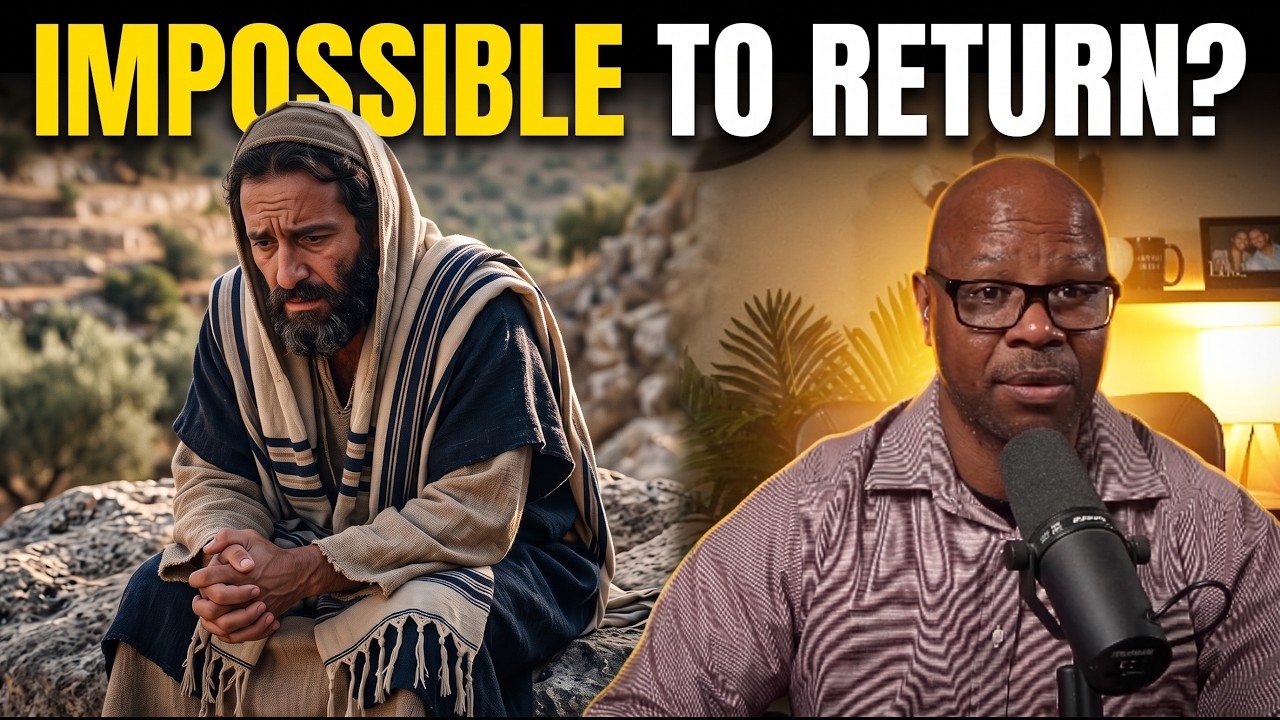
Video summary
The video addresses a frequently debated passage in Hebrews 6:4-6, which states that it is impossible to renew those who have fallen away after having been enlightened, tasted the heavenly gift, and become partakers of the Holy Spirit. The speaker argues that while the text uses strong language declaring this action "impossible," many interpretations mistakenly assume this refers to actual believers losing their salvation. Instead, the presenter suggests that the description of these individuals—having experienced profound spiritual realities like tasting the good word and the powers of the age to come—is so intense that it implies a hypothetical scenario rather than a literal account of true Christians apostatizing. The core argument is that if someone truly possesses Christ and the Holy Spirit, they cannot genuinely fall away in a way that makes return impossible, because God will never leave His people or allow them to permanently reject Him.
The speaker delves into the theological implications for Jewish believers, who were the original audience of the letter, explaining why the concept of needing a new sacrifice upon returning would make no sense under the Old Covenant system. In Judaism, repentance required a fresh sacrifice for every sin; however, Christ's sacrifice was once for all and sufficient forever. Therefore, if a person truly repented of their sins and then rejected Christ, they would be asking for a second sacrifice that could never exist because the first one had already been fully accepted. The text concludes that such a situation is impossible not because God lacks power to forgive, but because the very act of rejecting Christ after knowing Him means the person was never truly partakers in the first place. They were merely experiencing religious emotions or intellectual assent without genuine faith, which aligns with Jesus' parable of the seed falling on rocky ground that bears no fruit.
To resolve the apparent contradiction between Hebrews 6 and other biblical passages like James 5:19 or Hosea regarding the restoration of apostates, the video posits that Hebrews is using a rhetorical device to encourage believers rather than describing a real possibility of losing salvation. The author expresses deep confidence in his readers' perseverance, noting that God is not unjust to forget their works and love shown toward His name. This assurance implies that the "falling away" described is a warning against drifting into unbelief or superficial faith, not an event that true believers can undergo and recover from. Consequently, the impossibility mentioned in Hebrews serves as a comfort to the faithful, assuring them that their salvation is secure because they will not fall into a state where return is impossible, as such a state indicates they never truly had saving faith to begin with.
Ultimately, the video concludes that the passage should be understood as a hypothetical warning designed to strengthen the resolve of Jewish converts transitioning from their ancestral traditions to the new covenant. By presenting the idea of falling away as an impossibility for true believers, the writer reinforces the certainty of salvation and the sufficiency of Christ's work. The speaker emphasizes that while people may seem to leave the faith or engage in sin, genuine conversion involves a heart that holds fast to the word with perseverance and bears fruit continuously. Thus, the text is not teaching that salvation can be lost, but rather that those who appear to have lost it were never genuinely saved, thereby removing any fear of losing one's standing before God for those who truly trust in Christ.
Read the full video transcript
Impossible. Impossible.
That means not possible. That means it
can never happen.
>> [music]
>> There's a passage in the Bible that if I
tell you I get questioned on at least
once or twice every week. That actually
adds up sometimes more.
This passage gets brought up a lot and
the question is well what does this
passage mean? Well,
this [snorts] is Hebrews 6:4 and for
some people it can be confusing. For
some people it seems to be pretty
convincing. It seems to be pretty clear
and some of the folks who think it's
pretty clear are wrong. Some of the
folks who think it's pretty clear are
right. So let's go and look at the text
and see what it actually said. Remember
we're talking about the word impossible.
And so in Hebrews 6:4, depending upon
which version you're looking at, you're
going to see it start off with the word
impossible. As a matter of fact, let's
pull up I have the NASB but if you go to
the NET Bible, I'll go back to the NASB
in a second but if you go to the NET
Bible, it says for it is impossible. And
if you look to the right, the very first
word that's here in the Greek is the
word adunaton which is the word
impossible. So the first word in the
Greek that you're going to see is going
to be the word impossible. So now let's
go back over to
this verse and look at the NASB.
The way that writers write sometimes or
the way that translators might put it
they're trying to put it in a way that
you can best understand it. And so now
this is one long sentence from verse
four all the way to the end of verse
six. This is all one verse or all one
sentence I should say.
A lot of times New Testament authors are
going to use a lot of run-on sentences.
Paul does this. Now this isn't Paul
that's writing in the book of Hebrews.
In fact, we're not sure who the writer
is. Could it be Apollos? Could it be
someone else? Possibly. We don't know.
But we know it's not Paul because Paul
says that he had received this
information first hand but the writer of
Hebrews was told about this information
regarding the gospel. So,
back to the text at hand though, he says
that verse four,
and there's a lot implied in this,
there's a lot to to glean from this. He
says, "For in the case or it's
impossible." So, let's start with that.
So, as we read this text, it's
impossible for those who have once been
enlightened
and have tasted the heavenly gift and
have been made partakers of the Holy
Spirit and have tasted the good word of
God and the powers of the age to come
and then having fallen away, what's
impossible? It's impossible to renew
them again to repentance. Now, we'll
come back to the sense part in just a
second.
That's a lot. Now, some are going to say
that I don't think that this is speaking
about true believers. Well, I'm going to
disagree. This is speaking about actual
believers.
He says, "For in the case of those who
have once been enlightened."
That seems pretty convincing to say that
this is about believers, have been
enlightened, have been made aware of,
that have been shown.
And so,
or the light has been shined on him,
that's where we get the word enlightened
from, and have tasted
uh tasted what? The heavenly gift
and have been made partakers of the Holy
Spirit.
And have tasted the good word of God.
So, this seems to be speaking about a
Christian. As a matter of fact, the
writer also uses the this word partaker
earlier in Hebrews
in chapter 3, verse 14, he says, "For we
have become partakers of Christ."
How do we become become partakers of
Christ? That is, if we hold fast the
beginning of our assurance firm until
the end. So, to become a partaker is
someone who holds fast the word of God.
And now, it also says that that to be a
partaker,
you have to hold fast until the end.
Hmm.
Interesting. So, to be a partaker, you
have to hold fast. And if you hold fast,
then you'll become a partaker. But we're
being called in Hebrews 6 partakers, or
these I shouldn't say we, but these
people are being called partakers, or
having been made partakers. They have
been made or have become. So, what are
they? These are people who are
partakers. Now, he has says partakers of
the Holy Spirit, but are we going to
think that partakers of the Holy Spirit
are different than partakers of Christ?
They're the same. They are the same.
Having sharing in are partakers of the
Holy Spirit. Same with of Christ. And
so,
by the way, it's made of the word The
Greek word that's used here is
metokus, which is meta with and echo,
which is to have. So, with having, so I
have with. So, I have been made someone
to have had to have the Holy Spirit or
having Christ. Same thing. So, the
question is, how could it possibly be
that a person who has Christ, who has
been enlightened,
and um tasted the good word and the
powers of age to come, some will say,
and then having fall away. Well, so that
would seem for many people to say that
this is clearly a believer who can stop
being a believer, who can be a partaker
of Christ and then no longer partaker of
Christ, who can be saved and then no
longer saved, or who will have been
atoned for and no longer atoned for, in
right standing and no longer justified
or in right standing.
I think the problem is though that
people tend to focus too much on the
falling away aspect. They see this and
say, "See, it's clear."
There's a problem with this though.
We'll deal with the problem in just a
second about the falling away, but let's
not neglect what we also saw, the part
where it says it's impossible.
What does impossible mean? Not able to
do. It cannot happen. There is no
possibility, no scenario by which a
person come can come up with and figure
out a way around it. It is impossible.
It's impossible for an ant to lift up an
elephant. There's no way possible
whatsoever. No matter how much working
out he does, he can never garner enough
strength to lift up an elephant. I'm
being a little silly here, but the same
point. It is impossible. It's not
possible. That's literally what this
word
I do not time means. It cannot happen.
There's no way that this can be done.
You cannot do it. Not possible. Not
powerful.
Not able. That's what the word means.
So,
are we saying now that if a person
if they were going back to the point the
highlighted point that people bring up,
the falling away part, are we saying
that if a person were to fall away, the
person can never come back? It's
impossible to renew them? To answer
that, let's go back to the verse. He
says, "And then it's it having fallen
away, it is impossible to renew them
again to repentance." In other words, to
make them be repentant again.
Well, let's think about that for a
second. What does it mean to actually be
repentant? That means I have changed my
mind about the circumstance, about my
actions, about my feelings, all of that.
To be repentant is all inclusive.
A repentant attitude or heart
encompasses everything. To repent of an
action doesn't necessarily mean that I
repented of my attitude. So, when the
Bible speaks about being repentant or or
being renewed to repentance again, he's
speaking about the totality of it. All
encompassing that my mind, my heart does
not agree with this thing. That it's
changed from I've turned away from it.
And so, can you make a person who has
turned away from the idea of sin or what
they thought about themselves and turned
themselves because to repent of those
ideas wholly
also necessarily means that you have
turned towards Christ. So, could a
person turn away from those things once
and then turn away from those things
again?
That would have to indicate that they
never repented in the first place,
right? They have actually made a
internal decision or a changing away
from those things.
But if they didn't the first time, then
that would have to mean that they never
did. Since it is that they would have to
crucify themse- crucify to themselves
the Son of God and put him to open
shame. Now, remember who this book is
written to. It's called the Book of
Hebrews.
It doesn't really say that it's written
to the Jews,
but once you start reading it, it's
clear who the audience is. The writer is
constantly bringing up instances or
passages or things having to do with the
law
and how atonement and justification was
made and that we have a high priest. So,
you hear all these different terms that
these Jewish believers would understand.
And so, the audience are are is Jewish
believers who understand that when I do
things wrong, when I mess up, I've got
to deal with what the law tells me to
do. Which is why the writer is saying,
"No, you've got something better." As a
matter of fact, the person who gave you
the law was the one who died
and has instituted a new covenant,
meaning the first one is now made
obsolete in favor of the second.
And so, to a Jew who is sincere, who has
Here's that word again. Who has
repented, when they sin, just like you,
when you sin, if you mess up, and you
are truly repentant, you're bothered.
You don't like what you did, indicating
that you have a repentant heart.
So, what is a Jew to do who is repentant
of their sin? Well, what have they been
told to do all their lives? What has
their
family been told to do? What has all the
Jews been told to do? All the Remember
talking about a couple thousand years of
history and practice now having to be
changed in the matter of a couple years.
We're talking here about 30 years later,
probably less than 30 years, maybe 28,
25, 27, 29, 30 maybe years later after
the death of Christ and here you got
these believers who are leaving their
old way of thinking Judaism in favor of
this this new grace and this just a
little bit different because when I sin,
I know I've been wrong, I must do
something
to show that I've been wrong and to make
amends.
In their mind, I've got to repent all
over again, I guess. And then there must
there of necessity because of the law,
there needs to be a sacrifice. The
problem is there is no more sacrifice
that you can give. That is if you are
unless you are rejecting the earlier
sacrifice. Meaning this,
to be a believer, especially a Jew, cuz
we're talking about them,
they would have to believe that Jesus
Christ is the atonement. Jesus Christ
was the high priest,
Jesus Christ was the sacrificial
offering and Jesus Christ was the sin
bearer.
Well,
in order for you to atone for your sin
again,
the past atonement, the past sacrifice
is no longer enough. You need a new one.
So, in 2026,
I can't turn back and look at the
sacrifice of 2025 that I had had faith
in but then walked away from, I'm going
to need a new one. That's how the That's
how Judaism would work. They would
understand it this way.
The writer's trying to get them to
understand that there is no more
sacrifice that's needed. The sacrifice
that was given was sufficient. And so,
if you were to fall away and here it is,
if you were to fall away,
the problem is there is no way for it to
come back because
what are you repenting to or from or of?
Where are you focusing on now? And the
object of your repentance that causes
your repentance is the very same thing
that you could have allegedly fallen
away from. That sacrifice that you are
going to turn to now is the very same
sacrifice if you did turn away from
is the same thing. So, I'm I've turned
away from that sacrifice only to turn to
that sacrifice. In the eyes of a Jew or
in the eyes of the old covenant or the
law, that makes no sense. I've got to
have a new sacrifice. The problem is
though, this is what he says, it's
impossible. The reason why it's
impossible is because
you would have to crucify or they
crucified to themselves the Son of God
and put him to open shame. That was
already done and the writer continues
through this
all [snorts] the way through chapter 10
and say he what he's done he's done once
for all.
There is no more need of another
sacrifice.
And so where there where the shedding of
the blood is, especially by Christ,
there is no more need of a sacrifice.
And so he says for he uses an example,
for the ground that drinks the rain
which often falls on it brings forth
vegetation useful to those whose sake it
is also tilled
it receives a blessing from God. But if
it yields thorns and thistles, it's
worthless and close to being cursed and
it ends up being burned.
If a believer, a true believer
has the Holy Spirit
would [snorts] we ever call that true
believer worthless or even close to
being worthless?
Or this person yields thorns. Well,
Jesus tells us a couple things about a
true believer. As a matter of fact, he
even uses the same analogy about the
ground. And he uses the analogies in
verses 12, 13, and 14 of soil that's bad
soil, that's rocky or
it's on the wayside or the the seed,
which is the word of God, has no root.
But in verse 15, he says something
differently about a person signifying a
true believer, a person who has good
soil or in this case a good heart. So,
he says the seed in the good soil, those
are the ones who have heard the word in
an honest and good heart. And look what
he says, they hold it fast and they bear
fruit with perseverance. So, a believer
according to Jesus is going to hold the
word, keep the word,
not, here's another word, apostatize,
and there's a reason why I'm bringing
this up,
and the person will also bear fruit. So,
if we go back to Hebrews 6, then he
couldn't be describing a true believer.
So, the only conclusion would have to be
that this needs to be looked at as a
hypothetical, meaning a word a way to
comfort the Jewish believers. If this
were to happen, it's impossible
for you to come back. Why is Why is it
impossible to come back? Because
everything that's required for you to
come back is everything that you
rejected and it won't happen again.
Now, I want to pose a question to you, a
riddle.
If the writer is saying it's impossible
if they were to fall away,
that means nothing can be done. Who
believes that if a person were to fall
away, if they if their heart was never
in it, if their mind was never in it,
what have you,
who believes that it's impossible if
that person were to fall away, if
somehow they changed and understood
either the gospel or they had a true
conversion, that they could ever come
back? Who believes that it's impossible
for them to come back?
How many of you know someone who
seemingly has left the faith,
uh who's out there in engaging in all
sorts of sin or they just simply just
totally and mentally and spiritually
have rejected the gospel.
Do you pray for that person? Do you
evangelize? Do you hope and pray and
want that person to return?
Well, if we take this as a person being
able to leave the faith, then we've got
to take this text as saying that it's
impossible for the person who has
apostatized,
who has willfully um sinned and left,
it's impossible for them to come back.
The problem [clears throat] is though
that we've got text, we've got verses
that tells us that you can seemingly, it
looks like you can come back. Let me
give you a couple passages. One in the
Old Testament, speaking prophetically of
these Jews,
Hosea says, "I will heal their apostasy.
I will love them freely, for my anger
has turned away from them." And so it
seems like the person who has
apostatized can come back. The person
who has rejected the offer, or rejected
the faith, or who know who doesn't
believe these things, that that person
can come back. James 5:19 says, "My
brethren, if anyone among you strays
away from the truth and one turns him
back, let him know that he who turns a
sinner, calls him a sinner." So this
doesn't seem to be a believer, seems to
be someone who knows the word, um but
has not placed their faith in it, or
someone who's around the believers. If
that person turns away, he calls that
person a sinner. The Bible never calls a
believer a sinner, but he says that uh
who turns a sinner from the error of his
way will save his soul from death. Now,
whether you agree with my definition of
John of James 5:19 and 20 isn't
material. The issue is though, the
person who left can come back. So James
5:19 and 20 says the person who left,
whether you let whether you believe they
have left having faith or left the
tenets of the faith, I think it's the
tenets of the faith that they can be
brought back. Hosea says that God will
heal their apostasy. So in this case,
their apostasy can be changed. Now,
obviously Hosea is speaking about a
people, the nation of Israel, but still
it can be changed. James saying it can
be changed. Hebrews though is saying it
can't be changed. He's saying it's
impossible.
Perhaps then that's there's our clue to
say that he's not speaking about the
fact that a person could be saved and
come back cuz again, how does he
describe a partaker
in Hebrews 3:14? As someone who has
Christ. In order to be a partaker, you
have Christ. Having Christ is the the
end result. For we have become
partakers, that is if we hold fast. So
the person who's a partaker is someone
who is holding [snorts] fast, which goes
along with James James. It goes along
with Luke 8:15 saying that the person
who has a brand new heart, the ground is
actually good.
That person will do what? Hold fast the
word of God. How long? With
perseverance. Uh this means
continuously, which has to be forever
ongoing. And they will bear fruit.
Keeping in with that analogy of the
ground and how long will they bear
fruit? Again, continuously. They will
hold the word and bear fruit
continuously. So the writer of Hebrews
is trying to convey encouragement to
these people saying that this is not
going to be the case. If it were, well
then it's impossible to come back. But
because of what the Lord has done,
it's something that you don't have to
worry about. And what does he say? Verse
nine.
But beloved,
we are convinced.
I'm assured of.
I know. I trust. I'm persuaded of better
things concerning you and the things
accompanying salvation.
Though we are speaking in this way, for
God is not unjust so as to forget your
work and the love which you have shown
towards his name in having ministered
and in still in still ministering to the
saints. So, he's even telling the people
what their life is like. And so, he's
confident. He's persuaded that this
isn't you. And he goes through um
careful
um writings and instructions and proofs
going into Hebrews verse chapter 7
where he says that the Lord is
interceding on our behalf daily, always.
Uh 8, 9, and 10 where he's trying to
convince us that the way it was or the
way you think is not the case. So, when
he says impossible, the only way that he
can mean impossible is if this is a
hypothetical. If this is actual
real life, true apostasy,
being saved and moving away from it, he
says it's impossible to return.
If it's impossible to return after a
true believer has apostatized,
but there are other passages that says
that that true believer can come back or
he can't come back cuz remember, we only
have one unforgivable sin.
Unless this is the unforgivable sin.
I don't think so. So, therefore, we
cannot have a contradiction that it is
in one verse, it's possible, and another
verse, it's impossible. That's the
definition of a contradiction. It can't
be that the only way that this can stand
is if he's trying to convey to you that
it's impossible because it can't happen.
You cannot move away or fall away. And
those who have moved away from the
tenants of the faith, they were never
partakers cuz to be a partaker is to be
someone who has Christ, who has the Holy
Spirit, and he will never leave you. So,
I hope this helps. I know there's
probably going to be some pushback, but
I still wanted to go ahead and address
this keeping in mind this is written to
who? To Jewish believers who have
different sets of baggage to bring into
this new found faith. At that point in
time, we're talking 20 30 years after
the death of Christ. So, it's a new
found faith, new new religion in the
world. It's the only true religion, it's
the only true faith. And so, they're
having to adjust and reconcile their
ways in Judaism with now being in
Christ, the greatest Jew who ever lived,
who has saved their soul or who's made
provisions for them to be saved.
And now they don't have to think about
the old and relate to the new. This is
something brand new. No more is there a
sacrifice that remains for them that the
writer of Hebrews tells us later. And
that's the point that he's trying to get
across. So, I hope this helps. Hope it's
blessed you.
Uh if you have an issue still, please
let me know what you think in the
comments. Amen.
>> [music]
>> Power.
Power.
>> [music]
>> Power.
Power.