Video summary
The Print Army is a volunteer initiative based in Germany that connects individuals with 3D printers to support medical professionals and military personnel, primarily for humanitarian aid efforts such as those supporting Ukraine. The organization operates on a free-of-charge basis, allowing volunteers to create essential tools without cost barriers while maintaining direct contact points across various European countries. Their primary focus lies in producing specialized medical devices that address critical needs in field conditions, ranging from simple bandages to complex prosthetic components, ensuring that resources reach those who need them most regardless of location or infrastructure availability.
In the realm of medicine and emergency response, the group manufactures a wide array of practical items including hand splints made from PLA plastic for stabilizing injuries, vein finders equipped with lights to assist doctors in locating veins quickly during procedures, and portable ampoule holders designed for easy transport by medical staff. They also produce high-demand flashlights and helmet-mounted lighting systems that are crucial for search-and-rescue operations in dark or collapsed environments where electricity is unavailable. Additionally, the team assembles powerful power banks using recycled 18650 batteries to keep communication devices charged, enabling doctors and civilians to stay connected with their families even when grid power fails due to conflict or natural disasters.
Beyond immediate medical supplies, the Print Army has recently expanded its capabilities into advanced training and prosthetics by printing detailed models of human bones to help volunteers distinguish between animal and human remains during search operations in liberated territories. They also fabricate custom splints from flexible TPU material for people with disabilities, often collaborating directly with partners like Druckarmen in Lviv to facilitate a return to normal life. These efforts are complemented by educational initiatives where domino-shaped NATO training symbols are printed and distributed to officer academies, ensuring that both civilians and military personnel receive standardized instruction on proper procedures using accessible 3D-printed models.
To sustain these operations, the organization actively seeks used batteries from the public for refurbishing power banks and encourages individuals with their own 3D printers to join the network by registering online or contacting local coordinators. New volunteers are provided starter files tailored to their skill level, while experienced members can access more complex designs through dedicated curators who offer guidance on printing techniques and material selection. The overarching goal is simple yet profound: to empower ordinary people with practical tools that save lives in dark, dangerous situations where light and reliable equipment make the difference between survival and despair, fostering a global community of makers committed to humanitarian service.
Read the full video transcript
Hello. Uh, I'd like to briefly
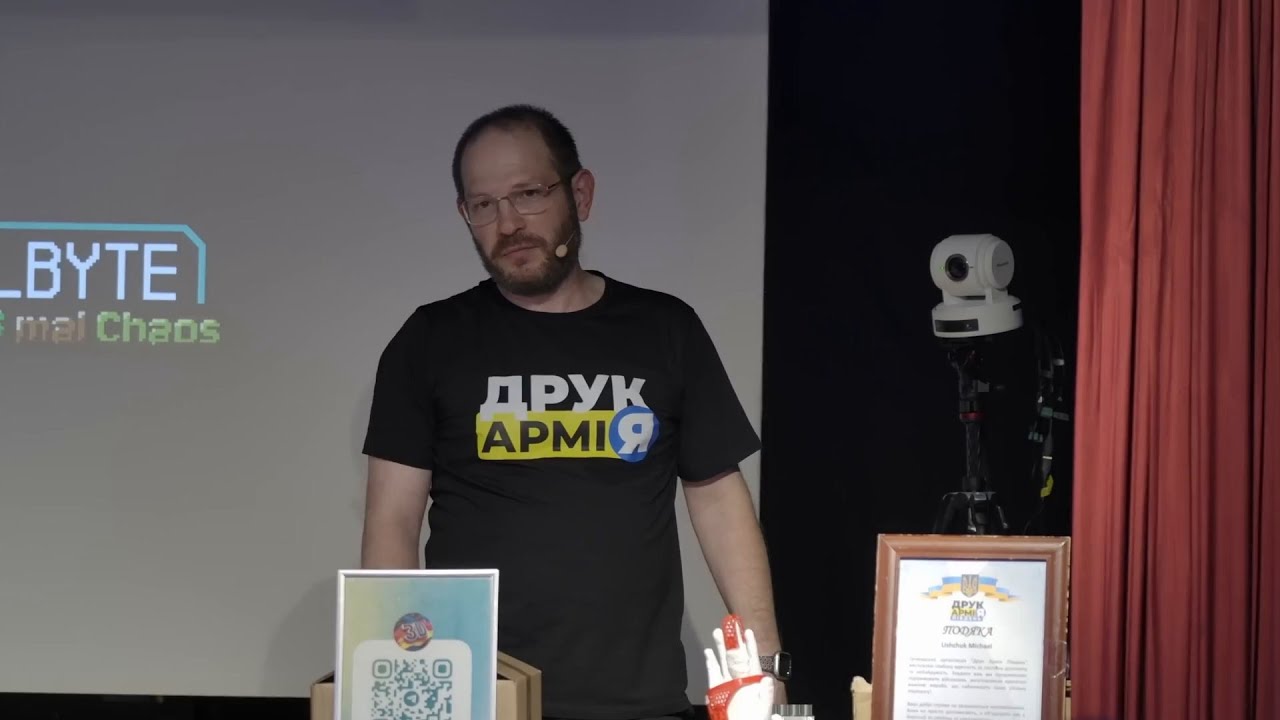
introduce myself. I'm Michael, I
come from Frankfurt, and I'll be presenting and
explaining a bit about the printing army,
or "print army," as it's sometimes called
. Perhaps you've already
heard about it.
That's why I'm here today. Print mir
unites volunteers who have 3D printers
and try to help doctors and the military
. You can do that here
,
if you go to their website,
Printarmy, it says immediately that it's
free. That's why we are Volte, which
we make ourselves. The main focus, as
I said earlier, is medicine and
training programs,
and I brought along some
presentation material about what
we do here in Germany. This
means that you can see here
as confirmation that I am really
more into printers. And what I'm
saying, the truth is, I usually
use, uh, flags that
confirm to the people who
received something like that, that they literally
got it for free. And here is our
3D group. That means if you
go to the Print Army website, you'll see that we
are networked in European
countries and we have contact persons
in each country so that if you
join and ask questions about
how and what, and this is our 3D group
in Germany,
you can register there and
learn a little more about Print Army.
What we do in Germany, for example, are things like
medical procedures. You can
see that from something like this, and it's
self-explanatory. We have a hand bandage like that that
prints. She
usually says something like that is a patented
German product, around 20 or 30, and anyone
who deals with dirt knows how much it
actually costs, and you can see the benefit
when stabilizing, you need it.
It's made from PLA and is
also suitable for fingers. This is usually almost
the only thing that is pressed from PLA
. Otherwise, the rest will be
printed from a patch. PLA, logically,
hot water can flow in and out, and
then it bends, for example, in one
idea, the sun's
rays have started to bend on their own
. That's why, uh,
the model hand bandage is
pressed from PLA and the rest from PAGE. What does
Page do at the Doctors? Let's start
with small things. There
are tablets available so that each person
has the right thing they actually
need, and that's for every
need, so that everyone has their own. There are
screw-in versions or special ones
with a finger for opening and
closing, so that you can easily access
your medicine and take it quickly
. So, this is the medical
field. There's also
an
ampoule holder like this for doctors. It is also needed for every
doctor and so on.
Uh, unfortunately I forgot
to find a uh, uh, Wenensucher there. It should
be somewhere in the box. Searching for a vein
actually helps to quickly find a vein,
and a woman explained to me that
if you, uh,
Kantusia, I don't know how that
translates into German, that means, uh,
Schallwahle, is standing, has collapsed a house,
and so on. One has
lost one's bearings. This happens because the muscles
contract and the blood tends to pool
in the head. To
get back to normal faster, you need to get an
injection. And that's the problem
when you can't find the Wens
. And the device has a light, which
actually helps
to search faster, something doctors
really need. Everyone needs something different, for
example,
flashlights,
because logically everyone needs a
flashlight if the house is too dark, or in winter, or if you're out and about in the dark, and they are in very high
demand. They are also assembled in Germany,
in Mannheim and
Munich, and
batteries are usually used for them, but
I'll come back to that later.
I wanted to show you one or two more gems
from the medical field.
For example, an ampoule holder, which is large, that was
the small one and this is a
large one that
is portable, namely for the
Now you close it like this and there is also
a good carrying handle.
I showed you the small one earlier,
and now we're going to talk about electrical work, which is
actually very popular and widely done in Germany as well
.
You just saw flashlights, but there are
also different types of flashlights, e.g.,
helmet flashlights. Logically,
if the emergency services go into my house
and they have to do something with their hands
, then they need
free hands, and the
helmet flashlight is very good for that.
Then, logically, you would also use the power banger
when you
are outside of it. Small town, no electricity,
we all know that. You need a power bank for that, and
that's actually the highlight, or
what uses the most batteries, to
make such a power bank.
People who are outdoors love
power banks because you can charge your phone, uh,
you can connect your laptop, and that
's actually the connection to the
outside world, to family and so on.
That's why power banks are in demand and we have to
suffer secondly. Oh, I'm always so
fast.
The highlight of today's performance is
, I thought I'd bring a
highlight. This is actually something that has recently
been adopted and implemented in our pressure army
. These are, uh,
bones, human bones, so that for
people who are missing—
search operations are now being launched and
people are starting to be found in liberated territory—and so that more
people, uh, who don't
have specialized knowledge, uh, can be involved,
these models are printed, and then an
ordinary person can say: "Okay, I
see this bone, then I know what kind it
is, so that one can
distinguish whether it's a
human bone or an
animal bone." And that's what's being done. There's
also
a special section for prostheses at the printer, the prosthetic
splints, which are printed from TPU, for example,
and there are partners in
Lviv who help prostheses help people with disabilities
transition into a
new life, and uh, Druckarmen,
for example, makes the splints from TPU
. It's a very complicated
thing, but Druckarmen is also involved,
and as I said, it's a recent addition
and not easy. So
I asked my colleague to give me a second hug
. He said, "Michael, I'm
sorry, I love you, but second..." Sometimes
I don't press that. It's not that
simple. The supports have to be raised, and that
's a bit easier for professionals.
I mentioned earlier that we also
do training exercises.
For example, this is one of the
training exercises, where the printer arm isn't just for
beginners, but also for the military.
This is one of the
training exercises, so that we
actually know what we're doing, how to do it
, so that it
's logically effective. And there are simply
symbols, I call them domino symbols,
because to me they look like dominoes.
But this is how it's printed and given to
training schools,
officer training schools, so that
they learn, and
this is actually a NATO symbol
, meaning there's an order number
and it's part of NATO standard training.
Now I would hand this out to you
and have a look around,
because I don't think everyone has ever had something like this before.
Just
walk around so you can see which batteries
you need and actually the
flashlights, too, for playing around.
We need used ones in the gigantic
models, like the ones for laptops,
for example. They're all 1865 in there
. Usually there are 10 to 15, and if
two of them are tired, the laptop also gets
tired; it doesn't last that long
without power, without a power grid.
Then you need to replace them, and
we need them. We take them
apart, test them, and look for the ones with
the
right power output. Then the
two are put back together so they work.
With
helmet flashlights like these, we make them a bit
weaker, and one less so they
're not so heavy. We use
better ones because they have to be
more powerful
and produce more light
and shine brighter. That's why
we're constantly looking for where to
get the 1825. If you happen to
have a source, I would be very
grateful if you would contact me and
say we have something. What to do with it? Well,
you can do something really good with it
. That would be the first appeal to
you. The second appeal is, if you
recognize more 3D printing and own 3D printers yourself
, perhaps this would be
something to help you, so that you can
actually hold something in your hand and
know... This device has truly saved someone's
life, because everyone
wonders how you can talk someone through life with such
a device, or even with the donated batteries. It's
quite simple. The doctor is in a
dark room, and we're talking about doctors
who don't just talk to civilians,
but we're talking about civilians, which is easier to
imagine: a
collapsed building, dust, darkness,
especially since this usually happens
at night. Then they come, and
when you go in there, you need
light, you need constant light,
and there isn't enough for everyone. So
, of course, they get help now, and then,
for example, a village or a
small area isn't as well-served
as big cities, for example. And then there are the
volunteers they appeal to: "
Can you help us? We've
seen this, heard about it from you, and of
course, you try to help everyone."
And so, a doctor in a
rural area, if he has such a flashlight
and no other light source
, it's already a way
to talk to people. That's why I think
you can achieve a lot with spun batteries,
and if you have the skill
to press or solder such things,
then talk to people who have lived with their hands – that's what
I wanted to say. Do you
perhaps have any questions for me?
[applause]
Yes, please.
Are the print files also available on this
site? Yes, if you register,
as a beginner, you'll get one or
two files to start with, because you don't know who's
registering there, what their level of
knowledge is. It's actually
meant for everyone, for beginners, and I'm
actually responsible for beginners who
have absolutely no idea; they get
everything from me, and I put together a carefree package
for them. But those who want to go further
or go their own way, they
register, they get one or
two STL files to download, then they have a contact
person, and that's the
curator. If they have questions, they can
contact him, and he'll explain how and what.
And one more small addition: when you
register there, the
registration is divided into sections, and there's, for
example, an international
section, which is actually intended for
people and colleagues who
are abroad.
You're welcome.
Perhaps someone else has your question?
Okay, then I'm glad there
were so many of me here and that I had the
opportunity to share it.
Thank you.