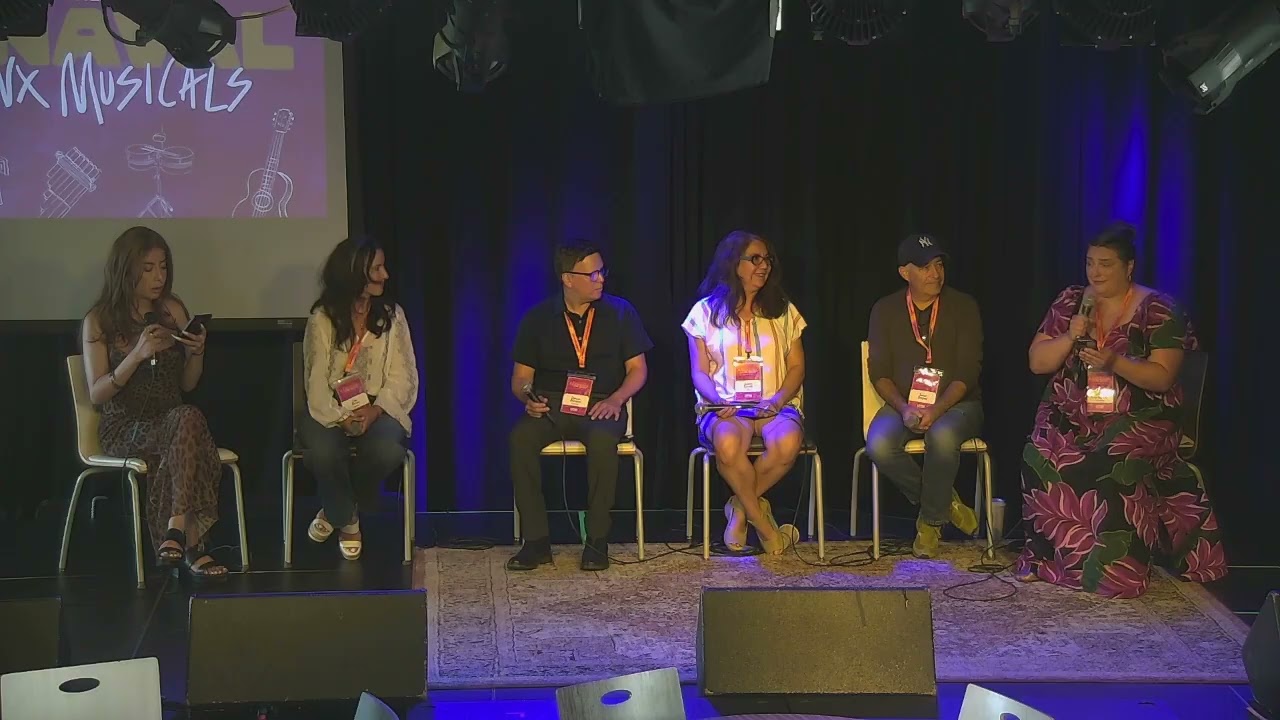
Directors Guateque at 2026 Latinx Theatre Commons Carnaval of New Latinx Musicals
Watch on YouTubeVideo summary
The opening of the "Directors Guateque" panel at the 2026 Latinx Theatre Commons Carnaval brought together five prominent directors, including Lisa Portes, Damaso Rodriguez, Juliet Caro, Pedro James Vasquez, and an additional participant, to share their artistic journeys. Facilitated by Juliana Fry Mendes and Rula Munos, the session began with heartfelt introductions where each director recounted personal origin stories rooted in family backgrounds, early exposure to theater through community centers or films, and influential mentors such as Joanne Echols and Pina Bausch. These narratives highlighted how diverse paths often converge on a shared passion for storytelling, setting a tone of inclusivity and mutual respect that defined the entire event.
A central theme of the discussion was the cultivation of deep collaboration within musical theater productions, with directors describing their work as nurturing a living organism rather than imposing hierarchical control. The panelists emphasized the importance of active listening and managing large creative teams by valuing every voice, while also offering practical advice for emerging artists on building experience through self-produced projects to maintain control over their destinies. They strongly advocated for hiring Latinx directors for works centering Latinx identities and provided strategies for navigating creative differences with playwrights or composers, suggesting that stepping away is sometimes necessary when visions do not align.
The conversation also extended to the challenge of engaging youth in an era dominated by digital distractions, urging directors to find meaningful ways to connect with younger generations despite these modern hurdles. Throughout the session, the facilitators and panelists consistently reinforced the idea that every attendee is both a unique artist and a person deserving of recognition, creating a supportive environment where gratitude was expressed for the audience's early arrival and active participation.
Ultimately, the panel concluded with a powerful call to action for continued community engagement within the Latinx Theatre Commons, encouraging attendees to carry forward the spirit of collaboration and advocacy discussed during the night. By blending personal anecdotes with actionable career advice and philosophical insights on leadership, the session not only celebrated the achievements of its distinguished directors but also inspired the broader community to foster inclusive environments where diverse voices can thrive without fear of hierarchy or exclusion.
Read the full video transcript
Uh, so thank you all for being here this
morning for our directors. We have all
of our directors from this weekend from
all of our readings here.
>> Yeah, give them a big round of applause.
>> Amazing. And we also have two of our LTC
steering committee members who will be
facilitating this discussion. We have
Juliana Fry Mendes.
>> Everyone and we have Amunos.
And they are going to take it away.
Thank you so much. Amazing. Thank you so
much, Bridget. Thank you all so much for
gathering in space with us. Thank you
for joining us on the live stream,
y'all. Um, this is called the director's
gu. So, um, we're going to introduce
ourselves, then we're going to introduce
these amazing artists and then we're
going to ask some questions and then
y'all have some time to ask some
questions. All of that in 50 minutes.
Let's dive right in. Okay. Uh, so Rua
Munos is a theater maker born and raised
in Mexico City. She's got a BFA from
Boston Conservatory and has an advanced
directing diploma from the National
Theater Institute at the Eugene O'Neal
Theater Center. She's an advocate for
presenting the intersection of queerness
and Latinad. Yes. and she directed
Crystal Ortiz, whose show we saw last
night Freaky Nation um for the Obie
Award-winning Criminal Queerness
Festival and is currently developing new
plays and musicals, new queer plays and
musicals.
>> Thank you. Hi everyone. Um yes, hello.
Uh well, no, it's my honor to introduce
Juliana.
Uh who is an Iowa born human who is
thrilled to be back in San Diego. She's
been giving me like insight here and
there working in campus. So, it's
amazing. I get like my private tour. Um
and uh where she got her MFA in
directing. Um and then um she's
currently d currently an assistant
professor at Oberlin College.
>> Yes. And conservatory teaching,
directing, acting and new work
development. Come on.
>> Yes.
And she will be directing the first of a
rolling workshop production of Alexis
Shear
Shear's irreverent adaptation of The
Passion Christina.
>> Right. Yeah. Give it up for Kulana.
>> And so now you know a little bit about
us, but we're not the main attraction
friends. We are here to have a
conversation with these incredible
directors and we're going to give you a
little insight to who you who they are.
Um and then we have a little bit of a
group activity planned. So get your
spirits ready.
>> Go for it, Rula.
>> Yes. Um so um let me introduce now uh
Lisa Portes
um who directed Suenos on Friday night.
Yes. Right. Um so Lisa is a leader,
director and educator and advocate whose
work seeks to expand our understanding
of who we are as Americans of the
Americas. Yes, she is the co-founder of
the LTC. So, she's one of the OGs, if
you will.
>> Yes. Um, and the chair of the theater
and dance department right here at UCSD.
>> Yes.
Most recently, she directed Kiote by
Octavio Solis at Brownhouse, Denver
Center, South Coast Rep, Seattle Rep,
Carland Center Stage, and Oregon
Shakespeare Festival.
Come on. Upcoming is the Lemon Trilogy
at Dallas Theater Center.
>> Antonio award-winning musical The of Two
Gentlemen at St. Louis Shakes.
>> Yes. Give it up for Lisa.
>> Amazing. I feel a little bit like we're
at an awards show and that feels right.
Like that's the vibe. Um it's my
absolute pleasure and honor to um
introduce to you all and you all know
him and love him, Damaso Rodriguez. Um
yes, we have to uplift Damaso who is
amongst the first Latina artistic
directors of a major regional theater
when he became the artistic director of
Seattle Rep.
now in his fourth season um at the Tony
Award-winning Theater. Um he previously
had a 9-year tenure as the artistic
director of Artists Rep in Portland,
which y'all, this is huge, which became
a member of the League of Resident
Theaters under his leadership. Okay, so
we are bringing up um institutions along
with artists. He co-founded LA's Furious
Theater, served as the associate
artistic director at the Pasadena
Playhouse. Yah, he's a director. He's a
producer of new and classic plays. And
the list of places that he has directed
is long. Actors Theater of Louisville,
ACT, Arizona Theater Company, Gable
Stage, Inman Theater, A Noise Within,
The Old Globe, OSF, Oregon Shakespeare
Festival, Playright Center, Portland
Center Stage, South Coast Rep, and many,
many more. upcoming. Very exciting.
He'll be directing Peter Pan Goes Wrong
and Amadeus at Seattle Rep and the world
premiere of I'll be your superhero by
Jose Casas at Seattle Children's
Theater. Give it up for Damaso.
>> Okay. And now I will uh introduce Juliet
Caro. Yes. Who directed Fruition that we
saw last night.
Now we've worked with the same
playwright Juliet. So we have more more
things in common now than we did before
this carnival. Uh Juliet has directed
critically acclaimed premiere and
revival productions in theaters across
the country and internationally
including Oregon Shakespeare Festival,
Mark Taper Forum, South Coast
Reparatory, Yale Reperatory, Denver
Theater Center, Arena Stage and Seattle
Reparatory.
As a huge supporter of new work, she has
directed over 50 workshops of new plays
and was the director of the Hispanic
Playrates project at South Coast
Reporatory for seven years.
Come on. Um, a participant in Sundance
Theater Institute's theater directors
retreat in Arl France. She is a 2025
Macdow MDAW fellow. Also a playwright.
Juliet has written four commission plays
for Cornerstone Theater Company and was
a 2026 writer in residence at Ohio
Playrights Conference.
Her upcoming projects include a
production of Benjamin Benz at the very
bottom of a body of water at Boston
Court Theater, Amy Herszuk's adaptation
of a Doll's House at Oregon Shakespeare
Festival and her film Sannasio, a
full-length feature to be shot in Baja
California in 2027.
She is a Yale School of Drama graduate
on faculty at UC Irving and a proud
originating member of Latinx theater
commons.
>> Let's give it up for Juliet.
>> Amazing. And um finally on our panel
today is Pedro James Vasquez who
directed Daydreamer which we will all
get to see at 1:30 this afternoon. Yes.
Yes. Sit in the shade. Uh-huh. Um, he is
a Mexican-American San Diego native and
an award-winning national director of
theater. His recent works include
Signature Theat's record-breaking
production of Lin Manuel Miranda In the
Heights, which was included in
Washington Post's top 10 DC and New York
uh theater events. So lovely. Uh he is a
resident artist of the Old Globe Theater
where his production of Hair reopened in
2021 to critical acclaim. He also
directed the premieres of American
Mariachi and Under a Baseball Sky and
directs the annual holiday hit Dr.
Seuss's How the Grinch Stole Christmas.
Amazing San Diego tradition. Now this is
where history starts happening, friends.
This past holiday season, he premiered
the Spanish translation of the show in a
twoight sold out stage concert event.
And this year he's going to direct the
full production, which means if you are
in San Diego, if you're in LA, if you're
in San Francisco, if you're remotely
close, come to San Diego to see how the
Grinch stole Christmas in Spanish.
Friends, give it up. Amazing.
Yes. Let's give it up for all these
amazing directors again.
So, let's begin. Um, I'm going to post a
question for you all. And um so you are
just the tip of the iceberg of so many
so many directors that are are doing
amazing work just like the work that you
already do in your in in the corners
that you are in the pockets that you are
in the country. Um so I want you to just
kind of in a popcorn style like the kids
say uh to to share with us who are the
you know names of other colleagues who
come to your mind who are doing inspired
work similar to the work that you
already do and we will be compiling a
list of directors and choreographers who
can be hired to do this work just so in
any case that someone is looking for
them they can be like oh I know there
are so many of of us. So yes,
>> and I want uh I I want particularly if
this is okay with you to focus on
directors that we know have done music
theater. Yeah.
>> Yeah. Since this is a since one of the
things that we're trying to do with the
carnival is answer the question or
answer the response, I don't know any.
Right. There's a lot of directors and
choreographers out here that have uh
worked on musical theater and put in the
miles. And I'm going to hand it to
Damaso because as an artistic director,
he knows everybody.
>> Yeah.
>> Uh thank you. And we also sort of like
teamed up in the corner before we
started and started brainstorming
together. So I'm going to go through a
little a list. All right. And we'll add
to it. Um okay. Uh so uh this is
treacherous by the way. It's live
streamed and recorded. Right. So I'm
going to I we're going to emphasize
people we know and then maybe later
we'll hear names we ought to know. Okay.
>> Start. Yeah.
>> So start thinking of names we ought to
know. Friends in the audience.
>> So these are people I have met, we have
worked with etc. Right. Moises Kaufman,
Jose Luis Valenuela, Michael John
Garces, I'm gonna Lisa Cortez, me I'm
interested. Let's do a musical. Henry
Godinez, Liliana Blaine Cruz, Juliet
Caro, Marcela Lurca, KJ Sanchez,
Lorie Woolery, Haime Haime Castineda,
who just became the artistic director of
Dallas Theater Center.
>> Yeah. Um, uh, Michelle Houseman, who
runs Miami New Drama. Amazing work
there.
>> Have to slow down. They're typing.
>> Oh, okay. Well, okay, I can repeat.
Michelle Houseman,
>> James Vasquez. Hey, James.
>> Um, Julia Rodriguez Elliot, who runs A
Noise Within in LA, founded in 1991,
been there the whole time running the
theater. Johan Morales, artistic
director of Seattle Children's Theater.
Jerry Ruiz, Talak Rivas, Mark Valdez,
Estfania Fadul. All right, so there's
some other names in here. Anybody want
to add it? William Carlos Angulo.
>> Yeah. Elena Arouse.
>> Next generation Eden Alan. Sarah
Rodriguez and uh Angela Cruz. Rebecca
Martinez.
>> Jean Carlo Yunen,
>> Rebecca Morilo,
>> Maya Garcia,
>> Ken Mass.
>> Who else? Yes.
at Syracuse.
>> Yes. Shout out Melissa. Yes. Melissa
Sanchez.
>> Olga Sanchez. Right here.
>> Yes. Um David. And then we'll come here
and then back there.
>> Rebecca.
>> Rebecc Rebecca Panio.
>> Aanio. Thank you.
>> Tatiana Carlo.
>> Tatiana Marie Carlo
>> and Matthew B. Cullen.
>> Great. Elena in the back. And then Oh,
great. Go ahead. Stephania,
>> she's there.
>> She's there. She's there. We got it.
Stefania.
>> She's got the wrong instead of She's
typing.
>> Kai is typing.
>> Go for it.
>> Tatiana Pandani.
>> Oops.
>> Great. Yes.
>> One more time.
>> Susan.
>> Melia Ben Susan. Darl
>> oversight.
>> Miranda Gonzalez. Thank you. Thank you.
Yes. O. And then
>> Christian.
Munoz.
>> Yes. Rula Munoz.
>> Eric Schwarz.
>> Eric Schwarz. Thank you.
>> Mark David Pinate.
>> Yes. Christian.
>> One more time.
>> Anna. Sargas.
>> Gorgeous. Thank you. And Dan, did I see
your hand?
>> Yeah. Lorca Perez.
>> Lorca Perez. Um, great. We'll go one,
two, three, four, five, six, and then
we'll move on. Okay. One.
>> Are you okay?
>> Yes. L.
>> Yes.
>> Next. Sebastian Bravo Montenegro.
>> Sebastian Bravo Montenegro. Okay. Who is
three? Call it out.
>> Yes.
Uh, yes.
>> Great. Great. Daryl.
Thank you,
>> Patrice.
>> Alex Mendoza, last word. David
>> New Jersey and Rick Sanchez and San
Antonio.
>> Amazing. We This is a rough draft of a
list that obviously we cannot capture
the completeness of it. It is in this uh
rough draft. We will put into the liner
notes. If you have the contact
information for these folks, please
populate it. Um, and um, then use feel
free to use this as a resource to send
to folks who are interested. The QR code
to the liner notes is in your program.
Um, and also you can always send a
oneliner email to Bridget to be like,
"Hey, what was the list of those folks?"
Amazing. Great. Shall we move on, Rula?
>> Yes.
>> Great.
Um,
oh, uh, great. It's me. Um, lovely. Uh,
okay. So, now that we have created this
beautiful list and we've called all
these people into the space, um, we'd
love to hear a little bit more about
your journey as a director. Um, thinking
about your trajectory, but also your
inspirations. We're curious about were
there artists or ancestors whose work
fueled fuels um your passion and anyone
can start.
>> I I'll start. Hi.
>> Um James um uh I I grew up here in San
Diego. Um my uh father um is a Mexican
immigrant and um uh my mother was a
dental assistant. So, while my mom was
um working, I hung out with my dad as a
kid. Um and he was a big old hippie. Um
we we sat around, we listened to Bob
Dylan. We uh painted a lot. We he wrote
a lot of poetry. He still holds up in
the bathroom in the middle of the night
and writes poetry. And he was part of an
organization here in San Diego um uh
called the Community Arts Center. And
it's in it was in warehouses where
Horton Plaza
>> now stands once stood.
>> Um they got kicked out because Horton
Plaza was being built. But what this
warehouse was was um three or four
floors where local artists or traveling
artists came in. And so when I was four,
five, six, seven, I spent my time there
with my dad. He was one of the people
who helped run it. um and on a daily
basis was was watching dance troops, was
watching uh artists come in and paint
each other. Um musicians were so very
similar to this. I grew up in a very
similar like just sort of artists world.
Um a and from a and when I was five in
uh school, you know, you have spirit
week
>> and for future day, I took my
grandfather's robe, felt from my mom's
sewing kit, um a a cutout director,
glued it to the back of the robe, put on
a beret and a scarf, and went to school.
>> And and my mom says, "And that was
that."
But but I feel blessed that I sort of I
I was thrown into a world of just
creatives and weirdos and wonderful
people, authentic people.
>> I'll go next because there's a little
bit of a similar connection here. Um
both my parents were painters. They met
at UCLA at art school. Um my uh my
father died quite young actually. He was
60. Um but I am still surrounded by his
paintings. Um I actually had a dream
when he passed away that uh he said to
me, "I'm still here." And he hold held a
frame around his face.
Um and um he now 30 years later is um
represented at the Smithsonian. The
Whitney has his paintings. He's like
famous.
>> Um but um
he he
was kind of a master of capturing the
world of in between. So he uh he he was
interested in realism. He did he did a
lot of realistic portraits but he was
mostly interested in kind of finding
heightened worlds um and also a master
of color and so uh tremendous tremendous
influence in my work. I'm also very
interested in the worlds of in between
um in the in not so much in materialism
but in like what else is out there in
the unknown. I'm very curious about
that. Uh so um so he is he's uh still an
influence on my work for sure. Um, I I
thought about directors and I would say
Joanne Echolytus and I want to show
shout out her name because not a lot of
people folks not a lot of people know
that she was actually chosen by Jop to
take over the public
>> and she took she took that she came from
the avantgard Mabu Mines
um and uh went into this organization
and shook things up and she got fired.
But I had an opportunity to um to to
assist her and it was it changed my
life. I had assisted many many directors
up that point. I went to Yale and I you
know had a lot of opportunities to
assist at Yale and then after. But when
I assisted Joanne who came out of this
avantgard tradition
um I was completely blown away and was
like
I understand directing now. Um, and then
the third one I wanted to shout out is
was is Pina Bosch. Um, I'm an incredible
I love the body, human body on stage and
uh, what I love about her work is that
she's so emotionally courageous. So,
it's a combination of her whimsy and
humor, emotional courage, and also her
incredible visual delight that she
creates in her work. So, I think all of
those
stirred around are pretty much what I'm
interested in and create on stage. So,
yeah,
>> nice.
>> We'll go down this way. I I'll I'll
we'll stick I'm going to stick with this
theme of f kind of family starting out.
So, uh my parents are amazing and they
are not artists. They weren't I didn't
have points of reference uh if
professional art or even just like um
you know non-professional art making. Uh
but we did my uh we we went to the
movies a lot. Um uh like regularly went
to the movies as a kid and my dad would
show me movies uh and it was this is pre
you know um you know uh recorded stuff
right to and whatever. So you have to
watch what's on. And I remember uh
Westside Story came on at 11:00 p.m. and
I was about 10 or 11 and I was allowed
to stay up late. I had to was like you
should watch this and I stayed up um
till 1 in the morning or whatever it was
watching that and uh and it's not only
obviously you know we we've talked about
uh its problematic nature viewed through
our lens now but at the time just seeing
um hearing Spanish my middle name is
Benado right so even that was kind of
resonant um uh and uh anyhow but I
learned it was a play first and you
could tell it was a play it was very
heightened not realistic
compared to like say the sound of music
which I had seen or fiddler on the roof
those classic film versions. So there
was a kind of an awareness there of
theater through that but we didn't go to
the theater. Um, and then and I was kind
of painfully shy as a kid. And then my
dad uh and my mom made ma made me
basically take a speech class in uh
junior high in nth grade. And the kind
of public speaking piece of it, the
preparation to perform in a way and even
like little improv games and exercises
in that context, I lit up and I got
positive reinforcement and I I did well.
And then I took the drama class the next
year and that kind of went down my
that's the you know it's a longer story
but I would say like that uh that speech
class led me to theater and then uh when
I went to college at Texas A&M
University just a general studies major
afraid to declare that I wanted to do
theater I went to the um drama club
meeting and there was an improv game at
the end of the meeting and I did the
improv there and uh I got a laugh and I
got positive recognition and it was fun
and so then I went uh to audition for a
play and I got cast in the play and then
two years later I declared myself a
theater major and I told my parents I
was going to be an actor. Um, but I
became obsessed with improv and in
college and started an improv group and
my learning was based on those games we
were playing and going and getting books
and reading about the Second City and
Truth in Comedy uh by Dell Close and
Chara Halpurn and uh and then I was also
doing you know plays and learning about
theater history and all of that. So I
went to Chicago and I and so the first
seven years of my career I was I was
like improvising five days a week. Um,
and then later I decided that uh I moved
to LA. It's a long story, but I I said,
you know, I don't know that it's acting
that I've been interested in all along.
I think it's the problemolving that
happens in community when you're trying
to figure out how to tell this story. So
maybe that's why I was seduced, you
know, by by this. And so then I said,
well, I guess I need to learn something
about directing. Now, I had been
directing, but it was more like
leadership versus craft and things like
that. So I went to a noise within which
Julia Rodriguez Elliot was our co-art
artistic director and I spent a year
there studying classical theater uh in
an apprenticeship there and then I
started a theater company and um so in a
way my influences aside those that very
early origin story has been like
watching what other people have done and
trying to copy that trying to learn
secondhand and then along the way you
pick up mentors and practical
experience.
>> Yay.
I'm gonna stick with the daddy issues
theme.
Um, my dad is a Cuban exile. My mom was
an Air Force brat. I'll bring in my mom.
My mom is a an Air Force brat from
Nebraska. So, they were um neither of
them had a sense of home. They were very
parapotetic. So, I grew up between uh my
dad was climbing the academic ladder
between college towns in the Midwest,
you know, Madison, Champagne, Austin,
you know, these towns. Lincoln,
Nebraska, you know what I mean? Um uh
and big Latin American countries like
Rio de Janeiro, Santiago de Chile, um uh
uh Cali Colombia. Um so by the time I
was 10, oh Rio de Janeiro, Brazil, um
Brazilia, by the time I was 10, I'd gone
to like eight different schools, right?
Um so um uh I started I think I just
started I just started making plays. At
one point I just started I did a puppet
show when I was five. if I put together
a little puppet show with paper bags.
You know paper bags? You remember those?
I sold tickets throughout the
neighborhood for a dime. I was so
excited cuz everybody bought a ticket
and I was like, "They're all going to
come. I'm going to have a huge house
like this." Um and um the March of Dimes
boy was collecting dimes that day and my
mom made me give all my dimes to that
boy
>> and also only two kids showed up and I
realized that all the parents had just
bought tickets to be nice to me.
>> So that was my first experience of not
for-p profofit theater.
But but I continued making shows and one
thing that I found out was that my
father was very busy climbing the
academic ladder. is a very famous
sociologist and um and my parents were
divorced. Um and I think one of the the
ways that I was um trying to make sense
of the world that I lived in because I
kept moving was to just start to make
worlds. I would just start to make
worlds of my own and I would I would
recruit anybody, you know what I mean?
Whoever was living in our house, my
brother, my sister, my cousins when they
were around and I would make plays and I
found out and they were often musicals.
I remember one called it was about um
you'll recognize this dominoes. He's the
mano. The terrible mano. No, nobody got
it. Okay. The mano is the first person
in a game of dominoes. It's very Cuban.
Anyway, um uh uh I could get my father
to sit down and pay attention when I did
a play.
>> All right. So, I did a lot of them. And
then my sister was very good. and um she
was very good in the plays and we
learned pretty quickly that we could get
him to pay attention to us if we put on
plays, positive reinforcement. Uh and
then she became an actor and I became a
director and I'll go into the directing
story in a second. And my dad said,
"Bro, why aren't two of my three
children artists?" And I was like,
"Well, because you paid, you know, if
you because you paid attention to us
when we were making theater." Um he's
like, "Well, I would have then paid
attention to you if you were, you know,
having a debate like becoming a lawyer."
Anyway, um uh so directing I acted a
lot. I acted from elementary school like
many of us. I acted in high school. I
acted in college. Um but I became very
interested in Forness
>> and Jane.
>> Um and I was reading Forness and Jane
and I was like, I want to see it. I want
to see it. So I began directing in
college at Oberlin College. We got a lot
of Oberlin. Um because I wanted to see
the world of Fortress and the world of
Jane on stage. Uh, and then I applied to
graduate school as an actor and I got in
nowhere and I cried and I cried and I
called my dad, "Dad, I didn't get into
grad school." And he's like, "Well, why
why did you apply as an actor?
>> You're a director."
>> And then I applied for a fullbrite and I
applied to UC San Diego
>> and it was a fullbrite to go to Colombia
to study under Enrique Wavventura. Um,
and I got them both
>> and so then I was like, I guess I'm a
director. And then I said, "Dad, how did
you know?" He said, "You always did it."
>> So, there's that. I will also say my I
want to shout out my mom for her
emotional heart. Um, and for helping me.
I have three emotions. Sappy, sad, mad.
I don't understand anything in between
those things. My mom helps me. Um, and
my stepfather ran the Civic Auditorium
in Lincoln, Nebraska, where I went to
high school. So I saw a lot of rock and
roll really early on,
>> you know, and I think that scale and
sense of spectacle mixed with a kind of
love for alternative dramaturies like
Forness, um, really created who I am as
a director. And then I'll shout out my
mentors, Dez Machino, Robert Woodruff,
Andre Serbon, um, Emily Man, uh, uh,
Carrie Pirof. Um, yeah, those are my
main kind of directorial influences.
>> Thank you.
Yes, let's give it up.
So many amazing stories. Thank you all
for sharing um that with us. Okay, so
moving on. Uh would love to know how um
how do you foster a collaborative
environment that uh honors the unique
aspects of musical theater because it
has so many entry points and we learned
we were talking about that in the
scholars mixtape, right? how it has it
just so many so many moving parts. It
takes a a village uh to to do it and
just the intricacies of musical theater.
So, how do you foster that collaborative
aspect when you get to work on music
theater specifically as directors?
>> Anyone can start.
>> I'll go. Um because my team just walked
in.
>> Um it's okay.
Uh so I I believe that this is true for
plays and also musicals that work has a
life of its own.
>> Independent of any of us.
>> So Crystal has a vision, Satcha has a
vision, but the work itself has its own
vision
>> and that our job is to listen to the
work. So, it's it's really about getting
out of the way, you know, and uh
allowing it to
fru fruition, right? To come to
fruition. Um, yeah. So, so it's like I I
think as a director, it's about deep
deep listening and standing aside
>> and when you need to come in and, you
know, maybe nudge it one way or another
because it's asking to be nudged, you do
so. But really, it's about holding space
um and allowing the the uh collaborators
to
breathe into it.
That's my philosophy.
>> My favorite thing about uh music theater
is uh I I mean I think out loud. I I I
could never be a writer. I could never
sit alone in my house and write a play.
I think I would lose my mind. Um, and
the great thing about music theater is
you have so many collaborators. You have
the composer, you have a bookw writer,
sometimes you have a lyricist, sometimes
it's one or one of those folks or three
of those folks. You have a music
director, you have a choreographer, um,
and the designers and that you so the
team is large. And as to Juliet's point,
the team is all working towards making
something um that has not I you know,
especially on a new work, something that
hasn't been seen before,
>> you know, and so, you know, to to to
kind of steward that ship is a profound
honor. It's also, I think, super fun
late into the night or sometimes super
torturous late into the night as you're
wrestling with like what the hell is it?
But I think that kind of largecale
collaboration with artists at the top of
their game um is thrilling is thrilling
for me as a director. Um yeah, I'll just
leave it there. That that collaboration
is I think the the highest um the
highest art of our collaborative form.
you know, um it's it's interesting
because I I I
am asked often um how I view musicals
differently than directing um a straight
play. And quite honestly, I I don't see
any difference because um I I love
musical theater so much and I love music
and movement so much that I think even
in my straight plays there's a a dance
to it and there's a musicality to it.
So, um I work with movement directors
and I work with uh uh musicians even on
um uh non-musical plays. Um, and and I I
what I love about it is like right now
I'm going a little crazy because we're
all just sitting in these chairs and and
and there's so much about being
authentic and and being human and full,
which is about like up and breathing and
just moving and um,
>> you know, so I I love that and I love
when when we all get so inspired that
we're up out of our seats.
and we're just find ourselves dancing
around the the room.
>> Let's start dancing, you know, and I I I
um uh I I love
They can tell you, Marley and Eliza can
tell you. I There have been a couple
moments where I've gone, "Big idea," and
they'll go, "Maybe not."
And I'm like, "Cool." But but I love
that. I love the freedom of a room to go
boom and everybody then look at you and
laugh and we go okay let's try something
else
>> you know but um yeah up up and like
let's get up and move and let's let's be
free
>> I don't know if that was an answer but
>> what everyone's saying definitely
resonates with me I uh I'll so I spent
way too much time telling myself I I'm
not a director of musicals
>> that that's because that requires some
sort of specialized expertise and skill
set insight into music in a way that um
I don't have because that wasn't my
path. So at some point uh I was one of
my mentors. I was associate artistic
director to Sheldon Eps at Pasadena
Playhouse and we were doing a lot of
musicals there and I kind of carried
that energy into a conversation. He's
like, "Oh, well it's all storytelling."
And he at the time was doing plays,
classics, new work, musicals. uh and
television. And so that core idea that
you actually have what you need because
the core skills are the same. Um I love
this notion of uh this there's basically
the the thing we're working on together
is an organism. I think of it as that
and it has it's it sort of like starts
to take on energy and it has things it
wants, right? And so your job is sort of
like to sort of to respond to it, right?
Bring your own instincts and impulses
and listen to them. you might as well,
but essentially listening to everybody
else. And so as soon as you gather a
group of people to work on something
initiated by the creative team, right,
their their impulses, people start to
respond to it. And so like this is maybe
a little bit of the improv, you know,
identity where you just you you kind of
make humility part of your artistic
practice, meaning you don't know, right?
So your job is simply to respond um and
then to be courageous in that response,
right? And then ma like magic it might
all work out. So the other thing that's
happening in any play uh any story right
is in this I'm not inventing any of this
right every breath is active right
somebody is trying to make somebody else
do something or feel something right the
actors are doing that the moment is
doing that um and so just like paying
the director's job I feel like is to pay
the most attention to that
>> right because other people are doing
things like writing music and dealing
with the technical things that have to
be done in the you know choreography and
the director is is actually like
studying it and then you are this
extraordinary um project manager kind of
prioritizer
>> and it's not because you're
hierarchically superior in that way but
that's your job because if somebody's
not doing that the thing will will fall
apart because the pressure is so high
right
>> I just also want to say you know when I
got to UCSD oh wait applause applause
applause no
>> applause applause applause
>> when I got to UCSD I thought I was going
to be doing like you know Fornes and
like Croitz and Fospinder you know I was
going to through these Europeans. Um,
and then I was apprentice I was um
through the the relationship with La
Hoya Playhouse. My residency was with
Dez Machino and so I did a new musical
with him, a new play. And then I was
became the associate on the Who's Tommy.
And um uh and it was at that moment that
I really realized what popular music I
think somebody was talking about this
yesterday. Yeah. Really meant in music
theater. And so the other thing I want
to say about I was always driven to um
I'm always driven by or drawn to
languagriven playwrights. Um and in
music I mean music is the language right
and so you have to be you have to be
driven by the music itself and I think
though I don't make a distinction in my
approach between the words of the page
or the words of the writer and then the
words of the lyricist but the music um
really makes so much so many of the
decisions actually. It tells you what
world you're in.
>> Yeah. Well, I I would just um I I agree
and I would I would just my my the
reason I would I would go, "Oh, I can do
this, right?" Is that that is happening
in every play. It might be the lights,
right? It might be that each play has
its own rules, right? It's its own
storytelling mechanism. And yeah, when
you're doing a musical, you have this
particular um element that is core.
>> Yeah. I just love the music
>> and and this is such a beautiful
conversation and it makes me think of um
great great thank you. Um it makes me
think of um if folks have watched the
documentary about Mar Danny Fornes done
by Michelle Mean. It's called The Rest I
Make Up. It's available for streaming.
Um please watch for and canopy for free.
and she has a note card that says, "Love
is paying deep attention." And I think
that the I'm just hearing that um how
much loving attention we are paying to
the whole um which is so beautiful. And
um speaking of loving attention, we
would love to attend to you all. Um we
have a little time under five minutes.
So, if we don't get to you, feel free to
um speak with these folks later. Um but
do we have any questions? Yes, I see one
over here. Go ahead, Elina.
Great. And I'm just going to repeat it
for the live stream, which is how do you
navigate a moment where you're unable to
lock in with the playwright composer
around um around vision?
>> I might consider that I'm not the right
director for the project,
>> you know, not in any kind of combative
way, but I think I think it's important
to remove yourself if you're not the
right artist for the artists as a
director, you know. I mean, you don't
need to direct everything. Um, and I
think that that collaborate that
collaboration is so important. Um, and
that collaborative flow and
communication is so important that if
it's not there, you know, soon into the
project, you're not maybe not the right
person. You know what I mean?
>> I I would agree.
>> May three
>> also.
>> Okay. It's definitive. It is definitive.
Great. Right up here. Go ahead. Well,
I'm a proud proud sister of Lula and I
want to say she uh brought us today
because our love for theater was was uh
nourished and flourished from her. Uh
but I have a question because I'm a
mother to three teenagers and we also
have two little siblings in this era
where technology, AI, TV, all these fast
uh rewarding um accessible devices are
available to all our kids. How can we
still like you know nourish and flourish
and like you from your perspective what
would you say to parents to teachers hey
this is how you should be like also
nourishing and flourishing this love to
the arts to your kids I don't know if my
question makes sense thank you
>> it does yeah go ahead
>> um you you know I I I actually um uh I
work with a lot of kids and I I work
with a lot of kids from seven to uh 14
um and a lot of them it's their first
time on stage or or or in a project like
this and um they will come in on their
phones and on their iPads
>> um and they are stuck to this sort of
way of going and what I find really
exciting is
>> I watch a lot of the Disney Channel and
I watch a lot of other things like that.
So I have an awareness of of what's
going on in their worlds and what
they're watching. So I'll spend about
two minutes with them and then I'll say,
"Oh, that's really fun. What if we did
that?" And so I try to then engage them
in that same activity in storytelling,
but up on their feet and off. And I find
that nine times out of 10, two minutes
later, those devices are gone.
>> And we're acting out the world.
>> Um, and it and and suddenly they're just
we're playing.
>> Yeah. Yes.
>> Any I think we have time for one more
question which will be right over two
more.
Exciting. Go ahead.
>> What would you say to young directors
right now who are building their careers
on this page of musicals and new?
>> That's going too much.
>> Just do it.
>> Keep doing it. Just keep doing it. Do it
on the street. Do it in your basement.
Do it in storefronts. Do it, you know,
for free. Do it for five cents. Do it
for 10 cents. But just keep doing it.
>> Yeah.
>> Agreed. And you know, I know I kind of
know when someone is a director when
they can tell me what they're directing
next. And it doesn't really matter
whether you've been offered or hired.
You have your project. You're nurturing
the script. You've got the reading
coming up. You're starting a theater
company. You're doing the thing. So, you
have to control your destiny in that
way. And it's really hard and
unfortunate. That's how it is. But that
is how it is. But you also have to
acquire these this experience to work at
scale. So one of the things on that list
of names and forgive me but I'm just
going to pitch to producers out there
you know so we have very few latin
directors directing major largecale
projects right very very few
unacceptably few and part of the reason
is that part of the job of the director
uh is that the producer uh uh is
entrusting you with this massive uh
project right so at a regional theater
like Aloho Playhouse or Seattle rep
we're talking about a musical is going
to be two to
million. So, you're the $2 to3 million
project manager. What are you going to
do to get somebody to trust you with
that? They could think you're a genius,
right? They could they could think
you've won all these awards and they
want to hire you. Yes, that could be. Or
they could look at your experience and
say they've been there before. They've
handled some things. I'm going to trust
them with this project. So, that's very
practical and and dull, but that is
what's happening out there, right? So,
um, we need to you need to go get the
experience, uh, over it took me 27 years
to get my job at Seattle Rep.
>> Um, uh, you have to, um, uh, so anyways,
go out in the and get the experience. I
I I pitch to anyone who has the
opportunity to hire a director when the
project centers Latinx identity in any
way is please, please, please hire a
Latinx director. for now at least for
like what if we all did it for 5 years,
right? What if if you if you wrote the
book, if you're the producer, etc. Like
do that for a little while because the
system kind of talks itself out of
hiring the director really fast.
>> Thank you.
>> Great. Last question back here. Go
ahead, Darl. Oh. Oh, great. Sorry. Go
ahead. My name is Matthew. Uh, and one
of the things I love about theater is
that he's constantly asking, be
learning. And so I'm an early career
artist and I love asking, okay, you guys
are so much further ahead of me, right?
What is something that you've learned
recently as a director that you're
starting to apply to your practice?
>> It's a great question.
>> I'm trying to um
learn how to I'm trying to learn how to
uh slow down. My work is a a little bit
antic. You know, people are My dad is
always like, "Why is everyone always
running around in your productions?"
>> So, I'm trying to figure out how to
direct something elegantly and maybe at
a different pace.
>> I Okay. I've been thinking about um
early in your career you may speak for
myself like everything I was directing I
had been carrying in my pocket for a
long time right because I was
self-producing so I like really this
piece had to had to exist I was you know
I had a vision for it all that so those
early projects may be like that right or
it's you're working with your closest
peer collaborators and then the more you
work you might just be assigned
something that that is sounds amazing
but you have no history with it right?
Or you have no history with the
collaborator. So, I guess the craft
itself of how to flow in the room and
manage process and just like the the art
the art of the process has been
something I've just been really um I
don't know, I realize I've been learning
it even even more recently.
>> Yeah. You know, um uh the learning never
stops. And and I think it's really
wonderful that um I I I'm surprised that
I will get emails um and uh from a
theater or my agent and they'll say,
"Hey, this person's interested in being
your associate and wants to shadow you."
And I'm like,
>> "What?"
>> Because to this day, I still actively
seek out directors that I admire
>> and see if I can sit next to them in a
process.
>> That's right.
>> Yeah. So, the learning never stops.
I think this is connected to what I was
saying earlier and this is this is the
practice the practice for me is
um how do I it's this is going to sound
very zen but how do I push a project
forward
um and let go of it at the same time
>> because I do like I said it is it
doesn't belong to me it belongs to the
room so how do I how do I allow that how
do I encourage that in myself and also
it has to do at the same time you have
to emotionally invest 1,000%. You have
to be the characters. You have to be
>> you have to go through the experiences
that the characters are going through
1,000%
in order for it to fully fly and at the
same time let go of it. So yeah, it's
that's that is a lifetime practice.
Yeah.
>> Yeah. Amazing. Amazing. Yes. Round of
applause.
>> Thank you so much to our wonderful
wonderful directors. Um, thank you,
Rula. We We've had a blast.
>> Thank you.
>> Yeah. Um, we are going to um transition.
We're going to hand it off to the
wonderful Bridget who's going to come up
here and let us know what's next. Um and
just to say that um one of the things
that is wonderful about the LTC is that
we gather in community on the same plane
literally the plane of existence and um
some folks have more credits and some
folks has less but we are all in the
journey together. So, keep coming back.
Join the steering committee to help us
make decisions, especially programming
that's coming up. And um don't be afraid
to talk to people because we are all
artists and we are all people. Um thank
you so much. Thank you.
>> Thank you all for coming out so early.
Yes. Yes.