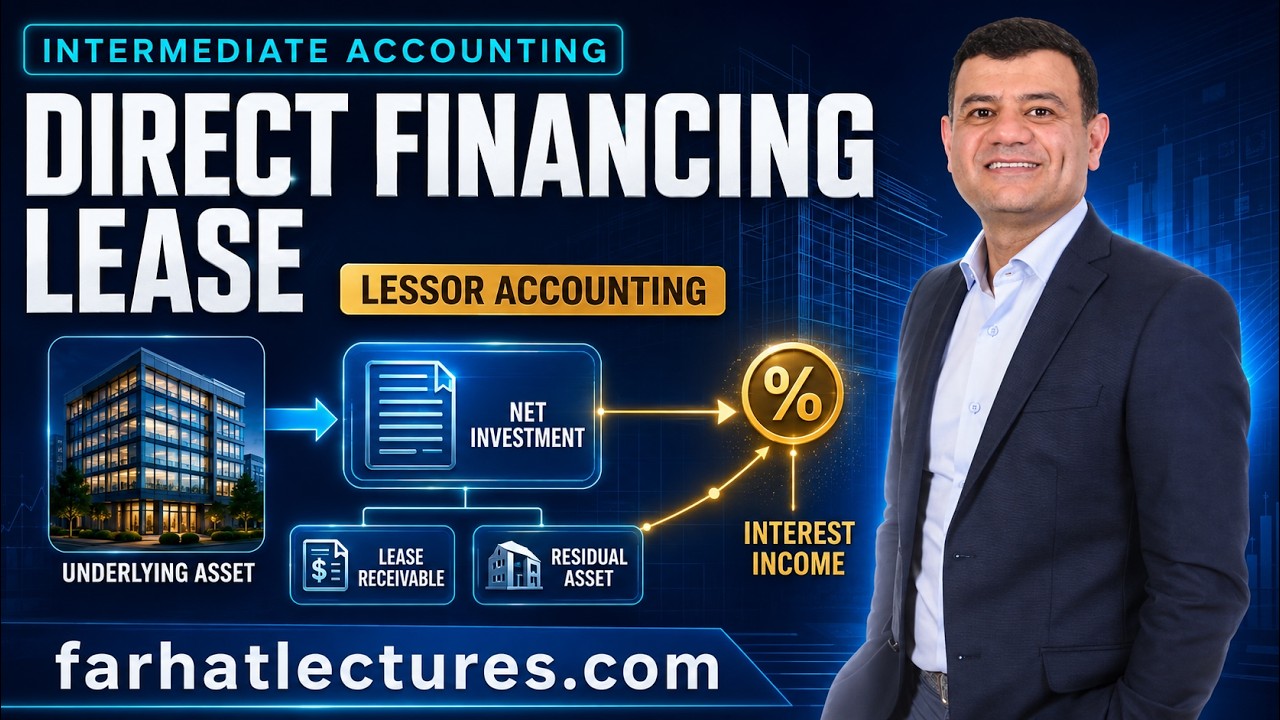
📊 Direct Financing Lease — Intermediate Accounting
Watch on YouTubeVideo summary
Direct financing leases represent a specific classification used exclusively by lessors to distinguish their role from that of a seller, particularly when the economic substance of the transaction differs from a standard sale. Unlike sales-type leases where ownership risks and rewards are fully transferred to the lessee, often evidenced by a lessee guaranteeing the residual value, direct financing leases occur when the lessor retains significant risk because no party guarantees the asset's future value. In these scenarios, the lessor does not recognize an immediate selling profit upon commencement; instead, they act more like a financial institution or lender, earning revenue primarily through interest income over the life of the lease rather than from a one-time gain on sale.
The critical factor that separates a direct financing lease from an operating lease is the involvement of a third party guaranteeing the residual value. When a third party, such as a bank or insurance company, guarantees the asset's value at the end of the lease term, the lessor remains protected against downside risk even though the lessee does not bear that responsibility. This arrangement means the lessor has not technically sold the asset but is instead financing its use while relying on the third party to cover any shortfall in the asset's value. Consequently, the lessor records a net investment in the lease based on the asset's carrying amount rather than its fair value, deferring any potential profit difference between these two values to be recognized gradually as interest revenue.
To illustrate the accounting treatment, consider a scenario where a lessor fails all criteria for a sales-type lease but meets the 90% threshold when combining lease payments with a third-party residual guarantee. In this case, the lessor records an investment at the carrying amount of the asset, ignoring any upfront profit that would exist if the asset were sold at fair value. Over time, the lessor calculates interest revenue using an effective yield rate that is higher than the implicit rate in the lease payments. This elevated rate accounts for the deferred profit, ensuring that by the end of the lease term, the total income recognized equals what would have been recorded immediately in a sales-type lease, effectively spreading the recognition of that profit over the duration of the financing arrangement.
Ultimately, while the timing of revenue recognition differs between sales-type and direct financing leases, the total economic profit generated over the entire life of the lease remains identical. In a sales-type lease, the lessor recognizes the full profit upfront and earns interest at the implicit rate, whereas in a direct financing lease, the initial profit is deferred and earned later through a higher effective interest rate. This distinction highlights that a direct financing lease is fundamentally a financing transaction where the lessor provides capital to the lessee, protected by third-party guarantees rather than bearing the full risk of ownership transfer, thereby shifting the accounting focus from sales revenue to long-term interest income.
Read the full video transcript
Hello and welcome to the session. This
is Professor Farhat in which we would
look at direct finance lease. Now the
first thing I want you to know about
direct finance lease, it's a
classification by the lessor alone. It's
not a classification by the lessee.
Remember the lessor is the person or the
party that owns the property like the
landlord and the the landlord allows the
lessee to use the property. So under the
lessor, they can classify a lease as a
sales type lease and we did cover that.
They can classify the lease as an
operating lease and then we did cover
that and there's a third category
which is called the direct financing
lease where the lessor can will be able
to classify the lease as a direct
financing lease. Now I'm going to tell
you the key point and why a lease could
be a direct finance lease. Now I'm going
to tell you also most
CPA exam courses, most CMA exam courses
don't go in depth and explaining the
reason why it's direct finance lease.
I'm going to try to make sense of it as
much as possible because it's very
important to understand the reason. The
reason why it's a direct finance lease
not a sales type lease. So this is what
I'll try to do in this session. First,
set the ground why it's a direct
financing lease and after that I always
work an example to consolidate the
knowledge and I will show you the
example side by side if it was a sales
type lease versus a direct financing
lease so you will understand the big
picture.
The key word in all of this is control
and you're going to see why I I say that
and control and within control it's
going to come something called residual
value. And who is guaranteeing the
residual value is important. It's going
to determine the control aspect of the
transaction and based on that we will
determine whether the lessor will
classify the lease as a sales type
lease, operating lease or a direct
financing lease. Let's go ahead and get
started.
>> Before we proceed any further, I have a
public announcement about my company,
farhatlectures.com.
My AI turns any lecture into a complete
study system. You can create summary
table, formulas, and example from each
lecture. Flashcard builds from the
lesson itself. A quiz built on the
lesson. And as a bonus, convert any
lecture into a portable short audio on
the go. So, it helps you with the
retention. No noise, no generic
responses, just clarity based on that
specific lecture. Don't just watch,
interact, test yourself, and retain the
material using Farhat AI. Now, go to
farhatlectures.com now and see how the
AI can help you understand, practice,
and retain the material.
>> So, for a lessor, what they have to do
is this. They have to make a
determination. We have a lease. Is it a
valid non-cancelable lease? We assume it
is. Then we have to see if we meet one
of the five leases criteria, which are
do we have ownership transfer in this
lease? Do we have a purchase option,
which is a to be specific a bargain, a
good deal?
Um are we are we leasing the asset for
the majority part of its economic life?
And remember, the key here is 75%,
especially for the CPA exam, we need to
use something specific.
How about if we compute the present
value of the lease payments? You know,
is it the the it's for the majority of
the value of the fair value of the
asset? And the key here is if it's more
than 90%. And if the asset has
alternative use. If any of the answers
we need only one yes. If there's an
ownership transfer,
then guess what? We met one of the sales
type criterion, then we have a sales
type lease. So, all you have to do is
meet one or if it's an alternative use,
yes or no. Now,
assuming we meet one of them, we have on
our hand a sales type lease. And if we
have a sales type lease and we have a
cost is giving
and a fair value is giving, then we
compute a profit and we record the
profit at the commencement of the lease.
Basically, we have a sale. That's how we
treat a lease. It's a sales type lease
and we have a sale. If the answer is no
to all these
test. So, we did no
no, there's no bargain purchase, not for
the major economic life, no the present
value test did not pass on the lease
payment only and there is an alternative
use, it means it's not specialized
asset. If the answers are no, are we
done yet? No.
Uh is it automatically an operating
lease? Not yet. We have to look at one
more thing and that one more thing is we
have to see if the present value
of the payments, notice the present
value of the lease payment
plus, notice here, plus a third party
residual guaranteed.
If those are greater than equal to
substantially all of the fair value. And
again,
the test still at 90% quantitatively,
especially for the CPA exam and the CMA
exam in college courses. Now, in
reality, they will, you know, they might
use something else. And of course, we
have the collection of payment and
residual value is probable. We always
have to assume that we can collect the
payment and the residual value. But here
we have to focus on residual value and
specifically
third party residual value. What does
that mean and why it why is it important
in changing what's going to happen here?
Okay, if we meet both of those, if the
present value of the payment plus the
third party residual guarantee now equal
or greater than greater than or equal to
substantially all the fair value of the
asset, we have a direct financing lease.
Again, what does residual value mean?
Residual value mean at the end of the
lease,
someone will guarantee the value of this
asset. Usually in a sales type lease if
in the sales type lease if we have a a
residual value guaranteed, that means
the lessee, the renter, is guaranteeing
the value of the asset. But what what
does that mean? What does it mean if the
renter if the lessee is doing so?
If the lessee says, "I promise that when
I return this asset, it will be worth at
least 6,000. If not, I will pay the
difference."
Now the lessee taken on the jewel value
risk. What does that mean? It means the
lessor transfer all the risks and reward
of ownership to the lessee. The lessee
is responsible for risk and reward
because they are guaranteeing because
I'm going to recover my payments plus
the residual value guaranteed. So
essentially,
I sold the asset and that's why it's a
sales type lease because someone is
guaranteeing the residual value. I'm
going to get that value back. But what
we're saying here, it's a it's a lessee
doing that guaranteed. Therefore, it's a
sales type. Now if there's no
guaranteed,
nobody guaranteed the residual value,
the lessor will keep the asset on their
books. They bear all the risk assuming
it's an operating lease.
How about we introduce a third party?
And this is bit unusual, but we we have
to understand that it does exist in the
real world.
So maybe an insurance company, maybe a
bank, some other entity that's not the
lessee.
So here we have the lessee, the lessor,
and a third party is doing what? A third
party is guaranteeing the residual
value.
Maybe the lessor is asking the the
asking that third party. Maybe the
lessee is asking the third party to
guarantee, but someone is guaranteeing
that residual value, the third party. We
don't care, but there's a third party
involved.
So what difference does it make if a
third party is guaranteeing that? Well,
when the lessee guaranteed the the
residual value, they bear the risk.
And the lessor is fully protected.
So, we sold the asset.
But something different when a third
party guaranteed the residual value.
Let's think about it.
The lessee did not take on the residual
value risk.
What does that mean? It means the asset
has not been fully transferred
economically to the lessee.
But at the same time, the lessor is
protected. So, hold on a second. The
lessor is protected means they sold the
asset. Mean they don't they don't bear
they there's no risk for them because
it's guaranteed, but it's not the lessee
that's guaranteeing that risk.
So, it's like it's it's it's a unique
situation.
So, the lessor's risk from the asset is
converted into a risk from a third
party.
Well, because of that, now the lessor
will have what we called a credit risk.
And credit risk means now you're looking
at the less at the third party to
guarantee whether we get paid or not.
Not the asset risk.
It's a credit risk. So, FASB says,
"Okay, since
you did not really transfer the asset to
the lessee,
but you found an outside party to cover
your downside,
well,
you did not earn your selling profit
because you did not technically sell it
to the lessee.
You're essentially acting like a finance
institution, like a bank, like a finance
company.
So, that's why
in a direct financing lease, the lessor
is treated as the lender, not the
seller. That's why there's no profit
That's why there's no profit.
There's no
profit
like in a sales type lease. In a sales
type lease, we actually sold the asset.
Here we are playing the role of a
lender. And what did trigger that role?
That third-party guaranteed. Again,
and how how did we start with that?
Because the present value of the payment
plus because we failed all of those. So,
first we failed all these tests.
Then we would look if there's a third
party plus the payment will give us 90%.
If that's the case, then we act as if we
are the financee.
Think of it this way. I'll make it even
I'll make a simpler analogy.
Imagine a bank gives you a car loan.
Great.
The bank doesn't say we made a 3,000
profit today because they did not sell
it when they hand over the money.
Because they did not they earn their
interest income as you make your
payment.
And if you default, the bank takes the
car. So, the car is their backup
protection.
And a direct financing lease works
exactly the same way. The lessor is
financing the lessee's use of asset. And
the third-party guarantee, like the
collateral protection, the lessor will
earn interest, nothing more, until the
less the lease is fully paid off.
So, when they have a direct financing
lease, when we fail all the five tests
for the lease, but now we have a third
party that's guaranteeing the residual
value. And if you take that guaranteed
residual value plus the present value of
the payment, they're equal or greater
substantially all the fair value of the
asset, which is 90%. We have a finance
lease. Technically, we are financing the
transaction. We don't have a sales-type
lease. We don't have the profit. All our
profit is interest. Wow, that's a lot.
Okay, but that's basically what a direct
finance lease. If you want if you want
me to to summarize this as much as
possible,
you cannot make a profit because you're
financing the lease.
That's it. Why? Because you have a
third-party residual guarantee that made
that 90% threshold. If we don't meet any
of these
if even if we did not meet this test
here, there's no third party, then we
have an operating lease and we go back
to operating lease and we hopefully we
all know how operating leaks operating
operating lease work. We have a separate
recording for that. So, remember in a
direct financing lease we introduce this
present value of lease payment plus a
third party residual guarantee.
And when we do the when we do the
present value, we want to get the 90%.
Then we'll look at an example and
collect collection of payment of
residual guarantee is probable. We
always have to make this assumption,
otherwise uh we don't have really a true
lease here.
So, what's a direct finance lease?
A direct financing lease is is a lessor
lease classification. Remember, this is
for the lessor.
The lessee don't have this
classification where the lessor act as a
financier, as a banker, not a seller.
The lessor does not recognize an upfront
selling profit. Instead, all income is
earned over time as interest revenue and
we will see that. You might have a
profit upfront, but you cannot recognize
that profit upfront. You will recognize
it as interest income as you are
financing the transaction. Few things
you have to know, no day one profit. We
talked about this. There's no sales to
record, there's no cost to record,
there's no profit to record on day one.
We use the net investment approach. The
lessor record a net investment in the
lease at the carrying amount of the
asset, not the fair value. If the fair
value was given, we don't use the fair
value, we use the carrying amount, which
is the present value of the payment. The
difference between, if there's any
difference, the difference between the
fair value and the carrying value is
deferred and that's the profit in quote
deferred. Now, the old rules we used to
carry a deferred profit. Don't worry
about the old rules, we have to move on.
Now, what we do, we'll take that profit
and we will include the profit in the
interest revenue. We will account for it
in the interest revenue. How? Just bear
with me. I'm giving you the theory for
now.
Now,
how do we compute the revenue? We would
use the effective yield recognition. So,
interest revenue is recognized using an
effective yield that makes the present
value of future cash flow equal to the
net investment balance. So, somehow you
have to change the interest rate stated
and you will see how. We We don't have
to do it, but I'm going to show you what
does that mean, and earn the interest
revenue based on the effectively how
much you are earning.
And why effectively? Because the
interest rate stated is based on the
payment, plus you would have to use the
profit that you deferred, if any. Now,
if you don't have any deferred profit,
then it's the
same interest rate.
Now, the best way to illustrate this, as
in everything, is to
work an example. So, now, if you are
tired by so far what I covered so far,
take a break.
Think about why it's a direct lease,
direct financing lease. Think about it
for a moment, come back and work the
example.
Why? Because
I I invested some time to explaining why
it's a direct financing lease. In most
CPA review course, they cover the direct
financing lease in this time frame that
I just covered, which is I don't. I want
to make sure you understand why. Just
understanding is important, so you will
never forget it.
Because there's a third party
guaranteeing the residual value.
And that third party guaranteeing the
residual value
allowed us to to consider the lease as a
direct financing lease, not an operating
lease, because we already failed the
sales type. So, let's take a look at
this example. Robotics LLC leases a
quick robotics package picker to Anson,
the lessee.
Now, Bank of America, an unrelated
party, guaranteed the residual value.
So, we have a third party. Usually, hint
hint, if they throw in a guaranteed
residual
uh a party guaranteeing the residual
value, you're may most likely heading
toward direct financing lease, but be
careful in case you met the sales type
lease, it could be a sales type lease.
The lease commences January 1st, X0,
with a payment due each year, ordinary
annuity, at the end of the year,
December 31st. Robotics believes
collection is probable. Okay, we need
that requirement, it's there. The
commencement of the lease, January 1st,
X0.
It's a 3-year
uh lease.
The payment is due at the end of the
year, ordinary annuity, in case you find
the present value. The fair value of the
picker, the fair value is 30,000. The
carrying amount is 28,000. It means
there's a difference, there's a $2,000
if it's going to be a direct financing
lease, which we will, it's going to be a
third profit, and we're going to see how
we do with this, how we deal with this.
The residual value is 6,000. And what's
neat about the residual value, it's
guaranteed by Bank of America,
which is a third party. The economic
life of the asset is three.
So, let's look at the lea- lease versus
the life, lease versus life, we failed
the 75%. The implicit rate is 6%.
And at the end of the lease, the asset
reverts back to Robotics. There's no
transfer of ownership, so we failed one
test. Collection is probable. There is
no bargain purchase. So, what happened
here is, if we look at the at the first
five,
no ownership transfer, we failed that.
Purchase option, there's no purchase
option, we failed that.
3 / 5 is 60% below the threshold, we
failed that. The present value of the
payment, if we compute the present value
of the payments, it's 24,962,
which represent 83% of the 30,000.
Again, we failed the 90% as that sounds
The alternative use assets expect to
have alternative use. We failed that.
So, we failed all of those. This is not
a sales type lease. Now, we have a third
party involved. How about if we take the
present value of the payment and we add
to them the present value
of the Bank of America guarantee.
Present value plus the Bank of America
guarantee, we have a 30,000 100% of fair
value substantially all met of the fair
value or what we need is 90%. We met
that and we said collection is probable.
We met that. Voila, done, bingo, we have
a direct financing lease. Now, if we
didn't have those, that lease will be an
operating lease. So, it's not a sales
type lease, but we were able to meet the
criteria for the direct financing lease.
We treat it as a direct financing lease.
Now, let's go ahead and start to solve
this problem step-by-step with a journal
entry. So, first, let's find the present
value of the residual value
step-by-step. 6,000 6% 3 years
present value of a single amount.
0.83962.
The present value of that amount is
5,037. Then, we would look at the
present value and this is the detailed
computation mathematically. The present
value of the payment, we have to deduct
what we're going to be getting from Bank
of America as a residual value. What's
left is 24,962.
Then
we look at the annual rental payment
and we if we find the
amount of the rental annual payment if
we take the what we need to recover
divided by the present value annuity
factor 6% 3 years, we found the payment.
The payment is 6,300
$38.64
and I showed you how to find the
payment. The payment was not given. We
had to compute the payment here. We
should know how to do this. We covered
it in prior recording when we looked at
sales type
uh sales type transaction. Now,
if we look at the present value of the
three payments
plus the present value of the of the
residual value, we got it, 30,000. Just
a verification mathematically. Now, how
do we book the the lease? Remember, we
book the lease at the carrying amount,
not fair value. So, net investment in
the lease, the carrying amount. Be
careful, that's a common mistake that
students make in a direct finance lease,
we use the carrying value, not the book
value or only. Be careful. Why 28 not
30,000? Because the 30,000 is the
selling profit. The profit is earned
over time via a higher effective yield.
Not selling at day one. We don't That
difference of 2,000 is not recorded in
day one. It's implicitly deferred. Now,
the good thing about the CPA CMA exam,
you don't have to compute that implicit
rate. It will be given to you or you
just don't need to do it. Okay? But,
remember,
the immediately think net investment
income equal to the carrying value, not
fair value. Okay, just be careful on the
CPA CMA exam or in your courses as well.
So, how interest is computed, don't
worry about this, but we're going to be
using an effective rate once we find out
what we should earn. We should be
earning 9.4994,
which is 9. almost 9.5%. So, the
effective yield
to earn the additional 2,000 is 9.5.
Now,
this is the net investment balance,
28,000.
How did we find this? You don't have to
You don't have to figure this one out.
The cash we would receive, the payment,
remember, we computed this. Definitely
you have to compute the payment at
$9,338.64.
To find the interest revenue, you
multiply the balance, I'm sorry, you
multiply the the payment, not the
payment, the balance, 28,000 by the
interest, you figure out the interest
revenue portion, and anything left from
the $9,338.64 that's not interest
revenue,
it goes against the reduction in
investment, which is $6,678.80. It would
reduce the investment to $21,321.20.
Then,
another payment is received of
$9,338.64.
Again, we'll take the prior balance,
$21,321
* 9.5. We'll find the interest revenue,
and the interest revenue is going down
because the balance is going down, and
the remainder is toward the principal
until the balance goes down to the
residual value, and guess what? Bank of
America will guarantee this residual
value, and the whole thing will go down
to zero. Now, if we computed all our
interest revenue, if we added all our
interest revenue, it will add up it will
add up to $6,015.92,
which we effectively earned nine almost
9.5%.
Now, here are the journal entries. You
should know how to complete this because
it's the same thing as in
sales type lease.
Debit cash, credit interest revenue for
the first payment, credit the
investment. Second payment, same thing.
The only thing that's going to be
different is the interest revenue will
be lower,
and
you know, second payment, the interest
revenue will be lower than the first,
then the principal, then this is the
last payment.
Now,
let's do what if. What if Amazon, the
lessee, not Bank of America, had
guaranteed the 6,000? If Amazon
guaranteed that, we would be able to
compute the lessee residual value within
the payment, and we would have met a
sales type lease. So, if the problem
says Amazon, the lessee, guaranteed that
residual value, we have a
sales type lease. Just so you know this.
The only reason we have a direct finance
lease because we transfer that risk
to a third party and that transferring
the risk made the deal as a financing
financing deal. Now, if it was a sales
type lease, remember, we book the profit
if it's a sales type lease, this is what
would have been the entry. Debit the
lease receivable for the full amount,
debit cost of goods sold 25, credit
sales 30, and credit inventory. And
immediately we'd have a revenue of
2,000, that's recognized immediately. In
a direct financing lease, you debit the
investment 28. So, notice the investment
here
the receivable is 30, here it's the like
in the investment or the receivable is
28 because you are financing.
And the 2,000, you would account for
that 2,000 later on in the payment.
Later on in the payment when you
increase the effective rate from 6 to
9.5. And this is the
schedule side by side. This is a sales
type lease.
You're You're earning interest at 6%
starting with a balance of 30,000. And
you should know how to do this.
And a direct financing lease, you're
earning interest at 9.49.
You're starting with a balance of 28.
Now, here's what I want to show you.
When all said and done, notice the
interest earned over the life of the
lease under the sales type lease is
$4,015.92.
The interest earned on the direct
financing lease is $6,015.92.
Well, guess what? The difference is, you
guessed it, exactly $2,000.
That difference of $2,000 is not really
a difference.
It's a timing difference. Why?
Because the sales type lease, you took
the $2,000 up front. Up front, the
$2,000
when you recorded the sales and cost of
goods sold at the commencement of the
lease, you had a profit of 2K.
So,
guess what? The profit on both leases,
the sales type and the direct, is 6,015
in total.
The only thing difference is the timing.
In a sales type lease, you got the 2,000
up front.
And here's the picture of it.
Notice, sales type lease, you get the
2,000 up front, plus your interest
payment equal to 6,015.
In a direct financing lease, you did not
get the 2,000 up front, but you
recovered the 2,000 in the interest
payment, and your total was 6,015.
Again, you you approximately earned 9.5.
Don't worry about the rate. The good
news is you don't have to compute the
rate on the exam day. Exam questions
usually
uh they don't tell you this, but you
want to know which method produce higher
income in year one.
You might have to know that. In year
one,
the sales type lease will produce more
because they get more profit up front
for year one. But overall,
it's always the same. It's always the
same profit. Now, here are the journal
entries for both. So, notice under sales
type lease, when you receive the first
payment, your interest revenue is 1,800.
Under direct financing lease, when you
receive your first payment, your
interest revenue is 2,659.
Sales type lease, the second payment,
interest revenue 1,347.
Direct financing, 2,025. So, you're
recovering that 2,000
over the life of the lease, and this is
the remainder of the journal entries,
which you should be
pretty familiar with. Few things I want
you to see here about the CPA and CMA
exam. Remember, under direct financing
lease,
net investment is the carrying amount,
not the fair value. Be careful.
No day one selling profit in the direct
financing lease. You need a third party
that's guaranteeing the transaction.
You would use the you'll end up using
the effective yield. Sometimes it's the
same as the implicit if there's no
profit.
Same total income
over over time and the sequence matters.
Sequence means what? First, you test for
a sales type lease and this is where we
started. If it doesn't,
see if we have a third-party guarantee
in the deal.
The present value of that plus the
collectability, the PC.
And if we don't have any of those of
both, if we don't have any not any if we
don't have both of the second test, then
we go well with the operating lease.
Let's take a look at this multiple
choice question from farhatlectures.com.
A lessor record a net investment in a
lease at 45. The fair value of the
leased asset is 48 and the carrying
amount is 45. This is mostly most likely
is what? Sales type lease, direct
financing lease, operating lease,
finance sublease. Let's remove the easy
one, finance sublease.
We could also eliminate operating lease
because we're adding a net investment in
lease. We're not looking at rental
revenue. That's out.
So, we're between sales type lease and
direct financing lease.
Well, you have to know
in a direct financing lease, you would
record the net investment at the
carrying amount, not the fair value. Not
the fair value. That's all you need to
know. And by doing so, it you will not
record any profit as well. And it's And
the initial investment is recorded at
carrying value. If there's any profit,
let's assume it's 3,000, that profit
will be deferred in the interest revenue
because as a in a direct financing
lease, what you are doing is you are
financing the transaction. That's what
you are doing. And because you're
financing the transaction, there is no
profit on the sale, so it's not a sales
type lease.
Your profit is the interest revenue.
Therefore, you would recapture any
profit in the interest revenue because
you are financing the lease. It's a
direct financing lease. Now, if you are
using Farhat Lectures, you could always
ask the AI to explain the topic, explain
the correct and incorrect answer, create
a similar MCQ for you.
At the end of this recording, what I'm
going to tell you is this. What you
should do now is go to Farhat Lectures,
whether you are a CPA, CMA accounting
student, look at additional lectures,
simulations, multiple choice, AICPA
questions, AICPA video simulations, AI
resources. The best investment you can
make is invest in yourself, invest in
your knowledge.
Stay safe and God bless.