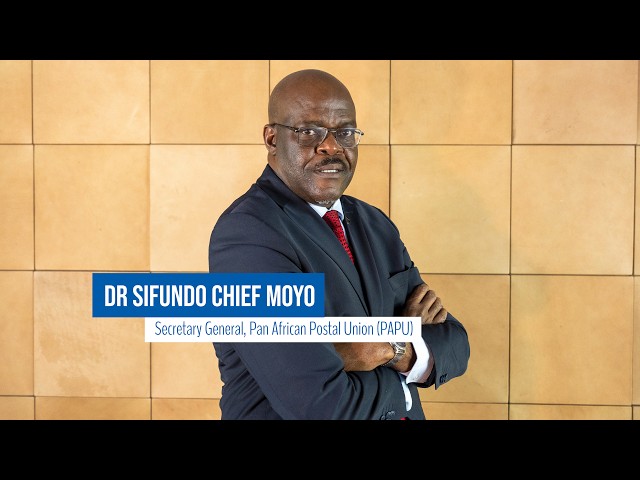
Digitalizing Postal Services in Africa | An Interview with Dr Sifundo Chief Moyo
Watch on YouTubeVideo summary
The primary goal of modernizing Africa's postal sector is to build a system that is digital, resilient, and aligned with current customer expectations and technological advancements. This transformation aims to reverse the significant loss of market share that postal operators have experienced by accelerating digitalization and upgrading infrastructure to better support e-commerce and last-mile logistics. By improving service quality through the adoption of new technologies, postal operators can regain ground in the competitive e-commerce business while simultaneously diversifying their offerings. A key part of this diversification strategy involves expanding into financial services to promote greater inclusion for all citizens across the continent.
To achieve these ambitious goals, a harmonized regulatory environment is essential to ensure that operators are not hindered by restrictive rules that prevent them from utilizing beneficial technologies or entering new markets. Governments play a pivotal role in fostering this conducive environment by promoting investment, which can take various forms such as direct government funding as shareholders or through public-private partnerships that leverage private sector equity. These collaborative approaches are designed to bring necessary capital into the designated operators, ensuring they have the resources required to upgrade their networks and services while maintaining a balance between public oversight and private innovation.
Central to the execution of this digitalization agenda is the Post Africa Union's (PAPU) well-equipped ICT capacity building center, which will serve as the intellectual hub for the continent's postal modernization efforts. Working closely with the Universal Postal Union, PAPU will coordinate projects that deliver tangible value to its members by identifying specific needs and overseeing their implementation from formulation to monitoring. A critical component of this initiative is addressing the skills gap; PAPU will collaborate with the UPU to provide expert training that equips staff and members with the necessary digital competencies. Additionally, specialized teams focused on remuneration, security, and digital services will be established and developed to support the broader digitalization strategy.
Beyond internal capacity building, PAPU is committed to keeping the postal sector open to private sector partners and facilitating the implementation of major initiatives like the African Continental Free Trade Area, where postal services play a central role in logistics and connectivity. By ensuring that external partners add value to the process, PAPU aims to assist its members in advancing their service provision capabilities to the next level. Ultimately, this comprehensive approach combines regulatory support, strategic investment, technological integration, and robust training to create a modern postal ecosystem that drives economic growth and social inclusion throughout Africa.
Read the full video transcript
The priorities were identified based on
the need by members to create a postal
sector that is modern, uh digital,
resilient, and relevant to uh the
environment where we have digital uh
technologies and expectations of
customers.
During this cycle, we expect to see an
acceleration of postal digitalization in
Africa, and we also want to see
infrastructure upgrade and delivery
networks to support e-commerce and
last-mile uh logistics. Again, posts
have lost a lot of uh market share.
During this uh cycle, we want to see an
increase in the uh market share by our
operators, especially in the e-commerce
business, and uh this goes hand in hand
with an improvement in the quality of
service. With the adoption of various
technologies, the quality of service
should improve, and this then should
support the diversification
uh initiative where we want to see a
strengthening in terms of
diversification of products and services
to also focus on financial services to
support um
inclusion uh of all our uh citizens.
This needs to be facilitated by
harmonization of the regulatory
environment so that uh uh our operators
are not disadvantaged by regulations
that may not allow them to venture into
areas and to use the technologies that
are beneficial to um
the citizens or to the customers. And
finally, governments have a big role to
play in ensuring that uh they create a
conducive environment, which includes
promoting investment. And this
investment can either be directly by the
governments as the shareholders of uh
the designated operators. It can also be
through the promotion of uh private uh
sector equity, where we have the
public-private
partnerships coming into play so that
investment comes from the private sector
in partnership with the designated
operators.
PAPU has its uh ICT capacity building
center, which is well-equipped. And this
center is going to play a central role
in making sure that digitalization
happens uh across the the continent. And
uh this center is going to be the brain
for uh the digitalization of postal
services in Africa. PAPU will be
coordinating projects as we work closely
with the UPU. We'll be playing a role of
identifying projects that uh will bring
value to our members. We'll be part of
the formulation, part of the monitoring,
and part of uh uh the team that will
oversee the implementation of uh these
uh projects. And in this environment,
capacity building is a key uh issue
because we need our members, we need our
staff to have the digital skills that
are required. And PAPU will identify the
gaps, coordinate with UPU on the
provision of experts that are going to
provide training so that the gap that is
there is closed. And speaking of
experts, PAPU is going to set up teams
in areas of remuneration, on
security, digital services, and these
will be trained, developed, capacitated
so that they will assist in the
digitalization agenda of the continent.
PAPU as the continental body will ensure
that it remains open the private sector
to other partners, and also ensuring
that projects like the African
Continental Free Trade Area
implemented, and the post plays a
central role in that. And PAPU also
ensure that partners add value to the
process and assist our members to be
able to move to the next level in as far
as service provision is concerned.