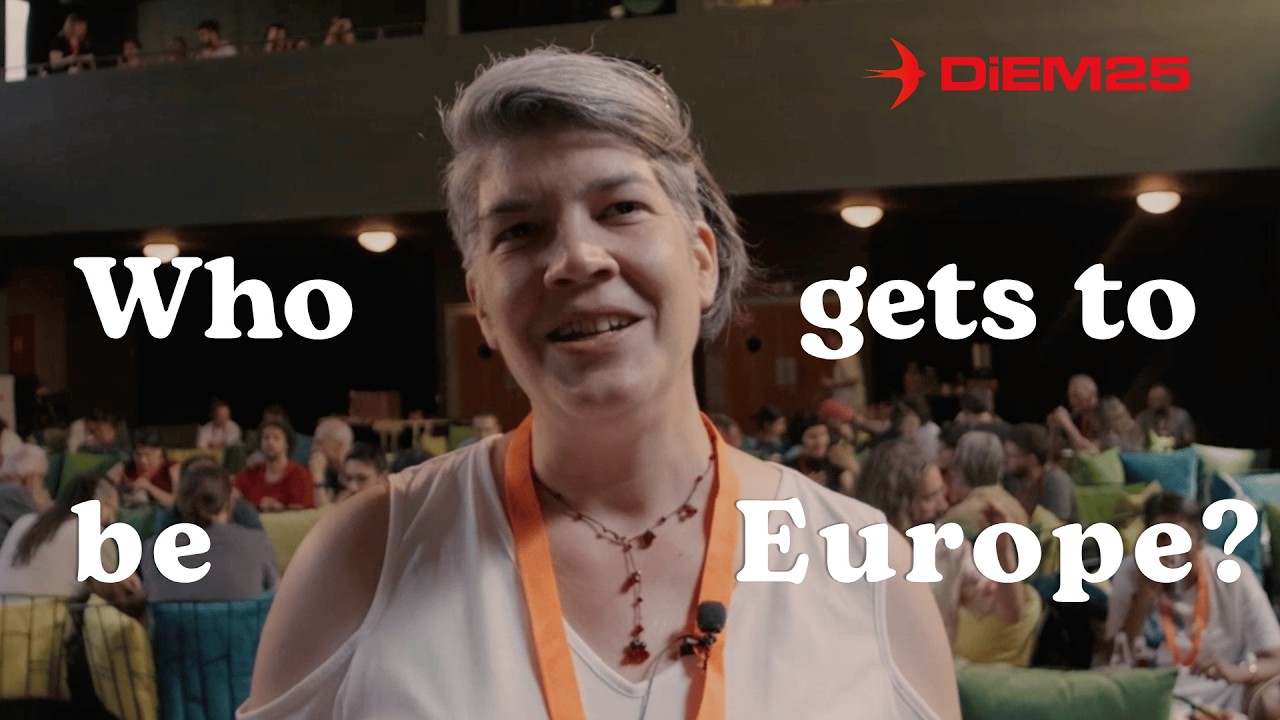
Video summary
The speaker recounts their journey with DiEM25 since its inception in 2016, highlighting the early establishment of the Belgrade local collective despite Serbia's non-membership status within the European Union. Initially, there was a hesitation to join what was perceived as a dysfunctional and undemocratic EU cartel; however, this perspective evolved into an aspiration for a united Europe composed of equal nations rather than exploiting peripheries. To bridge the gap between EU and non-EU countries while countering negative stigmas associated with Serbia following the Yugoslav wars, the group organized their first academy in Belgrade in 2018. This initiative aimed to visually demonstrate cultural unity across Europe and provided a platform for activists to learn how DiEM25 functions as an organization that supports grassroots movements under its international umbrella.
Following the initial success in Belgrade, similar academies were held in Cologne and Lisbon before being paused due to COVID-19 travel restrictions, with activities resuming in 2023 in Athens to support Greek parliamentary campaigns. The movement recently returned focus to Belgrade to prepare for the 2024 EU elections while drawing inspiration from local student protests that had been ongoing for a year. These events served as practical examples of how activists can influence their universities by blocking them and garnering professorial support, illustrating that DiEM25 is not merely an abstract party but a movement deeply embedded in specific national contexts like Serbia's MeRA25.
A central theme throughout the discussion was the critical importance of face-to-face interaction for team building and creating irreplaceable connections within the international network. While digital tools were essential during the pandemic, physical gatherings at academies or nearby cities foster tangible bonds that enable joint campaigns between different locations, such as Belgrade and Barcelona. The primary goal of these recent meetings was to shift focus from broad theoretical discussions on European policies to actionable local issues, ensuring members do not become passive due to feeling overwhelmed by global complexities. By narrowing the scope to specific local challenges while remaining aligned with international DiEM25 thinking, activists can effectively translate global principles into concrete actions within their own communities.
The speaker concludes that successful activism requires picking one issue and committing to it for three to six months rather than jumping between causes after a month of struggle, as this persistence is necessary to make an impact against capitalism or corruption. There is no abstract DiEM25 entity that will solve problems in any given city; instead, change must be built from the ground up by forming local collectives and identifying specific issues they can address with available resources. Although international support offers guidance and promotion, the actual work of building campaigns starts locally, requiring members to initiate efforts from scratch without expecting external bodies to fix their cities directly. This approach ensures that movements remain grounded in reality while contributing meaningfully to a broader democratic Europe.
Read the full video transcript
I've been a member of the M25 since the
very beginning, since 2016.
And we started the Belgrade local
collective also very early on in May
2016. [music]
So, we immediately jumped into the
family, so to say. And also it was very
important to us as
Serbian collective, and Serbia is not
part of the EU, to form our own
narrative and to fit
our perspective into the movement that
wants to democratize Europe, basically
EU. Our narrative at the very beginning
[music]
was that we wouldn't want to join this
dysfunctional undemocratic EU. However,
because at the beginning the goal was
the target was EU elections in 2019,
when we have full EU Parliament of DEM
parties, that is the Europe that we want
to join, which is not exploiting the
periphery, but is a union of equal
nations, a united Europe rather than
>> [music]
>> cartel that EU is. So,
as I said, when we started as a local
collective in Belgrade,
uh
this link between the EU and non-EU
European countries was also missing for
[music] us.
It was our initiative to organize the
first academy in Belgrade in 2018.
>> [music]
>> It was also to visually show
to people that this is the part of
Europe, that culturally we are not that
different. There is a lot of stigma
about Serbia after the Yugoslavian wars
and so on, which is all natural, but we
also wanted to at [music] least start
correcting that stigma or the narrative
that is very much present. So, the
purpose of it was, [music] of course, to
learn about DM as an organization, how
we function, to train [music] our
activists in a way to be able to start
from the grassroots and then build on it
whatever the local issue is, but under
international DM's umbrella. So, after
Belgrade, we had another academy in
Cologne in 2019, Lisbon. Then we had a
pause because of COVID, travel
restrictions. We restarted in 2023
[music]
in Athens in support of the campaign for
the Greek parliament, for our Greek
MeRA25.
Last year we were back in Belgrade, also
to
bring the focus back to the movement
after years of campaigning for the Greek
parliament, for the EU elections in
2024.
So, again, my wish was to broaden the
perspective that we are the movement, we
are not just a party, and we are not the
party. [music] We have DM's parties in
certain countries. Also in Serbia, the
the students protests were going on for
a year already at that time, and it was
really a good example for DMers to see
how how do we influence our university.
So, it was a good example to hear the
students and learn from them how they
started, how they blocked their
universities, [music] how they got the
support of their professors, and so on.
The other part, besides training and
learning about DM,
was, of course, team building and
meeting each other in person because
that's priceless. That's irreplaceable.
Zooms, of course, are the next best
thing. We are an international movement.
During COVID, that was the only way we
could function even. But, whenever
members have the opportunity to travel
to the nearest city, to the MD van, to
the academy, that is really my
suggestion to to do that because it's
priceless. It forms the connections. It
[music]
again tangibly shows you that you're
part of the group. [music]
And it's priceless in terms of creating
connections and then maybe making a
joint campaign,
Belgrade [music] and Barcelona, which we
did back in 2018.
That was the first collective that we
met at one of the events back in the
early days.
Um
This year's academy
um
goal was to focus on local issues. And
because we are this international
movement with policies for Europe on all
of the issues almost, it sometimes we
sometimes lose ourselves in a lot of
issues. [music] And the point was to
narrow it down and still stay under the
umbrella of DM's international thinking
and policies, of course, stands.
But, to translate to localize it, to
translate it to the local level and ask
ourselves selves what is the local issue
that we three people that are DMers in a
certain city, [music] five, 10,
depending on the capacity and the size
of the collective, what we can do. How
do we get in touch with other
organizations who are already working on
the certain issue and to encourage
members not to give up because sometimes
it does seem like impossible task to
start from nothing and to build the
campaign. Campaign also might sound
intimidating, but it could be as small
or as big as your capacity is. So, that
was the point of this year's academy in
[music] a sense to think globally, but
act locally. So, because sometimes we
also lose ourselves in discussions what
should we do? How could we do it? And
then it just becomes passive, people get
disheartened. So, the the
motto is pick one issue and stick
[music] with it for 3 to 6 months.
Don't give up after a month and then
jump to something else. Most of the
struggles can be connected at the end of
the day to fighting capitalism or
corruption, authoritarian government.
However, if we jump that high
immediately from the grassroots, [music]
we won't be able to make a big impact.
There is no DM25 as an abstract
thing. We are DM25 and if I want
something done in Belgrade, I would have
to start from scratch, have a local
collective and then find a local issue,
build on it and of course DM25 can give
support, guidance, promotion and so on.
But there is no DM25 that will [music]
solve the problem in your city.