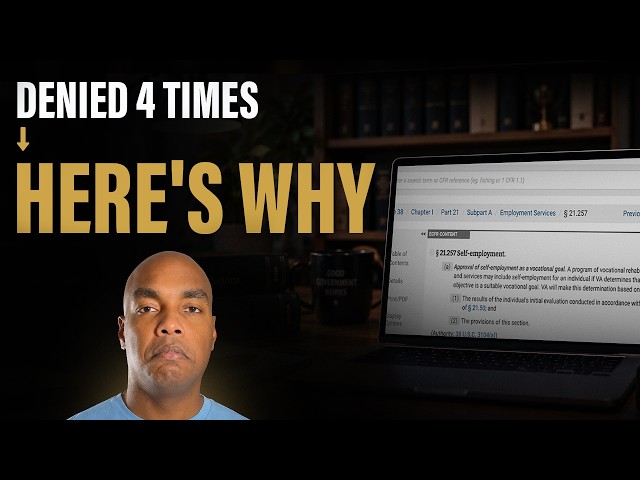
"Denied 4 Times." Here's the VR&E Rule Nobody Read You.
Watch on YouTubeVideo summary
The video addresses the widespread confusion and frustration surrounding the VA Vocational Rehabilitation and Employment (VR&E) program, specifically regarding self-employment grants for veterans. The narrator explains that despite high interest in starting a business through this channel, many applicants face repeated denials because they misunderstand the program's fundamental purpose. Contrary to popular belief, VR&E is not a small business grant but a rehabilitation service designed to help individuals with disabilities achieve suitable vocational goals. If a veteran is capable of holding a regular job, self-employment may be deemed unnecessary unless it is the only viable path dictated by their specific disability, a nuance often overlooked by counselors who simply reject business ideas without explaining the regulatory criteria involved.
To successfully navigate the application process, applicants must understand that their plans are evaluated against three strict tests outlined in federal regulations: economic viability, market analysis, and cost analysis. The narrator emphasizes that a business plan must demonstrate how it will generate sufficient income to support the veteran's livelihood, prove there is actual demand for the product or service in the local area, and justify every expense as necessary for the business operation. Common pitfalls include skipping the market research phase or requesting items like vehicles without tying them directly to revenue generation, such as distinguishing between a personal truck and a vehicle required for mobile medical services. Applicants are advised to prepare these three elements thoroughly before their first meeting to avoid vague rejections based on unexplained factors.
For those who have been denied multiple times, the video clarifies that a denial is not an absolute end but rather a decision with specific appeal rights available within one year of receiving the official letter. There are three primary avenues for appeal: submitting a request for higher-level review if new evidence, such as a stronger market analysis, has emerged; filing a Board Appeal if the initial review was incorrect; or pursuing retroactive induction for expenses already incurred prior to approval. The narrator stresses that applying for VR&E does not negatively impact existing disability compensation or open a new claim, dispelling fears that seeking assistance will jeopardize other benefits. Understanding these procedural options allows veterans to challenge decisions where the rationale was never clearly communicated, ensuring they are treated fairly under the rules rather than left guessing why their applications were rejected.
Ultimately, the video aims to replace misinformation with accurate knowledge about how the VR&E program actually functions, acknowledging that while no one can guarantee approval, understanding the regulations empowers veterans to advocate for themselves effectively. The narrator admits that some denials are legitimate because self-employment is indeed not a suitable goal for certain disabilities, but many others result from poor communication or missing documentation rather than a lack of merit in the business idea. By arming applicants with the specific regulatory requirements and appeal processes, the content seeks to prevent veterans from wasting years on futile attempts without knowing the real reasons for rejection. The message concludes that transparency about these rules is essential, as it allows individuals to make informed decisions and pursue their vocational goals with a clear understanding of what is required and what rights they possess under the law.
Read the full video transcript
In February, I put out a video about the
VA program that will pay you to start a
business. 49,000 of you watched it, the
single most watched video on my channel
this year. And then the comments came in
and they weren't exactly what I
expected. I've been trying to use the
VRE for 7 years, seven different
counselors, none of them knew their jobs
or how to help veterans. BS, this is the
hardest one to get. One time I tried
this and they put me through [music] and
at the end I had no money. I'm crippled
and got denied because of corruptness.
This is why the program doesn't work.
Lies, lies. I was in this program, they
made [music] me go to school get a
degree before they would find a startup.
Nobody in that comment section was
asking me where to find the program.
They found it, they got stopped. So
today I'm not selling you the program.
I'm going to open up the actual
regulation and show you the three things
it says have to be true. Because if you
were denied, it's almost certainly one
of these three and nobody told you
which. So here under code of federal
regulations, we want to go to 21.257,
which is this part, self-employment. And
it says a program of vocational rehab
benefits and services may include
self-employment for an individual if the
VA determines that such objective is a
suitable vocational goal. VA will make
this determination based on and then it
gives you the criteria. So this program
is not a small business grant, it's a
rehabilitation program. The question the
counselor is answering isn't is this a
good business idea, it's can this
federal holder a regular job and if not
is running their own thing the way to
get work. So when somebody walks in and
says I want to start a business and
they're capable of employment the answer
under this rule becomes no. Not because
the counselor is lazy, because the
regulation says the goal has to be
driven by the disability. And here's the
part that makes me angry on your behalf.
Nobody says it out loud. It's in a
letter that says not feasible and you're
left thinking somebody didn't like you.
If you were denied and the reason was
this, that's fixable. It means the case
for why employment doesn't work was for
you never made in the file. That's a
document problem, not a character
problem. Once you pass the first gate,
your plan gets judged on name three
things, not a counselor's mood, three
tests. So, one, economic viability, can
the business actually support you? Not
it's a nice idea, will it produce enough
income to be in your livelihood? Number
two, market analysis, is there a demand
where you are for what you're selling?
This is the one people skip and it's the
easiest to fix, the research, anybody
can do it. And number three, cost
analysis of the VA assistance. What is
VA being asked to pay for and is each
item necessary for the business? Now,
think about back to the comment section
that said, "I took all the training,
learned to write a business plan, and
got shot down." Six years of effort and
the plan still failed one of the three
tests nobody enumerated for me. If
you're going in, prepare all three in
writing before your first meeting.
You're not asking for a favor, you're
answering three questions the regulation
already told you it would ask. The
vehicle. Someone asked me where it says
VA won't pay for a vehicle. What if a
business requires one like medical
transport? Careful here because the
premise isn't quite right. There's no
blanket ban. The test is whether the
item is a necessary business expense
inside your approved cost analysis. The
vehicle is the business, medical
transport mobile services is a different
conversation from a truck you drive on
the weekend. Make the case inside the
plan item by item tied to revenue.
Retroactive reimbursement. Now, be
careful because someone asked if
training they already paid for a year
ago is reimbursable. I'm not going to
tell you yes because I can't verify that
it is. What I can tell you is that
there's a thing called retroactive
induction that deals with prior
entitlement and it's a real mechanism
worth asking your counselor about by
name. Ask about retroactive induction,
don't ask can you pay me back because
that gets a no. The fear. And this one I
want to answer as directly as I can
because I think it's stopping people
from applying at all. Does applying open
up my file to scrutiny the way opening
up a new claim would? No. VA's own
application form says applying will not
affect your compensation and And VR&E
decision letter says the decision
doesn't impact your other VA benefits.
Applying to VR&E isn't opening up a
claim, it's a separate program that
reads your existing rating. And somebody
asked about track two. VA doesn't really
number them, it names them. Five,
reemployment, rapid access to
employment, employment through long-term
services, self-employment, and
independent living. If you want the
business, then the one you're asking for
is self-employment. Say it by name so
there's no ambiguity in your file. Now,
for the four times tonight crowd. This
is the part most want to hear. A denial
is a decision and decisions have appeal
rights. You have 1 year from the day on
that decision letter and there are three
ways to go. So, this form VA form
20-0995,
this is when you have new evidence, a
stronger market analysis is considered
new evidence. Decision review request
higher level review. And what it says is
you use it when you think that you've
gotten it wrong on the evidence already
in the file, more senior reviewer takes
a first look. This is the one where they
lied and why I didn't qualify because it
forces someone else to look at the same
file. Board appeal form 10182 goes to
the Board of Veterans Appeals. 1 year
and if you're in a contested claim, it's
board appeal only 60 days. For denials
with no appeals filed and for decisions
that were never actually challenged.
That's not the same as being ineligible.
Let me be straight with you about what
this video doesn't do. I can't get you
approved, nobody can. This turns on your
individual disability determination and
a counselor's judgment about your file.
And anyone selling a guarantee is lying
to you. It is slow. The people in these
comments waited years and I'm not going
to pretend a form fixes that. And some
denials are correct. If you can work and
the regulation says self-employment has
to be the route your disability leaves
you, sometimes the answer really is no.
And hearing that clearly is better than
four more years of not knowing. But,
they lied about why I didn't qualify
tells me the reason was never explained
and now you've read the rule yourself,
you know the first gate, you know the
three tests, you know that applying
doesn't touch your compensation, and you
know you had a year to appeal. That's
not a guarantee. It's the information
you should have had the first time. If
you were denied and you want a second
set of eyes before you file, links are
in the description. And to everyone who
left one of those comments, thank you
for writing it down. This video exists
because you did.