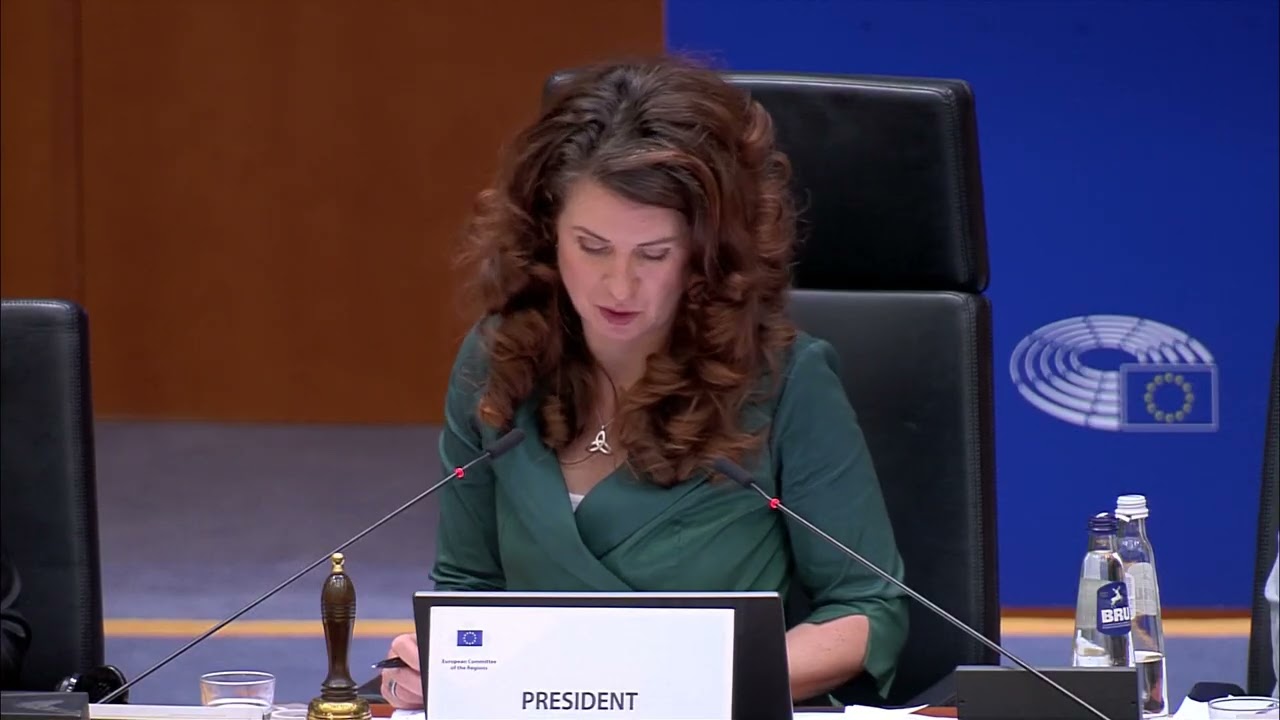
Video summary
The debate centered on the urgent need to shift European focus from external borders back to internal climate realities, driven by recent extreme heatwaves that have made adaptation a matter of immediate survival rather than long-term planning. Teresa Riber, Executive Vice President for a Clean, Just and Competitive Transition, emphasized that shared problems cannot be solved solely from Brussels but require trust built at the community level where facts take place. She highlighted the critical importance of the upcoming Multiannual Financial Framework (MFF), proposing a budget that places energy, climate, and environment at its heart with binding targets and strict adherence to the "do no significant harm" principle. The discussion underscored that while Europe has made progress in generating clean electricity, supply-side gains are hitting a ceiling without accelerated electrification of demand, necessitating a move away from fossil fuel dependency which remains a strategic vulnerability exposed by geopolitical conflicts.
Key arguments presented by reporters and committee members stressed that the transition to a green economy is not merely an environmental imperative but a fundamental issue of security, competitiveness, and social resilience. Speakers argued that relying on imported energy leaves Europe vulnerable to price shocks and supply disruptions, as evidenced by recent crises in the Middle East and Ukraine, which cost billions in extra imports. Consequently, there was a strong consensus that structural investment must begin at the local and regional level to accelerate renewables, improve energy efficiency, and strengthen grid infrastructure. The dialogue also addressed the economic costs of climate change, noting that extreme weather events are already causing excess deaths and damaging infrastructure, thereby demanding significant adaptation funding. Furthermore, participants insisted that no territory should be left behind, advocating for a just transition that protects vulnerable households from rising energy costs while fostering new business opportunities rooted in European value chains.
The proceedings concluded with a firm commitment to multi-level governance, ensuring that cities and regions play a mandatory role in shaping national and EU climate policies rather than being sidelined by centralized decision-making. Representatives called for the integration of local authorities into the National Recovery and Resilience Plans (NRRPs) and urged the creation of dedicated instruments to support small and medium-sized towns alongside major cities. The consensus was that achieving ambitious climate goals requires a bottom-up approach where innovation, clean technologies, and circular economy principles are deployed directly on the ground. Ultimately, the debate affirmed that the future of Europe depends on a collaborative effort between the Commission, member states, and local communities to build a resilient, optimistic, and sustainable future that defends European interests both at home and abroad.
Read the full video transcript
Now we arrive to point seven on our
agenda.
It's the exchange of executive vice
president for a clean, just and
competitive transition,
a long-standing friend of the European
Committee of the Regions,
Teresa Riber.
And I also invite the reporters
to the stage Constantinos Bakoanis and
Rafar Jeski to join us on the podium.
Uh the reporters are coming coming. No.
Yes. I see Constantis. I don't see
Rafal.
>> Okay.
We will start. So um
So in the past years um European
attention was dragged from clim everyday
realities of climate change to the
borders and beyond. But I think the past
few weeks changed a little bit the focus
uh to the inside and to urgent
adaptation to
growing uncertainty in also climate. So
I'll give the floor to the guest
executive vice president right away.
>> Thank you. Thank you so much uh
president, members of the committee,
friends. It is a great pleasure for me
being um with you today and I think that
my first message it's a message of
gratitude for allowing me to share this
very important uh being present take
part in this very important discussion.
Yes, 37° may be something frequent in
southern Europe. It is not so frequent
in Brussels, in Paris, in Hamburg, in
London.
It is a scary scenario that has been
lasting quite a lot during last week and
that may be increasingly frequent in our
continent. So allow me to start with uh
something that is important and that
please take this as a very sincere
recognition of your very important work.
I would like to quote Elanor Astrom. She
won the Nobel Prize for something which
is quite obvious but it is important to
remind. She showed that our shared
problems are rarely solved from the top
alone.
Trust Sarwood is built closer to the
ground in communities small enough to
act and yet connected enough to matter.
And you are representing exactly those
communities and climate and energy also
represents
with other fields those aspects of of
our day-to-day reality that need to be
addressed. So I come not to say what to
do but to recognize and see with you how
to improve our action because yes energy
and climate policies are not designed
and implemented exclusively in Brussels.
We have a very important role to take
but it is together with you. We need to
work hard to join efforts to multiply
success to build opportunities to
facilitate the scale to be prepared for
what it is already happening to decide
on the ground in your regions in your
cities in your communities.
You are the front line of this
transformation
and I am with you ready to back and to
support you but recognition has to show
up where it counts. So let's speak about
the budget. Let's speak about MFF. The
concerns you express the way we can
handle better your expressions of
interest and concern. A budget where we
place energy, climate and environment at
the hurt of the next MFF. They run
horizontally across every major program.
The 35%
climate and environment target is
binding. It will mobilize more than
seven 700 billion euros dedicated to
this policy goals and our proposal also
included the do not significant harm
principle which means that funding must
not negatively impact biodiversity
infrastructures people and other
environmental objectives and we track
our funding for climate mitigation
adaptation environment through a clear
expenditure mechanism
a mechanism that reflects your very
sincere
and bold opinion. Of course, more will
be needed in light of the huge
investment needs for the green
transition. It is the starting point of
the negotiations and the role is crucial
to ensure that our joint EU budget
delivers on the challenges we face as an
union. We also acknowledge the
fundamental importance of regional and
local dimensions because as I said, it
is there where reality where facts take
place. Turning away from fossil fuels to
clean homegrown energy, building
resilience to string weather and
restoring natural ability to support us
all happen locally. Green, healthy and
climate proof cities, highquality
services, water supply, housing, waste
management take place at the city level.
So the national and regional partnership
plans are designed to connect to
national energy and climate plans to
ensure stronger role for cities and
regions. It must be so. Let me reassure
you on the foundations because trust is
built on them. Still cohesion policy
remains a cornerstone cover within the
plans and ensuring your role in their
governance is respected because we
cannot deliver when working from
centralizing power. We need to share
responsibilities and join efforts in a
respectful and effective manner. We may
need flexibility but we need to respect
each other. Just transition in cities
and outermost regions are recognized as
well as the objectives of the social
climate fund are preserved so it can
shield vulnerable households from rising
energy cost. We have also heard from
this house and the parliament on life to
keep it visible and effective. This will
be a key demand in the further inst
inter institutional negotiations. Our
MFF proposal aims to support the clean
and just transition placing the regions
at its core. Europe imports more than
half of the energy we consume.
That is not a market detail.
It is a strategic vulnerability.
The recent conflict in the Middle East
cost us 40 billion euros in extra
imports in three months only. We have
made real progress. Over 70% of our
electricity is now clean, up from 57% in
2019.
But supply side gains will soon hit a
ceiling if not matched by
electrification of demand. Our rate has
stalled at 23% for a decade. Others have
identified a way to reach more than 34%
of their consumption.
This 23%
is the average level of petrol states
and behind other key industrial players
such as China that does not count on oil
and gas. We may discuss on the
importance to develop our strengths as
electro economies because we need to
electrify faster in industry, transport
and buildings. But as a relevant union
leader told me recently, we also need to
warn against those that behave as if we
were a kind of fossil idiots, so to say,
people that lock in fossil fuels
dependency. We need to navigate but to
get rid to build a much more respectful
and a much more optimistic future. And
we may pay more attention to the
so-called echon nations, those being
deeply vulnerable but remaining
committed and active on climate. It is
on the ground where you have a specific
capacity to make the difference.
Renewable energy, heat pumps, batteries,
clean grids. These technologies build
prosperity locally and a robust ETS
can be enjoined to fund that. Green
areas with climate shields, freshwater
security, climate proof buildings,
climate proof infrastructures
to prevent the collapse of our health
system, our transportation services
to assess the risk and anticipate the
debate of the acceptable thresholds and
identify the communities and individuals
that are exposed to the highest risk in
our communities. In that context, I
welcome your call for social leasing.
Heat pumps, rooftop solar, efficient
appliance, electric vehicles. They are
all placed within reach of every
household. That's the aspiration.
I also welcome your support to the
temporary estate aid framework as well
as on the windful profits measures and
solidarity contributions. That is how we
may beat energy poverty. How we can
build competitiveness at once. How we
can pay back and reward citizens efforts
to build a better future.
What you build at home, you can also
defend abroad. This brings me to the
diplomacy that you also comment on.
You're right that Europe should defend
the rulesbased order while raising its
ambition. The two go together. We cannot
ask others to act while slowing down
ourselves. And mayor mayors and regional
leaders deliver the Paris agreement
through real territorial action. Last
week I took part of the climate London
week, the 10th anniversary of the global
cabinet of mayors and the homage to
Antonio Gutes, the secretary general
that has been working hard on climate.
As I said, 37 degrees in London, 40
degrees in Paris, 36 in Brussels. It is
insane.
Let's work under the coalition for high
ambition, multi-level partnerships.
Let's join efforts. Let's join forces.
We can work with multi-level governments
and European Commission. You are also
the first line of defense against
disinformation and polarization.
So your voice has to carry at the
different levels including the
multilateral settings. Let me close
simply. This transition will be one
locally or it will not be won at all.
You can count on us and I hope I wish I
enjoy counting on you. Thanks a lot.
>> Thank you very much. you know that our
attention is constant on the everydays
and everyday realities and climate and
energy goals. So we keep up and now I
will invite
first Constantinos Bakuanis who is
reporter on the opinion EU global
climate and energy vision towards more
inclusive climate and environment global
negotiations.
The floor is yours.
>> Thank you very much Madame President.
Dear executive vice president and dear
colleagues, first of all, I would like
to sincerely thank all members who t
tabled amendments to this opinion. I am
indeed very much grateful for the
constructive cooperation across
political groups and national
delegations. This opinion sets out the
committee of the region's priorities
ahead of two major international
conferences later this year. the UN
biodiversity COP 17 in Armenia and the
UN climate COP 31 in Turkey.
These conferences come at a particularly
difficult moment. As we all know,
multilateral cooperation is indeed under
growing pressure. International
commitments are increasingly questioned.
Scientific evidence is challenged and
geopolitical tensions risk diverting
attention. And this is me being as
polite as possible. Yet, climate change
and biodiversity laws do not stop at
NASA borders. They require stronger, not
weaker, international cooperation.
The vice president mentioned before that
Europe experienced one of the most
severe heat waves on record in recent
days. But what is the truth? That every
year we break the record. And every year
extreme heat claims thousands of lives.
This is not an isolated weather event.
It is a consequence of the climate
crisis. This is why this opinion sends a
clear message. Adaptation is essential,
but adaptation alone is not enough. We
must also tackle the root causes of
climate change by accelerating the
transition to clean, secure, and
affordable energy. Reducing our
dependence on fossil fuels is not only a
climate imperative. It is also essential
for Europe's competitiveness, security,
and strategic autonomy. Across Europe,
cities and regions are indeed delivering
solutions. We know this very well. We
are renovating buildings. We are
creating greener and cooler public
spaces. We're adapting essential public
services. And we are strengthening
emergency preparedness. But local action
cannot succeed with they are without
adequate resources. A plan that is not
tested, staffed and funded is not a real
plan. The next MF must therefore provide
cities and regions with the investment
we need. The investment we need to
strengthen resilience and accelerate the
green transition. At the same time, no
territory must be left behind. The
Atoler cohesion must therefore remain at
the heart of Europe's climate and
biodiversity policies.
Climate action also means protecting and
restoring nature. Investing in
nature-based solutions, ecosystem
restoration, and water resilience is one
of the most effective ways to reduce the
impact of heat waves, floods, and
droughts while delivering environmental,
social, and economic benefit. Whether at
COP 31 or COP 17, we must be
systematically involved in national
planning and implementation, financing,
and monitoring. Global global
commitments will only succeed if they
are translated into action on the
ground. That is why this opinion calls
for a mandated multi-level dialogue with
the UNFCCC process, stronger
participation of local and regional
authorities, national delegations, and
our full involvement in shaping the post
2030 climate and energy framework. I
would like to thank everybody for their
support. I would also like to sincerely
thank our expert Paula Leori for her
valuable support with this opinion.
Thank you very much.
>> Thank you very much.
And now I invite Rafael Chasovski who is
the reporter on the opinion
mainstreaming climate, energy and
environmental priorities across the next
budget. That floor is yours.
>> Uh President, Commissioner uh
colleagues, too often the debate on
climate and energy is presented as a
choice between economic strength and
decarbonization.
But for Europe's regions and cities, a
clean transition is not only not only a
climate imperative. It is a matter of
security. It is a matter of
competitiveness and above all a matter
of resilience. If we want a stronger
Europe, we must do three things. Reduce
our energy dependence, lower the costs
of climate change, and create new
business opportunities rooted in
European value chains and clean
technologies. Europe's competitiveness
depends on its ability to produce more
clean and affordable energy in Europe.
As long as we remain dependent on
imported fossil fuels, our economy will
stay exposed to geopolitical
instability, supply disruptions, and
price shocks. We have seen this very
clearly in recent crisis. Since the
beginning of the war in Iran, the EU's
fossil fuel import bills have increased
more than 22 billion euros. We saw
similar effects after the war in
Ukraine. This is not only an
environmental program. It is a major
economic vulnerability for our
households, our businesses, and our
local economies. That is why structural
investment in homegrown energy must
start at local and regional level by
accelerating renewables, investing in
energy efficiency, and strengthening
grids and interconnections.
Competitiveness is also about reducing
the growth growing cost of climate
change. Climate change is becoming a
silent killer. According to the World
Health Organization, since 21st June,
more than 1,300 excess deaths have been
recorded in Europe, links to high
temperatures since many of our homes,
schools, and workplaces are simply not
built for these realities. Beyond the
human strategy, there are direct
economic impacts, damaged
infrastructure, disruption of transport
and public services, and rising costs
for healthcare and emergency response.
If we do not invest in adaptation, these
costs will continue to rise and weigh
heavily on local and regional economies.
The green transition is also about
creating growth, supporting clean tech,
the circular economy, and other
sustainable sectors open new markets and
drives innovation. Investing in regions
and city turns climate ambition into
real economic development on the ground.
It helps local companies and startups
scale up solutions in renewable energy,
energy efficient construction,
sustainability, mobility, and circular
materials. Europe's sustainable
competitiveness will be built on its
regions and on its cities. Yet, the new
MF proposals risk weakening this by
moving towards more centralized model.
This is a big mistake. We are Europe's
best allies in achieving this priorities
and that's why we need to do something
about it. We have three main requests.
Multi-level governance. NRPPS must
include multi-level governance platforms
and mandatory urban and regional
chapters. We welcome the support of the
European Parliament on this and we will
urge member states and European
Commission to follow the parliament's
direction. Investment in climate and
competitiveness. The Europe European
Competitiveness Fund should provide
direct financing to local energy and
climate plants and [music] direct
funding for cities. As Europe invests in
clean energy, climate adaptation, and
green innovation, its regions and cities
will be stronger, safer, and more
prosperous. Thank you very much.
>> Thank you very much. [applause]
>> And now I will give the floor first to
the representatives of the political
groups and then I will open to the
members for one minutes as indicated in
the list. Uh first the floor goes to
Maru Marula. Um, Madame Executive Vice
President Ria, uh, extreme heat is now a
reality. You pointed out it clearly
citizens know that. However, Europe can
achieve its ambitious climate goals, but
only if we radically strengthen the
implementation. The direction is
European. However, action takes place on
the ground in cities and regions through
cooperation with industry, universities
and citizens. This is where energy
systems, chains, clean technology are
deployed, uh investments are made and
public support is built. We need
systematic transformation rather than
fragmented projects. EU missions uh the
competitiveness compass the clean
industrial deal cohesion policy FB10 and
several other EU initiatives must
reinforce one another and support
integrated placebased action. The
committee of the region has mobilized
the major European resource that remains
underused. It's our members and uh
through them through us the public
private ecosystems
uh in cities and regions can really be
taken to active use. We have the CR has
a green deal calling local road mapap
where we commit ourselves to measurable
implementation
local green deals uh scaling of
pioneering uh solutions and stronger
links between mitigation adaptation
biodiversity
competitiveness innovation and
investments. Now on behalf of our green
deal going local work working working
group I propose that we prepare a joint
action program with you madame
commissioner and your services. We
should uh define uh a small number of
high impact actions through which we
really can implement and this is where
we can deliver and we can mobilize the
bottom up movement a real movement to re
to reach the commission ambitious
targets. Let's do that together.
>> Thank you. The floor goes now to Hanas
Danoska.
>> Thank you very much. I will speak in
Polish.
Global climate and energy vision.
Fore
speech.
for
electric.
Thank you very much. Thank you.
Thank you madam chair. I will speak in
French.
Foreign
speech. Foreign speech. Foreign speech.
Tooth legislation, toothlation.
Fore!
Foreign! Foreign!
territory.
Mercy.
Thank you, Madame President. Energy is
one of the most important ingredients of
our development, our progress and our
security. It is a foundation of our
competitiveness and strategic autonomy.
It touches the quality of life and
personal budget of every and each of our
citizens. Therefore, we should be
devoted our utmost attention. Our
uncontested goal should be sustainable
and affordable energy produced on the
territory of the European Union.
Dependence on energy imports must be
reduced in short term and eliminated in
long term. Alliances and international
markets have proven to be volatile and
therefore unreliable.
It should be equally clear that one type
of energy dependency must not be
replaced with the new one. Fossil fuel
dependency must not be replaced by
renewable smart system dependency.
Digitalization should increase
resilience not create a new layer of
foreign dependence.
EU can rely only on its own knowledge,
innovation and investments. Therefore on
its own competitive production that's
why energy transition must continue full
speed. It is existentially important to
upgrade the EU policy and legal
framework with firmly embedded efficient
multi-level governance as well as
funding for cities and regions to ensure
energy resilience, sustainability and
affordable prices as well as just energy
transition. Thank you.
Thank you France Costritorich.
Madame President
said
nationalism.
Municipal.
Metro
local.
President
territo.
territo. Europe.
consider
Marco Marcelio.
Presidentology.
Foreom
in the industry.
territorial.
Foreign
Energet
Andre Groy.
Thank you, President. [clears throat]
Executive Vice President Ribera.
Europe is facing a defining energy
challenge. High energy price continue to
undermine our industrial
competitiveness,
putting pressure on our businesses, on
our jobs, and investment across our
regions.
Recent geopolitical crisis starting from
Russia's aggression against Ukraine to
the instability in the Middle East have
once again demonstrated the strategic
vulnerability of our energy system.
If you want Europe to remain
competitive, we must guarantee access to
affordable, secure, and sustainable
energy. As transports, heating and
industry continue to electrify,
electricity demand will only increase.
We therefore need an energy system that
can meet this growing demand while
continuing the transition to lowcarbon
energy.
This requires a diversified energy mix
based on the renewables and other
lowcarbon technologies including wind,
solar, biomass and nuclear energy. And
at the same time, investment in
innovation including research into
nuclear fusion must continue. But
production alone is not enough. Without
proper planning and significant
investment in infrastructure, this
ambitions will remain out of reach. As
highlighted in the opinion on wind power
in the committee of the regions for
which I was a rapper, Europe must
accelerate grid investment investment.
Today Europe remains heavily dependent
on important technologies for renewable
energy production and at the same time
many of our grids still lack the
capacity to transport electricity
efficiently from where it is produced to
where it is needed. Recent events in
your country, Spain, have also shown the
importance of grid resilience and system
stability. We therefore welcome the
commission's recent initiatives on
electrifications, grids and energy
security. But now is a time to move from
strategic to implementation. Europe
needs financial resources and industrial
ambitions necessary to achieve energy
autonomy and strengthens its
competitive. Thank you.
>> Thank you, Nina. Linen.
>> Dear president, dear vice president of
the commission and colleagues, this is
the summer we should all remember well
because believe it or not, this is
probably the coolest summer that Europe
has left for some time.
But there is still a way of speaking as
climate change was an active agent.
Weather hasn't got caused any suffering
though. Climate didn't kill anybody and
environment didn't cause any economic
losses. Fossil intense industry did.
Over consumption did and unsustainable
forestry did. Inaction and negligent did
and lack of courage to drive systemic
change did.
These are very scary times.
The question is, are we scared enough to
act so decisively that we would not have
disputes over climate policies, no hard
negotiations and close voting results in
any of the European institutions?
Because if we continue like this, things
will only get worse.
I hope I really really hope that this is
none of the one of the not one of the
moments when we get very serious with
climate and aware but right after in the
votings of next opinions budgets and
policies we forget about and take other
priorities.
Dear vice president, the Greens and
Progressives want to thank you for your
leadership in climate ambition and
commitment to advance with green deal.
Eventually, the responsibility I believe
lies as much in the hands of the
commission as well as the smallest
municipality that is present in this
room. To succeed, we need you and you
need us.
We need the most ambitious climate
policy that the EU has ever experienced
this far. We need binding targets, EMI
funding, bold objectives
and we have so many cities that are more
ambitious and innovative than their
countries. All the more reason to
include cities and regions in a
mandatory way in NRPPS
and I like the future needs from the
local dimension most ambitious
implementation that we have ever seen.
Thank you.
>> Thank you. Now we will move on to the
one minute um um interventions. Please
keep the time. The more you keep the
time, more people can speak.
Transformers.
There's the program.
Gracias, Anikaf.
Fore
instrument.
capture utilization and storage.
The floor goes now to Daniel Fer.
Catastrophen
catastrophin.
for
the Kenton.
This
feel
the mic.
in Hamburg.
Parliament
Foreign
speech. Foreign speech. Foreign speech.
partner.
Dear Madame, dear members, as we look to
the future MF, we must draw clear
lessons from the recent energy crisis.
It has shown the urgent need for greater
budgetary flexibility at EU level so
that we can respond quickly and
effectively to support both households
and industry when cost increase. The
next MF MF should therefore include
adaptable financial mechanisms capable
of mobilizing targeted investments in
response to rising energy prices and
evolving economic pressures. At the same
time, climate and environmental spending
must be designed with realism and
coherence. It should be closely aligned
with the forcoming review of the EU
emission emissions trading system which
will be decreasive ensuring that our
climate ambition remains compatible with
industrial competitiveness, economic
resilience and strategic and autonomy.
Thank you.
President,
numeric, energetic,
Administrative
territorial
Mercy.
Probably I got the name wrong. So, it's
Stanislav.
Yes. Zeski.
No, he's not here. So then we move on to
Thank you. I will speak in
Fore
poem.
Antonio Dearo
investment.
prejudice.
Investment
Fore
Matula.
Foreign
speech. Foreign speech. Foreign speech.
Fore.
Thank you, Laura Capon.
territory.
Gracia.
Serio Perez Garcia.
and
Instrument.
Thank you, Madame President. I will
speak in Dutch on behalf of the Dutch
delegation.
Forever
states
industry
net
Lexioch.
Thank you madame chair, madame vice
president. First of all all I want to
congratulate the reporter both of them
for this opinion. It did address a
crucial issue for the future of cohesion
policy and the next MFFF. It is
essential that the next MFF reflects the
needs and the priorities of local
communities. In this regard, I welcome
the recommendation to allocate 20% of
the relevant funding to territorial
priorities.
This represent an important step towards
strengthening the territorial dimension
of European policies. As I said in the
former opinion concerning automotive
industry, this transition has to be done
technologically by innovation and
competitiveness and not ideologically.
Finally, Europe's climate ambition must
be inclusive including not only big
cities but also small and mediumsiz
towns that I represent here. The next MF
should include dedicated instruments
enable these communities to actively
participate in the green transition.
Only then can we speak of a truly
transition in which no one is left
behind. Thank you.
>> Thank you. We have a problem. We have no
interpretation. I will need to close the
debate. Uh um because I had to choose
between giving the words to members or
to give the words to the executive vice
president. And I'm sorry I chose the
members. Uh, I'm really sorry, but we
need to go um and talk to the press and
we need the reporters and I need to give
the floor to Gileian like right away. I
don't know what we do with
interpretation.
>> We need to wait for the
>> Okay, I'll leave this problem to
Gileian.
>> Thank you very much, Vice President,
excuse Vice President Terzar for coming
and for your flexibility. Thank you so
much.
>> Thank you. I will send you a kind letter
with some comments and I will thank you
all. I have I wanted to thank you all
for your observations and comments.
Thank you.