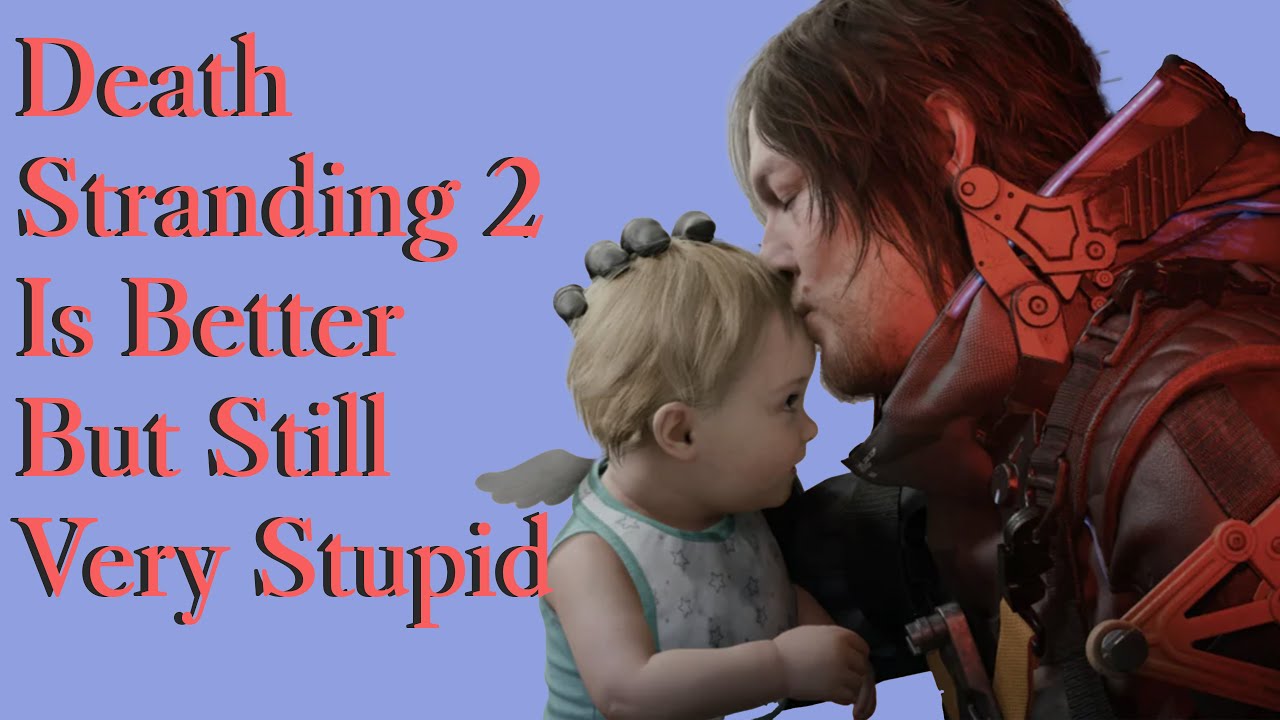
Video summary
Six years after releasing his scathing critique of *Death Stranding*, where he described it as a "massive disaster" filled with comically inhuman values and objectively wrong gameplay mechanics, the creator returns to discuss its sequel, *Death Stranding 2: On The Beach*. He argues that while the game is undeniably much better than its predecessor—offering far more human interactions between real people rather than just holograms—it remains fundamentally flawed. The reviewer notes that Hideo Kojima has addressed many of his previous complaints by improving combat and stealth balance, making enemies smarter and engaging fights less boring compared to the first game's comically easy encounters where players could simply shoot into the air. However, he maintains that on default difficulty settings, the game is still too easy due to excessive health pools and forgiving mechanics like falling down without penalty, suggesting it desperately needs a proper difficulty tuning option rather than just adding more "Timefall" punishment or forcing constant balance-mashing QTEs.
The gameplay loop itself has been significantly refined through small but impactful changes that transform the experience from a miserable slog into an enjoyable 60-hour adventure. The most notable improvement is the reduction of fetch quests' oppressive nature; while they still exist, the game now provides actual context and interesting characters with backstories for deliveries, moving away from the absurd stereotypes of the first title. Additionally, the mechanics involving the screaming baby have been toned down to be less annoying, and the geography has been adjusted so that falling is no longer a constant source of frustration unless in specific late-game areas. These tweaks shift the balance between walking simulation and action elements closer together, with combat now comprising roughly 35-40% of gameplay instead of just 10%, making the world feel more dynamic without sacrificing the core delivery mechanics that define the series.
Despite these mechanical victories, the reviewer remains highly critical of the narrative structure, which he describes as a reboot rather than a true sequel because it repeats almost every plot point and twist from the original game with only better execution. The story is plagued by ridiculous coincidences, such as characters who are technically dead but still functioning due to soul puppetry rules that make no logical sense in-universe, and absurd character motivations like therapists having affairs with their patients or government conspiracies revolving around stealing babies for a network created by killing them. He points out numerous plot holes where crucial information is withheld from the player solely to facilitate predictable twists, such as why a mother would let her son believe his daughter died when she was actually alive and grown up elsewhere, arguing that these elements rely on "coolness" rather than coherent storytelling or believable human behavior.
Ultimately, the reviewer concludes that *Death Stranding 2* is a visually stunning masterpiece in terms of direction, motion capture, and cinematography that deserves praise for its technical achievements but fails as a piece of fiction due to its ideologically childish philosophy and muddled writing. He criticizes Kojima's techno-libertarian optimism regarding social media connecting the world, arguing it ignores real-world issues like polarization and misinformation, while also noting how the game trivializes death by making life after death mundane without exploring any religious or societal implications of such a reality. While he recommends playing the game for its fun mechanics and humor, giving it a hypothetical grade of 7.5 out of 10 compared to the first game's 2, he insists that players should not expect perfection because the story is still so stupidly written that it becomes impossible to ignore while enjoying the gameplay, leaving him wishing Kojima would focus on his directing strengths and hire an actual writer for future projects.
Read the full video transcript
6 years ago, shortly after Death
Stranding released, I made a video
mainly about how mystified I was by the
critical reception of the game. The
video argued that literally everything
about the game was bad. The story,
despite having excellent individual
direction in its cutscenes, made no
sense. It was ideologically and
philosophically muddled and almost
childlike in its stupidity. The gameplay
was both totally at odds with what the
story was trying to get across and also
suffered from miserable balance. The
game was so absurdly easy. It was
impossible to feel anything playing it.
People talked about all the difficult
decisions you needed to make, but they
were just 100% objectively wrong. The
answer to every single mission was to
load yourself down with ladders,
climbing hooks, and carriers, and then
just discard crap as you went along. The
game actually required zero thought
because there was no penalty to dropping
stuff as you went. It was basically
impossible to run out of resources and
it was impossible to die. And if you did
die, there were no consequences at all.
The balance between combat, stealth,
cutscene, and walking sim was way out of
whack with something like 18 hours of
cutscenes, 30 hours of walking, and like
an hour of stealth and combat. The
context for why you were doing anything
was minimal, as the scores of dozens of
meaningless side quests added nothing to
the world, the story, or even to the
cardboard cutout characters who
populated the melodramatic soap opera
that was posing as an interesting
universe. When you actually looked at
what that game was, you ended up with
Fetchqu Quest, the game married to
dozens of hours of beautifully directed
but narratively empty cutscenes.
The game was also just comically inhuman
in its values. A world where nobody
actually sees or touches anyone else for
reasons. It made no sense. It was bad.
Like impossibly bad. But it had pretty
graphics and the name of the box was
famous enough that things players would
absolutely reject in other games were
defended to the death in this one.
6 years later, Death Stranding 2
released and after many dozens of hours,
I have finished it. In many ways, the
sequel is a direct response to many of
my criticisms of the first game. It is
far more human in that other actually
existent humans see and talk to one
another in real life and not exclusively
via hologram. The balance between
walking sim, cutscene, and combat
stealth is tremendously improved. The
story is certainly better, but it still
has huge ideological and philosophical
incoherencies, and the side quests are
much more entertaining narratively than
the first game's neverending strings of
pointless, contextless fetch quests. I
still have many, many serious
complaints. But unlike the first game, I
can confidently say that Death Stranding
2 on the Beach is a very good game that
you should probably buy. Balance and
context go a long way. So today, let's
look at the sequel to visionary genius
filmmaker Houdi Kojima's Death Stranding
and figure out why it is very flawed,
but also much much better than the
massive disaster that was the first game
after the logo.
Game play pacing is everything.
One of the biggest issues with the first
game was how relentlessly boring it was.
Combat and stealth were almost never
actually required. And when they were,
the AI was perhaps the worst I have ever
seen in a game. Stealth was pointless
because enemies posed zero threat. And
they weren't even fun to fight because
they'd run directly at you one after
another. I really quickly realized that
you could shoot your gun in the air and
then just kneel down and knock enemies
out one after another with a bowl gun as
they made a beline to you. They didn't
flank. They didn't try and flush you out
of cover. They didn't actually take
cover themselves. It was really amazing
when you consider that the enemies in
the Metal Gear games are actually quite
threatening.
There's no getting around the fact that
Death Stranding 2 is still way, way, way
too easy on the normal difficulty. I
didn't try the brutal one because I
always play games on the setting the
developers consider default the first
time, but I regret it now. I believe I
died once when I was surprised a boss
could swallow me with an attack, but
that's it. About halfway through, I read
what the difficulty settings did, and
while I liked the idea of Timefall being
way more punishing, having less health,
and ramping up enemy aggression, the
idea of falling down more easily was a
non-starter for me. What Death Stranding
2 desperately needs is a difficulty
fine-tuning option like many other games
have started doing now. I wanted the
rain and degradation aspects to be much
more intense. And I wanted enemies to
actually have a chance of killing me,
but the tradeoff of having to constantly
mash the triggers to keep my balance and
watching my character fall down is
unacceptable to me. I just like truly
despise that aspect of the game. Anyway,
back to the combat. While enemies simply
cannot kill you because you have a ton
of health, they are at least now
engaging to fight. Enemies take cover.
They do actually flank you. They do
force you out of cover. Now, again, the
game's too easy, but it's no longer
comically boring, which is a massive
improvement. Stealth is also
entertaining, but again, it's just too
easy. There are two places in the whole
game where setting off an alarm leads to
reinforcements.
I don't understand this. I enjoyed
stealthing through whole areas because
the game feels good to play, but there's
no actual reason to do it. Again, you
can simply walk into a camp and shoot
somebody and then just fight because the
AI is better. It's now more fun to do
that, but the game refuses to punish you
for playing stupidly. I just don't
understand this. Middle Gear 5 was
pretty brutal about enemy
reinforcements. They would alert other
camps and reinforcements would
constantly spawn in until you destroyed
a transmitter. Kojima already had a
great system that heavily incentivized
stealth. And Death Stranding 2 would
have been massively improved by just
putting a couple of transmitters in
every camp that spawned reinforcements
until they're disabled. When it comes to
the BTS, the game's monsters, stealth
again doesn't really matter. While it is
very fun to stealth through areas,
cutting the watcher's cords, the
punishment for being seen is either
having to run a short distance away and
do a QTE or just letting yourself get
caught and fighting a mini boss. Again,
the game gives you a bunch of fun tools
like a huge arsenal of weapons and even
the ability to catch BTS like Pokemon
and use them in combat. So, it's still
fun to fight, but the stakes are really
low because Sam is almost impossible to
kill. Man, at the end of the day, combat
and stealth are way improved because the
AI is better, and especially because the
game forces you into those situations
far more often, but it still falls short
on the default difficulty because of how
insanely easy it is. If I could
individually jack up combat difficulty,
lower Sam's health, and make Timefall
more punishing without having to
increase the falling down QTE, the game
would be probably perfect. But that's
not the case. So, while the game is much
more fun to play in combat, it still
ultimately suffers from badly tuned
difficulty. Where combat and stealth
were probably like 10% or less of the
first game, it's closer to 35 or 40% of
the sequel, which is a dramatic
improvement. But even the walking sim
aspect of the gameplay is improved by
subtle balancing and better context for
its endless stream of fetch quests.
Everyone derides fetch quests in games,
but Death Stranding, which was quite
literally an entire game of almost
nothing but fetch quests, strangely
escaped this critique. Death Stranding 2
is Fetch Quest the game too, but the
increased combat really helps with the
overpowering sense of boredom that was
in the first game. There are other small
tweaks to the fetch quest nature of the
game that also go a long way to make it
more interesting. First of all, you need
to spend way less time dealing with a
screaming baby. I've gotten three kids,
and in all my years as a parent, at no
point did I ever stop and think, man,
having an infant scream in your face is
so fun. Somebody should absolutely gify
this. In the first game, Lou was
constantly screaming. He screamed when
you fell down. He screamed when you took
damage. He screamed for like no reason
at all half the time if you got colds.
And every time that happens, you need to
stop what you were doing and use your
motion controls to rock him back to
sleep. It is very possibly the worst
thing that has ever been put into any
kind of game in the history of the human
race. Evolution has shaped the sound of
a human baby to be the most annoying
sound possible to a human adult. Now, in
the sequel, Lou almost never flat out
screams at you. He very rarely gets a
little fussy, but he almost never goes
full screaming mode, and he's much
quicker to calm down, so that's a huge
improvement. The game also features far
less of the most annoying types of
geography. There are still hills and
rocks and rivers to deal with, but far
less of the map is designed to purposely
make you fall down. It's not until the
very late game, and those areas are
fairly short. It's a strange thing, but
in the first game, walking around was
much worse and annoyed me so much that I
barely wanted to engage with the game.
This time, the actual deliveries are
less oppressive and ended up spending
way more time building roads. By the
end, I had built the vast majority of
the entire road system out just because
it was cool to do it. Not because it was
a way to avoid the annoyance, but just
because it felt good to actually have
the whole continent connected. Most
importantly, in the first game, the NPCs
were all absurd stereotypes with
absolutely zero character and nothing
nothing at all interesting about them.
They could have just used the same
character model for all of them because
there was nothing to distinguish one
from the other aside from their name.
This was one of my biggest complaints
with the first game and it has been
massively improved for the sequel. The
characters you deliver for are more
interesting. I honestly can't recall
even one character I made a delivery for
in the first game. The sequel has its
share of pointless nobodies, but every
area has at least one or two actually
fun or interesting characters. I'm much
more likely to do a fetch quest if I'm
given context by a character I find
interesting. The fisherman, the data
scientist, the motherhood, the pizza
chef, the sniper guy, and more were all
interesting characters with backstories
that made them closer to feeling like
real people.
The first game had a dark undercurrent
that seemed to imply people are nothing
but their job. It annoyed me that nobody
had an actual name, that they were all
just a job. The sequel still has
everyone be nothing but a job, but at
least they also have personalities and
like tragic backstories that provides
actual context to the fetch quest
chains.
All of these changes are seemingly small
things. The balance between fetch quest
and combat, the actual balance mechanic
of walking around being more forgiving,
giving the characters at least basic
backstories to ground them in the world.
None of those are huge mechanical or
narrative changes, but they are the
difference between a miserable slog and
a game I gladly played for like 60
hours. Now, let's get to the story where
I'm going to be way less positive
because while that too is significantly
better than the first game, it is still
not very good.
Story,
an interesting world, and a coherent
narrative are not the same thing.
Okay, so here's the thing. Death
Stranding 2 really isn't a sequel. It's
basically a reboot. The fact is, the
story of Death Stranding 2 is exactly
the same as the story of Death Stranding
1. You have to connect a continent to
the Chyro Network. Higs wants to kill
you. There's an extinction entity.
There's a mystery dude who you fight
through the game only to realize at the
end is actually a good guy after all.
Almost all of the characters return in
one form or another. It's basically what
the first game should have been. The
story is the same thing, but this time
it's better executed, though it still
has all the classic Kojima flaws. Let's
look at the good and bad of the
narrative. One thing to get out of the
way is Death Stranding 2 is one of the
best looking games ever, especially when
it comes to motion capture and facial
capture and character models. When you
combine that with super highquality
cinematography and direction, you get
cutscenes that truly feel and look like
a movie, which means the game story is
always entertaining to watch. And the
fourth wall breaking Kosimus games
always do is as fun here as it always
is. Once again, all the components to a
really great story are present. mostly
great acting from Hollywood celebrities,
including George Miller of Mad Max fame
this time. An absolutely tremendous
score, as well as a bunch of outstanding
music when you're doing deliveries.
Truly cinematic quality direction,
topshelf visual fidelity in and out of
cutscenes. The world and setting is
interesting and mysterious, and it is a
major component of the story.
All the pieces are there for a truly
great story. But as is usually the case
with a Kojima game, it is often bogged
down by plot holes, ridiculous character
motivations, soap opera style melodrama,
and obviously predictable twists that
leave you groaning.
Plot,
it's a lot.
I understand why people enjoy the story
in Kosma games. I really do. To start,
Kojima was one of the earliest
developers to use cinematic techniques
in games. And early on, the story in
middle games was much more pronounced
than it was in almost any other games of
the time. Games were a very young
medium, and his style of movie like
melodrama mixed with winking fourth wall
breaking was totally fresh and unique.
As the Metal Gear games moved on, the
quality of the cutscene direction
remained miles above what you see in
most games. While movie style direction
is now completely ordinary in games,
movie quality cutscene directions
remains very rare. And no matter what
someone thinks of the story in most of
Kojima's games, there's no debating that
the cutscenes themselves are like
cinematic quality. This is especially
true in the Death Stranding games that
feature a bunch of massively expensive
name brand actors, top-notch scores and
music, amazing art design, and artouse
style visuals. But for at least the last
three games, as his film making craft
has improved, the quality of his stories
has degraded. Phantom Pain had like 20
hours of cutscenes to barely tell a
story that ultimately made very little
sense and left a ton of plot points
hanging from the series. The form of the
cutscenes was fantastic and the content
of the cutscenes was halfbaked.
Death Stranding took the quality of the
film making to an even higher level,
making them some of the highest quality
technical and visual film making in
games. a quality really only rivaled by
Naughty Dog games. But Naughty Dog
marries that highquality film making to
literary quality writing. While Death
Stranding had hours and hours of
cutscenes to tell a story that left a
ton of questions unanswered and a bunch
of other questions totally unasked. The
plot was full of absurd coincidences and
the characters were collections of
quirky characteristics rather than real
people behaving in a believable way. On
the beach massively improves the
gameplay through small balance tweaks
and it improves the story a bit by
making the side quest characters
actually characters. But the main story
of the game is equally bad to the first
game. Let me explain why. On the beach
is only able to cobble together two
movies worth of cinematics because
Kojima keeps crucial information from
the player so we can have a twist at the
end. Even worse, that twist is so
painfully obvious that it's completely
unbelievable. We're about to go into
story spoilers here, so if you plan on
playing the game, this is your chance to
skip ahead. Move forward to here
for the wrap-up. 3 2 1 Okay. On the
Beach is best thought of as a reboot
because the story is basically the exact
same thing as the first game. The world
is [ __ ] and Sam Porter has to carry
boxes across a continent to bring people
together without actually seeing most of
them in person. He's opposed by Higs,
again, voiced by Troy Baker, and he
routinely has to fight a mystery man who
is somehow connected to his BB unit. Oh,
by the way, do you get the reference?
Higs, like the Higs Bosan, the God
particle. Does that reference mean
anything at all? No, it's just cool. And
that is going to be a pattern.
In the first game, the mystery guy who
attacked Sam with a team of skeleton
soldiers was actually his dad, who was a
soldier who somehow became aware of Lou
and mistakenly thought it was his child.
This was very convenient, but at least
made some sense. This time, the soldier
with a squad of skeletons isn't actually
a soldier. He's a smuggler, which makes
the whole squad of skeleton soldiers
thing stupid. I have no idea why he has
a squad of skeletons. This time he just
does. Don't think about it. It's cool.
I'm not going to go over the whole plot
because it's 7 hours, but I am going to
point out a few things make no sense
when you make the mistake of stopping to
think about them for a few minutes.
Okay. Suddenly, and on the beach,
multiple people are able to puppet their
souls into other things. Dead Man can
somehow puppet his soul into Heartman
when he's dead. That's very stupid. You
have a companion who for some reason has
been able to put his soul into a doll.
He is of course called doll man. This is
very stupid. The rules no longer make
sense in this world. Now there's
seemingly magic. I start with this
because it's important context for one
of the five pointless twists this game
pulls off. First off, after Sam abandons
his infant's son with Fragile to go to
Mexico, Higs attacks his house. Fragile
is killed in this encounter. But you
don't know this because it turns out
that Fragile is the only person in the
universe who is able to somehow keep her
body alive by having her soul puppet
into her own body from the other side.
Okay.
In general, philosophically, we have a
word for someone whose soul resides
within their body. We call that person
alive.
What the [ __ ] does even mean in this
context? Fragile is dead and on her
beach, but she is simultaneously
splitting her consciousness. Is she in
two places at once? Isn't puppeting your
soul into your own body just actually
called being alive?
Fragile for quite literally no [ __ ]
reason at all not only keeps the fact
that she's actually dead and just
puppeting her own for some reason not
rotting corpse. She also allows Sam to
believe that Lou, his infant daughter,
is dead even though she is not. Why? No
reason really. Just because twists are
cool. I guess the game says that Fragile
kept all this information from Sam so he
could heal. But he heal from what? His
daughter is not in fact dead. Instead,
his daughter, all grown up, is actually
on the ship. I want you to ask yourself
what your reaction would be if your
friend told you that your infant
daughter was dead despite knowing full
well she was not. I imagine I'd probably
beat that person to within an inch of
their life and never speak to them
again. I'm pretty confident that like
99.9% of people would also have that
reaction. Tomorrow is actually Lou all
grown up. This is because time is
different in the land of the dead. Why
didn't Fragile tell this to Sam? No good
reason is ever given. The actual reason
is because Koshima is a great director
and a terrible writer. What about the
new soldier guy you fight a bunch of
times in the game? Again, it's extremely
absurd that the exact same thing happens
again, isn't it? Of course it is. But
don't worry about that. It looks cool.
Well, it turns out that that guy is Neil
Vana. It sounds like Nirvana. Get it? Is
there any meaning at all behind this?
Perhaps some deep connection to
Buddhism. Is there a reason for his name
to sound like Nirvana? None. Absolutely
none. It just sounds cool. Well, it
turns out that Neil Vana had the same
therapist you had. You'll recall that
Sam Porter was married to his therapist
in the first game. I'm not sure how many
of you I must explain this to, but
marrying your patient is so titanically
[ __ ] it's instant grounds to lose
your license. It proves you are simply
not trustworthy enough to be a
therapist. This pissed me off in the
first game, but I let it slide. [ __ ]
happens. I guess, right? Well, it turns
out that when your wife/ther therapist
was a child, she happened to save Neil
Vanna's life during the Death Stranding.
A quarter century later, Neil Vanna is
now a porter who works for the US
government, smuggling pregnant women
from Mexico so they can give birth to
BBS. Quite the coincidence. This grates
at his conscience, and he seeks therapy.
And what do you know? The therapist he's
assigned to is the very same little girl
who saved his life all those years ago.
That's another insane coincidence. Once
the two realize this connection that
they briefly knew each other as little
children 25 years ago, they have an
affair. If you're counting, that would
now be the second totally inappropriate
careerending affair that Lucy Strand has
had with a patient. It's important to
note, by the way, she is not presented
as the irredeemable villain she actually
is in this game. She's presented quite
sympathetically when she is in fact a
borderline monster. We're piling up
ridiculous coincidences here, but we're
coming around the bend, I promise. You
might recall that Lucy Strand was
pregnant when she died, but Sam was told
the baby was not his. It turns out she
told everyone it was Neil Vanna's baby.
Why? Because Lou the BB was Sam's baby
all along. And the evil government run
by your mother, who you spend the whole
first game helping, was going to steal
Lou and kill him because it turns out
the Chyro network is created by killing
BB's. When Fragile was attacked by Higs,
she teleported to the beach and gave Lou
over to Neil Vanna. How did she know
Neil Vanna? How did she know he even
existed? Who knows? Doesn't matter. It's
cool. Vanna agrees to take care of Lou
in the land of the dead because he still
loves his therapist/lover
slash Sam's wife/s Sam's therapist. One
would imagine that dead but not dead
fragile would immediately tell Sam,
"Hey, Lou is not dead. Actually, I gave
him to this dead guy that neither of us
know but who had an affair with your
wife who was also his therapist." Crazy,
right? Anyway, we should immediately go
get her. But no, she doesn't do that.
Instead, she lets Sam think Lou is dead
so that he can focus on delivering
pizzas in Australia.
Why? Because the game needs a twist.
That's why. And it's cool. Shut up.
Eventually, you are teleported to the
land of dead to fight Neil.
Why is Neil attacking you while
simultaneously protecting your daughter?
There's literally no reason at all for
this. None. I guess because it happened
in the first game and skeletons with
flaming heads are cool. Eventually, you
kill Neil. I don't know how you kill a
dead person and the game doesn't either.
So, you're just not supposed to think
about that. Then Neil tells you to take
care of Lou.
Okay,
this is supposed to be touching. And if
you look at people online, they
apparently have a weakness for absurd
melodrama loaded with plot holes, but I
do not have that issue. This story is
ridiculous.
Nobody's motivations make sense. None of
the characters act like real people
would, and dead people aren't dead, so
who gives a [ __ ] in the end? I'm not
going to do this kind of breakdown for
the whole thing, but understand that
literally every single thing that
happens can be critiqued like this. The
villain of the game is a bunch of dead
people who combined with servers in the
afterlife after there was an explosion.
Why are servers suddenly transported to
the afterlife?
Is the afterlife also for inanimate
objects now? Is it just servers? What
about an Apple Watch? Does that get to
go to heaven, too? What about my
microwave? If my house blows up and I'm
brewing coffee, will I merge with my
carriage machine? I wonder what crazy
schemes to dominate the world we get up
to.
Die Hard Man. He knows everything that's
happening and is stowed away on the
ship, but he doesn't tell you what's
going on. Dead Man can puppet heart man,
but it's a secret for some reason.
Literally, every single character and
every single plot point is a plot hole.
If you didn't realize this, I implore
you to spend 15 minutes thinking about
each character and asking yourself, "But
why did they do that?
Why is Dead Man keeping it a secret from
Sam that he's in Heartman? Why?" You'll
find the story is quite terribly
written. Now, because the direction is
great and Kojima basically writes small
soap operas, you'll probably feel
something, but only as long as you make
sure not to think about anything. Like
every Kosima game, the story is great
right up to the second you attempt to
think about it, and then it falls apart.
Philosophy,
it's [ __ ] man. It's [ __ ]
One of my biggest issues with many of
Kojima's games is the philosophy and
politics of the narratives are absurdly
childlike. Kojima seems to want to
address current issues, but he's
basically wrong about everything. The
Metal Gear games were smack dab in the
middle of the war on terror and there
was an uptick in the amount of private
military groups being used in American
foreign policy. Then Eric Prince's
Blackwater was involved in several
controversial engagements including a
famous massacre and the role of
Blackwater became an important political
issue in the West. Now there were and
are legitimate social and political
issues around using PMC's and their
rules of engagement that deserved
careful thoughtful debates. There was a
raft of fiction and games around a
future where corporations had their own
private armies and became more powerful
than the state. The actual interesting
thing about PMC's is they're often used
in wars that aren't popular enough to
drive regular citizens to fight.
Mercenaries weren't really needed in
World War II because all of society was
fully bought into the war. They were
needed for the invasion of Iraq because
while society was bought in enough to
let it happen, they weren't even close
to bought in enough to go fight. This
has been the way war has worked for like
thousands of years. Metal Gear seemed to
imply that this was a tremendous
fundamental change in the way wars were
fought. This is false. Mercenary groups
have been a part of the vast majority of
wars in human history. The United States
used mercenary groups throughout its
early history, including massive use of
privateeers in their revolution and the
War of 1812. Kojima took an interesting
political question, mix it with
conspiracy theories and his disdain for
the nation state, which he implies
exists solely as an arm of corporations.
Now, listen, I'm not saying these were
bad stories. I'm saying they showed a
fundamental childishness and refusal to
see the world's actual complexity. We're
a quarter century on and who' have
thought the state is still larger than
the companies and PMC's are still a tiny
component of the great power militaries.
Death Stranding 2 continues Kojima's
childish political development. He seems
to have completely lost belief in the
state at all. In the first game, the
entire message was muddled. The state
was involved in a massive horrible
conspiracy that destroyed the world. But
the people who refused to become part of
the new United States were doomers and
preppers. The main villains of the game,
this is true, were former mailmen who
had gone literally crazy and had
entirely lost their identity after
losing their jobs to robots.
Nobody who opposed Sam had a legitimate
disagreement about politics. They were
all just crazy people. On the beach
takes this even further. The whole point
of the game is the same bringing people
together. But are you bringing people
together? The vast majority of people
you hook up to the network still don't
even bother to be in your physical
presence. They talk to you via hologram
from presumably the other side of the
door. the connection you're creating is
basically a standin for hooking people
up to the internet. I think that's
beyond debate that the connections
you're making in a game are in fact
analogies for the internet. I mean, the
game's XP is social media likes. The
entire time in Australia, the game keeps
talking about the massive increase in
creativity that is unleashed by the
interpersonal connections forged through
the Chairo network. The network brings
teamwork and togetherness. Social media
brings the people of the world together
in an unambiguously good way in the
universe of Death Stranding.
Now, I find it insane that one can live
in the world we live in and have such
faith in the universal benefits of the
internet in general and social media in
particular. The internet has not brought
us together. It has torn us apart.
People have become siloed in ever
smaller micro communities. They're
flooded with lies and propaganda. People
put more faith in memes shared by some
stranger than they do in the Wall Street
Journal or New York Times. The research
they do is basically finding information
that validates their pre-existing
beliefs. The internet is a giant machine
built to tell people that they are never
wrong, that they are never responsible,
and that it is always someone else's
fault. Your drug addiction is caused by
big pharma. Your economic situation is
caused by the terrible elites. The
failure of the government isn't caused
by your terrible voting. It's caused by
an invisible cabal. In Kojima's world,
the government is bad and people can do
it all themselves with the power of
technology and social media likes. The
current UCA doesn't actually even have
voting. Instead, a corporation uses data
to accurately decide what people want.
This is like a classic insane idea of
technoutopianism
that we will eventually not need the
state because technology will help us
make the right choices and we can have a
technoirect democracy without the need
for messy arguments or frustrating
representatives or voting or any of that
stuff. I came across this the first time
I built a road.
This nicely sums up the strange techno
libertarian optimism that Kojima seems
to have now fallen for. I can't even
begin to describe the sheer level of
wrong that this is. People cannot and do
not build roads. States build roads. No
amount of cooperation with your fellow
man can build a road. In fact, roads
didn't even really exist until states
arose. Rome built roads. And when Rome
fell, the roads disappeared. In the US,
you will find this starkly proven, man.
If you live in unincorporated areas,
you'll find that there really aren't
paved roads, but gravel tracks. How
could people cooperate to build a road
system? If this was actually the state
of things, roads would only exist for
the wealthy, and everyone else would be
using mud tracks. Who would help build a
road unless it went directly past their
home? Why would I go help build a road
in a community I don't belong to?
Without a state, roads would instantly
become a resource that was dominated by
whoever had more guns. Every road would
be a toll road and 95% of Mississippi
would be game trails. The game itself
proves this wrong because I never built
the few sections of road that I didn't
need. I never wanted to go to the animal
shelter. So, you know what? I didn't
build those roads. I was like, I'm good.
Why would I put my materials into that
road I'm not going to use? That's what
would happen in the real world. Want
more proof that only powerful states
build roads? If you go to this, you'll
see that the most powerful states have
roads and the weakest states do not. The
Democratic Republic of Congo has 106
million people and is the 11th largest
country in the world and has 95,000 m of
roads. The UK has like a 30% smaller
population, is 1/8 the size of the
Congo, and has 250,000
miles of roads. The US has 4.1 million
miles of roads. On the Beach is
ideologically stupid. It's also
philosophically and religiously stupid.
As in the first game, I think it's
important to point out that death is
totally pointless in this universe. As I
said after that game, I me plenty would
vastly prefer to live in the apocalypse
of Death Stranding than in our world
because in the universe of the game,
life after death is a known scientific
fact. Not only is it a fact that you
live on after death, apparently it's
possible to inhabit your own body after
you die and still hang out and go on
adventures with your friends. Or you
could like live in a doll. or you can
freely communicate through technology
with the living after you die. For a
game nominally about dealing with this
universe's shattering reality and never
ask how much different the world would
be if we were certain death doesn't
matter. If you could actually
communicate with the dead, who cares if
your friend dies? Why would any of us
fear death at all? Who cares if our
child dies? If we know they live on
after death and that there's probably a
computer that can make us talk to them
once in a while, wouldn't the Death
Stranding have a massive religious
component? Wouldn't people instantly be
killing each other over their different
religious interpretations of this event?
And yet, nobody in either of the games
seems to believe in a god. Seems a
little weird that in an apocalypse where
the dead now walk the earth, nobody ever
mentions religion. There's so many
things like this. A cool idea that's not
at all explored. Every single
interesting thing that is implied in a
world where the afterlife is real and
ghosts are all over the place is
unressed. Like the first game, On the
Beach left me annoyed and frustrated.
It's even more beautiful looking and
even stupider as a work of fiction. I
don't think Kojima is actually smart
enough to even write a coherent piece of
fiction. He'd be way better off just
doing the direction and cinematography,
which he is amazing at, and letting an
actual writer write the story.
Wrapping up. Okay, I'm sure I'll get a
bunch more hate in the comments for this
one because Death Stranding 2 has gotten
universal praise. And I think the game
is pretty good. It looks great. It's
loaded with a bunch of really cool tools
and mechanics, and the game has a fun
sense of humor lots of the time. It's a
massive improvement on the first game,
but it still has so many flaws that I
can't believe people insist on calling
this a masterpiece, man. It's definitely
worth playing, but its story is so
stupid. It's impossible to play it
without getting annoyed. If I had to
give it a number grade, it would be like
a 7 and 1/2 out of 10. Now, that's way
better than the 2 out of 10 I would have
given the first game, but it falls far
far short of the 10 out of 10 perfect
game treatment that it's been getting.
After playing it, I just found myself
really wishing the story wasn't so
muddled and ridiculous. I can't enjoy
something if I'm constantly thinking
about how dumb it is. For every awesome
electric guitar boss fight or giant mech
fight skybox, there's a pointless thing
that makes no sense. Like a huge samurai
who turns out to be dead man. Why is
dead man a samurai? Why doesn't he tell
you that he is the samurai until the end
of the game? Good question. There's just
so many pointless contrivances that it
grates on me. And if you have issues
with like ridiculous convenient plot
twists or like pointless secrets that
are kept just for the purpose of the
story that would never happen in real
life, you will have the same response,
I'm sure. Also, again, it wastes your
time so much, dude. You have to press
skip four times every time you deliver
something. You have to press skip every
time you drink a soda. Every time you
eat this thing to go shower and have
your three drinks and your three food,
you need to skip like 11 cutscenes,
dude. Why? Why is it take me 12 skipped
cut scenes to go from the surface down
to have a shower and drink my stuff?
Why? It's ridiculous. That's a waste of
time. Over the course of a game, that
adds up to like 20 minutes of skipped
cut scenes. Dude, why is there a cut
scene for putting the package inside of
the delivery box? Why? That kind of [ __ ]
still is all in Death Stranding. It
purposely wastes your time, and I hate
that. Either way, if you got the money,
I do recommend you play it, but man,
it's still really stupid in so many
ways. All right, I'm going to do Destiny
2 next because the new expansion has
things I need to talk about. All right,
thanks for coming. I'll see you next
time. Bye.