Video summary
The presentation addresses the critical issue of dormant packages within the Debian project, specifically those that have been neglected by their original maintainers for extended periods. The speaker outlines a rigorous selection process used to identify these packages, focusing on those with open bugs marked as "won't fix" or pending, outdated packaging standards older than four years, missing watch files, and copyright information that has not been updated in five years. A significant portion of the talk is dedicated to the philosophy behind handling these neglected items, challenging the traditional social rule of strict ownership where a package remains untouched simply because its original maintainer has disappeared or become inactive. The speaker argues that while historical ownership made sense for early Debian, the project's evolution over thirty years necessitates a shift toward a more collaborative model where the community takes responsibility for fixing issues rather than leaving packages in a broken state indefinitely.
To manage this transition effectively, the speaker proposes and demonstrates a practical workflow involving migration to Salsa and the use of team maintenance structures to ensure continuous care for software. The core argument presented is that Debian should adopt a policy of "diffused responsibility," where the entire project holds itself accountable for fixing or removing packages that are in poor condition, rather than relying solely on individual volunteers who may eventually leave. This approach involves contacting maintainers first; if there is no response after a reasonable period, such as three weeks, the community proceeds to fix bugs, update standards, and migrate the package to modern formats like D-Pkg 5. The speaker emphasizes that while some packages might be removed due to low popularity or lack of relevance, many others can be easily revitalized with minimal effort, thereby improving the overall quality and stability of the distribution without requiring a complete overhaul of every single piece of software.
The discussion also delves into the procedural challenges and social agreements that currently hinder this modernization process, particularly regarding the fear of overstepping boundaries or breaking packages maintained by others. The speaker suggests implementing clear mechanisms to document when a package should not be touched, such as using specific files or machine-readable metadata in control files to indicate complex build requirements or dependencies that need coordination. There is a strong emphasis on balancing the desire to fix broken software with respect for maintainer intent, proposing an "intent to orphan" procedure where maintainers are notified of planned changes before they occur. This ensures that while the community acts to improve the project's health, it does so in a way that respects existing workflows and allows maintainers to reclaim their packages if they wish to return, thus preventing the accidental burdening of new teams with packages they may not want to support.
In conclusion, the talk serves as a call to action for Debian to evolve its maintenance culture from a rigid ownership model to a flexible, team-based approach that prioritizes user needs and software quality over strict adherence to original maintainership. The speaker invites the audience to contribute ideas through the Pet (Proposed Enhancement) system to refine these procedures, acknowledging that while immediate implementation of all proposed changes is not feasible within a single term, the vision of a more responsive and collective maintenance model is essential for Debian's future. By fostering an environment where volunteers can confidently step in to fix neglected packages after proper notification periods, Debian can ensure that its vast repository remains up-to-date, secure, and useful for users, effectively celebrating both the French and digital revolutions through a commitment to freedom, equality, and continuous improvement.
Read the full video transcript
And happy birthday day. Liberty,
egality, fraternity.
And as we say in Debian, freedom,
equality, and endless mailing list
threats.
But seriously, seriously, these um
values line up with pretty well with the
free software is all about. We have the
freedom to use and improve software. We
have equal access for all and we have a
global community that mostly works
together. So let's celebrate both
revolutions, the French one and the
digital one.
Yeah, as I said this is above. Please
everyone comes come close here because
people need to run around with a
microphone.
uh please interrupt me at any time
and I really need your help
because as you might have seen in the
schedule I have two buffs in a row and I
was thinking can I manage
to talk about two things that are pretty
important to me and also to Debian as I
think but I think we can do it together
and I really trust you that that you can
help me because I got a lot of help in
the uh the preparation sprints and what
I'm presenting now is heavily based on
on the sprint we did on Friday but I
will give you a short introduction why
I'm why I at all thought about these
dormant packages
um last year in my bits from DPL I
announced um back of the Okay. And I had
the intention to attract newcomers with
this uh thing and doing some practical
demonstration for people who have only a
limited time frame.
And I can tell you regarding attracting
newcomers, it was a total failure. The
newcomers didn't expose themselves
whatever. But the outcome is um
uh we fixed not I fixes on we fixed lot
of QA issues.
We reported potentially
uh maintainers with potentially miss
missing in actions. We fixed lots of
packages that were not touched by their
maintainers for five years.
We asked for removal of package with a
either low popularity contest
which were off or possibly unneeded
which nobody cared about
and all the packages we touched were
migrated to Saza with the idea well I
consider Saza a good idea in any case
but if I want to demonstrate to
newcomers step by step what I'm doing
this is most probably the best thing I
can do and with this intent initial
intention in mind we hopefully did the
right thing. The first question
>> does that mean packages are maintained
better?
>> No I can
>> no
>> because you said you take all that
packages to the other on the other hand
you you have few packages from the other
to to to
fix. Yes, I could also uh touch packages
from za but our selection criteria which
I will present right now are the package
is not yet on saza.
So now now are the selection criteria.
The selection criteria is the package
has an open buck which is not teched
won't fix or pending. It has a standards
version which is lower than four which
means eight or nine or so years old. I
don't know the when this exactly the
standards version was it was not
uploaded the last five years by the
maintainer of the package. There might
be NMUS or something like this and the
package is not yet available on Sala. Um
it might be in some other version
control system. It might be somehow
remaining on on Elliot and not uploaded
again or somewhere else. And I usually
present
five or select five candidates by from
UD with these four criteria and I put
them these four candidates on a web
page. Um my slides are online. If you do
a web search for Andrea's till talks,
you find a table and you find this uh
PDF easily and then you can click on all
the underlined things which are links.
Right?
So the problem is we have uh quite some
package with lots of bugs even very very
simple ones which are unanswered. I
consider a simple um bug when the
homepage is missing or wrong. We had
quite a number of uh bug reports wrong
homepage. Right. This is a simple bug. I
think it should be fixed because if some
user was sitting down find report bug
blah blah blah missing homepage we
should acknowledge that the user has
spent some work in the package and this
work should be rewarded by doing an
update upload. So we had a lots of
packages with wrong wrong homepage or
not up to date watch file or missing
watch file.
We had outdated packaging standards.
Well, this is the selection criterion.
We had outdided copyright information or
format. I try to create uh to move to
the depth five format for every package
I'm touching.
It might be that I'm lazy in a few
cases, but usually if I upload a
package, it's dep five format.
And we found package which I call with
uh with no good reason on Zaza not on
Zaza because we have maintainer we said
no no no my package should not be on
Zaza. This is a very good reason to not
move the package to Zaza.
I'm not aware of other good reason to
not move the package to the other
because if the maintainer says yes I
don't care whatever
or the maintainer is not available I
think it's it's a good reason to move to
the other this is what we are doing so
there is no pressure and maintainers who
don't like it we ask before we do
something
and then we can talk about
and I found issues that were not
addressed for several years. So this
problem is in my opinion caused by the
following reason. We had once invented
the ownership based maintenance which
means I'm the maintainer of the package.
This is my package. And um it this made
perfectly sense historical historically
in the first five years because we had a
couple of experts dealing with a couple
of packages, right? And we have no not
really technical means enforcing this.
What we agreed upon, it's a social rule.
So I could upload
any package. I'm not doing it right and
I think usually it's not done
but Debian has evolved over 30 years now
we have uh two to uh two to the^ five
years now they 20 32 years old right
and um things have enhanced for sure we
have team maintenance which has quite an
open maintenance model and
the whole problem was not really clear
to me because I'm exclusively working in
teams inde I have a lot of packages but
all the teams have the policy well the
person who detects the problem fixes the
problem uploads the package [snorts]
team upload ready done this is um my
vision
what we could probably do generally in
Debian I come back later to this but
this is somehow uh Um yeah, we we have
usually the freedom to do some good
things, but the social rule somehow says
no, no, you should not do this.
Sometimes it's for good reasons. And we
talk about this.
And
another reason is we are all all
volunteers. Volunteers do a lot of good
stuff for some time, but none of the
volunteers has subscribed. Oh, I will
tell my friends that I'm going away.
Right? Volunteers might get children,
whatever, get busy with other things and
find no time to say, "Oh, I'm away." So,
we need to find out who is away. And we
have no good means for this. So, the
conclusions of this buck of the day is I
didn't met really solid stats, but say
if I contact the maintainer, I get no
response from 80% of the maintainers. I
fix homepages and watch files about 80%
of the packages I migrated to dep five
for about 80%.
Only 80% of the package we touch are
really worth keeping in Debian. So we
try to remove some but sometimes this is
even easier to fix the package than to
find reasons to remove and blah and so
we tend to keep but we also remove
packages
and in fact 80% of the things we types
are really easy
and we also have about 80% of the
packages have one smell there's a link
to smell it's done by Luca Newsbomb what
means smelly um yeah it's defined there
so I do want to go into this detail. So
the problem we have is we have no
efficient procedures to modernize
packages and only a few volunteers are
work on these due to a lack of non
frustrating procedures right we have
procedures but all of these procedures
are currently frustrating for the person
who wants to do it and so nobody's doing
it and we have sometimes disagreement of
uh some or who are quite vocal oh you
are permitted to touch and and a lot of
people agree with me that we should do
something but they
this is a silent agreement I I don't
know I want to go into the philosophical
details here what do we have we have
non-maintain uploads [snorts] or NMU
and formally only dedicated changes we
have permitted but just by talking about
what we are doing we recently relaxed
the rules to yeah you even can fix some
package smells except of moving to salt
this is too invasive
but this does not really solve the
problem of an inactive maintainer but
you have another NMU to the package but
the maintainer is there on its not there
we don't know
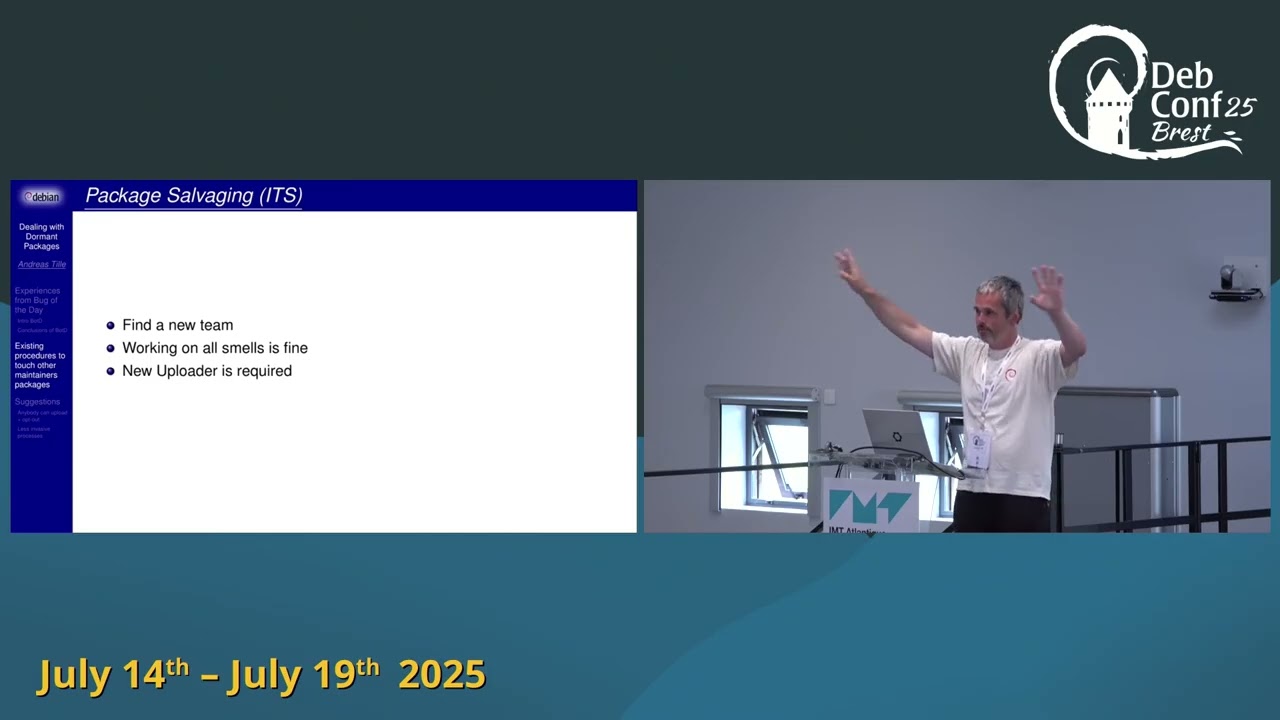
and we have the um package salvaging
procedure with a intent to salvage bugs
we find this means we Find a new team
which might be also the Debian team or
whatever.
Working on all smells is fine. Moving it
to salsa is fine because you you take
over the the responsibility for the
package.
That means a new uploader for the
package is required. That means I have
more than thousand package on my desk
which I really if anybody wants to take
one package of mine please do it.
please right and I have too many
packages
but yeah I can add myself as uploader
then we have another uploader and it's
it's it ends up in my mailbox if but
it makes no sense if I or the other
members of the salvage team add more and
more and more on their their desk. So
this is also not really the procedure we
want to follow.
So we try to find uh more teams with
volunteers to maintain the packages
and um we also have a special team on
sala. I hope everybody is aware of it.
Uh the previous leader Jonathan Carter
made a lot of noise about it.
We have formerly we had collab maintain
on Aliot. Now we have the Debian team.
This is in principle the team where you
can do team uploads and you can care for
a package.
Please do so.
Yeah. And we also I've also found a lot
of packages which remained in color uh
main onot according to their version
control system or the VCS fields. Some
of them were even on ZA but not uploaded
since then. Some of some of them I
picked from the archive, migrated from
SVN to git. So there's a lot of stuff to
do and um yeah, but it's also not really
funny work to do. Well, when when then
yeah may I ask questions you please?
>> Yeah. Um my question is could you please
go back to to Yeah. So uh you say that
um some packages are many packages are
on Debian Salsa team but as far as I
understand not all of them are marked as
team maintained. So it means that uh if
you see the package which is already on
salsa DBN group it is not automatically
team maintained. Um maybe we should
formulate it somehow that if the package
in DB and SARSA team please do uploads
because uh for me it's not quite clear
how we so you should check first of all
whether team maintain it or not and then
to check where it's hosted. So I think
it's very good
>> intention I understand perfectly the
question as I said Jonathan Carter made
a lot of noises this is the case
everything in Debian is team maintained
we have please look up the wiki we have
some wiki page stating that this is team
maintained I'm not sure if everybody is
aware that this is the case
but
let's assume that everything in the
Debian team is team maintained for the
moment
Right?
And if somebody is not happy about this,
this package can be moved to somewhere.
But let's assume for now and do
something.
So we have the uh missing an action
process which is um which is a man
manual process to find maintainers which
are missing an action and I reported
more than 30 of them. I see the package
in this list of the five packages. See
this maintainer. Oh, is he active? I
check contributors.net is and then I
report if it seems that this person is
not active anymore. The MIA team is
actively working on improving this
process. There will be some
announcement.
So uh what we can do now I have some
suggestion
two suggestion I start with a even more
invasive one to
do some to spread some ideas what we
could do in general and if the um in my
opinion
thinking of the the team structure make
Davian a team but in principle
when I was running for DPL I tried to do
the very same as I did in this smaller
subgroup DBN made D is is not important
for Dian right it's it's not a big thing
but we found a structure for the team
which is in my opinion totally
functional
and the proof that this is totally
functional is that I said if I get
elected from for DPL I will do not do
any team work anymore
And the the the most important message
for me from all this running at DPL the
team is functional and working. Thanks
to Eten and whoever is working in the
team. So this kept on working. Yes. Kind
of an applause. Thank you.
And I really want to bring also Debian
in a state that if someone is leaving
Debian
it's automatically others will
work on the stuff that is left behind.
So with this idea I started to apply the
same measures I did in Dian made also in
Debian. I well formally we had not these
procedures. I sometimes did things which
are not really in line with you don't
touch my package. I moved every single
package which is uh which is in the
field of medicine and biology to the
Debian made team and sometimes with the
maintain I was not asking then I did it
anyway this 15 years ago but yeah it
worked and
this idea is is one of my ideas why we
should try to do the same in in Debian
and so I want to somehow tear down down
the barriers between packages and people
uh all these are links to the two
threats in the mailing list. So if you
download the PDF then you see this
because um our current pol policy is
efficiently restricting the freedom of a
DD who is not maintain or mentioned as
maintain or upload and I don't think
this is a good thing. So we are seeking
mechanism for shared or a collective
diffused responsibility.
So if a package is in a bad shape, the
whole Debian project should be held held
responsible.
Either it gets fixed somehow or it gets
uh removed by someone.
So and I really really want to make you
some
better suggestions.
Um the um the schedule has a link to the
pet. This is the same link. So if you
have some ideas, open the pet, write it
down. The pet is not empty because we
worked on it on Friday, but just add
your ideas. Questions so far? Yeah,
>> there is a question uh from from IRC.
What about salvaging packages into the
QA team or salvaging team as well as MIA
procedure?
>> Yes. Well, uh I came to this sure uh
salvaging into QA team is is not the
right word because the salvage procedure
is defined as I find a new uploader and
QA team is a package without an
uploader. Right? So um I have I come
later to this that we have the intent to
off procedure which I try to uh suggest.
So I said I'm writing an email to the
former maintainer. [snorts]
I want to offan your package
and I wait 21 days and if I don't get
any answer I I'm fixing the bugs and so
on upload to delayed 10 or 15. We should
agree to about this. It is not a not a
decided procedure. I tried some what I
called experiments which I will blame.
No you are too fast. We have not agreed.
Yes, we have not agreed about this and
I'm not proud about doing some things
which we are have not agreed about this
but I think in general it helps Debian
it packages which are of so low
relevance of so low popcorn
and finally it could be reverted if
necessary right so intent to offen is
the process to set the QA team as a
maintainer, no uploaders and do a QA
upload and we do it as well and we put
it in the Debian team so anybody can
pick it up from there. So is this
answering? Yeah, I hope I hope this
answering.
>> Yeah.
>> Yeah. Um there is one more question or I
would say is more comment. Um
>> I'll just read it. I'm not sure that
Salsa Debian group being quite that open
as actually documented. we only have
it's a bit like a collab maintainment if
there is a real uh consensus on this we
need to document it better so I agree
with that so I I also support this idea
but I think we need to have one a single
source of truth where it's documented
maybe it's policy and just to maybe
start um discussion about changing it
changing it and uh to to make this
suggestion there
>> could someone do me a favor and put this
in the pet
because this is above we want to do new
things we want to do and some kind of a
to-do list in the pet is perfectly
welcome right
so my idea to to define the procedure to
um uh to that we can say okay every
package is free for everybody but there
are package with very very good reasons
to not to touch right I I would not
touch the kernel or lipy package for for
Right? We should be clear about this and
then we can agree about some file the
name I'm not good in inventing names but
I suggest as a working thing file Dian
don't touch my package if this file
exists
don't touch the package right
>> please please talk in in the mic
I think it's so hard hardly named
because there might be package which
people might be happy that people
contribute to, but they want to have
a second pair of eyes onto it because
there there might be trivia changes
which will break the package.
>> Yeah. Yeah. Yeah. to talk to me.
>> Yeah. Yeah. Yeah. So,
>> yeah, we we we talked about similar
things on on Friday. Um, we can use this
file to document [snorts] like
don't touch it before asking me or
well, in general, I really really
believe that this is a very good idea if
you want to touch the package to contact
the maintainer in advance. [snorts]
Well, we mostly talking here about
packages where the maintainer is in a
way absent that he is not answering for
three weeks
or longer. We time span I just suggest
three weeks. So if I write the
maintainer an email I've done this and
this is this okay for you and I get no
answer
and this file doesn't exist. [snorts] So
yeah, this is we we really like to do
something. Yes. Here's a question. Can
can you get the mic?
work.
>> Um I think in general it's a good idea
but I really think we need some sort of
mechanism that works as a canary in the
sense that if you put it there it should
disappear after a year automatic
automatically
>> because otherwise everyone will just put
it there and we have the same problem.
This file should include a timestamp
and this time stamp if it is five years
old then yeah and we should define these
rules clearly right it's perfectly right
so it I'm really happy that you are
repeating the things we we just were
talking about because it makes sense
right just talk about everything there's
another um remark
>> a bit a bit a followup to previous
question and uh another issue. So
basically one thing is uh the biggest
problem at least for me to touching not
my packages is that there is not uh
always obvious workflow of packages.
Sometimes GBP sometimes it's only Debian
yeah exactly only Debian stuff and so
on. So it's
>> it sometimes it makes more time to check
what it how to properly build package
and
>> and and upload this correctly uh then to
apply those changes and related to that
uh from the other side I've uh had the
cases that some some people uploaded new
version of packages but for example did
not push correctly everything to G. for
example only Debian branch and not orar
or something like this. Yeah. Well,
these are actually details, right? We we
need to talk about details, but yes,
with for the workflow, maybe you people
are sneaking in my slides and I don't
know. Yeah, but uh we are not talking
about G workflows here now because it
goes too complex. We have two
dimensions, right? I agree this is a
complex topic and it's important topic
but it distracts us from the point.
So we have some refinements found in the
uh in the sprint and we need to agree
upon the time frame when refreshing the
statement right if the file is uh five
years old I think it's clear
if it's one year old we well this is
these are details [snorts]
um
it's also a question um if
the people say I do not want to upload
to refresh this information and we can
agree okay if it's in salsa
the maintainer refresh in salsa that do
not touch but on the other hand this
requires that the package is maintained
in salsa right so if the package is not
in salsa you need to upload if it's in
sala we can agree upon things
and
for sure we should inform the maintainer
I'm not propagating that someone should
upload something without informing the
maintainer.
The thing we should discuss is how long
should we wait? Um Andreas, there is a
comment on either part or I would say
a couple of sentences. I will just
summarize it. The question is uh whether
we should agree that the package which
is not being uploaded in one release
should be should at least become one
upload per release. It doesn't matter
who is doing it. So I think it's details
but uh this is details. I tried really
hard once I was in a mamm to upload once
per release but on the other hand we
have packages
that really don't need touching if there
are really no bugs and it's
architecture all package which does not
profit from new compiler version. So we
we also need the people to do the work
right. we cannot set a requirement and
then we have nobody who fulfills the
requirement. So I would not I would not
attach this question to this specific
requirement. There's another question.
>> So my suggestion um regarding one upload
per release would be um to change the
reason. So some packages don't need
uploads but some page would benefit of
getting a new build. Um so if the
package is reproducible
then we could do archive rebuilds from
time to time and check if a new rebuild
of the package would change. So which
means for example we change a compiler
flag with security flag and that would
change the outcome then that would be
triggered to say okay we should have
another upload of that package to pick
up changes in the environment or the
compiler and not just do an upload
because we want to do an upload.
>> Are there really that many packages in
Debian that have no changes need no
uploads in a threeyear span? I mean how
many how many pieces of software
>> we don't know we don't know but as I
said setting this requirement
means somebody needs to do the work if
you volunteer to rebuild every package
great do it
right
so um other suggestion where we we want
to replace is we have a low NMU wiki
list and we should
just don't use it and use this is not My
suggestion because Dwell would be not a
good list but we can use similar to the
QA team
um somehow find some active uploader or
we use a collab maintained a well
mailing list which receives all the
messages back reports for packages that
have no real maintainer. Um this would
reduce responsibility of uploaders.
These are all links to the to opinions
on the mailing list. Please click on it
if you have the PDF. There were also
some implementation details like putting
it not in don't touch my package but
make readme.source source somehow
machine readable and it could contain
maybe even in control file something
like don't touch feel free to update
your m welcome something like this other
suggestions other methods you see it's
it's very open for discuss the thing
opinions are really welcome I have no
clear vision yet about how we implement
this but I think it's important that we
implement it
And u you should always document the
reason for discouraging others from
uploading. Maybe the build process for
this package requires a lot of
experience and handholding. These could
be documented and then yeah we don't
touch it or changes to this package must
be coordinated with other packages
some libraries right so if you think I
should update lip
make sure that you don't break anything.
Right? So this is not I I mean this is
not a good example. I intentionally take
this bad example to think to explain
that we do not want this. We want to do
lip something without any dependencies.
This is what we want in in the the
packages package pool I'm talking about.
Yeah. So and there are different reasons
that could be good reasons to not touch
the package.
Certainly what I'm suggesting here will
finally lead or it has heavy
consequences on our social agreement. So
we certainly will require a GR. So we
first need to find some consensus what
we really want. It's nothing it is
nothing that will happen in my DPL term.
Right? I'm talking about the vision.
It's not that we start tomorrow with
this.
For the moment, I'm just collecting
feedback, more suggestions. [snorts]
And any volunteers here in the room who
want to work on this, please raise your
hand.
One volunteer. Yeah. Well, volunteers
can write their names into the pet and
then we talk about this. Well, we have
tomorrow I have my bits from DPL.
Wednesday is uh uh the the uh day tour,
the day trip and but we have three
further days to discuss things and if
you find a group of people discussing
things this would be cool
parties
uh other parties pretty full now for
this talk. So you get a lot of feedback
here. I will not read everything but I
think uh your talk is good is is doing a
good progress and good activity.
>> Yeah. Thank you. So this is for the uh
more aggressive approach. We have less
invasive [snorts] things.
>> So you have one more question.
>> Yeah. Yeah. Sure. Sure. Questions are
everything I've written here. You can
read it but questions are interesting.
While talking about long-term plans, um,
are you considering automatic uploads
for reproducible packages?
Good. Yeah. Nice.
>> Okay.
But these are probably normal NMUs as
they are done
currently for rep reproducible packages.
It's not really
doing more things than necessary on on
this packages, right?
So what I specifically mean is that the
changes you're performing are manual
changes per package. Yes. Right. Yeah.
Yeah. Fixing the homepage is is probably
something you can't do automatically.
>> True. But some of the standards changes
some of the can done like
>> yeah this standards and deper compat
which also might break the build right
because of the edge missing something
needs to be changed also. Then if you
can do it automatically go for it from
here. So we always want to send our
intention to the maintainers
and we always upload delayed. So the
whole process from I start contacting
the maintainer to finally uploaded
packages at least one month. We can
agree about other things and
um we also send uh an email when we
upload to delay to the maintainer and to
the open box sending them pending. This
is this is always important if we do any
procedure and so I tried in the
intention to NMU.
Well, I said NMU has in had some
specific rules and I wanted to go beyond
these rules and wanted to int tell the
intention otherwise I can do a normal in
NMU
and
um some this is the result of some uh uh
uh response I got. The response is
linked there and the the receiving end
the maintainer said oh he understand I
want to improve the state of long
neglected packages this name is not good
we I have a better suggest suggestion
and it it is slightly expanding the NMU
process for instance move move to salsa
is not okay but I want to expand this
and um I just want to handle more
intrusive changes [snorts] and he this
this maner and others but he confirmed
it explicitly said I was just offering a
bigger oneoff help to the maintainer I
do not want to maintain the package but
the maintainer has left the package for
10 15 years and he said I should do this
ah this Andrea said done it great so
this this kind of response was it
I did not always resp get this response
But we have a couple of people with
exactly this response and this was told
here. So we thought about intent to NMO
is not good. We say intent to orphan.
Well, this is actually taking the the
package from the shoulders of the
maintainer. All fanning is the package
is QA a meant and we should think about
if you want to have this procedure
telling the maintainer we will or offend
your package
which is probably very necessary for a
lot of packages.
So the then it in includes investigation
whether maintainer remains active or or
welcomes oneoff help otherwise we do
this QA upload with a time span warning
and to delay it. So we are here for more
ideas. I'm basically through my slides
right [snorts] in time.
There are more ideas.
Yeah this the slides are here. Oh it's
not good to see it.
One issue I've run into in the Rust team
is what happens when a team member
disappears
or loses interest or whatever. The
current orphaning process doesn't seem
to have any way to document that this
package is still maintaining minimal
background maintenance from the team,
but it doesn't have a proper maintainer
at the moment.
>> Yeah. Okay. Well, what I'm not catching
by my my Sentinel is the M R team
packages have are in salsa. They are
maintained by a team.
If they have no bugs, I is not ringing a
bell and I hope hope really hope that
the Rust team has a standard version
bigger than four.
So
I'm not talking about these packages and
the Rust team is a team what that needs
to decide what we are doing with this
packages. If a maintainer goes away they
the team needs to implement their means
to to to deal with this package.
Is this answering the question?
>> Not really. Okay, then you should
probably go to into detail later
after I don't know the rough rust team.
I'm I'm in in in Pearl team. I'm Python
team, Java team, other science team.
There is very easy when the if the
maintainer goes away, we or the uploader
the maintainer is always the team in in
all teams I know. And if the uploader
goes away, then we replace the uploader
or add another uploader. This is this is
a usual team workflow and I really
really really hope that's not very
different in the Rust team. I don't know
the team
>> that certainly can happen in the Rust
team but
you get this situation where the MIA
team is telling us this guy's gone away.
>> Yeah.
>> And yet you don't have anyone who wants
to put their name on it. And currently
those packages are just getting left.
>> Care for my newcomers for the Rust team
who who will care.
>> Is this what we do?
>> Maybe.
I think what he's aiming at is the dev
cargo conf workflow where everything is
in one git repository
mixed up by different maintainers and
all them being in uploaders and with and
if one dis one disappears no one because
it's one git repository and not various
ones
>> in in in rust there's only one
repository
>> the the most of the git uh git caros are
in one repository.
>> So, um it's not that easily distinguish
>> like in the Huskll team, right?
>> I don't know. Uh
>> but uh what I wanted to say is actually
I forgot what I was say.
>> Um
I forgot. Sorry. Okay. So anyway, we
have time left or not. Shoot your task
master
>> Lucas.
>> Uh yes. uh two comments. The first one
is about removal of packages. I think we
need to remember that what we are trying
to do is build the best possible Linux
distribution for our users and sometimes
a low popcorn uh package that is using
completely outdated packaging
is still useful to our users. still
better for our users to have access to
some software even if the software step
is outdated rather than build it from
source and maybe they will try the
package discover it's outdated and
install it from source because they need
the latest version but that's still
useful to our users so I would be very
careful about removing packages I think
we really need to ask ourselves what is
the value of this package in Debian are
there alternatives that are strictly
better
>> before removing packages is based on
criterias that are mainly relevant to us
uh as a distri
for our users.
>> Sorry, sorry.
>> Are you ready? I I have an answer for
this. What do you want to continue?
Well, the thing is well looking at the
photos I took from this image I took 20
or so and my wife said only this is
good. Remove the others. So a [snorts]
collection in principle gets better if
you remove things but
in Debian is probably different
um for certain reasons and also in the
Dian mid we have zero popcorn packages
but other packages which have no zero
popcorn will be enhanced by this. So we
we know our users, we try to care for
them, but we should make sure that the
effort to manage these packages if even
the maintainer doesn't care anymore is
beable. So we do it by a case by case
basis to remove it. And as I said
before, sometimes removal is costs more
effort than just fixing it and doing it.
But but I want to have the permission to
to fix it without any constraint without
people oh you are not allowed to right
>> uh
okay I I didn't know you were finished
but you finished
>> so my second point is about uh ownership
I think that some amount of ownership is
useful it's useful for pe to have people
that feel responsible about something
>> even if they are not interested anymore
in fixing it the fact that you committed
to do something means that maybe you
will do it
>> feeling a bit forced but uh
>> uh so I would be very careful as well
with removing with changing this sub
balance that we have in Debian. So I
agree that we could we could go further
about NMUs. For example,
>> you in your slide about the delay Q you
say that you want you should we should
ask you should notify the maintainer
first not askify first and then wait and
then upload.
>> I think that if we had a way to uh
upload to delay queue and then easily
remove that upload from the queue or
even let the maintainer remove that
upload for from the queue we could
notify and upload at the same time.
That's a simple way to
>> Yes. Yes. Yes. I'm totally we made
failure in this process. We had two or
three where the changes were emer
packages in this worked on these
packages and we made one or two
mistakes.
>> Yeah. People who are doing things are
making mistakes. I'm not proud about it,
but it can be reverted and we should.
>> Yeah, but I mean if I if I'm able to
email the maintainer saying I fixed
this, I upload it to the DQ, feel free
to cancel the upload for any reason even
without explaining it to me.
>> That's much uh easier because it's just
a fire and forget process and don't need
to come back to
>> it. It happened that I've removed
something from the new queue. Yeah, but
yeah really I think uh the value
ownership is valuable teams the current
structure in teams is valuable because I
mean in the Ruby team we care about
stuff that was packaged at some point
even if we have no interest as current
interest in that package uh and uh yeah
so
>> I absolutely agree very careful with
that and
>> we need to find out if this
maintainership is not existing anymore
And this is the problem. We have no
means. We can't send some some uh
picture postcard to the maintainer at
home and are you there? Can you answer
whatever if it's not answering the
email? I don't know.
>> Any more question? I remembered what I
wanted to say, you know, of the first
place on my last when I last had the mic
and you have to be very careful to um
if you if you if you do an intent to
offen
it easily can happen that you just put
the burden on someone else some else
group which then again. So uh you need
to have some commitment to keep the
package uh living or just directly
remove it.
>> Often is means often and it is
>> yes but in the end it may may just
linger again in the QA team.
>> Uh
>> yeah yeah yeah. So, and the second
second one is you have to be careful
about popcorn because uh
>> there might be
>> misleading I'm totally aware
>> which has no popcorn but is still used
because it just is a middle dependency
or whatever. So,
>> I have zero popcorn packages on my desk.
I know this and I'm proud to maintain
them properly.
>> Okay, thank you very much. We are
running out of time. Uh we have one more
minute. So the last very very small
question
not comment question
>> question um regarding maintainership
uh I often feel like we're debating
debating whether it's useful and one
aspect I found useful there is that
maintainers tend to be in a position to
say no no no to changes then they feel
are out of scope and and that way they
establish vision this is something I
feel we are bad at collectively when we
touch other people's packages
because we are including just changes
because they seem good. Uh how can we
actually
get better at estab using this
maintainer centric vision and being able
to say no to things
in a way that drawing these maintainer
benefits but still maintaining packages
collectively.
It may be a stretch to answer this now.
>> Yeah, it's it's too short. By the way,
thank you for Hammood. Helm is
responsible for about 20% of the bugs we
fix because he is also fighting this FT
fight to cross build from with all
patches and this is also kind of an easy
bug from F. Thank you for doing this
work.
>> Okay, I have to interrupt the
discussion. I'm very glad that it was it
is really active discussion. We have
some comments on other part but uh it's
more technical. You can uh definitely
read. I ask you to use other part to
document everything and use the time
till the end of the week to discuss this
uh proposal and to make some things
happen. Thanks a lot. Thanks Andreas for
your very
>> Don't forget to add your volunteer
volunteer to discuss this.
>> Don't forget.
>> So thank you all and please greet
Andreas one more time. [applause]
Thank you.