Video summary
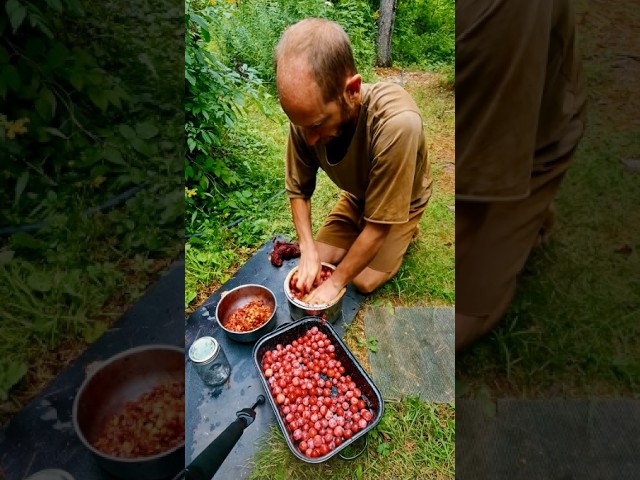
On day 322 of his year-long experiment to consume only foraged food and medicine, the host finds himself in the final stretch with just six weeks remaining. His home is abundant with a harvest of plums, apples, black cherries, choke cherries, hazelnuts, and acorns, all of which are currently being processed into various forms of sustenance. He explains that while nature serves as his garden, pantry, and pharmacy, the reality of this lifestyle involves significant time spent on processing and storing food rather than just harvesting it. With a bountiful supply of fruit secured for the Northwoods, he is confident that he will finish the year without any shortage, having successfully transitioned from relying on grocery stores to living entirely off the land.
The core of his daily routine involves intricate processing techniques to ensure safety and nutrition, particularly with acorns which require dehydration, cracking, winnowing, blending into flour, and cold leaching to remove tannins before being eaten as porridge or baked into flatbread. He also highlights the importance of efficiency when breaking free from conventional food systems, noting that while harvesting greens might seem simple, processing nuts like hazelnuts requires specific skills developed over a year. A significant portion of his diet comes from wild fermented staples such as onion, garlic, and plum vinegar, alongside dehydrated herbs and mushrooms that he harvested earlier in the summer to save energy during his busy schedule.
Throughout the year, the host undertook grueling tours across multiple cities including New York, Chicago, and Minneapolis, where he faced extreme fatigue due to smoke from Canadian wildfires but found renewed strength by consuming wild greens like dandelion root and yellow dock. These travels allowed him to deepen his connection with people and plants, hosting foraging schools that enriched participants' lives by teaching them to live in harmony with the earth. He emphasizes that this lifestyle is not unusual but a return to how humans have lived for tens of thousands of years, fostering a profound sense of belonging and freedom that cannot be replicated in modern society.
As he prepares to conclude his journey, the host shares his remaining harvest list which includes wild rice, various berries, venison, fish, and roots like parsnip and lotus. He expresses deep gratitude for his simple life on the shores of Lake Superior, drinking clean well water and sharing his story through upcoming film screenings and talks in Wisconsin. While he cannot yet reveal exactly what he will eat after this year ends, he remains committed to continuing his path forward in harmony with nature, viewing his relationship with the oak tree and its acorns as a lasting bond that defines his existence.
Read the full video transcript
Today is day 322
of the year of foraging all of my food
and [music] medicine. And my home is
full of foods to process.
Plums, apples, black cherries, and choke
cherries, hazelnuts, and acorns. I've
made it to the abundant harvest season,
and I have just a month and a half left.
I think it's safe to say I'm in the home
stretch and everything [music] is going
to be okay.
[music]
[music] Today I welcome you into my home
here. There's no grocery stores, there's
no restaurants. Nature is my garden, my
pantry, and my pharmacy. I'm going to
share with you what I've been
harvesting, eating, and what I'm
currently processing in order to eat a
diet 100% foraged [music] from the land.
I will have absolutely no shortage of
fruit to finish out the year. It is a
bountiful year of fruit here in the
Northwoods.
Plums, I am freezing, dehydrating, and
making plum sauce. With the apples, I am
making applesauce, as well as
dehydrating apple slices. With the black
cherries, I'm primarily making black
cherry juice. And with the choke
cherries, I'm making choke cherry juice,
but my number one food with that is
choke cherry leather. With that, I break
up the pits and the fruit together,
dehydrate it to make a wonderful fruit
leather. For my 40th birthday 2 days
ago, I went out and harvested hazelnuts.
And this is a plant that if you don't
know how to work with, it's very
timeintensive.
But I've been really developing my
skills over the last year. And this year
is a totally different realm when it
comes to the hazelnuts. I've got the
process down with dehydrating them in
the husk and then using the Davebuilt
nutcracker to crack them open. For those
of you who are just looking to harvest a
little bit of greens and herbs, etc.,
effectiveness and efficiency really
isn't that important. But when it comes
to breaking free from the grocery store
and even the farmers market, then
effectiveness and efficiency are
absolutely essential. Acorns are a plant
that really takes some time to get to
know and to become effective with. This
year, I harvested and ate 25 pounds of
acorns, and I just recently ran out. So,
imagine how incredibly grateful I was to
come across an oak tree that was
producing a bounty of of acorns in mid
August, much earlier than I ever
expected. And you know where I found
this? It was the exact meeting spot
under the oak tree in Riverside Park in
Minneapolis where the last foraging walk
of the year of foraging was taking
place. And about 70 people were there
and it only took us about 10 minutes to
harvest me 25 pounds of acorn. Enough to
provide a serious amount of calories.
Last year was a difficult year for wild
rice, one of my staple foods. So, I only
managed to harvest 75 pounds. Between
the acorns and the wild rice, well, the
last couple months have been a little
short in calories.
And these acorns have just been an
absolute savior in the bridge of getting
me to wild rice season that's coming up
soon. So, what I do with these acorns is
I dehydrate them first to get them to be
more brittle and for the nut meat to
shrink. Then I run them through the
Davebuilt nutcracker that breaks them
open and does a decent amount of
separation from the shell and the nut.
Then the next step is to winnow off the
shell and then do some hand picking to
get down to just meat. Then I blend it
up into a finer flour. And then I leech
them using the cold leeching method, a
slower method that removes the tannins,
making the acorns edible. With that,
I've been having a lot of acorn
porridge, and I also bake some into
acorn like flatbread. The acorn grubs.
A very, very tasty food. If you like
acorns,
there's a good chance you would like
acorn grubs, too. The only thing that
these have eaten is acorns.
So, wow.
That
incredibly delicious.
A lot of people would be grossed out by
this, but they are just another form of
the acorn. Billions of people around the
world eat insects as a very normal and
healthy and nourishing part of their
life. And if you're grossed out by that,
well, I encourage you to think think a
little deeper. When a lot of people
think of foraging, they think of the
really fun part, harvesting the food,
being out and connected to the earth
with the plants. Well, the reality is is
that that's just a fraction of the time
that it takes. The processing of the
food and then the storing of the food.
Wow, that takes a significant more
amount of time than the actual foraging.
And then of course, you have the dishes.
But it can be very joyful. It often is.
Sometimes it's a chore. Today I'm really
enjoying it. I just finished with the
plums. And I managed to make what will
become plum vinegar.
Yeah, that's nice and concentrated. That
was with the leftover scraps basically.
And then I've got all of these seeds
left here. So this is probably a good
500 to a,000 seeds. And I'm actually
going to put these into a community
fruit trees micro nursery bed.
And this fall they'll go dormant through
the winter. Spring they'll come up and
hopefully if everything goes well next
year we'll have 500 to a,000 plum trees.
That is part of our community program
where we're going to be planting 1
million fruit and nut trees over the
next decade. You can check that out at
community fruit trees. Wild fermented
foods have continued to be an important
staple for adding nutrition and flavor
and biodigestibility
to my diet. I have wild fermented onion,
two different types of garlic, and I'm
doing well plum vinegar. I mean, right
here,
two of my go-tos for learning about this
and pract practicing this are
wildcrafted fermentation by Pascal Bodar
and Wild Fermentation by Sandor Cats. My
pantry of dehydrated goods, such as my
herbs and dried mushrooms, have
continued to be bountiful, and I haven't
needed to put much time or energy into
harvesting these staples this summer,
which has been great because it's been a
busy schedule. After just two weeks of
being back from my West Coast tour, I
was off onto my summer foraging tour.
And I have to say, it was grueling. I
was not ready to go on another tour. As
I shared in the last video, we had just
had this serious smoke from the Canada
and the boundary wild fires. And on this
tour, I ended up extremely fatigued for
the first two weeks or so. I could not
figure out what it was.
And ultimately, I think it was that I
had been exposed to a heavy amount of
smoke. So the tour was not only very
challenging to be on the road, but I was
also one of the most fatigued that I've
ever been. And that was while I had many
foraging walks and foraging schools that
I was hosting. Some of the highlights
were my five burrows foraging tour in
New York City. And I'm happy to say the
New York Times came out and they are
working on a story right now about my
year of foraging. Then of course there
was the foraging walk at the US capital
and what a joy that was to show people
that food and medicine is growing freely
and abundantly right in the lawn of the
US capital.
And then cities included Cleveland,
Detroit, Pittsburgh,
Chicago, Milwaukee, Madison,
and Minneapolis. And it was just a real
joy. I have seen concretely and
profoundly how many people's lives are
being enriched through foraging. I've
seen people are developing the greatest
sense of freedom and connection that
they've ever experienced by learning
just one plant at a time. Of course,
while leading these foraging walks and
foraging schools and sharing my story
via interviews with the media and
engaging with hundreds of enthusiastic
people, I was also still living on 100%
foraged food. To a large degree, I was
living off much of the food that I
brought with me. My canned fish and
venison, canned fruits and dehydrated
fruits, of course, my herbal teas, dried
mushrooms, and more. And what I did
mostly for fresh foods that I foraged on
the trip were fruits. The Cornelian
cherry in Central Park, black cherries.
Black cherry was the plant that I
developed the strongest new relationship
with this summer. I was relieved to be
shown an early apple tree with fruit
falling to the ground at Omega Center
that had been planted long before that
center was even there. And to get to
enjoy that fruit and make applesauce.
Sometimes I lacked in harvesting my wild
greens, but when I was with my friend
Eric Joseph Lewis, I got up to eating
about one pound of wild greens per day,
and that is when my fatigue started to
go away. Perhaps the wild greens had
something to do with it. And then of
course there was the bo and the
dandelion root that I meant that I ate
as a wonderful calorie dense root. And
there was harvesting the yellow dock
root which is an important medicine for
me right now. And the hickory nut oil.
Well, that kept me company on the tour
and was a much needed source of fat and
calories. For dinner today,
I have white fish from Lake Superior,
apple plum sauce, water crust from
Apprentice Park, and acorn porridge.
Wow.
Oh, you know, sometimes friends,
I really feel it.
As I shared, today's day 300.
What is it? 23 of foraging all my food
in medicine for a year. So that's a year
without a grocery store or restaurant.
You know, a lot of wild food, a lot of
foods that we're just absolutely not
used to. And there's so much character
there. I have such built so much
relationship with these plants. There's
just such a sense of belonging and
connection and being here a part of this
earth, belonging to this earth. I don't
remember that what I'm doing is unusual,
different. Uh I've forgotten what it's
like to eat from the grocery store
restaurant to a large degree. But a
dinner of acorns is not something that
most people watching this experience.
And it is a deep connection to the way
human beings have lived for tens of
thousands of years. And there's no going
back. You know, we're here now, but
there is going forward in a way that is
in harmony with the earth. In a way
where every bite that we take, I'm going
to do a little bit of acorn, a little
bit of apple plum sauce, a little bit of
water crest, and a little bit of lake
white fish. Let's see how.
needed a little bit of wild salt.
Maybe it didn't. Wow. So, dear friends,
what is to come now? Well, here is my
foraging harvest list for the last month
and a half. On here, I have manomomen or
wild rice. It's coming. It's manomomen
season. Applesauce and pear, too. Plum
sauce, choked cherry leather, choked
cherry juice, grapes,
aronia, high bush, cranberry, venison,
fish, acorn, black walnut, hazelnut,
mushrooms, ramp bulbs, bo, parsnip,
[music] wapo, lotus, milkweed pods,
cattail, maybe manarda, water crust,
greens, elderberry, sumac, deer fat,
maybe goose. I'm so happy to be home.
[music] It has been a long year. Five
tours, so many cities, so many foraging
walks, talks, and foraging schools.
[music]
And I'm home for the rest of this year
of foraging. I am home here on the
[music]
shores of Lake Superior, living in this
simple, simple home that I have, [music]
drinking
this pure, clean well water from the
earth.
which I am just so grateful to [music]
have. And dear friends, I welcome you to
come see me in this last portion. If
you're looking for a reason to take a
trip up to northern Wisconsin, they are
showing the Wisconsin premiere of
Greenfield, the film made about my life,
my pursuit to live in harmony with the
earth and in service to all the life
that we share this home with. It's
showing at the Bay Theater on September
25th. I'm also giving a talk about the
year of foraging. Coming up on is it
September 9th at the Vaughn Public
Library, my childhood library. And in
November, I will be going on a speaking
tour throughout Wisconsin, some of
Minnesota, and Chicago area. So, I
welcome you all to come out and to see
me as I finish off this year of foraging
all my food and medicine and as I share
this message after the year is over. I'm
sure some of you have some questions.
What's next?
What will I eat [music] when this year
is over? And all of those questions will
be answered in due time, dear friends.
But for now,
I've got a date
with my love,
my partner, [music] the oak tree, and
our babies,
the acorn.
[music]
Thank you, Earth.