Day 2 Plenary Paper Presentations : Ethics of Death, Dying, and Moral Challenges in Surgery
Watch on YouTubeVideo summary
The ethical complexities surrounding death and dying were central to the plenary presentations, beginning with Dr. Kristo Laszlo Lazaridis's argument for protecting "physiologically maintained diseased" individuals who are declared dead but kept on artificial support. He emphasizes that surgical exclusion of blood flow to the brain is essential during normothermic regional perfusion after circulatory death donation to prevent any risk of reemergent consciousness, while also challenging existing research assumptions regarding long-term maintenance for xenotransplantation where precautionary measures remain necessary due to unknown neurotherapeutic effects. Complementing this discussion on end-of-life care was Dr. Julie Campbell's critique of common misconceptions about cardiopulmonary resuscitation (CPR), noting that patients vastly overestimate survival rates while underappreciating significant harms like rib fractures and potential induced consciousness; she advocates for a "modified prompted choice" framework that utilizes visual decision aids and educational materials to shift requests away from futile CPR toward Do Not Resolute status, thereby ensuring autonomous decision-making before crises occur.
The discourse on physician autonomy extended to the contentious issue of medical assistance in dying (MAID), where Dr. Timothy Murphy highlighted the American Medical Association's current stance that relies on conscience clauses rather than endorsing participation despite global legalization trends. A speaker further argued for a formal shift by the AMA toward accepting MAID as good medical practice, drawing parallels to its historical evolution regarding abortion policy and contending that voluntary death involves fewer moral objections related to wrongful homicide compared to involuntary killing; this perspective suggests that aligning ethics with legal landscapes where patients choose assisted dying could acknowledge patient distress while protecting physicians' rights through conscience protections. These discussions collectively underscore a tension between institutional guidelines, personal beliefs, and the evolving reality of patient choices in end-of-life scenarios across different jurisdictions.
Beyond issues of death and autonomy, significant attention was given to the emotional toll on surgeons and systemic biases within surgical practice. Ursula Francis described morbidity and mortality conferences as sites for "catharsis" where contemporary practices foster collective healing through empathy and balanced feedback rather than traditional shame or scapegoating; however, she cautioned that while these tacit functions help manage burnout and depression among high-responsibility professionals, they are insufficient on their own to address severe trauma like second victim syndrome. Simultaneously, Hannah Bents critiqued gendered patterns of surgical paternalism illustrated by skin-sparing mastectomies, where clinicians often preserve breast tissue under the guise of "beneficent foresight" without explicit consent, effectively privileging a hypothetical future self over present patient autonomy and reinforcing patriarchal expectations about femininity.
These themes converge to reveal how medical decision-making is frequently shaped not just by clinical necessity but by deep-seated cultural assumptions and temporal paternalism that subordinate current patient wills to imagined futures or normative ideals. This dynamic extends beyond oncology into gender-affirming care, where transgender individuals face systemic barriers including delays, insurance exclusions, and bias rooted in binary transition narratives; clinicians often act as arbiters of future well-being by withholding treatments based on fears of regret rather than respecting immediate self-determination. Ultimately, the presentations argue that informed consent must be reconceptualized not merely as a momentary signature but as an ongoing dialogical process requiring epistemic humility to honor patient refusals and dismantle sociocultural norms embedded in medicine that preserve system boundaries at the expense of genuine possibilities for patients.
Read the full video transcript
uh
Dr. Megan Applewhite, who is uh
professor of surgery and uh also an
associate director of the MacLean
Center, um who will moderate this next
session. So, Megan.
>> All right, thank you. Um uh this is
going to be a great lineup. Our first uh
speaker is Dr. Kristo Laszlo Lazaridis.
Um he's a professor of neurology and
neurocritical care at the University of
Chicago.
And he is faculty at the MacLean Center
for Clinical Medical Ethics.
His neuroethics work focuses on ethical
and conceptual problems in acute brain
injury, including disorders of
consciousness and determination of
death. Welcome.
>> Hi.
Thank you very much.
Um
Okay, let's get started. I'm going to
keep my own clock here so I don't go
over this.
Uh okay, so I'm going to be talking
about um I would I would making the case
that uh the dead need protection, too.
Um and I will argue for how potentially
to do that. And I'm going to be
specifically talking about a category of
being called a physiologically
maintained disease.
Uh I have no disclosures. Okay. So, here
So, here is what I'm going to be talking
about and everything is on this slide,
the entire presentation, really.
Um but I'm going to say what is a
physiologically maintained disease.
There are two types. One is kind of a
short-term PMD, which is encountered in
a normothermic regional perfusion after
DCD.
And then, there's a long-term PMD, which
is a brain-dead individual who is
physiologically maintained for
potentially days, weeks, or months for
discovery research purposes.
Um so, I'm going to ask the question,
why would we need to protect PMDs if
they are dead? Seems to be a very
natural question.
Um and the answer to this is that we
have to take precaution precautions
against the reemergence of
consciousness.
Uh I'm going to say a word about how we
can protect them
which is ensuring brain circulatory
arrest.
And then finally I'm just going to say a
couple of words
and potentially you know hopefully we'll
have a discussion uh about the
implications of thinking about this and
taking it seriously.
Okay, what is a physiologically
maintained diseased? Um
So it is a patient who has been
determined and declared to be dead
according to established medical
criteria and according to the UDDA in
the United States
uh who remains on artificial ventilatory
and circulatory support which is the
case classically for death after
neurologic criteria or brain death.
Uh or uh there is a this patient is then
uh
um actually has reinstitution of
artificial ventilatory and circulatory
support and this is what happens in the
case of donation after circulatory death
and specifically NRP.
Okay, let's start with NRP which is the
more common thing and probably larger
issue.
Um so this is just a graph showing you
the standard process for
uh donation after circulatory
determination of death. So there is
withdrawal of treatments as an
independent decision. We observe the
patient for an hour or two for
circulatory arrest. When that happens
then there is a 5-minute hands-off
period to make sure there is no um auto
resuscitation and then death is declared
based on circulatory criteria. So
standard DCD organs are either explanted
and uh directly uh implanted or they are
ex ex situ
um you know subjected to ex situ machine
perfusion.
Uh NRP changes a little the
uh the game. Uh The first thing that
happens
is that after the declaration of death,
the uh arch vessels from the aortic arch
to the brain are surgically excluded.
They're ligated. And one once that is
completed, then the NRP circuit, which
is basically an ECMO pump, reperfuses
the thoracoabdominal cavities.
Uh,
just for visuals on the procedure,
that's that's how the patient looks
after sternotomy and after
um as you see the arch arteries are
ligated. And so there is no conduit,
right, from the thorax to
um to the brain.
Uh, why
I mean there there are many This is a
complex uh and interesting ethical
topic. Um,
but but what but but you know, I'm uh in
the middle of all this controversy, why
why is this very popular and why do the
transplant community why does the
transplant community wants to really do
this? Uh, and there are good reasons.
Uh, so all organs um are perfused with
one machine, so there is a significant
reduction of warm ischemic time.
Uh, there is immediate functional
assessment of the organs. Actually, you
can actually have native cardiac
function restart, right, and have uh
direct functional assessment of the
heart.
Uh, there is higher organ yield and
there is early empirical data suggesting
better recipient outcomes.
Now, um
we have argued here
we have argued here um
that um
uh surgical exclusion of the vessels is
not sufficient. You actually have to
make sure that there is no blood flow
entering the brain after you restart the
NRP circuit. But this is also debatable
and not entirely acceptable from the
transplant surgeons.
Okay, now why is this the what what's
the point of this talk? What are we want
to protect uh
against? So, we want to prevent
reanimation of the brain and arguably of
the patient, right?
Um and so, this is not going to look
like the donor wakes up uh in the on the
table like in the movies.
Uh but um
what may happen what what's within the
within the uh sphere of possible is that
you may have re- If there's brain
reperfusion, there could be some
reemergence of even rudimentary
consciousness. Um and you would you
wouldn't even know, right? If you don't
have any neuro- even if you have neuro
monitoring actually, you wouldn't know
that the patient actually recovers some
potential raw phenomenal consciousness,
right? So, there is a risk for
experiential harm here.
Now, when you talk about consciousness,
it's the same about talking about death.
We don't really know what we're talking
about. Um
but uh but but but in a very basic
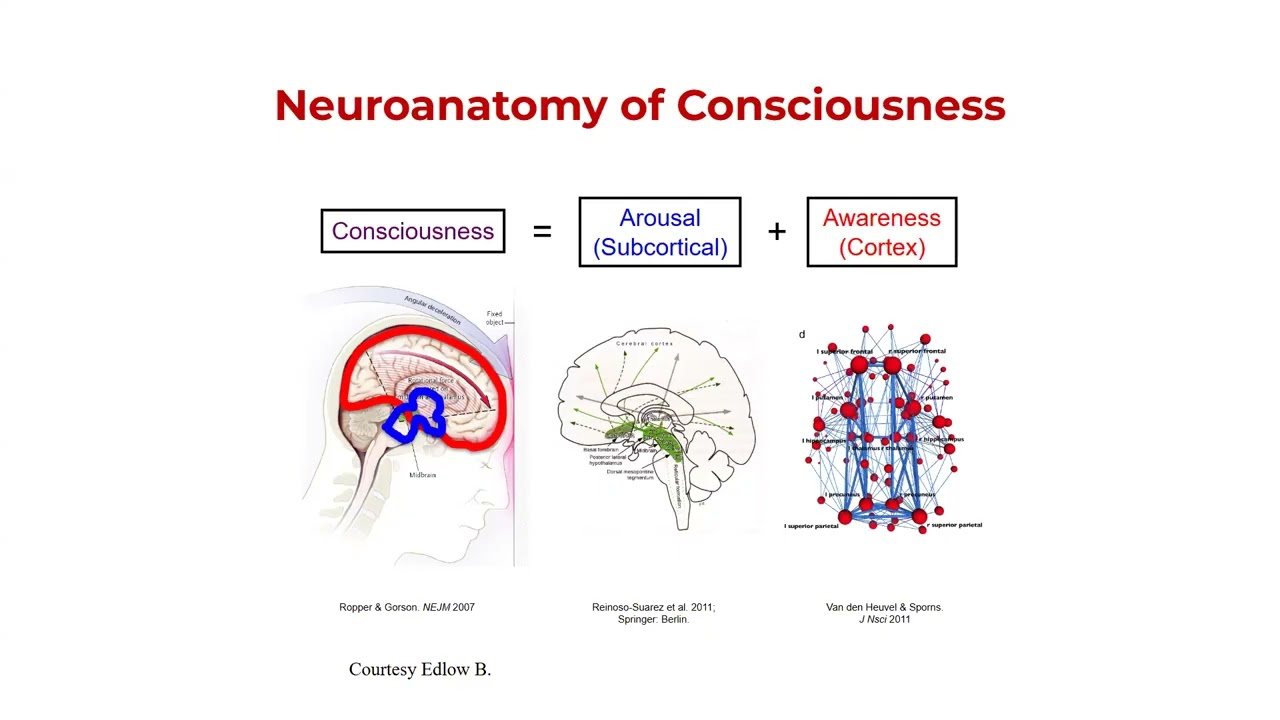
level, um the neuroanatomy of
consciousness is is is more or less
established in the sense that there are
you know there is a subcortical
brainstem component
that mediates arousal and there is a
cortical component that mediates
awareness and this is a very old model
for decades.
Um
but uh but the point here is that there
are
um
there are um
theories about So, the question is what
would be the minimal neuronatomical
substrate for consciousness? How much
brain do you have to have alive or
reperfused to think that there could be
some emergence of consciousness, right?
Um and this is the not an established
question, but the safest the safest
answer when you're doing things like uh
organ donation or discovery research
with brain dead patients, the the the
safest answer is that you really want
zero flow into the brain.
No not a little bit, not a few cc's per
per millimeter per gram tissue. You you
really want to have zero reperfusion of
the brain. Okay? To avoid from this
um
you know, any kind of reanimation to
occur. And these are just images from
you know, brain dead patients, what it
looks like to have a cerebral angiogram
with an empty skull, and then you see a
spec blood flow study
with again an empty skull uh suggesting
that there is no reperfusion to There is
There is no brain blood flow, better to
say.
Uh and these are So, when you do this
testing you see these images, these are
diagnostic for brain circulatory arrest.
Okay, let me let me uh switch now to the
the second topic. The So, that was the
short-term PMD because NRP takes an
hour, 2 hours that this patient is
subjected to this procedure.
Um but um but but this longer-term PMD
um
is a is somebody who has been declared
brain dead, and then um
they are subjected to discovery research
practices. Like for example, the the the
most um publicized um
uh use for that was in NYU Langone where
they had a brain dead PMD uh maintained
for 2 months. They implanted a pig
kidney,
and then they were studying
immunological reactions, transplant
reactions,
uh and studying the the science
of xenotransplantation,
right?
Um and uh a very nice summary of where
to read where the where is what is the
state of this kind of research was
published in Science by Padel. That's
the paper I have up there.
Um where they argue about the many many
scientifical benefits and breakthroughs
that could be facilitated by discovery
research. You could do like phase one
trials
uh that cannot be done in, you know,
they have higher risk of complications
or side effects with life patients. So,
scientifically and medically and
clinically, there's good reason to take
this seriously.
Now, El País, the the Spanish newspaper,
had this very interesting title in
English. Said, "Using brain dead people
for medical experiments, the new debate
at the frontier of bioethics." And
probably you cannot read the fine print,
but they say four US experts propose
using still breathing still breathing
humans to advance drug research.
Which is um
which is not a which is not a good way
to talk about
um a brain dead individual, okay?
That's the problem with newspapers.
Okay, so but I I I want to uh seriously
ask
can consciousness reemerge in a PMD?
Uh and if the answer is we are 100%
certain that this cannot occur,
uh then I think the argument easily
follows that we do need to take
precautionary measures to protect these
donors.
Uh and I think the answer about NRP is
widely accepted. Everybody accepts that
you need to exclude the circulation to
the brain.
Um
uh pro and anti-NRP crowd, I think they
all agree on that point. Uh they
disagree on everything else, but but but
on that, I think there's agreement that
you you cannot absolutely categorically
cannot do this procedure without
surgical ex- exclusion
of the brain.
Uh and again, the the reason you're
doing that is to ensure the permanent
loss of the capacity for consciousness.
Um
and uh so the additional question I have
is, you know, should we doing this in
patients who are subjected to this
discovery research purposes PMD brain
death.
Um and in the science paper I showed you
the authors, they don't consider this,
right? They actually say they have this
claim that PMDs do not have cerebral
perfusion and so that is not an issue.
Um but I would I would I would gently
disagree here and for the following
reasons and I do think these patients
also need
precautionary measures to be taken.
So the first thing to say is that brain
death is a clinical diagnosis. So it
doesn't require demonstration of brain
circulatory arrest and thus the
prevalence of preservation of blood flow
in brain death is
uh more or less unknown.
The second thing is that isn't is
entirely unknown, entirely unknown
scientifically, what happens to a brain
dead individual who is physiologically
optimized for weeks and months. In fact,
uh a proposed use for PMD research is
using neurotherapeutics, right? So we
have no idea uh how this kind of
interventions could potentially
uh both
uh um
um reestablish or change flow dynamics,
but also neuronal cell viability.
And then finally, the lower threshold of
the studies we're using, so for example
SPECT for diagnosis of brain death, um
we don't really know what is the lower
threshold flow detection for those
studies, okay? Uh and there's an old
theory going back in the '90s
that, you know, there is some degree of
global ischemic penumbra in these
patients. So this is flow that's not
detectable by conventional studies.
Um and uh and so, you know, you diagnose
brain circulatory arrest, but indeed
there is some residual flow that with
optimization could actually reach levels
that lead to reperfusion and potentially
reemergence of functions.
Okay, so two more slides.
So take stock here. What What am I What
am I saying?
So I'm arguing that PMDs both short and
long require protection.
Real precautionary measures. And the
reason they need protection is because
we have to ensure that indeed the loss
of the capacity for consciousness is
permanently lost.
Now the determination of death
determination of death both for neuro
and circulatory criteria based on
permanence and not irreversibility.
That's kind of tangential but related
because there are legal issues here. How
they contradict the language in UDDA.
Capacity for consciousness emerges as a
grounding biological function for the
determination of human death.
We have to ensure permanence.
The The only safe proof way to do this
is surgical exclusion.
Um
and then monitoring that actually
confirmation that this has been done
properly.
And so there is
there is an implication here that if
you're saying that you know
people who have been declared dead they
potentially retain some degree
or at chance for recovery of
consciousness.
What exactly are you saying? What what
are the implications for how we
understand determining and declaring
death
in the medical legal context.
And so and and this
one slide doesn't this probably is going
to come out confused because I have done
an entire talk on this on this issue and
my colleagues in the McLean are sick and
tired of
of hearing me talking talking about
different paradigms of death.
But what I just want to point out here
is that it's impossible to discuss this
coherently
by accepting that very traditional
biological paradigm of death that rests
upon
um
the irreversible loss of homeostatic
integration of the organism as a whole.
Um um
we have to revise this uh foundational
principle of death.
Uh instead, we have to focus uh the
target concept of the determination
should be the permanent cessation of the
capacity for consciousness. So, we have
to follow a unified brain-based
determination of death. Unified because
um both set of criteria are grounded by
the same concept, which is a unified
brain-based one. So, all death is about
brain death, basically.
Uh the dead donor rule can remain in
effect, but we we have to change the
paradigm. Otherwise, it's clearly
contradicted.
So, so if the if if death is based on
loss of homeostatic integration, then
routinely every day
organ donation, both circulatory and
neurological, violates the DDR.
Uh NRP is permissible if and only if the
brain circulation is properly excluded,
and there's solid confirmation for that.
Uh and then I have argued that PMDs, so
brain-dead individuals subjected to
research
or maintained for research purposes,
need to have a similar procedure that
makes the the possibility of
consciousness re-emergence really zero.
Um and then uh because these issues are
complex, they need uh they they need
public deliberation, right?
Uh and I think they need serious
informed consent. Um
uh instead of
talking about uh carrying over
authorization the same way we do
standard DCD or standard brain dead
donation, I think we actually need an
explicit disclosure of exactly what is
done in these procedures, what are the
risks done, and uh obtain proper consent
to to go forward.
Thank you very much.
>> Two minutes to ask your question.
>> Okay, I'll try to be fast.
Hi Kristo. So, um I know I've
said this to you already in person. So,
I apologize for asking again. But, I I
think your target concept is going to
have problems of permanent brain death,
right? I mean, I I do think there is a
biological definition of death that's
consistent and that's total cellular
death. That's when the
body is a bunch of bones and has
decayed. You know, and all these other
definitions are going to fall apart at
some point. So, I liked your idea of
focusing on the death behaviors that are
ethically permissible and making
arguments that uh research on the
recently deceased on PMDs uh may be
ethical be because we are guiding the
dying process, but we're not actually
declaring anybody re- No one's really
dead from a true in a true consistent
fashion until they are have experienced
their body has experienced total
cellular death and is decayed um
you know, beyond any question of a
doubt. So, curious
>> What what's the No, I I I I I I agree
with I think everything you said. Where
where is the
Is there a disagreement somewhere or a
or a
>> You you you described a target concept
of
>> Yeah.
>> permanent brain death.
>> Right.
>> Which I think will have the same
problems as everything else.
>> Okay, good.
>> Yeah. Yeah, I'm sorry. That's that's
that's a that's a great point. Um you
see um
the the issue is that I don't think uh I
I I the problem is that
it's it's unavoidable. We have to
construct
um
uh we we need to accept a certain
concept that we have to define death and
then, you know, derive criteria from
there
uh in order to perform the activities we
are performing. Meaning, if you go that
every single cell has to be dead,
uh you basically killing off
uh all organ donation.
>> Yeah, exactly.
>> Or or you have to get rid of the DDR,
for example.
>> Yeah, exactly. I just think you Right.
So, I think the DDR's got to go. I you
know, all these things have to go. Like,
the only thing That's That's I So, I'm I
guess my concept is is quite radical.
It's is is that we move the definition
of death to make it consistent. The only
thing that's consistent would be total
cellular death. And then instead work on
the ethics of what dying processes are
Yeah. legal and ethical and permissible.
And organ donation, yeah, I think is a
moral ethical way to die.
Um but it's a way to die. You are not
dead before you donate organs. The only
consistent idea of death is total
cellular death. But, I guess that's a a
very radical position given what the
UDDA says. And but I think, you know,
it's just gymnastics otherwise, but
>> Yeah. I I think politically
both of our suggestions are difficult to
get through, but uh
Yeah, please go ahead.
>> Chris, it's good to see you again. Um
I'm going to ask you to to uh do a
thought experiment, pun intended, about
BrainEx.
Right? So, the idea here cuz implicit
here is that we can do research on uh a
bodies that's brains disconnected, you
know, physiologically and and and by by
the procedures that you're mentioning.
So, what about the 2019 thing about
BrainEx, which showed that you could
reestablish cellular activities on the
prick brain if you preserved them for at
least they did it for 6 hours, right?
But, the NIH had a big issue about it
What What was that going to look like?
Um would that research be ethical here
now? Because you could potentially then
disconnect the brain, yes,
physiologically, no circulation, put it
have it reanimated by or at least have
cellular
uh activities restarted with Brain X or
Brain X 2.
And now, what do you do there, right?
Cuz you said for a moment it was, but
still not permanent, right? Cuz that
would now call into question the
permanence thing.
>> Yeah. Uh nice to see you as well, Les
In, and uh this is a very good question.
Can we go for 30 minutes? No, okay.
Okay. Okay, but but Brain X is an
experiment where uh done in Yale, right?
They took four head big heads
uh several hours postmortem, right? And
reperfused them with this magical liquid
of goodness or something. I don't know
what it was in there. And then you have
some cellular functions coming alive,
right? So, actually that connects very
nicely. Actually, that's a great answer
to Will's question, right?
That it's not about cells
um
or even organs. I mean, we have to draw
the line in some kind of principled
manner
uh thinking about what func- what
biological func- functions actually
matter, right? And
I'm siding with people who are saying,
"Listen,
uh a function that clearly clearly
matters is the capacity for
consciousness. And then from there,
think, "Okay, what follows? What kind of
medical criteria? How rigorous can have
to be?" Um and then public deliberation
because this is a neurocentric approach,
right? But not everybody agrees. Thank
you very much.
>> That's great. Thank you. I don't think
anyone in the MacLean Center gets tired
of hearing Kristo's talk. We're lucky to
have you.
Um our next speaker is Julie Campbell.
Um she's an assistant professor of law
at the Brandeis School of Law,
University of Louisville.
Her scholarship examines the
intersection of health law, medical
ethics, and administrative regulation
with a particular focus on informed
consent, end-of-life decision-making,
physician accountability.
Her current work explores legislative
and policy mechanisms to align clinical
decision making with patients' rights to
self-determination.
She'll speak today on a topic entitled
When Silence Harms: Misconceptions about
CPR and a legislative path forward.
>> Thanks.
>> Good afternoon and thank you for having
me here today. It's really a privilege
as a former fellow to be able to speak
to you all.
I'm going to forewarn you that I don't
normally read a script, but what I have
presented here is actually the law
review spin-off of the empirical study I
did with a fellow fellow, Gina
Piscatello, and this is 65 pages long
and getting it into 15 minutes is really
hard.
So, I did this so I can make sure I'm
not rambling.
So,
let's start with this premise. When a
patient's heart stops, we treat CPR as a
default. But, most patients have no idea
what that actually means for their
chances of survival or the life they
might or actually return to.
So, today I want to explore what that
gap in understanding means for autonomy
and how we might address it.
I have no disclosures.
We know that patients significantly
overestimate the effectiveness of CPR.
In our study, only about 10% of the
population correctly understood that
survival to discharge after in-hospital
cardiac arrest is roughly between 10 to
20%.
Meanwhile, over 70 70% of our study
surveyed believed survival exceeds 50%
and a third believed it it was as high
as 70 to 80%.
And when we asked why they demand CPR
even when informed it will not work,
two common themes that were troubling to
me emerged.
One was there was no downside to CPR,
and the other was that they don't want
to decide to forego a potentially
life-saving intervention for their loved
one.
So when patients say they are Sorry. Um
they want CPR,
they are often that decision based on a
fundamentally inaccurate understanding
of what CPR can actually achieve.
Am I not hitting this? There we go.
So there are several reasons for this.
Um media depictions dramatically
overestimate the survival rates.
Although I do want to give a shout out
to the show The Pit. I think they
actually do a really great job. And if
you haven't caught that, you really
should catch that show.
Um but on top of that, the CPR courses
focus on technique, not outcomes. I went
through my husband, he's an emergency
medicine physician. I went through his
advanced cardiac life support training
book. 183 pages. One sentence
that talked about the low efficacy of
CPR.
Right?
And these training programs are not just
for medical professionals. They're for
the lay people.
They're for our future surrogate
decision makers.
On top of that, our institutional
defaults.
Our legal system, the policies you have
in your hospitals, the ones that say you
have to do CPR unless there's
uh active do not resuscitate or do not
attempt resuscitation order in the
patient's chart.
These signal to the public that these
are the recommendations, that this is
beneficial treatment.
So
patients are not just uninformed,
they're being guided by a system that
implicitly signals that CPR is almost
always beneficial.
This
causes conflict.
And it's significant.
So, we have this information asymmetry.
Physicians know better. Patients don't
know enough.
For the patient, they experience CPR as
a positive, right? Something they are
entitled to.
On the other hand, the physician
experiences CPR at a negative rate,
something that they have the right to
avoid if the harms are more severe than
the benefits.
For a patient, when you tell them in the
dire moment that you don't recommend
CPR,
it creates distrust in the medical
recommendation because their entire
experience before that was that CPR was
beneficial and it would save their life.
For the medical professional who is
forced or obligated to do CPR on a
patient that they don't believe would
actually benefit, it creates moral
distress.
Sorry.
So, what is the real reality of CPR? I'm
sure most of you know this in this
audience. If I was to tell this to a law
audience, they would be shocked at this
point and they have been.
The reality is that CPR is both
ineffective and harmful than more
harmful than patients realize.
Survival to discharge is already low and
that drops further when you factor in
underlying disease.
And the harms are significant.
You have broken ribs, you have
neurologic deficits,
and you have something called CPR
induced consciousness, which really
dovetails nicely off of your talk.
Um all of the literature on that event,
that's when CPR is actually perfusing
the brain and the patient becomes
conscious again. And every single
instance of this, the patient has had to
be restrained either chemically or
physically because they are trying to
push people away.
And they are saying, "Stop."
So, my slides are a little off, but
okay.
Um so, what is the problem here? Why is
CPR so different? And the problem is
that there's a legal gap, right?
Typically, from the legal perspective,
we have informed consent that's supposed
to protect patients from interventions
that the harms greatly outweigh the
benefits, right? We're supposed to tell
them what the risks and benefits and
alternatives are.
But CPR is treated as the exception,
right? So, they are never fully informed
as to what
the the intervention they're going to be
receiving.
So, really we have we've created a
system that effectively defaults
patients into CPR without ensuring they
understand what it entails.
So, my argument is that emergency
exception should not excuse the failure
to inform patients before emergencies
occur.
If we take informed consent seriously,
then we need to rethink how and when we
provide this information.
And this isn't a new problem. The
original creators and the ad hoc
committee asked to actually establish
these um guidelines when CPR first came
out in the 1960s,
both concluded that CPR was not designed
for the severely ill or terminal
patient. It was designed for the patient
with an acute injury or an acute insult
like surgical anesthetic problems or
electric shock or drowning.
And the medical community has known this
reality for years, in fact, over 50
years.
And they have tried several things to
overcome this. They have tried the
unilateral DNR order.
Although this is extremely controversial
because it's very subjective on how we
define futile or nowadays medically
inappropriate.
They've tried slow codes or show codes,
which also are a deceptive practice and
there's mixed reviews as to whether that
can ethically ever ethically be done on
a patient.
Um they've tried conversations with
terminal patients. The SUPPORT study in
1995 involved this these conversations.
And the researchers said, "It's just
these conversations are happening too
late." When you when you wait to have
the conversation when the patient is in
crisis,
they go through Elizabeth Kubler-Ross's
five stages of grief. Denial is first
followed by anger.
Okay.
And my study along with Gina Pizziello
follows in the line of trying to rename
the do not resuscitate order. So we've
seen several iterations of this: do not
attempt resuscitation, allow natural
death. And we tested beneficial care
only.
But unfortunately, all of these have
failed because they don't really address
the core problem, the information
asymmetry.
And that's because again, these
conversations happen too late.
And that is usually as a result of both
parties waiting or physician discomfort
in having this conversation.
Or there might be training gaps for
physicians.
And the fear that maybe if I have this
conversation with the patient, that they
will give up hope.
In terms of the framing effect,
it's common knowledge that I found out
after our study resulted in a null um
result, um that
framing is only effective if it aligns
with the
the subjects experience,
intention, and most importantly
knowledge.
So, what are we trying or what am I
trying to argue in this is that we need
to align the patient's expectations
of, you know, how effective CPR will be
with for them with their current medical
condition.
So, this is actually taken from Michelle
Bedduli. She's a Swiss
researcher and she nicely put in these
three categories of potential patients.
Okay, so obviously for that young
healthy that did have that acute insult,
CPR would be the normal recommendation.
For the mild chronic disease, the
equippoise patient, which I'm hoping all
of us probably are in this room,
this you would let it be the patient's
informed choice, right? And then finally
for that severe disease, death is
imminent patient, DNR is the
recommendation.
So, we need to get the patients or just
lay people to start understanding that
the default does not maintain its
beneficial status through the course of
your life.
It shifts as your health shifts.
So, when patients are informed of these
choices,
we actually find that they make
different decisions.
So, in 2015 Elwyn Chuang did a study
where he used video decision aids to
show patients what CPR really is. They
included the harms of CPR and the likely
outcomes, which included the neurologic
deficits. And the results were pretty
impressive. They saw a shift from 3%
that were
3% willing to do a DNR to 38%.
And they found that there was no
increased anxiety.
Christopher Becker did a 2025 study and
he was testing the impact of code status
discussions at hospital admission on
non-critical patients, so the equipoise
patient.
These are terrible slides, I'm sorry.
And they found that um with these, you
know, visual decision aids and
conversations at hospital admission,
that patients actually shifted to
agreeing to a DNR status. So, I think
there was from like a 37% to 50%. And
mind you, these are patients that are
otherwise healthy.
Um and also they found there was no
increased anxiety.
So, how do we get this? How do we
implement these two studies into a
decisional framework today?
And that's where I am proposing this
modified prompted choice.
This is based off of choice
architecture. Um if you know uh Richard
Thaler or Cass Sunstein, they came up
with four different choice architect
choice architectures, presumed consent,
explicit consent, mandatory consent, and
prompted choice.
I'm creating a hybrid, so I'm taking
prompted presumed consent and I'm adding
prompted choice to it. And I'm doing
this because the current four don't
really address our situation.
So, in this one we're going to retain
CPR as the default, but we're going to
mandate the El-Jawahri
CPR video decision aid be provided at at
hospital admission,
as well as the Christopher Becker
admission conversations,
in which they do patient-specific
survival data and at admission,
potential harms from CPR, including the
neurologic deficit, and the iterative
provider-patient discussions.
On top of that, I want to include public
education campaigns. In the United
States, 48 states either mandate or
recommend that high school students
receive CPR training in their high
school curriculum.
This would be a wonderful place to
actually educate future surrogate
decision-makers.
Um as well as senior centers.
So, how what can we use to implement
this legislative nudge?
The Patient Self-Determination Act.
And why do we want to use that? Because
it has a national scope.
It already applies to all Medicare and
Medicaid facilities, and that includes
hospitals, nursing homes, and home
health agencies.
It already has a built-in compliance
mechanism. So, the Joint Commission
monitors uh facilities compliance, as
well as CMS monitors the compliance
through state um auditors.
And it has a proven track record of
success. So, when the government
agencies go in and look at how well the
PSDA in terms of advance directives,
they found that in under 2 years there
was a 21% increase in patient knowledge.
And that after 5 years, nearly all
providers were informing patients about
advance directives.
Now, there are possible limitations to
this. Um some argue that you're just,
you know, these disclosures at hospital
admission will lead to the patients
making, you know, involuntary or
unreasoned decisions.
Um or that patients may feel a huge like
as though the hospital is trying to tell
them they were doing something wrong, or
they were going to they were going to
die.
But I think I've shown you that the two
studies, the El-Jawahri and the Becker
study, both showed that there was no
additional anxiety in having these
conversations. And in fact, the Becker
study found that the the individuals had
felt more comfortable with their
decisions after the the information was
disclosed.
The other argument is the expense,
right? The staff time, the need to
educate and train staff, the need to
engage in community education efforts.
But I argue if you have specifically
trained, maybe you know, advanced
practice providers uh that can have
these conversations with patients at
hospital admission, that that wouldn't
actually burden the physicians
additionally, right? And in fact, if you
think about it, 40% of all ethics
consults have some relation to the CPR
conflict at the end of life. What I'm
arguing is let's front-load those
conversations
and spend our time and money there so
that we don't have to do them at the
back end where you most parties don't
leave happy, right?
And why do we need to do this? Well,
first of all, CPR was never designed to
be utilized on the terminally ill. Um
the original creators and ad hoc
committee specifically said do not use
it on this patient population.
This universal application really
violates beneficence and autonomy.
CPR is not always beneficial and quite
frankly, how we're using it in today's
society, it's more often not beneficial.
And this transparency, this disclosure
of information, it's the way that we
truly create an autonomous autonomous
choice in our patients. You know, as our
forefathers of bioethics have said, you
know, one must be adequately informed to
have an autonomous choice.
So in conclusion, really silence harms
in this context and if we have informed
choice, it will heal.
Thank you.
>> So So I guess my question, uh thank you,
very nice talk. This is a difficult
topic and one that affects all of us who
practice. I guess my question is is why
focus on CPR rather than advanced
directives or living wills? There's a
hospital system in La Crosse, Wisconsin
that just standardly, when you come in
for to the hospital, will say, "Do you
have an advanced directive? Can you fill
it out?" Why not focus on advanced
directives, which are broader
potentially for patient desires than
just CPR specifically?
>> The reason I don't focus on advanced
directives is cuz they don't actually
educate them on the efficacy of the
interventions that are being labeled in
the advanced directive, right? So, if
our population, 90% of them believe CPR
is going to be effective,
they're going to just do an advanced
directive that says to CPR on me, right?
So, until we address the knowledge gap,
um they're not actually doing even the
advanced directives being currently
filled out are questionably autonomous
because they're being filled out in a in
an environment of complete
misinformation.
>> Wonderful talk, very courageous. Um
my question for you is has this been has
CPR education been tested in the setting
of a effectiveness implementation trial
in a large-scale healthcare system? Has
that happened at any point?
>> The Christopher Becker study in 2025 was
published in New England Journal of
Medicine that took place in six
hospitals and
you know, across the board. And again, I
think what's so persuasive about that
study was these were not critically ill
patients. These were not patients at the
end of life. These were us, the
equapoise patients. And they saw a
significant shift in the people that
before the conversations were, you know,
CPR all the way, to after the
conversations filling out DNRs.
>> Hi, thank you so much for your talk. I
really enjoyed it. Um, I have a question
about um, like the general education on
like DNR DNI orders. Um, and I was
curious if like um, so your approach has
a lot of um, explaining and and
educating the patient on the negatives
of CPR which is really good, I think.
Um, but I wonder about like how we might
talk to patients about like the
potential benefits and like how to set
you up for success if we do have to do
CPR. I'm thinking specifically of the
patients who sign um, CPR but DNI.
Um, and like
maybe tell them about the like the
intubation aspect of it if they if maybe
there'd be like a holistic approach to
this or um, what you might think about
that.
>> You know, from the research that I did,
when you have CPR but you don't have
DNI, you're really doing like a show
code, right? Because there's no
possibility of reanimation or ROSC in
that situation. So, I think that's
deceptive in itself. So, if you're going
to you know, even think about entering
that order, I I I probably have a
problem with that from an ethical
standpoint. And I think it needs to be
explained to them that really we can't
achieve ROSC if we don't have the
ability to do a D like to actually
intubate at the same time.
Right.
Thank you.
>> Thank you so much.
Our third speaker is Dr. Timothy Murphy.
Um, he's a professor of philosophy and
biomedical sciences at the University of
Illinois College of Medicine. He holds a
doctorate in philosophy from Boston
College and conducts research on ethical
aspects of genetic research, fertility
medicine, and biomedical research
especially as these affect sex and
gender minorities.
He is the author or editor of 10 books
and the author of more than 125
peer-reviewed articles that appear in
such journals as the Journal of Medicine
and Philosophy, Bioethics,
Hastings Center Report, Journal of
Medical Ethics.
He has been on editorial boards of the
American Journal of Bioethics, Bioethics
and Reproductive Biomedicine and has
been a visiting scholar at the Institute
for Ethics of the American Medical
Association. Welcome.
>> Good afternoon. I I think the first
thing I want to say is that my CPR
training occurred when I was a Boy Scout
camp a long time ago. So, I hope nobody
needs to rely on me for that.
Um but I'm happy today uh to talk about
uh a topic that's of perennial interest
uh to uh medical ethics, to clinical
ethics, and that is to say
physician-assisted suicide.
I have no uh
disclosures to make in this regard. Uh
what I do want to today do today is to
um introduce, for those of you
unfamiliar, to the AMA ethics opinions
regarding physician-assisted suicide and
the exercise of conscience. In order to
talk about its limitations
and to make a recommendation for a shift
in the position that it currently holds
um with respect to this topic. All
right. So, um in the totality, uh the
code of method medical ethics consists
of these things, and this is what the
AMA says, not my making this up. The
code consists of the principles of
medical ethics, which is a short list,
uh its opinions, which are ethical
advisories on specific topics, and also
the supporting reports that come out of
the Council on Ethical and Judicial
Affairs um that justify the opinions
that they offer on particular topics
like uh abortion and physician-assisted
suicide and sundry other things.
So,
when you sort of just as a layman look
up to see what the AMA has to say about
physician-assisted suicide, it says
this.
Um after defining the term and
acknowledging that some people might
decide death is preferable life, it says
pretty boldly, "Permitting physicians to
engage in assisted suicide would
ultimately cause more harm than good.
Physician-assisted suicide is
fundamentally incompatible with a
physician's role as healer, would be
difficult or impossible to control, and
would pose serious social risks."
All right.
>> [sighs]
>> So, that looked pretty definitive, uh
but that's not the whole story.
Um
in 2019, the AMA was aware that the
world was changing around it with the
legalization of medical assistance in
dying in some states. So, it convened a
review of its uh opinion and advisory
about uh physician-assisted suicide, and
it asked itself whether they should
change the opinion or not. And the
answer was no.
All right. Uh and the reason for that is
because despite the condemnation of
physician-assisted suicide, provisions
regarding the exercise of conscience
make room for physicians engaged in the
practice.
All right. Uh I'm going to explain a
little bit more about what this means in
particular.
All right. So,
um
to get at the totality of the story
about physician-assisted suicide, you
also have to take into account the
exercise of conscience clause.
Um and this is this is a text-heavy
slide. I apologize for that. Um we're
doing a little kind of textual analysis
here. Um the declaration here is that
the opinion here is that physicians are
moral agents in their own right and are
informed by and committed to diverse
cultural, religious, and philosophical
traditions and beliefs. For some
physicians, their professional calling
is imbued with their foundational
beliefs as persons,
and at times the expectation that
physicians will put patients' needs and
preference first may be in tension with
the need to sustain moral integrity and
continuity across both personal and
professional life.
Um the upshot of this is
um in so far as physicians are not
interchangeable replicas of one another,
are the physicians should have
considerable latitude to practice in
accord with well-considered, deeply held
beliefs that are central to their
self-identities.
And it's here that the door opens to the
prospect of participation in
physician-assisted suicide as a matter
of the exercise of conscience.
It also uh allows physicians to opt out
of participation in philosophical in
physician-assisted suicide for the same
reason.
Uh I should mention I'm going back and
forth between the language of medical
assistance in dying, which is typically
the statutory language used, and
physician-assisted suicide. The AMA
wants to put um use that language to put
the physician at the center of the
analysis, rather than to make it an
institutional or legal practice. All
right? So,
in a master stroke of diplomatic
language,
uh in this report, the AMA came to the
conclusion,
weighing all these factors,
uh it said, "In the existing opinions on
physician-assisted suicide and the
exercise of conscience, the code offers
guidance to support physicians and the
patients they serve in making
well-considered, mutually respectful
decisions about legally available
options for care at the end of life."
All right.
All right. Uh as I read this, what the
the is saying here,
uh it indirectly permits physician
participation in medical assistance in
dying while the same time as an
institution formally condemning the
practice.
Right?
So, now the AMA is sort of aware of what
it's doing here. It call it says calls
the conflict between the pro and con
views about MAID, medical assistance in
dying, an irreducible moral tension.
All right.
Um are we stuck here?
Um well, let's look at the again the the
legal landscape. Uh the world is
changing around
uh the question of medical assistance in
dying in the United States. I think this
is right the last time I looked or at
least time I uh
uh prepared the slide, uh a significant
number of uh states
uh already allow physician-assisted
suicide. Uh
New York comes online in a few weeks. Uh
by my philosophical ac-
account, some 82, 83, 84 million people
live in a state
uh where physician-assisted suicide is
legal and in some cases uh more In
principle, everyone in the United States
have access to this because at least two
jurisdictions do not enforce residency
requirements. So, if you're healthy
enough to go to Vermont and seek uh help
there, you can do it.
All right.
Um now, I'm going to sort of segue
through uh a prior
conflict that the AMA has gone through
um
in terms of um
how to balance opposition with uh
inclusion of a
of a disputed practice. And that has to
do with abortion. And I want to suggest
that it's the AMA's change over time
offers a model for change uh in its uh
physician-assisted suicide uh thinking.
Uh specifically,
um uh historically, I'd say, uh the AMA
was
a leading, if not the leading force in
the United States for the
criminalization of abortion in the in
this country beginning in the 18 late
1800s.
Um the historian James Mohr called the
19th century efforts the AMA's crusade
against abortion.
Now the resistance to abortion was not
absolute. Um
the AMA did carve out possible
exceptions, but in general the default
was set against abortion.
And and quite plainly so.
Uh so I'll pull out an example from
1967.
The policy was that, quote, where there
is documented
evidence of a threat to the health or
life of a woman, and when the child may
be born with incapacitating physical
deformity or mental deficiency, or when
a pregnancy results from legally
established or forcible rape or incest,
this was an allowable
abortion as a matter of medical ethics.
Right? But otherwise, the default was
set against abortion
uh as a matter of uh defensible clinical
ethical practice.
Right? This opinion came under challenge
as United as US society changed. Uh
briefly I want to mention
Roe v. Wade and Doe v. Bolton, uh which
put sent put physicians at the center of
decision-making for abortion.
In some ways, I read these documents as
not
conferring on women the right to have an
abortion, but conferring on physicians
the right to practice an abortion.
Right?
Um
the the physician is center square in
these cases. Uh the physician has
specific responsibilities in con-
consultation, determining the stage of
fetal development, and discretion over
the technique to be used.
Uh Roe even specifically authorized
states to limit the practice of abortion
to licensed physicians if they wished.
Right?
Okay.
Um now,
having set the default against abortion,
Roe and Doe come along, the AMA has to
do something. This is what it did.
Uh its declaration its ethics opinion at
the time was the principles of medical
ethics do not prohibit a physician from
performing an abortion that is performed
in accordance with good medical practice
and under circumstances that do not
violate the law.
All right, note that well. Do not
violate the law.
Because along comes
Actually, I'm going to
uh skip this. Skip this one. Along comes
Dobbs versus Jackson.
Right? Um which denied any
constitutional right to practice
abortion and conferred all
decision-making on states and uh
territorial jurisdictions.
So, now many states, as you know,
prohibit abortion.
Um but the AMA is stuck with its
advisory saying that physicians are
entitled to practice abortion unless it
violates the laws of the community.
All right?
So, in this case, the guidance would uh
the AMA the guidance from the AMA would
confer decision-making
authority over abortion on the
legislature rather than on physicians.
So,
uh and this puts physicians in peril.
I'll mention this one example from
Alabama. Um it's unlawful for any person
to intentionally perform an attempt or
attempt to perform an abortion except
for medical emergencies. Uh the attempt
at an abortion is a class C felony
subject to 1 to 10 years imprisonment.
And the
the actual abortion a law unlawful
abortion is class A felony subject to 10
to 99 years imprisonment.
Uh and I thought this was curious until
I looked up this is the standard
imprisonment for a murder of a person.
Okay. So, the AMA had to change its rule
after Dobbs, and what it did here
um it said uh the the the the the
I'm going to skip the the
first part of it and go to the bottom.
The principles of medical ethics of the
AMA permit physicians to perform
abortion in keeping with good medical
practice.
There's no reference to the law here
anymore.
Okay. So, to contrast this
uh
before um Dobbs, we have the the law
being uh held in place. After Dobbs,
medical practice is the guidance
standard. All right? Now, to come to
this opinion, the AMA had to do these
things. It had to overcome the internal
dissonance of its membership. It had to
enfold practice within the medicine
practice of medicine. It had to commit
to the morality of the practice despite
its being illegal in the jurisdictions.
And it declined to endorse the claim
that abortion constitutes wrongful
killing.
All of these things bear on
physician-assisted suicide in their own
way. So, the abortion opinion grants
physician choice.
The AMA might do the same thing with
respect to medical assistance in dying.
Secondly, uh
the AMA situates the practice of
abortion with within the remit of
medicine
no matter that the practice is
criminalized in a number of states and
heavily penalized. All right? So, this
is the kind of questions I'm leading
down the path toward. Why should the
criminality of MAID in some states pose
any obstacle to accepting it as a matter
of medical good medical ethics?
Um the third point, again, um
the AMA endorses abortion in the face of
objection that involves the wrongful
killing of a person
arguably.
All right? By contrast, MAID is not
vulnerable to this criticism. All right?
Um because people are offered a lethal
dose to to adults with decision-making
capacity.
MAID is comparatively easier to defend
as a medical practice because it
involves no involuntary death.
All right.
So,
um
I think what the AMA might do in light
of its what it has done with respect to
abortion is start to think along the
same lines and um enfold the practice of
made within medical medicine
and uh model a judgment
on medical assistance in dying in the
same way it has done on with respect to
abortion. Namely, the principles of
medical ethics permit physicians to
participate in medical assistance in
dying in keeping with good medical
practice. And there are more reasons for
this.
Um
I first of all, to say that it's
defensible does not mean anything goes.
I think there should still be a standard
of care. We should still think about
that the practice of it that way.
Um but I do want to move to these
conclusions.
Um
the AMA ethics opinions um always
reflect the divergent views of their
membership.
All right. Uh
in this particular case, their opinion
now is that they both permit and def-
and and um
disallow the practice of medical
assistance in dying.
All right. But if you read it closely,
um they do give um philos- they give
physicians a way to practice med- um
physician assistance in doing not in
dying in good medical practice through
the exercise of their conscience.
All right. Um over time, the ethics
opinions have not been static.
Um the AMA has moved from staunch
opposition, a word dropped out here,
uh to abortion to indirect acceptance.
Um is formal acceptance ahead for
physician-assisted suicide? I think it
should be.
Ethics opinions are an outworking of the
theories of medicine and nature
and identity.
Um the AMA has moved from a staunch
opposition to abortion to a guided
guarded acceptance
to formal inclusion
uh despite the debate about the morality
of abortion and its relationship to
medicine.
All right.
The AMA right now is not very far from a
formal inclusion of MAID within the
practice of medicine.
All right. It declares the practice is
contrary to the nature of the
profession, but it also opens the door
through the exercise of conscience.
Uh the bottom line I'll draw your
attention to
um every physician right now could
invoke the free exercise of conscience
to justify their participation in MAID.
And when I say every physician
um
I mean every physician. I know this is
doesn't map onto reality, uh but this is
the way philosophers think.
Uh in principle anyone could invoke this
and say uh I can I I all physicians
could do this and say I'm entitled to do
this and I want to do this. All right.
So I think the AMA should ultimately do
for uh
medical assistance in dying for what it
has done for abortion, to accept the
practice while excusing physicians who
don't want to engage in this behavior.
So we have something like this. Again,
the principles of medical ethics of the
AMA permit physicians to engage in
assisted dying in keeping with good
medical practice.
Um in doing so, at the very least, uh
the AMA would acknowledge the practice
of MAID openly. We have a big swaths of
the country where this is going on. Uh
in any particular jurisdiction, it's
always a minority of physicians who
participate in this. Nevertheless, um it
is a part of the legal and ethical
landscape.
Um it also would make the position
clearer to the public of what it does
actually allow and disallow.
Um and I think this is an important,
too. Um
it it aligns his ethics opinion with his
own recognition that some patients in
extreme distress may come to decide that
death is preferable to life. If that's
true, then why not align the ethics with
it?
Um and then therefore we would be a
better able to achieve the aspirational
goal that every patient come to the end
of life as free as possible from
suffering that does not serve the
patient's deepest self-defining beliefs.
These are AMA statements.
With that, I think I'm done.
Those are my sources. Thank you. If you
like the slides, let me know.
And I'm sure there will be questions and
comments.
Or maybe not.
>> Uh do you know how the uh ethical
guidelines for the AMA are created? Do
they survey their membership? Does
someone draft it and they send it out
for approval from the membership? Or is
it sort of a unilateral
um sort of ethics committee within the
AMA that decides it?
>> Yeah, it is a
uh the opinions are uh the work from the
Council on Ethical and Judicial Affairs,
and they go through an approval process
above that. So the uh Council on Ethical
and Judicial Affairs will prepare a
report, and then it will be approved by
the Board of Trustees of the AMA, and
the the opinion uh is put in place that
way.
>> And you mentioned um everyone points
sort of uh conflict or internal sort of
tensions from the membership. Do they
get feedback? Yeah, or is that how that
sort of play like how does that play
out?
>> to to uh I don't know that they conduct
surveys per se. Uh I think the conflict
comes from the nature of the AMA. Um
most physicians as room I guess not
belong to the AMA.
So the AMA um is dependent on its
membership,
which tends to be
to come from particular regions
uh of the country. It's not
representative of the country physician
physicianship as a whole.
But there are, you know, there is deeply
embedded, and I recognize this, deeply
embedded views within medicine that
physician-assisted suicide does not
belong to the nature of the practice per
se.
Right?
>> We do these two quick and then
>> I don't
I don't know. You're You're here. Sure,
we'll go with you.
>> I Arthur Singson, Medical College
Wisconsin. Tim, nice to see you. Um So,
you said for abortion, this is, you
know, an issue about maybe the
intentionally ending a life. Uh and in
medical aid in dying, it's the same. Um
but what about the folks who say
abortion is different because we don't
think that that is intentionally ending
a person's life? And yet, for aid in
dying, that is the goal. Everyone's on
on board that at least the goal is
intentionally ending a person's life.
So, for those who don't accept that
abortion is in that same category, uh
does that give you any pause?
>> I
I will I will take your your your
comments as a as a
um
as a remark that I probably should have
been a little bit clearer about what I
was doing. Um so, um
an abortion and some some views is the
involuntary killing of another person.
Right?
Medical medical assistance in dying
is not that because it's a voluntary.
It's not the
It's There's no involuntary killing.
Now, um now there are There's also the
camps that abortion is not the killing
of an individual, and in that case, um
you wouldn't have the same carryover
value for my argument from that
position.
>> Yeah, thank you cuz I do think that
that's an important Yeah. aspect.
>> Yep. Thank you.
>> Um so, one line of uh one line of
criticism to MAID that I hear that I
find more more compelling than others is
um
you know, that that basically uh medical
practice is ableist and so uh um
uh expanding access to MAID or even uh
endorsing MAID uh will not will not sort
of justly or or uniformly uh increase
access to MAID for everyone. It'll
particularly increase access to MAID for
a population of patients like you know,
patients living with disability, um
particularly visible disabilities, uh
who whose lives you know, we are sort of
implying have less inherent worth,
right? And they will be uh the fear is
that there will be greater pressure. Um
so so to that line of criticism, how you
know, do you do you find that as reason
that the AMA maybe shouldn't, right? Or
or would be more morally consistent to
not endorse MAID along that kind of uh
criticism?
>> So this is the uh is there some reason
to be cautious about this because of
this kind of slippery slope argument? Uh
that the vulnerable be um
more likely to be as part of the
informed consent process brought into
medical assistance dying. I think the
same kind of slippery slope argument did
not stand in the way of the AMA coming
to its conclusion about the practice of
abortion where similar sorts of views uh
were brought forward that the practice
of abortion would necessarily lead to uh
uh uh actions against the disabled um
in in in in intent and in in fact.
>> Thank you.
>> I'm done.
>> All right, our next speaker is Ursula
Francis. Uh she is uh a full-time
clinical ethics fellow at the MacLean
Center for clinical medical ethics. She
earned her PhD in classics from Columbia
University, a law degree from the
University of Chicago where she was also
an undergraduate, and a masters in
bioethics from Harvard.
Her current research interests include
the relationship between emotions and
medical professionalism,
the impact of AI on humanity and
medicine,
and the temporal dimensions of illness
experience, caregiving, and in the
clinical space.
Today she will talk about a case for
catharsis, surgical M&M, and the
emotions.
>> All right, and now for something
completely different.
I have no disclosures,
but as John Donne once said, no man is
an island, and I'd like to acknowledge
the following people for their support.
Doctors Mitch Posner and Jeff Matthews
and the general surgery community for
allowing me to sit in and observe their
M&M conference for several months.
My surgeon mentors in this and other
projects, Doctors Peter Angelos, Sparta
Shockley, Sean Wightman, Megan
Applewhite, and Jason Sulkowski.
My fellow McLean fellows, especially my
surgeon colleagues, Dana and Song Greg,
who were so generous in sharing their
thoughts on this project.
And of course the administrative staff
who are foundational to the life and
logistics of the McLean Center and this
conference.
All right, so I'd like to set the stage
for this talk with a brief overview of
surgery and the emotions.
The practice of surgery imposes unique
psychic demands on surgeons who often
feel adverse outcomes to be a matter of
personal responsibility.
As Charles Bosk wrote in his seminal
monograph, Forgive and Remember,
when the patient of an internist dies,
the natural question his colleagues ask
is what happened.
When the patient of a surgeon dies, his
colleagues ask, "What did you do?"
As one might imagine, the weight of this
responsibility exacts a substantial
emotional toll.
Surgeons experience high rates of
anxiety and depression and have some of
the highest rates of suicidal ideation
among medical specialties.
Rates of burnout, defined by emotional
exhaustion, depersonalization,
and a decreased sense of personal
accomplishment range from 30 to 38%
among surgeons.
And indeed, there's a strong empirical
association between these psychological
vagaries of surgery
and the incidence and experience of
adverse events.
In a Boston-area survey of 281 surgeons,
90% reported experiencing an
intraoperative AE during their career
with 71% recalling at least one event
within the past year.
84% experienced significant emotional
turmoil after such an event, including
anxiety, sadness, guilt, and shame.
In another study that assessed 47
surgeons with the Impact Event Scale,
roughly a third demonstrated acute
traumatic stress that breached a
threshold of clinical concern 1 month
after an AE.
Reporting a medical error in the prior 3
months has a statistically significant
adverse relationship with mental quality
of life,
burnout, and depression.
Burnout and depression, in turn, are
independent predictors of reporting a
major medical error.
In a national cross-sectional survey of
US surgeons, roughly one in five
indicated that they considered taking a
break after a patient death.
And one in 10 thought that they would
abandon their surgical careers.
These statistics raise the question of
collateral effects on professionalism
and patient care.
In a 2024 study, Cooper and colleagues
determined that surgeons were more
likely to have at least one CORS report
of unprofessional behavior
and more likely to have patterns of such
reports than other fields.
It is possible that surgeons practice in
more stressful environments than other
specialties, they suggest,
resulting in interactions during high
stake events that increase the
likelihood of a co-worker reporting a
concern.
They follow this up with some
speculation about how the personalities
of surgeons might also contribute to
these rates, a subject over which I will
pass in silence. I'm just kidding.
But on the subject of the surgical
personality, on which there is in fact a
robust literature, sorry.
Uh
Surgeons as a group have a statistically
higher score on the neuroticism scale of
the big five personality profile, which
is often associated with greater
susceptibility and sensitivity to
negative emotions.
Yet the realities of frequent exposure
to significant morbidity and mortality
prompt emotional desensitization for
effective medical management.
And the culture of surgery has
historically lionized stoicism and
self-reliance.
Surgeons also have demonstrably low
rates of self-help
help-seeking behavior when it comes to
mental health.
All of this suggests that while
characterologically prone and
circumstantially goaded to negative
emotions,
the surgeon's professional ecology
offers little recognition or outlet for
affect.
As one surgeon put it, we all hide our
grief, suffer in silence. The pain can
be close to debilitating.
An emerging body of scholarship has
posited potential remedial measures,
including education on positive
psychological coping skills,
organizational and institutional support
for personal wellness and life balance,
and institutionalizing mentorship and
peer support groups to address second
victim syndrome.
However, as Dr. Shaksheer and Weitman
point to in a recent invited commentary,
moving from theory to practice remains a
challenge.
Further, implementation of resources may
be necessary but insufficient in the
context of of poor help-seeking
behaviors and cultural premium on
self-containment.
Indeed, one cardiothoracic surgeon
described this challenge as follows.
It is ironic, he writes, given the
similar high-stakes nature that unlike
the military and aviation, our specialty
offers virtually no education on how to
manage ourselves and support our
colleagues in such trying times.
Instead, we are handed, either overtly
or subliminally, assimilated scripts
from residency and our culture to do
what the retired Navy SEAL Jocko Willink
recommends.
Get up, dust off, reload, and reengage.
An algorithm that works well in many
circumstances, but is at odds with
current best practices for healing from
and growing after major psychological
trauma.
Having set the surgical stage thus, I'd
like to spend a few minutes talking
about the concept of catharsis, which I
will operationalize with respect to a
veteran institution in surgery,
the M&M conference, in the third
movement of this talk.
I will discuss four types of catharsis,
taking an interdisciplinary approach to
this concept.
The first is the Aristotelian theory
that tragedy is a medium for the
catharsis of pity and fear.
The second is the Freudian model
positing that psychic healing occurs
through bringing traumatic events to
conscious awareness and giving them
expression.
The third is the idea that modes of
social purgation, especially
scapegoating, are means of restoring
social order and reinforcing social
norms.
And finally, the idea of collective
catharsis through a mode of exchange,
whereby mutual sharing and support are
means of shoring up group solidarity.
Let's turn to the origination of the
concept in Aristotle's Poetics, where he
writes, "Tragedy then is the imitation
of an action that is serious, complete,
and of a certain magnitude with
incidents arousing pity and fear
affecting a catharsis of such emotions.
In fact, Aristotle imported the term
catharsis from ancient medical
literature where it refers to the
evacuation of bodily humors, which is
kind of a an interesting point.
Uh so, some scholars have interpreted
this passage along those lines arguing
that catharsis is the expulsion of
negative emotions.
Others suggest that catharsis is rather
a process of purification restoring
emotional and moral equilibrium.
Others still suggest that this is a
process of intellectual clarification
that attends emotional catharsis giving
us rational governance over our
emotions,
a richer understandings of the
vicissitudes of life as represented in
tragedy, and facilitating learning and
inference, a subject to which we will
return.
This process of emotional release is
taken up and reimagined by Sigmund Freud
and Josef Breuer as a process of
reducing or eliminating a complex by
recalling it to conscious awareness and
allowing it to be expressed.
A process they saw as essential to the
remediation of neurosis through the
talking cure.
Catharsis has also been imported into
the context of sociology in two
important ways.
First, in reference to social purgation
or scapegoating.
Here, when a piacular event, that is a
moment of moral crisis, occurs within a
community and threatens the collective
conscience, that is, a shared set of
norms and values,
the majority assigns blame to a
disempowered individual within that
community.
This individual is publicly pilloried
and or ostracized, and this process is a
mechanism for explaining chance or
systemic failures and misdeeds while
retaining positive collective
self-image, reaffirming shared values,
and maintaining social cohesion.
A second sociological model of catharsis
is that of social sharing.
The idea that a collective catharsis
takes place when individuals in a
community engage in a mode of exchange.
This has been articulated by social
psychologist Bernard Rimé as follows.
Emotion opened up a process that can
enhance social integration and social
cohesion within the larger community.
He writes.
By the same token, emotion appears to
open up a communal spreading of
emotional episodes through which
individuals have lived as well as of
related questioning and searching for
meaning.
Emotions experienced by individuals are
not only instruments at the service of
individual adaptation.
They are also major tools serving the
adaptation of members of a community.
With these four models of catharsis in
mind, I'd like now to turn a critical
eye to surgical M&M.
Morbidity and mortality conferences are
recurring meetings among clinicians
which focus on medical errors and
adverse outcomes.
During these meetings, clinicians
discuss cases from their own practices
involving exigent complications
which often rouse complex emotions in
their presenters and in their audience.
Although M&M conferences are ostensibly
about quality and safety improvement
and are exactingly technocratic in their
tone and presentation.
I argue that they perform a tacit social
function.
They are a forum for emotional and
collective catharsis providing a safety
valve for the release of negative
emotions like guilt, shame, fear, and
sadness
while shoring up group solidarity.
This contemporary model of M&M has
evolved considerably from the shame and
blame model of decades past.
Under this previous regime, senior
surgeons would famously interrogate and
chastise junior trainees excoriating
them with sardonic humor,
or relentlessly badgering them to
explain and account for bad outcomes in
which they may have had no hand.
A scenario Charles Bosk describes as
putting on the hair shirt.
Erstwhile M&M dysfunctioned as a
performance of scapegoating to establish
and uphold professional hierarchies and
norms around technical and normative
conduct.
But Bosk also acknowledges that M&M was
a space for grieving and medical error.
Indeed, my observations of contemporary
M&M bear this out.
In presenting difficult cases, there
were several occasions on which
presenters became visibly emotional and
exhibited behavioral indicators of
negative emotions, such as weeping,
sighing audibly, and avoiding eye
contact.
There was also a clear, observable,
collective response from the audience,
an acknowledgement of the emotional
salience of the event at hand, both for
the presenter and for themselves in
their commentary.
As one surgeon put it,
"M&M is like Catholic confession.
You expiate your sins."
There were also clear displays of group
solidarity in response to emotional
cases.
One indication of this was the frequent
citation of the social prescription
against Wednesday morning
quarterbacking,
an acknowledgement of epistemic humility
in contradistinction to the assertion of
epistemic authority inherent in the
shame and blame model.
Surgeons also engaged in informal
sidebars with one another and with the
case presenter in which they would align
themselves empathetically with their
colleagues by recalling a similar
complex case, adverse outcome,
or ethical dilemma.
Instead of shaming and blaming, senior
surgeons would take a so-called sandwich
approach to feedback, offering a
positive response, like an expression of
empathy or praise, followed by critique,
followed by another positive response.
Framing bias prompts us to recall the
first and last items in a series,
indicating that the most vivid exchange
here is a showing of support.
Overall, there was an ostensible social
norm that privileged perspective taking,
recognition, and social cohesion, in
many ways the inverse of the
scapegoating model.
The incidental nature of its cathartic
func- function raises the question of
whether M&M is the optimal modality for
confronting the emotional toll of
procedural complications on surgeons,
given recent calls for targeted
interventions to address the
psychological vagaries of surgical
practice.
I do not suggest that it is sufficient
to fill this gap.
Yet the tacit nature of M&M catharsis
may serve individuals who do not
acknowledge their need for emotional
stewardship,
and so do not seek out interventions.
This benefit is particularly salient in
the context of the American surgeon, who
often models him or herself on a strong
and silent archetype.
The foregoing case for the cathartic
function of M&M has implications for
surgeon well-being, and relatedly
surgical practice, cutting to the heart
of the ethics of professional ecologies
and downstream consequences for those to
whom we owe a duty of care.
In the final minutes of this talk, I'd
like to connect catharsis to clinical
ethics,
invoking the cognitivist model of
Aristotelian catharsis that links the
emotional process he describes to
intellectual clarification and moral
purification.
In a recent publication in JAMA Surgery,
Doctors Hanna Phelps, Peter Angelos,
Shawn Whitehurst, and Bardar Shah Sheer
argue that surgical M&M's focus on
personal responsibility is essential to
the development of the surgeon's moral
character.
This defense of traditional M&M comes in
the wake of calls to humanize the
conference by focusing on positive
outcomes or systemic problems that
precipitate adverse events, a lighting
human fallibility,
or to abolish it all together.
Calls animated by concern for the
emotional sequelae of medical error.
Phelps notes that there is a kind of
paradox in play here.
In an attempt to protect the moral
agency of developing surgeons, she
writes,
"The denigration of M&M has
paradoxically caused it to lose its
moral purpose."
If we take seriously the idea that
emotional catharsis attends the process
of ethical calculus and moral
development by offering a release of the
negative emotions that might otherwise
confound this process,
and allows us to see with clarity the
moral lessons to be drawn from cases,
there exists a kind of double irony
here.
Calls for humanization undercut a
process that is critical to engagement
with fundamental aspects of our
humanity.
That is, our emotions, our affinities,
and the ability to forgive, remember,
and forge ahead.
Thank you.
So, I welcome questions. This is still
in the very normative theoretical
domain. I'm hoping to follow this up
with a companion empirical survey and
also a qualitative study.
Uh so, I would really be delighted to
hear your thoughts, criticisms,
especially from the surgeons in the
audience.
>> Yeah, thanks, Ursula. That was great. Um
I I'm I'm sort of curious
uh
how you think it's uh
the process of M&M conference um helps
with this finding the middle ground in
terms of dealing with a complication.
So, I would say, if someone has a bad
complication, as a surgeon, if I have a
bad complication, I don't feel badly
about it, I have a problem. You don't
want me to be your surgeon if I actually
don't feel badly if I cause you a
complication. On the other hand, if I am
incapacitated
by my feeling badly about the
complication that I have caused this
patient, then I can't go on and I can't
help anyone else. And so so I I guess
I'm curious
how do we sort of thread the needle? So
we have the appropriate amount of yeah,
I feel bad, but keep going on.
>> Yeah, that is a a great question. I
mean, I think that according to my
observations, which were kind of just
one M&M at one institution at one
particular point in time, uh which is a
serious limitation of the study cuz I've
heard from colleagues that uh things
operate quite differently even today at
different institutions.
Um there was a pretty good balancing of
those issues. So on the one hand, I felt
like surgeons, senior surgeons in
particular, were quite frank in the
Chicago style about the problems that
they saw in the cases, the personal
responsibilities that they attributed to
individual junior surgeons who were
involved in a complicated case, and did
not mince words when it came to that.
But I think that they were also very
careful to couch that
in empathic response and a showing of
solidarity in a way that kind of
integrated the error into a broader
social structure, and also
kind of gave the understanding that
everyone experienced an error like this,
right? That there are no surgeons who
are advancing their careers without
complications.
And so I think that um that kind of
weaving back and forth between those
approaches was a really effective way of
managing these concerns that you've
cited, namely wanting to have M&M
conference be an effective uh medium for
moral development and taking that very
seriously,
but also having this sort of process of
emotional release and social solidarity
that kind of moors the surgeon back in
the community after a disruptive event
and is in a way a kind of expiation of
sins.
>> Great. Thank you.
>> Yes, please.
>> Uh thank you. Um very well presented,
very well said, very elegant. Um on a
kind of similar to that question,
actually. So, if a surgeon experiences
an event that overwhelms their capacity
to um
to adapt, overcome, learn from. And
there are such events that are kind of
seminal and are the beginning of the
destruction of a certain physician. This
has happened. Physicians commit suicide,
etc.
So, my question or even recommendation
for your study would be can you find
measurable ways that actually help
rescue that surgeon or particular
patterns within M&M that help restore
the morality and the the personal sense
of morality and self-efficacy of the
surgeon? And I'm talking about and not
your routine bleeding, leak, etc. I'm
talking, let's say, I have an OBGYN,
please correct me, guys, if this doesn't
give a good example, but if you have an
OBGYN who has the unexpected loss of a
previously healthy, low-risk
pregnancy delivery and the patient dies.
Um how can M&M help the recovery of that
especially when there doesn't seem to be
much to learn?
>> Yeah, I think that is a great question
because um in my albeit very narrow
experience with M&M, there certainly
were cases where it feel felt like there
was just no um
uh no error at hand. It was just an
adverse event that was unpreventable.
And I think that those are really
devastating in different ways. Sort of
more of a an existential or cosmological
uh traumatic response, right? The idea
that things are out of your control, in
fact, in a lot of ways.
Um I mean, I think the showing of social
solidarity and empathy is particularly
important in those cases, but I think
that um you get to an important point,
which is that I think a M&M conference
has, you know, maybe in recent history
served this function, maybe has a
certain particular function for surgeons
uh who sort of again as a as a group not
you know, in their totality. Uh
maybe don't typically engage in overt
health help seeking behaviors.
Um but I think that one of the points
that I want to make really clear is that
I don't think that this is a sufficient
mechanism for dealing with second victim
syndrome. And in fact, one of our
follow-up studies is to do uh some
unstructured interviews with surgeons
and talk in more detail about the
relationship between the emotions and
professionalism. And I think that that
very question is something that we
should ask. So, thank you very much.
>> Forward to reading your research.
Thanks.
Thank you.
>> All right, I will say um going into this
last talk um we following this last talk
we'll take a 15-minute break um and then
you can come back and we'll um
we'll manage our time appropriately
thereafter. Our last speaker is Hannah
Bents. Uh she is a Master of Science in
Bioethics student at Harvard Medical
School and holds a BS in Neuroscience,
a BS in Microbiology, and minors in
Sociology and Chemistry from Indiana
University in Bloomington. She is
currently a research intern at the
Disparities Research Unit at the Mass
Mass General Hospital,
and a graduate researcher in the Gender
Sci Lab at Harvard University.
Previously, she worked in a brain aging
lab at Harvard's Department of Stem Cell
and Regenerative Biology, and a
Molecular Neuroscience Lab at Indiana
University. She's interested in
interdisciplinary approaches that bridge
biology and society together. Today,
she'll talk about uh Leaving Skin,
Taking Choices, Gendered Patterns of
Surgical Paternalism. Welcome.
>> Thank you so much. I know I'm standing
in between you and the snack. So, I will
try to make this as efficient as
possible.
Um and I'm happy to take questions like
after we all adjourn and we can just
chat. Um
Okay.
Thank you.
Um so I'm so honored to be here and have
the opportunity to chat with you about
something that's very important to me.
Um today I'll be opening a conversation
on how surgical practices, particularly
skin-sparing mastectomies, can reflect
gender assumptions um that shape patient
care.
I argue that these practices reveal a
broader ethical pattern of temporal
paternalism in which clinicians
privilege a hypothetical future um of uh
patient over the patient's present
autonomy and expressed will.
Um and I would like to introduce this
conceptual framework um and and really
invite us to think about these issues in
a different light.
So to begin, I'd like to talk about the
broader contextual histories of surgical
temporal paternalism.
Um so
There we go.
Um so hysterectomy is um is a great
example of have historically been denied
to women um who are deemed too young or
insufficiently certain um even when
valid medical reasoning exists.
Um
such as endometriosis and cervical
cancer.
Additionally, in gynecology and
obstetrics, um studies show that many
women uh undergo procedures such as
vaginal examinations um without
meaningful consent. Um perhaps the most
famous and grotesque example of um an
unconsented procedure is um the
so-called husband stitch um in which
extra sutures are added after childbirth
um to tighten the vaginal opening
presumably to enhance um the um sexual
partner's pleasure.
So this stands as a a stark example of
intervention justified by patriarchal
assumptions rather than medical
necessity.
So I would like to introduce the
skin-sparing mastectomy into this
broader continuum
um and um
uh of gendered uh paternalistic
decisions.
So in 1991
um surgeons Bryant Toth and Patrick
Lapert introduced the skin-sparing
mastectomy or SSM as I'll be calling it.
Um this technique preserves the breast
skin envelope to facilitate immediate
reconstruction following mastectomy.
Prior to this innovation uh breast
reconstruction often required multiple
surgeries prolonging recovery and
increasing patient burden um and
skin-sparing mastectomy was therefore
celebrated as a major medical
advancement in surgical oncology um
offering improved aesthetic outcomes and
fewer procedures for patients.
Yet beneath this clinical rationale lies
a normative assumptions that many
patients have experienced that breast
reconstruction is expected or preferable
um aft an outcome after a mas- a
mastectomy.
Um and this is from
notputtingonashirt.org where there's a
huge community of people who have
experienced what I'm about to
um
talk about.
So this tension prompts a critical
question when does preserving choice
become overriding it?
So patients who opt for aesthetic flat
closures frequently report discovering
that large skin flaps as we see on the
left here,
um were left behind without their
explicit consent. And their surgeons
have justified this decision as uh
beneficent foresight, protecting
patients against potential regret during
a moment of vulnerability.
However, this assumption privileges a
hypothetical future self over the
patient's present wishes.
Rather than preserving autonomy, it
renders patients' decisions provisional
and subject to revision by clinical
judgment. The anticipation of regret
becomes a rationale for overriding
informed refusal.
In this way, the patient's autonomy
becomes something to be managed rather
than respected.
These practices are not ethically
neutral. They reflect deeply embedded
assumptions of femininity and
embodiment. Um breasts have long been
culturally associated with womanhood,
sexuality, and maternal identity. Um and
when surgeons preserve tissue without
consent, they implicitly reinforce the
belief that a feminine body ought to be
restored.
For patients who choose not to go
undergo reconstruction, unwanted skin
flaps can function as a symbolic erasure
of their decisions um to live without
breasts, which is already a decision
that resists conventional ideals of
femininity.
Um thus, what appears to be to be
clinical foresight can operate as a
subtle form of gendered paternalism.
These assumptions are rooted in broader
expectations surrounding heterosexual,
reproductive, and aesthetic
expectations.
Reconstruction is often framed as the
natural or desirable trajectory after a
mastectomy.
Within this framework, choosing to
remain flat can be perceived as deviant
or incomplete.
So, when surgeons leave the skin just in
case, they are not merely preserving
medical possibility, but that they are
inscribing normative expectations onto
the body, and the expectations of
beauty, desirability, and social
belonging.
What is preserved, therefore, is not the
tissue, but a culturally sanctioned
vision of womanhood.
These assumptions are reinforced by
institutional structures within
medicine. Clinical literature emphasizes
multidisciplinary teams composed of
surgeons, oncologists, and plastic
surgeons, yet notably, a lot of this
literature um
doesn't include the patient from
descriptions of the decision-making
team.
And even when shared decision-making is
invoked, discussions tend to focus on
surgical timing and risk management
rather than patient values, which we've
heard a lot of today.
Um decision aids frequently highlight um
cosmetic outcomes with comparatively
little attention given to the option of
declining reconstruction altogether.
Patients consistently report um feeling
under-informed at the time of diagnosis,
um sometimes assuming reconstruction is
medically necessary.
Importantly, breast reconstruction can
provide meaningful psychosocial benefits
when freely chosen. However, these
benefits cannot be ethically realized um
without voluntary and informed consent,
of course. Thus, when informing becomes
directing, autonomy is not protected. It
becomes reshaped.
Temporal paternalism is a form of
anticipatory decision-making in which um
clinicians privilege a hypothetical
future of patient over the patient's um
current autonomy. In these cases, a
patient's current refusal is treated not
as a legitimate decision, but as a
provisional state to be managed, um and
the leaving of the skin just in case
exemplifies this logic.
And this pattern extends beyond oncology
to reflect broader history of gendered
medical paternalism.
This harm is not limited to mastectomies
related to breast cancer treatment, but
extends to gender-affirming care,
particularly when transgender
individuals seek chest reconstruction or
removal, commonly referred to as top
surgery.
Um despite broad clinical consensus that
gender-affirming surgeries are effective
treatment for gender dysphoria, trans
and gender-diverse patients routinely
encounter barriers to accessing care,
including denial, delay, and extensive
medical gatekeeping.
Studies have shown that many transgender
individuals face systemic obstacles such
as insurance exclusions, lack of trained
providers,
um and bias within the medical
institution um that restrict access to
medically necessary procedures.
These barriers are not just
institutional, as they're often rooted
in assumption about patient capacity and
legitimacy. Providers may require
psychological evaluation, proof of
readiness, or adherence to binary
transition narratives before approving
surgery. And I'm very happy to talk to
you about binary transition narratives
um if you would like to know more about
that.
Um empirical research on access to top
industry further and demonstrates the
patient experience long wait times,
limited availability of affirming
surgeons,
and prejudice from healthcare providers
when non- bi- with non-binary patients
beings facing heightened scrutiny when
their surgical goals do not conform to
binary expectations.
Such practices further reflect a form of
anticipatory control like the ones we
see with SSM cases. Clinicians position
themselves as arbiters of the patient's
future well-being, delaying or denying
surgery on the assumption that the
patient may later regret the decision or
fail to meet normal standards of gender
embodiment. In this way, access to care
becomes contingent not simply on
informed consent, but the clinician's
assessment of whether the patient's
desired future is intelligible within
existing gender norms.
As with just-in-case skin preservation,
the logic of protection operates by
subordinating subordinating present
autonomy as to a medically imagined
future.
Only here it manifests it manifests not
through unwanted intervention, but
through the withholding of desired and
necessary care.
Whether through unwanted intervention or
withheld treatment, the same logic
persists. Clinicians acting on behalf of
a medically imagined future to preserve
binary gender norms.
What unites these cases is a shared
temporal structure of paternalism. The
surgeon's hand reaches not only into the
patient's body, but also their future,
guided by assumptions of regret,
femininity, and normative desire.
These practices challenge traditional
bioethical models that focus solely on
the moment of consent. Ethical
violations occur even when procedures
are framed as preserving options or
offering more options.
Informed consent requires more than
disclosure. It requires epistemic
humility, an acknowledgement that
patient's decisions are expression of
self-determination.
For clinical ethics, this case invites
reflection on how anticipatory
decision-making and protective
paternalism persists even in
well-intentioned care.
Um it calls for expanding the ethics of
informed consent to address not only
informed disclosure, but also the
temporal and gendered assumptions
shaping medical judgment.
Clinicians must cultivate humility and
recognition that respecting autonomy
includes honoring refusals and
uncertainties as legitimate forms of
self-determination.
And to address these harms, we must
recognize informed consent as an ongoing
dialogical process and confront the
gendered hierarchies that underlie
protective decision-making in medicine.
When surgeons leave skin just in case,
they claim to preserve possibility.
In practice, they preserve the
boundaries of gendered medical systems.
My argument is not that clinicians act
maliciously, but that their decisions
are influenced by broader sociocultural
norms
um embedded within medicine.
I have no relevant financial
relationships to
to disclose. Um thank you so much for
your time and attention. I welcome your
questions, feedback, criticisms, and
curiosities, and I'm very happy to email
you my references if you're interested.
Thank you.