Day 2 Plenary Paper Presentations: Autonomy, Consent, and Decision-Making in Complex Care
Watch on YouTubeVideo summary
The presentations collectively explored critical challenges in defining goals of care and ensuring genuine autonomy within complex medical settings. Sophia Cohen's research highlighted a significant gap between surgeons' belief in the importance of discussing patient goals and their actual practice, noting that over half do not inquire about these preferences prior to consent unless they believe it will alter treatment outcomes. This variability is compounded by a lack of formal education on conducting such conversations among many practitioners, although residents often advocate for more frequent discussions due to perceived necessity despite feeling less confident without adequate feedback mechanisms. Complementing this, Nthona Kobu critiqued the current structure of informed consent forms as "adhesive contracts" that prioritize institutional liability over meaningful dialogue, citing issues like standardized complexity, power imbalances, and a lack of negotiation space that silence patients regardless of their understanding or cultural context.
Further complicating decision-making capacity is the nuanced relationship between mental health conditions and patient autonomy in advanced chronic illnesses, as illustrated by Dr. Jeffrey Poongkunran's case study involving an LVAD recipient with depression symptoms. The discussion emphasized the ethical difficulty non-psychiatrists face when distinguishing between a valid refusal of care driven by poor quality of life and requests influenced by treatable psychiatric or neurovegetative conditions that may impair "appreciative capacity" without causing cognitive deficits. While some experts argued for stricter scrutiny of withdrawing reversible treatments like antibiotics compared to irreversible interventions, the consensus acknowledged that even with confirmed depression, patients retaining decision-making capacity should have their wishes respected if they understand the consequences and reasoning behind their choices regarding life-sustaining technology or care withdrawal.
Legal frameworks surrounding patient autonomy also face unique tensions when intersecting with reproductive rights, as Madeleine Canale demonstrated through her analysis of how state abortion laws impact advanced directives during pregnancy. The presentation revealed that while landmark cases established a constitutional right to refuse treatment, various "pregnancy exclusion statutes" in different states can automatically invalidate these directives or enforce viability-based restrictions, creating legal uncertainty for hospitals regarding life support and cesarean sections. This legislative landscape varies significantly across the United States, with no direct correlation between total abortion bans and the invalidation of end-of-life plans, prompting recommendations for specific "pregnancy advance directives" to better navigate state-specific limitations while preserving maternal autonomy.
Finally, patient trust in healthcare providers is influenced by socioeconomic factors and perceptions of conflicts of interest, a topic addressed by Karyn Wicker's study on how education level shapes views regarding pharmaceutical payments and speaking fees. The findings indicated that individuals with lower educational attainment tended to place complete trust in physician decisions compared to those with higher degrees, though concerns about drug samples varied slightly across income groups without reaching statistical significance for all demographics. To address these perceptual disparities and maintain public confidence, the panel recommended standardizing conflict-of-interest disclosures using clear language and training staff to explain potential conflicts neutrally, ensuring that transparency serves as a supplement rather than an obstacle to the therapeutic relationship between clinicians and patients from diverse backgrounds.
Read the full video transcript
All right, good afternoon. I'm very
excited for these last excellent talks
that will close out what's been an
absolutely wonderful conference. We are
going to change the order a little bit.
We are going to start with Sophia
Cohen's talk, what defines a goals of
care conversation for surgeons?
Sophia is a fourth-year medical student
at Washington University in St. Louis
who is finishing up a dedicated research
year with the Center for Humanism and
Ethics in the Surgical Specialties
before starting her Master's of Science
and Bioethics at Columbia University
this upcoming fall.
Her research interests include medical
ethics education and pediatric ethics.
Sophia hopes to use her bioethics
education and research along with her
medical school education to advocate for
and provide quality equitable health
care in in her future career endeavors.
I'm going to put a plug out that we want
to recruit her back here for pediatric
residency at the University of Chicago.
So, anyone who knows anyone there,
please tell them about Sophia.
>> Thank you so much, Dr. Sachs. You're I
actually rotated on Pete's surgery with
him back when he was back at WashU and
it was very memorable. So, thank you for
those kind words.
So, at this point in the day, I'm sure
we're all ready to revisit what our
goals of care are and many of them
probably involved the exit, but I'm
going to ask us all to stay just a
little bit longer and we can revisit
those at the end.
Today, I'm going to be discussing what a
goals of care conversation in this looks
like in the surgical field. I want to
thank my mentors, Dr. Kopar and Dr. Hahn
for their mentorship and support
throughout this project.
the green button
I have no relevant disclosures.
So, at the core of recommending surgery
for a patient is the belief that the
procedure will improve the patient's
condition in some way. However,
physicians and patients alike can get so
anchored in treating a discrete problem
that they neglect to consider the actual
implications that the surgery will have
on the patient's overall health.
Little research has been done to look at
how frequently physicians have goals of
care conversations with their patients
and what these conversations consist of.
Our goal was to learn more about the
opinions that physicians in surgical
specialties have on conducting goals of
care discussions, including how they
define goals of care, what factors
influence a goals of care discussion,
and how they conduct and train residents
to have goals of care discussions.
A 10 to 15-minute Qualtrics survey was
emailed to surgical faculty at WashU.
In the survey, basic demographic data
was collected followed by a series of
multiple-choice and short-answer
questions exploring participants' views
At the end of the survey, respondents
could opt in to participate in a
one-on-one interview further elaborating
on the questions that we asked.
A total of 52 surgeons started the
survey with 38 completing every
question.
A wide variety of specialties were
represented with the most respondents
being from trauma / acute critical care
surgery.
Each participant was asked to estimate
the amount of time spent in each of the
clinical settings that are listed.
This graphic shows that the mean
percentage of time spent in each of the
settings illustrating a relatively equal
distribution with the elective setting
being slightly more represented.
Oops.
Wrong order.
Um
Of the 39
surgeons that answered the question,
"How important is it to ask a patient
about their goals? Every one of them
responded that it was important with
64.1%
responding extremely important.
However,
11 of 39 respondents reported not asking
patients about their goals prior to
surgical consent with 30% of these
reporting the reason for not asking as
{quote} "irrelevant to treatment".
Participants were asked how they ask a
patient what their goals of surgery are
and a majority included as part of the
informed consent process
and during the initial consult
consultation. While only about half
responded when they don't think that the
operation would change a patient's
outcome, but it aligns with the
patient's goals.
Regarding the content of goals of care
conversations, a majority of
participants responded that they include
reducing pain,
improving quality of life, prolonging
life, best case worst case scenarios,
and the impact on ability to work.
A minority answered that they include
discussion of insurance coverage,
financial constraints, burden to family,
and cultural implications/factors.
When asked if certain patient factors
influence whether they discuss goals,
26.3% responded no.
While the remaining picked at least one
factor that did influence whether they
discuss goals with risk of
surgery/treatment,
prognosis, diagnosis, and patient's age
being the most.
The most common factors considered when
conducting a goals of care conversation
were prognosis, diagnosis, and
treatments available to the patient.
Only 12 of 38 surgeons considered their
own comfort with the operative options
when conducting a goals of care
conversation.
A A of seven interviews were conducted
over Zoom. Specialties represented
included trauma and acute critical care
surgery, transplant surgery, pediatric
surgery, plastic and reconstructive
surgery, vascular surgery, and
colorectal surgery.
Each interview explored a core set of
three questions.
What is the definition of goals of care?
What patient and surgical factors impact
if and when a goals of care conversation
is held? And how are trainees educated
on goals of care?
Informed by grounded theory methodology,
transcripts were coded using NVivo
software.
Initially, open coding was used to label
excerpts. Then, axial coding was used to
group excerpts into Strauss and Corbin's
coding paradigm. The codes included
phenomenon, causal conditions,
intervening conditions, strategies,
context, and consequences.
After grouping excerpts into these
categories, theoretical coding was done
to relate the codes to each other,
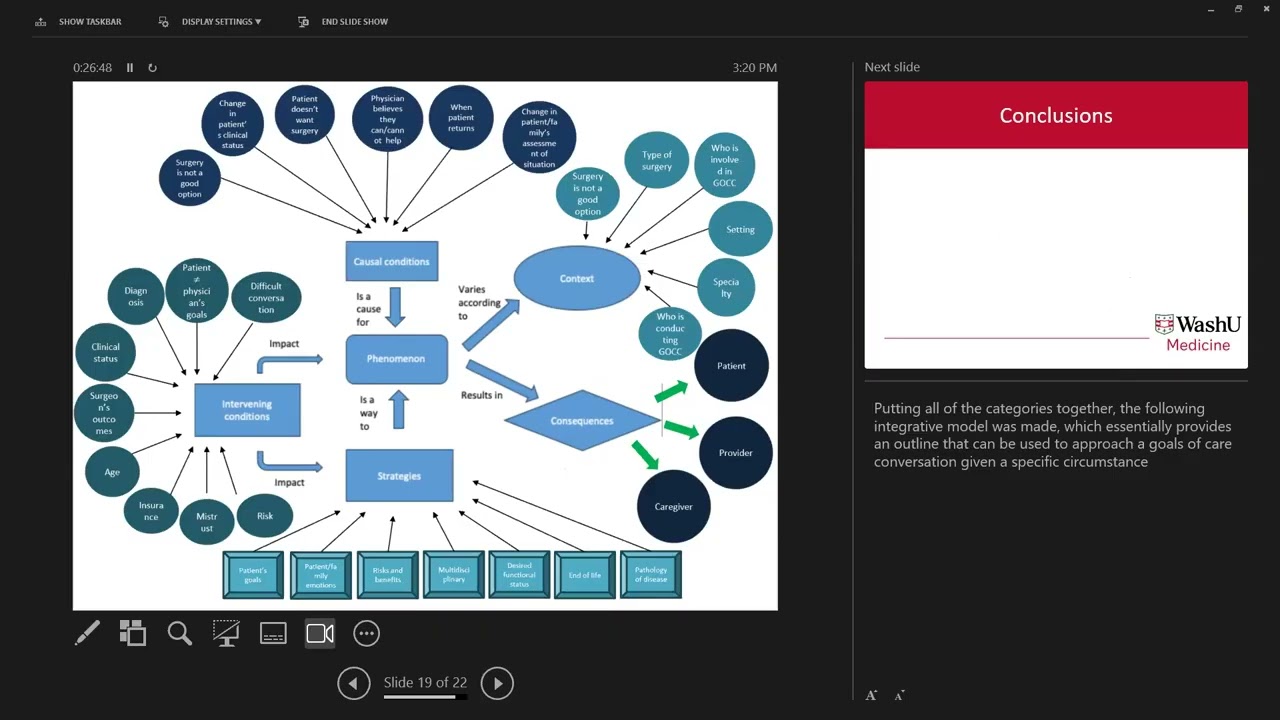
resulting in the diagram depicted here.
This diagram provides a useful
conceptualization of all factors
involved in defining goals of care,
conducting goals of care conversations,
and the impact implications of goals of
care conversations.
Now, let's delve a little deeper into
each of the components.
Starting off with phenomenon, or the
central concept at which the actions and
interactions are directed. In this case,
our phenomenon was how are goals of care
defined.
In defining goals of care, interviewees
were prompted to compare goals of care
with informed consent.
The consensus was that there are two
they are two different entities, but
there's some overlap.
While informed consent requires
discussion of an intervention, goals of
care can happen outside of discussing a
procedure.
As one interviewee put it, informed
consent is putting out the facts, and
goals of care is what you want to do
with those facts at each point in a
patient's journey.
The causal conditions, or what leads to
the occurrence of goals of care
conversations were grouped into six
categories based on interviews.
The circles and arrow size correspond to
the frequency of each subject that was
covered.
The most mentioned causal condition was
when there is a change in a patient's
clinical status. For example, if a
patient's tumor has metastasized and is
now causing unstable vitals.
Intervening conditions are factors that
influence both what a goals of care
conversation looks like and the
strategies used to conduct a goals of
care conversation.
A significant intervening condition that
was mentioned by almost every
interviewee was the inherent difficulty
of the conversation itself.
Thinking of what you would want or what
your loved one would want in a three out
of theoretical situation is hard and
talking about death is difficult. And
depending on the cultural context might
be frowned upon.
All of this impacts both how the
physician approaches a goals of care
conversation and how a patient and our
patient support system
and uh participates in a goals of care
conversation.
What a goals of care conversation is
also varies according to the context of
the situation including who is involved
in the goals of care conversation,
whether surgery is even a good option
and the type of surgery being discussed.
The strategies used to conduct goals of
care conversations also vary with the
most frequent strategy strategy
mentioned being framing the conversation
around a patient's goals or wishes or
desires.
Interviewees also emphasized the
importance of a multi-disciplinary
approach involving colleagues within the
specialty, other specialties,
interprofessional teams, and the
patient's family and support system.
Lastly, the consequences are the results
of the care goals of care conversation.
Because the interviews were more focused
on defining and characterizing goals of
care, the consequences were not covered
as extensively. However, it was clear
that the ways in which goals of care
conversation are structured and occur
impact three main parties: the patient,
the healthcare providers involved in the
care, and the caregiver such support
system of the patient.
So, putting all of these categories
together, the following integrative
integrative model was made, which
essentially provides an outline that can
be used to approach a goals of care
conversation given a specific
circumstance.
So, in conclusion, the survey responses
and one-on-one interviews established
that surgeons agree that goals of care
conversations are important. However,
there is quite a bit of variability as
to how they define goals of care
conversations and when / how they
believe they should happen.
Another notable finding from the study
is that, despite the importance that
respondents agree goals of care
conversations have, more than half
reported not having had any formal
education on how to have a goals of care
conversation.
So, currently we are conducting a second
phase of this study that is surveying
residents
on their opinions and understanding of
goals of care and whether they feel they
are being appropriately prepared to
conduct them on their own in the future.
In the initial data collected, already a
disparity is seen in how residents
characterize goals of care compared to
attendings, with residents believing
goals of care conversations are
warranted in more situations than
attendings.
In a focus group conducted with three
residents, the most significant reason
they attributed to their lack of
confidence in conducting goals of care
conversations independently was the lack
of opportunity that they have for
feedback. With one resident stating,
quote,
"Debriefing after is important because I
feel like I've had enough practice to
the point where I feel much more
confident in having them, but whether or
not they're effective has yet to be
determined.
Moving forward, we are working on ways
to improve ethics education, including
more opportunities to receive immediate
feedback in clinical scenarios and
standardized simulations that involve
ethics discussions.
Thank you for your attention and I'm
open to any questions, critiques,
etc.
I also noticed that at the day, so
>> [laughter]
>> I do have a question for you before you
So, who's who's teaching
these residents, right? They're learning
from the attendings who say that they
don't know how to do it. So, how do we
break that cycle, right, effectively?
>> Yeah, that That's a wonderful question.
Um, and um,
two two things here. One is that we also
want to improve the education of the
attendings. Um, and so we have um,
separate studies that are looking at
ways to um, educate attendings as well
on these concepts.
Um, luckily at our institution, we have
um, a couple of uh, physicians that are
specialized in ethics, um, some coming
from here. Um, and um,
they right now are leading the
initiative, but that is um, correct in
that when speaking with these residents
about experiences they've had, they were
able to say like, "Oh, I model my
conversations a lot after one specific
attending, and I definitely don't do
what X other attending does." Um, so I
think residents themselves are able to
kind of also identify based off what
they're learning and what they've
learned in medical school as well, um,
to differentiate. Like, that's something
I want to model versus I don't know if
that's the best example.
>> Don't want to be known as the person who
gives all the bad examples, I guess,
huh?
All right, our next talk is titled The
Hidden Ethics of Adhesion: Reconsidering
Informed Consent in Contemporary
Clinical Practice.
Nthona Kobu is an Assistant Professor of
Law at the Louis D. Brandeis School of
Law, University of Louisville, where he
teaches Administrative Law and Health
Law.
His scholarship sits at the intersection
of health law, bioethics, administrative
governance, and artificial intelligence
in clinical practice.
Professor Nthona Kobu's research
examines fiduciary obligations in
medicine, informed consent in
technologically mediated care, and the
regulatory design of emerging health
technologies. His work combines
doctrinal analysis with
interdisciplinary bioethics scholarship
to explore how legal frameworks can
safe- safeguard patient autonomy,
professional integrity, and
institutional accountability in
contemporary clinical settings.
In addition to his academic work,
Professor Nthona Kobu regularly provides
guest lectures and ethics-focused
training sessions for clinicians in
academic hospitals in South Africa,
engaging directly with healthcare
professionals on questions of consent,
technology integration, and professional
responsibility in practice.
His scholarship has appeared in the
South African Medical Journal and the
South Carolina Law Review, among other
venues, and he has presented nationally
and internationally, including at the
Ethics, Medicine, and Innovation
Conference and Harvard's Petrie-Flom
Center for Health Law, Policy,
Biotechnology, and Bioethics.
>> Thank you. Um, I am going to try to be
as fast as I can um because I'm trying
to catch um happy hour at 5:00. So,
um
most of us in this room um if I were to
ask you um you know how how were you
taught about informed consent about
clinical ethics? Um most of us are going
to say um we were we learned from our
Blue Book and our Childress um and we
know that um the standard is the patient
must understand the nature of the
procedure and um the authorization
um must be based on genuine disclosure
and understanding and that part is not
controversial uh controversial. Um
nobody in clinical ethics, you know, um
is um disagreeing with that.
Um so, the question I have right now,
which is the basis of my presentation,
is um
wh- when was the last time any of us
actually checked um whether, you know,
that's the standard that is happening um
in clinical practices um you know,
outside of um you know, the textbooks
and when we are getting the training.
Um and because I want to you suggest you
um today that we have built an entire
infrastructure of consent um including
based on forms, um signatures,
timestamps, um legal documentation that
looks exactly like um you know, what
Blue Book um described, but when you
look at how it functions, it functions
um you know, differently.
Um is it the large one?
Okay, I have no disclosures.
So, um
what I want to
show you um today is this is based off a
real case and I got the consent from um
the lady in question here.
Um so, it was around 6:15 in the morning
on a on Tuesday and a 50 a 58-year-old
woman arrived for a hip replacement. Um
she had she had waited for 4 months um
to schedule this um operation and at
that point she was anxious. Um she has
already changed into um hospital gown
um which um itself is kind of
transforming, you know, um
and um you at that point you stop being
a person with, you know, um a coat and a
bag and become, you know, in some sense
a patient. So, a patient um access
representative um came in into the room
and approached her
um and then handed her with a clipboard.
Um on that clipboard there were seven
forms requiring her signature and now
this is um one of the basis of my
presentation today. So,
here um there is the clinical consent,
you know, um here this is where
they are trying to get her consent
before she can go in and attend, you
know, and get the operation done. Now,
when you go through all of these
documents, um one of them relates to um
the treatment which she is about to
receive. Um but then if you go to um the
third form, it starts to talk about um
arbitration to say that um if anything
happens to you, um you waive your rights
to a jury trial, um you are going to
have to arbitrate. And then if you go
through the other forms, they start they
start to get more and more legal and
they talk about different things, right?
So, in this case here um if you walk in
um after she had signed it, 20 minutes
later um some somebody walked in, um one
of the family members, and asked her,
"Hey, um I saw someone coming in here
earlier."
Um and she was explaining that um they
were giving her forms to sign and they
were asked, "Okay, um what were you
signing?" And she said, "Well, I don't
know. I was just signing documents in
order for me to get the treatment that I
need to get um today."
Now, the question in that case becomes
um did she really consent um when she
was signing that form?
And if you think about it, um she was
anxious. Um she's about to get um this
major um, you know, um operation.
Um it might be the biggest operation she
has ever received um, you know, in the
past. so she is scared and you know
she's been waiting for 4 months so in
this case could she have gone through
the entire documents like the entire
seven forms and read each and one or
each one of them and tell the nurses to
wait while she's still reading. And you
know she couldn't do that cuz she was
worried that what if she takes more time
and then she end up you know having to
reschedule the operation
you know and she didn't want to bother
you know any other people.
So this is where
I this concept I I talk about here on
adhesive consent this is where it comes
in and I am taking this from a law of
contracts principle where is which is
the contract of adhesions. Basically the
contract of adhesions
take it or leave it type of contract
like for example if you have Netflix
they regularly change their terms and
conditions now every now and then and
when you try to log in they tell you to
you have to agree to the new terms and
conditions before you can proceed and
watch whatever show is playing on
Netflix.
So I'm sure none of us here or maybe a
few of us have actually taken time to go
through all of those documents all of
those terms and conditions and then we
then sign afterwards.
Even if you do decide to take your time
and read like 17 or 20 pages of the
updated terms and conditions there's no
way for you to scratch out some of the
things you do not agree with. You are
you end up with two choices it's either
you are going to sign the new terms and
conditions or you are just going to
cancel Netflix all together. So most of
us we end up signing and this doesn't
apply just only on Netflix it applies to
our cell phone plans and all of these
are important things in our lives.
So I use this now here to try and you
know apply it in the clinical
perspective to the lady who was in the
waiting room who had already changed and
she was presented with these forms for
her to sign before she can get the
treatment that she needed. Now, in this
case, she could have taken time and I do
understand she could have taken time to,
you know, read the entire seven forms
and then sign them or raise any
concerns. But the problem with all of
that is one, do we know if she was going
to understand any of those documents?
Cuz if you read some of these documents
which are given to patients, they are
written by attorneys and risk management
personnel.
Sometimes they do not even, you know,
discuss or have consultations with the
physicians or with the clinic clinicians
or, you know, ethicists in the hospital.
So, they just design all of these forms
in order to protect themselves and the
the hospital from any possible
risk when if the patient decides to sue
them.
Now,
so if you look here on the screen, um
you'd see how, you know, informed
consent has, you know,
evolved over the years. And the first
one is
in the in 1920 when the first case of
the New York hospital case when they
were Justice Cardozo said that every
adult being, you know, has the right to,
you know, consent to whatever happens to
their body, you know. So, this was the
first case and then if we move forward
to 1972 in Canterbury versus Spence,
this is when now the court decided to be
more patient-centered in this case and
then they started talking about informed
consent. So, the first case they only
mentioned on the word consent, it was
not informed. And then 1972, the court
started using informed consent which is
different and then the court also
explained how consent and informed
consent is different between the two.
And then in the 1980s, that's where, you
know, trouble started. And then we
started to see more litigation against
the doctors, you know, and the hospitals
where patients were suing them.
And most of the time they were arguing
that there was no informed consent. So
we had a lot of cases against the
hospitals. And then which then led to
the hospital department to create these
risk management departments and legal
counsels to create these, you know,
forms and document processes which
patients have to sign whenever they
Excuse me, whenever they get any
treatment
from the hospital.
Now,
if you look today,
we have one of the biggest problems here
is
we've been seeing on the news about the
literacy program and the literacy rates
in the in the US and how people, you
know, even at college level they still
cannot read. They can't still they do
not even understand. So now imagine you
are presenting a form which is drafted
by a by a group of attorneys, not just
one attorney, which is aimed at
protecting the clinician and the
hospitals. And now you're giving it to
someone who doesn't understand what they
are reading, you know. Some of those
documents even for us as attorneys, when
we are to read those documents,
we have to take some time, you know, and
do our own research because they are too
complicated.
So this is where we are today.
Now,
if we talk about
adhesive consent, there are six features
which I have identified.
In this case, the first one is
standardization,
which is the same form goes to every
single patient.
So if, let's say, one a person who is a
who is a
physician goes to a hospital for
whatever operation,
they are going to get the same form as
I would get. Um so now, you know, and
now a person who has um like no higher
education or who never went to school,
they'll get the same form and they have
to sign all of those forms um as
patients. Now, those forms um they treat
all the patients as if they are the
same, they have the same level of
education, they have the same level of
understanding.
And then we have now the second feature,
you cannot negotiate any of these terms.
Um if you like the hospital which I
usually go to, they use MyChart and you
you can um you have an option to check
in before your clinical visit. So, when
you check in on MyChart, there's no way
for you to scratch off anything you do
not agree with. You uh you have to
submit the entire form as it is. So, I
usually refuse to check in online and
then I go on to um you know, like uh
when I go there for my appointment and
then they will I ask them to print it
out and then when they print it out, I
tried this one time I tried to scratch
out some of the terms which I didn't
agree with like um that they can share
um you know, my health data and all of
those things. I asked them not to do
that and I do not consent to that and
they told me that there's nothing they
can do cuz it's part of the form. They
are not authorized um to accept any
forms which have been um tampered with.
So, I ended up leaving on that day. And
then the third part is complexity. These
documentations um they are too complex,
you know, um so patients do not even
understand them, they do not um
understand, you know, the entire purpose
of these documents and we also have to
look at the comprehension as well.
And um the other part is power
imbalance. Now, we have um the hospital
which is which has a lot of power, you
know, over the patient and now the
patient, even if they do not agree with
any of the terms which are contained in
the agreement, they are still going to
sign these um documents cuz one, they do
need um the medical help. Um also, the
hospital has too much power over them as
well. And then there's also agency as
well. Some of these um situations, they
are agent and the patient cannot just
decide to um say, "You know what? I'm
going to find another doctor or another
hospital." Cuz
patients have to go to work, you know?
Maybe they That's the only day they
could have like,
you know, got it left work to go and get
some medical help. You know? And then
there's also um
uh bundling here, which is one of the
biggest problem that I um have faced is
if you read these documents, um the
first form may have informed consent or
talk about consent, but then the second
form will talk about arbitration and the
other forms will talk about all of these
other things. And these are all
confusing to a patient who doesn't have
time to read all of these things. So,
the case that I have been making here um
about um against um this adhesive
consent, one is autonomy has been
diminished in this case.
Right? So, the patient here um they
cannot recall what they were what they
authorized um the moment after signing.
Cuz if we are talking about real
informed consent and you have explained
the terms to the patient and they have
understood those terms, then it's easier
for them to remember what they were
talking about earlier on. And then
number two, we also have dignity
compromised. Now, imagine a patient um
who doesn't understand what's written
and now they have to go and stand up and
tell the nurse or whoever is in there
while in a room full of other patients
and say, "Hey, I cannot read. I do not
understand any of these forms." Um they
are going to feel ashamed and they might
end up just signing and not even raising
any problems here. And then the last one
is trust. Um I Most of the time I use um
one of the examples I use when I talk to
my students is how I some of us men are
too loyal to our own barber shops and
our own barbers. Like we do not even
cheat on them. We have one person who
cuts our hair. So now here in clinical
as well in in the clinical settings as
well, if you trust your physician, you
are going to want to go back to the same
physician over and over again cuz you
trust them. Um so now if now there's a
problem the trust is broken, it's going
to cause so many problems between the
relationship between the patient and the
physician. One, the patient might not
want to come back to the institution or
two,
it might lead to you know the patient
when they do not trust the physician,
they might start even to doubt whatever
recommendation is made by the physician
in this case.
So
why does this persist? Cuz we have seen
that it has been happening for a long
time.
On the one side here is institutional
incentive and
in this presentation and on the paper
that I wrote based on this,
the biggest criticism that I have is
against the institutions and not the
physicians because if you look at all of
these problems, they are structural.
They are caused by the institutions.
They are the ones who are trying to
protect themselves. They are the ones
who are trying to make sure that they do
not get sued.
And
one of the argument that I can get like
a counter argument would be that if they
do not have these forms, then they open
themselves to risk, which is true. But
then at the same time, the risk is at
the patient's expense. And then the
other one is we also have the digital.
Here, if you look on this side, like we
use my chart. You cannot edit any of
these things and if you see some of the
forms on the digital platforms, you
cannot um you only have like it like
maybe three options to choose from. Um
there's no way for you to add your own
option. So, you already have these um
options which have been given to you
already, and there's nothing you can do.
And this has a high um
you know um effects on telemedicine
where patients are sitting at by
themselves at their home, and you know
they end up having to sign these digital
forms without any um anyone helping them
with them.
So,
um here what I what I I started to look
at in how we can deal with these things
here is one, if we look at um the
institutional governance, um they have
to be um a radical um you know
simplification in this case. Like we
have to simplify these forms. There's no
need for you to uh give a patient um
seven or 17 pages of documents to read
before they can get um you know whatever
health assistance that they need. You
can send these forms to them before they
even come to um the clinic, or you can
you know um give it to them um
electronically, and then um they can
come and edit them or sign them when
they get to the hospital. You know um
the clinical ethics committee has to be
involved in drafting all of these forms.
It shouldn't just be um a some work for
the legal department or the risk
management. There should be um patient
advocates involved as well in this case.
And then um we also have regulatory
interventions here. So, the state's
health um you know departments, they can
mandate you know um reading level
standards. Um we have seen in other
types of disputes like in this in
dispute resolution and arbitration, um
some states have decided to say that
since everyone has been using um or
making people sign these arbitration
forms, you have to um tell a person that
there's an arbitration form in the
agreement before they even sign. So, in
in this case with um consent here, you
have to also let them know what they are
sign signing. You have to confirm with
them. You You have to ask them, "Hey, do
you Did you understand what you are
signing?"
And then the last one would be the
clinical process, and I know it's going
to be a lot of work to say that the
clinicians or the physicians have to
read these documents and then disclose
all of these documents to the patients.
But the at minimum, what you can do is
you can ask them, "Hey, did you
understand the document that you
signed?" You know, and if a patient says
they do not understand, they have some
questions, you can direct them to
someone who can answer those questions
cuz that can also build trust between
you as a physician and the patient.
And then
Professor Kaplan gave me this last one
recommendation to say,
"You have to encourage patients to
record the consent
process and the consent conversations
when you are asking them whether they do
consent or not."
Now, here the main argument is that
these documents they are important, but
they must serve dialogue and not replace
dialogue. You should You should explain
what's happening to the patient. You
should explain what's good or what's
bad. You should
explain what's in there, what they are
signing, you know, cuz just to give just
giving a patient seven forms to sign and
then thinking that you are done with the
consent process isn't enough.
Um thank you.
>> I think we have time for one brief
question.
>> Hi. Um thank you for your presentation.
I was wondering if um you had thoughts
about
like if if there's
room for like stratification of these
requirements. Um so like to
differentiate someone going in for a
major surgery versus someone going in
for like a
um just a yearly checkup where
you know, if some
yearly checkup, like if there's going to
be a stratification um
if if you see there being a
stratification between like that that
differentiate differentiates how uh uh
the
enormity of the procedure that's being
considered for.
>> Thank you. Um so in the paper um that I
wrote um I actually made um one of the
arguments that I made is that um we can
try to differentiate between um
different procedures, like if a patient
is just coming in for a an annual
checkup um or if they are coming for a
major um surgery, um we can try and
create different forms for that. But
then what we have to do is the level of
um you know, discussion or dialogue
between the clinician and the patient
has to differ in terms of you know, um
how dangerous the operation is or the
service that they'll be getting. Like
someone who's just coming in for an
annual checkup and that you won't be
performing any um you know, surgery on
them, you won't be drawing blood on them
or doing any of the major things um that
that is okay. Um but then where there is
like you know, much risk involved um you
do have to have a much larger um
dialogue and explain everything to the
patient.
Thank you.
>> All right. Our next talk is titled
Depression and Autonomy in Advanced
Chronic Disease.
Dr. Jeffrey Poonkudy is currently an
internal medicine resident at NorthShore
University Hospital and Long Island
Jewish Medical Center in New York. He
did his undergraduate work in philosophy
at Dartmouth College and graduated from
Northwestern University's Feinberg
School of Medicine with a medical degree
and a master's degree in medical
humanities and bioethics. He is most
interested in the ethics of controlled
human infection studies, environmental
ethics, and assessments of capacity in
the clinical setting. Dr. Poongkunran.
>> Hi everyone. It's a pleasure to be here
today.
So, today
I want to speak to all of you about
depression and capacity in advanced
chronic disease. And I'm an internal
medicine resident, so how did I land on
this topic? And
it's really from a case that I saw on
the ethics consultation service earlier
this year
that got me thinking about this topic.
And I think the best way is just to dive
right into the case.
Okay. Also, I have no disclosures.
So, this case is of a 73-year-old male.
He has severe heart failure
and he has a left ventricular assist
device or an LVAD,
which helps augment his heart's
function.
And he presented from rehab
after a previous hospitalization. He's
had multiple recurrent hospitalizations
for various issues. He came in because
of a wound
and he was found to have a fever when he
came in. He was diagnosed with
osteomyelitis or infection of the bone
and he had surgery and was given a long
course of IV antibiotics. And now he's
sitting on the medicine floor and he
mentions to his medical team that, you
know, he's had enough
of of this and he would like his LVAD to
be deactivated stating that he doesn't
want to to go through this anymore and
the LVAD is giving him a quality of
life,
that he finds unacceptable.
He says quote, I'm
uh existing but not living and the LVAD
isn't really helping him.
Um
And notably, he reports difficulty
sleeping. He says sometimes he wakes up
in the middle of the night breathless,
which sometimes happens in patients with
heart failure.
He has decreased energy, he endorses
some fatigue, he has reduced appetite,
he has diminished enjoyment of
activities that he previously enjoyed.
You know, he liked to go to
watch movies with his family, but now he
feels like he has to stay at home. And
then some some activities that he feels
like he can do like read books, he also
feels like he's he's not really enjoying
those activities either. Um and on
physical examination, he appears a
little more slowed both in speech and in
his um
uh in the way that he moves.
Uh so this is the case and so I have
three questions
that I want to to sort of
uh address here or like ask.
One is does this patient have capacity
to make this decision? Is the first one.
Second, does this patient meet clinical
criteria for a diagnosis of depression?
I think that at first blush is a very,
you know, either clinical or psychiatric
question, but I think that is a question
in this context that has ethical
ramifications. Uh and three, if this
patient has depression,
how if at all does that affect their
capacity to make this decision?
So let's dive into the first one. Does
this
a patient have capacity? So we typically
assess capacity, as I'm sure I'm sure
all of you know, with the MacArthur
Competence Assessment Tool.
We assess their understanding. So he was
able to understand that he had an LVAD
and that it was helping his heart
failure Um ability to appreciate or
appreciation to recognize how that
information applies to one's own
situation. So, he understood that
uh
deactivating the LVAD would
lead to his death in in the subsequent
days and he understood how this would
affect his family. He was able to reason
about his quality of life and why he
wanted the LVAD deactivated and he was
able to express a choice over the few
days that our ethics team saw him that
he did want his LVAD deactivated. So, it
seems that he meets the criteria for
capacity.
Um
but what if he has
depression?
Um and does this patient meet uh
criteria for for depression? And And
maybe some of you have noticed what I
chose to pick out in the the case
presentation slide.
Um
Is it possible to go back?
What?
Okay.
Uh
so, I've put up here the criteria for
diagnosis of major depression in the
DSM-5 TR and uh
the purple arrows, I know they're small,
point to criteria he seemingly already
meets. Um you know, he has diminished
interest, he has weight loss, he has
insomnia, and it seems that he meets
this criteria, but criteria C also
stipulates that this shouldn't be
attributable to a medical illness. And I
think that is an important challenge
because I've seen patients with LVADs
with his same level of heart failure
that have much better functional
capacity than he does.
Um and it's very hard to tell what
exactly is attributable to medical
condition and what exactly is from a
like primary psychiatric uh condition.
And
the reason
I care about this or why I think this is
ethically significant is because the
patients most likely to request
withdrawal of care are the same patients
where this diagnosis of depression might
be difficult. Right, these
neurovegetative symptoms, the these
physical symptoms
within the criteria of depression might
already be met with patients with
decompensated cirrhosis or patients with
end-stage renal disease on hemodialysis
or patients with advanced malignancy on
chemotherapy. They might already have
those symptoms of fatigue or
insomnia or reduced appetite.
And so there's a risk of both
overdiagnosis and underdiagnosis, right?
We
attribute all of them as having
depression because they meet those
criteria and perhaps then we subject
them to a psychiatric evaluation when
they're just requesting a routine
withdrawal of care.
And then there's
probably
a risk of underdiagnosis where we ignore
those physical symptoms, attribute them
to their medical illness, and then
perhaps don't capture patients with
depression who might benefit from a
psychiatric evaluation before they make
a pretty momentous decision to to
withdraw life-sustaining care.
Um
Um and so I'm not the first person to to
to think that, you know, our
our criteria for diagnosis of depression
is in the medically ill is difficult. Uh
several individuals have brought up
alternative criteria. The Endicott
criteria 1984 aims to sub out some of
the physical symptoms like change in
appetite for tearfulness, sleep
disturbance for social withdrawal,
fatigue for brooding,
psychomotor agitation for lack of
reactivity. But the the studies that
have looked at these things are are
quite small and and there's been lack of
validation on a large scale for and the
use of any of these criteria for
diagnosis of of depression.
Um
So, lastly, I want to briefly touch on
uh you know, if our patient in in our
starting scenario does indeed have
depression, how does that affect their
capacity to make this decision? Why why
should we care that they might have
comorbid depression?
Um So, we know that depression can
affect capacity, but not in ways not
always in ways that are immediately
evident in at least non-psychia-
non-psychia-
It not not in not always evident for the
non-psychiatrist uh when they're doing
capacity assessments, right? Because
there's no um
there's not always a dramatic alteration
in that that patient's cognition.
Um So, analyses have focused on how the
depression might compromise
a depressed patient's ability to
appreciate the consequences of a medical
choice that they're making. They may be
able if a
cancer patient is depressed, they might
be able to tell you that chemotherapy
and surgery and radiation are all
beneficial for cancer, but they may also
turn around and say, "But that won't
help me because nothing helps me,"
right? They they won't they may not be
able to appreciate
um uh
how the medical information applies to
their own life. And and some empirical
studies seem to point in the same
direction
uh that it's really the the appreciative
capacity that's impaired. Um
And some have even gone so far as to say
our MacArthur model because it's so
cognitive, maybe doesn't even capture
the ways in which depression might
impair capacity because depression
uh leads to
leads to significant, uh,
changes our emotional states in ways
that maybe aren't captured by our
current, uh,
methods of, uh, of, um,
of assessing capacity.
Uh, so, in conclusion, I want to quickly
wrap up the case that we started with.
Uh, we did have site, uh, psychiatry
come by and evaluate the patient, and
the patient, uh, was deemed to have
depression, but not in a way that,
according to psychiatry, uh,
compromise their capacity. So, it was
decided, in collaboration with all his
different care teams, that he did have
capacity to make this decision to
withdraw his LVAD, and in the subsequent
days, his family came to bedside, and
his, the heart failure team came and
withdrew his LVAD, and he passed
peacefully. Um,
but I'm interested in this, as I said
before, because I think depression in
the context of all the advanced chronic
illnesses that we see in medicine, um,
it can be difficult for
non-psychiatrists to identify
accurately, and I think there's a need
for clear and validated methods of
diagnosing,
uh,
depression in patients with advanced
chronic disease, because they're the
ones that are most likely to request
withdrawal of care. So, it's important,
ethically speaking, to know which
patients need further evaluation by
psychiatry for, uh, further scrutiny of
their decision-making capacity, and
which patients' routine requests for
withdrawal of care should simply be
honored, and their autonomy fully
respected. Thank you very much.
>> You're welcome.
I have a question {slash} comment for
you. If psychiatry had said that this
person
this person's depression is
interfering with their ability to make a
decision, what would you have done then?
>> I think our team would have discussed
potentially
uh
discussing trialing treatment with him
to try to get him out of his
depression if if psych psychiatry
believed it was a reversible sort of
thing.
>> At what point would you have revisited
that decision?
>> I think that that's that's a difficult
question. I think
under their guidance, I think it takes
takes a great deal of time for for at
least treatment for depression to to
show um
signs of efficacy. So so it would maybe
be weeks to months.
>> What if their uh depression was
refractory and in spite of maximal
treatment, there was no improvement in
their depression? They continued to feel
like their life were not worth living.
>> Yeah, I I then
I'm not sure. That's that's a
difficult question. I what to do in
cases of refractory depression
when patients request withdrawal of
care. I I think and that refractory
depression is impacting their capacity.
I think that's that's a very challenging
question and I'm not I'm not sure.
>> For the expert
>> Yeah.
>> assist in the room. Good presentation.
>> Thank you so much for bringing this
topic up. Um it is hard. There's like an
overlap. Um I'm a palliative physician
and I think just like the comment, which
is not the point of like the case
itself, the LVAD, right? I think you see
a lot of people. I think this gentleman
was clearly a destination LVAD. There
was no
>> Yes, he was not a candidate for a
transplant.
>> Right. And so it is sad that there
wasn't this palliative
uh approach and I coming in with
osteomyelitis, all these things. So I do
think just for like the learners in the
room, right? Like there's a lot of
people we meet who are in destination
LVADs and don't actually realize they
have a destination LVAD. No palliative,
they have no hospice. Um and so that's
one thing.
My question is, would it have felt
different if he said no to the IV
antibiotics? Would we have asked all of
the same cuz right there's an action to
turning off the LVAD versus an omission
of not giving the IV antibiotics. And we
see this a lot in whether it's dementia
patients with dementia with
osteomyelitis and the IV and the
debridements and the this and the that.
So I'm just curious for yourself, anyone
in the room, like would it have felt
different? And if it did then like why?
>> I I think
for me it it it might have felt more
urgent if he uh
if he didn't want the IV antibiotics
because I think those address a clearly
reversible
medical condition and I think we would
scrutinize his decision-making capacity
more in that circumstance. Here I think
because we know that the LVAD is
destination and people routinely
withdraw care for their like
withdraw care for chronic illnesses
because they don't feel like their
quality of
quality of life is sufficient. I think
the for me the IV antibiotics maybe
counterintuitively are are more
deserve more scrutiny of their
decision-making capacity.
>> Yeah, I appreciate the counter because
usually it's the this is
I think that's really interesting and I
appreciate you answering that.
>> opposite.
>> And I'm
curious I would be curious to know if if
I
had to if I was seeing this patient
>> Mhm.
>> a psychiatrist
>> Yeah.
>> uh
I'd like to know some of the
history
uh when did this uh what we're calling a
depression, what sounds like a
depression
>> Mhm.
>> when did it start? Uh when in the course
of the chronic
uh,
debilitating illness that he have
that he became that there were were
signs of depression. They've been
present How long have they been present?
>> Yeah.
>> Is there anything else happening
>> Yeah.
>> in his life uh, that might be
precipitating the depression.
So, it I I would think before I came to
a decision I'd want to know a lot more
of the history
>> Mhm.
>> of of how he got to this point.
>> Yeah.
>> And then, you know, that would
it turn that would inform my ideas about
what might be done
>> Yeah.
>> besides com you know, going along with
his idea to to let
>> The withdrawal, okay. Yeah. Yeah. No,
but I It seems psychiatry did evaluate
the patient and they they did that deep
dive into when he he they looked at his
psychiatric evaluation when he got his
LVAD because there's a thorough
evaluation at the time that the LVAD is
placed.
Um, they looked at um,
when this episode started. So, it to to
them it seemed like he was in an acute
de-
not acute, but like sort of subacute uh,
depressive episodes had sort of sometime
after getting the LVAD.
>> And they
I guess they're concluding that there
was no treatment for the depression.
>> Yeah.
>> That would be effective.
>> Yes. I think so. Yeah.
Thank you.
>> All right. Our next talk is titled
pregnancy incapacity and the law,
navigating advanced directives under
state pregnancy exemptions.
Madeleine Canale is a rising third-year
medical student at the University of
Florida College of Medicine. She is
enrolled in the medical ethics and law
track of the Discovery Pathways program,
which has allowed her to pursue an
in-depth study of legal and bioethical
issues and their intersection with
clinical medicine.
>> Hi everyone. Thanks so much for being
here today.
All right. Um so as he talked about
today we're talking about pregnancy and
capacity in the law with navigating
advanced directives under pre-state
pregnancy exemptions. And I worked with
Professor Lawrence Solberg on this this
paper.
I have no disclosures.
All right. So a little bit about
background. Obviously we've talked about
advanced directives already thoroughly
um throughout this conference, but
they're legal doc documents that allow
individuals to outline their preferences
for medical care in the event that they
lose decision-making capacity. Um it's a
key tool for preserving prospective
autonomy and it's grounded in the
constitutional right to refuse medical
treatment. Patients can determine in
advance what kinds of life-sustaining
interventions they would or would not
want when incapacitated. However,
pregnancy exclusion statutes can
complicate this right. Um they modify or
even nullify advanced directives when a
when a patient is pregnant. So hence
there's a tension between respecting
individual autonomy and the state's
interest in protecting potential fetal
life. This often shifts decision-making
power away from the patient's previously
expressed wishes.
So our research question was how do
state abortion laws in states with total
abortion bans, in states with no
gestational limit on abortion, how does
that correlate with the validity of
advanced directives during pregnancy?
Um the legal foundation for advanced
directives and the right to refuse
medical treatment is rooted in a series
of landmark cases that collectively
established patient autonomy as a
constitutional and ethical priority. In
1976 the case In re Quinlan, there was a
young woman in a persistent vegetative
state whose family sought to remove her
from a ventilator. The New Jersey
Supreme Court um established the right
in privacy including declining
extraordinary life-sustaining treatment
e- even via a surrogate decision maker.
This was further strengthened in 1986 um
in the court case Bouvia versus Superior
Court, where a competent but severely
disabled woman who was hospitalized
against her wishes sought to refuse
artificial nutrition.
The court affirmed her right to do so,
emphasizing that such refusal is not
suicide but simply an acceptance of an
underlying disease.
In 1990, this was solidified at the
federal level in Cruzan versus Director,
Missouri Department of Health. A young
woman was in a persistent vegetative
state and was kept on artificial
nutrition and hydration. The US Supreme
Court held that competent individuals
have a constitutionally protected right
to refuse medical treatment while
allowing states to require clear and
convincing evidence of a patient's
wishes. And finally in 1997 with the two
cases Washington versus Glucksberg and
Vacco v. Quill, those cases involved
challenges to bans on physician-assisted
suicide and it clarified the distinction
between withdrawal of treatment and
assisted suicide, reinforcing that while
assisted suicide is not constitutionally
protected, withdrawal of treatment
remains a fundamental liberty interest.
Together, these cases established a
consistent legal doctrine prioritizing
autonomy and end-of-life
decision-making, one that becomes
notably inconsistent when pregnancy
exclusion laws are introduced.
When pregnancy is introduced, um
many of these established protections
are not upheld. Pregnancy exclusion laws
are when a present pregnant patient's
previously expressed wishes um in
advanced directives can be disregarded,
even in cases where they were in a
vegetative state like Quinlan. This
selective application of autonomy in
certain states with pregnancy exclusion
laws highlights an inconsistency in how
ethical and legal standards are applied.
It raises questions as to whether the
well-established right to end-of-life
decision-making upheld in court cases
across decades in US history, whether
that extends to pregnant individuals as
well.
So, a little bit about the historical
evolution of abortion law. The legal
landscape of abortion in the US has
significantly evolved over time. Um
prior to 1973, this it was largely
criminalized amongst most states.
However, um with Roe v. Wade in 1973, it
established a constitutional right to
abortion grounded in the right to
privacy. It created a trimester
framework that limited the extent of
state regulation. In 1992 with Planned
Parenthood v. Casey, it affirmed this
right by eliminating the trimester
framework in favor of the state
regulating based on pre- and
post-viability.
It also added on the undue burden
standard, which allows states to impose
restrictions so long as they do not
create a substantial obstacle to access
before fetal fetal viability.
This federal protection was overturned
in 2022 with Dobbs v. Jackson Women's
Health Organization, which returned full
regulatory authority to the states.
In a post-Dobbs world as we know it,
it's wildly divergent policies across
states ranges from total abortion bans
to um no gestational limits. So, this
increasing fragmentation of reproductive
law forms a critical backdrop for this
study. It raises questions as to whether
and how these policy environments
influence other areas of medical
decision-making,
including the treatment of advance
directives during pregnancy.
So, the study that we conducted was a
statutory analysis of 23 US states. We
looked at advance directive laws in
states with total abortion bans, which
ended up being 13, and states with no
gestational limits, which ended up being
10. And we developed a categorical
typology based on whether the advance
directive remains in effect and to what
extent.
So, this was the typology that we
created. I'll go into a little bit of
detail about each of them. So, in the
automatic invalidation, that means a
pregnant woman's advance directive was
completely disregarded once the
pregnancy was identified, meaning her
previously stated wishes, such as
refusal of life-sustaining treatment,
are not honored. In viability-based
enforcement, um that's whether the
directive is followed depends on fetal
viability.
For example, a directive may be honored
at 18 weeks, but overridden at 26 when
the fetus is considered viable.
In viability-based enforcement with
maternal harm and pain exceptions, that
still prioritizes fetal viability, but
allows clinicians to withdraw treatment
if continuing care would cause
significant harm or suffering to the
patient. And in contrast, some states
provide an opportunity to specify wishes
without default guidance. So that means
that individuals can document pregnancy
specific preferences, but the law does
not dictate what happens if they do not.
In explicit opt-out provisions, that
goes a step further. It allows
individuals to clearly state whether the
directive should remain in effect during
pregnancy, thereby preserving autonomy.
However, the default is still that the
pregnancy exclusion laws are in place
unless the patient opts out.
In states with statutory silence, the
law does not address pregnancy at all.
So this leaves decision makers decisions
to clinicians and surrogates without
clear legal direction.
Finally, some states bar patient
designated decision makers from ending
life-sustaining treatment for pregnant
patients. So that means that even if a
chosen surrogate decision maker can't
withdraw care if the patient has
explicitly written that they'd want um
their decision maker to do so.
So this was the data that we collected.
Um so on the left, that was states with
no abortion bans or gestational limits.
And on the right was states with total
abortion bans. This was as of 2025 when
we conducted the study. So as you can
see, there are some categories that are
only on one side versus the other, but
there are also a decent amount of
categories that are on both sides. Um so
there was kind of no clear correlation
um with having a total abortion ban and
having, you know, everyone have
automatic invalidation of an advance
directive.
Um and then there was one with an
asterisk, Louisiana. That statute did
not explicitly reference advance
directives, but its language implies
that life-sustaining treatment must be
provided during pregnancy regardless of
whether the patient has an advance
directive in place or not.
So I'll delve into a little bit of the
key findings. So while it's tempting to
frame reproductive policy in the US as a
polarized landscape, split neatly
between states that allow abortion and
those that ban it, the legal treatment
of advance directives during pregnancy
reveals a far more complex and layered
reality. This distribution underscores
the fragmented and inconsistent nature
of legal protections for pregnant
individuals and end-of-life autonomy,
and reveals that a state approach to
advance directives during pregnancy
doesn't necessarily correspond with its
stance on abortion access.
So, going into some of the specifics, um
states with total abortion bans, so we
can take um Alabama and Texas, for
example, they followed more of a
predictable pattern of both restricting
reproductive choice and automatically
invalidating advance directives during
pregnancy.
Um however, some diverge from this
model, so such as Michigan, Alaska, and
Minnesota. They did not oppose um
gestational limits on abortion, but they
still restricted end-of-life
decision-making for pregnant patients
through surrogate limitations or
viability-based standards, and that
sometimes required clear and convincing
evidence of a patient's wishes.
Conversely, states such as Oklahoma and
Idaho, they combined highly restrictive
abortion law with mechanisms that
preserve some degree of patient autonomy
in advance directives. So, that included
opt-out provisions or fully
patient-directed applicability.
Mhm.
And then also in Colorado and Oregon, um
despite strong protections for abortion
access, they remain silent on how
pregnancy affects advance directives, so
that leaves a lot of interpretation to
clinicians or to courts.
So, together these
uh these examples illustrate that
reproductive policy operates across
multiple dimensions, including abortion,
end-of-life care, and bodily
>> [clears throat]
>> autonomy, and then evolves unevenly
across states. It results in a
fragmented legal patchwork that
complicates clinical decision-making and
may ultimately undermine the consistent
application of patient-centered care.
The ethical challenges of medical
decision-making for incapacitated
pregnant patients has become
increasingly complex in the in the
context of evolving state-level
reproductive restrictions, promoting
consideration of pregnancy
Sorry. Um promoting consideration of
pregnancy-specific advance directives as
a potential solution.
As highlighted um by Joan Kraus um in
her paper pregnancy advance directives,
she proposed a distinct pregnancy
advance directive that allows
individuals to clearly document their
values, goals of care, and treatment
preferences in the event of incapacity
during pregnancy. While this concept is
important to voice, the effectiveness of
such tools depends heavily on clinician
engagement and patient education.
Healthcare providers must proactively
initiate discussions about advanced
directives with reproductive age
patients and revisit them during key
life events, while also counseling
patients on how state law may limit or
even nullify their directives.
As I've discussed, pregnancy advanced
directive laws vary widely across
states, and it's important that patients
are informed about their specific state
rights when creating their pregnancy
advanced directive. Advanced directives
are also not often made by younger
patients, so it's important that
clinicians initiate this type of
conversation with all of their patients.
Advanced directives are honored when you
travel across states normally. However,
an important question arises in the
context of pregnancy. Will an advanced
directive that's valid in one state be
honored in another when the patient is
pregnant? It creates significant ethical
and practical challenges for patients
who travel or relocate. Ultimately, a
pregnancy-specific advanced directive
combined with informed clinical guidance
can offer a more ethically robust
framework for navigating conflicts
between maternal autonomy and
state-imposed interests on fetal life.
This paper has examined the complex and
inconsistent ways that state law
addresses the rights of pregnant
individuals to specify life-sustaining
treatment, um situating these statutes
within the broader legal landscape
shaped by abortion restrictions.
However, key questions remain, such as
the right of capacitated individuals, a
blanket approach to pregnancy exclusion
laws fails to account for cases in which
a patient may retain full
decision-making capacity, and can make
informed choices about their care,
including the acceptance of fetal risk.
It also we don't talk about um if they
don't have an advanced directive, I
think that's another area for further
research. Responsibility typically falls
to surrogates, clinicians, or hospital
ethics committees in those situations.
Um we also only focus on situations
where the patient is still living,
intentionally excluding those where the
patient is considered brain dead. Cases
involving after-death decision-making
have historically faced similar legal
barriers as to those surrounding
end-of-life decisions for pregnant
living individuals.
And finally, further research is
warranted for cross-state enforceability
of advanced directives.
So, in conclusion, the implementation of
pregnancy-specific advanced directives,
combined with clear patient education on
state laws governing end-of-life
decision-making during pregnancy, it can
help empower individuals to make more
informed and autonomous choices about
their care. Thank you so much. I'll take
any questions you have.
>> I think thank you so much for this.
My first question was already addressed
specifically on the
the matter of
patients who are brain dead. So, I'm
I was interested to see that see that.
My other question was about does your
research
some of the questions in this involve
whether um
whether cesareans will be sort of like
compelled in circumstances where that's
sort of like warrant where where where
that might be that might be the only way
to like to save the fetus but the but
the mother is still is is
is would is
does not want that. And I'm I think
specifically like the
I'm thinking specifically
of
the Angie Carter case from from the '80s
and '90s. But, I'm curious if your
research has
shed any light on that on that
development question.
>> Yeah, kind of what I've read is it seems
like hospitals are a bit more weary
about kind of going forward with an
advanced directive if they're unsure
about, you know, what state policy is.
So, they'll normally lean towards the
side of, you know, not really following
the advanced directive to, you know,
keep the patient on life support. And I
think a lot of times they'll try to like
keep the patient until viability so
they're able to do that um cesarean.
But, I think there a lot of hospitals
can become afraid of, you know, the
legal repercussions if they go through
with following the advanced directive if
it doesn't end up following the law. So,
that is I think some more further
research of, you know, when will they
start doing those cesareans if they do
kind of follow. That's a good question.
Yeah.
>> It's a It's comment to end the question.
So, who wants to be pregnant if the
state can take over your bodily
sovereignty?
Isn't this like now a decision for like
the choice between sovereignty and
carrying a fetus or baby? So, I guess my
question for you is there any research
on that on how people feel about their
bodily sovereignty and autonomy in a
state of state exercised control?
>> I think that's a great question and
unfortunately I do not know the answer,
but I do think there's not a lot of
people who understand the the policies
behind advanced directives with
pregnancy and it's something that's not
often talked about between the clinician
and the patient. And so, I think that
lack of education about it maybe
is influencing
or if people knew more about it, that
might influence whether or not they
would want to become pregnant or have
their pregnancy in a certain state. So,
I definitely think there needs to be
more education for people about this
because of the way the state is able to
take over such autonomy of the patient,
especially eroding such an established
right that you have of bodily autonomy
that we, you know, established through
all those cases that I discussed,
something that can just be snatched away
immediately when you become pregnant. It
is definitely something that needs to be
talked about more.
All right. Thank you so much.
>> Our next talk is titled Perceptions of
Health Care Providers
Provider Conflicts of Interest Across
Socioeconomic and Educational Groups.
Karyn Wicker is a second-year medical
student at Lake Erie College of
Osteopathic Medicine in Erie,
Pennsylvania.
His research interests include
orthopedic surgery, clinical ethics, and
health policy. And he has contributed to
multiple research projects including
first authored work.
His current research examines physician
conflicts of interest and transparency
in healthcare. He has previously
conducted research at the NIH, Cornell
University, and the University of
Buffalo as well as Kennesaw State
University.
>> Uh good afternoon everybody. Um thank
you guys for coming.
Um let me see how to work this.
Okay.
All right. So, um my project was on the
perceptions of healthcare provider
conflicts of interest
um
across socioeconomic and educational
groups.
Um so,
um me and my partner Robert Tran were
um
we had the scholarship for the Winship
program and
uh we essentially were recruited to do
uh clinical research
um at Wild Cornell. And during that
research time, we were recruited to do
to doing um multiple community events.
Some of them included Heart to Heart,
which was a free screening for diabetes
and cardiovascular disease mainly in
minority popula- populations in the New
York City area.
Um and we also did contributed to the
naloxone distribution and overdose pre-
prevention and uh in similar areas
across the New York City communities.
And you'll see that these are events
that uh
that were important because we uh
conducted our own question and developed
a survey and uh conducted data analysis
during the 6-week period of our research
program.
Um so, to start out, uh uh so what is a
conflict of interest?
Uh we determined that uh conflict of
interest is a potential clash between
professional and uh professional
responsibilities and personal interests.
Um and we found that most patients in
the US uh depend on healthcare providers
who have financial relationships with
pharmaceutical companies.
And
we wanted to know why this matters. Uh
you probably want to know why this
matters.
Uh even the smallest incentives can
subconsciously um affect the healthcare
provider prefer prescribing behaviors
and raising ethical quality of care
concerns for the patient.
Um we conducted a QA QI study to assess
the perceptions of various scenarios on
the healthcare providers conflicts of
interest uh with various
uh
pharmaceutical companies.
Um and so for a little bit of
background, uh
we um
before we conducted the study, we did a
little bit of literature review and we
found that uh
the Sunshine Act uh was one of the acts
that was passed that um
was reporting the payments of
pharmaceutical companies in the CMS and
open um
open payments database.
And we also found another study um from
Perry in 2015 that found that studies uh
that found patients trust varied by uh
payment types, stock, and travel and
they were viewed negatively uh while
consulting and samples were more
acceptable.
Um and to our knowledge, no prior
research has been done to differ. Um no
prior research has done whether the
perceptions differed by socioeconomic
status or educational level.
Um so our study uh explores how
socioeconomic and educational influences
uh patients' perceptions on uh the
providers
uh
potential financial conflict of
interest.
Uh and so for our objectives
um we assessed
uh
how different socioeconomic and
educational groups perceived different
types of
of payments such as financial
relationships
uh speaking fees
uh trips resorts
and um
we
identified
um
the strategies
and we also wanted to identify
strategies for transparent health care
provider industry relationships that
preserve the patient uh
the patient trust across diverse
populations.
Uh and so for our methods
uh Cornell was gracious enough to give
us uh
$20 gift cards that we incentivized the
people that we were giving out the
surveys to to fill out the surveys.
It was pretty lengthy survey so
um a lot of the people were happy to
receive the $20 but um it was hard to to
recruit a lot of people so we only
recruited 66.
Um and
we had the survey include eight
demographic questions three questions
assessing the health care provider trust
uh six on the Likert scale six Likert
scale items assessing the
agreement of hypothetical conflict of
interest scenarios and then we had one
open ended question at the end just to
kind of see what the general vibe was
for the people
uh filling out the surveys.
And so
uh for our data analysis we did a uh
a logistic regression model that
examined the odds of agreeing and we um
we separated the groups into strongly
agree and agree and neutral to disagree
and strongly disagree.
And for each of the conflict of interest
scenarios, we base it off of education
and socioeconomic status.
And so this is uh
a part of the survey. This is like the
first part. So
we asked the people to fill this out. We
did not assist them in reading or
comprehension of the questions.
Uh so
this may or may not have had an impact
in the data that we got, but
I feel like the the questions for the
first part were pretty straightforward.
And for the second part, we gave
these uh
the people who were filling out the
surveys a scenario. And so
uh it says that the doctors have a
relationship with the drug companies.
These relationships can include
payments, gifts, or other forms of
payments.
Uh in this section, you will read a few
short examples of these scenarios. And
for each one, you have to answer each
one. Please tell us how much you agree
or disagree that the scenario could lead
to a doctor prescribing a drug that is
not in the patient's best interest.
And so we gave scenarios on the side.
Uh
but for this prompt here,
it was a little it was a little tough
because some of the people in the lower
socioeconomic status
and educational groups
had a hard time of understanding what
the question was really asking.
And so this is the second part that they
chose from uh strongly agree to strongly
disagree.
And this is the
open-ended side of the question
uh where
you were asked uh imagine if you're
selecting a new physician. One of one of
the physicians that you're considering
is Dr. Matt Wilson, uh whose office is
near your home. Uh such part of your uh
search process, you looked up Dr. Wilson
was was receiving money that shows that
he um
was receiving money from the
pharmaceutical companies. And so, you
were given scenarios A and B
and uh asked, "What do you think about
uh Dr. Wilson, if he's more likely or
less likely to prescribe you a drug that
is not in your
in the patient's best interest, and
why?"
And so, of the 66 people that we
surveyed, this was the breakdown of the
demographics.
Uh as you can see, almost half of them
were black or African-American. Um most
of them were non-Hispanic or Latino. And
most of them were of uh female race.
Or female sex.
Um and so, furthermore for the
demographics, uh the average age was
around 48.6, uh standard deviation about
18. And uh
we measured that approximately 24% were
immigrants.
And
of this,
there were majority of of the people who
were filling out the survey, around 72%
had some college or less. 27% or a
quarter or more had bachelor's or more.
And income, uh around 65%, slightly over
half, uh had an income of under 300% and
around 35% had an income of over 300%.
And this was determined by the federal
poverty line.
Um and so, for our results here,
um for the first part of the question,
uh whether
whether the people felt like they
completely trusted their physician or
not. Uh we found that
uh an overwhelming amount, 78.6%
of the people who had some college or
less,
uh strongly agreed that they completely
trust their physician. And people who
had a bachelor's or more, around half of
them did not completely trust their
physician.
Uh similar results were found in uh
asking if
uh the people filling out the surveys,
if they completely trust their doctor's
treatment decisions.
And so,
furthermore, um
we assessed the percentage of people who
believe that receiving drug samples
affected their affect their provider's
decision-making.
We found that about half of the people
with some college or less found that
that was a potential conflict of
interest.
Whereas 65% of the people with
bachelor's or more found that as a
potential conflict of interest.
Uh similarly was found with speaking
fees.
Um around 70% of people with bachelor's
or more found that that was a potential
conflict of interest.
Um and so, we crunched some data and did
some data analysis and we found that
uh
people who filled out the survey with
some college or less were more likely or
were less likely to think that receiving
speaking fees was a potential conflict
of interest uh with a p-value of 0.16.
Um
and we found that people who had an
income of over 300% were more likely to
perceive that receiving drug samples was
a potential conflict of interest
um
with a p-value of around 0.2. Um
although these numbers are not
statistically significant, we do figure
that um, with our small sample size and
with potentially more
more straightforward questions and with
um,
with a larger sample size and more
diverse group, we do think we do feel
like with these trends we may be able to
um,
lead in further research and maybe
potentially get that statistical
significance.
Um, and so for conclusion,
uh,
we found that uh, trend suggests that
educational level may influence the
trust-related perceptions more than
income.
And we found that some scenarios show
greater agreement than certain scenarios
influence
power
provider trustworthiness amongst higher
educational groups, but differ and they
aren't statistically significant.
Um, we also found that results are
explanatory and highlight areas uh, for
further study in the larger sample.
And some some for some of our future
directions,
um, we found that we could have more
opportunity to expand the research uh,
to more diverse and representative
populations.
Um, like as you saw almost half of the
population was of the black
African-American race. Um,
adding for a little bit more diversity
there may have a potential
um,
different outcome for the surveys. Uh,
we also found or we also thought that
uh, examining additional conflicts of
interest such as medical device
endorsements, research fundings, or um,
things of similar conflicts of interest,
um, may have different uh,
different patient perceptions. And we
also found that or we also thought that
uh, assessing the impact of conflict of
interest disclosures uh, on patient
decision-making
um,
could also have an impact.
All right, and so our recommendation for
Wild Cornell was that
they should that we should standardize
the conflict of interest disclosures to
all to ensure all patients receive the
same information.
We We believe that the CTSC should uh
the CTSC led patient education efforts
should use more clear and accessible
language to improve the understanding
for provider conflict of interest across
diverse populations
and that the CTSC training programs
should prepare staff to explain
conflicts of interest in a neutral
non-judgmental manner.
And so here are our references.
And for our acknowledgement our
acknowledgements, we just want to thank
the Winship program of VCU and um
Bristol Myers Squibb's, Gilead, Amgen,
and of course Wild Cornell Medical for
giving us this opportunity.
And
I believe that's it.
Thank you.
>> Do you think uh disclosure of conflict
of interest is enough? I mean, the the
slides that you put up there, you know,
indicated that there were some trust
issues to start with, especially in
certain populations.
Um you know, if I'm in You have an
interest in orthopedic surgery, right?
If I'm a orthopedic surgeon and I'm a
consultant for this implant
company and I do knee implants and
that's the implant I use, you know, is
that disclosure on the website enough or
does more need to be done? Does it need
to be an in-person disclosure? Does it
need to be a
reaffirmation to the patient that I have
a fiduciary duty to you and not to this
company? What do you think is enough?
>> Um
I think that's a tough uh
that's a tough situation there, but um
if it was my personal opinion, I think
the physician themselves should be clear
and transparent to all of their
patients. Um
just to give them a full full
understanding and being fully
transparent to increase the trust of
their of that patient. And um
if the patient decides that he wants to
go with a different provider because of
the conflicts of interest, then that
should be the autonomy of the patient
and not uh of the autonomy of the
physician in that scenario.
>> Thank you so much.