Day 2 Plenary Paper Presentation: Educational and Ethical Decision Making
Watch on YouTubeVideo summary
The session focused on innovative approaches to integrating ethics education into medical residency training, addressing the persistent challenges of limited teaching time and faculty discomfort. The first speaker, Dr. Heather Strobe, presented a multimodal curriculum developed at the University of Colorado designed to enhance confidence among obstetrician-gynecologists in handling ethically challenging situations. Her program utilized anonymous audience polling during grand rounds to create a safe environment where residents and faculty could openly discuss diverse viewpoints on reproductive health and patient autonomy. By involving trainees directly in creating content and expanding the scope beyond perinatal issues to include various sub-specialties, the initiative successfully increased resident preparedness for ethical dilemmas while fostering a more collaborative departmental culture.
The second presentation introduced a practical framework known as best-case/worst-case scenario planning to improve decision-making in complex pediatric surgical cases, specifically regarding tracheostomy management. Dr. Hans Burch demonstrated how this simple visual tool helps families visualize the full spectrum of possible outcomes, from ideal recovery to catastrophic complications like fatal hemorrhage. By explicitly discussing these extremes and using a graphic aid to map out treatment pathways, providers can shift the informed consent process from mere information transfer to a values-based dialogue. This method empowers families to actively participate in decision-making, reduces post-decision regret, and helps them find peace with difficult choices even when outcomes are not optimal.
Both speakers highlighted that traditional ethics education often fails to address the emotional weight of clinical realities or the long-term impact of procedures on family life. The proposed solutions emphasize moving beyond abstract principles to concrete tools that contextualize uncertainty and surface patient values. Dr. Strobe noted that while some discomfort regarding specific ethical principles persisted due to changing political landscapes, the overall structure improved faculty comfort and engagement. Similarly, Dr. Burch emphasized that the simplicity of drawing two lines on a piece of paper can transform how teams communicate across different healthcare literacies and reduce disparities.
In conclusion, these presentations underscored the necessity of evolving medical education to better prepare residents for the moral distress inherent in modern clinical practice. By adopting structured curricula and visual planning tools, institutions can mitigate feelings of isolation and help clinicians navigate complex scenarios with greater confidence and clarity. The speakers agreed that sustainability relies on integrating these methods into standard residency rotations and encouraging broader adoption across different specialties. Ultimately, the goal is to create a supportive environment where difficult conversations are normalized, allowing both providers and patients to make decisions that align with their deepest values while maintaining operational excellence in high-stakes medical settings.
Read the full video transcript
who will uh moderate the uh next
session. Uh Marshall is the Richard
Pillo Family Distinguished Service
Professor of Medicine. He's also the
associate chief and director of general
internal medicine research and director
of the Chicago Center for Diabetes
Translation Research and also uh an
associate director of the MLAN Center.
Um and so uh it's a pleasure to welcome
Marshall. Thank you.
Thanks very much Peter and first what
what a wonderful panel that is a great
great example of a collaborative effort
among a number of different institutions
and uh really a thoughtful conversation
and I think a winner. So we should do
these types of things in in the future.
So thank you very much for the panels.
So today's first plenary session is
going to be on education and ethical
decision-making.
Our first speaker will be Heather Strobe
who is a MLAN alumnus and a currently an
associate professor of maternal fetal
medicine at the University of Colorado,
a faculty affiliate at its center for
bioeththics and humanities and the
director of the perinatal grand rounds
program there. Heather's interests focus
upon reproductive health ethics and the
doctor patient relationship and patient
autonomy.
She's involved in a number of important
educational initiatives, including a
program that helps fourthyear students
transition then to residency, including
helping with difficult conversations
around gender and reproductive care.
Heather's talk this morning is entitled,
"Novel multimodal OBGYn resident ethics
curriculum improves resident and faculty
confidence." Heather,
good morning and thanks for letting me
talk on this. Um,
how do we change the slides?
Do I need a
>> Yeah. It's the big green button.
>> Okay. Um I have no disclosures or
conflicts of interest. Um so a little
bit of background here. So as we all
know, ethics education is an important
part of any residency training, but in
my paradigm OBGYn training for patient
care, it's included in our CREOG, which
is our national uh licensing body for
resident education learning objectives
and is required by some state licensing
boards such as Texas. um based on the
work that I did here with Dr. core at
the University of Chicago and during our
fellowship um we surveyed uh residency
program directors and we found that
nationally they wanted more ethics
education although this was a little
while ago slash like 12 years there
isn't any evidence that that has changed
and in fact I would argue given the
current political landscape is probably
more relevant than ever um barriers that
we had found in our study were limited
teaching time and then faculty
discomfort with ethics topics which were
the two um kind of uh lynch pins that I
was looking at when we were starting to
develop our program in Colorado.
So to try and approach this
strategically, we used the current
curriculum development model. So this is
kind of this diagram here. I guess
that's a hexagon, right? Um so we
identified the problem and did a general
needs assessment. Then we targeted the
needs assessment. We developed some
goals and objectives. We looked at
different educational strategies that
had been used in other places. Um we
implemented it and then we evaluated it.
So our needs assessment um at the time
was in uh 2020 2021. Um we reviewed the
current state of our ethics education
which spoiler alert really wasn't very
much. Um we did a literature review and
we wanted to make sure this was aligned
with the CROG learning objectives as
that was a metric that the residents um
routinely get tested on. Um we surveyed
our residents and faculty locally to get
a baseline of where they wanted uh where
they were at and where they wanted to be
both on topics and a needs assessment on
which ways they felt like were most
appropriate for their learning styles.
Um and then we had a couple of goals. So
one was to increase the structure of
residents e ethics education make it a
little bit more formalized. Um we wanted
to increase the involvement of trainees
and faculty across the different
divisions of OBGYn in creation of ethics
education content. Um this also
transcended beyond just our department
into the ethics community at the
university more widely. Um and then we
wanted to increase resident and faculty
confidence in residents ability. I would
also argue faculty ability as well, but
we didn't really assess that to handle
ethically challenging situations. Um,
for box D here, we did look at other
strategies, um, that had been employed
around the country such as reflective
exercises, um, journaling and things
like that. Um and we [sighs] um really
got involved with utilization of
anonymous audience polling which I think
is um something that we have found great
success with um in allowing people to
truthfully or hopefully truthfully
respond in a large forum zoom type
setting um and realize that the person
sitting next to them may have a slightly
different but equally valid point of
view. Um when I started at the
university in 2018, the perinatal ethics
grand rounds was really siloed at the
children's hospital and it really was
just talking about conflicts um in the
maternal fetal diad particularly with
medically complex babies. Um and so this
was an opportunity to expand that to a
larger audience on campus and also
expand beyond just pregnancy related
ethics and OBGYn.
Um
we added additional ethics readings
which were based on the work that Dr.
core so generously shared with us
because she had um surveyed um OBGYN's
nationally to try and find some sentinel
articles. Um we had some other case
studies that were provided um from other
institutions. Um and then this program
initially ran from 2021 to 2023 with the
goal of repeating key topics every two
years. That is still a little bit of an
idealistic situation, but we're working
on it. We did survey um to evaluate this
at one and two years. So we wanted to
see what the volume uh was perceived as
the content and the perceived level of
comfort. Um and some of this allowed us
to focus what the content was for the
next uh year.
Um so I I want to take a moment to talk
about this concept of um perinatal
ethics grand rounds. Um this is where we
have sort of a semiformalized structure
to them. Um so the first thing was
making this at a time that was
accessible to faculty and advertising it
um far out as possible. Um so this was
usually right after the OBGYn grand
rounds which were tend to be very well
attended. Um and it was during the
mandatory resident teaching time. Um we
also expanded the invitation to um
bioeththics um chaplain Cy social work
um niku anybody who was particularly
interested and if there was a topic
pertinent to a specific specialty such
as psychiatry
um pediatrics
uh family planning um we had like a um
a critical care and pulmonologist we
would personally invite them and their
team to come to the grounds to provide
additional perspective. We also invite
community members if appropriate. So
this is the oh sorry my titles didn't
come through there. I don't know why but
the first part that should say topic. So
these topics were a combination of
things that myself and our faculty
thought were important to make sure we
covered over the period of time, but
also these would kind of naturally
evolve from conversations on labor and
delivery or in clinic both from
residents and fellows, but also from
nursing staff and midwiffery and other
groups that felt like this was a case
that really highlighted some moral
distress or some ethical dilemmas on the
unit. Um the other part sorry about that
this should say presenters. Um so all of
these talks I was more of like the
molder of the clay in the sense that it
was really the residents med students
fellows who were the ones who were doing
the reflection and um presentation of
these talks. So we would generally start
um talking about hey are you interested
in being involved with this or if there
was a case that was brought to my
attention I would look at who was
directly involved in it to see if they
wanted to talk about it and to dive in a
little bit further. Um and uh the um
interest and demand was more than the
volume of time that we had which I
thought was really um interesting. And
then this last one here should say oop
maybe it won't say it
there. Okay. So this is the the
structure of the presentation. And so
the way that we have structured it is
having um activity goals or like
learning objectives of like three to
five things that um at the end of this
conference or at the end of this
lecture, we want to have this be like
the take-home. So OBGYN's we're fairly
fast-paced on labor and delivery. We
want like the too long didn't read and
so this is um this is where we start and
finish with this so that people have
something actionable to go home with the
cases are deidentified and progressively
disclosed. So the format generally is we
start with the beginning part of the
case. Then we have here this anonymous
polling of the audience and these
questions are designed to get people to
be maybe a little bit uncomfortable but
they're also anonymous like completely
anonymous. And so um people can reply
and then you can see sort of what the
the temperature of the room is. And it
also gives us an opportunity for
discussion not only real time at the end
of the specific talk or or also sort of
that real-time conversation that happens
between colleagues outside of the
lecture hall. And then we usually had
the fellow or the more senior person
kind of break it down into okay what
does the literature say about this
specific ethical topic or conflict and
how do we integrate that in the
experience or the modified experience we
have with this person's cake. uh case.
So these are some of our results. So
this was in the 2021 to 2023. Um we had
uh 13 lectures and activities. We
actually had 14 because we had an
introduction talking about um a way out
of the ethical swamp where we talk about
Dr. Seagler's four topics model and then
we also talk about the Baylor model of
clinical ethics to give the residents,
faculty and trainees, attendees some
tools to try and think about um moving
forward. Um we had
um 10 perinatal ethics grand rounds and
four on specific ethics topics. So one
of them is that um that intro lecture. I
thought this was interesting. Um so
maybe you do not know but OBGYn has
several subsp specialties. So we've got
maternal fetal medicine or high-risisk
pregnancy. We have gynecologic oncology.
We have eurog gynecology. We have
minimally invasive gynecologic surgery.
We have uh pediatric gynecology. We have
reproductive endocrinology and
infertility. We even have hospitalists.
So you know in a big academic
institution sometimes these things are
all siloed even though many of the cross
care of patients involve some of these
other sort of subsp specialties. And so
this um this uh this series of lectures
and um activities we had six fellows not
all of those were my MFM fellows. So it
wasn't just MFM. We have six residents
and then five faculty from other um
divisions. And here are um different um
oops sorry clearly I'm not fasile with
this. Um but these are you know these
are some other things. This is um the
Boulder Abortion Clinic which is an
outside entity that was directly
involved in in a case that we had them
attend so that um it was kind of open uh
discussion.
So then we look at so that was like the
content of what we developed and then
here are some of our survey results. So
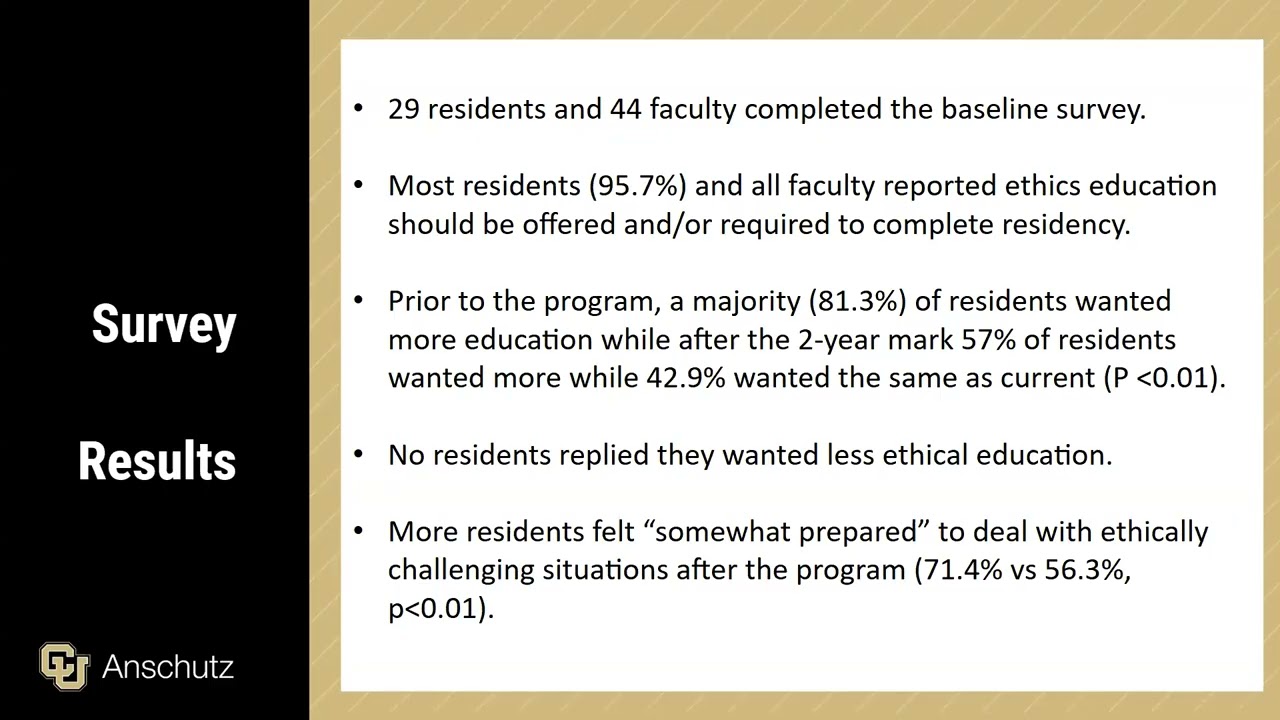
we had 29 residents and 44 faculty
completing the baseline survey. I
apologize I don't have the response
rate. um it's probably pretty low. So,
this is obviously skewed uh data. But
what I thought was um interesting is
most residents and all faculty uh 96%ish
reported that they felt that ethics
education should be offered and/or
required to complete residency. It makes
me wonder about that 4% who didn't feel
like ethics education should be
required, but we didn't really dive into
that. Um that baseline survey we did in
2021 was very similar to the survey that
we had done in 2013 2014 that residents
wanted more education in ethics. Um at
the 2-year mark um it seemed like most
of the residents wanted either a little
more or the same and none of the
residents felt like this was a time
burden or that they were you know
getting too much ethics kind of you know
in their training. um more residents
felt somewhat prepared to deal with
ethically challenging situations after
the program. So that's the 71% versus
56% that was statistically significant.
So this is a little bit of a busy slide,
but these are the CREOG learning
objectives and we looked at our
pre-ervey and our post survey and none
of these were significant. Um the dark
blue is uncomfortable or somewhat
uncomfortable. The uh light blue is
neutral and the green is somewhat
comfortable or very comfortable. Many of
them trended towards more people being
comfortable with the exception of
ethical principles, accountability to
patient society and professions and
uncompromising honesty. I have some
thoughts around that. Um again, this is
2021 to 2023. Dob's decision was 2022.
Um very relevant to my field of work. Um
and then this is looking at the topics
that people felt like were important. I
think this is also interesting where
residents felt that their top three
topics were a little bit different than
what the faculty thought was important.
So and um residents their top three were
uh and these were all significant um so
doctor patient relationship was
important foregoing life support this is
actually a typo it should be um uh where
is it access to health care so residents
really felt like that was an important
no sorry that's health policy that's the
one that was more uh this one was also
significantly different but this was the
the top of the third and then um faculty
felt like informed consent, doctor
patient relationship and abortion was
important too. Now, University of
Colorado is very progressive when it
comes to abortion care and uh we have a
fairly progressive state. So, um the
baseline training for residents around
abortion care is is pretty robust um
prior to this and continues to be
robust. Um so some discussion so
integrating residents and faculty and
and fellows I would argue into a
structured ethics education curriculum
improve the perceived needs of OBGYn
residents and faculty. Um involving
faculty as both developers and
participants may improve faculty comfort
with teaching ethical topics. This was
one of the barriers we had seen. Um the
again as I mentioned the ethical
principles of accountability to patients
in society and uncompromising honesty
were slightly more discomfort after the
program and I don't know what to make of
that other than to say like again the
world changed pretty significantly for
our field in 2022 and I think that
brought up a lot more questions than
answers for some of us um regarding um
how we navigate that
Um and then some next steps. So we have
this collection of cases that we're
going to deidentify further and um they
will be locally on a shared drive. We're
looking to scale this more nationally to
make it more accessible to people. I
actually attended a really interesting
talk about online escape rooms for a
mechanism for learning which I think
this could fit in nicely to. So you know
we'll see what that looks like. Um we
also went through the standard resident
lectures for the next year and went
through and suggested that the topic the
talk the speakers could put in you know
a little blurb or side slide about an
ethical component to that talk so it's
even more integrated
um and you know at the after talking at
this conference here and listening to
everybody um having these discussions
about moral distress I I wondered if for
the residents and fellows being involved
olved in um these educational topics. If
this helps potentially mitigate some of
their moral distress that they are
feeling because many of the topics are
brought to me because of a clinical
situation that the residents feel
uncomfortable with and the discussion
around it. Um I wonder if it gives them
potentially some validity to you know
instead [clears throat] of say did we do
the right thing did we do a right thing
right like there is the scope of
reasonable are we within it with what we
did and if not how could we mitigate
that um
I want to say thanks to my co-re reacher
researchers Dr. Braverman and um Dr.
Lejuski's actually got her PhD since I
made these slides so she's a doctor now.
Um these are all the fellow faculty,
residents and staff who presented.
Thanks again for Dr. Core for sharing
those Sentinel OBGYN ethics articles and
Dr. Lauren Sers um for sharing her
sample cases. Um here are my references
and I'm open for any questions.
Um thanks Heather. That's uh really
great work. And um my question is how do
you sort of see this moving forward um
since you you sort of it's hard to keep
doing the same you know whatever it is
10 topics you know every two years or
every year or so so you know I
understand bringing different cases that
exemplify them but how do you see it as
sort of a long-term
uh
program? Yeah, that's a good question
and I think that's kind of where we're
at right now trying to mitigate I think
we definitely um having these cases more
accessible um kind of remotely will make
sure we still hit on so so there's two
parts right so one is making sure every
resident in that four-year cycle gets
exposed to sort of the critical topics
and the other is the novel component of
you know what are we dealing with today
and now and so What I would say is what
we have been doing is sort of
cannibalizing some of the like some of
the um the ethics literature parts for
the topic and having a new case as it
comes and evolves because there's
certain things that are definitely
cyclic right like there's always going
to be drama in the maternal fetal diet
right is that a baby with anphily is
that a baby with renal aenesis right so
you know I can see that as a way to make
it a little bit more sustainable I've
also got more help so we've got Dr.
Braverman is coming up doing more of
this and then Dr. um I'm blanking on his
name, Dr. S is also very interested and
so having more of a community, more
different people is helpful.
>> Thanks.
>> Thank you and great work working in that
space that's very challenging. My
question for you is what you've done in
ethics is there a parallel in
communication paliotative and hospice? I
as a young surgeon I've heard many
senior surgeons synonymize paliotative
with hospice and it really makes things
very difficult for treating patients and
also for people learning how to get
better at communication how to
distinguish paliotative and hospice. Is
there a resident level curriculum for
this that could be developed?
>> Yes. So our gyn one of our gynongs
specializes in paliotative care and she
actually led um instead of calling it
paliotative care she called it a goals
of care discussion course um and so
that's integrated in some of their
oncology and we also have some of that
within our maternal fetal medicine with
our perinatal pali of care sort of goals
of care conversation and so there is
some of that infrastructure sort of kind
of with the hoffern effect sort of
emerging within the greater community
that I'm not particular particularly
specifically involved in but I am aware
having talked to other colleagues about
integrating that into the space of gynon
discussions and also complex uh neonatal
discussions.
>> Hi Heather such great work. Um,
have you been thinking at all about
doing like an OSKI, right? Because the
assessing um, attitudes, knowledge,
behavior um, you know, gets you so far.
Um, but kind of in the trenches and an
OSI type um, setting, you know, are are
the these trainings and workshops like
translating to how um, residents are
interacting with patients? And um it's
kind of a planting the seeds of like
let's talk about that and developing
that.
>> Yes, I would definitely be interested in
that. I mean we do that for the um
transition to residency for the medical
students. We do like I just revamped all
of the serious news for like all the
specialties and there's been some flux
in the leadership of the OBGYn and
residency but I definitely think there's
a space for that because they are doing
sims in other areas and I feel like
that's um definitely something we can do
and I'm happy to talk more about it. So
>> great job. Thanks.
>> Thanks very much Heather. Our second
speaker is Hans Bar who is a third-year
otoarangology head and neck surgery
resident at the University of Minnesota.
Hans's interests are at the intersection
of surgical care and and medical
humanities with including difficult
conversations complex conversations
around surgical decision-m cancer and
end of life care. He plans on doing in
the future a fellowship in
reconstructive surgery. And today he's
presenting on behalf of his colleagues
at Children's Minnesota with a special
recognition to Dr. Andrew Redmond. Hans,
thank you. Yeah. So, I'm Hans Burch and
like uh he said, I'm a thirdyear ENT
resident at the University of Minnesota.
Um and kind of in the theme of what
we've been hearing, I have very little
education in ethics at all. But um in
even the short course of my residency so
far, I've dealt with a lot of
complicated discussions regarding
airways especially oftentimes in the
middle of the night. And I've been very
fortunate to have a mentor in Dr.
Redmond um who has been able to kind of
help me think through these situations
and get me interested in this space. So
uh all that being said, I'm very
grateful to be uh here today talking on
our experience trying to enhance value
aligned decision-m in pediatric
tracheosttomy
utilizing the best case worst case
scenario planning uh tool.
See green so we have no disclosures. Uh
I want to start with this quote by
Winnie the Pooh. I love Winnie the Pooh
and I think it uh captures the essence
of really what we're trying to do.
[clears throat] When you're a bear of ve
a bear of very little brain, you'll
sometimes find that a thing which seemed
very thingish inside you is quite
different when it gets out into the
open. And obviously this isn't to say
that our patients or their families are
bearsers of l very little brain, but um
when they're in a hospital setting or
the ICU and they're navigating complex
decisions with uh uncertain outcomes, uh
a lot of different variables which seem
very abstract and difficult to hold.
They can seem very thingish and our job
really is to help get those things out
into the open and truthfully we we
really often don't. Um, and so that's
the point of the best case worst case
scenario planning tool which I hope to
demonstrate through just a single case
today.
So this case is an 8-year-old patient
x24e premature infant who uh has
multiple coorbidities associated
including lethal cord paralysis, severe
aspiration and a history of necroizing
teracolitis. All of which uh led to her
having a tracheosttomy for many years
which the family cared for at home. Um
and were recently able to decanulate
which was a great success for them a big
milestone. Um and unfortunately shortly
thereafter thereafter she developed a
bowel obstruction which ultimately led
to need for reintubation and then uh
inability to exabate despite four
attempts. So here we are as ENT
consulted again to discuss re revision
or repeat tracheiotomy with the family
and this was really a traumatic
situation for them because they thought
that chapter was behind them. Uh on top
of that the situation was complicated by
the fact that the endoscopy revealed
unfavorable anatomy such that the risk
of a tracheon nominate fissula was um
more significant than even normal.
So briefly this is a uh image just
showing the tracheominal fistula for
context. On the left you see the
anominant artery crossing over the
trachea and on the right you see the end
of the tracheal end tracheal tube or um
trache tube eroding through the
enominate artery uh causing catastrophic
bleeding into the airway and this is a
severe complication with mortality
reaching 100%. And in this situation,
the family really had to consider this
um kind of at the forefront of the mind
given their unfavorable anatomy and in
in the context of uh recent decanulation
and the need for revision.
Um it was all quite stressful for them.
So just a little bit of context about
pediat pediatric tracheosttomy as kind
of a optimal scenario for use utilizing
this model. uh it's not uncommon
especially in our world four to 5,000
are performed uh each year and compared
to adult tracheiotomy it has a
significantly higher morbidity and
mortality. Uh on top of that the burden
on the family and often times the length
of the tracheiotomy can be significantly
more. Despite all that, only 29% of
families receive a dedicated conference
and only 10% of those include the actual
surgeon who's going to be doing the uh
operation.
And this is important because uh the
decision is often complex with a lot of
anmatic outcomes um and not necessarily
it's not super clear what the
consequences of that treatment are going
to be. the patients have to manage not
only the clinical complexity including
the diagnosis, the indications, the
risks um but also they're doing this
communication oftentimes in an ICU with
multiple teams uh multiple providers
with different experiences, different
priorities
um in you know uh helping them at
different aspects of their care,
different phases of their care and often
times the the actual consequences or
long-term implic Applications of having
the TRA are not discussed
and really the patient this results in
the families having a significant
uh feeling of unpreparedness at home for
the tracheosttomy care which leads to
persistent discomfort and significant uh
measurable post-decision regret in these
families.
And so this really brings us to the core
problem of informed consent uh which is
that it was really designed to ensure
patients understand the nature of the
procedure like the risks, benefits and
alternatives. Uh but it was not designed
to understand how the consequence of
that treatment will impact their life,
how it maps on to their life going
forward. And there's no uh grounded
framework upon which to discuss with the
patient such that it surfaces their
values and makes them feel um engaged
and uh sound in the decision-m process.
In the setting of pediatric
tracheiotomy,
uh what families typically hear are
risks of bleeding, infection, loss of
the airway, and then they're always
wondering about the likelihood of
decanulation. But often the consequences
like the equipment needs, the
suctioning, the need for supervision,
and the impact that can have on um
employment. the rest of the family unit
are not clearly described in in addition
to the reality of possibly needing to
manage manage complications in the home
setting.
And all of these things on the right
side of of the screen remain very
thingish without any framework to get
them out into the open. And so that's
where best case worst case scenario
planning comes in. Um this was
originally developed by Dr. Schwarzy who
we'll hear from shortly. And um kind of
what we're presenting today is a
simplified
um
manifestation of it that just allows us
to use it frequently and uh in a lot of
different situations.
And the framework has three different
components. Uh scenario planning in
which the different options and possible
trajectories are clearly laid out in the
clinical context uh for the patient.
Then a graphic visual aid which is a
very simple diagram in our case just
essentially a spectrum from best case on
the left to worst case on the right and
then the most likely scenarios in the
middle which really allows visualization
and direct comparison of the options for
the patient such that they can see it on
paper, point at it, discuss it with the
provider, with the other family members
and then upon that uh have an
opportunity for values clarification
where they can emphasize the things that
are important to them, determine what
risks are worthwhile or not. And uh this
is fairly evidence-based framework and
most surgeons who have been trained in
it and are using it find that it is
superior to just standard informed
consent process and continue using it
thereafter.
So returning to our patient, there were
two real course uh options which seems
fairly simple on the surface. In option
A, um
they could attempt one more attempt at
exhibition. the non-invasive positive
pressure ventilation with the hope of
avoiding a tracheosttomy
um with the knowledge that this is very
unlikely to be successful and that a
tracheosttomy would need to be the
backup plan and in the setting of
repeated exhibition intubation attempts
uh carries greater and greater risk
especially with their unfavorable
anatomy versus option B accept the need
for a tracheiotomy forgo the ideal
situation ation and do it in a safe and
complicated setting.
So here is the
uh graphic aid that we use. It's very it
looks just like this very simple two
lines on the paper with the best case on
the far left and the worst case on the
right. Um in both options the worst case
scenario was tracheomomenula with likely
death. In option A which was attempted
another exhibition there's a best case
on the far left which would be the ideal
case avoiding a trachea altogether and
then in the middle slightly towards the
right you see the most likely which
would be a failed exhibition given four
previously failed excavations and then a
revision tracheiotomy um though with
increased risk of complication and in
option B the best case would be safe
uncomplicated controlled tracheiotomy
with short-term decanulation
um and then most likely likely discanul
um going home with the tracheiotomy.
So and having this framework for this
patient really um helped them compare
and contrast these options. Obviously it
makes most sense to try to avoid
tracheiostomy alto together but with
that you're kind of accepting an
increased uh you have an increased risk
tolerance and that is the real question
that I brought into light for the family
and facilitated discussion revolving
around that specific topic and
[clears throat]
ultimately that's what the family
decided to do which was accept that
increased risk pursue one more attempted
exhibition
Um and
somewhat expectedly that failed.
Fortunately
um the patient got a tracheosttomy
without complications
and in you know some time was able to be
decanulated
and [snorts] uh despite this nonoptimal
outcome the family really expressed
genuine peace uh with that because they
felt confident that they had considered
all the different possibilities and made
a choice that was really you know
theirs. They were active participant in
that decision. Um
and then when we uh queried the the
family and the care team about the tool
specifically the the actual scenario
planning and writing down or drawing out
the graphic visual aid. The the four
major themes that came to light were
that it really helped clarify the
options, contextualize uncertainty,
provide a piece of the final decision,
and then ultimately in uh transform the
informed consent process more into a
values-based uh discussion.
And this framework addresses some of the
main ethical principles. Um, it helps
patients feel that they're actively
participating in the informed consent
process rather than just being uh
directed and that surfaces values. Um,
it lays out the full spectrum of
possible scenarios and makes sure that
they are clearly communicated.
It uh necessitates the discussion of the
worst case scenario which helps avoid
unexpected or shocking outcomes and that
ultimately helps reduce decisional
regret and peace with whatever situation
occurs. And then it having a grounded
visual framework really uh gives the
family um it it creates a standard
platform to communicate upon uh between
various teams between patients with
various healthcare literacies and
language disparities which overall I
think reduces disparity as a whole.
So in summary, uh pediatric
tracheosttomy decisions are are a great
use case for using a tool like this
because in our world they're fairly
common. the the not only the decision of
when and how to do it is complicated,
but also the consequences are
complicated and poorly communicated and
uh often, you know, have a
disproportionate burden on the family.
And uh best case, worst case scenario
planning provides a structured
evidence-based framework that enables
providers to communicate the treatment
pathways and likely outcomes in a way
that helps surface the values and
engages the family rather than just uh
transferring information which I think
is a trap that we often fall into. and
and then it also fosters care team
cohesion and uh opera operationalizes
respect for autonomy while reducing um
decisional regret.
So going forward, we have started to uh
implement this for all pediatric
tracheiotomy discussions at Children's
Minnesota um and are hoping over the
next year to kind of um gather buy in
and start gathering some survey data to
see what the impressions of both
patients and the providers utilizing it
are. It's also being used um Dr. Dr.
Reman does a lot of complex adult airway
surgery as well and so he often times
utilizes it in that setting. In my own
experience as a resident, I often use a
brief version of it uh talking about
headneck cancer decision- making like
lingial preservation for example um in
larynx cancer. And um we hopefully we'll
get this integrated into the resident
education cuz uh similar to other places
it sounds like we really don't get any
um ethical framework teaching. Um and I
and I personally after learning about
this have found it extraordinarily
useful. Um and found that patients
really
just fall into a sense of peace um even
in a setting of a lot of hectic things
going on. Um so you know we encourage
other institutions to standardize the
training and spread it across service
line as well. Um, in the future, who
knows, maybe something like augmented
reality might augment it, but really the
core tool is so simple as two lines on a
piece of paper and just a willingness to
bring the things out into the open. Um,
I want to thank the MLAN Center for the
opportunity, Dr. Redmond of course for
his mentorship, my co-authors, Dr.
Schwarzi for developing the the basis
for this tool that we're using. And then
I'll just leave you where I started with
uh this image from Winnie the Pooh. Um
and just, you know, just like this
extraordinarily simple exchange between
Piglet and Pooh uh helps Piglet become
sure of Pooh, this extraordinarily
simple tool can really help patients and
families become sure of sure of us and
sure of themselves as well. So, thank
you.
Yeah,
>> there's a terrific conversation or in
presentation hunts and I'll ask you one
question that you had one slide which
talked about ideally you the families
would be aware of them like life at home
if if it was a tracheiotomy that lived
experience and in the slide you had of
the two timelines. It was mostly focused
upon like the clinical setting as
opposed to them that post turkeys
experience. And so how might that be
incorporated?
>> So just to reiterate your question, um
you're asking about how the kind of the
emphasis that I was placing on the
long-term understanding the long-term
outcomes can be incorporated in the
tool. Is that correct? Yeah. So that
that um
graphic is essentially the starting
point um and then upon that you can
essentially use it as a scratch pad to
discuss with the family. So you start
with the the different initial decision
points, the possible uh outcomes and
then you can talk to the family about
what those outcomes actually mean. And I
think that the graphic doesn't
necessarily need to include all of the
details. In fact, that I think kind of
gets us back into the weeds again. Um,
but rather just serve as a point for for
discussion. And I think also in this
specific case, um, you know, the family
already had a tracheiotomy and so they
knew a lot of those implications. And so
for this for this specific circumstance
um the emphasis was really on trying to
help them feel at peace with the fact
that they needed to have a tracheosttomy
again um by using that
>> nade.
Yeah. It made me think of the last panel
where there was like one of the
suggestions about like well the lived
experience and so if you if there was
the opportunity to you know whether it's
video or whether it's like um a program
where people could talk to parents who
were in that situation um that made
another possibility or your point about
augmented reality you know very
interesting but a fantastic presentation
congratulations and Heather also two
wonderful presentations