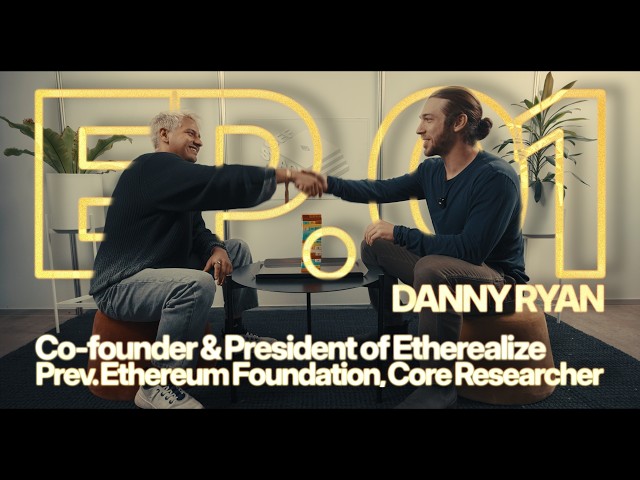
Danny Ryan on: leading crypto’s biggest upgrade, paving his own path, and bringing $120T to Ethereum
Watch on YouTubeVideo summary
Danny Ryan, a former researcher at the Ethereum Foundation who played a pivotal role in architecting "The Merge," shares his journey from freelance work in Louisiana to leading the foundation's research team. His career trajectory shifted dramatically after the 2016 DAO incident, which resulted in significant financial loss but deepened his understanding of blockchain technology, ultimately leading him to dedicate himself fully to Ethereum. Ryan emphasizes that decentralization is essential for eliminating counterparty risk, ensuring that no single entity can seize or freeze assets as a traditional bank might. This commitment to security and neutrality drives his current mission to onboard global institutions onto the Ethereum ecosystem, aiming to replace inefficient and fragmented markets with superior systems.
Ryan explains that he left the Ethereum Foundation because he felt he had maximized his contributions there and sought a new personal challenge focused on application-level research rather than protocol-level work. Although he acknowledges the foundation's praised neutrality and values, he wanted to engage more closely with researchers to secure Ethereum's future by integrating the $120 trillion in institutional capital currently held outside the ecosystem. He redefines his work not as traditional decentralized finance but as "rearchitecting capital markets" to make them more efficient and reduce middlemen, arguing that pragmatism is necessary rather than strict purity. Drawing parallels between this challenge and the early internet's TCP/IP wars, he notes that strengthening Ethereum's core allows its edges to experiment freely while recognizing that human behavior remains the ultimate constant requiring coordination.
The interview also touches on the intense public scrutiny Ryan faced regarding his relationship with Vitalik Buterin during SEC legal proceedings, noting that the resulting conflict ultimately prevented him from returning to the foundation. Despite these challenges, Ryan maintains an optimistic but realistic view of technology's role in society, balancing technical expertise with family priorities. The conversation concludes with a tense game of Jenga between Ryan and the interviewer, highlighting his ability to maintain composure and perspective even under pressure. Ultimately, his story illustrates a pragmatic approach to building robust financial infrastructure while navigating the complex social and political dynamics inherent in the crypto space.
Read the full video transcript
Hey, Danny.
>> Hi. What's up?
>> And this might be actually what
happened. You're the only one that
responds to their emails.
>> Wasn't into gaming cuz he was talking to
girls. How'd you do the merch? How does
that happen?
>> Who can make it go offline or who could
take it from you?
>> Yeah.
>> If there's The answer should be no one.
>> I was like, "Oh, this is fun. I changed
my major."
>> You have a great head of hair, by the
way. Like I I would assume you'd be
bald.
Can you play to continue the game?
>> That's a good question.
>> Hey, Danny.
>> Hey. What's up?
>> Thanks for coming.
>> Thanks for having me.
>> How's it going?
>> Great.
>> Um, when was the last time you played
Jenga?
>> You play with the kids?
>> The kids are not quite there. Who knows
what their age is? Um, no, but uh some
friends of ours have a bunch of games
and you've played a couple times
recently.
>> Okay, cool. Yeah, I think like I've
played 36 of these. I've gone slightly
better than I was before. Um I've gone
to the
>> I feel like but it's a skill level cap
at a certain skill level. It's just like
randomness on who's going to
>> for sure. You just got to take what the
Jenga gives you. Um how how's Yeah, you
just go you
>> when do you start like do you ask
questions in relation to the numbers?
>> Uh when you pick them? Yeah. Not
>> okay.
>> Slightly.
and rules like can I prod or once I
touch it's
>> you can do whatever. Yeah, very open. Um
nice.
>> Yeah, you got the I always use that one
at the end and so it was surprise one.
I'm I'm already I'm at a disadvantage
here. Um do you remember the first time
you discovered the internet?
Uh,
I got a book from a from a book fair
>> or maybe like a book order thing at
school in second grade about the
internet
>> and it was about the internet but really
it was about chat rooms.
>> So I read this book and I was like okay
great and now I chat on the internet and
you know went from there. I probably had
done things on the internet before
second grade, but that was definitely
like this moment of read. It's just
hilarious now. Like how do you learn
about the internet? You get a book. Uh
but that was that was second grade.
>> Were we like was your family also into
tech or is that different?
>> We had a computer.
>> Okay.
>> And my my dad was like really proud of
having a computer. That didn't mean we
did anything other than like word
processing. Yeah. Um, and we had a
printer that had the the dots on the
side
>> and they were all connected. Are you
familiar? You know what I'm talking
about?
>> I have no idea.
>> Oh my god. Okay. So, it's like a ream of
paper
>> and they're folded back and forth, back
and forth, and they're connected with
perforation. So, they're all connected
and then there's like these
dots you can rip off on the side that I
guess help with the feeding. But the
cool thing was
>> you could print long things. So, it
would just make like banners. Ah,
>> okay.
>> So, do you remember your first banner?
what we look like.
>> The Halbop comet came that'll date this.
I don't remember when it was, but we all
got we're very excited about the comet
and we would take
>> uh like like a a basketball and then put
like flame behind it and make a comet
and like a baseball and put flame behind
it and make a comet.
>> So these are long banners like in A4
paper or I guess it's not A4.
>> Yeah, but it's connected.
>> Okay.
>> Like perforated.
>> Oh wow. Okay. Not per. Would you be able
to hang them just like
>> Yeah, you put put them long way on the
wall, you know, and get a nice
That's what we were doing at 97 or
whatever.
>> Nice. Um, is there like, you know, in
your childhood, is there for
foreshadowing to what you're doing now?
Like, is there any distinct moments that
just you're like, you look back, you're
like, "Oh, yeah, that makes sense."
>> Uh,
I mean, I was always the one that could
like fix things.
>> Uhhuh. I was always the one that
uh
yeah if there was a problem like Danny I
remember my grandparents always quoted
me I think I similar era I was probably
like seven or something and it was
always uh
I would help them with their computer
and and one time I just said sometimes
you just have to turn it off
>> and turn it back on.
>> Yeah.
>> Um and they quoted me on that forever.
It's ironic cuz crypto.
>> Yeah, I think my node went down the
other day and I was like, I don't know
the [ __ ] going on.
>> Reset. It works.
>> Yeah. Why is that? You think it's just
like is there like a tech? There's
probably
>> just going to get into weird states,
right? Like the memory compounded in
this weird way or it like wrote wrote a
variable in a weird buggy way and like
it was kind of fine and then it just
>> Yeah,
>> I just got to got to start fresh. Like
when you boot something, it goes through
the boot process. It sets up the memory
all clear like everything's fresh.
>> Yeah,
>> it makes sense.
>> So, you were fixing things. Does that
necessarily mean like tech related or is
that just everything you just like
fixing things?
>> Yeah, I think um like was there
something that you fixed early on that
really got you into it fully?
>> Uh,
no. I'm like not a um
I don't go deep. I go deep on some stuff
like sure went to deep on the merge went
deep on Ethereum but like I compared to
even people that I work with like
>> I'm I'm much better at like
oh I can figure that out quick.
>> Oh I can make a good decision about that
thing quick. And like that was always
the case as a kid and I get fascinated
with things but I then I kind of get
dragged and I yeah I go I go wide. Okay.
Yeah. Was there like a like an aha
moment or a spark or a mentor or
something early on that made you follow
a certain path?
>> My uncle certainly like set the stage.
He um he always like just talked to me
like I was a human being and not a kid.
It was the first kind of relationship
with an adult that way. Um
and
through that like I don't know learn
about the world and instilled like a lot
of confidence and just like being able
to do things and like
>> I don't know if you treat if you treat
like an 8-year-old as a capable person.
Turns out they are pretty capable.
>> Yeah. Um, so that was that was
definitely piece of the puzzle. But I
mean,
>> I don't know in terms of like getting
into I was always kind of into computers
because they're around, but I wasn't
like a deep computer science expert in
>> study computer science or
>> I I did I went I went to school and I
was like, "Oh, I'll study mechanical
engineering because like making stuff's
cool."
>> Uhhuh.
>> Um, but I had to take a computer science
class.
>> Yeah.
>> Sophomore year.
>> I'm like of college and I never
programmed before. I was like, "Oh, this
is fun. You make stuffer."
>> Okay. And so, again, I'm not like one of
those programs since the age of six.
Yeah. Kind of whatever. And like that
shows like I'm not like a crazy
programmer. I'm not a crazy
mathematician. I'm not a crazy any of
this. I just
>> good at kind of like
seeing the the problems and stitching
them together.
>> Yeah. What do you do after college?
>> Was that any?
>> Uh, so I'm from Louisiana.
>> Oh. opsac, but I'm
>> from Louisiana out
>> and I moved
>> I moved back to Louisiana, moved to New
Orleans and my goal was to um to not get
a job.
>> Okay.
>> Yeah. Are you
>> like in a way in which like you just
like refused to work or you just sort of
like
>> no
>> trying to be an entrepreneur or like
>> I uh
I I I mean I worked I I did freelance
work but I was like I'm not getting like
a job where I have hours and someone
tells me what to do, right? and um and I
ended up working with a bunch of small
businesses in Louisiana just like
helping them think through how to solve
problems like automation and and that
kind of stuff. Um it was quite fun. It
was quite fun. It's funny. I like I was
talking about this the other day, but I
got one client.
>> I got them to pay me a decent amount of
money per hour.
>> Yeah.
>> What were you making?
>> And I
probably too much for what I was doing.
$85 an hour.
>> Oh [ __ ]
>> I know. I think I like kind of hugged
wiggle them a little bit,
>> but I ran the math and I was like, if I
work one hour a day,
>> I'm good.
>> $25.
>> Uh,
>> how old were you?
>> I was like 22, 23.
>> Yeah.
>> Um, yeah, it was it was good. It was
>> What were you building for them?
>> That kind of went up in flames. I don't.
It was some like dutyfree
company that was trying to make some
like duty-free
theme park honestly like on the border
of Mexico and like I was programming
apps for them. I don't know.
>> Amazing.
>> Some of the more fun stuff was like
literally like random small businesses
that didn't realize automation existed,
you know, were like manually doing
reports. is like, "Yo, bro,
write like 30 lines of code and never
ask that again."
>> Yeah.
>> Do you get annoyed when people are
inefficient?
Like is that like a
or like are not or underutilizing
technology for certain things?
>> I'm not
I'm not
Maybe so maybe. So I'm like thinking
about my wife using her computer and
like not knowing any hot keys. It's like
you did that action like a thousand
times and you just press control
whatever. Um so may maybe a little bit
but I'm not like an automation maxi like
I don't I'm I'm not I don't optimize my
life.
>> Yeah.
>> Um I don't get like I don't get a lot of
pleasure out of it.
>> Um I like to
>> I like to be very thoughtful but I also
like to kind of go with the flow.
>> So you did the websites. you were during
duty-free theme park in the border of
Mexico just like wow there's so many
questions there it'll take a whole
episode um
what do you do after
do you remain jobless
>> uh and like what was that
>> I mean I think I might be cheating um
you're good
>> yeah so I did that for years and um I
had a lot of fun I actually started a
screen printing business in high school.
>> Oh, same.
>> Been going.
>> Nice.
>> 20 years.
>> Wait, you It's still there.
>> Yeah. Yeah. My My best friend partner
runs it.
>> Giraffic.
>> Um G I R A P H I C.
>> Um
>> Oh, that's nice.
>> No, it's great. It's
>> I did that too in college. We ran this
thing called Inktank.
>> Yeah. Cool. I mean, we have we have like
a bunch of automated presses and do we
started doing it for our band anyway.
>> Why?
>> For a band.
>> That's how we started. We started then
we started doing all the shirts for our
high school. anyway and my buddy runs
it. It's it's sick. Um, so I was I was
kind of like involved in that a little
bit. I was kind of involved in some of
the freelance stuff.
>> And then in 2016,
um, a friend of mine sent me a New York
Times article
>> for the DAO. Okay. The DAO had raised, I
don't know, $120 million or something,
largest crowdfunding in history. Um, and
I had I knew of Bitcoin. I'd transacted
Bitcoin. I probably lost money on
Bitcoin. I hadn't really clicked.
>> Yeah.
>> And I read this and I start I dug into
it and I was like, "Oh [ __ ]
>> this is crazy."
>> And then it was kind of all I could
think about.
>> And I actually my first mainet
transaction, I remember sitting on the
couch next to a friend and sending it
and I said, "This is not going to end
well."
>> Yeah.
>> And I funded the DAO
>> and it didn't end well. I was I was
deeply skeptic of whether we could
actually as a software engineer Yeah.
like can't can't write code without bugs
like that you can never change. That's a
maybe a failed premise but yolo. Um and
that was a crash course in I don't know
blockchain. All of a sudden it went from
like oh I understand this blockchain
thing to like wait they're trying to
fork it. What does that even mean? And
it was a crash course of of that. I was
probably pro D fork.
>> Uhhuh. Just
>> because I lost money and didn't actually
understand what the hell was going on.
>> Yeah. Um, but just like got deeper and
deeper down the rabbit hole and the
first day of 2017, I said, "This is all
I can think about.
>> I will get rid of all my clients and
I'll figure out I'll give myself a year
to figure out how to make this my work."
>> And and that's what I did. And on day
one, I was like, "Okay, I'm going to go
to the New Orleans Ethereum meetup."
It's like, that's obviously something I
could just do. Um, there is no New
Orleans Ethereum meetup. Okay, I have to
make the New Orleans Ethereum meetup and
I like downloaded the white paper and
printed out and like read it the yellow
paper and read it. Yeah, in the
technical specification over and over
again and like made notes and okay, I
think I understand Ethereum now and just
like started contributing open source
repos and things during that time
period.
>> Actually learned about proof of stake
>> and I was like that doesn't make any
sense.
Um and then I kept learning, kept
learning. I was like maybe there's an
opportunity here actually. Okay, maybe
this does make sense. maybe I could like
make a staking pool or something. So, I
kept like trying to learn about it. I
heard Casper was coming at the time.
That's what proof of stake was called.
Uh so, I started reading the code. I was
like, "Oh, they could do some more
tests." I wrote some tests. At the end
of 2017, the research team was like,
"Hey, do you want a job?"
>> Said, "Okay."
>> Yeah.
>> How'd you find your community and your
people? Like, so you you're like, "Okay,
this is cool. I fund the Dow. I lose my
money." Most people there first of all
would just be like okay [ __ ] that. Uh
what kept you going there? I guess
that's one and then two like how'd you
find your people? You just excited?
>> Um yeah I mean I also like kind of
believed in it. I'm a bit of a ly
>> and like
a bit concerned about the trajectory of
certain components of technology like
such a massive centralization of like
companies that is powered by
surveillance capitalism and like you
know my they're programming me to open
my phone 10,000 times a day through like
gambling research and other things. So I
you know I'm like oh this technology
actually might be able to change the
world. It might actually it's not going
to like stop the trajectory but maybe we
can alter the trajectory. So I and it's
like the most interesting problem.
>> It's like tech and finance and mechazin
design. Yeah. Money. It's it's wild. But
how did I find my people? I just started
showing up to stuff on the internet. Um
there was like a research call every
week for proof of stake. Yeah.
>> And they put the public Zoom link and I
would just go
>> and be like Vitalic and Vlad and like
some wizard.
>> Yeah.
>> Greg Craig Mer. um
>> a wizard.
>> He was a he was a wizard.
>> Um
>> how'd you build up the confidence to get
that? cuz I I feel like there's people
in the Ethereum community now when it's
like these are you know major calls and
things like these they're like everyone
you want really big names like okay it's
harder to reach them maybe at this point
and they might be like oh I'm too shy to
maybe talk I'm too shy
>> well and I didn't talk
>> okay
>> for a bit
>> okay
>> but I would try to just make things
better
>> be like they're talking about some blog
post they read that week and and the
relevance the research or something and
I'd be like the quiet guy that just
found the link and dropped in the chat I
So, everyone had it.
>> Oh, cool.
>> And like some of my initial open source
contributions like I would just be
reading docs and like fix typos and try
to just make things better and like all
of a sudden you're making things better
and you have a dialogue with I don't
know a member from guest
>> is like you had to submit some PRs and
then you show up to an event in person.
They're like, "Oh, oh, you're that guy.
Oh, cool. Hey, what's up?"
>> And just I don't know. I mean, I haven't
had to walk through the doors in a long
time.
>> Yeah.
>> But the doors were like comically wide
open and I imagine for like at least
>> Ethereum is much bigger and maybe
there's different like sections of it,
but many of those sections of it I
imagine doors are pretty wide open given
like
>> the nature of the work being in in open.
>> Um,
>> is it you or me?
>> Yeah, it's me. So, you know, what was it
that a guy who wasn't into gaming
because he was talking to girls, uh, was
in a band, started a screen printing
business,
um, funded a Dow hack
>> by a doubt
and and, uh, ended up joining this
foundation by help being helpful
initially, end up essentially
architecting Jordan possibly one of the
most insane engineering feats of all
Um, how did you do the merge? How does
that happen?
>> So, I show up, I'm on the research team.
>> Uhhuh.
>> I was mainly like working on tests and
just trying to make things better. And
then I don't know, six months in, I'm
functionally running the team.
Hudson,
and this might be actually what
happened, but Hudson Jameson at the time
we met, we became friends, and he's
like, "You're the only one that responds
to their emails."
which was representative of like
>> Vitalik's time and attention like it's
very valuable. He's focused on other
stuff like and
>> and I realized like one I could do I was
good at doing the work but I could also
do the things that other people weren't
doing
>> right. I could be like what needs to
happen
>> to move this all forward. Um because you
know people's heads are in the clouds
and they're work like they're working on
incredibly complex and difficult stuff.
And so my my frame was just always like
what can I do? What can I do to make
this a reality? And like
>> sometimes I was doing research,
sometimes I was writing specifications
and that increasingly that became like
communicating and coordinating across
like a very complex project.
>> Yeah. Um
>> yeah, just doing the things that need to
get done. What was it like like being in
that room? Um, yeah, I guess like how
how did you manage the stress? Because
that must have been, you know, pretty
stressful. You have a gray head of hair,
by the way. Like I I would assume you'd
be bald. The amount of stress that I
probably said.
>> Um,
what did I do?
How did I manage it? I don't know. I
mean,
I have a really good work life balance.
I actually chose to work remote my most
of my my adult life.
>> Yeah.
>> Because I like to
I like to be judged by my output,
>> not by like how many how much I'm
sitting at a computer or like whether I
showed up to the office.
>> Cool.
>> Um and so a lot like
>> I prioritize my health and my family
over everything. Yeah.
>> And actually in doing so I do my work
better. You do?
>> Yeah.
>> And I also
I identify I mean my I'm pretty consumed
by my work like I think about it a lot
>> but I also know that like for the type
of work that I'm good at and the type of
things that I do like it doesn't mean
sitting on my computer.
>> Yeah.
>> Like taking a walk is just as if not
more valuable for me to think through a
problem than like me
>> typing it out or something you know. So
I very free form in how I structure my
life and my work in a way that
usually
helps me manage the stress.
>> The technical problems are never the
stressful problems. It's a complex like
technopolitical sphere. The people are
the hard part.
>> Yeah.
Um, so you recently co-founded
Etherealize
and that is a very different world from
like EF research and like upgrades,
right? Um, where did your interest for
that come in? Beyond that, like how do
you stay curious in this industry
generally? Um, and now you're you're
heading you're speaking institutions.
It's very different than the researchers
you're emailing um,
>> in the past. So, how how did that turn
about? And I guess what keeps you
excited about it
>> and why do you think that work is
important?
>> Yeah, I mean, so I left. It was time
time to leave. It was time to get some
air.
>> I had done the thing with the merge and
then spent another couple years at DF
and and loved the work, but at the same
time like felt like I needed to get
space, see what was up. Um,
and I
Yeah, I guess last year was a bit of a
whirlwind. I got served by the SEC
>> in April of 2024.
That was day two of my sabat three month
sbatical. So I spent all my sbatical
dealing with that.
Then the case was dropped. Then I went
back to the EF but I was like not
>> you got served individually.
>> I think I was the highest person at the
EF in the US.
>> Okay. or like most visible person in the
>> Can you can you share more about that? I
I think it's something that like most
people
>> may not because you there there's
criticism that the Yap has gotten of
like moving slow and like
>> all that but I I think like you
experienced it firsthand. I would share
more. I mean, fortunately,
the like looming spectre of the SEC
>> act and like what you do to defend
against them having a case against you
is actually to be decentralized.
>> Yeah.
>> To actually not, you know, gather
control and to like let other people in
the ecosystem lead. And and that's what
the EF did during that era. And they did
a really [ __ ] good job. Um, and they
didn't have a case against me. They
didn't have a case against the EF, but
they were trying to make crypto
disappear. And yeah, it was the last
shepherd before the ETFs were approved
to try to build a case.
>> Yeah.
>> Um,
and they served me, handed me a stack of
papers and scared the [ __ ]
>> Where were you?
>> I was at my house. It's Easter Sunday.
Like,
>> say knock in your house.
>> My parents are there. A bunch of friends
are there. We're literally setting the
table. They knock on the door and hand
me a stack of papers. It was like the
most adrenaline ever vote. Um
it was kind of terri It was terrifying.
Terrifying.
>> Um and you know like
they're probably not coming after me.
Then you learn like okay it's a civil
organization so the worst thing I can do
is
you you know find you and you can lose
all your money but you can't go to jail.
Oh but the DOJ might be lurking. You
never know. And it's like like um it's
kind of kind of terrifying. This is me
like being like, "Okay, maybe you need
some space from crypto or the EF." And
then like that happens. Then it
disappears because it was all politics
and they threw out the case because they
were worried about losing the election
because they were alienating special
interest groups aka tech.
>> Um then went back to the EF then left.
Then Trump launched a memecoin and it's
like literally like whiplash
like what reality to live in. Then I
consider going back to the F and we
close that door. And then really the
first opportunity the first like
interesting the first thing period that
like landed in front of me was I got
intro to Vivc.
>> Yeah.
>> And I was like oh
this
like is actually during this window we
might actually we might be able to get
Ethereum to be adopted.
>> Yeah.
>> It's like this might really be the thing
and Vivic has a really complimentary
energy.
>> Yeah. He has a complimentary background.
Dude is from from Tradfi. Um, and I just
said, "Okay, let's do it. Let's on board
the world." Um,
>> why why should Ethereum be onboarded to
the Why should the Why does the world
need Ethereum?
>> Why does the world need Ethereum? Well,
we need to onboard the world for
Ethereum succeed. I think uh Tomas says
we need to onboard the global economy. I
think that's a definitely a piece of of
the mission and how we should think
about success. Um,
but I think we can just build
fundamentally better systems and
fundamentally better markets and
fundamentally more efficient systems and
markets. And I spend a lot of my time
looking at like terribly inefficient,
archaic,
fragmented
uh, markets riddled with middlemen and
risk and costs. Um, and when I think
about rewriting those markets from first
principles on Ethereum, so much of the
garbage just goes away. It's just a
better environment.
>> Like Vivic had the aha moment in like
2020,
leaving Wall Street, learning about
Ethereum, and he's like, "Oh, all
capital markets should be upgraded with
Ethereum."
>> Yeah.
>> And he's right.
>> He's right. And it's time. So why uh you
know Ethereum
is heavily focused on decentralization
on credible neutral on these value
properties where you might have uh
competitive forces that may not as much
right and there's this criticism that
like oh that's not important oh like you
know you could forego decentralization
for efficiency you can onboard more
people today it's faster cheaper
whatever like what's your rebuttal
against that like what what is in your
case. Yeah.
>> The reason for you know this to remain
as like trustworthy
>> and I've been thinking about this a lot
and
>> um
if you don't have I talked about this on
stage the other day. If you don't have
decentralization
then the infrastructure has counterparty
risk.
>> Banks give a [ __ ] about and financial
solutions give a ton about
counterparty risk. who can screw them
over and Ethereum is the only answer in
like the programmable blockchain space
where the answer is no one
>> and that that means a ton to banks and
financial institutions. I think that's
going to mean a ton to the real world
and real use cases as we move past these
banks and finance solutions as we as
when you're thinking about like
putting your life savings in on chain in
crypto managing I don't know the deed to
your house in crypto you know who can
make it go offline or who could take it
from you.
>> Yeah.
>> If there's the answer should be no one
>> you know um and Ethereum is the answer
to that. So
uh yeah I think we have a little bit of
work to do in terms of
scale.
>> Yeah.
>> Although Purdos is launching PROS is
going to set the stage for massive
amounts of scale. Okay. Okay. And layer
twos. Um
we do have a lot of I think work to do
in terms of like evolving such that
these things are us not just excellent
decentralized protocols but like
excellent products,
>> safe products, easy to use products.
>> Um but as we make this transition like
Ethereum actually is I think the best
answer to on board the world. Ethereum
actually is going to have enough scale.
Um
yeah.
What do you wish more people were aware
of
>> when it comes to it doesn't even have to
be a crypto thing.
>> It doesn't even have to be a crypto
thing, but what do you what do you wish
more people were aware of
in the world today?
Very open-ended question. I'm saying
this to because your move is next.
>> Yeah. Uh
>> um I wish people were a little nicer to
each other
>> and also realize that like this whole
crazy thing of modern society
>> I don't know be careful
>> and treat it with care.
>> What do you mean by that? Uh
it's complex
>> and it's in it's been in like a
moderately stable equilibrium.
>> I think we can continue to improve it
and should
but we shouldn't just throw it all away.
um you know earlier in the year when I
think when like the EF was about to
undergo changes and you like were thrust
into this limelight right like spotlight
um probably like not probably shortly
after the case and stuff that the the
you getting served right
>> around that time no that was more in the
April regime of 2024
>> I see
>> the conversation that I was engaged with
with Vitalic that leaked and became a
bit of a mess was more like
November to January
>> of 20 24 into 2025.
>> Um, and you know it's like
when I was seeing like a picture of you
lifting this weight and like a bunch of
people were just sharing it and it was
like all the timeline like what was your
reaction to that when you saw it?
>> Like not that picture but just a full
thing, right? Like it is I know this
>> wave that came into your life. Yeah. So,
I I thought about leaving crypto forever
>> between the SEC and kind of the the
massive swing of the pendulum.
>> Yeah.
>> Um then I realized there was potentially
some good to be done and maybe going
back to the F might be fun and very
fulfilling and and could be good work to
do. Um,
and then I don't know, I mean,
simultaneously when all that happened,
like it felt good by some standard
because people believed in me. That
feels good, but also got quite nasty
quite quick. I have a massive amount of
respect for ya. were close friends and
we worked closely together for a long
time and like a lot of the decisions
that she made I helped make and support
and execute and so I'm you know it's
funny to be pitted against her in a
public arena foiled against her when
like
>> um you know I'm I was excited about
potential changes with the EF but like
I'm not not like deeply philosophically
divergent from from IA and have massive
respect for her. So it was it was kind
of I didn't
I like to be kind.
>> Yeah.
>> And I like to treat people respect
especially in public forums and I just
it didn't feel good to be have like a
close friend. I mean she was she was
very hurt
you know and I it's absolutely not what
I wanted. And honestly, that happening
was probably the nail in the coffin for
me not going back,
>> which is like
the opposite of what the mob intended.
>> That's not a fair word to use. It's not
It's kind of the the opposite of the
intention,
>> but yeah.
Is there like a
moment in your childhood that feels like
foreshadowing?
>> I just remembered thinking
>> in like 8th grade
>> I worked on this future cities project
me and two other people. Um
my English teacher, she it was her
thing. She like everyone everyone in the
class had to do it. Then she would pick
one winner and then she would work with
the winners and like they would go and
and like went to state and then we went
to nationals like this future city. I
haven't thought about this in a long
time. So we made this big model and like
you clan a whole city and you like you
read a bunch of research and make make
up a you know future society. Um
maybe that was a bit of foreshadow.
Nice.
Um,
>> I guess that's what we're doing, right?
We're making up the future
>> essentially. I mean, I think uh, you
know, you mentioned the modern world
thing. It got me thinking of like
something said actually like today,
which was how um,
crypto used to be moving and the world
used to be still, but now the world is
moving at a faster rate than even crypto
is moving in many ways with AI. Um, do
you think that's AI or is that AI and
many other things?
>> I think it's the culmination of
>> I think it's a culmination of all those
things. I'm getting I'm getting close to
your merge face. Uh, cuz I I haven't
seen a single sweat drip down yet. Like
very impressive. I'm swearing I'm
sweating right this this is tough. This
is
>> um
Yeah. So essentially, you know, like it
almost feels like it's time for Ethereum
to meet the world because now all these
things that the crypto people have been
paranoid about and like talking about
like is are happening like privacy is
being invaded pretty directly.
>> Um you know all these things are eroded
right nothing.
>> Exactly. And it's just like it feels
like we have a good chance now to
hopefully convert how people view what
this is to actually become more of a one
of the last bastions of humanity serving
technology. Um I'm curious if you
resonate with that.
>> Sorry, I was very focused.
>> Yeah. No, but now I'm not going to be
able to pay attention because this isn't
awesome.
>> Um
>> this is actually I'm I'm an optim I'm an
optimist in a sense. I I Okay, actually
I was thinking about this the other day.
I guess
>> this is what happens when you get like
the merge architect to write prejango
like he's get this unbreakable
structure. Um
>> Oh, it's going to break.
>> Yeah, I mean that's going to be because
of me. Um
>> um I used to have like unbridled
optimism for the tech, you know. I
thought Ethereum
was going to change the world,
decentralized technology going to change
the world. I'm a bit more in the
it's a tool. It's a very powerful tool.
It will change the world, but like we
also
it depends on how it's wielded and it
depends on the people.
>> And so I guess that's
that's why I'm optimistic about the
things I'm working on. That's why I'm
optimistic about, you know, onboarding
institutional capital into Ethereum and
making these markets better and have
better access and other things because
I'm doing it and it's a really powerful
tool to be able to leverage. Um,
but like I'm not I'm not some
I don't have the unbridled optimism of
like if you just build a decentralized
awesome tech that like the world's just
going to be better.
>> Yeah. the build it and you'll come
thesis not like I think it's I I would
agree with you 100% vision um
thing is the issue with like
build it and they'll come in my opinion
is the cost of capital is going to zero
>> uh anyone can build anything
and I think explaining things taste
making
and deriving having genuine human value
from it from the things that are made or
the only way I actually have to be made
of option be sustainable in the world.
Um
I don't know how to do this. This is so
scary.
You think I go on top or you think I add
a support lever?
>> I didn't even know you could do support
levels.
>> No, you can do support levers at this at
this junction. It's so it's so risky.
>> She's making up the rules. Yeah. Is
Oh, man.
Oh, wait. I just literally took this one
out, though. I not at a rip.
[ __ ] support level.
>> [ __ ] It's been a long day. Um, [ __ ]
Okay. Well, guess I just got to go for
here.
This might be the tallest one I've done
so far. We It's a joint effort.
You said you started a screen printing
business with your high school friend.
>> Um, what do your friends from your past
think about crypto? Are they any of them
are they adopting it now more than ever
or like are you guys have different
lives? Are you still in touch?
I have I have like I don't know
>> from the past like three very good
friends.
They all are not they're not crypto
native. Mhm.
>> They're incredibly wise and have done
interesting things in other domains
>> and are great sounding boards
>> and are always curious about what I'm up
to
>> and I don't know if they bet on crypto
>> changing world or doing big things, but
they they bet on me and they believe in
what I believe in. So, I don't know. But
I actually I really like having
I'm not like uh
>> I have a I have a lot of balance in my
life.
>> I don't I don't only have um
>> extra balance right now.
>> Not surrounded entirely by crypto all
the time. I like to
be connected across all sorts of
different things.
>> Awesome. Um so you have kids. Sorry if
that's the docs. Yeah. Oh, good.
They're great.
>> Uh because of the world,
>> you let's say fast forward 20 years from
now, you the things that you believe in
have worked out. How does that change
the lives of your kids? And what happens
if like how how how much of a motivator
are your kids in wanting to build this
world that you're building?
>> Yeah. I mean, take AI out of it and like
if we succeed, I think we have like a a
fairer,
less top down controlled, freer world,
which is great. I will say at AI and I
don't [ __ ] know at all. I was I mean
I spent a lot of time when you have a
kid you they're about to go through the
[ __ ] the gauntlet
>> and they're going to go through the
gauntlet potentially with like the thing
in their pocket being better at art than
they'll ever be, maybe being better at
math than they'll ever be, maybe better
writer than they'll ever be. And it's
like what is what is it to grow up in
that? And it hopefully at least we have
like a fair
and open and free society
partially because we can architect good
systems on top of crypto or partially
because let's like carry this thing
forward.
>> Um
but yeah, AI is a complicating factor
into the to the what is it to be human?
>> Yeah, changes a lot.
You could try a support.
You just No support levers.
>> The support lever is That's a That's a
fool's errand because it's going to
misbalance this thing.
He's done it again.
Oh my god.
I don't I I mean, maybe I should
I don't want to breathe on it.
Scared.
None of them are loose like at all.
>> Sure.
I mean, they can't be equal pressure on
every block in this thing.
I
mean,
no.
>> Lucky number 13.
>> Well, it's a bat.
>> Now, this is the real challenge. Um,
>> what's one value you'd never compromise
on?
>> Honesty.
>> How's it been like to like be speaking
to an entirely different set of people
now
>> for your work?
>> Really fun. And you feel like you have
to adapt in different ways, but like
>> uh I don't yourself.
>> I kind of like talking to Danny.
>> Yeah.
>> Which is great. I'm not
>> I don't like playing Jango with Danny.
This is
>> I'm not really my heart. I'm not much of
a chameleon.
>> Yeah.
>> It's fun. I get to learn a ton. I get to
leverage my expertise,
>> but learn a ton. Um I get to explain
things. I love explaining things. I
teach a computer science class.
uh a grad class at local university and
I just I love explaining things and I
get to do that to
you know people running $80 billion
funds.
>> Nice. It's kind of fun. What's your
go-to explainer like right now if you
were to speak to a fund?
>> Oh, I don't know. I mean I I don't have
a go-to. I'm very dynamic.
I read their own, understand what their
needs are, understand what they're
curious about, and figure out the right
entry points and metaphors.
>> I'm not I'm not um
not a big planner.
>> Not a big
>> You just been planning your whole life
>> for the moments that you're in.
Especially this moment, apparently. I
don't know how you're going to pull it
off.
This one's so stubborn. 15.
easy.
>> Oh,
we'll find something.
Four might be it.
What do you look up to outside of tech
and crypto?
>> Wow.
>> I'm not one to have heroes. Um, I also
don't follow anything. I don't watch I
don't I barely follow the news. I don't
watch movies. I don't watch TV.
>> Well, how do you spend your time?
>> Uh, I hang out with my family.
>> I work out and play outside. I play the
piano
and and I do my works.
>> Where are we going? Insist on.
Oh,
>> I have a good question for you. So,
yeah. Uh, no.
>> Oh, [ __ ] Oh, Liam.
>> I don't know.
>> I kind of wish we would say that. That
was very strategic. Say it right at the
end. Now I'm nervous. Um, I feel like it
has to be 15.
I don't know why.
That thing is stuck.
>> It's so stuck, right?
>> I think it's 20. I think that's 20.
>> Where's 20? Oh, here.
>> No. No.
>> I mean, you had to really push.
>> I had to like I had to get some.
>> Is it 39?
>> No, it can't be 39. Like the That's
against the physics of Jenga.
>> True. That won't work, would it? Um,
>> oh no.
>> Okay, but the thing is like I I might
even I might come around later. You do
what you have to do.
You know what? It came this direction.
I'm just going to keep going.
This is crazy.
What are you going to catch it?
>> Wow, it looks really cool from here
actually.
Like look at art.
Can take a picture of this before it
falls. Sure.
All
right. Ready.
Oh, I should not have done that.
>> Yeah. What's changing
of chaos? Come on.
>> I don't get enough for this scene.
Why am I shaking so much?
The house down the side.
That's cool.
might be 20.
>> Yeah, I was thinking it might be 20.
>> Oh, it might be 20.
No.
>> Feel like the next time I need to get a
camera, it's like down here.
>> Yeah,
>> you guys see it. No, it is 20.
>> Wait, is this even in frame anymore? I
feel like it's probably gone.
>> It's still in frame.
Um. Oh no. Okay.
You see the sweat right now? Crazy
work.
I mean, there's no way that
is it 11.
So, one.
Wow. I did 11. Thank you.
Thanks for the sis. This is the EF
etherealized cohort
>> collaboration right here. Look at that.
Oh, this is our work right now.
>> Yeah, definitely.
>> Yeah, I I
>> feel like a joint project now. I'm just
like, how long can it go?
>> Yeah.
>> I want to solve it. I want it to be I
want there to be no possible way.
>> Okay.
Yeah, I'm trying to catch the drift of
it, but like
>> Yeah,
>> honestly, it looks it looks insane. I'm
going to get another
>> We got to get another picture of this.
>> Don't bump that table. Yeah. Can you
imagine after all this?
>> Okay.
Crazy.
>> Yeah, this is definitely the highest
I've ever seen it.
This I think it's I think it's cash
as they say about the mate. It's lavado.
It's wash. It's washed.
Oh man.
I I'm just impressed we got the swans.
Me still asking a question.
Oh no.
No. You did it. You got the
>> dude. There's no way. Wow.
>> Watch out. Watch out.
I love that we're on the same team.
>> We're definitely on the same team.
>> Maybe push mark this.
Oh.
I just add way at the bottom.
April,
dude.
This 100% uptime right here
now that you've said you could beat
Jenga and he just like I'm like maybe we
can do it. Um, I think there's only one
move left. It's 21.
>> Yeah,
>> that was like the most intense moment of
my year.
>> I think there's only I think it's I
think 21's literally the only one that
could theoretically be moved.
I thought there was absolutely nothing
to do with
There's like it's it's like
>> Yeah, there's too much weight on it.
>> It's fully in place.
>> Yeah.
>> Uh I'll
That was definitely That was intense.
That was a great moment in my career for
sure.
That was great.
>> Wow.
>> I hear my question.
>> Yeah.
>> Why'd you leave optimism?
>> Oh,
all right. I gotta look at the camera.
Um I I was optimist like three years. Um
it made me like I so my whole origin
story in crypto is I was forced into it.
Um because I'm from Nepal but I went to
Costa Rica for high school. So and money
there's capital controls
like money transfer issues. Uh then in
2017 I found bitrex and I was like okay
like let's see how trading works. Uh
bought a bunch of ETH lost it all by
buying the top of Tron was like I'm not
a trader mind this whole trading thing.
Um and then I did like behavioral
economics in school and I don't know why
I'm reciting my entire life story but um
from there I got into this idea that
like if you can program like if you
program society you have to program
incentives. Money is the biggest
incentives. If you can program money you
can actually like do very interesting
things. Uh that took me down the
Ethereum rabbit hole. Um joined Coinbase
as product manager after college was
doing like international homepages and
stuff and I left like eight nine months
in. So I want to go deeper into crypto
and this is like I was foolish as a kid
that literally thought I could just get
a job uh really I could not um and you
know because I had no experience
literally and also took a chance on me
and like literally gave me a platform to
basically be this like energetic kid in
opinion who um was able to talk to
everyone and tell them what L2 was and
just had to learn what L2 was in the
process and just be there. Um, so I
always be grateful for it. Um, I think
the reason why I left was I I felt like
I did everything I could have done
there. And I think what I wanted to do
now was like the EF is very unique in
that it is it's done a lot. It's got a
lot of flack for it, but it's done a lot
to protect its neutrality, to protect
its values. And so I still feel to this
day as someone who's like trying to
mature in this ecosystem and understand
more and like be move with the times of
where this thing is going to go because
it's going to outlast anything that
exists today. It's like bigger than all
of it. um the EF is a great place to be.
Uh I've already found this like when I
go and speak to somebody, they don't
think I want anything from them because
the EF is not a startup, right?
>> Um and I just think that was mainly it.
I mean also there were just people that
I wanted to get closer to. Um I wanted
to dive a bit more into like the
research side of things but not like
protocol research mainly on app level
research. Um I think being at a layer
two and doing that it's it's slightly
different like as energy wise. Um but
yeah, this very neutral answer. I think
the decision was very personal uh in
that I I needed a new challenge as well.
So
>> what were you going to ask me?
>> Um I was going to ask you how do we make
sure that Ethereum does not lose like
what's the most controversial take that
you have
to secure Ethereum's future?
Um, I don't know if this is
controversial, but like $120 trillion of
the world's investable capital is held
by institutions.
We're going to have to figure out how to
get that on Ethereum. If we're going to
change the world, otherwise we're not
playing the game. And like to play that
game, I mean, I've been working on
decentralized systems for a decade. It's
very strange. And it's like, and I asked
myself, someone asked me to speak about
institutional DeFi. And I was like, I
don't know if what I'm working on is
DeFi.
>> I'm working on like rearchitecting
capital markets
on top of Ethereum in ways that make
them better.
>> Maybe it reduces the middleman. Maybe it
makes it more efficient. Maybe it makes
it so there's better products. But like
and so I guess it on the spectrum I'm
moving towards ZFly but I don't know if
I'm I don't know if that's actually what
I'm doing. Like
I think that's okay. I think we can make
the world better with Ethereum without
being purists.
>> Yeah.
>> But at the same time we need to make
sure that Ethereum remains Ethereum.
>> Yeah.
Yeah. I think um we have to strengthen
the core so the edges can experiment as
well. Like I I think like being too
rigid in it. It we we need to meet
people where they're at and this is not
an Ethereum special case. This for any
technology whatsoever like um actually I
think we can learn a lot from like early
internet. So it's being on the TCP IP
wars and all that. I'm like wait a
minute this stuff sound like Ethernet
internet. I'm like this is kind of
similar because as you said like the one
constant is human behavior. Like that's
it. Like at the end of after after you
forgo every single technical challenge
and stuff like the one ultimate
challenge will always be just
coordinating.
>> Cool. Danny, this is an honor, man.
>> Oh,
>> I honestly think we broke our Django
record there.
>> That was great. Um,
>> wow.
>> Yeah, that was good. We both won.
>> Yeah, we both lost.
>> Yeah,
thanks for making it out.