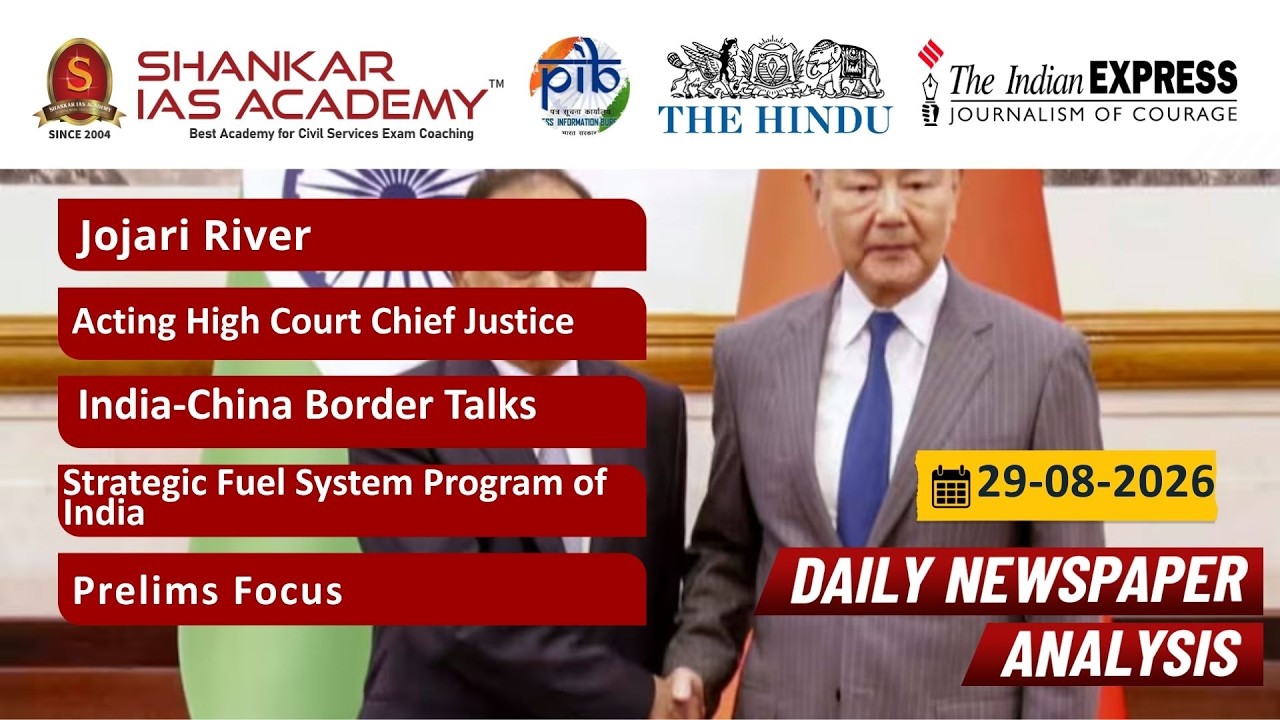
Daily Current Affairs Analysis | 29th August, 2026 | Shankar IAS Academy | UPSC | Mains 2026
Watch on YouTubeVideo summary
The daily current affairs analysis for August 29, 2026, begins with an examination of the environmental significance of the Jojari River in Rajasthan and the Supreme Court's recent directive prohibiting construction within a 100-meter buffer zone to protect its ecosystem. The court has specifically mandated that hazardous industries must be kept at least 500 meters away from the riverbank, which is a seasonal waterway flowing through Jodhpur and Pali before merging with the Luni River near Balotra. This regulation addresses critical issues of industrial pollution, contamination, and ecological degradation, aiming to prevent disease outbreaks among local flora and fauna and to safeguard groundwater recharge. The analysis highlights that industrial waste can lead to eutrophication and water stress, potentially exacerbating social issues like "water wives" in the region, thereby emphasizing the need for a scientific approach involving flood lines, ecological buffer zones, and institutional mechanisms like the Integrated Coordinated Group (ICG) to relocate industries away from riverbanks.
The second major topic explores the constitutional framework governing the appointment of an Acting Chief Justice of a High Court under Article 223 of the Indian Constitution. This provision serves as a stop-gap arrangement when the office is vacant or the incumbent is unable to perform duties due to illness or absence, allowing the President to appoint any other sitting judge from the same High Court without consulting the Governor. The discussion clarifies that this is a temporary measure requiring no fresh oath of office since the appointee is already a judge, distinguishing it from the regular appointment process under Article 217 which involves the Governor and a broader consultation cycle. The analysis also touches upon concerns regarding the potential permanence of acting appointments due to administrative delays and suggests reforms such as fixed windows for collegium decisions and transparency in delaying elevations to uphold judicial independence and reduce vacancies.
The third segment focuses on recent diplomatic engagements between India and China, specifically the talks involving National Security Advisor Ajit Doval and Chinese Foreign Minister Wang Yi aimed at de-escalating border tensions. The analysis details the eight-point consensus reached during these discussions, which includes maintaining peace along the Line of Actual Control (LAC), advancing negotiations for a boundary settlement framework, and establishing additional military hotlines in the eastern and middle sectors to prevent accidental escalation. It explains the technical distinctions between boundary delimitation (defining the boundary via agreement) and demarcation (physically marking it on the ground), while noting that despite various confidence-building measures like working mechanisms established in 2012, a comprehensive settlement remains a long-term process due to underlying geopolitical conflicts and sensitive areas like Arunachal Pradesh.
The final portion of the summary addresses India's energy security vulnerabilities amidst ongoing geopolitical tensions in West Asia and introduces the proposed strategic fuel reserves program. The government is considering a massive investment to build storage capacity for crude oil, LNG, and LPG, targeting coverage that could sustain consumption for up to two months during a crisis, although current operational underground natural gas storage remains limited. The analysis underscores that storage alone is insufficient without robust logistics, including shipping agreements, pipeline networks, and efficient withdrawal mechanisms, as well as the need for clear emergency release protocols. It concludes by highlighting the importance of diversifying supply chains, investing in domestic refining capabilities to reduce dependence on foreign vessels, and ensuring coordinated governance to manage crises effectively, while also briefly touching upon other prelims focus topics like the historical Jewish presence in Tamil Nadu and the Mission Samrit Gan scheme for rural development.
Read the full video transcript
[music]
Hi, hello and welcome to Shankara
Academyy's daily current affairs
analysis and today's date is the 29th of
August 2026.
Please like, comment, share and
subscribe to our YouTube channel and hit
on the bell icon to receive instant
updates and all our notifications. With
that, we also have a small announcement
to make. It's regarding our pre-torrming
test series. You'll have 48 integrated
tests, CASEAT and GS. And you'll also
have detailed discussions. There's also
a QR code below beside me. You can uh
scan that and you can see the
reflections from our test series that
have appeared in the previous UPSC uh
prelims question papers. So uh please
make use of the opportunity and if you
have any kind of doubts please call the
number 90030931
and with that let's move into the topics
of discussion for the day. The topics of
discussion the first one is about the
Jojari river of Rajasthan and how is it
very very significant for the UPAC
perspective and why um uh the
environment uh is very important and why
do we need to have a buffer zone for
industries? What is the buffer zone for
normal industries? What is the buffer
zone for hazardous industries or is it
that will be dealt here? The second one
is about the acting chief justice of
high court when they have some kind of
um absence or they're not able to
perform their duties. We have a ad hoc
posting what is the constitutional state
what are the articles that are devoted
to it or will be dealt with this in this
topic. The third one is about the India
China boundary talk. So you talk about
India and China. You see that there are
a lot of conflict zones. So what
happened with regard to our national
security advisor Mr. Rajit Dwal and the
Chinese um min foreign minister what
talks happened what are the outcomes of
it will be dealt here and the fourth one
is about the strategic fuel reserves
there's a geopolitical tension that is
ongoing and with regard to that tension
a lot of us are actually facing a lot of
crisis we know that during a particular
point we did not even have gas cylinders
at home so people who had gas cylinders
they were the richest people right so uh
how do we maintain resource How do we
protect our populations? What the
government is talking about in this
article? It is a very very beautifully
explained Indian express geopolitical
article and the final one is the prelims
focus for the day. So what are we
waiting for? Let's move into the topic
and the first topic of the day is about
the Jojari River. So today we are going
to deal with the first topic of the day.
This is taken from the Hindu. So we all
know that environmental degradation is
something that is a growing concern with
today's day and time. And you see that a
lot of industries are located in the
river bank. Today we are going to see
about one such industry which is located
in the banks of Rajasthan. So what is
the river? What is uh the issue is what
we're going to deal with. So let's move
into the article. So why this is in
news. You see that the Supreme Court has
prohibited construction within 100 m of
the
Jojari river which is present in
Rajasthan. So what happened here? What
kind of industries are present here? The
question answer the answer to the
question is there are hazardous
industries and that is prohibited within
500 m. So there there is two paths. One
is the flood path and the other one is
the uh flow path. So the flood path is
where the flood line goes and this is
the flow of the river. You see that is
the flow path. On both sides you're not
allowed to have any kind of hazardous
industries. So this is for 500 m. So now
what are the measures? The measures are
that you need to have some kind of
safeguard. So because there is a
scientific determination that is needed
for the flood line and you'll have a
ecological buffer zone. So even in case
your industry has some hazardous waste
that is coming along the way in that
case it will not affect the river as
much as it should because there is a
economic buffer zone that is present. So
the buffer zone is the 500 m. So in case
this is the river and in case this is
the industry, the industry is present
here, the river is present here. This
500 m that you see here, this is the
buffer zone that is required to protect
the
environment.
This simple diagram can also be used
when you do your environmental answers
in GS3. So with this let's move to the
map. So you see this is the map of the
Jojari river and here you have the
Looney River, the Guya river, the Bandi,
Sukkari, Javai, Kari and Sagi. This is
basically the map of the river map of
Rajasthan. So the Jojari river the
geography see you have perennial rivers,
you have seasonal rivers, you have
different kinds of rivers. So what kind
is it? It is a seasonal river that is
present in Rajasthan. The second one is
it flows the flow. Where does it flow?
We saw with the flood line and the flow
line. Where does it flow? It flows
through Jodpur and Pali. And there are
two rivers which merge with the Looney
River. You see here we saw about the
Looney River. Right here you see that
there are two rivers that merge. So what
are the two rivers that merge? Those are
the Jojari river and the Bandi rivers.
they merge with the Looney River near
Balotra. So the Looney River, the Looney
River is also something very very
important. What is the Looney River
important for? It is the river of the
western Rajasthan. You see western
Rajasthan usually is a aid region. That
means it's a dry region. It's not a very
fertile region. So the aid region and it
drains towards the ran of Kutch that is
present. You see this area in your map,
it'll drain towards the ran of catch. So
this is very very important to note and
what is the environmental concern? Even
though we talk about environment
industries, what is the actual
environmental concern? See industrial
pollution and contamination of the river
system will not only affect just humans.
It will affect the species living there.
It'll affect the flora and fauna. There
might be disease outbreak because of
that. There are various factors that
might happen because of this particular
degradation. So the industrial areas
particularly around Pari Pali I'm sorry
Pali they're located close to the
riverbank. So it affects the riverine
ecosystem. So ultimately as already told
the flora and fauna will be affected and
you because of that if there are high
nutrients present
you also might have uh growth
of resistant species.
Because of the growth of resistant
species you might have utrification.
It might affect the groundwater. So you
might not have adequate groundwater
recharge
and livelihoods might be affected
because water stress
leads to
need for
Water war. There are water wars. There
are even terms called as water wives
wherein pe men in Rajasthan
actually marry women to fetch water.
They're called as water wives. That is
the condition of water there. There is
also the bombers suicide of Rajasthan
which was an imitation game where women
[clears throat]
jump into the wells.
So the balmer suicide of Rajasthan also
is something that you can note very well
and you can talk about it. The next one
is the issue also illustrates the
connection between industrialization,
water pollution and the ecological
degradation that is present. So all
three of them are connected. If you note
now the Supreme Court's direction what
does the Supreme Court say? So the
construction development so no
construction within 100 meters assad
industries if you have 500 meter buffer
the scientific exercises that high flood
line and the buffer zone you have to see
there's a institutional mechanism the
integration coordinated group the ICG
headed by Rajasthan chief secretary a
broader approach that is long-term
reallocation of industries away from
riverband this is the broader approach
this can be used in your mains
way forward
Right.
UPS's question. Consider the following
statements regarding Jojari River.
Jojari River is a tributary of the
Looney River. Jojari originates in the
Arai range. No, we know that statement
two is wrong. The river flows through
Jodbour district before joining Looney.
Unlike the Looney, Jojari is a perennial
river. No, we know that Jojari is a
seasonal river. So, option D also will
go. So the answer should be option A 1
and three only. Let's check. Yes, the
answer is option A 1 and three only.
With this we have come to the end of the
first topic of the day. Let's move to
the second topic. So now we are going to
be dealing with a very very important
article about the acting chief justice
of a high court. You see that a Supreme
Court judge seeks transfer of the
Rajasthan High Court acting chief
justice and it says this. See when you
have an allegation over one person when
you say that this person is being
favorable to someone or this person does
not act in the right capacity or this
person is misusing his power when you
say certain things just because you say
that we cannot take it as truth even
though you are a truthful person you're
an honest person we need proof we need
finding we need to believe that this is
the truth yes so this is what happens
and CJI Surya Khan says that this matter
has been examined at appropriate level
and the process will take
account of the material placed by
justice ma as well as the response of
justice Sharma. So this is what
happened. So our justice sepa he sought
justice Sanjiv Prakash Sharma's transfer
he why did he say about the transfer? It
is because he spoken about favoritism
and mismanagement. So what happened with
regard to favoritism and mismanagement
is what we are going to deal with in
this article and how the process of fair
opportunity to respond is required also
will be dealt with this article. So
first let's talk about the
constitutional foundation of article
223.
See article 223 appointment of acting
chief justice when the office of the
chief justice of a high court is vacant
or when any such chief justice is by
reason of absence or otherwise unable to
perform duties of office duties of
office shall be performed by one of the
other judges of the court and the
president may appoint for the purpose.
So this is basically from the
constitution of India taken as such. Now
what are the trigger conditions and what
actually is this article because it's a
jargon of words right so
the condition is one the chief justice
should be vacant in his office due to
any reason or he should not be able to
perform his duties uh due to illness or
otherwise some issue personal problem
whatever it is he's absent or he's not
able to not in the mental capacity or
physical capacity to perform his duties.
So the president of India then will
appoint from the other judges. He'll see
the four five judges. Okay, you are
fine. Let me appoint you as the CGI of
the high court. So he what are the
requirements? So the president cannot
just be favorite uh see his favorite and
say you are better to be the CJI. So he
must see that who are the sitting judges
who are already high court judges and uh
who do not have any external appointee
and then he will appoint them as the CGI
and it is a stop gap arrangement. So
just because he is the CGI now when the
original CGI comes he cannot say that no
I've become the CGI I cannot move from
this. No, it's just a temporary. It's
just a top gap arrangement that is
arranged and it's not an substantiative
appointment. So these are the
points to be remembered with regard to
the ad hoc posting of uh the CGI. Now
there is the regular chief justice
article 217. So article 217 it it
governs the appointment of every judge
including the CGI and uh the appointment
authority is the president of India by
warrant under his hand and seat. So the
president is the main person here and
the president consults the chief justice
of India and the governor of the
concerned state. So high courts are in
state courts. uh high courts are the
state court right so let's take the case
of Madhya Pradesh so in case you are
appointing somebody for Madhya Pradesh
so there the central uh person who is
actually a bridge between the center and
the state is the governor so the
governor will be asked is this person
fine for the high court judge and when
he says okay this will be there so the
recommendation flows from the supreme
court poligium that is the CGI plus two
senior most judges and the senior most
judges of another high court is
typically elevated as the CGI and he can
hold office until 62 years as per
article 217 unless elevated to the
supreme court. So it is administered by
the governor of the state under article
219 in the third scheduled form. Now
acting chief justice the appointment
process and where does he take the
source of power from? So the source of
power is from article 223 with the
memorandum of procedure for judicial
appointments. So the union ministry of
law and justice it moves the proposal
based on the recommendation of the CJI
it will move the proposal up and seeing
that the chief justice of India will
identify the senior most person present
there and he will uh talk about that and
he will have a acting CJI based on the
convention. So the seniormost person is
given preference and the warrant of
appointment is issued by the president.
So just because the CGI says the CGI
does not appoint it's a very very
important prem area. The president
appoints and it is notified in the
official gaset by the department of
justice. Who gives it in the official
guess also can be a prelims question. So
the duration is that it continues until
a regular CJ is sworn or a incumment
resume presumed duties. So since the
person is already a sitting judge no
separate oath will be taken. This is
also a prelims pointer wherein does a
judge need to take the constitutional
oath or give an allegiance? No, he does
not have to do that because he's already
a sitting judge. Now regular chief
justice versus acting chief justice. So
the regular chief justice article 217
here article 223 this is a permanent
post this is a stop gap arrangement this
is the consultation of TJI plus governor
this is TJI only governor is not
consulted it is just informed that this
person is going to come here any senior
high court judge is usually there here
only judges of the same high court will
be uh taking decisions fresh oath will
be taken by the governor as per article
219 Here no fresh vote is required as
he's already a judge until 62 years of
age or elevation is the tenure time.
Here you see until regular CGI takes
charge the tenure will be as such the
powers are full administrative and
judicial powers full CJ powers while
acting. So these are the difference
between the regular CGI and the acting
CGI. Now you see article 214 talks about
high court for each state and article
216 talks about the constitutional
provisions of the high court. 217 about
appointment and tenure. 219 about oath
and affirmation. 220 about practice
after retirement. 222 about transfer of
judges. 223 about what we were
discussing now acting chief justice. 224
about additional acting judges. 224A
about retired judges present at high
court sittings. So now this is the
constitutional ecosystem that is
present. The convention memorandum and
procedure
you see that it is governed by the 1999
MOP evolved after the second judge's
case. So the CJ recommends that the
seniormost person becomes the CJ after
any such adoc
requirement and it uses the word article
223 explicitly uses the word the
president may appoint. So unlike article
217 the governor has no formal role in
the CGI appointment and the collision
and government consultation cycle keeps
changing and multiple high courts
routinely function under acting CJS
pending collision cleared elevations. So
now the concerns is that acting CJ
tenure may become permanent because the
person who has gone vacant has gone
vacant he's not come back for a long
period of time and there's hesitation on
long-term reforms and posting. So the
administrative g drag is also present
and government sits on files and delays
confirmation because they want to have a
deadlock or acting tag weakens the
authority. So when you go and give some
orders if they say you're just an acting
person let the original person come and
we'll do it that and HC vacancies
compound I already high tendency so way
forward is that you have to have fixed
windows for the colligium execution and
whenever there is um any kind of
anticipation if there is a trigger
elevation of the process 6 months before
retirement it should be taken into
consideration then publish reasons for
delay supreme Court always has told
about the transparency. If something
happens, if you want something to be
transparent, say that you want it to be
transparent and uh sanctioned high court
strengths to reduce dependence and
uphold judicial independence via prompt
and regular appointments. These are the
way forwards. So with reference to the
acting chief justice of high court in
India, consider the following
statements. The appointment of acting
chief justice of high court is made by
the president under article 224 of the
constitution. The president consults
both the chief justice of India and the
governor of the state concerned before
making the appointment. Only a sitting
judge of the same high court can be
appointed as the acting chief justice.
The acting chief justice takes a fresh
oath of office administered by the
governor of the state. Which of the
statements given above is or are
correct? One and two only, three only. 2
three and four only. 1 three and four
only. So this is the question for the
day with regard to this article. Please
send us across your answers in the
comment section. We'll respond to it
with a correct answer. And with this
let's move to the next topic for the
day. Please send us across our answers
again. So now we are going to deal with
an article that was taken from the
Indian Express. The article is about the
expert explaining India China boundary
talk. See there's a long record of um
you know conflict here but with a long
record of the conflict we are also going
to make some progress which is where you
see our NSA Mr. Ajit Dawal and the
Chinese foreign minister Wang E they met
in Beijing on Tuesday this is the photo
of that and this is from the geopolitics
section of the Indian express. Now what
are the recent developments? You see
that 25th round of India China special
representatives. The talks are held
between Beijing Ajit Dwal India's
national security advisor and China's
foreign minister Yang Gi. There's a
eight-point consensus. You see that
first one is maintaining peace and
tranquility along the border. The second
one is for advancing negotiation on a
framework. So the framework is not yet
entirely
drafted but there's a framework that is
required for the boundary settlement. So
exploring early harvest of boundary
delimitation in appropriate sectors.
What is the early harvest? So based on
the boundary limitation based on the
sector they are going to have a boundary
delimitation that they are going to talk
about. then strengthening the border
management mechanism and two additional
military hot lines are proposed for the
eastern and middle sectors that are
present. So now boundary limitation is
when you actually have an agreement so
through return agreement word of mouth.
So this is the agreement and you
actually demar draw it in a map when you
demarcate something that is boundary the
limitation you define it. Boundary
demarcation is when you physically mark
the agreed boundary on the ground and
border management is when you manage the
border through patrols, communications,
infrastructure. So progress in broader
management is not equal to the final
settlement of the border dispute. So
India China border there are three
sectors. One is the western sector that
is the Ladak in the Axai chain region.
The second one is the middle sector, the
Himachal Pradesh and the Uttakand range.
The third one is the Arnachal Pradesh
and Sikkim range. So the western sector
has historically witnessed the most
serious military tension while the
eastern sector remains politically
sensitive particularly regarding the
Arnachal Pradesh because China usually
says that Arnachal Pradesh is there.
It's a very very politically sensitive
area. So that is something that we have
to note. Now there are a lot of
institutional mechanism that we have to
discuss. You see the first one is the
special representatives. There's a
political level mechanism for
negotiating the overall boundary
question. So when this happens working
mechanism for consultation and
coordination on India is present. So
border affairs is established in 2012
for consultation and coordination on
border affairs. There's also an expert
group the diplomatic military officials
involved in technical or operational
aspects of negotiation. There's also
working group relevant mechanism for
advancing discussions and border
management is also present. So you have
expert groups, you have working groups,
you have working mechanisms and you have
special representatives who are present.
Now the important agreements is that in
1993 there was an agreement on
maintenance of peace and tranquility
along the line of actual control and
then they took confidence building
measures in 1996 in the military field.
After that in 2005 there was a protocol
the protocol on the CBMS and in 2012 uh
is where the WMCC working mechanism for
consultation and coordination came into
accord and there was a border defense
cooperation agreement BTCA in 2013. So
any escalation uh that is happening they
wanted to prevent that through all of
this but whatever mechanism they made
made it did not solve the problem. So
recently even in a lot of interviews if
you see there's a thing wherein if you
have a fluctuation on the 44th floor of
your building and you keep changing the
lights or the wiring or the bulb but the
problem is in the basement that is what
you have to address right so the problem
is not with bringing all these measures
the problem is that there is a
geopolitical conflict in itself so which
is why there is underlying boundary
dispute so the confidence building
measures are very very required You see
that there are examples. Examples like
border personal meetings,
militarytoilitary communication. Um and
hotlines. Hotlines will help us know
what is happening in one particular
area. Agreed meeting points. So when
they have consensus, how to deal with
the consensus, how to deal with things
that are happening, how to deal with the
points of difference when it is
happening. measures to prevent the
accidental escalation in case there's an
accidental escalation that is happening
in that case what should be done and
existing mentioned BPM locations include
Shushul Modalo
Bambla Natula
Kibu Dawisi
all of these are all of these are
examples so significance of hotlines
what are the significance the first one
is additional hotlines in the eastern
and middle sectors
they will enable they will enable rapid
military communication. So through rapid
military communication you can see there
is a combined
effort
and
sharing of
camera array
there. They also can prevent local
incidents from escalating local
incidents in a non-me escalated and
facilitate clarification of troop
movements strengthen uh so sometimes we
might think that these people are trying
to attack us but they might just be
moving that way anyway we have to be
very aware when we have a conflict with
a neighboring country but still uh it
can strengthen the crisis management and
mechanism. So hotlings are actually
conference building and crisis
management tools. So this is for
determining the international boundary.
You see the early harvest what does it
mean? See a spe sector specific progress
when you have a boundary delimitation a
sector specific progress when it is
addressed it is called as delimitation.
So this is waiting for a comprehensive
settlement covering the entire India
China border. However existing
difference even remain in the uh even in
the sikim and the middle sector. There
are a lot of working groups and expert
groups that need to be finalized.
Therefore, a substantiative boundary
settlement remains a long-term process.
There's a recent confidence building
step. The article highlights that the
reassumption of Kailash Manasar over
Yatra. This is a very very spiritual
thing that a lot of people want to
undertake. Also the re reassumption of
direct flights to China and direct
flights from China to India and the
border trade. The border trade will help
faster
faster transport
of necessities
and also
commercially
help in
transport of
critical
requirements.
There's also a continued political level
engagement and there are also attempts
to stabilize the bilateral relations
beyond the border issue. You see the
UPSC practice question. The line of
actual control is a mutually agreed and
demarcated international boundary
between India and China. The boundary
delimitation refers to defining a
boundary through an agreement whereas
demarcation involves physically marking
the agreed boundary on the ground.
Working mechanism for consultation
coordination was established in 2012 to
facilitate the consultation and
coordination in India China border
affairs. Border personal meetings and
military hotlings are examples of
confidence building and crisis
management measures. So you see that
line of actual control is a mutually
agreed and demarcated international
boundary between India and China. This
was not actually properly defined. So
statement one should be wrong and the
answer should be option B 2, three and
four only. Let's check. Yes, the answer
is option B 2, three and four only. With
this we have come to the end of this
topic and let's move to the next topic
for the day. So now we know that the
West Asia crisis has disrupted the
energy security in a lot of areas and
India is also facing energy security.
With regard to that we are talk going to
talk about the strategic fuel system
that is present. So you see that India's
strategic energy storage
in that you have crude
in that you have LNG
that you have LPG
so LPG you have underground footprint
But this is limited.
Now you also have to talk about um the
crude. The crude oil has the
most developed system
and also the LNG is there. So now there
is this geo political
instability that is present.
So now based on
geography
we can determine the storage
of these
fuels.
It can be based on shipping.
It can be based on pipelines.
It can be based on any other storage
mechanism like caverns.
This will help us during geopolitical
instability and give consumers
prolonged consumption.
So this is basically the article. I've
given an outline of the article. So
basically India has energy security
vulnerability. So we have through three
things the LPG, the LG and the crude. So
reserves alone just because we have
reser reserves reserves alone cannot
guarantee us we will not find any kind
of issues with regard to the consumption
patterns. So we need to build um a
mechanism wherein we can have better
reserves wherein we can have better uh
uh storage with regard to shipping
pipelines and distribution networks. So
what are the measures that we are going
to take and what is the story so far is
what we are going to discuss. So with
regard to the story so far you see that
there are vulnerabilities in India's
crude LPG and LG storage that is uh we
have supply chain the current system is
based on the underground crude reserves
plus LPG caverns you know that the
caverns are the cave like storage
structures that are present but they are
not operational nonoperational
underground natural gas storage is
present. So decade lawn fuel program is
um coming into proposal adding uh 2
million uh tons of crude 28 million tons
of crude and 9 million tons of LG and 4
million tons of LPG nearly so the
coverage target is that even though
there's a crisis even though nothing
comes in even though we are a closed
economy for two months we will have the
resources for two months to secure our
consumers and protect our consumer base
that's what is uh spoken about here. The
program is under consideration with a
proposed target. It is not in committed
capacity. So tons are are not stored.
Withdrawal rate to um uh is is also
going to reduce. But in case also it
increases how to end it during a crisis.
So the crude oil if you see actually we
had 3.37 million ton but with the phase
one we are trying to push it to 5.33
million t capacity and in phase 2 we are
trying to push it to 6.5 million t
capacity the sites are in vishagapatnam
mangaluru and padur and the chandi coal
is delayed due to some land issue and
public private partnership issues lpg
there's limited footprint the combined
capacity is 0.14 million uh tons but
there is a 30% jump that is required so
new caverns are required nationwide but
the only two present caverns that we
have one is in Vishagapatam one is in
Mangalore so bottling and distribution
links are necessary and also no
operational underground storage is there
for natural gas it relies on terminals
and pipelines there's also salt and
depleted field caverns proposed so
withdrawal rate is a key constraint that
is present here. So you see in 28
million tons for crude oil approximately
2 months of national demand 56 days of
import will be covered if we have 9
million tons of LNG and 6 weeks of LPG
demand can be managed if we have more 4
million tons of um LPG. The important
thing that you have to note is the
program cost is reportedly up to $42
billion
and um this uh infrastructure plus
purchase plus maintenance of the
inventories will be included in the
program cost. So the confusion point is
that India has already having a
regification structure and the LG import
that is going on. So the reg terminal it
receives um the regifies the LG and it's
not a strategic inventory. So it is
above ground cryogenic LG tank. So
there's also a 20-day priority sector
that is a stress scenario. In case
there's a stress scenario also the
priority sectors will get first priority
and uh 56 day of import cover we saw it
already. So roughly 1 billion is covered
and only eight additional tanks in the
ICFKs are given. So 9 million tons is
going to be much larger than how it was
earlier. And the surface LG tanks and
underground natural gas storage in salt
caverns is a portfolio option that we
can do. So beyond storage if you see the
state of Hormus is a important shipping
point. So that has high vulnerability.
So we need to have new agreements with
Algeria more uh for LNG as well and
explore direct positions in very large
gas carriers. And now if you see which
is why the fleet plants the refiners and
SBI JV should have high investments like
about 59 ships are there. So objective
is to reduce dependence on foreign
vessels and control uh supply chain and
also in the pipelines new LPG grid new
investments
of up to 0.7 billion impact is that
it'll cut the road transport it will cut
dependence it'll cut uh any kind of um
dependence that we have on other uh
areas and it'll boost the
deliverability. So storage is useful
only if it withdraws at a required rate.
So uh the if the requirement is for 100
gases, the requirement should be for 100
glasses. The withdrawal should be 100
gas empty cylinders and then again you
replace it with the required amount. So
it should be based on the injection and
taking out principle on the required
rate and LPG caverns need bottling and
distribution connectivity. So this is
beyond the storage. So who is going to
pay? Um so the headline cost is based on
the capex plus purchase and maintenance.
The split is based on buying and filling
reserves for balance and more than half
towards storage infrastructure.
Government has rejected reports of the
consumer set to fund reserves. So
there's a consumer says tax that we pay.
So ongoing burden that is the inventory
must be replenished at higher prices
after every release and there should be
minimum stock obligations that are
present emergency release authority that
is present. So private users share cost
if capacity stays available during
emergencies. Now storage alone is not
enough because the way forward is that
you need to have shipping you need to
have research to buy time. You need to
have pipelines to carry it in land. So
there should be clear emergency release
protocols. You should have clear um SPR
expertise with regard to LNG and LPG.
Geology also matters. The Krishna,
Godavari, Kai, Mumbai, offshore,
Rajasthan, all of these are present for
the field storage. The withdrawal for
short duration can also be done with
Rajasthan areas because they have salt
caverns that are present here. A lot of
shale gas ex extractions also were
spoken about in the West Bengal area. So
coordinated storage and logistics is
very very important for governance
during crisis. So the UPC main's
question for the day is can strategic
reserves alone ensure India's energy
security critically examine the role of
shipping pipelines and governance. It's
250word answer for 15 marks. Please send
us across your answer copies for this
particular question. We'll help you aid
better in the preparation. And with this
let's move to the prim's focus for the
day. So now we have come to the prelims
focus for the day. The prelims focus the
first topic is about Jews fun shiva
temple hall. You see that 13th century
CE there there was a Tamil stone
inscription present. In the Tamil stone
inscription it was found at the
Tanteshwara temple in Anandur. It is
near pochali that is pochumali is
present in Krishna giri. So before that
the announcement is this article is
taken from the IAS parliament of
Shankarayas Academy. So please do go
visit the website you'll get oneliners
for prelimin's perspective exclusively.
So with that we'll move into the topic.
There were four Jewish merchant guilds.
So guild usually are groups pe people
groups that is called as guild. One is
Sutakar
Mandla merchants
Tenilankai
Wangjiar and Eg
so four of them and they've financed the
construction of a hall. Now why is it
significant?
Because it shows the Jewish presence in
Tamil Nadu with local guilds, temples
and economic centers. So they're not
just spiritual centers, they're also
economic centers and Jews settled in
Kochi thousand years ago and immigration
the migration was linked to crusades. So
Jews you you see that Kochi was the
place where V was also came. We all know
about Zamurin what happened after that.
So even this Jewish place also thousand
years ago Jews were also present. That
is one important context and integrated
into south trade networks. We can see
that this bought in a assimilation of
cultures
and the inscriptions connects the
Tagadore naval tavalam to
Andra. So this is a important thing. The
second one is mission samrit gan scheme.
Recently the rural development minister
he unveiled the mission Samrit gan at
krishi bhavan. So it is aim is to
develop a povertyfree employmentrich
village. So today's main issue is
unemployment. So an employment rich
village should be there with assured
basic amenities. So a integrated rural
development framework with prosperous
village strong foundation of developed
India. So this is through prosperous
rural communities. So this is about the
samrit gone scheme. Then the state
sponsors of terrorism list 2026
reports whenever it come out it's very
very important for UPSC prelims. So US
removes Syria from terrorism list after
45 day of congressional review. So
because it recognizes the positive
actions that have been done and
commitments by President Ahmed al-Shara
to distance Syria from terrorism. So it
lifts the last major obstacle. obstacle
was investment and it reconnects Syria
to global financial and economic systems
and Syria is designated as a sponsor of
terror from 1979
under half his al- Azad and it continued
under Bashar al-Assad until December
2024. So remaining Cuba, Iran, North
Korea are still on the terrorist
responsor list. So now the significance
is to stabilize Syria, attract
investment and rebuild them after 14
years of war that is present. The UPSC
prelims practice question of the day.
Consider the following statements
regarding mission Samrit gone. It aims
to promote integrated development of
rural areas through convergence of
various government schemes. Focuses on
improving livelihoods, infrastructure
and basic services in selected villages.
The mission is implemented exclusively
by the Ministry of Agriculture and
Farmers Welfare. So we know that option
three is wrong and statement one is
right. So the answer should be option A
1 and two only. Let's check.
Yes, the answer is option A one and two
only. With this we have come to the end
of today's video. Thank you for watching
today's video. Thank you for watching
me. We'll meet again in a new video.
Thank you.
>> [music]