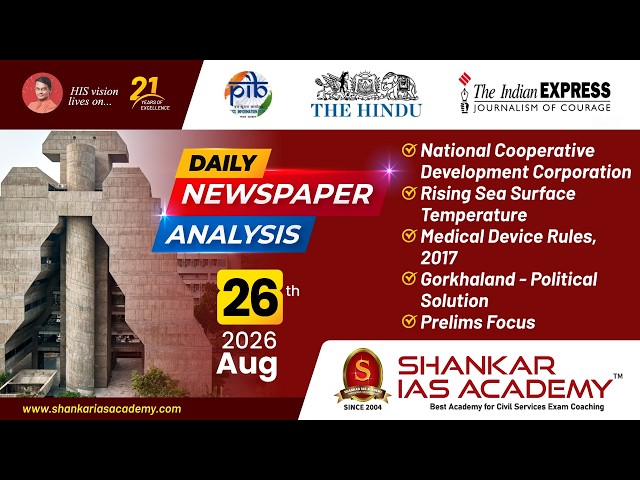
Daily Current Affairs Analysis | 26th August, 2026 | Shankar IAS Academy | UPSC | Mains 2026
Watch on YouTubeVideo summary
The session opens with an analysis of the National Cooperative Development Corporation (NCDC) Amendment Act, which seeks to expand the statutory body's mandate from rural agriculture to include urban cooperatives and non-agricultural sectors under the Ministry of Cooperation. While this expansion aims to provide direct financial aid and equity ownership, it has sparked significant controversy regarding federal encroachment, as critics argue that unilaterally altering state-listed cooperatives violates the 2021 Supreme Court judgment without the necessary ratification from half the states. Furthermore, stakeholders express concern that centralizing funding undermines the principles of autonomy and self-help championed by the International Cooperative Alliance, potentially diverting resources away from India's traditional rural backbone. To address these issues, experts propose solutions such as interstate council consultations for proper ratification, establishing a Cooperative Federalism Tribunal for dispute resolution, and ensuring transparency in equity disclosure to protect cooperative independence.
In parallel, the video examines the alarming rise in global sea surface temperatures, with data indicating that extra-polar regions have reached an average of 21.1°C due to greenhouse gas emissions trapping heat, El Niño effects, and persistent ocean warming patterns. This thermal anomaly has severe implications for marine ecosystems, causing coral bleaching through acidification and damaging seagrass, while the resulting thermal expansion contributes to rising sea levels that threaten coastal livelihoods. Additionally, warmer oceans absorb less carbon dioxide, weakening their role as a primary carbon sink and disrupting the global carbon cycle, whereas increased atmospheric moisture intensifies tropical cyclones and heavy rainfall events. The discussion clarifies that while oceans currently absorb about 90% of excess heat, the misconception that they become more efficient at absorbing CO2 under warmer conditions is corrected, highlighting instead the risks to weather extremes and biodiversity.
The regulatory landscape for the medical industry is also updated with amendments to the Medical Devices Rules 2017 designed to streamline business operations and align with international standards. Key changes include removing the requirement for manufacturers to obtain separate sterilization licenses if they outsource the process to a licensed third party, while maintaining strict traceability through labeling. The rules now recognize the European Union alongside the USA and UK as having stringent regulatory jurisdictions, allowing devices approved in these regions to enter the Indian market without additional clinical investigations. By introducing the concept of "predicate devices" for comparison and reducing bureaucratic paperwork, these reforms aim to accelerate market access, support India's domestic manufacturing ecosystem, and promote regulatory convergence with global norms like those of the EU.
The session concludes by highlighting three preliminary focus topics that underscore recent developments in agriculture, space exploration, and history. First, the National Bureau of Soil Survey and Land Use Planning has released a new soil texture map to aid farmers in selecting appropriate crops based on sand, silt, and clay composition. Second, National Space Day was celebrated on August 23rd to honor India's historic achievement with Chandrayaan-3, becoming the first nation to successfully soft-land at the Moon's south pole. Finally, archaeological findings include a fifth-century Eostone inscription discovered in Tenasi, which depicts local warriors from the Sangam period using epigraphic text rather than pictographs, offering valuable insights into ancient history and regional culture.
Read the full video transcript
Hi hello welcome to Shankaras Academyy's
daily current of analysis for the date
26th of August. Please like, comment,
share and subscribe our YouTube channel
and also have the bell icon press for
instant notification and better current
serve to you. So before going on there's
an important announcement regarding this
pre-torming test series targeting the
UPSC pulims 2027. So this batch one
starts on 7th of September 2026 and it
has 48 test which is inclusive of
general studies as well as seat. So
these questions are expert picked and
also there is detailed solutions and
guidance given to you. you you'll be
ranked institute wise you'll be ranked
all India wise and you'll know where
what is your position and where to
improve for cracking this upc 2027
please visit our website shankaray
academy and get enrolled in it this
batch one is exclusively for Chennai
Ananagar branch which is in offline mode
so subsequently there will be other
other batches which will be started and
which can also have hybrid mode of this
test which can be available so today's
topic for discussion is the first one is
national cooperative development
cooperation that is NCDC.
So there was a recent amendment to this
NCDC which is a statutory body. So we
will see what is this uh amendment is
what are the concerns raised by the
farmers body and also other stakeholders
and what can be the way forward to have
the better amendment or better
cooperative development corporation and
the next topic will be on rising sea
surface temperature. So this rising sea
surface temperature has been observed by
many data sets including copper climate
change service and it notes that the
temperature anomaly. So the temperature
anomaly is getting rised significantly
that is the rate of rise is high. So we
will discuss what is this temperature
anomaly? What is the term temperature
anomaly is about and what are the causes
for this rise and temperature and also
what can be the impacts and the third
topic will be on this medical devices
policy that is medical devices rules
2017. So the union health ministry has
changed certain rules related to this
medical devices. We will see what are
the rules that has been changed what can
be the impact that it is going to
produce and also a question a plans
based question related to this for
discussion and our fourth discussion
will be on this Gora land issue. So Gora
land which is present in West Bengal
that is north part of West Bengal. So
they are demanding for more autonomy
they are demanding for statehood. So we
will see what is the conditions of the
boral land today. what is the historical
background for such movements and also
what are the demands and what can be the
solution that the union government or
the present West Bengal government can
provide to Gauta people and finally we
will finish our discussion with films
focused points which are fil three
topics briefly we will discuss about uh
these things and also have a question
related to the discussion let's discuss
the first topic for the day which is
NCDC amendment act NCDC stands for
national cooperative development
Corporation, National
Cooperative
Development
Corporation.
So this act actually extends the scope
of this corporation that is National
Cooperative Development Corporation. So
this act uh this amendment is extending
the scope of NCDC but by extending there
are concerns by farmers body and also
other states claiming that there's
encroachments of states autonomy. So
we'll discuss what is NCDC first then we
will see what are the amendments that
are bought by the union government
through this act. What are the concerns
raised for this amendments and also what
can be the way forward. So NCTC if you
see it was established in 1962. when it
was established in 1962 there was no
ministry of corporation. Ministry of
corporation came later in 2000 uh that
is in 2021. So when it was established
when NCDC was established it was under
ministry of agriculture.
So it is a statuto body. It is a statary
body formed under this act national
cooperate development cooperation act
that is NCDC act in 1962. See it mandate
is to plan, promote and finance the
cooperatives. The cooperatives are
specifically rural cooperatives because
it was more related to agree related
industries and agree related
cooperative sectors.
So agree related societies and agree
related industries were actually
financed promoted by this NCDC and also
it acts it has access body extending
loan grants and equity to states entire
cooperatives. So state cooperatives and
multi-state cooperatives are two
different things which we will discuss
in this article that is where the
concern is rising about. So all you need
to know is that NCDC was a is a statuto
body and its mandate is to plan, promote
and finance the programs for the
cooperative societies. It comes under
ministry of cooperation today. Today it
comes under ministry of cooperation but
when it was established those ministry
of agriculture. So we will see what are
the amendments done to this act. The
first one is it extends the scope. It
widens the financial and operational
reach behind the 1962 mandate. 1962 what
happened is the mandate was the NCTC
will be only promoting the rural
cooperatives rural societies but here
the financial scope is increasing you
can also you can you can also finance
you can also promote the urban
cooperatives so the funds are going to
be not focused only for rural but also
for urban cooperatives and the direct
aid is permitted today because then then
it was rooted through different banks
because NCD DC is not going to directly
give you loan, directly give you grants.
It is it is going to root through the
banks. But here the direct aid is
possible to the cooperative societies
and NCDC can also have a equity
ownership today. So equity ownership is
directly even without concern of the
state. See basically cooperatives comes
under state list. So we'll see what is
that cooperatives comes under the state
list. But here NCDC is in this article
but in this amendment what it is said
that NCDC can intervene in societies and
take up shares that is equity shares in
the cooperatives and the urban cover as
I said it is going to increase the
inclusion of urban cooperatives. So it
removes the rule confining that
industries and village cooperatives are
only to rural areas. It is not only to
rural areas is going to move on to the
urban cooperatives as well. And sector
of reach if you see it is not only to
agriculture sector because earlier in
1962 it was predominantly agriculture
sector but today it is going towards
non-aggriculture sector along with
traditional sectors as well. So these
are the amendments. So first amendment
you need to know is it it is extending
the scope that is financial scope and
operational scope and also it is going
for urban covers that is urban
cooperatives and the cooperatives are
not restricted only to rural it is
non-aggricultural and also it includes
few traditional sectors as well and it
can also have the equity ownership the
NCDC can also have the equity ownership
in the cooperatives so what is the
concern so this SKM is a former body no
need to know what is this where where it
is it's just a formal body which raises
concern. It says that this is a naked
intrusion by union into the state powers
because cooperatives as I said it is
under state list.
So whenever you're going to make a law
which is encroaching the encroaching the
powers of states you need to have the
ratification of states. you need to have
50%age ratification of states before you
pass that amendment. So it says that you
are you are unilaterally making changes
and saying that national cooperative
that is NCDC will actually fund directly
will have equity shares will have urban
cover so these things are encroaching
the states autonomy because states will
have certain priorities for their
cooperatives but here you're directly
intrusion means you're directly
intruding in your federal structure and
autonomy laws see there is ICF
principles called international
cooperative alliance so international
cooperative alliance is a global
cooperative standard where it has seven
pillars for cooperatives. Seven pillars
for cooperatives which are usually
followed by many countries and in that
out of the seven pillar this
independence and autonomy are the
crucial pillars.
So independence and autonomy of the
cooperatives. So in this in this
amendment if you see the independence
and autonomy of the corporate is getting
reduced because the union is going to
decide what funds they going to give for
what projects they are going to give and
to urban or rural or for agriculture or
non-aggriculture what it depends it
depends on their decision. So the
cooperative autonomy and independence is
getting reduced and there is
centralization as I said because there
is direct financial aid that is being
given because now NCDC can directly
finance. So that is centralizing your
cooperatives but cooperatives itself a
decentralized
decentralized working or decentralized
industries but centralization is
actually a concern because it will
actually one size fit all will not work
because union will have only certain
priorities which will not be working
well with the states or in the lower
level of the federal structure and the
corporate tilt. If you see see to today
we have lot of lot of things moving
towards urban means you can see many
many urban many people are moving
towards urban cities many things or many
economic activities everything is
concentrated towards urban but earlier
it is used to be more of rural so in
rural economy the NCDC was actually
created to support the rural economy to
fund these corporate societies in the
rural economy but now you're moving to
corporate when everything is moving
towards corporate that is you're moving
towards urban area you're moving towards
urban centric corporate model then the
rural corporate model which will be left
which will be left uh
unel so you need to you need to also
focus these things because there are
only certain certain corporations which
are specifically focusing rural bodies
or rural corporates but when you shift
the attention to corporate to urban
model urbanentric model so your
traditional sectors will be left alone
which is still the backbone of India's
economy
So resource diversion as I said the
funds will be meant for agriculture and
rural industry will be shifting to
non-aggricultural use. So these are the
things objectives these are the concerns
raised by the farmers party. The first
one is federal intuition autonomy
centralization and also it is over
overruling the supreme court's judgment
in 2021. So what is the Supreme Court
judgment in 2021? We will see here. So
in this case you not no need to remember
the case. In this case what Supreme
Court has told that part 9B
of constitution. So part 9B of
constitution actually has the provisions
of
these cooperative societies because this
this was given in given in 97th
constitutional amendment act. So 97th
constitutional amendment act created
this part 9b in the Indian constitution
which gave constitutional status to form
the cooperative societies. It is also
included as a fundamental right under
article 19. So forming a cooperative was
included under article 19 as a
fundamental right through 97th car
social amendment. Okay. So in after this
Supreme Court has told that when there
was a case rising what what can be the
power distribution of power within the
cooperative. Supreme Court has clearly
told that whenever this part 9B is
applied to any cooperative, it should
not be applied for a cooperative which
is within a state because any
cooperative only within a state it is it
comes under state list. Union cannot go
there and make rule with for whatever
the concern is. Whenever the corporate
is multi-state means the cooperative can
work in Tamil ladu, Delhi, Kerala or
Maharashtra. When the cooperative is
working in multi-state, multi-unit
territories then the rule the part 9b
whatever the provisions are that is
applicable to that states. But whenever
the
copies is within a state then it should
be it should be considered within the
state's ambit or within the state's
legislature power. So that was the
ruling by Supreme Court judgment and
this amendment is actually overruling it
because it is going to centralize
everything. It is going to bypass the
state's power over the cooperatives. So
that is that is what this uh judgment is
all about. So you need to just know what
is this judgment. So before we go as I
said union list state list. Okay. So
here if you see cooperative societies
specifically come under state list but
multi-state cooperative societies come
under union list. That is where the
point of contention is. Supreme Court
has said that whenever it is state list
whenever the cooperatives are working
within a state then the state
legislation has the whole power to to
govern the cooperatives but whenever it
is multi-state cooperatives then the
union government can come forward and
make rules. So that is where the
constitutional charge or that is where
the concern raised by these former body
saying that this amendment is
encroaching this cooperative society
which is in a state list. So that is
again repeated here which you can have
it for your uh understanding. So we'll
move ahead and see what is the rural
urban dimension that is created by this
amendment. See in post that is in
pre2026 before the amendment came it is
most the cooperatives are mostly the
NCDC is mostly focused on industrial and
village cooperives confined to rural
areas confined to rural area that is
very important but in urban expansion
now it is going to expand post 2026 it
is not only rural it is going to expand
anywhere even in urban even in
semi-urban areas but the fed the shift
towards corporate and urbanentric
urbanentric development model is being
focused in this amendment and the
resources are divert from agriculture to
non-aggriculture
uh cooperatives like the cooperatives
can be for for many other many other
things like not only agriculture but it
can also be for
it can also be for other economic
activities which are which are
urbancentric
and the financial aid will be directly
given by the union that is a major
concern finan financial aid.
So earlier the employment was observed
by these cooperatives in the rural areas
but when the financial aid and the
attention is going to urban areas the
rural unemployment might spike or might
increase to a significant level and the
priority sector of agriculture and other
activities will be left without help.
So agriculture and other still are the
major back still is the major backbone
of our Indian GDP of Indian economy.
This cannot be left without any help
like focusing towards urban model. So
there need to be a balance. So we'll see
what can be the way forward for it. The
way forward can be the federal consult
consultation. The first thing is through
the interstate council you can discuss
these things. How to make these
cooperatives better functioning? How to
use the funds for likes bar? how to use
the funds more effectively. So that can
that can be consulted in the interstate
council and seek ratification where
subjects overlap with the state list
because whenever it is overlapping state
list you need 50%age ratification from
the states. See this amendment will
apply to the union territories as it is.
Union territories doesn't need you need
no you need not have permission from
union territories but you need to have
permission from the states that is at
least 50%age of the states and autonomy
you should be autonomic guard should be
present the stat should protect the
cooperative autonomy as the principle as
I sold Indian international cooperative
alliance principle and judicial
compliance as I said 2021 supreme court
order should be respected where within
the state the state should be left to
control or govern the cooperatives is
rural priority should be given because
still the economy is more more dependent
on rural economy more dependent on rural
objectives. So rural priority should be
given. So that should be the major thing
and also there should be transparency.
The statewide cooperative funding and
equity disclosure should be annually
put on the websites or put on the put to
discussion in the parliament so that we
will know what is the NC what is the
equity that NCDC hold what is the
capacity of states to manage it. If
states cannot manage it then union come
forward and can try to manage it. So
that that those things can be also uh
put into mechanism and also dispute
redressal mechanism should be always
present for any issue. So this
cooperative federalism tribunal can be
created so that these tribunals can
handle this cooperative issues
multi-state cooperatives or even the
state level cooperatives the this redal
mechanism can make it smooth so that the
cooperative funings or whatever the
issues that are present can can be
managed easily.
So we'll see a pence place practice uh
question related to this topic. So we
have discussed what is NCDC, what is
amendment is about, what are the
concerns and what is the way forward for
it. So here's the question with
reference to national cooperative
development cooperation and cooperative
federalism in India. Consider the
following statements. NCDC is a statuto
body established under the NCDC act 1962
and functions under the ministry of
cooperation. Yes, it functions under the
ministry of cooperation but when it was
established it was under ministry of
agriculture. So first statement is
correct. Cooperative societies falls
under the union list of the seventh
schedule of the constitution. No. Under
seventh schedule there are three list.
Union list, container list, state list.
But this cooperative society forms under
the state list. So statement two should
be incorrect. Right to form cooperives
was given in the original constitution.
No. Right to form cooperatives was given
in 97 constitutional amendment. It was
not given in the original constitution.
So three should be incorrect. So answer
should be A. Let's check.
Yes, answer is A. Let's move on. So next
part of discussion will be on this ocean
warming and also rising sea sea surface
temperature. So the copper is climate
service
actually as recorded in extra polar
ocean region that there is significant
amount of sea surface temperature rise
that is it is around averaging around
21.1°C.
Though it seems less, we will see what
it is actually how it is significantly
has risen, what can be the causes for it
and also what are the impacts that is it
is going to give it to this world. So
this data is actually compared with the
March 2024 levels of sea surface
temperature and we will see what is the
difference though there is only slight
difference and what can be the greater
impacts that it going to produce.
So the news is about the global average
sea surface temperature is actually
recording 21.1°C.
It has reached 21.1°C
especially in extra polar regions. What
is extra polar regions? If you see this
is 60° north 30° north equator this is
30° south
60° south
and these are poles. Okay. So the extra
polar in the sense these regions above
60° north is pole that is arctic below
60° south it is pole which is Antarctic.
So extra polar in the sense the region
between 60° north to 60° south. So these
regions so in these regions only this
sea sea surface temperature is actually
calculated or been observed by this cop
nic climate change service. The data is
given by this center and it is also
supported by this erafi data set. So
we'll see what it is. So the region
covered is this that is extra polar
region where previously in March 2024
the temperature the average temperature
was 21.09 but now it is 21.1
the increase is very much minimum. You
can say this very much minimum but the
rate of increase is too much. Within 2
years we have such an.1°C
of increase. Okay. 01 actually 01
level of increase within 2 years which
is very significant. We will see what
what are the consequence and what are
the causes for this rises. So before you
go that you see what this heat map or
the temperature anomaly map temperature
anomaly in the sense it is a term in a
geography where you compare today's
temperature with average of 20 years or
even 30 years of temperatures. See let's
say today temperature in Chennai is 30°C
but today if you take average of two 20
years of today's temperature if it is
31°C
then the temperature is 1°C that is -
1°C 30 - 31 it means it is cooler than
your temperature that is being
historically being calculated. So when
you take the temperature anomaly if you
say historically there was less
temperature historically the temp
average temperature was very less but
now today the temperature is very high.
So the temperature anomaly is positive
in the sense there is global warming
there's warming not global warming
there's warming of the surface. So in
the temperature anomoly
temperature anomaly
so temperature anomaly in the sense
where today's temperature that is
today's temperature
is subtracted with average temperature
taken for two decades or three decades
at the same date. So when this is
positive when this is positive what
happens?
it means there is warming of surface
okay but when this is negative when the
temperature anomaly is negative so
temperature anomaly as I said again I'm
repeating temperature anomaly
is
is a difference between today's
temperature and also the temperature
taken for decades on the same date on
August 25th what is the temperature
today and August 25th what was the
temperature for two decades that average
and Today's temperature there is a
difference and when it is positive it
means that today is warmer than the
average when it is negative it means
today's cooler than the average but
basically what this copernicus climate
change service is saying that with the
data it is saying that since 1991 to
2020 it has taken all the data is saying
that temperature is mostly positive so
that is what is creating this rise in
sea surface temperature what is the
significance the temperature usually
peak in the March to April because
during the summer only there's going to
be peak But now it has occurred in
August but it is due to the persistent
unusual effects called this unusual
ocean warming that can be induced due to
the global warming or other human
activities. So we will see
what are the causes. The first causes is
the climate change which is caused due
to the GHC emissions that is greenhouse
gas emissions which is enhancing this
greenhouse effect and more heat is
trapped in the climate system which is
in the oceans because oceans have the
major carbon sync or oceans are the
major heat absorbers. It also absorbs
actually 90%age of the excessive heat.
So whatever the heat is that is getting
generated is mostly absorbed by the
ocean. So it directly increases the
surface temperature of the ocean and
during Elino if you see Elino is is
where let's say this is Australia and
this is
South America. So Elino is where here
the eastern part of Pacific Ocean. The
eastern part of Pacific Ocean warms.
So when the eastern part of Pacific
Ocean warm there's also rise in the sea
surface temperature in those regions. So
this brings warmer water to the surface
and raising the sea surface temperature
across the tropical Pacific. So in the
tropical Pacific that is in the southern
Pacific Ocean due to Elino effects there
is rise in the temperature there is warm
current sorry warm surface
being created at this point that is near
Peru the borders of Peru there is warm
surface warm uh seawater surface that is
getting created and which is also
affecting the temperature rise. So these
are the causes for the
for the rise in uh sea surface
temperature. So we will also see what
can be the impacts that it is going to
give. So the impact it directly affects
the marine ecosystem. So what is marine?
How it is going to affect? It is going
to affect your heat waves. Let's see the
marine heat waves is going to increase.
So when the marine heat waves is going
to increase your ocean
will absorb more heat
and in the sense it is absorb it is
going to absorb more CO2
means ocean is going to get acidified.
Okay. So this will affect your coral
systems that is coral bleaching will
happen. The corals will die because of
excessive heat and also lack of carbon
dioxide or sorry the lack of carbonic
ions that is CO3 2 minus ions. So
because lack of this ions because
whenever the acid is formed that is H2
CO3 carbonic acid is formed there is
lack of CO3 2 minus ions the carbonic
ions are in lack for the coral to get
developed. So because of lack of this
ions there is coral bleaching and also
damage to seaggrass ecosystem which are
directly related to this ecosystem. So
maran ecosystem is getting damaged then
the climate system the warmer oceans
have thermal expansions. So whenever
you're going to eat something whenever
you're going to eat the water or eat the
ocean it is going to expand. So this
expansion is actually the sea level r.
So when there is sea level rise it is
going to impact your coastal systems or
coastal livelihoods. So more heat
moisture transferred to the atmosphere
potentially stronger rainfall and
storms. So whenever there is high heat
surface temperature the cyclones that is
tropical cyclones can evolve easily.
So this can be more dangerous. So
because the more moisture can be
supplied as the temperature is high the
tropical cyclones can be deadly and the
carbon cycle if you see the warmer
oceans can absorb less CO2.
Okay, warmer oceans can absorb less CO2
weakening the important natural carbon
sync. So whenever this
ocean is warm, it is going to have less
CO2 absorption. So whenever the less CO2
is absorbed, so it it is actually having
an natural carbon sink. The carbon sink
because ocean is actually the biggest
carbon sink in our world. It is more
than the tropical evergreen forest. More
than anything ocean is the biggest
carbon sink. So whenever you eat is
going to increase there is less
absorption of CO2 that is the
photosynthesis process is going to
affect
because in photosynthesis process what
happen you're going to absorb CO2 and
let O2 so the photosynthesis process is
going to affect due to overheat the CO2
will be less which is getting when the
CO2 is getting less there's ocean
acidification and due to ocean
acidification the coral beaching
problems are happening.
So we'll see a briefly we'll see a
question related to our discussion with
reference to potential impacts on high
sea surface temperature. Consider the
following statements. It can contribute
to sea level rise through the thermal
expansion of sea water. It can
contribute to sea level rise. Yes,
because whenever you are eating you're
going to expand the sea level means
you're going to expand the sea that is
sea level rise. It can increase
atmospheric moisture and potentially
intensify heavy rainfall and tropical
storms. Yes, exactly. because it is
going to supply more moisture to these
kind of cyclones these kind of um
hurricanes. So definitely it is going to
a deadly tropical storm. So statement
two should be also correct. Warmer
oceans generally become more efficient
and absorbing atmospheric CO2. No warmer
oceans are absorb less CO2. So that is
what the important point is when it is
absorbing less CO2 it is acting as a
mean ineffective carbon sink. So that is
where the major impact is. So statement
three should be incorrect. The answer
should be one and two. Let's check. Yes,
the answer is 1 and two. So all you need
to note the relations between the sea
surface temperature and the coral
beaching. C whenever there is rise in
sea surface temperature your carbon
dioxide sink that is carbon dioxide
absorption is very less. That is why it
is less because the photosynthesis
process is getting affected due to eye
temperature. So due to eye temperature
your photosynthesis process getting
affected. So there's less absorption of
carbon dioxide. When there's less
absorption of carbon dioxide, there is
no carbonate ions that is present for
these corals to develop itself. So there
is coral bleaching. So in this coral
bleaching, it automatically affects your
marine ecosystems. So that is the link
that you need to understand. Now let's
move on to the next topic. So the next
topic for discussion will be on medical
devices rules 2017. So here the
government that is union health ministry
has changed the rules or tweaked some
rules which is which can actually
promote the ease of doing business
reduce duplication and also standardize
the regulatory process in medical
devices. So we will see what are these
uh what are these provisions that have
been changed and also we will see how
significant this is for India at at
present. So moving forward this
sterilization first you need to
understand what is sterilization. The
sterization is nothing but whenever
there is a medical device whenever there
is a medical device you cannot use
directly to the patients. You need to
actually clean it. Clean it in the sense
you need to remove all the living
organisms like bacteria, fungus whatever
it is you need to remove everything and
then you have to provide it to the
customers or you have to provide it to
the hospitals whoever it is who going to
use it on the patients. So sterilization
here means cleaning of the medical
devices which is a separate industrial
process. So in this context what this
rule says is that earlier when
manufacturer are using this medical
devices they used to have a separate
license called loan license. So first of
all the medical devices will be uh
sterilized by certain companies they
will have a license okay though they
will have a license these manufacturers
who are going to use that product who
are going to use that medical devices
they are they also have to get a
separate license called loan license. So
there are two different licenses for the
same thing that is for the same process
called sterilization which was actually
being in the being the norm. But now
what the rule says is that there's no
separate loan license required. So the
manufacturer who using this medical
devices no need to have a separate
licenses but he need to just label it.
See he has to just label the outsourced
facility on his on the medical devices.
So saying that this has been sterilized
in so and so place and that place should
have the license. So that third party
should have the license but not the
manufacturer itself. So it is actually
going to reduce the paperwork and also
lowest complaint cost and removes the
duplication. So these are actually going
to increase your or it is going to
improve the ease of doing business. So
what this proposed changes that I'm
going to repeat it. The first change is
there's no low no loan license required.
The loan license was actually obtained
by the manufacturers
for sterilized for sterilization of
medical devices.
So what is sterilization cleaning of
medical devices? Oh that that much you
need to understand
and the sterilization can be outsourced
to a third party facility holding a
valid license under the medical devices
rules. So only the third party need to
have the license but not the
manufacturer itself. That is a major
change. So what this other thing is that
the traceability that is traceability of
these medical devices from where it has
been cleaned where it has been produced
these things are retained. So here if
you see the regulatory oversight is not
completely relaxed. It means the
traceability is not completely re
relaxed. The six month transition period
is provided for modifying the label. So
every label has to have certain things
including where the sterilization was
done, what is the license of the
sterilized facility, where is the
facility being present. So these things
should be present in the label. So that
for that they they given a 6 month
transition period to move ahead for such
kind of labeling and the manufacturer
must mention the license number of the
sterilized facility. As I said the label
should have the third party
sterilization facilities license number
and the relaxation of licensing
requirements does not mean that removal
of traceability requirements.
Traceability means from where it starts
from where it till where it ends should
be present. It doesn't mean that if
you're cancelelling the loan license of
the manufacturers, it doesn't mean that
you are going to just skip on who the
manufacturer is. It's is not mentioned
in the device is not doesn't mean like
that. You have to mention where it is
sterilized, where it is manufactured,
where it is where it is then uh where it
is then actually
supplied from where it is supplied to
where it is actually given to the end
customers or the hospitals.
So that is the traceability and if you
see the next thing is related to this
stringent regulatory jurisdictions. So
what is the stringent regulated
jurisdictions mean there are certain
countries you have stringent regulations
on these medical devices including EU
that is European Union, USA, UK,
Australia, Canada and Japan. So in these
countries whenever the medical devices
which are already having stringent
regulations you no need to have separate
clinical investigations in India. when
you're going to bring it when you are
going to bring such medical devices from
these countries you no need to have
separate clinical investigations so that
is the important thing see this EU has
been added to the list of recognized
engine regulatory resistance earlier it
was only these countries now EU is also
added to this when EU is added what
happens the eligible eligible medical
devices approved in these jurisdictions
so in these jurisdictions wherever the
eligible the eligible medical devices
which are manufactured or which are
sterilized
in these places but these can also
benefit from wier of clinical
investigation requirements. So whenever
the medical devices are getting imported
or whenever the medical devices are
being used from these places then
there's no need of clinical
investigation requirements in India.
That is the important thing mentioned in
this rule and
there is something important called this
predicate device. What is predicate
device? So PTK device is an medical
device against which new devices can be
compared for regulatory purpose like for
example it it can be a regulator kind of
device see the standard it sets a
standard for a device. So whenever you
you bring a new device to replace or
whenever you bring a new device to for
certain specific function you need to
compare with this predicate device and
say that okay this is this device is
okay you can use it. So this predicate
device is an existing medical device
against which a new device can be
compared so for a specific function. So
in this amendment st specifically
concerns device without predicate
devices. So without predicate devices
let's say you're going to have some
medical devices for your tooth. So for
tooth you are bringing some medical
devices but there is already a medical
devices called predicate that is
standard device that is present for your
functioning that is tooth functioning.
When you're bringing new medical
devices, you need to compare it with
this predicate device and then use it on
the patient after the standards are
okay. But without comparing with the
predicate device, you're directly using
it on the patient or directly using on
the consumer and that is not allowed. So
this amendment specifically concerns
about the devices which do not have
predicate devices. For every medical
devices there should be a predicate
devices. for the this this rose is
indirectly saying and the approval by
the recognized singen regulatory
jurisdictions can help India's eligible
devices to Indian market without
undergoing same clinical investigations.
So as I said the eligible jurisdiction
that shinjen jurisdiction places these
devices which have better standards than
which have top standards compared to
India. So these devices can help Indian
market without undergoing the same
clinical investigation for India. So
that is the
advantage those devices actually have in
India. And what is about this regulatory
convergence of these medical rules or
medical devices rules? The first promote
it promotes international regulatory
convergence. It actually aligns with
EU's medical devices rules and also
faster market access because ease of
doing business is encouraged.
So faster
market access, greater availability for
new medical technologies and
competitiveness of India's medical
device industry to the world is actually
present because it increases the
standards of our devices
and the timelines for regulation for
paperwork and these things are reduced.
So what is the broader significance of
India? If if you speak in one line, the
medical device industry has regulatory
ease, faster innovation, investments and
patient access. So whenever you are
going to reduce your paperwork, when
you're going to increase your ease of
doing business, then automatically the
patient access is what the ultimate
benefit is and it suppose India's
objective of developing a stronger
domestic medical device manufacturing
ecosystem.
So we'll have a princip practice
question related to our discussion. So
with reference to proposed amendments to
the medical device rules which comes
under Union Health Ministry. Okay, you
need to remember that too. Union Health
Ministry.
A manufacturer outsourcing sterilization
is to a licensed facility that is a
third party will no longer require a
subate loan license for the
sterilization activity. That is true. He
no need to have a subate loan license.
That is the important change that has
been done by this rule. First statement
is correct. The license number of the
satellite facility continue to be
required on the medical device label.
Yes, the third party who having the
license should be also put in the label
and the traceability is not actually
compromised. So that is statement two is
also correct. The European Union has
been added to the list of stringent
regulatory jurisdictions whose approvals
may facilitate ware of clinical
investigation requirements India. So
earlier there were certain countries
under this stringent regulatory
jurisdiction which was US, UK, Canada,
Australia. Now you European Union is
also getting included in that. So this
is correct. The amendments completely
eliminate clinical investigation
requirements for all medical devices
devices approved in the EU. No, it is
only to certain medical devices which
are having stringent regulation
conditions not for all medical devices.
So that is completely incorrect. So
fourth statement should is incorrect and
first two first two three are correct.
One to three is correct. So let's check
uh yes 1 2 3 is correct. Now let's move
on. So the next interesting topic will
be on this Goraland issue. So Gorkal
land is actually demanding for more
autonomy
uh for a stateood. This problem dates
back to centuries since 1907 1908. This
issue is flaring up now and then. So we
will see what is this issue why Goraland
is demanding or why Goras the people of
Goraland are actually demanding for
autonomy and what are the concerns of
them and what can be the solution given
to them within our constitutional limit.
So the news is about the center has
constituted a committee means under
ministry of home affairs the center has
constituted a committee to work towards
permanent political solution for the
long-standing Gora issue. So this
committee is headed by Pankage Kumar
Singh who was who was earlier the deputy
national security adviser for India. So
this committee is going to recommend
what can be the solution for this
Goraland issues. What can be the
solution for the autonomy uh request
that has been raised by the people of
Gorkaland within the constitution of our
India.
So this Ga movement if you see you need
to understand first where is Gorka. So
we will have a map also to understand
where is Goka. So if you see Gorka.
So this is West Bengal. Okay. This is
VR. This is West Bengal. This is the
Siliguri order corridor. Here Nepal,
Sikkim and Bhutan and Bangladesh. So if
you see this green color area Darling
and Khaling Pong. So these two areas
forms the Goka land. So Goka is nothing
but
it indicates
Nepales. So there is a linguistic or it
can be called as ethnic group. Ethnic
linguistic group
who have the roots in Nepal
but still they are part of India.
They're part of West Bengal but they
demand separate Goraland that is the
green area to be given as a separate
state for them. So there are certain
valid reasons that are raised by them.
We will see what are those reasons and
also we'll see what is the history of
that movement. Why since when the
movement has started and who are the
predominant players or who are the
predominant leaders who actually took
forward that such movements?
So the Goka movement if you see there
was they demand a separate state for
Nepalese speaking Gorka community. It is
linguistic or ethnic group you could
call
linguistic group in northern West Bengal
as I said. So this proposed area
includes darling and kaling pong the
green area which I highlighted I'll show
it again along with parts of certain the
regions. The is nothing but the fertile
planes
okay and the demand for the separate
movement started since 1907 as I said
when the local group submitted
memorandum for autonomy. So since 1907
there's it dating back to almostuh
120 years back. So since then there is
such movement being raised now and then
and also if you see
this evolution of this go movement. So
1907 there was a demand. So the the
hillman's association demanded separate
administration under the British India.
Then in 1980s there was a significant
turnaround because in 1980s what
happened the first major agitation took
place under subashing. So he led this
Gora National Liberation Front launched
a violent stateood protest in northern
Bengal. Then followed in 207 what
happened this this movement got revived
again into different format different
form and the leader was Bimal Bur who
revived the demand eventually leading to
an creation of Goral and territorial
administration. This Goral and
territorial administration was given
certain powers, certain legislative,
certain financial powers to improve the
conditions or improve the livelihood of
the Borca people living in the northern
Bengal. And in 2017 was the major flash
point because the Bengal there is there
are two different linguistic groups
living here. If you see that is Bengal
people living in the plains speaking
Bengali and Gorka people living in the
ills speaking Gora language or Nepali
language. So these two people are
whenever whenever there is a there is a
point of concern is that when Bengali
has been forced in the schools of or in
the schools or in the administration of
the ill community so there the flash
point begins because they don't want to
they don't want to use Bengali
everywhere they want to use their
indigenous language that is Gorka so
that is actually concern over the
cultural and linguistic identity the
cultural linguistic identity is becoming
the flash point that is Bengali versus
the Gora So that is why there was there
was a major flash point in 2017. There
was almost 100 days of shutdown erupted
in the dazzling region.
So what are the reasons behind the
demand? Why they need this? Why they
need the separate identity or why they
need the autonomy? Why they need the
state? The first reason is that they
need distinct identity and culture. The
Nepali speaking majority are distinct
from Bengal people. So they they are not
going well with whatever the things that
are going within the state. So it needs
a separate identity. So it needs a
separate stateood. Then the culture is
unique because they are they live in
hills. These people live in plains
Bengali people. So they need there is a
different culture. So for which there's
there needs a different way of
administering. So different culture
means you need a different place that
different way of administration. Then
identity concern as I said there is
always a stigma that these are Nepali
peoples they are not Indians. We always
see them like that. But they consider
themselves as Indian gokas. So for which
they need to separate statehood and say
that we are Indian gokas and we actually
contribute or we actually respect the
federal federalism of India. So for
which they need to remove this foreigner
stigma and they need identity and the
political administration if you see the
territorial administration as I said the
Gora territorial administration has add
certain legislative and also financial
powers but it is very weak very limited
it is not as as as to the level of even
the autonomous district council that is
present in the schedule six areas of
Assam Megallayaura regions and it is
also under reppresented in politically
and also economically and The state
would demand for greater autonomy and
constitutional status under article 3 is
always demanded. So they need a
constitutional status for which they can
preserve their identity, culture,
language and also say that they are they
are not foreigners and they belong to
India.
Economic development grievances are
always present in every region. If you
seen Vidarba, if you seen Gorka, if you
seen uh Assam Bordo, so there are
different regions where these economic
and development grievances are always
present. So there there in Gorkca is
also the reason there's limited benefits
that means if you see the economic
activity in Gorka, there's region there
is only Tourism important economic
activity that that two things are very
limited growing with the growing
population. These two things alone
cannot be dependent for livelihood. So
the economic
concerns are there and also employment
if you see only few industries are
present in these regions and the
infrastructural gaps are still
pertaining roads, bridges, hospitals. So
these things are also present. So for
which they need separate attention for
that is why they demanding an autonomy.
So before going into the solution for
this uh problem, we will see what how
can a state be formed first. How can a
state or union territory be formed in
Indian con in India especially? So under
article three if you see the union
government or the parliament has the
power to form a new state increase the
area of any state diminish an area of
any state alter the boundaries of any
state and alter the name of any state.
This alter the name of any state you
could also connected with Keralum.
Recently Keralum Kerala was renamed to
Keralum.
So this can only be done by parliament.
These five things can be done only by
the parliament not by the state
legislature. But what is the condition
here? The condition is the president
should actually prayer recommend means
with before the bill is being introduced
into the parliament the president should
have the prayer recommendation to
introduce the bill in the parliament.
Once the president has this prayer
recommendation, this recommendation will
be sent to the respective state. Let's
say the Andhra Pradesh was divided into
Telangana and Andhra Pradesh today. But
when the state being divided before the
president has to send an recommendation
to the respective state legislature
saying that so and so activity or so and
so bound to change or diminishing or
increasing or dividing the state is
going to be done. You need to give your
views on it. The state gives its views
but that is not binding on the
parliament. So that is not binding on
the president as well. Once the state
gives the views the president then
submits it it to the parliament. Then
parliament introduces a bill and then
proceeds with whatever it wants to do.
So in this way if you need separate Bora
land what it happens the president will
send a recommendation to West Bengal
state legislature. West Bengal state
legislature will give give its views on
it. President may or may not accept the
views and it may sum and he or she can
submit it to the parliament and the
parliament introduces the bill and
finally the Gora land or whatever the
state that needs to be done is actually
created. So that is that is the thing is
the recommendation of the bill and the
concern state legislature reviews is
is very much necessary even though the
state's opinion is not binding.
Okay. So that is important. You need to
understand the prayer recommendation of
president and also the state's opinion
on the bill. The state's opinion on the
bill is not binding. Then parliament
passes the bill with simple majority. So
you need to understand with only simple
majority you can change the name of
state. You can increase the dimensions
of the state, decrease the area of
state. You can also divide the state.
That is a power of the parliament which
it still holds today.
So concerns in granting statethood. What
are the concerns that are provide that
are being present in granting a stateood
for such issues? See if you give
stateood for such issues. There is even
there is even such things that are that
are being present in other northeastern
states as well like Bordo land or Naga
or even the Manipur. If you see the
mateies and the cookies are demanding
for separate states itself. So but when
you when you start giving separate
states to such issues you need to
understand that this will act as a
precedent. This will act as a precedent
and every now and then the issues will
be boiling up and saying we need
autonomy, we need statehood. So that
cannot be managed by the union
government. So that there should be
there should be a careful balance for
it. So the security angle is very much
important in this concern because if you
see the siliguri corridor
see if you see the siliguri corridor. So
west bengal this is west Bengal. So the
dargling and also this kaming pong is
present in these places. Okay.
So this is sigury corridor right the
chicken neck. So this cigar card is very
much a security concern for India
because it sits closely to Bhutan and
that sits closely to China.
Okay. So since the location is very much
strategic or very much security
concerned, we cannot simply grant
stateood for such places because without
any machinery the state cannot function
immediately immediately to the needs or
to the aspirations of the people which
can clear vulnerability in certain
regions. So security is a major concern
here. then ethnic tensions can boil up
because whenever you divide a certain
regions within the same place. So
tomorrow Bengali and Gorka people can
actually fight for water resources like
Tista or whatever it is because the
river flows here. Tisa river starts from
Sikkim and flows through West Bengal and
then to the Bangladesh. So such issues
can also rise up. So ethnic tensions can
be there and West Bengal can West
Bengal's opposition is still present in
this issue because it is going to lose
its state's revenue. it is going to lose
state's revenue on tourism tea which has
been cultivated in Darling especially.
So West Bengal is contention is that the
revenue loss will be there and also the
economic viability options will be very
much less when such things are even
breaking up from the main state. So that
are concerns for statehood. So the
solutions so the concerns we see it can
act as a president security concern west
Bengal's opposition ethnic problems can
rise. So these are the concerns. What
can be the solution for this is that
separate Goral and state can be a
solution but it needs a careful balance
directly fulfills the state would demand
but it should not act as a president for
other states or other conditions where
people can start demanding separate
state and they can stronger autonomous
council. See you can put it under
schedule six
you can put it under schedule six and
say that you can have a autonomous
district council. So this autonomous
district council have enhanced a
legislative financial power compared to
this GTA which is Goral and territorial
administration. So this can be a
solution putting them under the schedule
6 but they still retained within the
West Bengal but they given a special uh
council that is district council for
them to have their own powers of
legislation. Then it can also have an it
can also be converted into union
territory as directly the central can
control it. that can also be an option
and constitutional safeguards can be
given for Gorka identity, language and
culture. So providing more
constitutional value to these Gora
people development package, more
employment opportunities, more
infrastructure development over there.
So these are solutions that can be given
to the stateood concerns of Goraland but
directly giving the state state separate
state is not a it should not be the
primary goal but it should give certain
autonom autonomy. So certain autonomy
can be given through schedule 6 uh
putting it in schedule six or even
putting it in schedule five where you
can have tribal councils tribal advisory
council as well TAC.
So schedule five or schedule 6 can be
can be an option for this Goraland.
So we'll have mains practice question
related to our discussion. So we
discussed what is Goraland issue its
evolution what can be the solution on
what are the concerns of Gorka people
and what are the concerns of espenal
government and other things which
actually deny the stateood for Gorka
people. So the question is the Goraland
issue reflects the complex interplay
between regional aspirations
federalism and national security. So you
need to just in first part of question
you need to understand and write that
what is the issue by giving Goraland a
separate stateood. So the state it can
be it can be actually balancing of
regional aspirations. What are the
regional aspirations for the state and
also what are the national security and
federalism issues that can be faced by
giving such work and stateood and
discuss the possible constitutional
administrative solutions. So you need to
give solution as well. First you discuss
the problems then you say the concerns
then you say what are the constitutional
and administrative solutions to the to
the problem. So that is all the
discussion about the goraland issue. Now
let's move ahead. Let's move on with the
prelims focus topics for the day. The
first one is the soil texture map. So
what is soil texture? First of all soil
texture means the composition of sand,
silt and clay. Based on these three
compositions the soil's texture will
vary. So the so the soil's properties so
the crop it supports. So we need to know
what is the soil texture before we
harvest any crop in the certain regions.
So these three things sand clay has
different properties because sand has is
bigger size than silt is which is bigger
in size than clay. So when they are
difference in size the water holding
properties also varies. Sand holds less
amount of water while clay holds more
amount of water. So these properties are
important to understand what kind of
soil is present in a certain region. So
such soil texture map was first for
India's first of kind was given was
created by national bureau of soil
survey and land use planning. This is a
specialized organization under IC
council of agriculture research which is
under ministry of agriculture.
So he has given the soil texture map and
this will benefit the farmers
identifying the best crops for the
certain soil which can be harvested and
also better land use strategies and crop
planning in region specific. So we need
to understand what is the soil before we
actually harvest. All you need to know
is what is soil texture sandal clay the
different composition determines the
soil texture. What is this national
beauty of soil survey and which under
which ministry it is? It is
headquartered in Nagpur. this ber
headquarter in Narpur and what are the
benefits that it actually provides by
giving this soil texture map.
Now let's move to the next topic that is
national space day. NASA space day is
actually celebrated actually uh viewed
on August 23 to honor the Chandraan 3
success. The Chandraan 3 actually was
India's landmark space project. So this
was carried by GSLV GSLV rocket to the
southern pole of the moon. So where
India where India was the first country
to land in the southern pole of the moon
and where though the other countries
landed though other countries had the
soft landing on different parts of the
moon India was the first to land on the
southern part of the moon which is
actually a
significant task which other countries
never did it. So the Soviet which who
landed first on moon that is who landed
who had the soft landing first soft
landing on the moon followed by US then
China
then came India on south pole. So within
in the first attempt itself India landed
in the south pole then then came Japan.
Japan is now also had its mission to
to have the soft landing on the moon. So
these three countries were earlier than
India but they never landed on south
pole but India was the first country to
land on the south pole that difference
you need to understand. So the milestone
is actually this milestone is actually
celebrated as the India's national space
day. So the vikram lander had a soft
landing in near the moon south pole and
the rover used called as pagan rover
which is used for the research
on the moon. So these things you need to
understand. Now let's move on to the
next topic. So the eost stone
inscription
on around
region tenasi. So in tenasi region that
is in mallayadi pati there was eo stone
found which dates back to the fifth
century.
So what is an eostone? Eostone actually
depicts the warriors the local warriors
who are present in certain regions. So
it can be uh the pictographic
representation of the warrior or it can
also be epigraphic. Epigraphic means it
just mention the names of the warriors.
So here this stone is actually just in
as having the names of certain warriors
like Karukan, Sulagan, Nana Kodian. So
these people are not specific to certain
dynasty are not the kings of or kings
and princes of certain dynasty but these
are the local warriors in the region of
Tenasi which was found there. So this
measured 1 m into.3 m and this are
script translated from Tamil
brahmiscript to what means it has older
script of Tamil that is a brahmis script
and this actually are these four people
who are not specific to certain dynasty
and also these eostone is similar to the
stones that were found in Pulimon Kumbai
Aanor and Malikapuram. So these three
places also we found certain eosones
which are similar to the hero stone that
we have found today where there is no
pictographic representation of the
warrior but there is epigraphic that is
textual representation of these names or
the warriors. So that is all you need to
know and this is actually dating back to
sum period. So that is briefly about it.
So here you can see the stone.
Okay.
Yeah. Now let's have a practice question
led to our discussion of films focus
whatever we are now. So with reference
to India's first soil texture map
consider the following statements. So
the first statement is it has been
developed by the National Bureau of Soil
Survey and Land Use Planning under ICA.
That is exactly correct. This is under
Ministry of Agriculture
headquarter. This
IC
this national bure of soil survey comes
under the ministry of agriculture and it
is headquartered in Nagpur and it
utilizes it uses field studies, remote
sensing, satellite imagery and AI based
techniques that is intuitive. These all
techniques are used for the soil texture
to determine what is the amount of sand,
silt and clay. So that is correct. It
can help it can help. So in crop
selection, land use planning and region
specific agriculture policies that is
the major benefits of this soil texture
mapping. So this statement three should
al also should be correct. So 1 2 3
everything should be correct. Let's
check.
Yes 1 2 3 everything is correct. Thank
you for your time. Thank you for
supporting us. Thank you for watching
continuously. Please like, comment,
share and subscribe our YouTube channel
and also have the bell icon press for
instant notification. See you again in
the next interesting current affair
discussion.