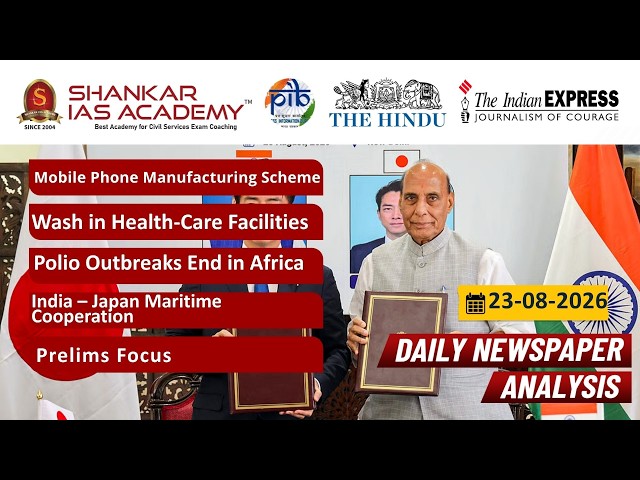
Daily Current Affairs Analysis | 23rd August, 2026 | Shankar IAS Academy | UPSC | Mains 2026
Watch on YouTubeVideo summary
The Ministry of Electronics and Information Technology has introduced a new scheme to revitalize India's mobile phone manufacturing sector, succeeding the Production Linked Incentive program which concluded in March 2026. With a budget of approximately ₹62,500 crore covering the financial years 2026-31, this initiative aims to shift the industry's focus from mere assembly to component manufacturing and design, thereby increasing domestic value addition and strengthening the supply chain. The scheme offers performance-based incentives ranging from 2.25% to 5% for large manufacturers and up to 5% specifically for Indian mobile brands, which are defined by majority Indian shareholding and control. Additionally, incentives for design, R&D, and sourcing domestic components will further promote Indian brands and attract foreign companies to manufacture parts locally, with the overarching goal of creating over 6 lakh jobs and achieving an export value of ₹15 lakh crore while reducing vulnerability to global supply chain disruptions.
In the realm of public health and sanitation, a joint WHO and UNICEF report highlights that only 40% of global healthcare facilities meet basic WASH standards, affecting nearly a billion people, though India has launched several initiatives like Kayakalp and Jal Jeevan Mission to address these gaps. The report emphasizes that while water supply is available in 85% of facilities, hygiene services and waste management remain critical challenges, particularly in conflict-prone regions like the Sahel where environmental cleaning practices are minimal. To combat healthcare-associated infections and antimicrobial resistance, basic norms now mandate specific toilet facilities for staff, sex-separated restrooms with menstrual hygiene support, and accessible toilets for people with disabilities. Concurrently, the WHO's 2026-2035 strategy prioritizes reducing deaths caused by unsafe water and building climate-resilient infrastructure to ensure equity for vulnerable communities.
Global developments also marked significant progress in disease eradication and international policy discussions. The World Health Organization confirmed the end of poliovirus type 2 outbreaks in five African nations, including Burundi and Uganda, signaling a major step toward elimination through improved immunization and surveillance despite the virus's potential to cause irreversible paralysis via fecal-oral transmission. On the legislative front, proposals under the Save America Act sought to reform US elections by introducing biometric voter IDs and limiting mail-in voting, drawing inspiration from India's high-participation general election, though these measures faced congressional division and resulted in a Senate adjournment without action. Meanwhile, Chhattisgarh made history as India's first inland state to export value-added tilapia products, a resilient fish supported by the Pradhan Mantri Matsya Sampada Yojana, while the International Day of Remembrance for terrorism victims observed on August 21st focused its 2026 theme on "Healing through Memory" to protect survivors from exploitation and promote psychological well-being.
Read the full video transcript
[music]
Hello everyone, welcome to the daily
current of affair analysis brought to by
Shankar Academy 23rd August 2026. Before
getting into the discussion, please make
sure that you subscribe to our YouTube
channel. If you haven't, please do
subscribe and also hit the bell icon to
receive on time updates from the
academy. And before getting into the
discussion, we have an important
announcement. It is regarding the
pre-torrming UPSC train series. Batch
one at the Shangreas Academy Ananagar
will be starting on 7th September 2026.
So the offline batch for the first batch
pre-torming is exclusive for the
Ananagar center. Those who are planning
to take online, they can write the exam
after 2 days of offline uh test. And uh
if you join this batch, you will be
receiving last 10 years of PY2
compilation in subject wise. So those
who are aspiring or those who are
preparing for 2027 prelims, please do
register and crack the prelims in 2027.
And coming to the topics for today's
discussion, the first topic is about
mobile phone manufacturing scheme. So
now the ministry of electronics and
information technology notified this
initiative to boost the mobile phone
manufacturing uh design and research and
development in India. And the next topic
is wash in healthcare facilities 2025
2036. So this is a report released by
the WHO and UNISAP which studied the
development of wash infrastructure in
the healthcare facilities. And the third
article is about the polio outbreak end
in five African countries. So a recent
report from the WHO uh found that the
five African countries they have
successfully stopped the polio outbreak
and it's not about eradication they
stopped the polio outbreak in their
territory. So we'll be discussing what
are the initiatives or the strategies
adopted by them and also we'll be
discussing the basic facts about the
polio infection and uh fourth article is
about the memorandum of agreement on
maritime cooperation signed by India and
Japan. So we'll be discussing what are
the area of cooperation under this uh
memorandum of agreement and what are the
major developments in the India Japan
relations in the recent time and also
the significance of this initiative and
finally we'll be discussing the prelims
focus for the day. So if all said let's
begin the discussion with the first
article. Coming to the first article
sender notify key scheme to manufacture
mobile phone. Article is taken from the
Hindu. So on Friday the ministry of
electronics and information technology
notified mobile phone manufacturing
scheme to boost the mobile phone
manufacturing in India. We can see that
the tenure of the scheme is from the
financial year 2026 27 to 203031. And
this scheme, this mobile phone
manufacturing scheme is replacing or it
is succeeding the previous production
linked incentive scheme for large scale
electronics manufacturing which was
started in 2020 and recently only this
scheme came to an end that is on 31st
March 2026. This scheme came to an end
and now it is continued by the mobile
phone manufacturing scheme. So this is
succeeding this scheme. And what is
objective? Boosting mobile phone
manufacturing in the country. Increasing
domestic value addition. One of the key
objectives strengthening supply chain
and promoting Indian mobile brand. So
these are the major schemes of this
mobile phone manufacturing scheme. And
what is the nal ministry? The ministry
of electronics and information
technology. So before discussing further
what is the purpose of the scheme? What
is the purpose of the mobile phone
manufacturing scheme? So we know that
currently India is the second largest
manufacturer of mobile phones in the
world. But we have certain problem. For
example, we can see that most of the
time we are depending on imported
components for manufacturing the mobile
phone and the major role of India in the
mobile manufacturing is in the assembly.
So instead of designing instead of
component manufacturing our major role
is in the assembly. So imagine that the
price of a mobile phone is around 1,000
rupees. The price of the mobile phone is
around 1,000 rupees. So in that case the
assembly value of this mobile phone is
around let's say it is 200 rupees. In
that case the value addition the
domestic value addition done by India is
just 200 rupees. So our objective one of
our objectives through the scheme is
increasing this domestic uh value
addition that means we are expanding our
role in the mobile phone manufacturing.
For example sometimes instead of
importing the components we will give
more importance to manufacturing the
components or we will strengthen the
design and research and development in
the mobile phone. So our mobile phone
domestic manu uh domestic value addition
will increase. So instead of just
focusing on the assembly, we are trying
to expand our role in the mobile phone
manufacturing through the mobile phone
manufacturing scheme which has a budget
of approximately 62,500 cr.
And talking about the target so we
already discussed so the target can be
broadly divided into two. So the first
is mobile phone manufacturing and second
is promoting the Indian mobile brand. So
we will discuss in the upcoming slide we
will discuss what type of mobile phone
can be considered as Indian mobile phone
brand. So uh the first is mobile phone
manufacturing. So large manufacturers
and companies are you know uh supported
by the government through the scheme not
just the domestic companies even the
foreign companies are also welcomed to
manufacture their components in India.
And the second is they will they are
eligible to receive the com the large
manufacturers are eligible to receive an
incentive from 2.2 25 percentage to
5%age based on the performance and
incremental production. For example,
this year the for this the base year of
the scheme is to the financial year 2026
27. So in the next year that is in 2728
if they are able to boost their
production and sale and based on that
increase uh they will receive increased
incentive and the next is Indian mobile
phone brand. So we are focusing the
scheme is focusing on promoting Indian
mobile phone brand that means
Indianowned mobile phone at least 51%age
of the uh uh stock has to be owned by
the Indian citizens only that will be
considered as Indian brand under this
new scheme and we can see that they are
eligible to get 5%age of manufacturing
incentive 3%age more than three or more
than 3%age of incentive for Indian
design and research and development and
up to 1.5%age of incentive for domestic
component sourcing. For example, if they
are components like chips and other
things from the domestic market, then
for that also the Indian brand mobile
phones will be able to get more uh
incentive and we can see that additional
uh non-fiscal support also will be
provided by the government for example
you know uh senders facilities to
manufacture the components all this
support will be provided by the
government for the Indian brand through
the scheme and uh so what qualifies as
an Indian brand according to the mobile
phone manufacturing scheme. So here we
will support only genuine Indian on
brand. Some of the criteria are there.
For example, the company has to be
registered or incorporated in India and
more than 50 51%age of the shareholding
will be from the Indian citizen and
management uh and control by the Indian
citizen and Indian ownership of
intellectual property and trademark
in-house design and research and
development capabilities in India. So if
the company has all these criteria only
that company will be classified or
qualified as Indian brand in the uh as
per the uh mobile phone manufacturing
scheme
and uh talking about the significance so
we can see that this is continuing the
previous PLI scheme on large scale you
know electronic manufacturing. So what
is the significance of this mobile phone
manufacturing scheme? So the first is
economic significance. So as per the
prediction we you know we uh we can see
that at least six lakh plus jobs are
expected through the scheme and this
will definitely give a boost to the
electronic manufacturing uh export
value. So we are planning to attain an
export value of approximately 15 lakh cr
through this uh scheme and the strategic
yes we we can see that these days the
supply chain is getting more vulnerable
right uh you know recently many
companies uh increased their uh product
price by more than 50%age we saw that
many larger companies so in such case we
can bring you know if we can boost our
re uh design research and development
domestic component sourcing Then to an
extent we can uh reduce the shock uh
created by the uh you know uh in the
global level. For example uh some
sometimes the supply chains will be
affected. In that case the the price of
the components will increase. So such
shock can be absorbed or such shocks can
be addressed if we can give a domestic
base for our manufacturing. And next is
technological support. So the scheme
promotes Indian design, research and
development, IP and technology transfer
and next is ultimately the objective of
atmandraharbara. So it is a major step
towards self-sufficiency and also the
self-sufficiency is very important for
the vigasid bar vision of 2047.
Right? So these are the major
significance of this uh mobile phone
manufacturing scheme brought by the
government. And now we are going to see
a prelims practice question. The
question is with reference to the mobile
phone manufacturing scheme consider the
following statements. Statement one, it
provides incentives to large mobile
phone manufacturers and electronics
manufacturing services companies. Yes.
Statement two, Indian mobile brand can
receive an additional incentive of
10%age for domestic design and research
and development. No. 3%age right for the
for the domestic component sourcing it
is approximately 1.5%age.
So the statement two is incorrect not uh
10%age immediately. So the statement two
is incorrect. And statement three uh it
is implemented by the uh ministry of
electronics and information technology.
Yes, they are the nal ministry and they
are the uh ministry of information
ministry of electronics and information
only notified the scheme. So the correct
answer is going to be yes option C one
and three only. So with this we will
move to the next article. Coming to the
second article only 40%age of the
world's health facilities meet basic
sanitation standards. Article is taken
from the Hindu. So recently the WHO and
the UNICEF they jointly conducted a
study to assess the development of wash
infrastructure in the healthcare
facility in the last one decade and they
found that only 40%age of the healthcare
facilities across the world meets the
basic standard and 11%age of the
healthcare facilities do not have any
sanitation standard or sanitation
mechanism and this can affect
approximately 936 million people. So in
this background let us understand more
about this article. So talking about the
report so based on the study they
published a report and the report name
is wash in healthcare facilities 2015
2025. So uh this is assessing the
development of the wash infrastructure
in the healthcare facility in the last
one decade and and we found that only
40%age of the healthcare facilities
globally meet the standard and 11%age of
the facilities lack sanitation services
altogether and this can affect
approximately 936 million people. Okay.
And talking about the basic water
service 85%age of the facilities have a
basic water service. So the question is
what about the quality of the water
and the next is basic hygiene service
only 72%age of the uh facilities have a
basic hygiene service and talking about
healthcare waste management 71%age of
the facilities only 71%age of the
facilities follow the healthcare waste
management uh system and uh the next is
the practice of environmental cleaning
so we can see that only 60%age that is
59% So only 60%age of the healthcare
facilities have this practice of regular
environmental cleaning. And talking
about different regions we can see that
least developed countries in the case of
least developed countries only 24%age of
them meet environmental cleaning
standard. That means only 24%age of the
healthcare facilities in the least
developed countries meet the basic
environmental standard. And next is
regional variation. So the healthcare
facilities in the staharan region only
23%age of them meet basic sanitation
standard and in the case of central and
southern Asia only 55%age of the
healthcare facilities meet basic uh
health sorry sanitation standard. So
from this we can understand that the
practice of basic sanitation standard
and the practice of environmental
cleaning is not properly followed in
many healthcare facilities and also
there is a high health inequality
because we can see that in the case of
subsaharan region only 23%age of the
healthcare facilities have a basic
sanitation standard and we know that the
subsaharan region especially the the
Sahil region is considered as one of the
most highly instable regions in this
world because of various conflict Right.
And if you take the case of this uh
global terrorism index of 2025, we can
see that as per this report now the
epicenter of terrorism is Sahil region.
So the the Sahil region as well as the
other regions of Africa is getting more
affected because of the conflict and
other issues. And now we can see that
only 23%age of the healthcare facilities
have a basic sanitation. So this is
raising concern about health inequality
globally. And uh talking about the wash
infrastructure, what is mean by wash
infrastructure? Actually wash is not
just infrastructure, it is also a
behavior. It is a behavior pattern to
maintain basic hygiene and also to
prevent infection and also to ensure
safety. So uh wash infrastructure refers
to the physical health sorry physical
system and facilities that provide safe
water supply, sanitation facility,
hygiene practices to communities,
schools and healthcare centers. So these
are the set of practices and systems or
facilities that provide safe water. So
the safe water uh water supply. So the
water supply. So the wash is coming from
the WA for the wash is coming from water
and sanitation. H is S is coming from
sanitation and H is coming from hygiene.
So this safe water supply, sanitation
facility and hygiene practices. These
are the basics of the wash
infrastructure. So it is not just the
physical facility but it is also a
behavior a set of behavior that we
practice to prevent the uh uh infection
and also for the environmental safety.
And uh the next is basic sanitation.
What is mean by basic sanitation
according to who? One of the aspects is
a a healthcare facility should have at
least one usable toilet for the staff.
And the next is at least one sex uh
separated toilet with a menstrual
hygiene facility. And the next is at
least one toilet accessible to people
with the limited mobility. So imagine
that the people who are using that that
means for example if a patient with some
infectious disease he's using a toilet
and another person and an an uninfected
person is also using the same toilet
right it will increase the risk of
spread of infection so that is why
according to the basic sanitation norms
of who there should be a separate toilet
for the healthare staff pe uh infected
people and also people with mo limited
mobility or facing other physical uh
difficulties. So we can see that only
40%age of the uh world health facilities
have the basic standard. And the next is
the concern about the environmental
cleaning. What is mean by environmental
cleaning? Environmental cleaning is also
a part of the wash behavior. It is also
a part of the wash behavior. So
environmental cleaning includes a
systematic practice a daily systematic
practice of removal of debris waste uh
from the surrounding to keep the
surrounding clean pathogen free and also
for the environmental safety and we can
see that only one in 10 healthcare
facilities or or or just 60%age of the
healthcare facilities across the world
follow this practice regularly. So this
is another area of concern.
So we can see that uh 72%age of the
facilities have hygiene facility basic
hygiene only 85%age of them have water
supply and we can see that only 40%age
of them have basic sanitation standard
and only 60%age of them have the reg the
regular practice of environmental
cleaning. So what are the major concerns
associated with this? The first is the
increased risk of infection. So we can
see that the poor wash increases
healthcare associated infections that is
one of the major concerns. For example
the uh the healthy person and infected
person both are using the same toilet
both are using the same facility that
will increase the risk of infection. And
next is the the possibility the threat
of antimicrobial resistance. So we know
that one of the major reasons behind the
AMR or the antimicrobial resistance is
nothing but unscientific use for the
practice of medicines and also limited
sanitation. So the limited sanitation
will give opportunity for the pathogens
to enhance its immunity. So it will be
more stronger and now fighting this
infection or fighting this pathogen will
be more costly. So this will increase
the risk of poverty and also health
vulnerabilities. Next is the unsafe
based management will lead to
environmental hazard. Right? And next is
data gap and also healthcare inequality
can be seen. So we can see that we are
uh this as a part of this uh assessment
or as a part of understanding the health
sorry the wash infrastructure we have
assessed only certain aspects of the
basic standards of sanitation and
hygiene. There are many aspects are
still remaining to be studied. So that
is addressing that is uh reminding us
about the gap in the assessment of the
healthcare facilities and next is the
the report is also highlighting that
from this report we can understand about
the health inequality like I mentioned
the Sahel region the subsaharan region
uh if you take the subsaharan region
only 23%age of the healthcare facilities
have basic standards so that is rising
the population in this region is already
vulnerable because of various conflict
economic vulnerability social issues
ethnical tension but now the healthcare
facility is also very limited. So that
is increasing the risk of health risk
for those people
and government initiatives. So what are
the government initiative? That is what
are the government Indian government
initiatives that we have taken so far to
address or to develop the wash
infrastructure and wash behavior. So we
have the umbrella program that is futar
mission since 2015. So we know that the
Kuchbar mission is working on uh you
know uh the waste management uh and also
eliminating for eliminating the practice
of the open defecation and we know that
we have the Swatchbar mission Grammy
so with which is exclusively focusing on
the uh the rural healthcare and the
sanitation and currently we are in the
face of Kushbar 2.0
Right. And next we have the Jal Jan
mission which is launched by the
ministry of Jal Shaki which is focusing
on providing portable water to the
household every household in India. And
this mission is also focusing on water
safety. That means it will uh you know
make sure that the water is pathogen
free and also it does not have any
chemical chemical pollutants. And next
is the project of Namabi Ganga. So Nami
Ganga is focusing on the holistic uh you
know waste management regeneration of
the the Ganga basin and also its
biodiversity and next is Adal Bjal
Yojana which is focusing on the
groundwater management with the
community participation and this is
focusing on the safety and basic stand
you know basic conservation standards
for the groundwater and in the case of
India we can see that 60%age of the
agriculture water is taken from the
groundwater so that is one of the major
issues faced by the groundwater resource
of this country and uh
yes we cannot
uh you know we cannot uh uh remain
silent about this kayakalp initiative.
So we know that kayakalp initiative was
an umbrella initiative taken by the
government of India in 2015 uh to
improve the uh cleaning hygiene and
quality of public healthcare facilities
in India. So this initiative was
launched by the ministry of healthare
sorry the ministry of health and family
welfare. So what are the key areas of
this initiative? The first is hospital
keep up and sanitation. Next is hygiene
and cleanless and the next is biomed
biomedical waste management. So we know
that in 2015 we brought the biio
biomedical waste management for managing
the hazardous waste from the hospital or
from the healthcare. And next is
infection prevention and control. So
these are the key focus area. These are
the four focus area under the kay
initiative. One of the major initiatives
taken by the government of India in 2015
and we have improved this initiative. We
have made a lot of changes in this
initiative in the later years. And uh we
can see that this the approach of this
initiative. So it's a it is based on
rewarding approach that means the
hospitals or the healthcare facilities
which have a better waste management
better uh infection control they will be
rewarded after assessment
and uh considering the wash
infrastructure strain or the the the
issues associated with the wash
infrastructure. Now the world health
organization have launched wash strategy
202635
so this initiative is focusing on
reducing 1.4 4 million annual death
cause preventable annual death caused
from unsafe water, sanitation, hygiene
and waste and uh talking about the key
focus. So norms and regulations. So it
is focusing on strengthening the global
standard for the wash behavior and
infrastructure and it is another area is
monitoring the healthcare facility
through improved data collection
identifying the inequalities and guide
investment. And next is health
integration. That means integrating the
practice of wash into healthare and
universal health uh universal
healthcare. And next is making the wash
infra infrastructure climate resilience.
So we know that climate change is one of
the major reasons that changes the
epicenter of disease disease pattern as
well as it will it can also support the
antimicrobial resistance. So, so
addressing this issues and enhancing the
WASH system to uh face this challenge is
one of the objectives of the WASH
strategy of WHO. And next is equity that
means uh when whenever healthcare policy
is trained uh focus will be given to uh
women vulnerable community and
underserved communities. And next is
infection control that means reducing
the uh antimicrobial resistance
enhancing the hygiene practices in the
hospital. So these are the major
strategies under the WASH strategy of
202635 by the WH and UNICEF also
cooperating with the WHO for the
implementation of this strategy. And now
we have the prelims practice question.
The question is with reference to the
WHO wash strategy 2026 20U 35. Which of
the following are the are among its key
priorities?
Statement one climate resilient wash
infrastructure. Yes. Statement two, aims
to reduce 1.4 million annual death
caused by unsafe water and hygiene. Yes.
Statement three, strengthening
antimicrobial resistance prevention
through improved hygiene. Yes. All the
uh three comes under the priority areas
of the wash strategy of WH. So the
correct answer is going to be option D 1
2 and three.
Yes, with this we will move to the next
article. Coming to the third article,
five African countries mark end of coro
outbreak according to WHO. So recently
the regional office of WHO in Africa
conducted independent outbreak response
assessment from January to June 2026. So
they conducted the assessment for the
last 6 months and the report from the
assessment confirmed that the outbreak
of polio type 2 virus in five African
country has ended and they are Gurandi
Ga Ghana Gaia Bisau uh Republic of Congo
and also the nation of Uganda. So we are
not talking about the elimination of
polio. So these five countries have
stopped the polio outbreak in their
territory. So this is indicating a slow
progress in polio eradication efforts of
Africa and it is also reflecting the
improvements in routine immunization,
disease surveillance, laboratory
capacity, vaccination campaign and the
community outreach in the African
region. So we know that polio was the
biggest concern for many nations uh in
the past. So in the case of India the
last polio case was reported in 2011 and
after 3 years that is in 2014 India was
declared polio breath. That means now
the polio is not a public health concern
in India. But that is not the case of
Africa. In many regions of Africa, the
polio is still a public health concern
and frequent outbreaks are also reported
in many countries. And now we can see
that five African countries that is
Burandi, Ghana, Gunabisaw, Uganda and
the Republic of Congo, they have stopped
the polio outbreak in their region
through various measures. So they
haven't eliminated it as a public health
concern. Instead they have stopped the
outbreak of the polio virus. Maybe in
the very future that is in the near
future they may eliminate it as a public
health concern. So this development is
seen as a major progression uh towards
the elimination of or eradication of
polio efforts in the Africa
and the strategies. So what are the
different strategies adopted by the
countries? So in the case of Burundi
they mainly focused on routine
immunization and environmental
surveillance. So we know that one of the
major reasons behind the spread of this
polio is nothing but limited sanitation.
So through environmental surveillance
through environmental cleaning and also
through routine immunization in targeted
population the burundi has stopped the
polio outbreak in their territory. And
in the case of Ghana they improved the
laboratory cap capacity for better
testing and also they focused on
surveillance. And in the case of Uganda,
they intensified their surveillance and
also intensified their outbreak
response. That means immediate they
focused on you know immediate response.
That means that includes uh you know
immediate identification of infected
people in a population and giving them
adequate care. And next is in the case
of Gina Bizo that they focused on
targeted vaccination of underserved
communities. and the case of in the case
of uh Republic of Congo, they focused on
multiple vaccination campaigns and also
strong surveillance to deal with the
polio outbreak. So these are the
different strategies adopted by the the
five countries in Africa to stop the
polio outbreak. And talking about polio,
so we know that polio and it is also
known as polomiitis. So it's a highly
infectious viral disease that mainly
affecting the children especially
children under the age of five and this
can lead to irreversible paralysis or
death in the people and we know that uh
the polio virus will be attacking the
central nerve system. So it will attack
the nerve system of the people. So what
happens the signal from the nerve system
will not reach the muscle. So over
period of time the muscle will lose its
strength and eventually it the the
person will end up in paralysis state.
So this is how the polio will be
affecting a person. So it will be once
it enters into the human body then
through the blood it will reach the
nerve system and once the nerve system
is affected because of this virus then
the signals from the brain will not
reach the the muscles. So the muscles
will will remain inactive and over
period of time it will lose its strength
and the person will become in a they
will end up in a paralyzed stage. So
this is how the polio virus is affecting
a person. And the next is spread. So it
is mainly spread through fecal oral root
via contaminated food and water and
respiratory transmission of this
infection can also happen and silent
transmission. So we can say that most of
the infections are asytomatic allowing
unnoticed spread. So the immediate uh
you know uh evident or immediate
apparent symptoms is not uh you know
easy in the case of the uh in the case
of the polio virus. So once a person is
infected he can he can remain as a
carrier a healthy carrier for many uh
many days and this can increase the risk
of transmission and uh mainly it is
transmitted through pickle or oral root
but respiratory transmission is also
possible. So these are the facts you
have to remember regarding the the
transmission of polio and talking about
the polio so we can see that we have
abortive type of polio. So this will not
lead to major challenges or major
complication. It can lead to mild flu-l
like symptoms. And uh next is
nonparalytic polio. So here uh you know
uh brain inflammation or many menus. So
it is possible but eventually the person
may recover and also the person may
experience headache and muscle
stiffness. And next we have paralytic
polio. So this can lead to acute plastic
paralysis and may cause permanent
disability or even death.
So what are the uh methods that we have
to deal with the polio? So the effective
method there is no cure for polio. We
can treat it, we can prevent it. So the
effective or the best method to deal
with the polio is vaccination. So the
prevention is the best method against
the polio infection. So vaccination
along with the sanitation, hygiene and
proper disease control or disease
surveillance is the effective strategy
to fight against the polio. And we can
see that now many countries in this
world have declared polio free. That
means the polio is not a public health
concern in their territory. And talking
about polio, we have a silent crisis
related to polio that is the post polio
syndrome. So postpolio syndrome is
nothing but sometimes the people will
identify the polio in the very early
stage and before getting complicated uh
before getting into complex uh stage of
infection they will also make recovery
but after many years that means once the
person gets
into their 50s or 60s the symptoms will
reappear the symptoms will reappear and
that is known as postio syndrome. The
symptoms is not always necessary to end
up in paralytic stage. Sometimes it can
lead to permanent inflammation in the
muscles you know mobility issues and
all. So posttop polio syndrome is one of
the major challenges that we are facing
as in dealing with the polio. So even
though if we can save this person uh
through early diagnosis still the
concern or the challenge of the
postpolio syndrome is there. So
postpolio syndrome is nothing but the
reappearance of the polio symptoms after
years of recovery. So this will mostly
happen in their 50s or in their 60s and
uh
global polio eradication initiative. So
we can see that we have made a lot of
progress in the polio eradication and
the the umbrella program for the
eradication is the global polio
eradication initiative which was
launched uh in 1988 by the world health
assembly and it is implemented by world
health organization other health
specialized health agencies national
governments along with the support from
NGO and also uh you know uh other
research foundations and we can see that
achievement we have reduced the polio
cases by more more than 99%age and core
strategies in the eradication program
includes mass immunization both
vaccination and also treatment and next
is the surveillance that means you know
that includes environmental surveillance
tracking the population you know
identifying the risk area and all and
next is the novel oral vaccine to
control type two variant polio virus so
this is the vaccine that we are giving
to children to prevent the polio and
next is targeted measure that includes
high-risk area vaccination, crossber
coordination and innovative delivery
methods. So these are the major
strategies under this global polio
eradication uh initiative to control the
polio. And now we can see the map of the
the polio risk map of the world. We can
see that almost 80 more than 99%age
polio cases have reduced and also we can
see that most of this world regions are
free from polio but it is still
remaining as a problem in certain areas
for example in Papiaania in uh in the uh
in certain parts of Southeast Asia in
Afghanistan and
uh Pakistan and in certain areas of the
northern uh part of Europe and uh but
the majority are the high-risk
population or high-risk region is still
in the uh Africa but now we can see that
the African nations are also making
progress in the polio eradication
efforts. So maybe in the coming future
maybe in the near future we can expect
all these regions to be polopree
and now we have the prelims practice
question. The question is with reference
to polomiotis consider the following
statements. Statement one polio virus is
primarily transmitted through pickled
oral root. Yes. And statement two, acute
flaccid
paralysis is an important indicator used
in polio surveillance. Yes, you know
muscle loss eventually the person will
lose the muscle. So this muscle loss is
one of the indicators of the polio
surveillance. And statement three polio
infection always produce visible
symptoms in the infected person. No many
weeks the person can remain without any
symptom and that is one of the major
challenges in fighting the polio. So
remaining uh two statements are correct.
The first and the second statements are
correct. Third statement is incorrect.
So the correct answer is option A 192
only. Yes. With this we will move to the
next article. Coming to the fourth
article India Japan Maritime security
pact what new memorandum of arrangement
means? Article is taken from the Hindu.
So on 20th August India and Japan signed
a memorandum of arrangement on maritime
security cooperation and in this event
India was represented by the Indian
defense minister Rajna Singh and Japan
was represented by their defense
minister Shinjiro Koi. So the objective
of this meeting or objective of signing
the memorandum of arrangement is making
the India Japan maritime cooperation
more regular structured and more
operational. So let us see what are the
areas of cooperation under the
memorandum of arrangement. So the first
is maritime domain awareness. So this is
focusing on establishing uh a a robust
framework for intelligence and
information sharing for better maritime
surveillance and security. And the next
area of focus is search and rescue. That
means joint coordination and support
during the time of maritime accident and
emergencies. For example, during the
time if there is any uh you know
shipwreck or uh any uh oil spill or any
other disaster that time both nations
will cooperate for saving the life. And
next is the humanitarian assistance and
disaster relief. So both countries will
be cooperating during the time of
cyclone, tsunami and flood and also
other disasters. So we know that the the
frequency of cyclone in the Indian Ocean
is increasing especially in the Bay of
Pengra and we know that Japan is located
in the uh in the region where more
earthquakes are knowing. So the Japan is
more vulnerable to earthquake and India
is experiencing higher frequency of
cyclones in the recent times. Therefore
area uh this cooperating in this area is
very important for both the nations. And
next is establishing key lines of
communication to protect key roots of
trade, energy and supply chain. So we
know that uh in the India Pacific region
it is very important because we are
going for you know oil exploration in
the Anaban basin and also uh Indepacific
you know uh this Indian Ocean region
carries 70%age of the total trade volume
of the world. So ensuring uh the or
protecting the supply chain is very
important for both Japan and India. And
next is naval cooperation. So uh this
includes regular ship visit, joint
exercises, personal and expert exchange
for you know better uh you know capacity
building. So we we already know that
both nations are carrying out uh
exercises like Japan, India maritime
exercise, Dharma Guardian. Dharma
Guardian is an army exercise between
Japan and India and next is beer
guardian. So it is an air exercise
between India and Japan. So both
countries are already focusing in this
area. NXT is logistics and ship relief
sorry ship repair. So it is uh focusing
on cooperating for uh port accesses,
maintenance and ship repair.
And we know that India is known for ship
recycling. No. Uh and at the same time
we know that uh India in the recent time
we are focusing more on uh you know
exporting that means uh import and
export that means establishing
infrastructure for boosting the export
and import and the next is other
developments. So what are the other
areas of developments that we can see uh
in the relation between India and Japan
in the recent time. So the first is
defense manufacturing. So both countries
are focusing on defense manufacturing
using their own capacity. For example,
India is known for production and ship
building capac capability while on other
side Japan has advanced maritime
technology and expertise. So both has
their own strength. So both countries
are using their strength to shift their
relation towards defense uh
manufacturing rather than just you know
selling the defense equipments. And the
next is technology and research and
development. So both countries are
especially the DRDO the defense research
and development organization and also
the acquisition uh of technology and
logistics agency of Japan. It is a it is
a it is it is an agency working under
the ministry of defense in Japan and
they are responsible for defense
equipment acquisition and all. So uh
DRDO and the ATLA they are cooperating
for you know exchange of the research
and development design and also you know
uh other technology transfer
and uh next is unmanned system. So more
complex and technologydriven exercises
are in the list of Japan and India and
the both countries are also focusing on
uh third country cooperation. That means
India and Japan they are cooperating to
expand their relation with the third
country. For example the uh the PAS so
PAS it is a trilateral naval exercise
that includes India, Japan and
Indonesia. So both countries are
focusing on expanding their uh you know
relation with the other countries. So
the re this exercise was recently
conducted in the month of February 2026.
So both countries are cooperating to
expand their uh relation with the other
countries. NXT is Indopacific logistic
network for logistic support for
disaster relief and humanitarian
assistance. So these are the other major
developments that we can see in the
recent time in the India Japan relation.
So what is the significance of this uh
new development? So the first is
operation inter operational
interoperability or you know uh so like
I mentioned the the the naval exercises
cooperation in the field of disaster
relief cooperation in the field of
search and rescue technology transform.
So this is enhancing the mutual
capacity. So strengthens the naval
coordination through exercises and
exchanges. Next is shifted towards
defense manufacturing. So very long for
a very long time India was a consumer
but now India is moving towards
co-manufacturing the defense equipments
with other countries. So recently we
have established this framework with
France and now we are moving with the
Japan one of the highly technologically
advanced countries in this world. And
next is technology transfer. So we know
that Japan has high technology and
expertise uh in various field from
camera to highly advanced know disaster
response. So this will be useful for
India. And next is India Pacific
stability. So we know that these days we
are exploring more opportunities in the
way of Bengal and other areas of
Indopacific region and Indian Ocean
carries nearly 30 sorry 70%age of the
world trade volume and we can also see
that India has a maritime border of
approximately 7,500 kilometers. So India
is more responsible. India has more
responsible and also more potential in
the in in the Indian Ocean region and
therefore in in in this situation you
know a a support from a highly advanced
country especially a country like Japan
is very important. And next is disaster
response. Both countries are going to
get benefit from this. Japan is more
vulnerable to tsunami and earthquake
while India is more vulnerable or India
is facing the problem of increased heat
wave, cold wave and also cyclone. And
next is strategic balance. So Japan it
is located in far east and India we have
done enough to expand our uh you know uh
influence or our strong relation with
the west but now we are moving towards
east. So it is a you know uh it is a it
is a the cooperation with Japan is going
to expand our act east policy act first
act east policy.
we can maintain uh know uh a strong
relation with both the west east and
also with the far east world and we know
that recently we are know we have made a
lot of progression in uh concluding the
free trade agreement with the New
Zealand right so in this way we are
expanding our influence towards the far
east so this the cooperation with the
Japan is very important in our in our
stability in our stability in the
Indopacific region and also in the far
east region so these are the major
significance of
India Japan Maritime Corporation. And
now we have a mains practice question.
The question is the India Japan maritime
security marks a shift from symbolic
defense corporation to operational
maritime partnership. Discuss its
significance for India and the
Indopacific region. So it's a 15 marks
question and you have to write around
250 words. Write the answer. Post it in
the comment section. We will review and
we will reply for your answer. Now it's
time to move to the prelims focus for
the day. Coming to the prelims focus for
the day. The first topic is save America
act. So the save America act was
proposed by the US President Donald
Trump recently to bring certain reforms
in the American election system. So what
are the major proposals done under the
save America act? First is proof of
citizenship to register in the uh in the
electoral role and second is linking the
voter ID to the biometric database and
the next is nationwide voter ID card and
also limiting the vote by mail. So we
can see that this proposals or this
reforms proposed by the US president
under the slave America act is highly
inspired from the election of the India.
So American president also praised the
Indian election uh and and also the
democratic participation that he said
over 4 sorry 646 million people
participated in this general election of
India and just 1%age or less than 1
percentage of them voted through ballot.
So uh he's uh know from this inspiration
he proposed certain reforms in the
American election system through the
save America act but we know that there
are many ground level issues in the in
the special intensive ind intensive
revision in India and we are witnessing
it every day right so uh the the
reaction from the US was also similar
because uh the the bill led to a
division in the congress and the the
senate was adjuned without any action
and uh the next is tilapia product
export. So, Chhattisgarh became the
first inland state in India to export
value added tilapia product. So, what is
tilapia? It is the fish. Tilapia is
actually a fish and it is known as
aquatic chicken. So it is known known as
aquatic chicken because we know that
fishes they are one of the most
sensitive organisms in this world
because the saltwater fish may face
difficulty in surviving in fresh water
and also the freshwater fish may face
difficulty in surviving in the salt
water. So we know that the fish is one
of the most sensitive
beings in this world but this tilapia
fish is like a chicken because it can
survive in backyard bond to large scale
aquaculture facilities. So the
flexibility of this fish to survive in
any situation makes this fish the
aquatic chicken. And uh we can see that
the Chhattisgarh government is it is
developing many infrastructure under the
Pradan Madri Mati Sam Yojana to promote
the cultivation of tilapia. And next is
next topic is international day of
remembrance and tribute to the victims
of terrorism 2026. So international day
of remembrance and tribute to the
victims of terrorism. It is annually
observed on the 21st August to honor
victims and survivors of terrorism. So
this was established by the United
Nation uh by the United Nation General
Assembly resolution 72 bar 165 in 2017
and this year the theme of the day is
healing through memory promotes
victim-entered trauma-informed
remembrance. And uh so healing through
me memory means it is focusing on you
know uh prevention of uh the trauma you
know the psychological well-being of the
people I know. So we can see that it is
the the major focus of the day is
protecting the victim from secondary
harm. So we know that the once a region
is affected because of terrorism the
people will lose everything right and
they are more vulnerable and they will
face the cascading effect of such
catastrophic events like exploitation
you know uh and other issues. So
protecting the people the survivors from
the secondary arm is one of the major
objectives of this year's theme and next
is re retraumatization and online abuse.
So uh you know this is addressing the
emerging challenges faced by the the
survivors and victims of the the the
terrorism. So uh prevention of retro uh
traumatization
prevention of online abuse and also
protection from the secondary harm. So
these are the major focus of this uh
international day of remembrance and
tribute to victims of terrorism day. And
u now we have the prelims practice
question. The question is consider the
following statements regarding tilapia.
Statement one, tilapia is a freshwater
fish widely cultured for food
production. Statement two, it belongs to
the family of uh cichlide fishes. And
statement three, it is naturally endowed
with the tilapia. Uh sorry, India is
naturally endowed with the tilapia as an
indigenous fish species. So which of the
statements given above is are correct?
Option A one and two only. Option B two
and three only. Option C one and three
only. And option D 1 2 and three. So you
can mention the correct answer in the
comment section or you can check out our
link for the answer. So try to answer
the question post it in the comment
section. We will reply for that. With
this we are coming to the conclusion for
today's prelimin forecast. With this we
are coming to the conclusion for today's
current affair analysis. If you like the
video hit the like button give your
feedbacks as comments and share this
content with your friends. And before
leaving this channel don't forget to
subscribe and also hit the bell icon to
receive on time updates from the
academy. Thank you for listening to us.
Thank you for listening to me. Have a
nice day.
>> [music]