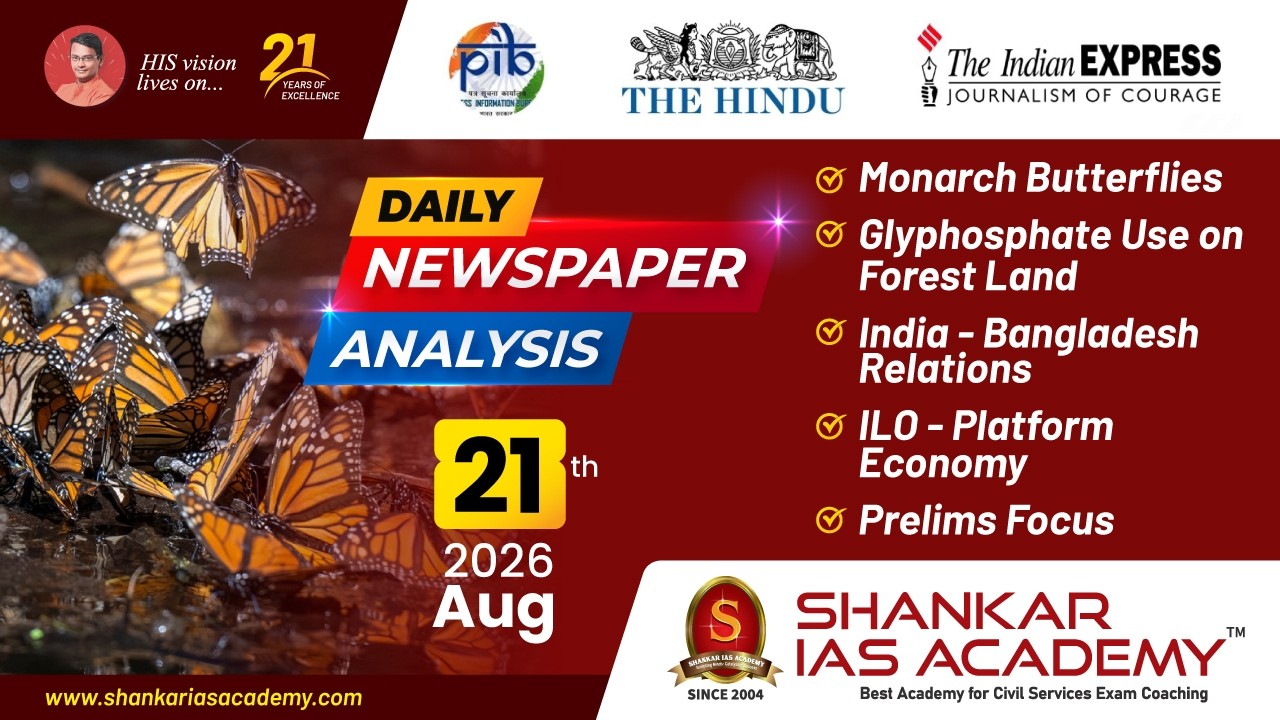
Daily Current Affairs Analysis | 21st August, 2026 | Shankar IAS Academy | UPSC | Mains 2026
Watch on YouTubeVideo summary
The daily current affairs analysis for August 21, 2026, opens with a significant scientific development regarding the Monarch butterfly, which has been added to the endangered species list due to habitat loss and climate change. Scientists in California have introduced solar-powered radio backpacks to track these migratory insects from North America to Mexico, monitoring their health, weight, and movement patterns without interfering with their natural lifecycle. The analysis highlights the unique symbiotic relationship between the butterfly and the milkweed plant; caterpillars rely exclusively on this toxic leaf for food, which grants them immunity against predators while storing toxins in their bodies. This biological defense mechanism is further reinforced by the Viceroy butterfly, which mimics the Monarch's orange and black coloration to deter predators through Batesian mimicry. The tracking initiative aims to understand how climate change affects migration routes and the availability of nectar-producing plants, providing crucial data for conservation efforts under GS-1 and GS-3 perspectives.
The discussion then shifts to environmental concerns surrounding the use of glyphosate on forest land in Himachal Pradesh, where illegal pea cultivation led to its application, sparking legal action. Glyphosate, a systemic herbicide that inhibits the shikimate pathway essential for plant amino acid synthesis, poses severe risks to soil health, water resources, and biodiversity, particularly in fragile mountain ecosystems prone to erosion. While the Central Government has ordered restrictions on its use due to concerns over human carcinogenicity and ecological damage, implementation remains contested. The analysis emphasizes that beyond chemical contamination, the conversion of forest land into agriculture causes habitat fragmentation and disrupts ecosystem services. Consequently, the way forward advocates for integrated weed management using mechanical and manual methods, mulching, and cover crops to reduce dependence on hazardous chemicals while protecting community water resources and local livelihoods dependent on natural resources.
In international relations, the focus turns to the evolving dynamics between India and Bangladesh following the victory of the BNP party under Tarique Rahman in 2026, which marks a geopolitical shift with a tilt towards China and Pakistan. Despite the political rupture and diplomatic freeze caused by minority concerns, border friction, and water disputes over the Teesta river, the bilateral relationship remains anchored in six critical pillars: trade, energy connectivity, cultural ties, tourism, security cooperation, and diaspora links. India continues to be Bangladesh's largest South Asian trade partner, supplying vital power and diesel, while maintaining infrastructure links through railways and inland waterways. The analysis suggests that despite strategic challenges like the China factor and stalled water treaties, sustained engagement across economic and political realms is essential. It recommends leveraging soft power, public diplomacy, and multilateral forums like BIMSTEC to strengthen ties, ensuring that energy lifelines are not weaponized and that regional stability is maintained through constructive dialogue rather than confrontation.
Finally, the session addresses the regulation of the platform economy in light of the 144th International Labour Conference's adoption of Convention 193, which mandates protections for gig workers such as fair compensation during idle time, transparent rating systems, and data privacy. India's current stance involves extending labor protections through existing laws like the e-Shram portal and the Code on Social Security, yet gaps remain regarding minimum wages, earnings floors, and algorithmic transparency. With millions of gig workers operating across multiple apps without upskilling opportunities or job security, the analysis calls for a reform that classifies worker status based on reality rather than contract labels. State initiatives in Rajasthan, Karnataka, and other regions are noted as steps toward creating welfare boards and security funds. The conclusion advocates for enforceable rights, algorithmic audits to ensure explainable systems, and a balance between employer flexibility and employee dignity, urging the government to adopt binding standards that prevent arbitrary deactivation and ensure fair treatment for all platform workers.
Read the full video transcript
[Music]
Hi Hello and Welcome to Shankar IS Academy's
Daily Current Affairs Analysis and Today's Date
is the 21st of August 2026. So please like,
comment, share and subscribe to our
YouTube channel and hit the bell icon to
receive instant updates and all our
notifications. So, with that I also have a
small announcement to make on behalf of Shankar
IS Academy, that is the pre-storming test
series is starting and you can see a
QR code mentioned here, right? You can
scan this to get the reflections from
previous year based on the test series,
what are the amount questions that have been
reflected in the actual UPSC
exam. And also the admissions are open now.
You can take this test both online and
offline. So offline you can take the test in
Shankar IAS Academy Anna Nagar Branch. So
please call the number 9003090031
for any more information regarding this
particular pre-storing test series.
So, it starts from the seventh of
September. So, ah you can also visit the
website to know more about it. With that,
let's move into the topics of discussion for the
day. The first topic is about the monarch
butterflies and what relation it has to the
milk wheat and that is also a scientific
proof that has been included here. Let's see what that is
about. The second one is
about glysphate on forest land. How is it
impacting the environment? Is it a good
impact or a bad impact? What is
happening and what are the regulations that have been bestowed
upon it. The third one is the
England India Bangladesh relations. What
happen? What is the Eunice interlude? That is
happening. So what are we going to do with that
and that is the India Bangladesh
relations that we are going to deal with this is
in the men's perspective. The fourth one is also
in the main perspective on the
Indian labour organisations and the
platform economy that is present and the
fifth one is the prelims focus for the day.
So, the first topic of the day is about the
monarch butterfly. So, this article is
taken from The Times of India. So if you see the
monarch butterfly has been added to the
endangered species list and
scientists in California have given something called
a solar powered radio
back. So this solar powered radio back is
something that is used to actually conserve
and make ah ah make them ah more efficient
and you can see where ah the monarch butterfly
is going and what is the health condition of
the monarch butterfly using this solar
powered radio back. So, let's decode in
detail with this background. So, you see so the
solar power
radio transmitters and back pack is the
first thing that you have to note. This is the one that
is relevant for the science and
technology angle. But if you see in
specific the monarch butterfly
this can be asked in the
environment.
For your prelims
GS one
GS three recent in both so now we are
going to track the monarch butterfly let's go into the
topic the appearance how does it appear it has
an orange color appearance with
black color and white color spots so white
spots black wets orange so if you see the
butterfly here
you have
the border. This place will be black. The
dominant color will be
orange.
The spots
will be white. So basically there is
a long migration journey that this
butterfly takes. It comes from North
America to Mexico. So this journey, the
North America to Mexico journey is something very,
very important because of
its migratory nature, it is also very
important. So Now You See the Route Long
Distance Migration North America and
Mexico. This route is something to be noted.
So, Across This Is Not the First Generation of
Monarch Butterfly That's Coming Towards
This Route for Migration. For generations
together for a long time these
butterflies have been taking this migration
pattern. So also the caterpillars you see there is
actually the milkweed milkweed has a
leaf. So the female butterfly, the monk butterfly,
goes on to the milk wheat plant and on the
particular leaf it lays out the eggs. The
Larva. Once the larva comes out and it is led there.
So this is where the birds ah this is where
the butterflies actually hatch. So
once they hatch they start eating this milk
wheat. So what happens? So now your
question is okay there is milk wheat? So why doesn't it go
to another
tree and let's eggs. So in this case then the
caterpillar will not be able to feed. So this is
a
symbiotic and orientationally oriented
relationship that is present. So if at all there is any other
leaf that is present this
particular butterfly will star. So it needs
milk weight for its survival. Which is why it is
both interlinked and it is
symbiotic in nature. So now the milkweed is
not a normal
plant. Milk thistle if you see it is
poisonous in nature.
So it has poisonous content but it actually
gives immunity to the catbullers. So
immunity development happens.
So now they're taking a journey from ah
North America to Mexico. Now the
question is how do they actually take
this journey and what is happening to these
butterflies. How are they finding their
directions? It's based on the Sun's magnetic
field. So again this is the beauty of nature.
So this is something again you have to keep in mind
for your prelims. Now we are done
with this slide. Let's move to the next
slide. The next slide talks about the
physical traits and defenses. So the first one
is the blight orange wings. The black color
borders white spots. So the dominant color
is orange. So it has a wing span of about
9 to 10 cm. And the gender ID
is that males will have a black spot on each
hand wing and females will have thicker wing
veins. What is Wing Wayne? So this is the
wing vane. Ok? So, caterpillars will feed on
the milk wheat. And as already told, this is a
poisoner, Ah
Leaf. This Is a Poisonous Milk V. This is a
poisonous lead. So, the toxins will go into the
caterpillar's body but the caterpillars will have
immunity to it. So they will actually
store the toxins. Once this is happening they will be
vulnerable to predators. So the
Predators Will Not Come Eat Them. And the
Viceroy Butterfly Resembles the Monarch
Butterfly. So, The Predators Will Actually Be
Deterred. They will think that oh, this vice
butterfly is also poison. Let me not go
near this butterfly. So it is also
helping other species. Now the next one
is about why are Monarch Butterflies being
tracked. See The Migratory Marathon That This
Monarch Butterfly Takes From North
America To Mexico It Is Classified
As Endangered By The Iucn Because Of The
Threat. So, the first one is the habitat loss.
In habitat loss and degradation, if you see if
milkweed is affected, there is
a direct correlation
to
butterfly decline due to climate change that also
affects the migratory potential
in the growth of milkweed. These are
pointers that you should be using in
your menu. So the decline of nectar-
producing plants will affect the
grown
monarch butterflies.
Changes in Migration Conditions
Due to Climate Change.
Difficulty
in withstanding
migration route
loss of over wintering sides
help in
better
resting. So these are the major threats that are
present and this is how the monarch
butterfly is being treated.
So what is the solar backpack? Now comes the
science and technology angle where in it is
a miniature solar powered radio telemetry
tag. It Is Attached To The Butterfice Bag. You can
remember a backpack. Have you all seen it? Dora.
So the explorer will always have the back pack.
Just Like That This Butterfly Is Going To Have
A Back Pack Where In It Converts The
Sunlight Into Power For The Device. So, you
can't find out the butterfly and take it
out of the bag and then put a charger on it
like you charge your mobile phone, right? So, this is
going to be late. And it senses
signals containing the butterfly's location.
So, you can locate it. And This Can Deduct
The Signals To Monitor Movement And Monitor
The Habit Use. So this can also be a
parallel
to the
tracking collars
in wildlife sanctuaries and national
parks.
So the information collected what are the
information you collect? First one is butterfly
sex
male amount of population.
The Other One is the female. Female is
identified using
black veins
Male is identified using spots
Weight of the butterfly
Determines
the health potential of the butterfly
The health potential of the butterfly is very
different to note ok so the health
potential of the
butterfly
Body measurements
Movement and location data helps track
migration patterns
Right weather conditions
Difference between
consumption
of caterpillar
to butterfly Use of overwintering grouse.
So, these are the information that we will be
collected with the presence of the solar back
pack that we have seen. So these are the points
basically the butterfly sex, ah the migration
routes, ah the weight, body measurements, weather
conditions and sources, and what we will do with
it. Why is it collected is in the
parallel. I have written it that. So, now with
reference to the monarch butterfly
consider the following statements. It
Undertakes Long-Distance Multigenerational
Migration Between North America and
Mexico. Yes. Caterpillars primarily feed
on milkweed which contributes to
chemical defense against predators. Yes, this we have
seen for the immunity.
Absolutely. Right. The Viceroy Butterfly
Exhibit mimics the monarch's color
and pattern. Yes. So the answer should be
option D one two and three. So let's check if this
answer is correct. Yes, the answer is option
one, two and three. With this, we have come to the
end of this topic and let's move to the
next topic for the day. In the next
topic of the day is about the glycophosphate
on forest plants. This article is taken
from the down to earth. So you see that
Himachal Pradesh, you see this is the Himachal
Pradesh forest and there is an FIR that is
going to be filed because glyco
phosphate has been used in this forest
land. And that's not something that is uh that should be
used because it is actually used
to throw out the uh unnecessary plants we throw out
those plants. So, this is Ah done to
use this land for pea cultivation. And this is
forest land in the part of the Mandi
district
and now the environmental groups have come if said that do you know
glycophosphate can
harm the environment, it can harm the soil, it can
harm the land, how can you use it?
So this is the basic one liner. Okay, with this
background. Let's move into the topics. Ah
the first one is the forest department it has
deducted that there is illegal pea
cultivation. First point the second one is
glycophosphate is used to clear and weed
out vegetation that ah actually will create a
hazard an invasive species kind of
species. Now this is raised concerns over
water, biodiversity, livestock and
human health because we are just throwing it around in such
steep land. That is
Himachal Pradesh is a mountainous region. So
when there is water leaching and something like that,
it will flow down. So, it's going
to create some kind of issue for us, right?
So, the forest department has destroyed all these
illegally cultivated crops and
it is going to plan a plan and file
FIR against the people who are responsible for
this particular thing. Now, glycophosphate,
what is it in a broad sense. So, it is
first a heb herbicide. So, it is made
from herbs. It is a herbicide that is
used to control weeds or take the weeds
out. And it inhibits the Shikimate pathway. So
this Shikmate pathway
is in plants.
So the shikimate pathway is essential and this is
the pathway through which the amino acids
flow and the plants are healthy. But this
particular glycophosphate will go and it will
burden up this particular pathway. So the pathway
will be affected but in animals it is
absent
in humans it is absent.
So it is important for the herbicidal
action. So it can affect non-target
vegetation and ecological systems
depending on the exposure and the
use. Now the regulatory angle is that
glycophosphate is regulated under the
Insecticides Act of 1968.
So it notes that the registered use in
India is always associated with any kind
of weeding out of any kind of
plant and the tea plantation. So in North East
the tea regions Orissa it is common there to be
used to weed out because other plants
also will grow with this plantation so to
weed out those plants and make this
particular plantation very healthy it is
used. Now the Central Government orders
to restrict its use. So the concerns
regarding human and animal health are
still prevalent and present. It also
highlights that the implementation status of
this restriction will be contested. So the
implementation status is not yet
confirmed. That is also something to be
noted. Now what are the environmental
concerns? So Ecological Impacts of the
Incriminate Herbicide Use. So first it
will contaminate the soil and degradation and
we no takes lot
of time.
To get soil
and help
soil health
is imperative,
possible contamination of near by water sources will
affect the ecological health of a region. Here
you can bring in the concept of
ectons,
ozone
effects on micro organisms,
their role
in food web and food chain
that will be affected.
And the forest ecosystems process
will be affected. So these are the six to
seven points that are given as the
environmental concerns. So this is something important
to note. Soil contamination,
possible contamination of near by water
resources, non-reduction of non-target
plant diversity, effect on micro
organisms, impact on live stock and
disturbance of forest ecosystem and
processes that is present. Now the
forest land and encroachment that is
present. So if you see here the forest
land represents a form of land use
changed. Why? Because the forest land is now
becoming an agricultural land. Which is why there is
a forest degradation. So which is why
illegal cultivation will actually
stop already of changing the forest
land into an agricultural land. Now that
agricultural land is also not taking care of
properly. So the laws of natural vegetation
will affect
the biodiversity in the region.
Habitat Fragmentation Might Happen Ecosystem
Services There are four types of ecosystem
services. Here mainly we are talking about
the regulatory service of the ecosystem
that will be affected. The four types need to be learned its
very variant
for the prelims here also you can take the
provisioning service
of the ecosystem
so mountain the ecosystems have increased
pressure there is also a legal and governance
example that is present so the relevant
framework Indian Forest Act 1927
Insecticides Act 1968 State Forest
Laws and Regulations, Environmental
Protection and Unsustainable Land Use. So, from a
health perspective, if you see, there is
exposure to pesticides, it can occur
through contaminated food and contaminated water
and environmental exposure to this
glycophosphate and occupational exposure
among agricultural workers who go into the
region to collect timber, to collect food, to
collect anything that is necessary for their
livelihood. Ah even today there are a lot of
people who go to get honey who go to get any kind of
produce right so that can be
affected so the research on cancer the IAARC
International Agency for Research of Cancer they have
classified the glycophosphate has
possibly carcinogenic what is
carcinogenic cancer causing agent it's a
cancer causing agent. So this is a huge
thing and by itself so that it can
necessarily cause cancer.
Himachal Pradesh Has Fragile Mountain
Ecosystems. So there is a steep slope
and high erosion susceptibility is present
and it is dense
forest and ah wildlife will be
affected and springs and streams are
there. So
contamination of streams and rivers might be
there
and this during down flow
affect flora and fauna due to
strong dependence of local communities on
natural resources. Therefore, agricultural
encroachment and chemical-intensive
cultivation can have downstream ecological
effects. Now there is also the sustainable
agricultural angle. That is there is a
need for integrated weed management. So,
we know that there are a lot of weeds that need to be
thrown out. So, integrated
handling them should be there. So mechanically
and manually we should be controlled taking it out.
So just having the use of
technology will not help. Mulching and
cover crops, pest control should be there
and reduce dependence on chemical
herbicides should be there. Protection of
forest and community water resources should also be there.
Now, consider the following
statements regarding glycophosphate.
Glycophosphate inhibits the enzymes which are
associated with the succinate pathway. Yes Shikamat
Pathra is present in humans and
essential for the synthesis of aromatic
amino acids. No it's pleasant in
plants. So we know that the second statement
is wrong. Anyway we will see the third and
fourth statements. Glycophosphate is a
broad spectrum of systemic herbicide
used for weed control. Yes. ICAR has
classified glycophosphate as probably
carcinogenic to humans. Yes. So, the answer
should be option A, one, three and four only.
Let's check. Yes, the answer is option A one three
and four only. With this. Let us come to the
end of this topic for the day. Let's move
into the India Bangladesh relations. Which
is the next topic for the day? So, the
next topic of the day is about the India
Bangladesh relations. So, you see that there is
a BNP victory that happened under the
Tarique Rahman regime and it offers India a
fragile reset. So, there is a lot of
tension in the border. You see that India
Bangladesh border is one of the longest
borders that we share. Actually the
longest border that we share. So there is
water sharing dispute there is trade ah
dispute that is happening there is a key
challenge. So let's see the bilateral relationship
between both these countries. Now if you see that
in 1971 there was a liberation war that happened,
and after the liberation war there was
a diplomatic tie that was formed
between both of the countries. After that in
1972 we had the Indira Mujib Friendship and there was
a treaty that st. After that in
1996 the Ganga water sharing treaty came
into accord and then there was a
land boundary agreement that also was
operationalised. And then Younis regime was
formed and Sheikh Hasina herself came to
India to get an edge. So this regime was
formed in 2024 and now BNP wins the
polls and Tarique Rahman has become the PM.
Now there are six pillars for this bilateral
agreement. The first one is India's India
is the largest South Asian partner for
Bangladesh. So, the first one is trade and
commerce. Spread is very very important
because the import and export is such that the
country might grow and the country might face a lot
of downfall. So, India being the
largest South Asian trade partner is
very important. Again we have the rails,
roads, inland waterways and links across
North East India. And there are 54
shared reverses. Ganga and pending Teesta
Accords are there. There is a 400 ah 96
km. Border. So, here in this area is where
you have a lot of insurgency that is
happening. So, the insurgency may cause issues.
But also there is a terror cooperation in
certain times, so we also have a lot of
bilateral exercises that we do in case there is
an external threat that comes to our
region. So, that is also important to note
and energy.
160 megawatts of power and diesel to Bangladesh
India is supplying and there is also a
cultural linguistic diaspora and also
the tourist visas now they are raised now these are the
six pillars of the bilateral engagement
that is happening now the Unus factor
what is happening in the Unus interloot
and what is [sound of clearing throat] the
determination of the ties that is happening here
so hasinas Paul ended the close ties that were there
from 2024 84. Now this person he
had his first state with it to
Beijing. So, maybe he might be close to
China and it might we might perceive it as a
geopolitical threat because he is not less
visited India. The close ties will be
late and will not be late it has to go through
the regime again to know ah what is his
plan. So the China factor, the China nexus, it's
sitting on top of us. And also there is
the ISI and diplomatic ties that are
revived and also there is a minority
concern present that you see ah Bangladesh
has a lot of Muslims right so the Hindus
that are present that there is a lot of
killing of the Hindus attacks on the Hindus.
That is present from 2025 and 2024.
So, this is a concern for us, and there is also
border friction that is present.
Over thousand plus infiltration attempts
have been happening from 2025. And there is also
a diplomatic freeze. So any high
level decisions, any high level authority, any
high level exchange they were suspended. So
political rupture, China tilt, Pakistan
outreach, minority concerns, border
friction, diplomatic triage. Only these
words can be used during your menses.
You cannot write answers with sentences.
Like you are doing it in your optional paper.
So, these words are very very important
note in the men's perspective. And there are also
relationship numbers. Now we are going to go into
the statistical details. C
There is a longest border of 496
km. There is a total trade turnover that is
14 billion and
160 MW of power supplied from India to the
world. Trans 54 Trans Boundary Reverse R
Share and in Trade If you see India
exports about 11.1 billion India
imports about 2.0 billion there is a
trade balance of 9.1 billion
and in South Asia the number one partner is
India to Bangladesh. So now post
elections the reset is what is going to happen
in the BNP era. The first one is the new
government will have the Tariq Rahman
Swearing. Once that happens, Indian Speaker
Om Birla will be at the swearing-in and
Bangladesh Finance Minister visited New
Delhi and after that the visas to
Bangladesh were restored and power and
connectivity projects remain intact
and both sides are seeking balance and ties.
So there is a strategic challenge ahead that is ah
daka still towards
Beijing and Pakistan it stays and there the
seat gain near the border alarm in Delhi
and water sharing pack is also stalled this is
because of the river t. The Tee River Has
a Deadlock That Is Present. So there is also an
attack on Hindus that persecutes Daka
Remain Re demands. The few demands fuel
friction because it is asking for Hasina to
return back to Bangladesh and there is a
rhetorical flame that is present in the anti-
India push. So the cooperation is that
lifeline that is a power and diesel that energy
lifeline that is going from India it will
continue connectivity will be there in
railways and waterways by the Akura Agral rail
and waterways around India and Dhaka will be
the top trade partners and ah there is ah
line of control for infrastructure
so the development aid will also be there ah
and the BIMSTEC STARK and IOC regions
will have multilateral trade and medical and
education exchanges also will be going
on. So the way forward is that we must have a
broad engagement across all political
and economic realms. We have to have an
engagement. There is a trade and energy
link. So, it is an economic interlock. So we should not
use it as a bet to affect the
nation. There is a water ah water diplomacy,
so, Teesta and Ganga Renew. So this can also be
used in ethics where you see during
Operation Sindoor
water was used as a weapon right how was
water used as a weapon
blocking of Indus water
counter narratives versus soft power so there is also
root ties in neighbourhood that is
the regional view and there is also public
diplomacy that is present. So UPSC
Mains Practice Question is that critically
examine India Bangladesh tie after
2024 highlighting strategic economic
security challenges and suggest a road map
to strengthen unsustainable bilateral relations
for 250 words 15 marks.
The Next Is Decent Work in the Platform
Economy. So regulation of platform economy
must import the spirit of the ILO
Convention and the employer flexibility should be
matched to the rights of the employees.
So this is about the 144th
International Labour Conference which was
in Geneva
in June
and this talks about the labour protection.
and the Employer
Employee Relations.
So this platform work
how is a national law classifying it?
So now there is innovation
and also there is the right of workers how do we
balance this is about the platform
economy and this is about the ah news
article that is present. Now let's go
into the context. I have given you the
background but that then the context is that
number 193 extends labor protections
for platform workers India's abstain it is
told that the national discretion is important despite
domestic support so what is it about so you see that
International
Labour Organization organization going to see its
certain facts so very very
factual data is founded in 1919 o
oldest specialized agency India is also a founding father there are
187 states
it is tripartite that is the government
employer and worker three of them also are givens there is
a global labor standard Nobel
Peace Prize is presented it was
adopted in 114 in Geneva. So the Convention also
has a privacy of facts over
contracts. So, what are the facts that
is the core rule. It covers digital
and on-demand work, upscaled with nine other
nations. Or all present six
provisions of the convention mandates
first
what is your stay status is based on the
contract status is not based on
control you can't control gig workers.
Second, if you are not getting
any amount of orders during your idle
horse, you cannot say that you will not be
compensated. You should be fairly compensated because it is
not your fault that you are not getting
work because it is an integrated
system. It is the fault of the particular
app or any whatever platform you are
working on. The third one is ratings.
Incentive Reductions. A lot of people do not have
awareness on that. And it is not in the
vernacular language also. So, here you can also talk
about the language.
The Vernaculars
It Is Not There in the Vernacular Language.
So you will also have issues there people to
understand. So the awareness should be made and then there
is the data protection work, data
safe guard should be there and then the
portability rights also should be there.
Due Process Before Suspension on Account
Exit. You Can't Say One Day That This
Person Will Not Be Working for Our
Platform Anymore. This you cannot do that without
giving proper reason. This is
unfair. This is against the fundamental right.
So it is very very important to note.
And the sixth one is the
state should have an oversight over the conditions if they are actually
going above and
beyond and what is happening should be
known. So, India's position is that by national
law, the legal basis is extended by
existing laws. So you see here India is
by asking ah by national law but the
classification is by privacy of
facts. We Saw In On The First Slide
Itself. The legal basis is by existing
laws. But here by a new global
framework. That's why it's opting out. The
language is appropriate and here it is a
binding standard. Flexible for
startups. Here it's prescriptive
and it is not a prah it is not based
on the important loss. So, final vote we have
obtained and the final vote is adopted by
majority. Here in the regulation angle we
want the flexibility for startups. Here they are saying that we have
already
prescribed. So for you alone we ca
n't change the law, right? So, this is India's
platform. 7.7 million gig workers are
present in India. 2 23.5 million R
Projected Workers. Three times is a
growth in less than a decade and there is a
code of social security. So there is a
levy on turnover cap on payment portable
ID in the eStorm portal and it covers the
health maternity and accident angle. So the
Code on Social Security is from November
2025. So platform workers are in a
special category. eShram Portal Is A
Portal For Gig Workers It Has A
Universal Account Number. So with that you can go
register and you can take use of the
benefit. Up to 2% of turnover through the
welfare fund should be given like a CSR
and accident health and maternity
benefits are there no individual right to
any benefit. There is no entitlement. This is
India's domestic framework. So the gap is that there is
no
earnings floor,
that there are no minimum wages, that earnings
floors are unregulated. So what happens?
One Individual Goes and Works in Multi
Apps. That is a multiplying concept. They
work in many apps and they also don't have
upskilling opportunities.
So it is going to affect them.
S Ideal Hearts That Are Compensated Long
Shifts That Remain Common Sick Maternity Leave Is
Absent Ratings and Incentives Are
Non-Transparent Those Arbitrary
Deactivation Without Process That Is The
Unfair Exit That Is Present. So Opaque
Algorithms Do Not Give Transparency.
We say this but many of them are going on loss
of pay. So long shifts remain common because
earning is based on hearsay.
Earning is not based on
regulation.
OK
the next slide State Initiatives
So Rajasthan is the first to have a Gig
Welfare Board after that Karnataka has a
bill for the platform workers and the
security fund Bihar and Jharkhand have
welfare rules Telangana has gig work
framework eShram Growth has millions
of workers are now registered and convention
193 has a common floor. Now way forward is
that classify your status based on
reality not based on contract labels.
Give minimum standards, give minimum wages.
Even if they do not get any work during that
particular time. If they are working for
eight hours for your platform. You are
bound to give a minimum wage. There is
algorithm audit so have explainable
systems. Ah have a proper information that is
conveyed to the person before deactivating
their portal. Have platform size and
stage do not keep ah expanding that and
ah without proper ah face regulation and have
flexibility and enforceable rights.
So, in Right to the ILO Convention 193,
critically evaluate India's legal framework
for platform workers and suggest
reforms for balance protection. It's a
250 word question for 15 marks. So,
please send us this across the answer copy, so that we can
help you at better in the
preparation with that. We will move to the
prelims focus for the day. The prelims
focus is about the World Humanitarian Day
of 2026. The World Humanitarian Day is
on 19th August to honour the humanitarian
workers. So honoring foreign humanitarians
ah and the greater protection for health
care is that. Ah there and their focus is to
have health care workers.
Who Lost Their Lives and Crisis for
Them to Give a Tribute to Them is what
their focus is. So a patient's facilities
and medical transport care is very very
important and its the need of the art and
human international humanitarian law and
act for humanitarian campaign is very very
important. So Jal Jeevan Mission clocks seven years
rural drinking water tap coverage surges
from 16.7 to over 82%. So it started
in 15th August 2009. So the coverage rose from
3.23 crore to 15.91 crore and there are 188
districts 2 lakh villages for Harghar Jal
and the impact is 12.68 new households are
there with tap water with health, hygiene
and dignity. Also it focuses on the
delivery of the service. It should be sustainable
and the community should jointly work on that
particular Jal Jeevan Mission and it is
continued till 2028. It promotes rain water
harvesting and ground water recharge
and water security that is present. Now
the final one is about All India High Girls
High Attitude Long Track called as the
Aparjita that is in ah New Delhi. The
Parangala 2026 It Is From The NCC The
National Cadet Corps New Delhi. So this is a
250 km. Long pass connecting the
Spiti Valley and the Changtang over 30 days. So this
is representing three services.
Right? So with reference to Jal Jeevan Mission
consider the following statements: The Mission
envisages a service level of 55 litres per
capita per day. Under the funding pattern,
Himalayan and North Eastern states receive
higher central share than other states. Under
Jal Jeevan Mission Sujalam Bharat Framework
Aims to Map the Rural Water Supply from
the Source to Tap Option A One and Two Option
B Two and Three Option C One and Three
Option D One Two and Three So Please Send
Across Your Answer for This Particular
Question in the Comment Section Given Below and
We Will Ah Get Back to You Thank You for
Watching Today's Video Again Please Like
Comment Subscribe to Our YouTube Channel and
Hit on the Bell Icon to Receive Instant
Updates and All Our Notifications Thank You
for Watching Me Thank You for Watching Shankar
Academy and Again Let's Meet Again in a New
New Day in a New Video. Thank you.
[music]