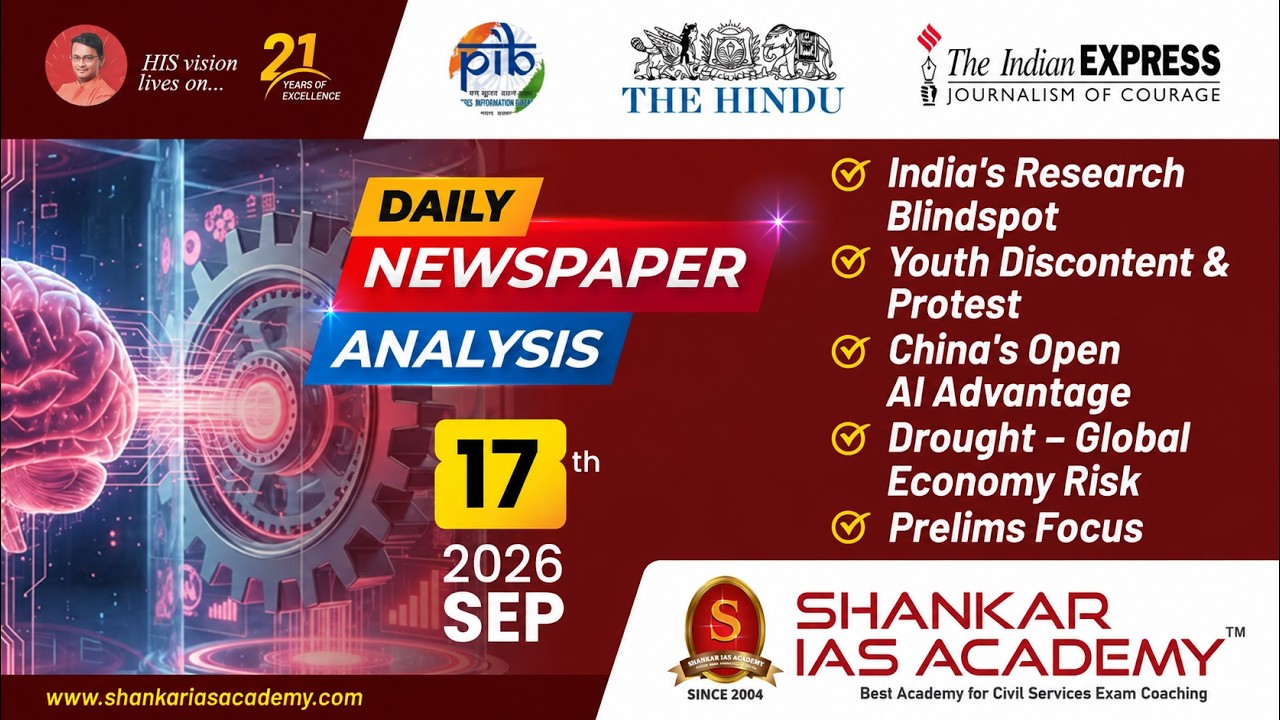
Daily Current Affairs Analysis | 17th September, 2026 | Shankar IAS Academy | UPSC | Mains 2026
Watch on YouTubeVideo summary
The video begins by addressing India's critical "research blind spot," highlighting the urgent need for meta-science within the nation's scientific ecosystem. While India has historically been a pioneer in science, from the Chandrayaan missions to ancient contributions like Aryabhata, the current system lacks self-reflection and investment in studying its own structures. Meta-science is defined as the "science of science," which analyzes scientific practices, ecosystems, funding models, and publication quality rather than just generating new data. The speaker argues that the current focus on quantity over quality leads to redundant efforts and ignores systemic issues like researcher burnout or institutional memory loss due to frequent leadership changes. To overcome this, India must establish think tanks and full-time professional roles dedicated to monitoring and documenting scientific progress, ensuring that policies are based on rigorous evaluation rather than temporary administrative whims.
The discussion then shifts to the changing nature of youth protests in India, exemplified by recent events like the NEET exam fury. The speaker notes a paradigm shift where modern protests are driven less by specific ideologies and more by raw anger toward governance failures, institutional mismanagement, and media bias. Unlike traditional movements rooted in principles like non-violence, these new rebellions often target authoritarian tendencies within democracies, leading to force-based responses that risk escalating tensions. The video warns against labeling students as anti-national or foreign agents, emphasizing instead the need for genuine engagement and addressing root grievances such as corruption and lack of checks and balances. The conclusion here is that unchecked discontent can grow from a small spark into a national fire, necessitating a proactive political approach that restores faith in institutions before protests spiral out of control.
Finally, the analysis covers two major global risks: China's open AI advantage and the escalating threat of droughts. Regarding AI, the video explains how Chinese models like Deepseek offer low-cost alternatives that create technological vulnerability for India, potentially leading to dependence on foreign infrastructure. To counter this, India should leverage its multilingual data advantages and focus on domain-specific applications rather than competing directly in frontier model development. On the issue of drought, the speaker details various types—hydrological, meteorological, socioeconomic, and agricultural—and highlights how climate change, El Niño phenomena, and rising evaporative demand are making water scarcity a cross-border crisis affecting food security, energy, and transport globally. The proposed solution involves moving from reactive crisis management to proactive resilience strategies that include soil health restoration, early warning systems, and whole-of-government coordination to mitigate risks before they become disasters.
The video concludes with a focus on Prelims practice questions derived from these topics, reinforcing key facts such as the definition of meta-science, the drivers of youth dissent, and details about Sir M. Visvesvaraya's contributions to India's engineering history. The overarching message is that for India to maintain its status as a scientific and technological leader, it must institutionalize self-evaluation in research, address the socio-political causes of youth unrest with empathy and reform, and build robust, indigenous capabilities in AI and water management to navigate future global disruptions effectively.
Read the full video transcript
[music]
Hi, hello and welcome to Shankar
Academyy's daily current affairs
analysis and today's date is the 17th of
September 2026.
Please like, comment, share and
subscribe to our YouTube channel and hit
the bell icon to receive instant updates
and all our notifications. And uh with
this let's move to the topics of
discussion for the day. The first topic
we're going to talk about is India's
research blind spot. We're going to talk
about why India has a need for meta
science and what is science and what is
meta science and how we are going to
deal with this. The second one is about
the youth disconnect and protest. There
is a changing nature of protest and
there's a lot of um protest that is
happening in India. So is this the birth
of nationalism or is it something else?
That is the article. We'll decode it
further. The third one is about China's
open AI advantage. Why will China have
to restrict itself when the competitors
are growing? Can it give in all of its
um you know resources for free for long
and can it dominate the world? Let's
see. And the fourth one is about the
drought the global economic risk and um
why do we have such a threat and how do
we deal with it and the final one is the
prelims focus for the day. So we all
know that India has been a pioneer in
science right right from the chandran
one and if you talk about the chandran
that's looming on the surface of the
moon collecting if it has water samples
we have been a pioneer in science so uh
you talk about Arya you talk about
shushuta you talk about a lot of people
you know that they have been very
advanced in science but today that same
science faces a policy problem that is
India's research has a blind spot. This
article is taken from the Hindu and it's
a premium article. India has a research
blind spot its own science system. So
the country needs to invest in meta
science. So when we see this word meta
science we see that when you take your
WhatsApp you have this word meta. So
meta is a word that is used again and
again and again. But we do not
understand what this meta science is.
And it is very very fundamental and
imperative of us to understand what this
meta science is to understand uh how
this will be correlated in the UPSC
perspective. So this can be asked in
your GS3
and also in your GS1. GS3 it is in the
science and technology angle. In the GS1
you can use this in the society angle
with implications.
Okay. Now let's move to the core issue.
The core issue is that we have a missing
self-reflection. You see that India has
advanced in the scientific frontiers but
there is a blind spot that is there is
lack of investment in studying its own
science system. So now you understand
the difference between science and meta
science. So science is let's say that
there is a biologist a biologist is
taking a virus and he's seeing it in the
microscope. is identifying that oh this
is a pathogen this is going to cause so
many diseases but then you also see that
on the par there's another um person
who's analyzing the biologist there he's
thinking that oh these people need
investment okay these people are getting
burnt out so these people need proper
rest or these people need proper
remuneration these people need better uh
facilities these people need better
infrastructure they need microscope or
they need a different lab so a person
who's analyzing these people and
analyzing the system of science, he will
be able to identify the blind spot.
Right? So, meta science is something
that analyzes science itself and gives
us a
um a rigorous study on how Indian
science actually works. So that is meta
science. The reflection that we are
talking about is the meta science. Now
what is met meta science? It is the
science of science. So when you write an
answer in GS3, if the question is what
is meta-cience? Meta science is the
science of science. It is the scientific
methodology to study science itself,
science practices, science ecosystems,
all of that is meta-cience. The second
one is so we have the funding practices,
the research structures, the
publications. So in today's world there
is a
quality
versus quantity paradigm.
So you see that the quality versus
quantity when you talk about this today
you see there are millions of research
papers that are published. How many
people access that in a proper way or
how many people do know that okay this
is what is happening for my research or
this is what I should do with my
research. So people stack the research
papers. So even recently when you see um
uh a movie, there is a person who's
talking that she's done a 2,700page
thesis on human behavior. That is
humanly impossible. But even then, if
you're doing a 2,700 page research
paper, what is the use of the thesis for
2,700 pages? So it is quantity over
quality. People think that if you stack
papers, the quality is good, right? So
that and improvement the ultimate goal
is to improve. It is not just about
improving the quality it is also about
improving the efficiency of whatever we
are doing and the impact of that that it
happens on the world. Now what is the
challenge? See currently there's a
leadership challenge. Imagine I am a
researcher. I'm the head of the um
science department and I am bringing in
a protocol saying you have to follow a
regress routine. you have to come at
9:00 every day. You have to do this at
5:00 I need a report. I'm I'm taking
everything smooth but my tenure will
only be from 3 to 5 years. We all know
that R&D you only have a leadership role
for 3 to 5 years and then you'll move to
another role. Right? So whatever if even
if I retire or if I get transferred
whatever I do we do understand that it
will be painfully um sorrow to see that
I will be moved to another place and
again it will go back to its own ways.
So if my practices are
institutionalized, if my practices come
into policym, if my practices are taken
so seriously that okay this will be
institutionalized so that even if I
leave this will go then whatever I do
has an impact right. So Indian ecosystem
is vulnerable to shift in
administration. So every change every
leadership every past leadership all of
that has an impact. So institutional
memory are frequently forgotten which is
why institutional memory should be uh
properly cemented and there's a lack of
documentation. See um I'm telling you
that I have to bring in women in STEM
fields. So what am I talking about? I'm
talking about women in
STEM fields.
Now one person person one is telling
that let's see let's bring in
25 women in stem fields person two
whereas he's saying that just because we
bring in 25 women the amount will only
be growing with the growing demography
we'll have to bring in more people but
we have to understand a measure in which
we can bring in people that is when you
will understand that okay so when I
bring in people or when I bring in women
into STEM fields, I have to understand
at what age do they start quitting, at
what age do they come in, what are the
issues that they face, I need to
understand this in a policy angle. Only
when I understand this in a policy angle
will I be able to bring in women at
proper um age, proper time and give what
they need. It is a institutional measure
and a policy measure that is needed. So
there's a systemic failure to properly
document what has worked and what has
failed in the past. So because of this
redundant effort that is there we see
that there are repeated mistakes in the
policy cycles. So these repeated
mistakes needs to be avoided. Now you
see framework for meta science. There
are three frameworks that we'll be
discussing today. One is the
institutional framework. The second one
is the expertise framework and third one
is people framework. So we must build
proper think tanks, proper academic
departments to actually do the R&D in
our age. So only then can science policy
and evaluation be done. Also there's a
scientific output that should be
measured beyond just publication counts.
Today we just as already stated we just
go over qual over quality. You take
quantity and go. So this should be done.
And the third one is training
professionals with full-time jobs. They
should monitor document and guide the
progress in Indian science. So what is
the way forward? Today I've spoken about
a lot of issues and the science of
science. What is the uh way forward? The
way forward is you should be having a
meta science data. Only when you have a
meta science data even 100 years later
when we are not even in the face of
earth when uh this video becomes too old
even then one person can go and they can
understand that this is how it has
worked and that is this is how it is
working. So it gives us a trajectory.
History gives us a window to what has
happened in the past and history repeats
itself all the time. So meta science is
very very important and documenting
India can ensure the trajectory of
growth and individual leadership
changes. So it can see that under
leadership A it has grown 80% under
leadership B it has fall fell down by
56%. Under leadership C it has gone down
to 97%. So something like this can
happen right? So now we have come to the
prelims practice question for the day.
With reference to meta science in the
context of Indian ecosystem, consider
the following statements. It refers to
the application of scientific
methodology to study and evaluate the
practice of science itself. Yes. Its
primary goal is to ensure institution
memory by documenting research policy
successes and failures. Yes. So option C
should be the answer both one and two.
Let's check. Yes. Option C is the answer
both one and two. With this we have come
to the end of this topic and we're going
to move to the next topic for the day.
So you see that in today's world
increasingly there's a lot of protest
there's a lot of revolution and the
genesis are playing a important role in
that. The recent neat protest that you
see in India you see that there are a
lot of gen people who have done
[clears throat] different reels who have
done different marketing ways to
approach it. You recently saw one girl
who became the face of the Jensen
protest. So the ways in which people
protests are changing. The ways in which
people get what they want is changing
increasingly in a very digital world. So
let's see about the Jenzi protest and
change phase of protest. This article is
taken from the Hindu. It is an editorial
article. So let's decode it in detail.
So globally the gen master brains are
reshaping the growing anger over
governance and institutions and they're
handling it in a very different way. So
what happens is that uh the uh the the
new rebellion that is genesis are
embracing a challenge to a unequal old
order. See now they have an ide anger
they have an anger. So the anger is more
than the ideology. So earlier we used to
have an ideology and we see aimsa was a
ideology. So people when they said
nonviolence we are going to follow the
satyagra we are going to follow truth
that was an ideology today increasingly
we do not have an ideology we
increasingly have anger over the system
anger over institutions anger over
governance anger over people and that is
showing
authoritarian regimes that are falling
to studentled movements. So what is an
authoritarian regime and why are we
talking about it now? See ex example you
see that a lot of democracies
not a lot of democracies are exempt from
this. Even a lot of democracies facewide
protest even a lot of democracies face
issues like this. So uh it is not just
that in authoritarian regimes or where
in penitentiies where there are extreme
amount of pressure only there will you
see protest or rebellions. It's not like
that. You will see that in a lot of
areas even in democracies. So media and
parties often fail as effective checks
and balance. You see media is seen as a
pillar of uh our community right? But
then the media does not give checks and
balance. Let's say that you go to a news
channel. Let's say news channel one says
that this is the news. News channel 2
says something different. News channel C
three wants to be the first one to break
the news. So they do a lot of things for
the TRP. Right? So the TRP is very
important. So people
forget that they have to give checks and
balances and they move into more
commercial and mainstream journalism. Do
we say that we are right or wrong is a
very different question. But then should
they be doing it is the question. If you
ask me then it is wrong. They should not
be doing it. There should be a line to
which they are doing it. Of course their
ratings or their channel their growth is
very important but what is more
important is the credibility of the news
that comes across right? Uh so now there
is a sovereignity risk that is poisoned.
So now in India if you see CJP sit in
Janta Mantra Delhi there there was youth
protest in Jarkin in Ranchi for exam
recruitment um um irregularities for
mismanagement and tampering of the news
uh tampering of the question paper the
neat protest exam fury was there. So now
there is a lot of fury over the exam
that is mismanaged. People are saying
that it is not conducted properly.
People are saying that it is um an
issue. There was a studentled protest in
Jarkand by Dendraat Mahhatau in Jarkand.
So this protests are also seen in J in
Satiskar in Bihar over similar concerns.
So the warning is that Nepal in Nepal
students
went and fought against the long
longestablished regime. Also in
Bangladesh political order is reshaped
by youthled revolt and
protesters are seen as foreign agents.
They're called as alien. They're said as
traitors and media is amplified as
antinational and India is not yet to
that scale but signals must not be
dismissed. So we should read the signals
early before they slip out of hand. Why
are they protesting? Why are protesting?
Because when you could nip it in the
bud, you do not do it. Which is why it
came to such a big issue. So governance
failure should not be there. We should
have proper checks and balances. It's
not just about the government, it's also
about the media because they are not
giving proper checks and balances also
about the opposition wherein we have to
bridge all these gaps. Now public
performance and quality of governance is
falling short because political
institutions and democratic um
institutions both of them they are
losing their trust that is present and
the centralization of power that is
aggravating the discontent. So
institutional safeguards are being
undermined. So
these deals are stuck at the expense of
country's youth and there should be a
middle ground in politics and anger
risks are
there. So there's a force-based response
the use of force but understanding is
when you understand why this issue is
happening understanding the issue. So
when you use force there is a wider
backlash that comes saying how can you
use force on me but here it addresses
the grassroot grievance because you're
understanding what is happening right so
exam you're saying if the exam itself
will not be conducted that is a reflex
you're saying that out of spite you're
not actually meaning it but careful
targeted handling is what is necessary
so labeling descent as national is an
issue genuine engagement and not sus
suspension is what you have to True. So
nalism is dead.
So that misses that every protest it it
starts as a small beginning. If you see
that a small 1960 spark in Nakalbari
grew into this national threat. So once
people who were India's best and
brightest, they also got caught into
this moment. You see um series like
Family Man, it is just a small person
who trained into somebody else, right?
So a single spark can cause a fire when
grievances do go unressed. When you try
so hard but then the grievances go
unadressed, that's when it becames the
Dimmagi.
The Dimmagi Knoxil they have
exploitation and further coins of anger.
This word dimin was mentioned in the
independence day
speech
by our beloved PM
Mr. Narendra Modi. He's
C CJ Gap is already being the Cockro
Janata party is already being referred
as Diwagi Knil's sibling. So the way
forward is you have to treat the warning
signs of protest with proper
seriousness. Avoid the indiscriminate
force. Leave little room for complency.
Political parties and adop opposition
must adopt the corrective measures.
Address corruption and education and
restore faith in institutions. So UPC
mains practice question critically
examine the drivers of youth descent in
India, its neighborhood and sits
measures to enhance democratic
responsiveness to youth aspirations.
This is for 250 words, a 15 mark answer.
Please send us across your answer copies
for this question and we'll get back to
you. So the article that we are going to
deal with now is about India's open AI
advantage that may not last forever. Why
am I saying this? It is because the
Chinese AI companies such as Deepseek or
Gwyn, they are having an advantage over
us. The weight of the AI models are at
relatively lower cost. So when you see
that Indian startups are forced to
reduce their expenditure because they
give it as a lower cost. It is just
about the demand input. Let's say that
you have a company and I have a company.
Both of us are selling tomatoes and you
sell tomato at a rate wherein it is 5
kilo per uh five rupees per kg. I sell
it at 20 rupees per kg. So people
obviously go that the quality is good.
Right? So this dependence on foreign AI
models could create a technological
vulnerability that is present for India
because we have a lot of youth and we
have a lot of good brains who are able
to give us all the effort and the time
that is necessary. So uh why do we have
to depend on somebody else? Now you see
that models whose train parameters are
made available for others are to use
modify build applications. Now you see
that the R1 model is about $294,000.
So the potential of efficient AI
architecture and distillation is to
reduce the development cost that is
present so that China is using these
models not just as a commercial tool but
also as a technological diplomacy and
they're using it for a global influence
because people will be dependent on them
because these are the people who are
giving it at lower cost. Right? So now
if you see that the uh the uh free and
capable models if they reduce the
pricing power and if they make advanced
AI capabilities widely accessible it
will become a threat. Now we have to
have a strategic capital and a state
support to uh the AI ecosystem and we
have to have a cyber space authority by
early of 2026. So when this demand for
cloud energy is increased, Chinese firms
have significant capabilities that are
present. Now if you see that a large
number of competing AI models are there.
So ah you see that claude china
you see a lot of models are there right?
So the coordination of the government
will be easier if we have a smaller
group of major models that is
indigenously prepared and we can group
them together and China would have a
greater in incentive to restrict models.
Once these foreign developers become
dependent on these Chinese cloud
infrastructure because they are getting
it at a cheaper rate. When these people
restrict and China says that you have to
give me double now. Now the price of the
tomato is 10 rupees then they will have
an issue there. So one person has a open
weight model from US or elsewhere. So
this competitive pressure is always
there and China may gain less from the
unrestricted releases. So they also will
come to a point where they have to
restrict. Now what will happen for
India? India if you see that the
development cost for Indian startup is
lower and there is faster diffusion of
AI across all sectors. There is
application specific scope and there is
domain specific AI. So advanced model
without developing frontier models is
present. So the risk is technological
dependence and switching cost of Chinese
models become embedded in Indian systems
as data security threat autonomy
concerns and access to model weights or
API will be there and what should India
do? India should focus where that it has
comparative advantage. It has advantages
in AI application. It has advantages in
industrial areas. it has application uh
proficiency in language because India is
a multi-
language uh country so our datas will be
better trained we have silicon uh
inference that is edge cutting and we
have domain specific fine-tuning so we
also have our atmaar bat our
self-reliance so that we compete uh AI
self-sufficiency and openweight AI and
AI governance will be there for our
multilateral platforms. So open
ecosystems will develop resilience
against the future disruptions that is
present. So consider the following pack
deep China China Claude USA Mistl France
serv India. So all four pairs are
correctly matched. Let's check
yes all four pairs are rightly matched.
With this we have come to the end of
this topic. Let's move to the next topic
for the day. So drought if you see it is
a water scarcity based condition wherein
a lot of people are affected and if you
see there are different types of drought
there is the hydraological drought the
meteorological drought the socioeconomic
drought and there's also the
agricultural drought. So what is this
hydraological drought? Hydraological
drought is when your area if it is able
to get 100 cm per day let's say for an
example. Okay. So now 25% if it is
getting lesser then in that case you're
facing a water scarcity in that region
because the region is prone to getting a
lot of water that is called as the
hydraological drought. The
meteorological drought is when your
rivers dry up or your waterprone regions
dry up wetlands die in such a situation
you have a water scar city that is
meteorological drought. But a
socioeconomic drought the word itself
says socio. So society is made up of
people. So when people are impacted by
all of this that is the socioeconomic
drought and the agricultural drought is
when you have a lot of crops but then
the crops are not able to grow because
the soil does not have enough moisture
to help the crops. This is the four
types of drought and it is also stated
that India when you talk about India
specific 2/3 of India
are drought prone
what are the regions especially when you
see
the western side
this side of
the western side is usually prone
towards drought more than the eastern
side. Right? The eastern side is prone
more to cyclones, right? So the drought
is nearly triple the 1990s average. And
if you see from 1990s to 2020, the
global data states that about 300
million people have been affected by
drought. And if you take the half, 150
million people are affected. 150 million
cattle are affected. And in a global
average, there's a study that states
by the year 2050
about
75% of the world
will be draw.
Why am I giving all this data? so that
you can use it in your GS1
geography
and GS3
[snorts] disaster management.
Now let's come to the implication. So
when you have drought, it will not just
affect one section but it'll affect
multiple sections like the food sector,
the transport sector, uh the trade
sector. So there are a lot of things
that are affected. Now
traditionally it is treated as a
periodical or agricultural environmental
crisis. So that is how it is treated.
But then it is a cross- sectoral risk
because as I said it is affecting the
transport, it is affecting people. It is
affecting cattle. It is affecting trade.
It is affecting a lot of things. So
energy, transport, health, all of this
are affected. For example, not just one
area. If you see the Panama Canel and
Nile basin they have also faced
disruption because of drought. So trans
it is transcending boundaries. So this
cross borders is you can write it as it
is transcending boundaries
when you write it in your mains answer.
So it is driven by less rainfall short
and more by rising evoperative demand.
So it moves from a hydraological rot to
agricultural rot
and agricultural dot moves to
meteorological rot.
Yes. Okay. So the warming land pulls the
warming land pulls more moisture from
the vegetation and the cover that is
present. So henceforth it goes above and
all the evoporative nature is taking
away the little moisture that is present
in the soil.
Now 30% of the global land is in
drought. There's a three times increase
in drought potential from 1990. 75% are
to be affected by 2050 and Elnino is
likely to persist till February 2027.
Now you see El Nino
gives dry spells,
lanina gives
wet spells. Both elino and lanina if you
see again then you have to talk about
the iod. When you have positive iod dry
spell
when you have negative iod you have
wet spell.
Yes. So drought footprint has tripled.
There's no inhab no continent that has
been spared through 2025 to 2026. All of
them are affected because of the
strengthened Elnino. Why is strengthened
Elnino? Because it is a super Elnino.
So this is connected to geography and
disaster management. These are things
that you have to remember and brush up
when you go through disaster management.
So now the next thing is West Africa has
persistent drought.
So it has water insecurity. Asia if you
see the Tibetan snow pack that is
reduced and it threatens water for
billions downstream. So Europe Europe
faces a intense heat draw spell in a
century. South America the Amazon and
Pantanal canal rivers it fell to
multi-deadal lows. North America you see
there is wildfire extensive western
wildfire and that is um reducing the
snow pack that is present there and
almost through 2027 world meteorological
organization has said that we will face
a elino. Now the convention to combat
desertification UNCCCD is going to
happen in Mongolia from 17th to 28th
August. So the global framework for
drought risk management is the core
focus. So there is no consensus that is
reached on the internal uh international
architecture that is present to combat
drought. The debate is that we have to
have a framework or a binding protocol.
We should have a policym that will help
us understand that this is how we should
do things and uh the climate cop and uh
um biodiversity cop both of them are
linked to these talks that are present.
So reactive approach is when wait let
the drought come and then I will act but
then um proactive approach is okay I'm
going to assist this at every given
point in time so I'm able to handle all
of this and rainfall based early warning
is reactive. Soil land and moisture lens
is proactive post emergency when you're
mitigating that is reactive
you are fully prepared comes this is
what I'll do from first I'm going to do
it that will that is um uh proactive and
sectoral silo see when you have a whole
of a government working together a
coordinated response that is proactive
when you have silos people segregated
that is reactive we'll see all the
measures the way forward word in uh
detail after this slide.
See what it requires is look at the land
not only the sky. Soil and land health
matters the most. We know how hard it is
to get our soil back. Why it is very
very imperative right? So we have to
strengthen our moisture retention
capacity and
not only rainfall forecast what
vulnerability is present because there
are different types of droughts. We have
to map all of that properly and we must
fit each region's own risk and exposure
profile before and during after draw.
There is full cycle planning that should
be done. So we should not just involve
agricultural ministry but we should
involve finance, health and all other
ministries and have a coordinated
response plan.
Now the way forward is institutionalized
broad risk assessment. Whole of
government and whole of society should
respond. There's a community
participation that is needed. Framework,
protocol and hybrid instrument is
needed. So biodiversity convention
should end the policy silos. Invest in
restoration and soil health and ensure
prevent post crisis relief operations.
Now that we've seen this, there are also
certain examples and certain ideas that
you have to note before you go to the
exam that you can use in your mains. So
before we go to the question we see that
when we have the mitigation measures
first one we should have a early warning
system.
So this related early warning system the
SPI alert is present in Rajasthan.
Then contingency planning
of fer bank.
This is present in
Anandapur.
Then
rainwater management.
This is present in
jalut
shivar
crop diversion.
Diversification.
Diversion and diversification.
Odisham inlet mission.
8 lakh farmers trained under
Jal Shaki Aban.
Forecasting model
for droughts.
Drought resistant seeds.
water budgeting
for example Kerala.
So all these are mitigation measures and
example that you can put in your mains
question. It is very very imperative
that you have all these points you use
this in your way forward or mitigation.
You use this in your reactive proactive
approach and then write this answer.
Critically examine the shift from crisis
response to resilience based broad
management. Assess challenges in
developing effective inter international
cooperation. So this is a 250word answer
with 15 marks. So the answer should be
for three pages. Please send the sakra
the answer copy so that we can help you
better in the preparation. With this we
have come to the end of this topic.
Please note down these points for your
mitigation message for draw. It will be
very useful for your mains. And with
this let's move to the next topic for
the day. So we have a few facts for the
prelims focus for the day. This is taken
from the IAS parliament. So the first
topic of the day is about India's data
center boom. So you see that the data
capacity is 375 megawatt to 1.57 gawatt
and the growth is projected as 8 gawatt
by 2030. So the drivers are you have the
digital economy, the cloud computing,
you have um AI and high speeded
connectivity and growth. So investments
are also underway and you have a tax
holiday till 2047 for foreign cloud
providers that you can build your
infrastructure and India's AI mission
and semicon India phase 2 is also there.
So the green energy rules and BIA's
norms are helping us gain AI push and
sustainability and we have the first
drawathon launched in 2026 at Pocran
field firing range in Jalman. 20 plus
defense firm and startups are present
here and it assesses the technologies
and it says this is how it'll perform in
real world operational angle and we are
surveilling it. We have the autonomous
ops and we have swam technologies that
help us give a road map on how these
unmanned alap system perform and
highlight the vayou utam the unmanned
traffic management system and this
location is the pokran fire field firing
range in jalmer that is present now
engineers day visharaya
September 15th marks the anniversary of
sir m visharaya he was the dwan of mysur
father of modern Mysu the chief engine
of Krishna Raja Saga dam on Cavaryi
river he was awarded the Baratratna in
1955 the night food in 1915 by the
British so the planned economy recon um
planned economy for India reconstructing
India was his book and today India
provises 1.5 million engineering
graduates from IIT NIT and all other
institutions which is why it is very
very imperative for us to remember Now
with this let's move to a prelims
question.
So with reference to sir Mr. Sa whose
birth anniversary is observed as
engineer consider the following
statement. He served as the dwan of
prince state of mysu during 1912 and
198.
So all of this have one in them. The
Krishna raja saga dam is built across
the Krishna river. No he was conferred
the baratrna in 1955. Yes, he authored
the book planned economy for India. Yes.
So the answer should be 1 3 and four
only. Let's check.
Yes, the answer is option B 1 three and
four only. So please like, comment,
share and subscribe to our YouTube
channel and hit the bell icon to receive
instant updates and all our
notifications.
I hope today's video was uh clear to
you. Uh so thank you for watching
today's video and let's meet again in a
new video in a new week.
>> [music]