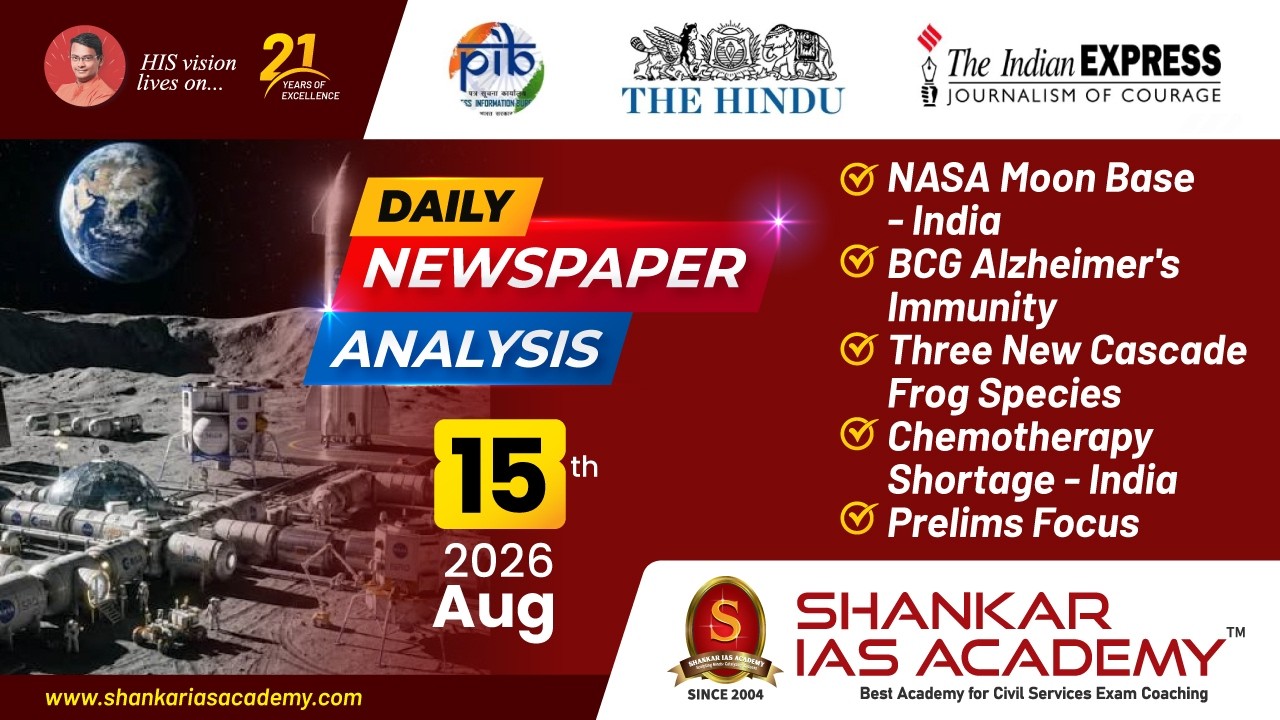
Daily Current Affairs Analysis | 15th August, 2026 | Shankar IAS Academy | UPSC | Mains 2026
Watch on YouTubeVideo summary
In March 2026, NASA officially invited ISRO to participate in its ambitious $20 billion permanent lunar base project under the Artemis Accord, marking India's continued strategic alignment with global space exploration goals. The initiative aims to establish a human habitat at the moon's southern pole by 2045 through three distinct phases: environmental studies from 2026 to 2029, infrastructure deployment between 2029 and 2032, and the arrival of researchers starting in 2032. The selection of the lunar south pole is driven by its stable yet extreme temperatures, shadowed craters that may contain water ice, unique insights into solar system origins, and potential use as a launchpad for future missions to Venus and Mars. While China and Russia pursue an alternative International Lunar Research Station, India retains the strategic flexibility to align with either bloc or both. This collaboration offers significant benefits to India, including enhanced technical expertise, training support for upcoming crewed missions like Chandrayaan-4 scheduled between 2027 and 2028, improved global standing, and expanded access to deep space resources.
Significant breakthroughs in medical science have emerged alongside these technological advancements, particularly regarding a potential new approach to treating Alzheimer's disease. A recent U.S.-based study suggests that the tuberculosis vaccine BCG might provide immunity against Alzheimer's through "trained immunity," which reprograms monocytes to combat protein accumulation such as amyloid-beta and tau linked to neurodegeneration. Although current findings are limited by small sample sizes, lack of placebo controls, short observation periods around one year, and restricted genetic diversity, the implications for future healthcare are profound. If validated, this approach could drastically reduce costs compared to existing anti-amyloid therapies while offering preventive potential before symptoms onset and applicability to other inflammation-driven conditions. This discovery also signals a major shift in research focus toward studying brain immune cell gene activity rather than solely targeting protein accumulation directly.
In the realm of biodiversity conservation, researchers have made exciting discoveries involving cascade frogs after fifteen years of dedicated study in Northeast India's critical forest streams. Three new species belonging to the *Amalops* genus were identified: *A. patmini* from Tripura honoring social worker Patmini, *A. sandenu* from Nagaland's Sanden village, and *A. bella*, distinguished by its green mosaic pattern. Additionally, five other species including *A. afghanus*, *A. nepalus*, *A. wangali*, *A. medogensis*, and *A. belulus* were found elsewhere in the region. Genetic analysis indicates that these frogs diversified approximately 32 million years ago during the Eocene-Oligocene transition, a period marked by Himalayan uplift, climate shifts, river system changes, and east-west biogeographical movements across Asia. Northeast India's location within both the Eastern Himalayas and Indo-Burma biodiversity hotspots makes it an essential sanctuary for these amphibians that rely on fast-flowing streams for survival.
Despite scientific progress in space and medicine, critical challenges persist in healthcare infrastructure and environmental sustainability within India. The pharmaceutical sector is currently grappling with a seven-year crisis involving shortages of essential platinum-based chemotherapy drugs like cisplatin and carboplatin, which are vital for treating ovarian, lung, breast, testicular cancers, and pediatric conditions such as neuroblastoma. This shortage stems from rising global platinum prices that have more than doubled, narrow supplier dependence, production halts by generic manufacturers due to low price ceilings revised between ₹7–60 to ₹10–90 per mg, and weak control over active pharmaceutical ingredients amid a surge in non-communicable diseases accounting for 60% of deaths. Concurrently, the ship recycling industry remains robust with Gujarat's Alang-Sosiya facility dominating approximately 98% of domestic activity, producing about 3.2 million metric tons of steel without exploiting natural resources and increasing India's global market share from 30.1% to 35.4% in 2025; however, the industry operates under a legal framework where the Ship Recycling Act of 2019 implements provisions of the Hong Kong Convention rather than the Basel Convention regarding hazardous chemicals.
Read the full video transcript
[music]
Hello everyone, welcome to the daily
current affair analysis brought by
Shankar Academy 15th August 2026. Before
getting into the discussion, please make
sure that you subscribe to our YouTube
channel. If you haven't, please do
subscribe and also hit the bell icon to
receive ontime updates from the academy.
And uh before moving to the topics for
today's discussion, we have an important
announcement. It is regarding the
pre-torming UBSC prelims test series.
The first patch for 2027 will be
starting on
7th September 2026.
So the link for the registration is
available on the website. Do register
and crack the prelims in 2027. And uh
coming to the topics for today's
discussion, the first topic is NASA moon
base and India's participation. So
recently the NASA invited India to
become a part of NASA's moonbased
project. And the second article is about
BCG vaccine and Alzheimer's immunity. So
we know that V BCG vaccine is used for
tuberculosis treatment and a later study
from the muscle charts found that this
will provide immunity against the
development of Alzheimer's. And the
third article is about three new cascade
frog species. So recently the
researchers found three new cascade
frogs from the northeast part of India
and also we have discovered five species
of cascade tracks from different parts
of the country. So in this background
we'll be discussing the key features and
the new discovery and the fourth article
is about the shortage of chemotherapy
drugs in India. So we'll be discussing
what is the reason behind it and what is
the response from the government and
finally we'll be discussing the prelims
focus for the day. So if all said let's
begin the discussion with the first
article. Coming to the first article
what is NASA's moonbased program and why
does it want India to be part of it?
Article is taken from the Hindu. So
recently the ninth India US civil space
joint working group meeting was held in
the city of Bangalore and in this
meeting NASA formally invited the Indian
space research organization to be a part
of NASA's moon base project. So in this
project NASA is planning to establish a
permanent moon base in the lunar surface
for further exploration into the space
and we can see that this moonbased
project of NASA is an extended program
under the Armus Accord of 2020 and we
know that in 2023 India became the 27th
signary to the Armus Accord and recently
we saw that astronaut Mr. GC Shukla
traveled to the international space
station in the Axiom 4 mission. So
talking about the moonbased project of
NASA. So like I mentioned through this
mission through this project NASA is
going to establish a permanent moon base
in the southern pole of the moon and
through this they will explore other
aspects of the solar system and also
about the deep space. So the project was
actually announced in the ignition event
of NASA in 2026 in the month of March
and the estimated budget for this
program is around $20 billion and we can
see that they are planning to establish
the moon base in the southern pole of
the moon and the duration so this entire
program that means until setup of this
project sorry setup of this base it is
going to happen in the three different
phases that means you know first phase
is about study second phase PH is about
deployment of infrastructure and the
third phase is about deployment of the
researchers and the next is leading
group. So definitely NASA is going to
lead the project other countries can be
a part of it including India if NASA
sorry if I isro accepts the offer and
the next is goal. So the goal is
long-term ensuring long-term croved you
know habitat in the lunar surface for
exploring the space and other aspects of
the solar system. And uh talking about
the road map for this uh moonbased
project. So like I mentioned it is going
to happen in three phases. So the first
phase will be from 2026 to 29. Second
phase will be from 29 to 32 and the
third phase will be from 20 20 uh 2032
onwards. So between this three years
that is from 26 to 29 the in the first
phase we will study the lunar surface
the conditions you know uh for you know
uh for uh uh is that suitable to send
the people. So we will study the
environment. We know that the regalithic
you know the dust particles on the moon
is not suitable for human human beings
because if human people uh sorry if the
human beings uh you know inhale those
dust particles it can even lead to
pulmonary infection. So the condition is
that much harsh and also the temperature
will you know will be very extreme
right. So suddenly the temperature may
fall to minus and suddenly it will rise
to 54°C. So the temperature is also very
extreme. So the we will study the
extreme conditions of this moon in the
first phase that is from 2026 to 29 and
in the second phase we will be deploying
the infrastructure in different suba
phases and in the third phase that is
from 2032 onwards we are planning to
deploy the researchers to carry out the
research in the uh in the moon. So the
this is a road map of the moonbased
project of NASA and next is why south
pole. So the question is we can see that
in the recent time so or since the you
know the uh since the research started
the researchers the scientists they have
more interest about the southern pole of
the moon. What is the reason? So we can
see that the temperature of this region
the temperature of the southern pole of
the moon vary from minus 203°C to 54°C
and also this region has certain shadow
regions which is protected from the
sunlight and also the peaks of this
region also you know they constantly
receive sunlight. So the condition is
extreme volatile and next is know the
possibility of water ice. So like I
mentioned there are certain craters in
this region in the south in the southern
pole of the moon we have some craters
and within this crater you know the
sunlight or the insulation will not
reach that much. Okay. So the within
this crater there there is a therefore
within this crater there's a possibility
for the presence of water in the form of
ice. That's what we are believing. Okay.
So the people have interest about
discovering the water in the moon and we
believe that this permanent shadow
regions in this crater are protected
from the sunlight. Therefore there's the
possibility for the presence of water in
the form of ice. And next is it will
provide yes moon you know we we can see
that we have discovered uh the Mars
rocks from earth. We have discovered
earth rocks from moon you know we have
discovered the you know the the traces
of amino acid from the moon. So uh the
moon will definitely understanding more
about the moon will give more idea more
uh you know in details or insights about
the origin of life origin of planets and
also the you know the early or the you
know early solar conditions and the next
is it will it can be used as a launch
pad for future missions to Venus and
Mars and also through this project NASA
is going to anchor the deep space
mission for a long time. If they are
establishing the moon, if the project
becomes successful, then NASA can lead
the deep space uh sector for a very long
time. So these are the major reasons why
the you know we have chosen the southern
pole for studying the moon and we can
see that recently the NASA block also
faced an opposition that is from the
China and Russia because recently China
and Russia they opened talks for setting
up an international lunar research
station. So this is also similar to the
NASA both NASA and the the Russia China
pact they are going to you know
establish a permanent base in the moon
and we can see that the if you compare
these two projects we can see that this
plan the NASA's plan was announced in
the uh in the March month of 2026 and
here the announcement is already done
and the progression is the study is
everything is going on and recently also
we have seen a news about the uh about
the meeting between the Russia and China
regarding ing this and the cost so
NASA's program will cost as per the
estimation it will cost around $20
billion and in the case of international
lunar research station the cost is not
publicly disclosed by China or Russia
and framework. So here we have the Armus
accord. So we can see that this is an
extended program under the Armus accord.
Therefore, Arthamus accord is going to
guide the it is going to be the guiding
principles uh behind the space uh you
know uh moon space project of NASA and
in the case of Russia China they have
the international lunar research station
partnership guide and both nations that
is both NASA and the Russia China block
both are focusing on you know
establishing base in the southern part
of the moon that is in the south pole of
moon and we can see that NASA invited
India in in the month of August that is
in the 9th India US civil space civil
space working group meeting NASA
officially invited ISRO and on other
side here the invitation is open that
means the countries can join you know
after consulting with the Russia and
China. So we have possibilities to join
with the either NASA or Russia China or
with both of them. and uh talking about
India space journey. So we can see that
in the recent time we have done lot of
progression in the field of space sector
and Indian space uh sector is known for
providing good quality services at a
very low cost you know and that becomes
that is becoming a role model for other
space research organizations and this is
the uh journey that we are planning uh
in the recent time. So from 2023 to 24
we can see that India have lot of plans
launches in our schedule right. So in
2023 we joined the armus accord as the
27th nation and uh in 2025 Mr. Mr.
Shukla visited the ISR sorry uh the
Indian space sorry international space
research station international space
station and in 2026 you know we received
invitation from NASA to join the
moonbased project and in 202728 we are
planning for Chandrean 4 which is going
to be a sample returning mission. So, so
far we have studied analyzed the sample
in the lunar surface itself through the
technology but for the first time we are
going to bring the minerals or rocks or
particles from the lunar surface back to
earth and we can see that in 2025 we
have a a great mission that is
establishing a bari and station or an
exclusive space station for India and in
2040 we are going for even bigger dream
that is Indian crewed lunar our mission.
So these are the major missions in our
schedule and in between we are also
planning for Gagan, we are planning for
Shukrayan right Gagan we have both crude
and uncrrewed mission. So these are the
schedules uh in our space journey in the
coming days and talking about the
benefit of India. So what India is going
to get if India joins the NASA block? So
first of all we can get lunar expertise
that means we can get knowledge we can
get more insights from the NASA and the
vomot of India will receive more
training from NASA or along with NASA
and that can be useful for both upcoming
missions like you know for uh for our
Chandrean 4. It can be used for setting
up the Indian space station you know it
can be used for our 2040 crude lunar
mission and all and at the same time we
are going for vikasid bar in 2047. So
boosting the space station is very
necessary and therefore like I mentioned
this alliance with the NASA or the
alliance with the Russia China is going
to benefit India in our 2035 BAS mission
and also in our Luna mission of 2014 and
also we will get more insights and
accessibility to deep space technology
and also the area of deep deep space and
also strategic balance. So we have
options between Russia, China and also
NASA. So we know it is a time to take a
very good decision right so it's a time
to take a strategic decision to make
sure that we are cooperating with the
both nations because in the case of
space missions even though you have
advanced technology or if you have lot
of budget still the the chance of
success is 50/50 so we have to take you
know we have to uh study more we have to
take a decision based on that and next
is global standing so we already have a
very good prestige about our space
missions in the international community.
So therefore if we can join the the the
blocks which are going to success in the
space mission then it will further
enhance the Indian image or Indian
position uh in the global community
about the space sector. So these are the
major benefits India is going to gain if
India becomes a member of this moonbased
project. And now we have the prelims
practice question. The question is with
reference to Arthamus Accord and NASA's
moonbased program. Consider the
following statements. Statement one,
India became the 27th country to join
the Arthamus Accord of 2023.
And statement two, the Moonbase program
aims to establish a permanent human
presence at Moon's North Pole. And
statement three, the International
Lunar's Research Station is a joint
initiative of Russia's Rosscosmos
and China's CNS. And statement four,
Chandrean 4 is India's first crude
mission to lunar surface planned for
2014. So we can see that here the
statement four and the statement two are
incorrect. Statement one and three are
correct. So the correct answer will be
option A 1 and three only. So we know
that India became the 27th country. That
is correct. In the Arma Accord in 2023
that is correct. And in the statement
two we are planning to establish the the
the base in the south pole not in the
north pole. We are planning to establish
the base in the south pole not not in
the north pole. And the the third is
international lunar station is the joint
initiative of Russia and China. That is
correct. And the Chandran is going to be
India's first crude mission. No. Uh
planned for 2040. That is also
incorrect. It is going to be the first
sample returning mission for India. So
the statement four and statement one uh
sorry statement uh two are incorrect. So
the correct answer is going to be option
A 1 and three only. Yes. With this we
will move to the next article. Coming to
the second article, TB vaccine offers
clue to retrain immune system against
Alzheimer's. Article is taken from the
Hindu. So a recent study conducted at
Masoch's General Hospital in United
States found that the baselate gu is a
vaccine that we are using to treat the
tuberculosis. So the study found that
this vaccine is effective against
Alzheimer's. So the experiment was
conducted in 23 older adult and we found
that the you know the there is a you
know fight against the immune system is
fighting against the Alzheimer's and the
study regarding this experiment was
published in the journal communication
medicine. So how this mechanism will
work? So we know that Alzheimer's is
classified as a neurodeenerative
condition. So what causes the
Alzheimer's? deposition or accumulation
of certain proteins like uh you know
amoid and toao. So those proteins will
be accumulated in the brain you know as
a result the neur the neuron system of
the brain will not work properly and
eventually the balance will become you
know weak. So the person you know will
eventually by stage by stage the
Alzheimer's will progress in the people.
So this is how the Alzheimer's or the
neurodeenerative conditions develop in
the people. So the accumulation of the
tow and amoid. So these are the proteins
that causes the uh Alzheimer's in the
people and mostly we can see that this
al Alzheimer's will be developing you
know along with the aging and here comes
the term inflammaging. So what is
inflammation? Inflammation is the
chronic lowgrade inflammation of an
aging immune system. So when a person
gets older you know his immune system
will slowly weak. So as a result when
the immune system is weakened the
accumulation of this you know protein
like tow and amaloid will be accelerated
and eventually the person will become
vulnerable to uh the Alzheimer's and
other neurodeenerative conditions and
what we found is that this vaccine give
innate immune cell lasting functional
memory that means we will train we will
retrain this immune system to fight
against the Alzheimer's this vaccine
will retrain the immune system to fight
against the Alzheimer so how this
retrain will happen. So it will be
targeting the monocytes. So monocytes is
a main immune cell that is found in the
blood. So we can see that this once this
vaccine is injected in the people this
monocy will turn the genes for faster
and more alert response against the
infection. And we found that this BCG
vaccine is not just reacting strongly to
the Alzheimer's. It is reacting to many
other infections including the
Alzheimer's. And uh talking about the
limitations of this uh uh this med this
experiment. So first of all we can see
that it is conducted only in a limited
group of people and the diversity the
genetic diversity of those people would
have been very limited. So we cannot
assure uh that this will become
effective in every population. So that
is one of the major limitations. So the
small sample size. So that itself is a
major limitation. Second is you know no
placebo that means trial lacked a
placebo arm for a controlled comparison
between you know uh the the the people
who have received the vaccine and the
people who are not vaccinated and the
cognition. So the cognitive scores
barely shifted either way over the year.
So we have monitored this people over a
period that means nearly one year after
this we injected or we vaccinated this
people in two phases and after this
vaccination we have monitored this
people and we found that you know the
there was no major cognitive you know uh
change changes in the there was no major
cognitive changes in the score and the
next is timeline so one year is too
short for dementia slow disease progress
so we can see that this Alzheimer's
dementia all this neurodeenerative
conditions will take a long time
sometimes maybe one year sometimes maybe
five or 6 years so we cannot con
conclude that you know with the one year
study we cannot conclude that this
medicine is effective against the
Alzheimer's for a long time so these are
the major limitations of this you know
study and uh
the next is clinical and future future
implications so we can see that you know
first of all if this uh medicine or if
this experiment it is effective if it is
sustainable then it will reduce the
cost. So we know that this mundane anti-
amoid therapies are far more expensive.
So therefore you know this medicines can
uh you know this cost of uh Alzheimer's
treatment can be reduced. And second is
large trial. So already the banner
institution they have sought uh you know
at 200 million grand proposal to conduct
a large scale trial of this same
experiment. And next is preventive
angle. So we can see that this uh BCG
vaccine for the you know uh for the uh
tuberculosis is showing more promise as
a prevention rather than a cure. So you
know it is for prevention that means we
have to administer even before the onset
of this condition. So once it is started
once the condition is progressed in the
people then reversing the condition is a
great question. So it is it is another
step towards preventing the Alzheimer's
or any neurodeenerative condition. And
the next is broader scope may help other
inflammationdriven neurodeenerative
conditions not just Alzheimer's or
dementia and future target. So gene
activity in the brain immune cells
emerges as a new focus. So we can see
that now you know from understanding the
neuron now we are shifting towards the
the genetic of the brain activity. So it
is opening a new window in the
neurological study. So these are the
major you know impact of this
experiment. And now we have the prelims
practice question. The question is with
reference to the baffila culminate guin
vaccine and its recently reported role
in Alzheimer's research. Consider the
following statements. Statement one BCG
produces specific antibodies against
amaloid beta protein linked to
Alzheimer's disease. Statement two
trained immunity refers to the
long-lasting functional reprogramming of
innate immune immune cells after certain
vaccinations. And statement three, the
BCG vaccine has been historically used
in the treatment of bladder cancer. And
statement four, trained immunity like
responses of monocytes are where seen
only in the peripheral blood blood and
not within the central nerve system. So
which of the statements given above is
or are correct? Option A 1 and two only.
Option B 2 and three only. Option C 2 3
and four only. And option D 1 2 and four
only. So we can see that BCG produces
specific antibodies against amaloid beta
protein linked to Alzheimer's disease.
Uh the statement is incorrect. Actually
it is not producing any uh specific uh
you know the you know uh antibodies to
deal with the amoid that is the protein
that is causing the neurodeenerative
condition. So the statement one is
incorrect and the statement two trained
immunity instead of producing antibodies
it is training the existing immune
system for faster for shifting the gene
and faster uh you know response to the
infection including the accumulation of
tow and amaloid. So the statement two
immunity or trained immunity refers to
the long-lasting functional
reprogramming programming of innate
immune cells after certain vaccinations.
That is correct. And statement three the
BCG vaccine has been historically used
in the treatment of gallbladder. So yes
uh gallblad it can be used for
gallbladder and gallbladder cancer
treatment and the statement for trained
immunity like responses of monocytes
were seen only in the peripheral blood
and not within the central nerve system.
No see the once this vaccine is given it
will train the monocytes. So the
monocytes will shift the gene activity
to alert the immune system against the
accumulation of toao and amaloid or any
other infection and immediately they
will also inform the central nerve
system. So they will also inform the
central nerve system and that is one of
the features of this experiment. So the
statement four is uh you know incorrect.
they are not only found in the
peripheral blood and not within the
central nerve system. Here the statement
is going incorrect. So they they they
are playing a crucial role in alerting
the central nerve system against uh this
infection or any accumulation of the
protein. So the statement four is
incorrect. So the correct answer will be
option B 213 only. Yes. With this we
will move to the next article. Coming to
the third article. Three new cascade
frog species discovered in northeast
India. one named in the honor of Kerala
social worker Patmini article is taken
from the Hindu. So recently we have
discovered three species three new
species of cascade frogs in the
northeast part of India after 15 years
of research and also we have discovered
other five species of cascade frogs in
different parts of the country for the
first time and the study regarding this
uh research was published in the
peer-reviewed bulletin of museum of
comparative zoolology. So talking about
the newly discovered species from the
northeast part of India. So the first
species is Amachi's cascade frog or
scientifically known as Amaloth Amachi.
So this was found in the Jamui hills of
Tribura and the name was given in the
honor of the social worker and
philanthropist Pathmini working. And we
can see that the second species is
Sandenu cascade frog scientifically
known as Amalop Sandenu. And they are uh
they were discovered in the uh state of
Nagaland and named after the village
centen. This is the village where we
have discovered this species. And the
next is uh beautiful cascade frog. This
was a scientific name is Amalob's Bella
and this was discovered in the state of
West Bengal and it is named for its
distendive green body with a mosaic like
pattern. And the next the newly
discovered SP five species from other
parts of the country. The first is
Amalops Afghanas. So it is a marbled
cascade frog. And the second is Amalops
Nepalus. So it is a Nepal cascade frog.
And next is Amalop's
Wangali. So it is it is a Wangial
cascade frog. And the next and the next
is Amalop Meadow Genesis medok cascade
frog. And the next is Amalop's Belulus.
So it is the Pinama cascade frog. These
are the other five species of cascade
procs that we have discovered from India
in the recent time and these three are
discovered from the northeast part of
the uh India. So what is the
significance? So we can see that across
the world the scientists have studied
nearly 300 plus population geographic
populations of the cascade frogs and we
used different techniques like DNA
analysis, morphological comparison of
adult prog and morphology of the know
morphological comparison of the tpoles
and the developments to classify them
into different you know species and we
found that using the DNA based dating uh
you know using the DNA based dating we
found that major diversification of this
rock happened around 32 million years
ago that is during the eosen oligosen
transition. So this is indicating the
radiation of or the you know
diversification of one sorry
diversification of many species from one
common ancestor and that happened in the
32 million years ago. So this is
pointing towards what? This is pointing
towards the climate condition you know
changes in the geography at the time. So
uh talking about geography and
evolution. So the cascade frogs in
inhabit fast flowing forest streams. So
the spor streams are very important for
their meeting you know their food and
also for the development healthy
development of the tros. So therefore
this cascade frogs are mostly found in
the fast flowing forest streams and the
and we can see that their present
distribution is indicating the
upliftment of Himalayan region multiple
waves of west to east colonization
across Asia climatic and geological
changes during the EOS and oligos and
transition. So we can see that you know
for example if you take the case of uh
you know human evolution we can see that
you know the the changes the climate
conditions in the mosen you know that is
one of the major reasons behind the
diversification of primate population
right or the homminate population. So in
the same way through understanding the
you know the uh this diversification of
the frog species we can understand that
between the eosen and oligosen time
there was changes in the you know uh in
the climate condition there was changes
in the topography for example the
upliftment of the Himalayan region and
there was changes in the in the flowing
pattern of the rivers you know there was
changes in the in the in in the food
availability so all these things can be
studied using this you know frog
population.
And now we have the prelim practice
question. The question is, consider the
following statements regarding recently
discovered cascaded frogs in northeast
India. Statement one, cascade frogs of
genus envelopes are primarily associated
with the fast flowing corrines. Yes. And
statement two, the newly discovered
species were identified solely on the
basis of their external morphological
characteristics. No, we have studied
their genetics. No, and we have traced
their DNA. All these things are studied.
So the statement two is incorrect. So if
the statement two is incorrect means we
can come to the answer that is option B
1 three and four only. Statement three.
The diversification of cascade frogs has
been linked to the upliftment of
Himalayas and also east to west
biogeographical movement across Asia
and statement for the northeast forms a
part of both the eastern Himalayas and
Indobma biodiversity hotspot. Yes. So uh
the diversification of cascade frogs is
linked to the east to west
biogeographical expansion or the
movement of the frogs and also the using
this we can understand about the
upliftment of Himalaya. So we know that
upliftment of Himalaya is led to the
emergence of you know river system in
this region and this river system
eventually formed you know uh this
streams. Therefore we can understand
about this using the cascade props.
Therefore the statement three is correct
and statement four the northeast India
forms a part of both the eastimalas and
indogerma biodiversity or sport. So it's
a general environmental question. So the
uh statement four is definitely correct.
So the correct answer is going to be
option B 1 three and four only. Yes with
this we will move to the next article.
Coming to the fourth article why vital
chemotherapy drugs are in short supply
in India. Article is taken from the
Hindu. So now the Indian health sector
is facing a crisis that is the shortage
of drugs like cisplatin and caroplastin.
So this two drugs are used widely for
chemotherapy but now these two drugs are
facing a shortage and this is raising
concern about you know about the cancer
patients in India. So in this background
let us understand more about this
article. So talking about cis platin
this is a first generation platinum
based drugs for solid tumors and blood
cancer treatment and next is
carboplatin. It is a second generation
platinum compound to treat treating
multiple solid tumors and we can see
that this is widely used in the
chemotherapy especially for you know
ovarian lungs breast test testicular
gallbladder and the headnock cancers and
we can see that this drugs are also very
important for treating pediatric cancers
such as neuroblastoma retinolastoma and
the hepto blastto. So this neuroblastoma
it is you know it is a cancer found in
the immature nerve system that is mostly
or commonly it is seen in children and
the next is retinol blastoma.
Retinoblasttoma it is a type of cancer
in the eyes in the retina. So this is
also usually found in the children and
next is the heptoblastoma. It is a rare
type of cancer which is uh which is
usually you know diagnosed in the river
sorry in the liver. So in this way we
can see that this this uh two medicines
cyl cisplatin and carboplatin these are
very important for cancer treatment
especially you know it is used for you
know many cancers found in the children
and we can see that they are the
backbone of chemo radiation therapy for
several cancers and now we can see that
you know the uh we can go for
substitutes but the problem is there are
concerns about high cost and also side
effect and India is facing this crisis
for the last seven years and why the
shortage is a concern. So we can see
that over 1.5 million new cancers have
diagnosed in India annually on an
average. So we can see that the
population is high. you know the the the
lifestyle is changing and also we can
see that currently 60%age of the death
in India is caused because of
non-communicable diseases right so there
the the the you know the the cancer role
uh in this uh non-communicable disease
related death are also increasing right
so near on an average nearly 1.5 million
new cancer cases are diagnosed in India
annually therefore it is a big concern
and we can see that this limited supply
of cyplatin and caroplatin is disrupting
the on-time chemotherapy radiation chemo
radiation therapy and higher cost. So we
can see that second and third generation
drugs can be used but there are concerns
about know cost and also there is a you
know possibility of higher side effect
and we can see that India is facing this
uh issue this crisis for the last 7
months and talking about the roots of
crisis why there is a shortage or why
there is a shortage of the you know
cancer treatment drugs first of all the
platinum search so we can see that
global raw material prices for platinum
have uh you know have increased the more
than double and we can see that the
outdated caps so we can see that you
know the price there's a price capping
uh for uh drugs so this will uh this has
benefit and also this has a negative
impact because benefit means it will
ensure affordability to everyone but at
the same time if the price cap is too
low then it can limit the supply of
drugs so that is why now the government
is revising ing the uh the the price
ceiling. Okay. And shipping routes. So
we can see that the vestation crisis has
already disrupted the global supply
chain. Therefore you know the
fertilizer, chemical, all these prices
are going up uh going higher. And we can
see that India is heavily depending on
you know narrow set of global platinum
suppliers. So we don't have wide
platinum suppliers. If these countries
are facing any problem then there is a
possibility for reduced or shortage of
drugs. And next is production halt. So
the Indian generic makers temporarily
slowed or stopped output. So the reason
is lower price ceiling. And next is
weak you know uh API based that means
act we we do not have a pharmaceutical
that much we we do not have that much
control on the pharmaceutical uh active
pharmaceutical ingredients. So that is
also uh you know raising concerns about
the constant supply of medicines and
what is the response from government. So
how the government is responding to the
crisis. First we can see that the
government invoked uh the the price
revision. So uh you know uh uh that
means now the government is going for
the price revision that means we have
raised the the ceiling from 7 rupees to
10 rupees per millm of this pl this
platin. And we can see that for the
caroplatin the price ceiling got raised
from 60 rupees to 90 rupees per millm.
So we know that if the price of
commodity is sealed at very low then the
production also will be very low. That
means you know the over period of this
will ensure affordability but over
period of time you know the the the the
supply will not be you know this will
not uh encourage the producer or this
will not encourage the supplier. So now
the government is going for higher
price. So what happens more supply can
be ensured. Okay. So this is this is a
major response from the government and
also the government cited that this is
this price revision is because of the
public public interest and then we can
see that the government hospitals in the
state levels they are stabilized uh in
you know uh with the limited supply of
you know through providing adequate
supply of this medicine and we have the
health ministry they are maintaining or
they are monitoring the the supply chain
as of now. So these are the major
response from the government
and way forward. So how we can ensure
drug security in India. So first is you
know uh you know the adverse event can
happen anytime. Therefore we have to
make sure we have strategic reserve of
medicines and also the ingredients for
certain medicines especially for drugs
like uh you know sisl cisplatin and
caroplatin. And next is pushing for more
domestic production. So we have to
diversify our production chains
especially we have to focus on the rare
diseases like cancers and within this
cancer we have to identify the rare
cases and we have to give focus on that.
Next is active pharmaceutical
ingredients has to be produced or they
have to we have to diversify the supply
chain that means we have to reduce the
dependence on imported active active
pharmaceutical ingredients. And next is
central procurement that means
consolidate hospital level demand into
national tenders. So this will ensure
you know proper supply to every hospital
in India. And second is constant
monitoring and policy prioritization. So
we can see that constant monitoring of
the drugs their supply their reserve is
very important. So if there is any
sudden fall then we can give immediate
or early warning to address this issue.
So we can address a short know a
long-term shortage of this. uh we we can
reduce the long-term shortage of uh you
know certain drugs including this platin
and caroplatin. Next is policy
prioritization that means treat oncology
drug access as a national healthcare
priority. So we know that because of
this lifestyle changes you know the the
disease pattern has shifted. Therefore
this is the time to make changes in the
health policy. Therefore we have to give
more priority to cardiovascular cancers
and pulmonary diseases and within this
cancer we have to identify the rare
cancers or common cancers you know and
then we have to give focus for each of
them. So these are the major changes
that we can you know uh incorporate in
our in our upcoming health policy or in
our considerations to address the
problem of drug shortage in India. And
uh coming to the mains practice
question, the question is India's
recurring shortages of essential
oncology drugs such as fis cysplatin and
caroplatin have exposed deep structural
vulnerabilities in the country's
pharmaceutical supply chain. Critically
examine the underlying causes of these
shortages and suggest a comprehensive
drug uh drug security framework to
safeguard equitable drugs access uh to
life-saving cancer medicines. So it's a
15 marks question and you have to write
around 250 words. So we know that you
know you can start with the data that is
approximately 1.2 million cases are
diagnosed annually. So this can be your
introduction. So you can give a
substantiating uh you know uh a data
with a more substant more substanti
substantiation and next you can address
what are the causes behind the shortage
or what are the structural
vulnerabilities in the pharmaceutical
supply chain. So we have only limited
control over active pharmaceutical
ingredients. We do not have you know
that much you know we limited changes in
the healthcare policy and heavy
dependence on imported drugs and the
narrow suppliers. So these are the
structural vulnerabilities in the
country's pharmaceutical supply chain
and also the the the low price ceiling.
Okay the low price ceiling. So these are
the major vulnerabilities in the
pharmaceutical supply chain. So what are
the uh measures that we can suggest? The
measures includes diversifying the
supply chain, revising the price you
know and also uh uh changing the
healthcare policy according to the shift
in the disease pattern. There you can
site data from the national health
account. So we can see that currently
50%age of the uh the out of pocket
expenditure is around 50%age and the
60%age of death is caused by
non-communicable diseases. So you can
link these two no and then you can give
a suggestions like we have you know we
then you can talk about certain
initiatives taken by the government. For
example last year there was a mass
allocation of budget to the tertiary
cancer research. Right? So in this way
that can be your conclusion also. So
using this hints try to answer the
question post it in the comment section.
We will review and we will reply for
your answer. Now it's time to move to
the next article. Coming to the prelims
focus for the day. The first topic is
Sangamage irrigation structure at
Kolidam. So recently we discovered
bricks and stone structures or stone
remains on the riverbed of Kolidam in
Triti. So we can see that according to
the interpretation of the archaeological
survey of India this brick and stone
remains or this structure dates back to
3rd or 4th century CE and this is
possibly an inlet. That means it is a
part of the water management existed
during the time of pangam age and the
key features of the structure include
semic-ircular wall par parallel
submerged walls and also large bricks.
So we can see that you know such
structures or such irrigation system is
indicating a strong government. That
means through this we can understand
about the government and the
architecture or the you know the
architecture style of the culture. For
example, if you take the case of the
indust valley, we can see that the
bricks were uh in similar size, right?
And the construction style was almost
similar or it had a uniformity. So all
this is pointing towards existence of a
strong government to implement this. So
this is this structure from the the
sungum age is indicating or it is giving
more insights into the sungum age
governance and also about the
architecture style existed in the
southern part of India during the sungum
age and uh
talking about the next topic it is the
let river of ice sansar glacia so we can
see that the sanskar Himalayan glacier
is flowing by 2.4 million sorry 2.4 4
meter per year per decade since 1992. So
the ice is thinning. The ice is
thinning. So we know that the the the
glacier is the source of water in the
Himalayan rivers, right? But now we can
see that the the glacier the Sanskar
glacier is slowly thinning since 1992.
And therefore this will reduce the
driving force and slows the glacier flow
and eventually the rivers originating
from the glacier will also experience a
fall in the water level. So the rapid
melting can increase the water level for
a short period of time but in long term
the rivers will experience a fall in the
water level and this will affect the
agriculture and other human activities
in this region. So in the case of the
Himalayan rivers especially in the case
of the Indas river basin you know both
India and Pakistan will be affected and
we can see that according to the studies
this trend is seen in regions of Alps
glaciers of Arctic and also in the
Tibetan region. So it is not just a
localized phenomena across the world we
can see the thinning of glacia. If the
glacier is thinning, the river system
will experience a fall in the water
level and in long-term the agriculture
and other activities in this region will
be affected. And the next topic is India
world's leading ship recycling nation.
So we can see that the ship recycling
share of India rose to 35%age in 2025
from 30%age in 2024. And we can see that
India is handling around 2.9 million
gross ton of uh ship uh you know ship
recycling or steel in a year. That means
within this year India handled that
means from 2024 to 2025 India handled
approximately 2.299 million gross t of
steel. And we can see that we enacted
the ship recycling act of 2019 which
aligns with the Hong Kong convention
about uh about the ship recycling and uh
uh talking about the important facility
in India we have the along so region or
along so facility of Gujarat and this
facility handles approximately 98%age of
India's ship recycling activity and the
output. So we can see that through this
recycling we produced approximately 3.2
million metric ton of steel without
exploiting the natural resources and
also we now we are planning to improve
the capacity to 9 million light
displacement t. So that's all about the
recycling capacity of India and moving
to the prelims practice question. The
question is consider the following
statements with reference to the India's
ship recycling industry. Statement one,
India's global ship recycling share rose
to 35.4%age in 2025 up from 30 30.1%age
in the previous year. Yes. So the
statement one is correct. And statement
two, the Alamosia facility in Gujarat
conducts approximately 98%age of India's
ship recycling activity. That is also
correct. And statement three, India's
ship recycling act of 2019 was enacted
to give effect to the provisions of
basil convention.
It's incorrect, right? It is for the
Hong Kong convention, not the basil
convention. Hong Kong convention. So the
statement three is incorrect. So the
basil convention is about the management
of chemicals and pesticides not about
ship recycling. So the statement three
is incorrect which means the correct
answer will be option A. The correct
answer will be option A 192 voltage.
Yes, with this we are coming to the
conclusion for today's current affair
analysis. With this we are coming to the
conclusion for today's current affair
analysis. If you like the video, hit the
like button, give your feedbacks as
comments and share this content with
your friends. And before leaving this
channel, don't forget to subscribe and
also hit the bell icon to receive on
time updates from the academy. Thank you
for listening to us. Thank you for
listening to me. Have a nice day.
>> [music]