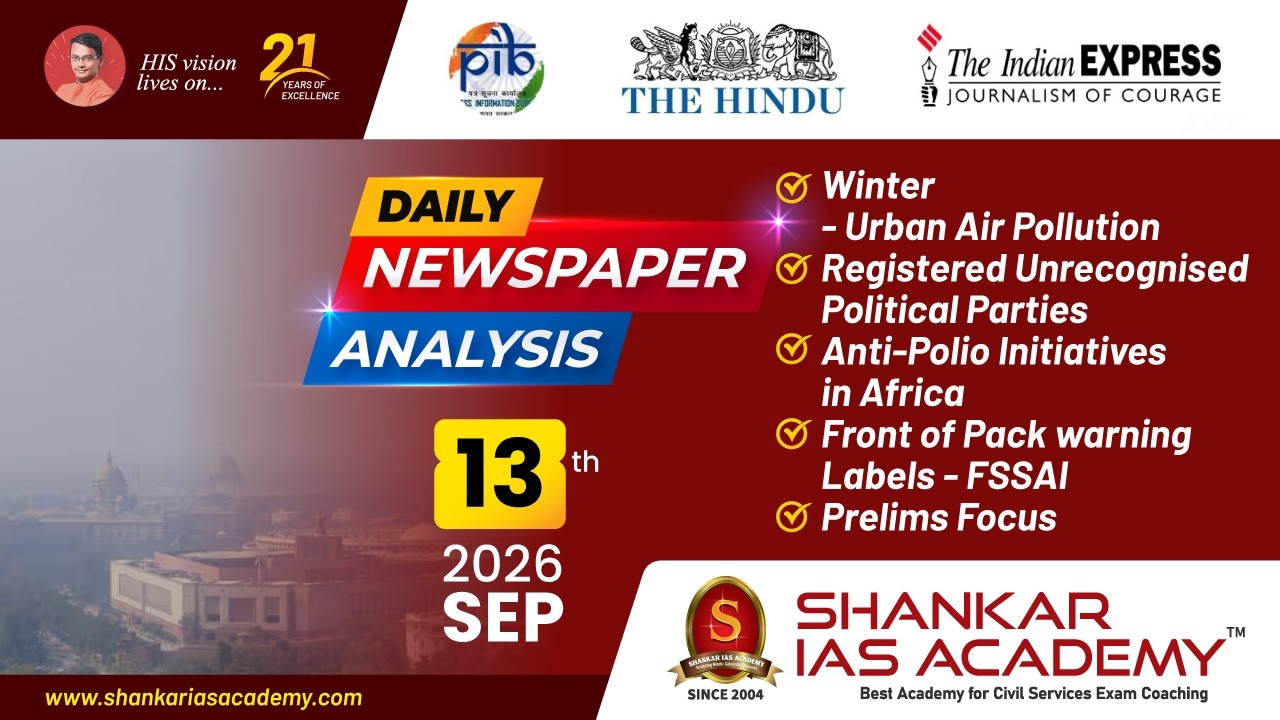
Daily Current Affairs Analysis | 13th September, 2026 | Shankar IAS Academy | UPSC | Mains 2026
Watch on YouTubeVideo summary
A recent study by the World Resources Institute spanning from 2019 to 2026 highlights a critical escalation in winter urban pollution across eleven major Indian cities, driven largely by the burning of waste such as paper and plastic. The data reveals stark seasonal disparities, with waste burning incidents in Tier-3 cities tripling during winter compared to summer, while Tier-2 cities witnessed a dramatic rise in total burned quantities from 21 tons daily in summer to 41 tons in winter. This surge is exacerbated by unfavorable meteorological conditions like weak winds and temperature inversions that trap pollutants near the ground, disproportionately affecting poorer populations who lack adequate municipal services. In response to these socioeconomic inequalities and health risks associated with particulate matter entering blood vessels, the National Commission for Air Quality Management (NCAQM) has deployed trained workers, launched public awareness campaigns, and strengthened inspections under "Operation Clean Air" to mitigate air quality issues in the Delhi-NCR region and adjoining states of Punjab, Haryana, Rajasthan, and Uttar Pradesh.
The regulatory landscape surrounding political funding and party recognition also presents significant challenges, particularly regarding Registered Unrecognized Political Parties (RUPPs) which, despite enjoying tax exemptions and common symbols, often operate with opaque donor identities and weak audit mechanisms. Investigations have uncovered that six RUPPs in Gujarat received approximately ₹700 crore in a single fiscal year, raising concerns about money laundering and the whitening of black money, yet legal constraints prevent their deregistration solely due to inactivity as per Supreme Court rulings. This complex ecosystem involves strict criteria for state and national party recognition based on vote percentages and seat wins under the Representation of the People Act, 1951, leaving thousands of registered but inactive parties in a gray area where they can accumulate funds without contributing to electoral democracy or filing annual reports, thereby creating vulnerabilities for financial crimes and undermining the integrity of the political system.
Beyond domestic environmental and political issues, India has been actively engaged in international cooperation and conservation efforts, marked by South Sudan receiving its first UNESCO World Heritage Site, Badilo Bulma Parks, which supports massive antelope migrations and diverse bird species. Simultaneously, India strengthened its maritime ties with Malaysia through Exercise Samudra Lakshmana and enhanced defense interoperability with the United States via the 22nd Yudh Abhyas exercise, which featured advanced drone systems and Arctic-trained units for high-altitude warfare drills. These diplomatic and military engagements underscore a broader commitment to regional stability and technological advancement, while also highlighting the importance of scientific literacy in public policy, as seen in ongoing debates over front-of-package warning labels that aim to protect consumer health by distinguishing between processed food types and ensuring clear communication across language barriers.
Read the full video transcript
Hello everyone, welcome to the daily
current affair analysis brought to you
by Shangar Academy 13th September 2026.
Before getting into the discussion,
please make sure that you subscribe to
our YouTube channel. If you haven't,
please do subscribe and also hit the
bell icon to receive ontime updates from
the academy. And coming to the topics
for today's discussion, the first topic
is about winter urban pollution. So a
recent study found that comparing with
the summer time during the winter days,
the waste burning is very high in India
approximately three times higher than
the summer days and this study was done
by the world resources institute. So in
this background we'll be discussing what
are the reasons you know why this waste
burning in the winter time is a is a
major concern and the next article is
about registered unrecognized political
party. So a recent study uh sorry a
recent investigation done by the BBC
found that six registered unrecognized
political parties from the state of
Gujarat received approximately,700
cr rupees in the financial year 2023 24.
So in this background we'll be
discussing what is registered
unrecognized political party the
classification of political parties in
India the registration and what are the
major concerns associated with the
registered unrecognized political
parties and the third article is about
antipolio initiatives in Africa. So
recently the WHO informed that the
Africa is making lot of progress in the
fight against the polio and now the
concern is vaccine derived polio
infection and the fourth article friend
of pack warning labels and nutrition
literacy. So recently the Supreme Court
of India asked the food safety and
standard authority of India to give the
a clarity regarding the implementation
of the second phase of front of pack
warning label in India and finally we'll
be discussing the prelimin's focus for
the day. So if all said let's begin the
discussion with the first article.
Coming to the first article pollution
from winter waste burning in cities
three times higher than summer study
article is taken from the Hindu. So a
recent study done by the world resources
institute. So it's a nonprofit
organization conducts research regarding
the environmental problem. So they found
that in India during the winter time
during the winter season the waste
burning practice is much higher than the
summer season that is almost three times
higher than the summer season. So in the
background let us understand more about
this article. So now we are going to see
what are the major findings from the
world resources institute. So they
conducted the study from 2019 to 2026
that means almost seven years covering
11 major uh polluted cities of India and
we can see that in tier 2 cities the the
recorded the highest quantities of waste
burnt. According to the study the tier 2
cities in India has has recorded highest
quantities of waste burnt and tier three
cities recorded the highest winter
burning incidents. So the tier three
cities cover recorded the highest winter
burning incidents that is almost 49.6
incidents per square kilometer per day
that is during the time of winter in
every square kilometer every day 46
times sorry 49 times the waste is
burned. Okay and uh talking about
another major finding so this is also
indicating the socioeconomic aspect. So
this study also you know throws light
into the soio economic aspect regarding
the waste management because uh
comparing with the regions or the the
the areas settled by the welto family
the pollution problem is much higher in
the region settled by the poor
population. So this is indicating the
economic uh disparity in the municipal
waste collection and waste management.
And next is the waste composition. So
out of the total burned waste major
components are paper and plastic. And
next is the seasonal increase. So during
the time of summer in tu cities you know
uh every day the people burned
approximately 21 tons of pigs. That is
during the time of summer in the tier
two cities people burned 21 tons of
waste every day. But when it becomes
winter it you know the rate of burning
reaches almost double that is 41 tons
per day. So this is indicating how the
the shift in the season is increasing or
influencing the uh the the waste burning
practices in India. Okay. And now we are
going to see what is the uh why you know
the waste burning in the winter is a
concern. Why the waste burning in the
winter is a concern. First is the weak
wind. So we know that during the time of
winter the region becomes cold and calm
right. So that means there is no much
wind. So the dispersion of the
pollutants will be affected. That means
the pollutants will be accumulated. It
will be concentrated in a particular
region. Even if the region has only very
low amount of waste burning practice.
For example, imagine that in a square
kilometer there is only one time uh you
know uh the waste is burnt per day. Even
in that case if that happens in the
winter time then the know due to the
limited dispersion the risk of air
pollution and health problem is very
high. Okay. And second is the stable
atmospheric condition. So because of the
stable atmospheric conditions the
pollutants will be trapped they will not
be dispos dispersed and next is the
temperature inversion. So we know that
during the time of winter temperature
inversion will happen. So you know a
warm layer of uh air will be uh you know
will be formed around sorry will be
formed on the uh above the cold layer of
uh air mass right. So because of this
condition the pollutants will be trapped
near the ground. Okay. As a result, this
will lead to accumulation of the
pollutant and limited dispersion. And
next is the use of warmth. So we can see
that during the time of winter
especially in the northern part of India
which experiences continental climate
the people will burn the the paper
plastic and you know other waste
products to keep themsel warm. Okay. So
these are the major reasons why the so
this is this practice is you know also a
concern because you know uh without
understanding the impact without
understanding the the risk of this uh
practice the people are still continuing
it. So the these are the reasons why the
waste burning practice in the winter is
a major concern and talking about the
environmental and social significance.
So the first major issue is the
localized exposure. So we can see that
burning the waste near the house to keep
the region warm or whatever it can lead
to uh you know health problem and during
the time of winter because of the stable
atmospheric condition because of the
temperature inversion even if you are
burning only a small amount of waste
still it can cause air pollution and
health problem and second is the health
risk. So we can see that pollutants
releases pollutants harmful to the
respiratory and cardiovascular problem.
So we can see that this particulate
matter you know all the issues can enter
into the blood vessel and it can cause
problems in the heart and the legs. And
next is the urban inequality. So we can
see that higher burning in the poorer
poorer area reflect inadequate municipal
services. So you know uh in in the in
the study we found that the the waste
burning incidence is much higher in the
region settled by the uh economically
backward communities. So this is
indicating the economic disparity and
how this economic disparity is
associated with the the you know the
disparity in the waste management and
next is the governance gap. So it
highlights the needs for better waste
segregation collection processing and
enforcement. So we know that you know in
the recent times we are going with the
winter plan especially the national
capital Delhi is going with the winter
plan. So to you know to address these
type of governance gap so it is time to
bring such initiatives focusing on these
areas. And the next is the government
response. So what is the government
response? So the we have the commission
for air quality management. They have
announced measures in the national
capital region to identify the locations
where the waste is burned repeatedly and
developed solutions for waste sensitive
sites. And the commission also called
for trained waste management workers to
collect the waste especially with the uh
you know focus on the re on the regions
with the the repeated incidents of the
waste burning and conduct public
awareness campaigns you know uh to raise
awareness regarding the negative impact
or the harmful impact of the waste
burning and strengthen the inspections
under the operation clean air and also
improve waste processing capacity and
provide heating alternatives for the
worker. So you know these are the uh uh
you know the directions given by the
national commission for air quality
management. So we know that national
commission in the upcoming slide we will
discuss what is the national commission
for air quality management. So these are
the guidelines measures taken by the
national air quality management
commission for air quality management to
address this waste man uh sorry this
waste burning problem in the winter
phase
and talking about the commission for air
quality management. So we know that it
was established in 2021 under the
commission for air quality management
act and this commission this uh
commission for air quality management
act replaced the previous ADOC body that
is the environmental pollution
prevention and control authority and the
jurisdiction. So this commission for air
quality management has jurisdiction over
uh Delhi NCR and adjoining areas of
Punjab, Hana, Rajasthan and Uttar
Pradesh and it is under the
administrative control of the ministry
of environment, forest and climate
change and the composition. So it
includes government representatives,
pollution control bodies and also
technical experts to manage the air
pollution and next the major powers of
the uh commission for air quality
management. So it can issue binding
directions. So the directions given by
the uh commission is binding on the
authorities and it can coordinate the
measures against the stouble burning
industrial emission and construction
desk because recently we saw that uh
know uh the uh the air commission for
air quality management along with the
Punjab government they have uh you know
uh they met the ISRO for the satellite
monitoring of the stubble burning
practice in the north India. So they can
take such initiatives and they can
oversee the implementation of greater
response action plan. So we know that
greater response action plan is
implemented to mitigate the air
pollution uh in the national capital and
its adjoining regions during the peak
air pollution times and uh it can impose
environmental compensation and order
closure of non-compliant establishment.
For example, if the industries or the
you know the establishments are not
working according to the guidelines
given by the commission then in that
case they can take action against the
such institutions. So the so these are
the major powers of the commission for
air quality management. And now we have
the prelims practice question. The
question is consider the following
statements regarding the commission for
air quality management. Statement one it
was established under the commission for
air quality management act of 2021.
Statement two, its due restriction
includes Delhi NCR and adjoining areas
of Punjab, Hiana, Rajasthan and Uttar
Pradesh. And statement three, its
directions are legally binding on the
concerned state governments and
pollution control authorities. So which
of the statements given above is or are
correct. So we can see that the
statement one, two and three all the
three statements are correct.
Yes, with this we will move to the next
article. Coming to the second article,
how should registered unrecognized
political parties be regulated? Article
is taken from the Hind. So a recent
investigation done by the BBC found that
from the state of Gujarat six registered
unrecognized political parties received
approximately 1,700 cr in the financial
year 2023 24 and the 1,700 cr rupees it
is much higher than if you compi if you
combine the the total donations received
by five national parties in the same
financial year excluding BJP. So in this
background let us understand more about
this article. So now what is the uh
issue? The question is how we are going
to regulate the recognized uh unregister
uh sorry registered unrecognized
political parties. In the case of India
we have approximately 2,800 plus
registered but unrecognized political
parties. And out of this 2,800 only 750
parties participated in the 2024 general
election and only 26 of them filed the
annual report and we can see that in
from a single state six registered but
unrecognized political party received
approximately,700
cr rupees and this is much higher than
if you combine the total donation of
five national recognized parties
excluding
So why this is a concern? See we can see
that you know if uh the uh this parties
are receiving fund and this fund can be
used for money laundering or it can be
used for you know whitening the black
money. So there are different concern
there are various concerns associated
with the uh you know this issue. Okay.
So we can see that in the case of India
we can generally classify the political
parties into three category. So before
that what is mean by political party?
Political party is a type of
association. In this association, the
people will have a common ideology and
also they will be working for a common
objective right and you know they will
be forming polit and compar and if you
compare with the pressure groups the
political parties will be active in the
politics and they will be forming the
government if the people vote for them
that is the core. So it is a type of
association formed by the citizens or
the individuals who are working for a
common cause and we can classify the
political parties into three types.
Registered unrecognized political party
that means you know these parties are
registered with the election commission
of India but they are not active in the
politics and second we have the state
recognized party. So state recognized
party you know the best examples are the
DMK, ADMK, Biju Janadal in Odisha,
Delilingian party in Andhra Pradesh.
These are the examples of the state
recognized party. And then we have the
national recognized party. For example,
the international congress, BJP. These
are the examples of national recognized
party. So this is how we can classify
the political parties in India. And to
consider a party as a national party or
a state party. We have certain criteria
that we will be discussing in the coming
slide. And how we can form a political
party in India. So we can see that under
the section 29 of the representation of
people's act of 1951 the you know we
when a group is planning to form a
political party that political party has
to register with the election commission
of India and this application has to be
filed within 30 days of the party's
formation and the memorandum must bear
allegiance to constitution the
sovereignty of the country and also the
integrity of the country that means the
political party that you are forming
should not affect respect to the
sovereignity, autonomy and the integrity
of the nation and also the party must
commit to principles like socialism,
secularism and the democratic principles
of the nation and the party should have
at least 100 members and uh and each
must be a registered elector. So the
party should have at least 100 members
and each must be a registered elector
and also the party should hold periodic
inner party elections according to their
own constitution. So these are the uh
you know criteria or this is how the
registration of a political party is
done. So in the case of the recognized
sorry registered but unrecognized
political parties these political
parties are recognized with the the they
have registered with the election
commission of India. So they are in the
list of the election commission of India
but they are not filing their periodic
uh know reporting and at the same time
they are not conducting sometimes they
may not be active they are not
conducting the internal election. they
are also not participating in the
general election. They are not
participating in the state election but
they are there. So the concern is that
this uh party or this recognized but
registered but underrecognized platforms
or political parties can be used as a
medium to divert money or it can be used
for whitening the black money. So these
are the major concerns associated with
the you know the registered and
unrecognized political parties
and uh recognition of the state party.
So according to the election commission
of India, if a party meets any one of
this criteria, then that party can be
considered as a state party. For
example, if if the party wins six
percentage of the valid plus at least
two seats in the state legislative
assembly, then that party can be
considered as a state party. And if uh
if that is not there in case if they can
meet if they can win six percentage of
valid votes in lock sabha from that
state plus one lockaba seat from that
state in that case the party can be
considered as a state party and in if
that is also not there then if the party
wins at least three percentage of the
total assembly seats or three seats in
that assembly then that case whichever
is higher that will be taken into
consideration and in that case that the
the party can be considered as a state
party and the next is winning one
lockaba seat for every 25 allotted to
that state. So you know you know for
example u if a if a state has 50 seats
in that case if the party wins at least
two state seats in that case also the
the two lockaba seats in that case also
the state the party can be considered as
a state party and if it is secures 8%age
of total valid votes in the assembly or
in lockaba polls from that state. So if
that party gets uh 8%age of total valid
votes in the assembly or in the loss of
a poll that can that party can be also
considered as state party. Okay. So
these are the criteria for the uh you
know for considering or categorizing or
recognizing a party as a state party.
And next is the national party. So what
are the criteria for national party? So
if they meet any one of these criteria
then we can consider the party as a
national party. So the first is securing
six percentage of valid votes in four
more than four states plus four lock
saba states. So they have to secure six
percentage of valid votes in four states
and also they have to win at least four
plus seats in the lock saba. And next is
winning two percentage of lock saba
seats not less than uh you know 11 drawn
from at least three different states.
That means winning two percentage of
lock saba seats at least from three
different states. And the next is be
recognized as a state party in at least
the four states. So the party which is
recognized as a state party in at least
four states can be also considered as a
national party. And uh the review cycle
so you know the regular review will be
conducted regarding the status of the
party. So before that it was conducted
every five year that is uh you know uh
until 2016 it was conducted in uh every
five year but now the uh the review the
status will be reviewed in every 10
year. And what are the benefits for the
national party? They will have a
reserved symbol for entire India and
they can use 40 star campaigners for
their election and also you know they
have you know they can use office and
land in Delhi. So these are the major
benefits for the national party and then
we have the
registered unrecognized political party.
So you know they are not conducting an
election they they are not actively
participating in the politics then why
what is the uh you know what is the
reason behind this registered
unrecognized political party because
this registered unrecognized political
party will have certain benefits enjoyed
by the political parties for example
they will have a tax exemption on
donations under the section 12 of the
income tax act of 9 2005 so they will
have a tax exemption under the section
12 of income tax act of 2005. So to uh
for the you know here comes the concern
sometimes the registered unrecognized
political parties can be used as a
medium for trackision and next is the
common symbol for state and local
elections and they can use up to 20 star
campaigners for the election and they
have to maintain record for every donor
who are giving a donation above 20,000
per year and they have to you know file
annual contribution report with the
election commission under the section
29C of the uh representative
representation of people's act of 1951.
In case if they are not filing then in
that case they will they will sometimes
they can lose the ex exemption on on
taxation provided under section 12 of
the income tax act of 19 sorry 2005 and
uh you know yes uh under the you know uh
like I mentioned the penalty in case if
they are not able to file the uh the
account if they are not able to file the
audit then in that case they will lose
the exemption provided under the income
tax act and uh the uh and the political
party who receiving the donation about
2,000 rupees has to receive in check or
in bank transfer that means digital
record or the record has to be there. So
these are the major benefits enjoyed by
the uh you know the recognized uh
registered unrecognized political
parties. So now what is the issue? The
issue is the letter pad parties. So uh
you know we can see that if you take the
status uh in in 2024 out of this 2,800
registered unrecognized political
parties only 750 participated in the
general election that is just 27%age
and uh another major concern is about
the annual report. So according to the
uh the data from the democratic
association for democratic reforms uh in
the in the financial year 2022 23 only
26%age of the registered unrecognized
parties filed their annual report and
this is raising concerns about the
opacity in the donation and the fund
management and next is the tax exempt
donations create a scope for money
laundering and the fund routting. Yes,
the exemption the exemption of the on
the taxation can be used for tax
evision. It can be used as a platform
for you know fund rooting and money
laundering. So that is another major
concern and money laundering it is
directly affecting the security of the
nation. And next is field fielding token
candidate. Yes, sometimes the political
party you know they will uh they will
contest in the election nominally. That
means without uh much effort they will
you know uh they will uh you know file
the uh the uh you know they will they
will participate in the election and the
candidates may not be interested the
political party may not be interested in
in really they are not interested in
conducting the election or winning the
election. So they will nominally
participate in the election. So that
will make the the authorities uh you
know more difficult in finding the the
real inactive political uh registered
unrecognized political party. So the
candid the token candidates you know
it's another major concern about the
registered unrecognized political party.
So they they are not real candidates
they will be standing in the election
just for you know nominal purpose. And
next is weak audit absence of inner
party polls and opaque donor identity.
So these are the other major concerns
associated with the registered
unrecognized political parties. And next
the dregistration. So now we may have a
question why can we dregister such
inactive registered unrecognized
political party but that is not easy. So
in the case that is the international
congress was institute of social
welfare. This case happened in 2002 and
in this case the Supreme Court of India
ruled that for being inactive a
political party should not be
dregistered. The political party should
not be dregistered and also according to
the people's representation act of 1951
there is no d power for the election
commission to you know uh dregister a
political party for being inactive. But
we can dregister political party if the
political party obtains the registration
through any fraud activity. If the party
cease to bear allegiance to the
constitution, sometimes if the party is
acting against the the principles of the
constitution, if the party is acting
against the sovereignity integrity of
the country, in that case we can take
action against uh the political party,
we can dregister the political party.
And next is the party declared
unlawfully unlawful by the uh central
government. If the central government
declares that this party is unlawful,
then in that case the dregistration is
possible. So apart from that you know
the election commission of India do not
uh do not receive the power to dregister
a party from the uh the from the
representation of people's act of 1951
and another thing is that in 2025 in the
month of October the election commission
of India notified delisted uh 800 plus
uh registered under the political party
but the d-listing is not dregistration
okay the d-listing is not registration
uh sorry dlisting is not dregistr
registration. Deregistration means
completely dregistering a party. That
means the party is not formally
existing. Listing means dellisting means
removing the party from the list of the
election commission of India for being
inactive. Okay. So both are different.
Okay. And also like I mentioned election
commission cannot uh dregister a party
for being inactive or for not conducting
the the inner election or for not filing
the annual audit
and reforms uh you know uh that can be
brought. So you know it is time anyway
it is uh we need some sort of regulation
for this registered unrecognized
political party because there are a lot
of risk factors associated with them. So
first is the the suggestion from the law
commission. So according the law
commission's uh 255th
report says that deregister the
political party who are being inactive
for 10 consecutive years. So if a
political part is being inactive for 10
years uh you know uh consecutively then
that political party has to be
dregistered. uh this is this is
mentioned in the law commission's 255th
report and uh in uh the according to the
election commission's electoral reforms
memorandum of 2015 grant statuto
dregistration power to the election
commission. So now we said now we now we
just mentioned that the representation
of people's act of 1951 does not grant
power to the election commission of
India to deregister a political party
right but the electoral uh reform
memorandum presented by the election
commission of India in 2015 sorry 2016
suggested uh this this provision so they
said that if they have the power to
dregister the party then we can reduce
the the you know the the recognized uh
rec regist assisted unrecognized
political parties and next is tying the
tax exemption to a minimum vote share
threshold. So this will help us to
regulate the the funding you know and at
the same time we can uh to an extent we
can make sure that the political parties
are active. NXT is conducting the
digital audit with the support of uh
know the income tax department so we can
flag the suspicious transactions. NXT is
mandate public disclosure of donor and
annual report on the election commission
of India portal. So this will also bring
transparency in the management of the
fund and we can see who gives the fund
to the election uh sorry the the
political party. And next is the
crossverification use crossverifery pan
of the registered unrecognized political
donors under the PMLA and black money
act framework. So this will make sure
that the fund is not diverted for any
money laundering or for funding any
illegal organizations. So these are the
reforms that we can take. And coming to
the prelims practice question. The
question is consider the following
statement regarding recognition of
political parties in India. Statement
one. A political party is recognized as
a national party only if it secures at
least six percentage of valid votes in
four or more states and wins a minimum
of four state four seats in lockup. And
second statement, a registered
unrecognized political party is entitled
to entitled to rece to a reserved
election symbol across all states and
union territories. Which of the
statements given above is or are
correct? Option A one only, option B2
only, option C both one and two and
option D neither one nor two. So from
this question we can say that the
statement one is correct. The political
party is recognized as a national
political party if it ensures at least
six percentage of valid votes in four or
more states and wins a minimum a four
seats in the lock sabha. So that that
that is one of the criteria. So the
statement one is correct and statement
two a registered unrecognized political
party is entitled to a reserved election
symbol across all states and union
territories. No, they are not entitled
to a reserved election symbol. They can
use the common symbol. Okay. So the
political party can contest using the
common symbol but they are not entitled
to a reserved election symbol. So the
statement two is incorrect. So the
correct answer will be option A one
only. Let's check yes with this we will
move to the next article. Coming to the
third article Africa moves closer to
polopree future as detection fall
33%age.
WH article is taken from the down to
earth magazine. So recently the world
health organization reported that the
continent of Africa is making lot of
progress in the fight against the polio
virus. So between January and July 2026
only 183 detections were recorded in the
Africa and out of 47 countries 31
countries report only fewer polio cases
and recently five African nations they
are the Burundi, Ghana, Gina, Basau,
Congo and Uganda they have successfully
contained the polio outbreak and
142 million children in Africa have
received at least one of the polio
vaccine doses and 284 248 million
vaccine doses are delivered in Africa in
the recent time. So uh from this we can
understand that Africa is making a lot
of progress in the fight against the
polio. But now why it is in the news?
What is the concern for African? Now
before that let us understand uh certain
basics about the polio. So we know that
we have discussed it many times. So
polio also called polomiatis. It is a
highly infectious and know it is a
infectious and contagious uh disease
that that causes the irreversible
paralysis in the people and this
infection is mainly transmitted through
fal oral root especially through the
contaminated food and water and once the
virus enters into the human body it will
be damaging the the central nerve
system. So once the central nerve system
is affected uh the the signals from the
nerve system will not reach the muscle
as a result the muscles will become
inactive and eventually this will lead
to irreversible paralysis in the people.
So uh the only way to fight this
infection only way to deal with the the
polio virus is nothing but vaccination.
So vaccination is the only way to deal
with the infection. And in the case of
Africa we can see that you know there
are generally there are two types of
polio viruses. So the two types of polio
virus. So the first is the wild polio
virus. So wild polio virus means
naturally occurring polio virus and
there are the different types of wild
polio virus like type 1, type two and
type three and successfully we have
eliminated the type two and type three
globally. So across the world now the
type two and type three is not a concern
but in certain areas like in the certain
regions of a Afghanistan and Pakistan
the type one wild polio virus is
remaining as a concern. And in the case
of Africa in 2020 we certified that
Africa is free from wild polio virus and
now the concern is the vacciner polio
virus. So what is vaccine derived polio
virus? See we know that this vaccine
derived polio virus is caused because of
low vaccination coverage because uh for
the oral polio vaccine we are we are
using the weakened live virus. uh but
due to this low vaccination coverage due
to due to this low vaccination coverage
what happens is that this weakened live
virus in the polio vaccine will
eventually undergo genetical change. It
will undergo the pressure and it will
you know it will experience genetical
change and once it goes underos this
genetical change it will start spreading
infection. So it will it will acquire
the ability to uh infect the people and
you know it will circulate as the
vaccine derived polio virus in the
population. So this this uh vaccine
derived polio virus is caused not
because we are using the the polio virus
in the vaccine. It is caused because of
the limited or
low immunization coverage. Okay. And uh
coming to the measures taken. So what
are the measures recently Africa taken
to fight this infection? First is going
for mass surveillance and mass uh you
know vaccination campaigns across the
board and second is integration of the
polio vaccine with the misel dtheria and
vitamin A interventions and next is
strengthened the uh disease surveillance
and laboratory capacity. So the in the
previous slide we have mentioned about
five African countries which
successfully contained the infection
right. So the five African countries
focused on strengthened disease
surveillance and laboratory capacity and
next is the use of digital tools and
geospatial data to identify the
population and also the you know the
missed communities and next is who uh
who's policy uh sorry who's polio
transition and the sustainability
framework which aims to integrate the
polio vaccination into the national
health system and uh at the same time
there are a lot of challenges. So the
first is low immunization coverage in
some communities. So this will lead to
vaccine derived polio virus and second
is crossber transmission due to the you
know migration due to the conflict the
people are you know migrating to some
other region. So in such situation
proper health intervention is not
possible and next is the continued
circulation of vaccine derived polio
virus which you know makes the situation
more difficult to you know deal with the
infection. And next is need for
sustained funding and surveillance even
after elimination of wild polio virus.
So we can see that elimination of the
wild polio virus doesn't mean that the
situation is safe. Right? Anytime the
transmission is still possible because
this uh this infection is highly
contagious. And the next is global polio
eradication initiative. So we know that
you know uh now the world have
successfully eliminated the type two and
type three wild polio virus. Type one is
still remaining as a concern in in
certain regions of Afghanistan and
Pakistan and many regions you know
especially the regions of Africa they
are facing the problem of uh you know uh
the vaccine derived polio virus and we
know that in the case of India we have
successfully eliminated the uh the
neonatal tetanus you know and at the
same time polio as a public health
concern so we have the world is you know
you know it's a world has taken a lot of
initiatives and we have achieved the the
or or we have successfully won the uh
eliminated the polio virus. But at the
same time you know we have to thank the
global polio eradication because it was
a polio eradication initiative was
launched in 1988 and we can see that it
includes uh the private public
partnership led by national governments
and various other research organizations
and also the foundations of various uh
you know entrepreneurs to fight against
the polio and we have brought down the
polio virus by more than 99 percentage.
So now we have a prelims practice
question. The question is consider the
following statements regarding polio
virus. Statement one wild polio virus
and a vaccine polio virus can cause both
can cause poliois. Yes, that is correct.
And statement two vaccine polio virus
can emerge in population with a low
vaccination coverage. Yes. And statement
uh three while the polio virus type two
and type three have been globally
eradicated. Yes. So all the three
statements are correct. So the correct
answer will be option D 1 2 and three.
So type one is still remaining as a
problem in uh you know Afghanistan and
Pakistan. So let's check the answer.
Yes, with this we will move to the next
article. Coming to the fourth article,
Supreme Court of India sees timeline for
food safety and standard authority of
India's food warning label roll out.
Article is taken from the Hindu. So what
is the news? So recently the Supreme
Court of India that is on 10th September
the Supreme Court of India sought a
clear timeline from the food safety and
standard authority of India for the
implementing the second phase of the
friend of package warning label on
packed food items. So in this background
let us understand more about this
article. See this uh you know the issue
regarding the friend of package uh
labeling is going on between the Supreme
Court of India and the food safety and
standard authority of India for a long
time. So this case can be traced even
back to 2024. So in between there was
lot of you know there were lot of
initiatives to uh implement the front of
package labeling and food safety food
safety and standard authority of India
they had their own concerns associated
with the introduction of the print of
package labeling and eventually in
between that is in the towards the end
of the 2024 and in the early phase of
the 2025 the Supreme Court and the food
safety and standard of the India
accepted to appoint a committee to study
uh know this issue but there was no
major progress and eventually Later the
food safety and standard authority of
India in uh you know decided to
introduce the labeling system in two
different phases. So now the Supreme
Court of India asked the timeline from
the food safety and standard authority
of India regarding the implementation of
the second phase of the front of package
labeling that means when since when you
are going to start the second phase of
this labeling you know system. So that
is the question asked by the Supreme
Court of India to the food safety and
standard authority of India. Now so in
this background let us understand more.
So we know that food safety and standard
authority of India it is a statutory
body working under the ministry of
health and family welfare and it is
responsible for monitoring the food
items in the country right and coming to
the front of package warning label. So
what is front of package warning label?
So this is how it will look like. So if
you look at this chips packet we can see
that you know uh there are certain
warnings or certain labels. So from this
a common consumer can easily understand
the risk factor associated with the
consumption of this food product. So
from this we can easily find that this
food item has excess calorie, excess
saturated fat and also excess sodium.
Okay. So this is how the friend of
package labeling is going to work. So
consumer can easily understand about the
uh the nutrient value, the nutrients and
also the risk factor associated with the
consumption of the food. Okay. So the
front of package labeling is nothing but
displaying the the label in the front of
the package uh which will help the
consumer to make an informed choice.
Okay. And the major focus will be given
for added fat, added sugar and added
salt because added fat will increase the
risk of cancer and cardiovascular
problem. Added sugar will increase the
risk of diabetes and added salt will
increase the risk of hypertension.
Right. and talking about the uh food
safety and standard authority of India's
proposed two-phase roll out. So how this
two-phase you know uh implementation of
the warning is going to work. So in the
first phase we will introduce the
warning labels for the fact for the
packed food item which has two or more
excessive nutrients. For example, if a
biscuit packet has too much sugar, too
much salt and also too much you know
sodium. In that case we will identify
such product and we will label them. So
in the first phase we will be focusing
on labeling the food items which has two
or more excessive nutrients. And in the
second phase we will be focusing on
warning the food items even if the food
item has only one excessive nutrient.
For example in a food item for example
in a in the case of a biscuit know all
other nutrients are normal. For example
the fat saturated fat sodium content
everything is normal but it has excess
sugar. In that case we will label such
food items in the second phase. So the
first phase we'll be focusing on you
know labeling the food items which has
two or more excessive nutrients and in
the second phase we will label the food
items even if the food item has only one
excessive nutrient. So why the the food
safety and standard authority of India
suggested such or proposed such uh you
know two-phaseed implementation of the
warning label because it will give time
for both consumer and also for the food
industry. So the consumer can adapt to
the new labeling system and the the food
industry can reformulate their food
policy and the food product. Okay. So
this is how this is why the uh the FSSAI
proposed two-page roll out of the
warning label.
And coming to the concerns so on 10th
September the Supreme Court of India has
raised certain concerns. The first is
the indefinite delay. So you know uh
that means there is no clear uh you know
there is no clear mention about the
transition phase that means until when
the first phase is going to continue
from when you are going to implement the
second phase. So what are the major
future plans for protecting the health
of the people or regarding the labeling
of the food items? So there is no clear
response from the food safety and
standard authority of India. So these
are the first two concerns uh addressed
by the Supreme Court of India. And
second is the scientific basis that is
the Supreme Court questioned why warning
should require high level of at least
two nutrients when even one nutrient in
excess may cause health. So we can say
that sometimes you know excess sugar
alone is enough to cause diabetes.
Sometimes excess salt is enough to cause
hypertension and sometimes the excess
trans fat or the saturated fat is enough
to cause you know other health problem.
In such a situation, why we have to
focus on two or more excessive nutrients
in the first phase? That is the next
question asked by the Supreme Court. And
next is alternative approach. So the
Supreme Court asked the food safety
authority to consider introducing
warning first for the products with the
highest level of nutrients for concern.
So in instead of focusing on the two or
more nutrients, go for the nutrient
which has the high risk of bringing
health problem to the people. Sometimes
it can be sugar, sometimes it can be
salt or sometimes it can be trans fat or
sometimes it can be you know calcium
anything. So instead of focusing on two
uh instead of focusing on the number of
nutrients go for the nutrients which has
the high risk for the human health. And
next the product classification. So the
Supreme Court noted that you know uh
there is uh there is you know there
there is no major classification between
ultrarocessed food and minimally
processed packed food. So you know
Supreme Court wanted a scientific reason
behind you know uh the classification
and Supreme Court asked the uh the the
food safety and standard authority of
India to classify the food items that
means bring a distinction between the
ultrarocessed food and minimally
processed food. So these are the major
concerns raised by the Supreme Court on
10th September. And next along with uh
you know the question the supreme court
also asked the union government to
include the nutritional literacy in the
school that means including the you know
nutritional education in the school
curricula. So this will help the teacher
you know uh the teachers and sorry that
this will help the students to interpret
the uh the food label. So we can see
that you know sometimes if you purchase
a packet of chips you can see you know
uh that it will be labeled like 100 g
sugar per serving. So this is how it
will be labeled. So what does it mean?
Is it is easily understandable for the
for the children? No. So you know if you
can introduce the uh the nutritional
educ literacy in the school the children
can interpret the food label and next it
will promote informed dietary choices
and also it will address children's
vulnerability to impulsive based or
uninformed food consumption. So we can
see that comparing with the adult
population the children especially the
children who are studying in the school
you know are at the high risk of cons or
or you know or they are at the high risk
of consuming the the the food products
with the excessive fat, excessive sugar
and excessive salt. Right? So therefore
the inclusion of the nutrition literacy
is very important to protect the health
of the children and uh significance. So
what is the significance uh you know uh
about of this front of package labeling?
The first is protection of the consumer.
So it will inform the consumer regarding
the nutritional value. It will inform
the consumer about the the you know the
proportion of of nutrient in a food
item. Therefore you know they can make
an informed choice uh regarding the
diet. Next is the public health. So we
can see that know front of package
labeling comparing with the uh the
present labeling system it is more
easily to understand right. So it it
will be more easy for the consumer to
understand it and therefore if the food
is too much salty in that case the
people with the hypertension they can
avoid it so they can reduce the risk of
cardiovascular problem and the uh stroke
and next is the informed choice. So in
India under article 19 we have something
called right to be informed. So this is
this is applicable to election. This is
applicable to conception and also this
is applicable you know to every aspect
of life. So we can see that through
informed choice we are protecting the
fundamental right of the people for
better health. And next is the industry
accountability. So it encourages food
manufacturers to reformulate food
products and reduce excessive sugar,
salt and fat. So if you are going for
labeling of the food item you know then
people will avoid food items with the
excessive nutritions right for example
if you know like high salt or high sugar
in that case if the consumption falls
then the you know the the profit will
fall and eventually the food industry
will change their their food policy.
They will you know try to uh you know
bring down the the excessive salt
content and sugar content in their food
product.
and what are the major challenges in
implementing it. So first is defining
the scientifically valid nutrition
threshold. So what is the level of
nutrient is harmful to the human health.
So this will vary from people to people
and population to population. Therefore
we cannot bring a scientific threshold
for this and second is balancing the
consumer health with the industry
concern. So we can see that the foot
market is a big market right. We can see
that you know it is you know it is
across the world. So in that case you
know if we bring a change in in India or
in a particular country how far it will
impact the the consumers as well as the
the industry that is going to be a
question. And next is ensuring labels
are simple visible and understandable.
So we can see that know yes the the
common literacy is very you know uh it
is a concern especially when it comes to
interpreting the food label. So most of
the time you know the food labeling can
be uh you know um uh easily can be
understood easily in the case of the
front of package labeling. But at the
same time the language the way of
highlighting the concern is is going to
be you know uh a limitation for the
people. Sometimes the people may not be
able to read English. Sometimes the
people may not be able to read Hindi. So
this language barrier is going to be
there. And if you're going for color in
that case also the people will not be
able to understand it easily. That means
every population will not able to
understand it easily. And next is
avoiding the misleading comparison
between ultrarocessed and minimally
packed food. So you know so far there is
no much scientific classification behind
this ultrarocessed food and minimally
processed food. So this overlapping can
lead to confusion and you know this can
mislead the people and next is
preventing delay in implementing the
second phase. So you know yeah the so
far there is no response from the food
safety and standard authority of India
regarding from when they are going to
introduce the second phase of the the
the front of package warning label. So
you know the this indefinite delay in
the implementation is the another major
challenge. So these are the major
challenges in implementing the front of
package labeling. So now we have a mains
practice question. The question is front
of pack warning labels can promote
informed dietary choices and strengthen
public health outcomes. Discuss the
significance and the challenges of
implementing such labels in India. So
it's a 15 marks question and you have to
write around 250 words. Write the answer
post in the comment section. We will
review and we will prepare for your
answer. Now it's time to move to the
prelims focus for the day. Coming to the
prelims focus for the day. The first
topic is Badilo Bulma UNESCO site. So
recently the South Sudan got their first
world herit UNUSCO world heritage site
that that is Bulma and Badangalo Parks.
So talking about the Bulma and Bandala
parks, it is a 30 million acres of
Africa's largest intact savana system
and this region witness a migration of
approximately 6 million antelopes every
year including white-eared cob and
mongala gas and the birds found in this
region includes jubel stro kingfishes
and nearly uh you know 470 bird species
you know migrate through this region and
talking about the ecosystem so this
region has wetland swam woodland and we
can see that this region is also linked
to the Sud Ramsar site. So Sud Ramsar
site is one of the largest you know
tropical wetland and freshwater system
located in the country of South Sudan.
And uh talking about South Sudan we know
that it was formed in 2011 and it is a
landlocked country located in the uh in
the East Africa and uh uh the
significance of this event. So this is a
step towards better conservation of the
Africa's ecosystem particularly in South
Sudan. And uh the next topic is exercise
Samudra Lex mana. So recently the INSU
arrived at Lamut in Malaysia for the
fourth edition of Samudra Lexana. So
it's a naval exercise between India and
the Malaysian Navy. And this year the
venue is Malaysia that is limit. And the
activities of this exercise this some
other leakana includes cross the visit
operational interactions and the
sporting events. So the objective is
achieving you know better coordination
in joint operations and also exchange of
you know expertise and uh this is linked
with the the Mahasaka the maritime
policy of India and also uh you know
this this marks the ASEAN India year of
maritime cooperation 2026
and the next topic is operation sorry
exercise Yudhabias. So uh the the 22nd
edition of India USA jointed military
exercise Yudabias is being held in India
and we can see that as a part of the
22nd edition you know Indian army with
the 11th airborne of airborne of USA
that is you know it's the section which
is trained to fight in the Arctic region
along with the third multi-dommain task
force will be participating in the uh
exercise and talking about the Udabas so
it is an annual India US joint military
exercise and it is focusing on high
altitude warfare long range precision
fire precision fires and also counter
drill uh drone drills and this year one
of the major features of the exercise is
the introduction of or the deployment of
the emllets emlitz is the mobile low
flow uh small unmanned aircraft
integrated defense system which was
developed by the United States of
America so we'll be using this system
you know for the first time as a part of
this exercise and the drills includes
command post exercise field training and
also combined live fire demonstrations
and now we have a prelimin practice
question the question is recently the
22nd edition of Udabia's milit military
exercise is being held in India consider
the following statements statement oneas
is a joint military exercise between
Indian army and the US army statement
two samudra leakana is a bilateral
maritime exercise between India and
Indonesia
And statement three vadra prahar is a
special forces exercise conducted
between India and Russia and the
statement for Indra is a joint triervice
exercise between India and the United
States of America. So which of the
statements given above is or are
correct. Indabia as we discussed just
now we discussed it is correct right and
statement two samudra leakana is a
bilateral maritime exercise between
India and Malaysia not Indonesia. So the
statement two is incorrect. And
statement three, Vadra Prahar is a
special force exercise conducted between
India and the USA not Russia. And
statement four, Indra is a joint tricer
exercise between India and the United
States of America. No, it is between
India and Russia. So the
statement 2, three and four are
incorrect. So the correct answer will be
option A one only. Yes. With this we are
coming to the conclusion for today's
prelimin forecast focus. With this we
are coming to the conclusion for today's
current affair analysis. If you like the
video hit the like button. Give your
feedback comments and share this content
with your friends. And before leaving
this channel don't forget to subscribe
and also hit the bell icon to receive on
time updates from the academy. Thank you
for listening to us. Thank you for
listening to me. Have a nice day.