Video summary
The video explores the concept of "cursed objects," defining them not merely as haunted artifacts but as items that technically function correctly while betraying the spirit of their intended purpose in a cruel or unsettling way. The speaker illustrates this with historical examples such as radium-laced energy drinks that melted jaws and computer worms that destroy data, arguing that technology is perhaps the most potent vector for creating modern curses. A key lesson drawn from organizing live zombie games is that fear must be carefully managed; if an experience is too scary, audiences abandon it entirely, which ruins the narrative flow and creates dangerous situations like long queues where people stop moving. Therefore, successful horror design requires balancing intensity with safety, ensuring that the audience remains engaged rather than paralyzed by terror.
To address these challenges, the speaker's company, Stormjar, developed a philosophy for creating immersive experiences that are dynamic, accessible, safe, and joyful to maintain. They learned that relying on complex animatronics or rigid scripts often leads to failure, so they pivoted toward using sound technology and simple props to create living, breathing environments. A prime example of their evolution is the "Paraggo," a Tamagotchi knockoff filled with digital parasites that grows uncontrollably when fed, eventually tricking users into plugging it in to deliver a payload. This device demonstrates how they prioritize core interactive loops over visual complexity, ensuring the technology remains reliable and repairable while still delivering deep creepiness without forcing people into physical danger.
The practical application of these principles is seen in their debut show on Flatolm Island, where limited capacity forced them to bridge the gap between a small group of physical players and a large online community via Discord. They utilized a network of pirate radios scattered across the island to broadcast Morse code messages and clues, allowing remote players to solve puzzles and assist those on-site in real-time. By focusing on auditory storytelling—such as a whispering skull prop or a ship-in-a-bottle that screams when tipped—they created an atmosphere where the story felt like it was happening directly to the participant rather than just being observed. This approach allowed them to scale their horror experiences beyond physical limitations while maintaining safety and engagement.
Finally, the speaker emphasizes the importance of proper design frameworks and early testing to avoid creating "cursed" projects that are difficult to fix or disappointing to users. They introduce a free tool called Bones, which helps creators map out their shows, manage budgets, and gather feedback through heat maps before full production begins, effectively preventing costly failures. The talk concludes with an invitation for local creative industries in the Bristol region to collaborate on growing the sector, highlighting that by designing with empathy, safety, and modularity in mind, creators can build immersive worlds that are both terrifyingly effective and technically sustainable for the future.
Read the full video transcript
[applause]
Cursed objects.
Cursed objects. This is a circuit. Ben
ET. Um, oh, what are they called? Uh,
oh, the terrifying little creature
animatronic things. Flurby.
>> Furby.
>> Furby. God, my brain is melted. The jack
had to go somewhere intimate for it to
work. Cursed objects. This is a fan-made
Pierce Morgan collectible calendar.
But what is a cursed object? Bless you.
This is a curse object. This is a cursed
tablet from about 100 BC. And what it
was is a curse that's like indented into
lead and then folded upon itself to hide
the curse from the world. Inside the
victim's hair would be put or sometimes
herb and then it would be thrown into a
grave of someone who died either a
violent death or young so that it could
reach the gods of the underworld.
What What do I mean by a cursed object
now? Well, we're really good at making
them. microlastics, radiation, forever
chemicals.
A really good example of uh this for me
is technology. I think technology is
really the best vector for making an
object that is cursed or indeed just
straight up curses.
So I'm going to go through some examples
to start with of technologydriven cursed
objects and curses.
The Radiththor energy drink. This was
very popular in the 1920s. It contained
quite a lot of radium and it famously
killed an industrialist by melting his
jaw uh which led to the first regulatory
overhaul of the FDA in America.
I'd like to define cursed objects in a
narrative sense as something that obeys
the request. Right? This will make you
feel better, but betrays the spirit of
it in a cruel way.
The Bindy's aqued from 2007.
This was a huge scandal. These are a
kinetic toy that children can use to
build things. And in 2007 they were
coated in a cheaper alternative chemical
which when mixed with uh water or more
pertinently saliva creates a very heavy
seditive leading to a number of children
being rushed to hospital.
The cabbage patch snack time kid very
fun toy has a mechanized jaw that will
eat some foam chips as you feed it. Will
also bite children's fingers and eat all
of their hair. These were also recalled.
Worms, I think, are the purest
expression of a curse that exists in
reality. And there are so many amazing
computer worms. And given this is a
hacker camp, there are many, many more
qualified people than me to talk about
it. But I do want to direct you to this
amazing website, Malware Museum, which
is a living museum of computer worms
from throughout history. It's very, very
cool.
So why am I talking to you about cursed
objects? Well, I want to give one
further example of one before I go into
that.
Theic 25 software bug. It just
Yeah, somebody knows that's amazing. So
coming back to this idea of obeys the
request but betrays the spirit of it.
So, this was a radiation therapy uh
piece of hardware that people would lie
in and was computer controlled in the
1980s.
And due to an invisible programming
error, occasionally it would deliver 250
times the radioactive dose uh leading to
a number of fatalities.
This stuff terrifies me, especially
after the talk earlier about uh
radioactive stuff being brought to site.
Um because when we design things and we
make things, there can be unintentional
consequences.
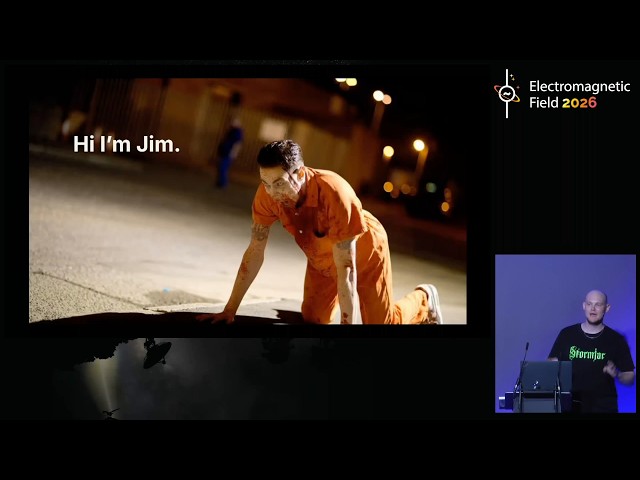
So, hello, I am Jim. This is not me. Um
this is a guy called Alex. I'm not
really a technologist at all. I am a
terrible programmer and I am an awful,
awful electronic engineer, but I make
things. And I started out making cross
city zombie games. And we tooured these
games around the United Kingdom to 12
cities. You'd have 500 people a night
being chased by zombies who were a
volunteer army. We'd ran multiple
locations. We'd close down roads. And it
was essentially a game of tag. Once you
were tagged, you were marked with a UV
pen. And when you got to the end, you
were turned into a zombie by makeup
artists before we had a big party in a
warehouse. I learned very quickly that
fear is is a design tool that has to be
delivered very, very carefully. If you
scare someone inappropriately, you can
drive them straight into a wall or down
a flight of stairs or into traffic. But
one of the biggest problems we had was
about creating a queue. If you make
something that is too scary as a video
game or as a book or as a film, really
the worst that's going to happen is
someone is going to put it down and
they're not going to complete it. And in
a sense, that's a shame. They're not
completing your amazing piece of
creative work.
But it also adds to the mythos of the
piece, right? It can help with word of
mouth. It can make it something that
people anticipate and heighten the
excitement in a live experience. What it
does is it creates a really big queue.
And a big queue stops the flow and it
breaks the experience and it makes it
less scary. It makes it more dangerous.
So how do you get people who are too
scared to move to move? This was a big
conundrum for us.
And the solution turned out to be
rewriting the narrative so that zombies
couldn't really see very well. And so
you could move very slowly and avoid
being chased. That was permissive enough
for most people to give sneaking a go
until the zombie snapped at them and
then they ran. Someone moving slower
through our zones was infinitely better
than someone just stopping. And that was
a really important lesson for me for how
you scare someone safely and how you can
design to scare people across many
different thresholds. If you talk to
anyone about their phobia, I know people
who are scared of butterflies. I myself
am terrified of wasps. Being scared is
different for each person. And so how
you design a broad set of criteria for
that is quite complicated.
And so that's what I'm going to talk to
you about. My company is called Storm.
storm jar. Um, you'll see me wearing
this a lot over the next few days
because these arrived just before I left
and they were the only clean laundry I
had. Um, so I'm going to be easy to
find. We've been working on this idea
for the last few years of content-driven
attractions of trying to create these
really immersive, engaging experiences
that extend into Discord where there is
a full online community of people that
can essentially roleplay and come back
to our experiences time and time again.
And the way we're trying to do that is
through connected devices. Partly
because building a very large
performance show like something like
Punchrunk where you have hundreds of
actors is very very difficult and very
financially challenging. And secondly,
because until very recently it was just
my myself and my wife. So very small
team. So trying to deliver scares
through technology that's safe
is a problem. [sighs] If it's too scary,
people won't pick it up and interact
with it. But if it's not scary, then
it's a disappointment.
Our debut show was called The Static
Sea. It was on Flatmol Island, which is
off the coast of Cardiff. It's a fairly
remote island, about the size of EMF
Camp, to be honest. On it is one warden.
He's the only person who lives there.
the tiniest pub in the UK, a lighthouse,
and a series of underground tunnels that
connect up various old gun pits and
historic ammunition sellers. We had the
opportunity to run an experience there,
but you can only land 12 people a day
onto the island. This is a problem. As a
result, we ran a lottery. We got many
people there over the course of a week
as performers, but we could only have
six winners and a few people from media
and press, but we didn't want to run a
show for just six people. That didn't
feel that exciting or fair, even via
lottery. And so our intention was to
build a device that connected between
these two worlds. The digital online
world where we could build and engage a
community and the IRL uh world on the
planet on the planet on the island.
So I want to talk very quickly about
what our needs from tech are then.
So, we define immersive in Stormjar as
you need to cross a threshold into a
story. You need to be able to leave your
world at the door and have the
opportunity to be a different version of
yourself. The story has to happen to
you. Now, you can be following a story
about other characters, but your
experience is the dominant narrative.
And we learned this the hard way with
the zombie game. I would spend a lot of
time trying to write a show that was
very
ornate, lots of like twists and the
characters were doing stuff and there
was a big reveal at the end. But
ultimately the actual story for the
player was my girlfriend pushed me in
front of a zombie. I shouldn't have
eaten that kebab. I haven't run since I
was a child. Oh my god, I've got a
stitch. Wow, I look great as a zombie.
That's the real story at the heart of
it. So when we build these immersive
experiences for us, we're constantly
thinking about how does this happen to
you? And that means our objects and our
technology have to be something that is
happening to you, not telling you about
something that happened to someone else.
We also need the technology to help us
build an affordable world, something
that we can afford to develop to
showcase.
So before I go into how we did the right
uh kind of objects,
um I want to talk about the wrong kind
of cursed objects. And I've touched upon
some of them earlier with things like
horrible machinery that can kill you and
computer worms that can destroy your
savings. This isn't as bad as that.
It doesn't look great, though. So I
really want to emphasize this was by
accident. So, this was a kind of a
breakthrough piece of work for us. We
were testing some ideas and so we
developed this idea for wouldn't it be
cool if we could make almost like a
choose your own adventure horror
experience that happened in an old 1920s
telephone, a really cursed looking
object, really beautiful. And it was a
field telephone. So, you like open up
the thing and you pull out the handle
and it rings and it knows you're near.
And I was like, wouldn't it be great if
there was these fingers that were
sticking out of it and each finger had a
ring on it and each ring was different?
And when you touched that ring, that
allowed you to make choices about the
kind of person you were on the phone to
who was like an evil entity.
So, the problem is when you 3D print a
finger
or fingers
and they don't move and they're not on a
hand anymore,
they kind of look like something else.
They kind of really look like something
else.
And then other design decisions like in
order to start the experience, you have
to put your finger in that hole. They're
not scary. That's really silly.
Furthermore, being on a phone chatting
through with these spirits and whatnot
who are communicating with each other
actually just felt like you're on hold
on an automated call thing because the
most real world analogy to this
experience
is being on hold to someone you really
don't want to talk to who's wasting your
time. So, it actually wasn't fun. What's
more, in terms of making it, I didn't
follow the feeling in making it that I
wanted people to happen. I was thinking
about how we solve the technology. And
it sounds really cool. It's called Ring
Ring. What a great title for this thing.
It's going to have fingers coming out of
it. It's this old cool box. But it isn't
delicious. It sounds delicious. It's
like that thing on the menu that really
catches your eye, but then is a
disappointment. I did not design this
for repair, so fixing it was a
nightmare. There were no spares. I
ignored I wasn't working full-time on it
and it required full-time. The time
frames were terrible.
It looked really nice in parts. That was
quite a big win. I hadn't done prop
design before, but I didn't recognize
that till long afterwards. It wasn't
simple. It was very complicated. It was
very crunch orientated.
And I thought, maybe I'm cursed.
Maybe I'm cursed. And there's a few
objects that I brought with me to EMF
camp which really do to be honest
reinforce this thesis. But it's not that
I'm cursed.
It's that I hadn't really put a proper
design framework in what we were doing.
We didn't have additional budget or
time, not just money, but time to like
master the object to really think about
what would make it excellent. It was the
first draft went straight out. I love
this. It was I'm quite dyslexic. I just
got it wrong one day. But protoshite
instead of prototype. If you're not
embarrassed to show it, you've worked on
it too much. And that's something I need
like tattooed under my eyelids. Building
stuff out of easy to find things.
Thinking about what success looks like
and writing it down. Testing it with a
target user before it got installed.
Um, yeah, no discovery phase to think
about what that feeling might actually
be like. And the final thing and the
biggest crime in a sense was it was just
very unkind to us to make. It was a
miserable thing to work in and it was a
very hard thing to build and it
technically worked and was a
disappointment. It's kind of worst case.
So we set ourselves a criteria. We want
the things we make to be dynamic. I
don't want to make something that's like
an automated telephone thing. I want it
to feel like it's alive. I want it to
still be good in 20 years time, which is
a very difficult thing to do with a lot
of technology because it ages so
quickly. I want it to be accessible. We
know horror is like sound is such an
important thing. So, we pivoted into
focusing on sound technologies. We
wanted it to be joyful so it could be
easy to debug, reliable, repairable,
extendable, cheap, modular potentially.
Think about environmental friendliness.
That wasn't something I was thinking
about. Really, the phone didn't happen
to the audience. You were just listening
in. And we wanted it to be scary. And I
also wanted it to be safe. I want to
build things that don't force people
into a curb or isn't someone jumping out
at you with a chainsaw because although
that's very effective, it's not very
controllable.
So, this is how we approach making the
right kind. How am I for time? Yeah,
thumbs up. That's vague. Okay.
>> [laughter]
>> Coming back to the island. So, we needed
a conduit between our six players on the
island and the people online in our
Discord. And for that, we built this.
So, this allowed the players to ask
questions in Morse code. One thing I
forgot to tell you about the island is
it was the first place that radio was
broadcast over water. Um, so it has this
like real heritage of radio technology.
So, we built a radio pirate station, a
pirate radio station. I am quite warm.
And we scattered radios all across the
island, literally about I think 50 to
60. And they acted as our way of
delivering the soundtrack across the
whole island and also clues that came in
from the Discord. And so what it allowed
people to do was broadcast Morse code
into the Discord to ask for help. And
then the people in Discord could respond
and solve puzzles online working
together and then um that would be
broadcast over the radio which would
inform all the players across the island
at once and we ran that as a live game
and that was really exciting but there
was something so magic about approaching
this thing and opening it up. Our story
was about ghosts. So this is the skull
of one of the main characters. So,
whilst you're interacting with it, the
skull whispers in the voice of the ghost
that you've already met. That was a
really lovely kind of interaction that
wasn't a horrible jump scare, but was
definitely deep and creepy.
This is another example. This is just a
puppet. But originally in my head, I was
like, I really want to make this really
amazing animatronic thing, and it's
going to be so cool. I can't build an
animatronic. And I was like, oh, it's
going to be an amazing puppet thing, and
it's going to be really cool. I'd never
made a puppet before. So, under sage
advice from the wonderful people at Air
Giants, um, they really forced me to
make it simple. This is the fishmonger.
He has one arm and the arm is a knife.
And it meant I had to perform. And that
made it so much easier to make something
that was a good experience for my
audience rather than making something
that was just a way of interesting me
and being something that I would love to
make. I would love to make automter. I
am not the person who should make
automter.
I have brought something with me that
you're very welcome to come up and try.
And I wanted to play with these themes
of cursed objects. This is the Paraggo.
It's uh so cursed I couldn't get a photo
of the screen. Uh it doesn't refresh
fast enough to take a photo of. It's a
Tamagotchi knockoff
that has parasites.
The more you feed and look after this
using the conventional interactions of a
Tamagotchi, so cleaning it, putting it
to bed, feeding it, the more worms start
to ripple in its body and it gets bigger
and bigger until the the software shifts
and all it wants to do is be fed to get
as large as possible. It then fakes out
that it's running out of battery to get
you to plug it into a computer. And when
you do, it delivers a payload. In this
instance, all it does is open up our
website. But I thought it'd be really
fun if it could install one of these on
your computer. I'm not that good. I
don't know how to do that. But that was
a nice way of getting to a very simple
loop. And I if you come and see how
terrible this case is, how truly god
awful it is, but how the core mechanism
is quite joyful. You can see we're like
slowly starting to learn and take on
board our own own lessons and design
philosophy. So come try this guy. He's
he's he's good fun. Wow.
>> Wow.
Okay, fair enough. Uh what we're up to
now, so we discovered that sound is
really our best friend. So a lot of the
tech stack that we're using is looking
at um using rainbow which is a type of
max um which can run on a Raspberry Pi 2
W and above which allows us to make very
dynamic objects. It's not about
completing an object like you might
escape room. It's about picking up an
object like a skull and it whispering to
you and it doing that in a very dynamic
way or picking up a ship in a bottle and
as you tip it you hear the screams of
the sailors. It's all about adding
intrigue and diamondism and unexpected
little thrills and creepiness.
However, in the background, we're amping
things up. So, with the help of the
wonderful Sam Underwood, who has
designed loads of amazing installations?
Has has some been here? I presume so.
>> He was here last time.
>> He was here last time. He's not here cuz
he's cycling around the world and he
very very kindly lent us his strange
setup for making horrible deep noises.
And we're in the process of building
this giant Doom instrument that produces
infrasound and modulates and screams
like a creature. And the next show we're
developing is an adaptation of Aljenon
Blackwoods The Willows, which is a 1907
novela. You can read it on Project
Gutenberg. It's fantastic. and it's
going to be like a dark ride. So, you
won't see this, but you'll feel it. And
that has all stemmed from this idea of
like how do we want people to feel?
Well, we want to feel like there's a God
in the room. And that is what is going
to help us get there. I've got a couple
of closing things. Am I okay for time?
>> 7 minutes.
>> 7 minutes. That works. First of all is
bones. It's very hard in our world. Does
anyone here make immersive or has
thought about making immersive? I
actually can't see hands, so give me
like a little whoop.
Hell yeah. Okay, great. There isn't like
a tool for like writing and developing
and testing and failing. And so
immersive can be very expensive to fail.
It can often involve actually trying to
build the thing outright and then
test it and you've run out of money. So,
we've been developing this tool to write
our own show. It's free. It's called
Bones, and it allows you to build out
the skeleton of your show. It allows you
to write it like a traditional script if
you want. You can do a back of the
cigarette packet. We call it dirty maths
financial plan for your show. You can
put your tech stack in, your cues, you
can put in costume and props and tag
them all across um the interface, which
makes it nice and easy to project
manage. And you can have teams working
in it. But the most valuable thing is
you can generate a link of your show and
you can send it to someone and they can
play test it and they can put feedback
at every kind of major milestone within
that story or bone as we call it. And
that can generate a heat map that gives
you a really good sense of feedback from
very very early testing. And we think
it's going to be very helpful to get as
much testing as early to fail fast and
follow the fun. Um, so this is what this
tool has been built for. And then very
finally, this is contact stuff and
stuff. Um, I wanted to ask who here is
from Bristol, Bath, North Somerset or
South Gloss.
Great. So um there's 25 million pounds
that's come to the creative industries
over the next three years in that
region. There are six regions across the
UK but each one's being delivered
differently. I'm advising on creative
technology. Come and find me. Tell me
what your needs are as a business or as
a freelancer because the objective of
that is to support uh the growth of the
region and it'd be really wonderful to
hear your thoughts. So that is me. Thank
you very much for listening. It's a real
honor to be here and thank you for
joining me.
[applause]