Video summary
The speaker begins by establishing soil as a fundamental component that shapes landscape morphology through its interaction with underlying bedrock. The elevation of the ground surface is determined not only by geological processes but also by the dynamic balance between soil production, erosion, chemical weathering, and biological activity at the soil-bedrock interface. A significant portion of the discussion focuses on organic carbon within soils, distinguishing between particulate organic carbon (PC) that decays rapidly and mineral-associated organic carbon (MAOC), which is tightly bound to minerals and turns over slowly. The speaker highlights a critical gap in current understanding: while many models treat these pools separately based on operational measurements, microbial activity constantly transforms one into the other, making it difficult to clearly define where they split or how long each persists independently.
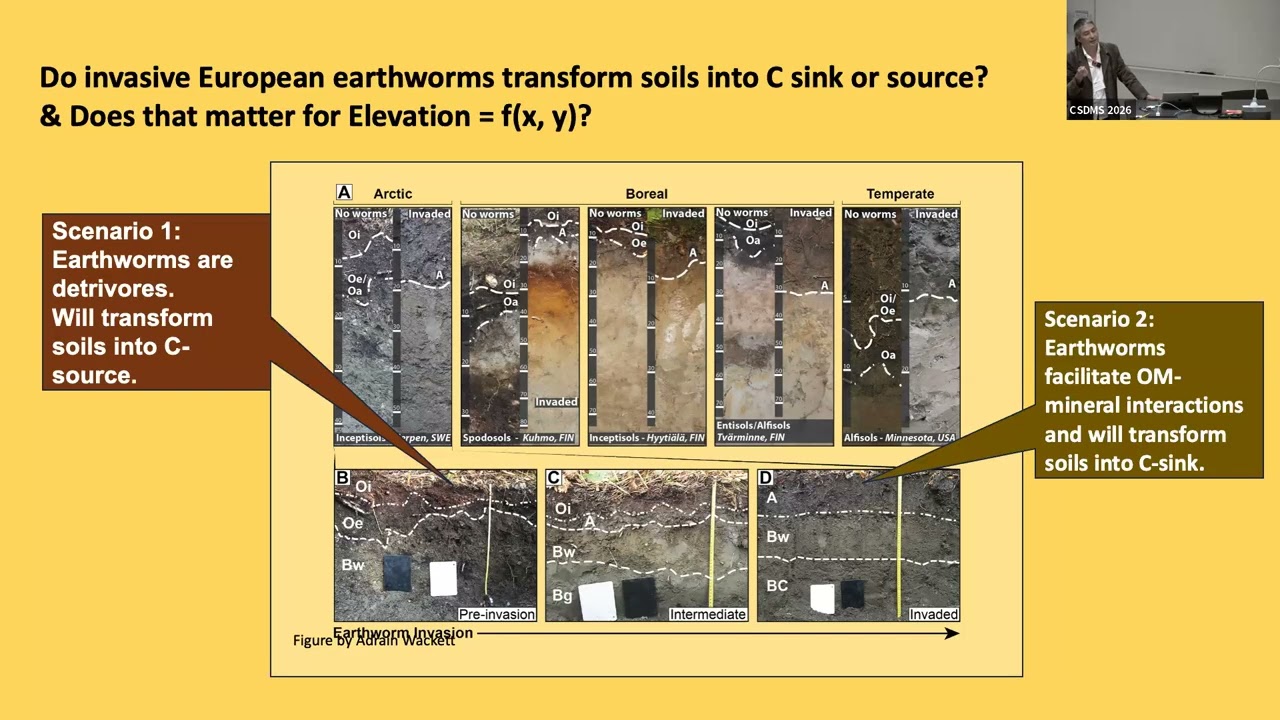
The core argument presented connects this carbon cycle directly to changes in ground surface elevation through the invasion of earthworms (Oligochaeta). Historical data from post-glacial environments in Sweden and Minnesota illustrate that as forests recover after glacial retreat, native understory plants initially create a thick organic O horizon. However, once non-native earthworm species arrive—often introduced by human activity—they rapidly consume this litter layer within five to ten years, replacing the porous O horizon with a denser A horizon rich in mineral-associated carbon. This biological invasion fundamentally alters soil structure; while it reduces total carbon concentration in the surface layers due to decomposition, it simultaneously increases bulk density because organic matter is mixed deeper into the mineral matrix. Consequently, even though carbon storage might appear stable or slightly increased when accounting for volume changes via bulk density adjustments, the physical thickness of the topsoil layer decreases significantly.
To quantify these volumetric changes independent of biological inputs like leaching, the speaker introduces a normalization method using immobile elements such as zirconium to calculate an epsilon factor representing soil expansion or contraction relative to parent material. Modeling experiments over fifty years demonstrate two distinct scenarios: one where earthworms act primarily as decomposers that strip away organic layers and compact the soil, leading to rapid carbon loss from the surface; and another where they function as bioturbators that create substantial mineral-associated carbon pools while increasing porosity in deeper layers. The speaker emphasizes a crucial distinction between geochemists, who focus on mass per unit area (concentration), and geomorphologists, who care about volume per unit area affecting elevation. By linking changes in organic matter fraction to bulk density, the models show that earthworm invasions can alter ground surface elevation by several centimeters within decades—a rate far exceeding typical geological uplift or erosion rates of millimeters per year—thereby proving that biological agents are powerful modulators of landscape evolution and potential accelerants of soil erosion.
Read the full video transcript
Thank you so much for uh the opportunity
to share my um work and some salt and
see. So I'd like to start with uh the
soils as a component of shaping the
morphology of the landscapes. As you see
here um you have a soil covered hill
slope and the soil basically overlies
the underlying uh bedrock and then if
you want to um you know follow the
trajectory of the ground surface
elevation that elevation is basically on
changing according to the change of
elevation at the sole bedrock boundary
and also the sickness of the source. So
at the boundary of the soil and bedrock
that elevation is going to be affected
by omnip rate and the soil production
but at the same time the mass of the
soils will be determined by the balance
of soil production and then the mass
loss by uh so erosion and chemical
weathering.
Okay. uh but if I go to uh you know uh
other conferences like so science
society of America or ecological society
of America or most of uh you know our
department seminars and I start uh
talking about soils as a carbon
reservoir and the soil is such a very
important reserve of carbon that has a
big impact on the global carbon cycle.
So within this community of soil carbon
cycle, the big question is how much of a
soil carbon is actually associated with
the minerals. And if you dig up the
source and look at the organic matter,
you will quickly find that some organic
matter are not really combined with the
minerals, but there also significant P
of organic matter that are tightly
combined with the minerals by basically
being sobbed onto the mineral service or
by being accruded in the aggregates.
Um so they also have their own models.
So this is a very uh simple and
incorrect in many ways uh view of the so
organic carbon. So uh so organic carbon
can be considered as a sum of
particulate organic carbon which is uh
described as PC here and also mineral
associated carbon which is described
MAOC and they have their own uh their
own inputs and their own uh decay rates
but it's al often very hard to really
differentiate uh the two and then it's
very hard to really uh define where
those two are clearly split. So many of
the experimental work to uh to quantify
those separate pools and depend on very
operational uh experimental measurement
and then those two pools are also
connected because of the microbes. So
here some of the particular organic pool
uh carbon will be consumed by microbes
and the microbes die and then some of
those dead masses or alive mees
biomasses of microbes can be sequestered
into the mineral associated to carbon.
So uh in my talk today I like to make a
two argument and the first argument is
that this uh so carbon cycle actually
matters uh to the elevation of the
ground surface. So uh the morphology of
the landscape is somehow connected to
what is happening to the organic matter
in the source. That's the first argument
I like to make. And the second argument
I'm going to make is that ours really
highlighted. So you can see this uh
example of connection between carbon
cycle and the ground surface elevation
through the action of the earths and see
so uh I'm going back to uh about you
know 10,000 years when the glacier
covered much of the North America. So
when the glacia retreated and you know
uh forest and uh pretty uh followed um
and then this is uh what the forest
floor used to look like before aromes
caught up. So if you go into the curious
forest that are very common in Minnesota
like a sugar maple or basswood forest
then you will see that uh there is tons
of understory plants and as you walk in
you'll also find that ground surface is
very soft because they are covered with
a s uh o horizon. What's going on here?
Okay.
But once or arrive then much of the
those understory plants disappear and
then being replaced by gramminoid and
grass types of plants and then uh also
the o horizon or the lip layer quickly
disappears.
So and this is the two data from a very
different environment. The top one is
from uh Abbyiscoco, Sweden, the first
national park in the country and the
second one is from uh North Central
forest in Minnesota. So here in the
accesses you see the distance. So that's
basically distance from the point where
we believe were introduced into the
forest. So are moving into the forest.
In the Minnesota case it has advanced
about 200 meter. In abisco aiscoco case
it has advanced about one kilometer and
then there are two y-axis and the green
one showing the lip sickness or lip
biomass and the dark one is showing uh
the ursome biomass. So here are the dark
forces and eating into the forest and
consuming the organic layer. So by uh
monitoring this speed and also by uh
dividing the length of our invasion
chronos sequence uh by the speed of
their movement we can also tell how long
this site has been invaded. So among you
know from those research we know that uh
you know if they're left alone they
advance about you know five to 10 meter
per year. So from here and most to the
end of this uh you know classroom. So uh
if you multiply 10,000 years uh with the
dead rate you can go about 50 kilometer
to 100 kilometer. So it's very
insignificant in the scheme of the
continent. So much of the uh North
America basically stayed uh without
native for last uh 10,000 years. So, so
when I first studying uh there was some
invasion in Minnesota. I met with uh you
know with tribe people in the liter lake
and some of the young pe uh one of the
young people there told me that his
grandfather uh grandfather had told him
that came in the white people. So they
had been uh aware of this for a long
time but now his scientists arrived and
then got surprised. So then uh I was
very curious about whether uh OG
language actually record anything about
it. And so before our last Oj linguist
retire uh I asked John Nicol who used to
be in the uh American Indian department
here you know whether Oz language has
any t for u thems
but then he also told me that you know
uh he had been always curious why
language doesn't have a tongue forums
and then when He heard this from uh
those descriptive words and his uh kind
of conjecture was that probably was
invasive species or someone introduced
the species but he couldn't believe it
uh himself. So
uh going back to our uh questions.
So let's think of uh soul sickness and
then being governed by those uh factors.
So let's say you know or just arrive
then what do you think is going to
happen?
Do you expect expansion of the soil or
do you expect collapse of the soil? So
do you see epsilon as a positive sign or
negative sign? So
so keep your thinking and you may write
down and uh whether you will be
surprised or not. So uh one thing that
is really surprising about this earths
is that wherever they invade they
basically do the same thing and over and
over again and then that is that
basically they remove the organic
horizon the lift layer and then they
create this top soil in a mineral rich
but also organic rich uh in top soil
which we call a horizon. So another way
of saying it is that they replace the O
horizon with a horizon and that seems to
be happening everywhere from Sweden and
Finland in Minnesota and Alaska
everywhere that uh we have visited.
So if you think of this from you know
carbon perspective and then you can uh
see two things you know one is and very
contrasting things you can see as very
uh vigorous detore and then they come
and they arrive and then they remove
that litter layer within a matter of
five years to a decade. So they turn
soil into carbon source by removing the
O horizon. But that's when you really
focus on the little layer. But let's say
you don't care about the oil horizon,
but you care about the mineral soil.
Then you are going to see the opposite
thing. So you will see as animal that
are very strong biotopators
and the mixing organic matter and the
minerals together and create what we
like to see the mineral associated
organic carbon that turnover slowly. So
then we may you will be tempted to say
the ors are probably helping source to
uh sequest the carbon. So uh here is the
carbon uh concentration data from
different parts of the world uh you know
boreal arctic and temperate and then you
know you may see the decrease of the
carbon concentrations from pre-invasion
to post invasion but uh but you are not
actually seeing the decrease of the
carbon storage here because you're only
seeing the decrease of carbon
concentration to really get the storage
you have to multiply ly those
concentration by the bur density. So and
also there's a horizon changes. So those
white circles uh which describe the
normal situation uh you have very high
uh carbon concentration and making them
all horizons and those horizons will be
later replaced by a horizon. Now uh they
taking the surface of the soil their
carbon concentration is uh smaller but
there are denser. So you can see this
again uh depending on whether you look
at the O horizon or a horizon you can
see it as a you know carbon sink or
carbon source. So now let's look at the
burket density. So uh here
uh there's a really a nice relationship
between uh organic matter fraction in
the source and the burka density. So but
uh wherever we go and wherever we
collect organic matter fractions and the
bur density data uh they follow this uh
nice nonlinear f uh trend that you
reduce the organic matter content then
you increase the bur density and then we
find this from several different
invasion chronos and but also uh another
thing that is important is that it also
O matches with much larger collection of
the data that shows the relationship
between organic matter fraction and the
B density. So here uh
basically uh I'm not really telling you
which direction the system is moving
because that also depends on whether you
look at the O horizon or you know a
horizon. So if you're looking at the O
horizon you will see the organic matter
fraction decrease and the burk density
increase but if you look at the a
horizon then your organic matter
fraction will increase and the burk
density will decrease. So uh there are
both directions uh in this diagram.
So
the one way to resolve this to really
focus on
uh the volutric changes uh is to
normalize all the concentrations to
something immobile that we trust that
this particular element doesn't get uh
washed down by le or doesn't get
introduced into the soil by biological
and carbon cycles and one of those
candidate is zerconium. So by combining
uh zerconium concentrations in the soil
uh versus the apparent material and also
by comparing the burke densities uh that
we can calculate uh epsilon which is uh
volutric uh deation um uh factor. So if
epsilon is zero that means your soil has
no has gone through no change in volume
uh during the formation and in
comparison to the parent material. But
if epsilon is eight that means soil is
basically containing 800% of the volume
that it parent material used to have. So
if it is minus one then basically volume
has disappeared. So here uh so uh the
x-axis is the cylum values and the
y-axis is soil and then there are three
categories you know pre-invasion and
intermediate invasion and then also
intensively invaded the region. So
before uh the earth invasion because of
the or horizons that you have a dramatic
uh expand uh dramatically volutrically
expanded the source so it's a 800%
volumetric expansion but then once um
arrive then the volumetrication
decreased quite dramatically to 100%. So
um kind of going back to earlier
question. So uh ORS
you know uh they tend to uh decrease the
existing volumetric expansion before
their arrivals. But uh but this is just
one example because depending on which
stage of invasion your sample and also
depending on what kind of ursomes
invading at the place and you may have
different signs. So this is just a take
uh take this as one uh possible outcomes
of the volumeatic uh volumeatic change
in the soil uh due to swim invasion
here. Okay. Uh
so now I'm going to uh do a very simple
experiment a simple
uh mass balance modeling to you know
test or highlight the idea that the
carbon cycle and then which is in this
case strongly mediated by earth invasion
has a big capacity to modulate the
sickness of the source and by also by
doing so the elevation of the ground
surface. So there's a two uh scenarios
here. You know one scenario is that or
some are really strong so they get rid
of all horizons that that's the model
focus. The second case uh it focus on
the scenario that are actually uh more
than that they actually create a
significant mineral associated organic
cut. So uh under the hood of the models
there is uh three horizons and then O
horizons and also the root rayer and the
mineral horizon that is going to turn to
a horizon and thenomes are being
introduced at certain point of the time
and then uh they eat some of the plant
leaf litter and then they also eat some
of the fine roots and then they transfer
those carbon into the soil and at the
same time they partition the carbon into
two different poles that are turning at
different speed and also there is a
bioteation happening uh between uh the
root layer and the underlying middle
source. So two scenarios uh
so uh you know x-axis here is time
relativity invasion. So we are only
simulating a 50 years because that's how
much we know about uh what is happening
in the uh the field and the y-axis shows
basically the entire soil carbon pool.
So if you have uh osomes as deadly bores
uh uh okay uh scenario one which is red
then your carbon storage is decrease
quite rapidly and then uh by 20 years
you lose most of the carbon in the
system but if you have ursomes as you
know producer of the mineral associated
carbon that is turning over slowly then
your total carbons to will increase but
that's not really surprising because
that's how we uh you know set up the
model.
But now uh let's think about some
difference between uh geocchemist or
ecologist and um and gemophologist
in my view and the geocchemist are very
much concerned about how much uh things
are here at certain location. So we care
about the mass of something per square.
But if I talk to germaphologist and they
care about the elevation. So they care
about the volume of the materials uh per
uh given areas and then so we if we want
to go back and forth uh we need a
conversion factor. We need a conversion
factor that uh makes us to do the unit
change and in this case the burket
density is that uh the key. So I'm going
back to this one. So we have a really
nice relationship between organic matter
fraction and bal density which means
that if I can track down how the organic
matter concentration in the soil change
then we can simulate how the burka
density will change and by doing so then
I can change the mass carbon per square
or mass soil per square meter to the
thickness of that layer and which can
lend me to to the elevation of the
ground surface. So uh so this is the
result. So if you look at the uh earth
surface again land surface elevation in
comparison to the preosome invasion and
depending on you know whether you have
earths as dribbles or you have ursomes
as a creator of the min associated
carbon your ground surface uh will
evolve differently you know plus minus
uh 10 or 20 cm in
20 years or 50 years and that is a lot
faster than millimeter per year or uh
you know meter per million years. So but
then we don't really know how long it
will last but kind of going back to the
burka density we can go a little
further. Uh so when you combine a burka
density with the particle density of the
minerals and the particle density of
organic matter then you can calculate
the porocity. So you can also model how
the porocity will evolve with uh the
invasion of the earths and then this is
the results. So two scenarios again at
the time zero uh those two scenarios
kind of converge and then as time goes
on by 10 years those two two scenarios
diverse and then the red line which
simulate the earths as deadly bors
showing the uh the senos soil and then
less porosity. But in contrast where
your ursomes create the mineral
associated carbon uh you uh have a
sickening soil but also it porosity uh
increased quite dramatically.
So here um I showed you uh modeling
result uh only up to 50 years which is
really uh short uh time compared to the
most presentation we have seen uh so far
and the reason being um that we don't
really know what is going to happen
after 50 years of earth invasion. So
there could be a very different
scenarios. You know, for example,
the biomass of biomass of the European
ors we see in Alaska and Minnesota are
way higher than those uh biomass uh in
their origins like a southern Europe.
And then we also have a new invasion of
jumping and those are of Asian origin.
And then they really uh change the souls
within couple of years. And then they
also show tremendously higher uh
population density uh than those they
show in their kind of home countries
like you know China or Korea and Japan.
So we don't really know whether they
their population level will uh slow down
and we also don't know uh how their
perturbation of biochemistry by
accelerating organic matter can change
the nitrogen cycle or phosphorus cycle.
In the case that they can help the slow
release of the nitrogen, they may solve
the problem with light nitrogen
limitation for certain s certain time
and boost the plant production which
will bring in a more li into the soil
and then that will lead to the more
organic matter in the soil and also we
have a very limited data that stretches
beyond in 30 years and then those
limited data seem to suggest that osomes
are getting more effective in creating a
mineral associated organic carbon but
that we we don't really know uh you know
what is really truly happening beyond
the 50 years I think that is a fair
assessment
so here um I hope I convinced you that
uh the arsomes are important and in that
uh their kind introduction into a system
can change the porocity and also uh the
volume at volume of the source uh quite
dramatically enough to uh change the
elevation of the ground surface and that
also has uh implications uh for uh so
erosion because the first thing is that
uh when ours arrive
uh they can lead up you know over
horizons which means you're uh they are
getting rid of this protective layer
that protect the mineral surface from
the rain or from the uh the overand
flow. So, so they may have a negative
impact or kind of accelerate the soil
erosion and also u this modeling and our
some field data show that you know or
some uh in certain cases can they can
dramatically decrease the porocity of
the source which may uh elevate
occurrences of the overend flow that can
also uh acceler leading to accelerate
the erosion. So uh Nate my students
presented the poster. So if you have
visited with the Nate that uh you know
Nate had some uh some data to show you
uh the erosion rate change with ursomes.
So uh I will leave you with some uh
potential discussion topics and I also
also like to acknowledge uh my graduate
students Nund and and Adrien W Sarah
Bower, Tyler Bowman, K Restno and Amy
Little who all contributed to uh
understanding the impact of ours in the
poorest Minnesota and Alaska and thank
There.