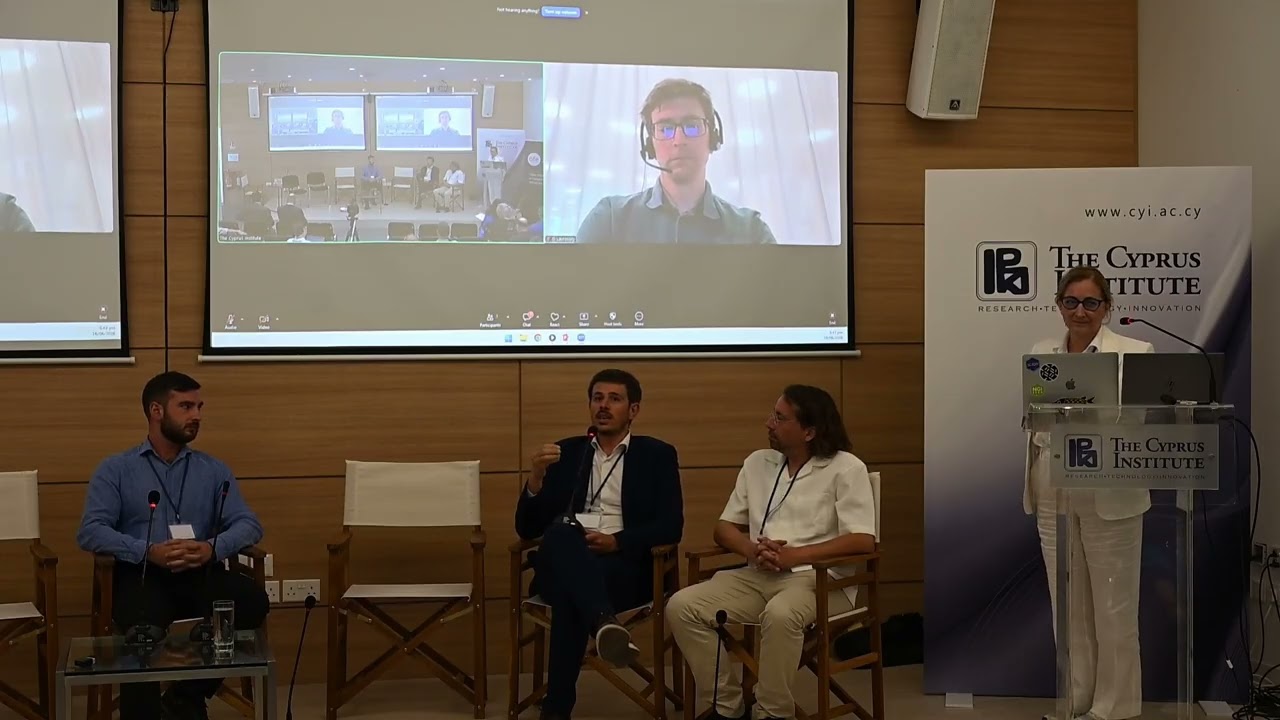
CS CY - Trust by Design Open Source Systems for Secure Digital Infrastructure: The Swiss approach
Watch on YouTubeVideo summary
The panel discussion centered on the critical concept of "Trust by Design," emphasizing that trust must be an intrinsic component of digital infrastructure rather than a feature added after development. The speakers highlighted how Europe faces unique challenges in maintaining trustworthy innovation as digital systems become vital to economies and democracies. Key arguments included the necessity of integrating security, governance, and societal values from the earliest stages of technology creation. Open source was repeatedly identified as a foundational element for achieving this trust, providing transparency that allows users, regulators, and researchers to scrutinize code, data sources, and algorithms before deployment. This approach ensures accountability and prevents technologies from operating as black boxes where biases or malicious intentions could go undetected until it is too late.
Several specific examples illustrated how open source principles are being applied across different sectors of the digital landscape. In financial infrastructure, the SCION protocol demonstrated that resilient network technology could transition from academic research to operational use in critical ecosystems like Swiss interbanking networks, driven by strong collaboration between universities and regulators who prioritize resilience over mere speed. Similarly, the KUBIX project addressed global inequality by bringing Wikipedia content offline for populations without reliable internet access or facing censorship, proving that open source software serves as a powerful tool for knowledge transfer and digital inclusion. In the realm of artificial intelligence, the Apparatus model showcased how community-driven development can prioritize explainability, data quality, bias mitigation, and human-in-the-loop mechanisms to ensure AI systems align with ethical standards and remain accessible to diverse user groups.
The conversation concluded by defining what success looks like for Europe in building a trusted digital future within the next few years. The panelists agreed that true progress requires shifting away from a "move fast and break things" mentality toward one where society remains at the center of technological development, with social sciences playing an active role in AI ethics research. Success will be measured by the ability to harness AI's transformative potential without compromising social relations or democratic values, ensuring that technologies like large language models do not harm human psychology through unchecked flattery or misinformation. Ultimately, the speakers envisioned a future where open data and software are cultural norms across Europe, supported by dedicated digital innovation offices and robust governance frameworks that enable sustainable entrepreneurship while protecting public interests against global competition.
Read the full video transcript
[applause]
Before I talk to um the panel the
panelists I want to connect with
Switzerland and the poly technic school
of loan because uh Oleg Labros Lavroski
who is uh a panelist working for aus
artificial intelligence
the only as I know so far opensource
artificial intelligence who can connect
with us and particip
So if someone can help me here with your
infrastructure, I would be
>> hi. Perfect. So far away.
>> Can you hear me? Okay.
>> Yes. Can you hear us?
>> Fantastic. Yes. I I had I had been uh
having a little bit of trouble in the in
the previous panel because of some
people seek to speak away from my the
microphone. But I hope in this one we
will all be well behaved and loud and
clear. Thank you.
>> So good afternoon dear friends, ladies
and gentlemen. In 1993, I was a student
at the University of Ber and then I
realized that CERN [snorts] made a
historic decision. Rather than keeping
the worldwide web proprietary, it
released it freely to the world.
The reason was simple but profound. A
global information network could only
succeed if it remained open, accessible,
and interoperable for everyone. Today,
Europe faces, I think, a similar
challenge. As digital infrastructure
becomes critical to our economies,
societies and democracies, the question
is no longer only how to innovate but
how to ensure that innovation remains
trustworthy.
Trust is not something that can be added
later. It must be designed into the
technologies we built from the start.
This is the theme of our discussion
today. Trust by design. We are fortunate
to be joined by expert working on it.
From secure networks and its resilient
access to knowledge to trustworthy
artificial intelligence and privacy
preserving digital payments as we've
heard before from Leo Schumach. Let me
begin by inviting and welcoming each of
our panelists.
Ole Rose, Keef, Nicola Rosoli, thank
you. Um,
Emmanuelart
and John who is the youngest
and will speak about his experience with
Albertus
please.
[applause]
So uh my first question and I will stay
in here and I'm not going there because
I want also to have a eye contact with O
this is
um please introduce yourself briefly and
tell us about your work and project um
let's start with you Emmanuel
press the button button
>> press the button
>> only once collect your body.
>> Fantastic. Yes.
>> So my name is Manuel Ling. I launched 20
years ago a project called Cubix which
has for purpose to bring online content
offline for people with difficulties to
access problem internet
and 20 years later I'm here to uh it.
>> Go on Nicola.
>> All right. [snorts] My name is Nicolari.
So I lead design association. We are a
nonforprofit organization based in
Switzerland and we maintain design
protocol. So that means uh open source
implementation specifications and then a
lot of community.
>> Yes. Hi. So I'm the technical community
manager for the Swiss National AI
Initiative. It's a collaboration between
the two technical universities EPFD
teach as well as the Swiss
supercomputing center in Logano and I am
based in uh actually in Bur. So
greetings from Bur uh where we have
today the Swiss IGF internet governance
forum and uh yeah I would have otherwise
been happy to be with you in person but
we have parallel conferences today
>> hopefully next year in Athens.
>> Exactly.
So, um, George,
>> hello. Hello.
So, uh, I'm George Bernakis. Difficult
last name. Please, uh, excuse the Greek
background. Um, so my my background is
in military history and security
studies. Uh, and I have engaged in
research regarding the impacts of AI and
large language models on uh, society uh,
and the economy. uh and uh my main uh
concern and presence here is uh to talk
a little bit about my experience with
apprentice but also to comment on um the
engagement of uh the social sciences in
the AI space.
>> Thank you all. So then my question to
all of you is uh that the title of this
panel is trust by design. What does
trust mean in the context of your work
and how can be embedded into digital
infrastructure from start Nicola?
All right. So um especially when it
comes to new technologies, trust by
design means uh that you have to think
about the security but also the
governance uh part of a technology
really from early on and uh possibly
really bake it into the technologies and
this is really what science does at at
the networking layer when it comes to
the connectivity.
>> Thank you.
manual.
>> So in TV that's a bit easier because we
are not really such a big part of the
infrastructure like the replacement of
network infrastructure or sales
solutions this kind of thing. So the
solution is easier. Um and for the rest
of the trust uh this is probably one of
the biggest assets we have like as a
trademark as a project and what I can
say is that the fact that we are dealing
with open source only open source
software and open content in general
both of them gives almost by definition
a super good uh note in term of trust
trustworthiness.
Thank you.
>> Well, apparus means openness and it's uh
you know in the context of my work as a
community builder uh very much about
opening technology projects to the users
and trust to me means not like a static
uh concept. It's something very dynamic
needs to be continuously maintained
through ongoing efforts basically to
address user concerns to be an active uh
partner to incorporate their feedback
and of course to reflect societal values
laws and emerging technological
capabilities and I mean there are so
many areas where an AI project like
apparatus you know touches upon things
I'll just mention a couple of things
we're working on one is explanability
ility. Of course, we would like to be we
are I think one of the most transparent
projects of our kind with a massive
amount of documentation going out, but
we also have an interpretability track
where we are taking specific concepts in
the development of LLMs and making those
um you know making explanations about
them. The other one is around data
quality and mitigating bias. We know
that there's an enormous amount of
problems and issues uh in in
understanding how how bias comes into
play. This is a massive area of concern.
Um things like security and privacy get
putting putting boundaries around what
people can do with LMS
places where LLM should push back. Um
and of course human in the loop you know
how do we involve researchers and the
general public in critical decisions?
How do we build feedback mechanisms into
the model? Um, one of the main areas of
that is of course value alignment, but
also things like accessibility, making
sure that the system is accessible in
multiple languages, that it's intuitive
to people from different backgrounds and
abilities. Those are just a sampling of
many areas. And we believe that the open
source approach to large language model
development um is is definitely one of
the fundamental blocks to a more
trustable system.
>> Thank you. George, do you have a take as
a user of technology?
>> Uh, as a user of technology, well, um,
what I would say is that for me trust uh
in um in open source technologies and in
uh AI broadly has to do with um
governance uh incentives, which is
something very important. It's what kind
of incentives do the proprietors of uh
AI, the developers of AI, those funding
it, what incentives do they have to um
make these technologies interact with
the public properly? and also uh for
regulators to be uh intimately aware of
all the ways in which uh these
technologies interact with uh the public
broadly not just people who know how to
use them and how to work with them not
just people in tech but everyday people
who will interact with LLMs in
increasingly uh you know large ways in
their daily life. How do we avoid uh the
certain pitfalls? how do we investigate
uh those uh the problems that could
arise from something like this? Uh and I
believe that open uh open source and uh
open uh research and uh an environment
of discussion is the most important way
in which we can explore these uh
problems.
>> Thank you Nico. I have two questions for
you. Uh many groundbreaking technologies
remain in the research space. What
enabled scan to move from academic
research into operational development?
>> Um, thank you. So
scan is a network technology used in
critical infrastructure ecosystems and
this is notoriously uh hard uh very hard
sector to to to produce in innovation
because technology life cycles are very
long and typically operators of crystal
infrastructure are very reluctant to
change things. So scan I think here is
really a bit of a special case in the
sense that um the technology could
really move out of 88 sur towards uh for
example deploy big deployments like the
Swiss interbanking network. So really
processing billions hundreds of billions
of friends in financial transactions
thanks to sign connectivity and this was
possible because of a few ingredients.
So one of this I think the most
fundamental was a really collaboration
between a very strong um research uh
community in Switzerland and uh
potential users.
One of the most important one was for
example the central bank that is also
the regulator when it comes to payments
and they have been looking at the
resilience of uh the internet network
and uh by looking at that and at the
same time by having research
collaborations with the university then
they realized that there is some
potential to use some emerging
technology like scan and that's that's
really how then the early trials of the
finance network started and that's
really what gave scan its
initial commercial impulse and yeah
today it's it's really widely deployed
in in that use case and it is there are
many more that are uh coming to life.
Last factor I would say is also that uh
I think in Switzerland
there is a lot of attention to
resilience. Why? because I think uh
typically uh there is some risk aversion
and that really helps that that the
regulator was really looking at even the
network which is something that
typically we we all forget about we only
think about you know the data center and
so on.
>> Yeah. My second question to you is that
Europe talks increasingly about digital
sovereignity. Can digital sovereignty be
achieved without investing in sovereign
network infrastructure?
>> That ties back to what I was mentioning
that we are talking a lot about the data
center. We are talking um uh a lot about
governance on on who owns uh you know
our supply chains and so on. But we
forget the network and the network is
really a really key part of any IT
supply chain. you know there is no no AI
uh no cloud without connectivity and
that's something that can scan uh tries
to tackle by really giving its users
visibility on which uh which telco
providers you're going through the
network by creating this federation so I
think this is really a very important
piece that we need to kind of keep keep
in mind beyond beyond what sits in in
the data center and what sits on the end
user side so yes of course
Thank you, Emmanuel. I have also two
questions for you. The first question
is, what lessons can we learn from Hubix
about ensuring that knowledge becomes
and remains accessible, open and
independent?
So, the first things to learn is that
half of the world population does not
have an access to internet.
That's something we tend to forget
because it's so privacy for us. We have
it everywhere here at home in the train
everywhere just there. But actually even
if problem access internet
moves ahead, more and more people have
access to it. Uh there is still so many
of them who don't have access and even
worse
we have more and more people having
access to broker internet without having
free access to proper internet that
means the internet access is censor uh
we talk here about very important
country like uh China that's obvious one
but also new countries like Russia where
the censorship is very severe they don't
have access the Wikipedia. So
as Kubix this is we are kind of spin up
of the Wikipedia movement. So we are
always sensitive about who has access to
Wikipedia.
So that's was the problem about the
solution.
Uh obviously
opensource software is a technology
transfer.
So you don't have a first access
um problem type by paying everybody can
use it and that's I mean that's that's
an obvious thing but that's something to
say and we we talk a lot about helping
what we call the global self uh but uh
just making open source software is a
very good things to do it and it's for
everybody so including the global
The second point is the content itself.
Uh we are not only a software solution.
We maintain a library of thousands of
content to be available offline.
Wikipedia is one of them but we have
hundreds of other content and that's
made possible in a legal and practical
manner only because there is a strong um
I don't like like really the open
content movement but a movement to make
free content content which can be reused
and downloaded freely and redistributed
freely. So um free content is very very
very important for us and it's very very
important for people having difficulties
to access to knowledge.
>> Thank you. My second question to you is
that Kix um has shown that access to
knowledge remains possible even when
connectivity is limited or unavailable.
Why should access to knowledge be
considered a strategic component of
digital resilience?
Maybe this is
>> yes that's an easy one.
>> So everybody need access to reference
documentation
to books
to curriculum to study.
Um maybe the the best point is just for
schools for universities that they can
just work. If they don't have access to
the
to this document then they cannot work.
Of course this is only part of the
challenge. They also need kind of medium
for mediators, teachers, librarians to
explain to follow the curriculum and to
get the job done on transmitting from
the uh from the document from the books
to the to the students. But if you don't
have the reference documentation and I
would say if you don't have in a digital
manner today everything is digital. Um I
I just just just something to remind if
you have the document as a book in your
library you can give it one student but
if you have a the same content as a
digital book using kix or any other
platform then you can give it to all
your students. So the digital form is
very important to help to spread the
knowledge.
So if you want to prepare the next
generation to be educated and make
educated choices then uh better use
cubics and better secure their access to
the content.
>> Thank you. Uh Ole I have three questions
for you.
>> Sure
>> only because I have only one for uh
George
>> afterwards. Artificial intelligence is
becoming part of Europe's critical
digital infrastructure. What role does
openness play in making eye systems
trustworthy?
[clears throat]
>> So first of all I think in your
introductory remarks you mentioned
something like apparatus is a very
unique uh project. It's not there are
actually prior projects for years before
I joined the appertis team I had been
using the Euro LLM uh model from kind of
a joint venture between the various data
science centers across Europe. Um we are
connected to organizations really around
the world creating um you know large
language models really thousands of them
are being uploaded to places like
hugging face. This is a burgeoning
industry, but it's also a place where
people can find an amazing amount of
creativity and inspiration
practically on every topic. Whether
you're interested in in health or if
you're interested in education, you can
find efforts to you know develop new
systems around that. But also very very
niche things like you know local
problems, local dialects, local data
sets are also being addressed by these
machine learning and large language
model communities. So I just want to
first point out that this is not
something unique and I think that
openness is really one of the key things
that can engender creativity and at
least to perceive the amount of
creativity and and interest there is to
to use this particular technology.
Right? Because if we if we stay only
consumers of products and have a very
personal interaction with large language
models through a chat interface, we do
not we are not exposed to what other
users are doing. We're not exposed to
what other communities are building,
right? So it's very important to to at
least publish to talk about what we're
doing and we have regular scientific
exchanges colloquia and I think that's
that's really for me this uh this the
pillar of that. Um but of course on a
you mentioned on a governance level so
we're currently going through a review
process with the digital public goods
alliance who are one of the
organizations there you know there are
others um who are scrutinizing our work
going through the report downloading you
know the the code and checking to see if
the data sources that we're using are
you know really free of uh of of legal
or political issues and of course
they're not. Of course there are always
things you can find and so it's also
important to have you know openness as
as as a strategic uh instrument in order
that regulation can be developed in
order that things can be assessed and
that there is and that this in in the
case of apparatus we try to represent
Swiss values right but you know what
what is Switzerland it's it's it's it's
a message it's a construct you know
transparency neutrality these are these
are topics we have to defend on a daily
basis right and again you know if you
try to pack that into a project like
apparatus it's it's it's a constantly
shifting goal, right? So I think in in
that in in that sense you know that we
have the Swiss AI initiative um which is
also important to say Peris is one of
[clears throat] of many dozens of
projects within this large you know uh
collaborative environment where we
democratically govern access to this
shared infrastructure which is the
supercomputing facility in Lugano where
the model gets trained or where other
experiments get run also materological
simulations happen and all kinds of
analytical tasks get done with that with
that system um you know we have tens of
millions of GPU hours and those are
shared across our teams and this we hope
that others would also you know
understand that principle and apply it
to various other kinds of infrastructure
you don't have to have a second fastest
supercomputer in Europe you can also do
this on university infrastructures or
federated machine learning systems um at
at at a at a at a smaller scale you know
so for me that's also something like
openness is like an invitation to
approach problems and you know even from
this level of home labs or amateurs or
hackathons you know giving giving people
the right to learn and to experiment
with the technology and again if they
find a way to do that creatively
expressively inclusively they should be
able to share that with others.
>> Thank you. My second question is that
there is often a tension between
powerful eye systems and transparency.
How can open source I help Europe build
trust while remaining competitive
globally?
>> Is that a question for you or for
George?
>> For you.
[laughter]
So I mean first of all I think we need
to question what AI means and it's it's
become a very diluted
uh moniker for a whole bunch of things
which in many cases are not particularly
artificial nor intelligent.
So you know I I've I've read the
European Union's um report. I think it
was it was mentioned um in in the
keynote earlier you know the one that
was published at the beginning of the
month you know and I think we we should
not first of all lose the fund view on
the fundamentals I I've been working in
the area of open data for many years and
trying to understand what is really the
value of these you know this digital
heritage right these these resources
like digital archives and statistics and
you know engineering analytics that are
you know that's dup
some cases this all just about
duplication of effort. Um and in some
cases yes it's questioning you know
these aspects of sharing the commons
right like in the case of kwix you know
you you definitely want people to have
access to knowledge but you also need to
have some form of scarcity because
without you know scarcity there's also
it's very hard to for people to see
value in in a particular resource right
so there's all these variables at play
and and these these have already you
know been very much part of
digitalization strategies and open
source strategies so fundamentally We
talk about open-source large language
models. So that's the kind of open
source we're developing. An open source
large language model is these model
weights, these parameters, these
recommendations, but it's also within it
doesn't work on its own. It's a
component in a system which includes you
know the frameworks to you know to run
the model to to test it to offer it to
users in the form of chats or APIs and
and there and it's it's just very it's
just a very advanced piece of
engineering but it's doesn't mean that
it's not something you could put in in a
box you know that you could take offline
right so I'm also quite excited by the
way of maybe combining forces with with
projects like uh like Kix to kind of you
know make LLM available um on smaller
devices. Actually yesterday we released
apparatus 1.1 uh the mini version of
apparatus which runs on a Raspberry Pi
for example. Right. So we are taking
also steps in in that direction so
things can be more more portable and
accessible.
>> Right. But
>> yeah thank you. I am going to George and
then I will come back to you if time
allows because I have also other
questions for our participants. So
George, as a new user of Alberto, what
kind of differences do you notice
compared to other LLMs?
>> So um I have been using LLM for a little
while as have all of you. I started
using LLM while I was in uh university
in 2023
and I did not like them. I did not trust
them. I did not enjoy uh my use of them
and I noticed two major differences when
I started using uh appertus. Um
something that always uh bothered me as
a broader implication of the use of LLMs
was uh the amount of flattery they
engage in. They are little sick of fans
a lot of the time. And something that I
noticed uh about uh Apertus was that
first of all it did not want to flatter
me. It wanted to uh be straight about
what it can do, what it can't do.
Hedging something that other LLM often
don't do. Uh and that was the main
positive thing that I had as a as a
takeaway uh when uh using a purchase.
And I think um it made me think a little
more about
um what the day-to-day interaction
between uh LLMs and people broadly
outside of the tech world uh can do to
uh society. Um you've probably heard of
stories with uh people uh having
psychotic breaks after discussing with
AIS uh for a long period of time. uh and
that has to do with uh us not
necessarily being capable of
distinguishing
uh an AI LLM as a tool uh and as a
potential friend, advisor or confidant.
Um it is vital uh for um societies to be
able to um investigate very closely how
uh millions and millions of people
interact with AIS and uh to avoid having
them damage our psyche.
just to um as a as a last thing here's
where I think public funding uh is very
important and
in combination with uh open-source
approaches
uh to LLM development because if there
isn't oversight uh and incentives beyond
just let's maximize how many users uh
are involved here by any means necessary
uh I believe that LLMs could seriously
uh harm a lot of our social relations.
So uh I'm very glad uh with my
experience with Apertus was I saw those
uh guard rails being uh formed in real
time and being implemented into the
development uh of the LLM from the
beginning uh having the appropriate um
incentives
uh to continue forward. Since we are in
Cyprus, I have for all of you a question
on Cyprus. Um, if if Cyprus wanted to
become a regional hub for trusted
digital infrastructure and opensource
innovation, what would be the first
practical step to do?
I would uh definitely recommend having a
platform framework somewhere to have
collaboration between um between the
private sector, the the governmental
sector, policy makers and uh the
academia. It definitely looks like from
previous discussions that the
ingredients are there and you need to
somehow mix them. But for trusted
infrastructure, then the governance part
of it is also very very important.
Am
I live?
>> It will be difficult to say something
different. Um,
>> it's not very different to ask
what should be the the the
environment to to be uh to help to to
create uh companies or to to to push
entrepreneurship. It's basically the
same the same kind of of thing you need
to create the ecosystem.
uh at least the most basic things uh
like uh the places uh the support uh and
of course an economical environment
coverizing this that's been with with
clients or sponsor uh to help to to to
bootstrap your project and move forward
because this is really the beginning the
most complex thing.
>> Thank you.
So [snorts] I I think it's quite quite
important to to have a kind of a digital
innovation office of some kind some
agency. That's something that's been
topic of course in in Switzerland but
also within each Canton. Uh we've seen
this emerg the emergence over the past
years of new roles like data steward you
know people who are really taking
responsibility for uh these topics
addressing public concerns quite
seriously. And I think it would be good
for them to have a mandate and a team
and some resources to to to to run you
know programs and uh you know I'm a
little bit biased because we have the
you know Swiss IGF here in Burn today
but you know working with the internet
society you know having having that
chapter involved is also a very good
step towards that
>> and I will have a last question I have a
lot of questions of course but my last
question to you because I suppose I
don't have enough time uh is that um
imagine we need again in 2030 this is in
few years uh what would success look
like what would need to have changed for
Europe to say that it has truly built
trust by design I start with you
>> there's uh an interesting contest um
until the end of July any anyone who is
a writer can submit a short story in for
the Protopian writing award. It's just a
little bit advertisement that's uh run
through the public AI network. Um so
definitely thinking about the future is
great. I I think it would be I think we
we should I would I would I would maybe
think about my children, you know, who
are growing up with this technology who
are definitely
thinking about AI as their companions
and and confidence like George said. Um
and maybe fulfilling, you know, new
needs that are hard for the previous
generations to to imagine. Um but I'm
not really an oracle, but let's write a
story.
>> Nice. Emmanuel, what you think?
Yes. Yes. So actually openness,
transparency is core for trust. It's a
cultural things, a cultural switch and I
think at the European level it's moving
in the right direction. uh open data is
a something obvious for the moment and
now it it wasn't in the past and uh open
source software uh is a key asset for
sovereignity for trust uh for Europeans.
So this is I think a fight which is
going to be won and the next step is
obviously for AI like said Ole and then
there is still a lot to do so let's see
four years
>> George do you have a short please
because we don't have time
>> um so for me success in uh maybe four
years time uh looks like a movement from
the mentality of move fast and break
things. I don't want to break things.
I would rather see uh people uh properly
taking the steps to harness the uh
productive and um and uh transformative
aspects of AI that can genuinely help
society and not have this blas attitude
about oh yeah we're going to just uh
enter a development arms race with uh
China and the United States and if we uh
destroy society In the meantime, that's
okay. That's a a different discussion.
No, no, no. I think society should be
right in the center of the discussion of
AI. And uh the I want to see the a much
greater involvement of the social
sciences in uh open-source uh research
and in um and in AI ethics. And that's
what success looks like to me.
>> Thank you. Nicola, your take
>> on my side. community on more on
critical infrastructure ecosystems. Um
for me success is that in ideas that
they are uh built on on open source on
technologies that have trust by design
and maybe that the next ECB tenders are
then uh more open to uh to new
technologies because we definitely have
the ingredients but today we are not
really uh always leveraging what we
have.
>> So thank you very much. Do we have time
for another question or not? No. Do you
if you want wish to um ask our guests
please go on. We have also a social
event afterwards. So we our guest. Thank
you very much all. I thank you very much
FOR [applause]
[applause]
I hope that we will be able to organize
something next year. um as
internet society switcher uh chapter and
um NGIO maybe in Athens, who knows? Um
we will be there to welcome you. Thank
you very much.