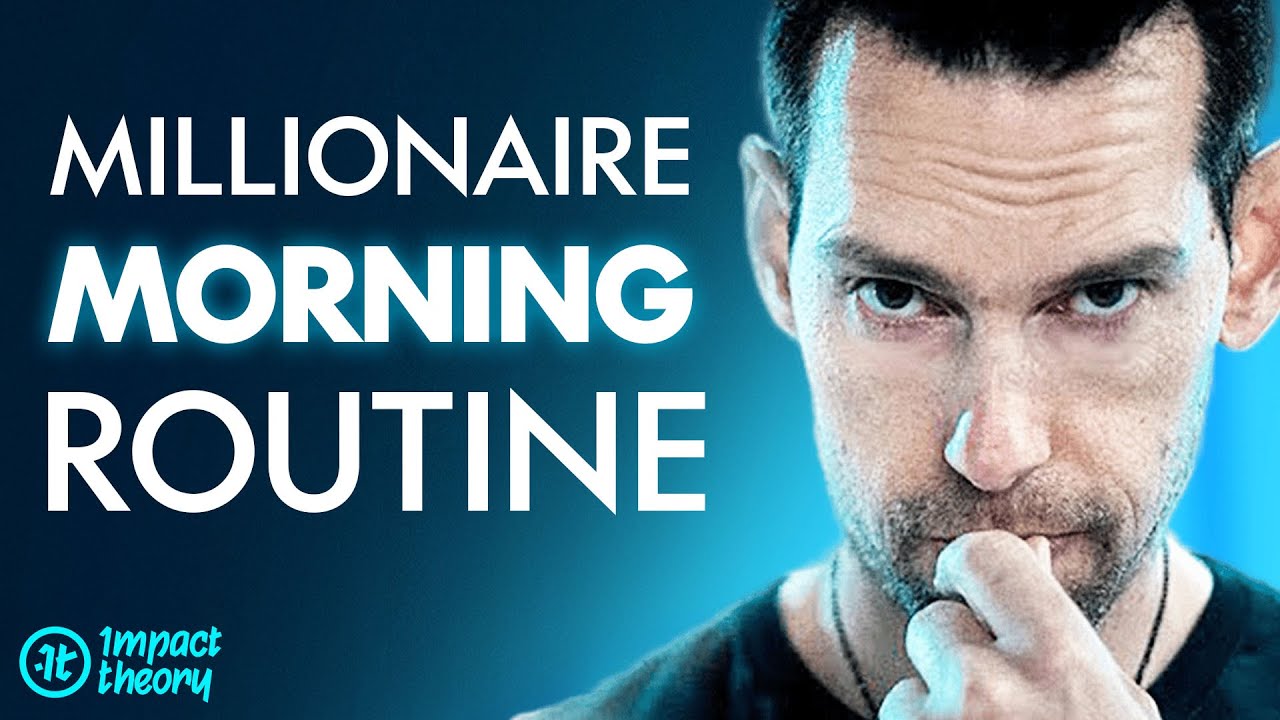
Video summary
The core philosophy presented in this discussion centers on the idea that a successful morning routine must be highly personalized rather than adhering to a one-size-fits-all model. The host emphasizes Kevin Kelly's advice not to "prematurely optimize," urging listeners to treat different habits like Legos and experiment with various routines found online or through others' experiences until finding what works best for their specific life context. A critical component of this experimentation is identifying the single most important task—the "lead domino"—that must be accomplished regardless of other distractions, whether that involves going to the gym first when focused on physique health or meditating immediately if mental clarity is the priority. The speaker notes that while there is no universal order for activities like meditation and exercise, he personally oscillates between starting with a workout followed by "thinkitation" (meditation specifically related to business) before diving into work, as this sequence effectively wakes up his brain and transitions him from sympathetic nervous system arousal to parasympathetic calm. Sleep quality is identified as the foundational pillar upon which all other morning habits depend; without adequate rest, subsequent efforts are compromised. The host shares that he no longer uses an alarm clock but instead relies on natural waking times based on sufficient sleep duration, typically aiming for seven and a half hours by going to bed around 9:00 p.m., even if it means adjusting his schedule significantly when necessary, such as sleeping with children who go to bed early. To combat fatigue or the inability to fall back asleep during the night, he employs specific techniques including listening to audiobooks at low volumes on slow speeds while wearing headphones that require slight pressure to hear clearly, which helps him drift off quickly without being woken by sudden noises. Additionally, he discusses his experience with a device from Modius that stimulates the vestibular system via electrical impulses behind the ear; after stopping its use and experiencing poor sleep again, he concluded it was effective for many people despite initial skepticism about whether it worked solely through placebo effect. Nutritional timing plays another significant role in maintaining energy levels throughout the day, with the speaker adopting a strict intermittent fasting schedule that extends his eating window to roughly 18 hours daily. He typically postpones his first meal until between 8:30 and 9:30 a.m., after completing his workout, meditation, and several hours of work, while delaying caffeine intake—specifically black coffee—for about two hours post-waking and diluting it heavily with water to avoid jitters or crashes. This approach ensures that he remains physically healthy enough to perform demanding tasks without relying on stimulants early in the morning, addressing potential issues like lower back pain caused by underutilization of muscles through targeted low-weight, high-rep deadlifting rather than heavy lifting alone. Ultimately, the speaker argues that building excitement around one's goals and aligning daily behaviors with a compelling "why" is essential for sustaining these rigorous routines; without genuine desire and enthusiasm for what one is pursuing, maintaining such discipline becomes an uphill battle against old habits and lack of motivation.
Read the full video transcript
How do you make it stick? Your biggest
enemy is you.
Hey everybody, today's episode is
brought to you by Impact Theory
University's own business
decision-making workshop. If you're a
business owner looking to scale your
company, I can help. I've created a
four-week intensive workshop that's
going to give you the decision-making
strategies that you need to scale your
company. It's the exact things that I
used to take Quest to a billion-dollar
exit, and it's exactly what I'm using
today on Impact Theory that's allowed us
to grow by 400% in just the last 2
years. If this sounds like something
that would be beneficial to you and your
business, I want you to go right now to
decision.impacttheory.com
to apply. Once again, that's
decision.impacttheory.com.
You can apply today. All right, I'll see
you on the inside.
Everybody, welcome to another episode of
Impact Theory. Today, we're going to be
talking all about morning routines, mine
specifically. I'm going to walk you
through all of your burning questions
about how I do things, why I do them,
what's the result that I get out of
them, and all that good stuff. I think
the way that you start your day is one
of the most important things for
guaranteeing that you're going to be
successful. So, get this right and you
get a lot of other things right as well.
Get it wrong and you're in real trouble.
All right, without further ado, let us
jump in. Here we go. Is there a process
one can follow to experiment and find
out what type of morning routine works
best for them?
As always, trial and error is going to
be a big part of this, but the wonderful
news for you is that you live in the age
of the internet. So many people have put
out material on morning routines that
this really becomes one of the more
common questions that I get asked about
my morning routine. So, go out, take in
a bunch of different people who are
living a life that is close to what you
want to live, see how they do their
morning routine, and then experiment.
And I've actually seen people do videos
about, "Oh, I spent 30 days doing X
person's morning routine, and here are
the results that I got." Um so, that is
a really good way of just trying a lot
of different things and seeing which
ones work for you. Uh there's a really
powerful quote by a guy named Kevin
Kelly, and he said, "Don't prematurely
optimize." And he was talking
specifically about when you're trying to
decide what you want to do with your
life, said, "Go explore, try a lot of
things, find the things that give you
more energy than they take." And I think
that's good advice here as well. Don't
just settle on a morning routine because
I say it or because somebody else says
it. Think of each part of those routines
that you hear as being like Legos, and
you're going to try a bunch of different
Legos, and then you're going to see
which ones create the morning routine
that's perfect for you.
And that is the key. It needs to be
perfect for you. So, there isn't going
to be any one-size-fits-all. There going
to be different things that work for
different people. So, make sure that you
get out there, you try a bunch of
things, and then see what works for you.
So, if you just go to YouTube and type
in morning routine, you will get more
than enough ideas to get you started.
All right, next.
Is it proper to have things set in a
row, or do you have an allowance of
jumping around the same list and using
no order?
Okay, I don't know what you mean by set
in a row, but I will tell you that my
to-do list is always in order of
importance. And I think that there is an
optimal order to do things in. So,
important things, 100% using the lead
domino strategy. So, what's the biggest
bang for my buck? What could I spend the
next 15 minutes on that would have the
biggest impact in leading me towards my
goals, okay? That's how I always think
about my official to-do list. Now, when
I think about a morning routine and what
order I'm going to do things in, then it
has to do with what's going on in my
life at that point, what's the most
important thing to me in that moment,
and then ordering things accordingly.
So, there have been times in my life
where the first thing I do is meditate.
There have been times in my life where
the first thing I do is go to the gym.
And so, those are really the big two
things that I oscillate between, but
there are also times where I will
immediately go to work. So, any one of
those three things may be the first
thing that I'm doing in my morning
routine depending on what's going on in
my life. So, how do I decide between
those? So, when I'm really focused on
getting my physique in order, I'm
focused on
um
the gym as being the the thing that I
want to make sure that no matter what
else happens during the day, I get that
done, then I do that first. And that
really is what slot number one is for in
any morning routine is what is
the most important thing that you know,
no matter what else falls by the wayside
that I know that I'm going to get that
thing. And so, right now I'm going to
the gym first. There was a long stretch
of time there where I wasn't as focused
on the gym, and so it was like, well,
I'll I'll work out later. Let me do a
little bit of work first and then I'll
go to the gym. And I found what was
happening was instead of working out 5
days a week or 6 days a week, I was
working 3 days a week or sometimes 2
days a week cuz so much would pop up
during the day that I wasn't getting to
it. Now, that made sense and I didn't
change for a long time because there was
so many key initiatives at Impact Theory
that I was trying to get to that that
was truly more important to me. But then
I hit a threshold event where I was
like, nah, now I really want to get back
in and really really focus on the gym.
And
ironically, it was because my lower back
started to hurt from underutilization.
Just a quick shout-out to anybody
suffering from lower back pain, can
basically tell you what it is, poor
diet, high inflammation, and not
deadlifting enough. Now, that doesn't
mean high weight deadlifts. In fact, I
used to do that. Now, I just do low rate
low weight high rep, but I find that my
back hurts when I don't work it out. So,
again, everything's individual. Try it
out for yourself, but that's important.
So, that's how I judge what to do first.
Um my typical modus operandi would be
that lifting is the first thing I do.
Then, I would meditate. And the
meditation I use what I call
thinkitation to get into then the work.
So, working out, meditating, work is
typically my path.
Again,
mileage may vary. Try your own. But, if
you're not sure what to do, you can try
that one.
It's pretty damn effective for waking up
the brain.
Then, practicing lowering your
heart rate, your breathing rate by going
straight into the meditation. And then,
when your brain has all that clarity
that comes from working out, then you
can leverage that as you meditate to get
the ideas you're going to need to
actually be effective at work. That's
why I do it.
All right.
I wake up at 3:00 a.m. in the morning
and work hard. And also, I'm feeling
physically healthy to do the work, but
after 8:00 a.m. I feel sleepy and not
able to give my 100% after then. Please
suggest something I can do to overcome
this. Okay. So,
I want to make sure that you're getting
all the sleep that you actually need.
So, if you're waking up at 3:00 a.m.,
but you're going to bed at 8:00 p.m.,
then it's fine. That's 7 hours of sleep,
and I would say the average person
probably does fine between 7 and 8
hours. But, if you need eight and you're
only getting seven, that's already a
problem. And if you're going to bed at
9:00 or 10:00 and getting up at 3:00,
then odds are you just aren't getting
enough sleep. Whenever you're feeling
tired, one of two things is true. You
are not getting enough sleep or
high-quality enough sleep, or your diet
is off. Those two things are going to be
the things that contribute most to
whether you feel fatigue or not. There's
a third one which I'll throw in which is
exercise which does a great job of
addressing your mitochondria, which are
the actual energy cells, uh energy
organelles, I guess, within your cells,
and it is critically important to keep
those guys in shape as well just to make
sure that they can generate the cellular
energy. Uh but when you say you wake up
at 3:00 a.m. without giving me any
indication, I'm checking it again. Yeah,
there's no indication what time you go
to bed. So, my gut instinct is that
you're waking up too early. Now, if
that's just naturally what time you wake
up, trust me, I get it. Um I spent a
very long time just getting between 5
and 6 hours a night. And if I got 6,
everything was great. If I got 5 one
night in a row, I was fine. But if I got
5 multiple nights in a row, then I
started to get really tired. To the
point where I was once getting my
haircut and I did one of those head
bobs. Thankfully, it was
timed well and I didn't end up getting a
huge chunk of my hair taken out. Um but
that was when I realized, if I can't sit
still for more than 5 minutes without
falling asleep,
I don't think I'm getting enough sleep.
Now, it's outside the scope of this
video for me to get into what I did to
improve my sleep, but there are a lot of
things you can do to improve your sleep.
And now I'm actually sleeping more than
I've ever slept in my life. So, I've
really got that dialed in and I
have to admit, it's been awesome to just
never feel Not never feel tired cuz of
course towards the end of the night I
start to get tired. But during sort of
peak productivity hours, I don't get
that anymore. So, get all the sleep you
need. I don't sleep with an alarm, okay?
I've run a billion-dollar company.
I didn't set an alarm then. Running a
company now, grew by 400% over the last
2 years, I don't use an alarm now. So, I
work 93 hours a week without using an
alarm. So, I don't want to hear excuses
that people can't set an alarm. You just
need to go to bed earlier. Now, if you
have kids,
go to bed when your kids go to bed, even
if it's 7:00 p.m. Do whatever it takes
to get the sleep that you need. Need to
be a fiend for your sleep. It impacts
everything else.
Hugely important.
I hope you guys are enjoying this
episode, which is brought to you by
Impact Theory University's Business
Decision Making Workshop. With nine
full-length classes and weekly live case
studies with me, the Business Decision
Making Workshop is a hands-on approach
to honing your abilities to scale your
business. I'm going to be in there with
you working through your hardest
problems so that you'll be able to
master how to overcome any impediment by
getting the most foundational way to
think through novel problems. And that,
my friends, is exactly what you need to
do if you want to scale your company and
have the kind of crazy success you've
always dreamed. I promise it is
possible. This is teachable. This is
something that you can learn. It is a
process that you can deploy against your
business and be able to move confidently
forward. Just go right now to
decision.impacttheory.com
to apply. Do not delay, my friends.
Spots are limited. Again, go to
decision.impacttheory.com
and apply today. I'll see you guys on
the inside.
What should go first, meditation or
workout? Hey, I'm glad you asked. We
addressed that earlier. That's
ultimately going to come down to what's
going on in your life, what is the
highest priority for you. Figure out
what is the thing you just absolutely
cannot miss for that day and do that
thing. Now, all things being equal, I
will say meditation before workout is
less effective than workout than
meditation. So, this comes down to the
parasympathetic nervous system and the
sympathetic nervous system. So,
sympathetic is fight or flight. You're
in the gym, you're struggling, you're
out of breath, you're pushing hard,
you're putting yourself into that
stressful fight or flight mode. Boom,
that wakes you up. Okay? You need that
cortisol to get you springing out of
bed. So, for me, one of the reasons that
I like to work out first is I am slow
to wake up. Really slow. So, for me to
not spend an hour sort of dragging ass
around the house, if I go straight to
the gym and I start working out, let me
tell you, one set
I'm breathing heavy, my blood is
pumping, and boom, all of a sudden I'm
wide awake. There are few things that
will wake you up faster than exercise.
In fact, back when I used to get tired
in the middle of the day, what I would
do, as I was getting tired, I would go
do sit-ups, push-ups, jumping jacks,
anything to get the blood flowing. So,
it's a great way to wake up. Then,
because we want to go from the
sympathetic to the parasympathetic,
and seeing how quickly we can do it, and
getting really good at that, by the way,
if you suffer from anxiety or stress,
this is a great way to practice how
rapidly can I go from the sympathetic to
the parasympathetic nervous system. By
I'm there in the gym, I'm out of breath,
I'm now going to sit,
I'm going to relax,
I'm going to focus on slowing my
breathing down, slowing my heart rate
down,
which you actually can do.
And by practicing that over and over and
over, then you get better at rapidly
transitioning from
heavy breathing,
pulse racing, you know, all the signs of
anxiety, and bringing them back to
normal, bringing them back to baseline.
And the faster that you can do that, so
actually, if I'm not mistaken, the more
in shape you are, the faster you will go
from high exertion, out of breath, rapid
heart rate to normal heart rate, and
that's one of the things that they can
test as a a test of being in shape and
being healthy is how quickly you can
normalize your heart rate. So, anyway,
good thing to practice. So, that's why,
when all things are equal, that's the
order that I do them in.
How do you reset into a new routine? Any
considerations, principles, how to
escape late nights and succeed? Any
mantras? Okay, so whenever you're trying
to get a new routine, what you're really
trying to do is change your behavior. If
you're trying to change your behavior,
you must understand that behavior
follows your beliefs. So now you need to
get your beliefs in line. Now, one of
the ways, one of the beliefs you have to
get in line is that it's worth getting
out of bed, that you want to do this new
thing, that you want to stop doing thing
A and start doing thing B. So getting
uh a mantra that you're repeating around
this exciting new thing, that you want
to do it to make sure that you're
building excitement, building desire
around that thing. So attaching to the
why, right? I believe this thing is
important. I'm excited about this thing.
I want to do this thing. Once you get
that in the right place,
you have a sufficient why,
you have a sufficient level of
excitement, now all of the sudden the
behavior of getting up and doing that
thing takes care of itself. So one of
the most important things you can do in
your life is to realize that it's
critically important to be excited about
the things you're trying to wrap these
routines around. I see so many people
fighting this ridiculously uphill battle
to do a really hard thing
that they don't care about.
I have a really hard time doing things
that I don't care about. So I'm always
focusing first on getting myself to the
point where I care.
Now, that may mean that you have to
change your life.
If you hate your job, hate the things
that you're doing with your time, step
one is to start doing things that
actually give you more energy than they
take, that are exciting to you, that
you're amped about, that seem worth
pursuing, that you look out into your
future 3 to 5 years, you know where you
want to be, and you're taking meaningful
steps to get there. Having a dream that
is exciting and honorable, and you know
that if I do this thing today,
and tomorrow, and the day after, and I
can make it a habit,
and this becomes my routine, now I'm
really making meaningful strides towards
my goal. All of the sudden, when you
don't feel like doing it, you just
remind yourself
what you're chasing.
You remind yourself what that goal is.
And most importantly,
you remind yourself why
you're pursuing that goal.
It's a great Nietzsche quote.
A person
with a strong enough why can survive
almost anyhow.
When you know why you're doing
something,
because it is so thrilling to you,
the thought of having that thing is so
rad,
the process of getting it, you've
invested in, and you're even enjoying
that process,
that's when
it's easy to get that new routine.
Because you have to let the old routine
atrophy.
But the only way to atrophy it is to
replace it with something else. Just not
doing anything isn't necessarily going
to atrophy those sort of old habits,
those old desires. You've got to give
something new that you can lean into,
that you can be excited about, that you
can pour yourself into, that you can
fantasize about. I'm going to have that
future, that's going to be mine, and I'm
doing XYZ thing, and it's actually
moving me towards my goals. When you
have that, when you have that sense of
progress, and you know, "Yo, if I keep
doing this and pouring myself into this,
look, I am getting better." And if you
take the rate at which I'm improving and
stretch it out over three or five years,
or if you're willing, 10 years, it is
crazy. It is absolutely, utterly
life-changing. When you're pouring
yourself into getting better at
something, it is life-changing what you
can do in three, five, 10 years.
So now when you're thinking about it,
you're talking to yourself about it,
you're talking to other people about it,
all you have to do is change your
routine and you get that thing?
That's very easy. And then when you get
that feed loop of actually progressing,
it becomes really easy to cement it.
But you need excitement.
On the last part of that, how to escape
late nights and succeed. So
I have rules in my life
because I'm so excited about my goal.
And I know that my goals will only
become real if my behaviors back them
up. So I'm doing the things I need to do
in order to achieve my goal.
So then I build rules in my life to
ensure that I do the things that excite
me, that push me towards the goal that I
want to achieve. That's exciting. So
I've done the work there.
And then so for instance in my life,
Monday through Friday,
I go to bed, it's actually technically
when it comes to sleeping, Sunday
through Thursday night, I go to bed at
9:00 p.m. like it's a religion.
I stay up a little bit later on Friday,
a little bit later on Saturday, but it's
not too crazy.
And I do that because I so know the
value and benefit of sleep. I so love
feeling well rested and I so understand
the realities of circadian rhythms and
sleep timing and all of that stuff that
because I'm so obsessed with the goals
that I'm chasing and I see the reality
of how these things impact it, it's very
easy for me to put in a rule says I got
to bed by 9:00. Simple as. And then
stick to it because it gives me an
outcome that I want.
This goes back to don't chase things you
don't want.
Chase things that you want. Invest in
that and all this stuff gets a lot
easier. Hate your job? Find a new one.
Pursuing dreams that your parents think
you should be pursuing? Find your own
dreams. Have the guts to stand up to
your parents and say no, that's not the
life you want to live.
Trying to impress your neighbors or your
friends or whatever, stop.
They don't give a and you should
neither.
The whole punchline of life is joy.
Now, once you have that, and those are
the things you're actually pursuing, it
gets real easy to go to bed on time. And
then make sure that you're carving
yourself out time to do the things you
love. So, if you're like, "Yeah, but if
I go to bed at night, I won't have time
to read, play video games, hang out with
my spouse, whatever."
Do those things. Put them on
your calendar. Make sure that you have
time for them.
Don't try to sneak in things like that
at night because you think that's what
you're supposed to do or you're supposed
to be, you know, a good hustler busting
your ass or whatever. Look, nobody's
more hardcore than me. I work 93 hours a
week every week and have for years.
I still make time for just outright fun
Even at 93 hours a week, there's a lot
of extra hours.
So, do things that you love.
What time do you sleep and what time do
you wake up? Would you start with
reading or showering? How long do you
take to do your first work-related task?
All right, this is really interesting.
Okay.
We've covered what time to go to bed. Go
to bed at 9:00 like it's a religion.
Now, what time do I wake up? I don't set
an alarm. So, I wake up when I wake up.
I wake up whatever time my body says,
"Hey, I've gotten enough sleep."
Which, by the way, if that's less than 6
hours, I will force myself to lay in bed
and try to fall back asleep, which I've
come up with some ridiculously useful
things that help me fall back asleep
that have been
absolutely transformational to my life.
Um and I will share those in a second.
But, what would I rather do, read or
shower? What would I do first, reading
or showering? So,
quite literally, the second I get out of
bed,
okay, I I will walk you through the
actual step-by-step things I do. I get
out of bed nice and quietly cuz 99% of
the time I wake up before my wife.
I put on my socks, put on my pants, and
I leave the same shirt that I've been
sleeping on in the morning, and leave
that on, and I immediately put in
headphones, and I turn on a book or a
YouTube video. Literally, right there.
I'm standing at the edge of the bed,
still being quiet so I don't wake up my
wife,
and I've got something queued up, a book
or a YouTube video. Boom, I'm right into
learning mode. Then I go, I'm brushing
my teeth while I'm learning, feed the
dogs while I'm learning, and then boom,
it's at least right now, it's straight
into the gym, and I keep listening to
whatever that thing is that I'm
learning. So, for me, I subscribe to
ABL, always be learning. That is
critically important to me. I think
everybody should do it, so you should
always have things that are coming into
your mind. Uh when do I take my first
work-related task? My first work-related
task
is as soon as I finish the gym, and then
my meditation, which is really meant to
serve uh the business anyway, because I
do brief meditation followed by
thinkitation. The thinkitation is
strictly related to the business. So,
then I start working. So, I typically
wake up around 4:30. So, go to bed at
9:00, wake up at 4:30, it's about 7 and
1/2 hours sleep. Then,
uh I work out, usually work out 45
minutes to an hour, so now you're at
roughly 5:30, um and then I start
working out immediately at that point.
So, I'm, you know, maybe 5:40, 5:45 by
the time I finish doing the sort of
non-work-related part of the meditation.
Uh and then I'm off to work, and I'll
work until I go to bed at 9:00.
Now, going back to what are the sort of
magic things that I do to stay asleep?
Um so, I do two things, and the first
one is that I have realized that if I
keep headphones next to my bed, um I
keep two pairs just in case I'm really
having a bad night's sleep. Uh I'll keep
a pair of headphones next to my bed, and
I have a book queued up that is not a
book with like um yelling and screaming.
Tried that, doesn't work, ends up waking
you back up. But a nice sort of easy
read and I put it on slow speed for me.
This is an audiobook obviously. I put it
on a slow speed. So I'll put it on 1.3.
And then I put the volume of the book
right to the level where if I put a tiny
bit of pressure on my ear, I can hear it
clearly. But if I were to take that
pressure off, you can still hear that
there's sound but you can't you can no
longer hear what they're saying.
That is so perfect. I will fall back
asleep in like 3 minutes. Now, what I
used to do is I would put them in and I
would turn them up to a volume where I
could hear it normally and then if the
narrator got loud for a second it would
wake me up or I tried using the timer
and as the timer would run down, then I
would wake up because I could hear it
going down. So I found that what happens
is because I have to keep a little bit
of pressure on my ear that as soon as I
sleep that pressure lets off and it just
naturally shuts off the exactly perfect
moment. And so I will just finally wake
up and usually the book just keeps
playing but it's in my ear and it's so
faint that I don't even notice it. Works
like a charm. Now, this the reason I
wanted to put this at the end is because
there's one thing that I do that I am
I'm on the advisory board for this
company. So full disclosure, if the
company does well, that's financially
beneficial to me. So I will say that
because of that I'm actually way more
scrutinize of these guys than I think I
might otherwise be. But it's a company
called Modius.
I'm not even sure if they sell in the US
yet but they have a device that is
in FDA approvals for a sleep aid.
And it stimulates the vestibular system.
Long story about why that works and once
a day for 30 minutes a day, it sends a
slight little electrical zap into uh the
nerve behind my ear that stimulates the
um that sort that system in the brain.
And for whatever weird reason, it makes
you sleep better. And I used to tell
people that it falls into the placebo
zone, which is like where I think it's
helping, but I'm not entirely sure. And
so recently, I was like, "Man, I've
really been sleeping well.
Maybe I don't need this anymore. Or
maybe it was just a placebo." So, let me
just stop. You know, maybe the headphone
trick, maybe that's good. And so I
stopped doing it for about a week, and
then all of a sudden now, I'm waking up
four or five times a night again. And
I'm like, "What the Is it really
possible that this thing has that much
impact?" So, I've now gotten back on it
religiously. I'll I'll report back if it
goes back to me sleeping again to where
I'm only waking up once a night and I'm
able to fall And that's the other thing.
I'm not falling back asleep as fast as I
was before. Um so the headphone trick
still works, but it'll take, you know,
say 15 minutes or 20 minutes to fall
back asleep. And man, if that ends up
working, I'm going to be pretty bullish
on this thing. But again, full
disclosure, um I am involved with the
company, but whew, it is very
interesting. And I do things around blue
uh light blocking 3 hours before bed. Um
so all of that stuff, I do everything I
can to help myself make sure that I get
a a good night's sleep.
And it's a perfect place to end cuz I
consider the night's sleep to actually
be the beginning of your morning
routine. Because if you mess up your
sleep,
everything else downstream falls apart
from there. So, make sure you're getting
good sleep. All right, experiment a lot,
guys. Try a lot of different things. Get
that morning routine down to a science
to optimize your cognition, your
performance, your enjoy. You don't want
to go through life tired. Going through
life tired all the time is a unique form
of hell in my opinion. So, avoid that at
all costs. It will help you think
clearer, move faster, everything is
better. And then, the only thing we
didn't cover on here is food. So, I
postpone my morning meal. So, I normally
wake up, like I said, about 4:30,
normally eat my first meal between 8:30
and 9:30, sometimes a little bit later.
Uh and then I eat my final meal of the
day at 1:30. So, I've got that, you
know, whatever, roughly 18 to 19-hour
window. Um for the week, even including
weekends, my average is about 17 and 1/2
hours for the whole week. Every night
that I go without food. Um so, I work
out, I meditate, I do a couple of hours
of work before I eat anything. Um and I
don't even have black coffee until I've
been awake usually for about 2 hours,
and even that I dilute dramatically with
water. Um so,
that's my routine.
That's how I do it. All right. I hope
that serves you guys well, because when
you get your morning right, you get your
day right. All right, everybody. Till
next time, my friends. Be legendary.
Take care.
Thank you for watching this episode,
which again was brought to you by Impact
Theory's very own business
decision-making workshop. If you guys
are ready to take your business to the
next level by investing in yourself and
learning the first principles of
business, then I want you to take action
right now and go to
decision.impacttheory.com
to apply. I promise you I am giving you
every piece of information that you will
need to overcome any obstacle that your
company is facing to stare down problems
that will arrive a year, 5 years after
you take the course. This is the
strategies of business decision-making
that every successful entrepreneur has
to learn to deploy against their company
if they want to grow. All right, guys. I
promise it will deliver 10x the value of
what you paid for it, and if it doesn't,
I'll give you your money back, no
questions asked. You know me. I live in
the public eye. There's nowhere for me
to hide. This is me trying to give as
much value as humanly possible. I really
think this class would be transformative
and I hope you will sign up. Now, we'll
see you in the next live class. All
right, guys. Take care and be legendary.