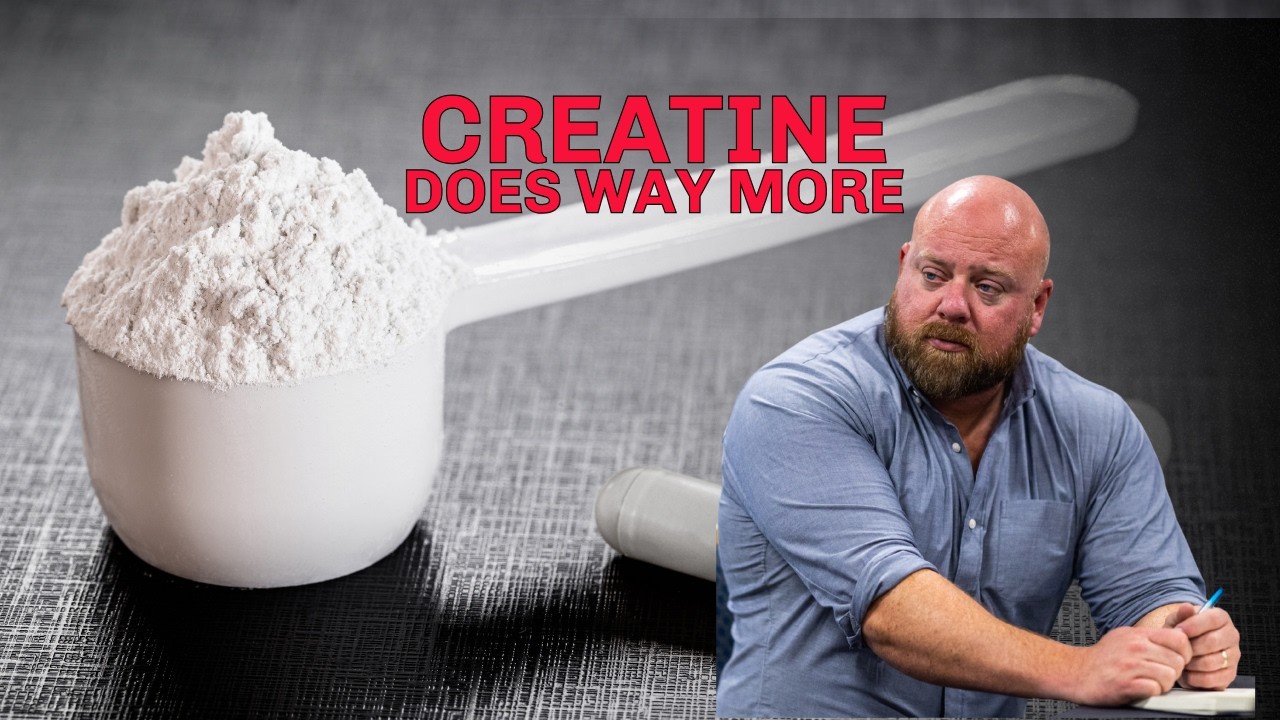
Video summary
Creatine is widely recognized for its ability to saturate muscles with electrolytes, glycogen, and water, which enhances muscular performance without causing subcutaneous bloating. While a standard daily dose of five grams is sufficient to achieve full muscle saturation after thirty years of established use, increasing the intake to ten or fifteen grams per day unlocks significant benefits beyond physical strength. At these higher doses, creatine dramatically improves brain activity, mental clarity, and focus, providing a natural cognitive boost that eliminates the need for stimulants like caffeine, nicotine, or other medications that often cause jittery feelings.
The transcript highlights a particularly impressive application of high-dose creatine for individuals suffering from severe sleep deprivation, such as new parents caring for newborns. When taken in amounts ranging from fifteen to twenty grams, creatine can effectively negate the negative effects of getting only three or four hours of sleep for one or two days. This temporary restoration of mental sharpness allows individuals to handle critical tasks like important presentations or reports without feeling impaired, offering a practical solution for those who cannot afford extended periods of poor rest due to demanding circumstances.
However, consuming such high doses requires careful consideration of gastrointestinal tolerance, as creatine can sometimes cause stomach upset. The speaker notes that while powder forms may lead to digestive distress, switching to gummies can mitigate this issue, allowing users to ingest large quantities more comfortably. It is advised that individuals ensure their digestive tract can handle the load before committing to high-dose regimens, especially when aiming to combat the effects of sleep loss for a specific event or period.
The discussion concludes with a broader perspective on managing health costs and making wise decisions regarding medical treatments like GLP-1s and peptides. The speaker shares a personal story of dealing with diabetes markers that were at diabetic levels despite insurance coverage, noting that expensive medications like Mounjaro cost over $1,200 monthly out of pocket. In contrast, alternative treatments such as Reatride are available for under $100 per month until FDA approval is granted, emphasizing the importance of seeking reputable sources and avoiding unverified sellers to manage healthcare expenses responsibly.
Read the full video transcript
with creatine. A lot of you are taking
creatine now and you're probably taking
five grams a day. It's what we've taken
for 30 years. And the at five grams a
day of creatine, uh you're really going
to get all the benefits from a from a
muscular standpoint, from a creatine
helping to your muscles to store more um
creatine as well as electrolytes,
glycogen, and water. And so it
essentially helps saturate your muscles.
It's doesn't cause bloat. It's not
subcutaneous water. People that say that
are just they don't know what they're
talking about. But what is incredible is
over five grams you still get the muscle
saturation but but with the over five
grams you get into the 10 grams and 15
grams plus per day. You start to really
see tremendous improvement in in brain
activity and focus in mental clarity and
all of those sorts of things. And so
without having to having to hammer
caffeine or nicotine or medafanil or
something that's going to cause like
really jittery sort of feelings, um the
creatine just it's just makes you sharp.
Um, it also has been shown that at least
for a day or two, if you're extremely
deprived of sleep, those of you moms and
dads who have uh newborns at home or
babies at home or and you don't get good
sleep, you get four hours or less sleep
by taking 15 to 20 grams of creatine the
next morning. It essentially negates all
of that loss of sleep. Now, that doesn't
last forever, but for a day or two, if
you've only had 3 4 hours of sleep last
night and you just slept poorly for some
reason and you take highdose creatine
the next morning. Now, I would say
again, creatine can cause some gastric
distress. I've been using the gummies.
Uh, it's a lot to chew to throw 10 or 12
of those in your mouth. Um, but I don't
have I used to have a little bit of
upset stomach when I took the powder.
The the gummies don't cause any at all.
So, um, but to take highdose creatine so
long as your your, uh, gastrointestinal
tract can can handle it seems to really,
uh, negate the effects of of lost sleep
for a few days, uh, which can be a big
deal if you've got something important
that next day. You got a big, uh, report
to do, um, presentation, something like
that, and need to be, uh, sharp on your
toes. And so, um, there you go. There is
GLP-1s and peptides by me. Uh, happy to
talk about it, happy to answer
questions. Again, I'm not going to help
you find them, but it's not hard to
find. Um, just make a wise decision. Um,
you know, just like anything else, don't
buy something out of the back of some
guy's car, uh, or somebody that's not
reputable. Um, certainly there are
companies, again, no rel have no
relationship to this company. But a
company like him, um, they're going to
be the ones that that are they've
already started offering they're
offering simaglutide
and, uh, tzepite at a decent price. So,
one of the reasons I made the the switch
is even with my insurance and even
though when I had my blood test taken, I
don't know, a year ago or so, I was my
HBA1C, my basically diabetes markers was
right at the level of I have diabetes.
And now they're super super healthy.
Even with that, my insurance wouldn't
cover it. So, Munjaro Tzepide was
costing me $1,200 a month out of pocket.
It was crazy. That's a mortgage. Um, and
so I wasn't, you know, I couldn't pay
that forever. Um to put it in
perspective from these labs, reatride
costs $100 or less per month. So, we're
talking about onetenth the cost until it
gets FDA approval.