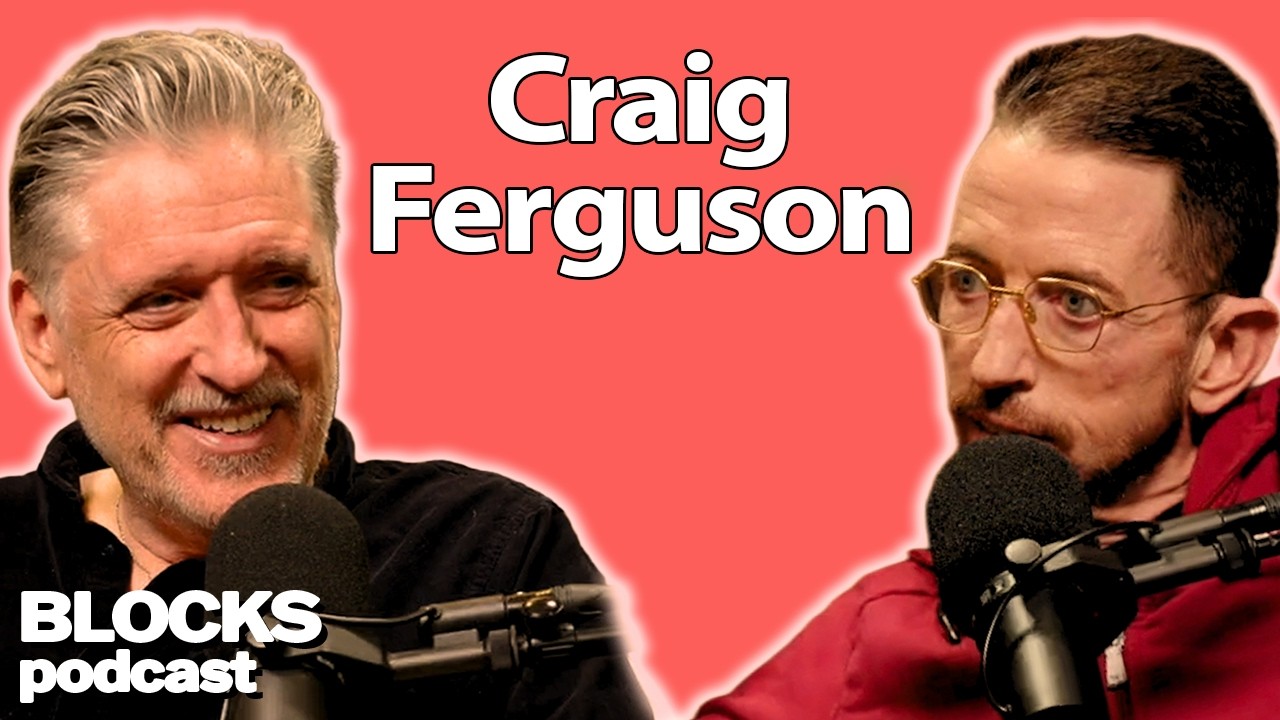
Video summary
Craig Ferguson opens by reflecting on his unique tenure hosting *The Late Late Show*, noting that unlike his peers who studied predecessors like David Letterman or Johnny Carson, he entered the role without watching any previous late-night programs. His success is largely attributed to Peter Lassally, a legendary producer and Holocaust survivor whose moral authority instilled in Ferguson essential performance ethics, such as avoiding shouting at guests' homes and judging jokes on their merit rather than ego. This creative freedom existed during what Ferguson describes as a "no man's land" following Letterman's era, allowing him significant autonomy until that period concluded. His approach to life was deeply shaped by growing up in violent Scotland amidst sectarian conflict, where he developed an affable nature and used humor as survival mechanisms against corporal punishment and societal violence.
The conversation delves into Ferguson's personal struggles with alcoholism, recounting a harrowing Christmas morning when he intended to commit suicide after heavy drinking but survived only because a bartender convinced him to drink sherry instead of leaving immediately. This pivotal moment led him to realize that the substance destroying him was paradoxically keeping him alive until 1992, when he achieved sobriety and has remained sober for over three decades by taking responsibility rather than blaming external circumstances. He also touches on his brief experimentation with cocaine in New Orleans but emphasizes that avoiding the first drink is crucial for maintaining recovery. His agnostic beliefs are highlighted through his discomfort with Catholic imagery despite growing up in a Catholic household, comparing religious iconography unfavorably to cinematic universes like *Star Wars*.
Ferguson discusses various topics ranging from visits to religious sites and aviation museums near crash sites, where he debates the appropriateness of displays versus opportunistic funding. He shares how overcoming his fear of flying involved getting a pilot's license and identifying ice on wings as a primary danger rather than bad piloting alone, while also reflecting on historical figures like Origen of Alexandria and Søren Kierkegaard to explore themes of magical thinking versus OCD. On parenting, he reveals that after marrying twice and raising two sons aged 15 and 25 while sober, he rejects the modern notion of molding children entirely, viewing them as fully formed individuals whose role is simply to keep safe rather than shaping their personalities like a director guiding actors. He contrasts this with talk show hosts who become defined by one role, noting that his preferred improvisational style on *The Late Late Show* allowed for deep connections without adhering to conventional formats.
Ultimately, Ferguson marvels at the magic of comedy and life itself, citing instances where jokes land unexpectedly well or writers like Stephen King tap into collective unconscious ideas unknowingly. He praises Scottish crime writer Denise Mina for blending dark subject matter with an upbeat demeanor, contrasting her work with Hollywood rom-com writers hindered by industry pressures. In a touching segment on friendship, he contrasts his relationship with guests against typical celebrity fan culture where fans display awards in their homes; while one guest admits to hiding his own Emmys and Peabody Awards behind cabinet doors, both express deep mutual respect for Ferguson's ability to reach profound emotional depths alongside humor. The episode concludes with reflections on mortality, the negligible nature of human concerns against vast cosmic timescales, and a lighthearted acknowledgment that even in sobriety, life remains overwhelming enough without needing additional substances like LSD or drugs.
Read the full video transcript
Guys, hi. It's Neal Brennan. This is the
the black [music] shut up.
>> Oh, no. Sit stay out of it. I I know I
thought you'd forgotten my name. I was
trying to help you.
>> I was trying to remember the name of the
talk show, but I remembered it. I
remembered the name of that CNN show.
This guy is my guest has a new series
called American on Purpose on CNN.
>> I want to show you why I became American
on purpose.
>> He used to host the Late Late Show
with Craig Ferguson.
>> Ladies and gentlemen, Craig
Ferguson.
>> Have you figured out who it is yet?
Guys,
please clap.
It's any zip [ __ ] really funny dude
and a very instantly charismatic
charming guy.
Instantly
we have a rapport, I'd say.
>> Oh, I think so.
>> I think you have a rapport pretty
easily. I'm you're pretty [ __ ] with
your rapport, if I'm honest.
>> I I you know, I throw it around a little
bit, but I'm a I'm rapport equal
opportunity rapport. I mean, I rapport
with anyone who rapport back. I think
rapport is a two-way street.
>> It is, but there you're you have you
have chemistry with most people.
I have chemistry with a certain kind of
person.
>> I don't know if that's true. I I cuz I
think that you are very attractive both
on the podcast cuz you know, what you
you and and when you do your stand-up,
you're very
you look like someone who knows what
they're talking about. Maybe it's your
glasses, but I don't think so. I think
it's a I think it's you.
>> But even that people don't like people
who look like they know what they're
talking about.
>> I do.
>> I know. That's why I say I have rapport
with certain kinds of people. If the
person respects someone who looks like
they know what they're talking about,
then we're fast friends. If they're
most people
>> don't like that.
>> They don't like [laughter] it.
>> I don't have any friends, so you'll have
to tell me.
>> I believe that.
>> I don't I don't I really don't. I I I I
keep my friends to a very very small
group of friends.
>> Let's just get into the podcast. Why?
Let's his first black limited friend
group.
>> small people, so I really I don't
That's so stupid. I'm sorry.
>> It's fine. I might cut it out. I might
give you a lead. I'm going to I'm going
to cuz a lot of people were would have
turned off.
>> [laughter]
>> I can't take this.
>> Oh, [ __ ]
>> I'll wait for someone clever.
>> Okay, so you small friend group a minor
no new friends.
What's your what's your feeling? I think
that you are more opinionated
and more irritable than you let on.
>> Oh, 100%. I think that's that's
absolutely that's very astute. Yes.
>> I look opinionated. You look affable.
>> I I I do I do affable because I grew up
in a very violent situation. Not at
home. I would I mean my family weren't
violent to me, but the
uh
>> Wait, say what do you mean to you? They
were violent to neighbors to pass us by?
>> were I didn't I wasn't raised by a crime
family.
>> I don't know anything.
>> I was raised in in Scotland in the late
60s and 1970s. So or the 60s and 70s
really and and it was a time where I was
raised was
uh
It was very jumpy.
You know, there was a lot of sectarian
hatred between Catholics and
Protestants. It was it was a kind of a
adjacent to the troubles in Ireland.
There was a lot of that stuff.
>> Troubles one of the greatest
terms names for conflict.
>> Yeah, violence.
>> So [ __ ] Irish.
>> Yeah, gorilla What's that we bit of
trouble?
>> [laughter]
>> What's we bit of trouble there? They're
killing each other. It's trouble.
>> Let's not make a big deal of it.
>> This is this is true story. A friend of
mine told me this. He was at a funeral
for an IRA soldier in
Belfast.
And at the end, you know, the funeral
part of it is they shoot um
you know, you get the salute with the
guns fired and they fired the gun and
somebody had a [ __ ] pigeon, and it
landed on the coffin,
and the priest the priest said,
"Well, sure, the pigeon was involved."
>> [laughter]
>> They used to say that about somebody who
was in in the you know, part of the
whole thing.
>> Part of the troubles. Yeah, he was he
was affiliated he was involved. He was
>> Oh, that's very funny.
Um, and so you grew up around violence
you grew up in a violent time in a
violent
>> it and the the the and the actuality of
it. And so what you do is you you you
develop an ability
>> violence in your in is there violence in
your neighborhood in your region?
>> we we had a
they had corporal punishment at schools
when it was outlawed uh
just after I dropped out of high school,
but corporal punishment yeah, just in
time. It was outlawed by the European
Court of Human Rights. That's how far
they had to take it before they got rid
of it. Um, but they used to belt us when
we were very very young. They I mean I'm
5 years old I'm talking about being
thumped by a thick leather belt uh that
was specially made for the purpose. You
had to hold out your hands and they
would just bash you
>> This is Catholic school?
>> No, this is Protestant well
>> State school. Right, okay, but so it's a
state it's a Protestant state school.
>> school. It's it's a state school. It's
the government school and it was and
there was a lot of kind of
and
I would think I think of it as normal
like pushing and shoving and violent
with young men, but but I I don't think
it is that normal really. I've when I've
talked to people who grew up outside of
that they did not grow up with violence
between young men. I think of it like my
oldest son who's 25 who grew up in
California. I would be like teaching him
how to box and stuff and he's like,
"Dad, it's not Scotland."
>> This is for to burn calories? So I can
have a beach body?
>> [laughter]
>> But I was like, "No, you got to keep
your left up and all that kind of
stuff." He's like, "What are you talking
about? I'm going to art class, you know,
I mean
>> We live in Brentwood. What are you
talking
>> Well, it almost yeah, it was that good.
Yeah, there you go. [laughter]
And it was it so it was a kind of
you develop a people-pleasing thing. I
think that's right to say that that
affability becomes a useful tool. You
know, you have
>> Do you think a lot of Scots are like
that as a result? Because it doesn't
seem You seem I I will say that the
Scott comics I'm I'm aware of and know
are really
really affable. They're really like fun
and like they can make small talk and
it's very charming and moms like them
and girl like, you know what I mean?
>> Depends on what part of Scotland they're
from, to be honest, cuz I'm from the
west of Scotland, which is
I mean, my grandparents are Irish, you
know? And so it there's a there's a
there's a kind of difference between the
east and the west of Scotland, weirdly
enough. It's 45 mi, you know, from
Glasgow to Edinburgh, but there's a
world of difference. And and the
>> So is it with the west is more Irish, do
you think?
>> the west is more Irish. And the west is
>> put it on a darker Is it a darker note?
>> I think they're all pretty dark. I think
I think the whole thing is on a dark
note. I think I think anyone
who does stand-up has a darkness. Anyone
at all. I'm talking anyone.
>> I might completely agree.
>> The most like, you know,
uh affable, lovely
>> Louie Anderson was the the best.
>> I I knew Louie, yeah. That's yeah.
There's a lot of darkness in Louie.
>> I can't stay long. I'm in between meals,
so bear with me.
Okay, so you find yourself affable as
like a a survival mechanism.
>> I think that
that's fair enough to say. I think it
was probably developed. I genuinely I'm
not looking for trouble.
>> No.
>> You know, I mean,
>> But you know how to like you can
>> I can hang.
>> You can hang. You can give somebody a
real good 3-4 minutes. Most people.
>> I think so. I I think
I think what it is is that I I also
developed a lot more through Peter
Lassally. Do you know who Peter is?
>> The producer.
>> Yeah.
>> Peter
>> That's interesting. He He produced The
Late Late Show.
>> Yeah, but he was he was a legend of
of that kind of thing. He had produced
Johnny Carson for 35 years.
>> Oh, right.
>> done Dave and and so the way of what I
learned from Peter
just about anything about any kind of
performance or just being uh
active politically and by politically I
mean, you know, in in life and in show
business.
He he was a real kind of Mr. Miyagi for
me. I mean, he really turned me around
with all that.
>> And what do what when you say that, what
do you mean?
>> Well,
>> Cuz I'm fascinated.
>> He was the guy who brought me into late
night, right?
>> He like found you, so to speak?
>> Sort of, yeah. I I'd been a guest on
Craig Kilborn show.
>> Mhm.
>> And I had just been, you know, kicking
around with Craig and just talking and
stuff and
>> What were you doing work-wise?
>> Uh The Drew Carey Show.
>> I hereby join you in civil union.
>> Hooray! TIME FOR THE HONEYMOON, DEAR.
>> OH, THANK YOU, DARLING. I'M FINALLY AN
AMERICAN. I CAN'T WAIT TO GET FASTENED
BY GUNS.
>> [laughter]
>> UH I WAS DOING ENGLISH LESSONS AND
>> WHAT I THOUGHT. OKAY.
>> I
>> I literally was like, I knew I I knew
you were doing something. I just didn't
know what it was.
>> that, really. I'd do some independent
movies and stuff and and working as an
actor and writing and and then I never
thought about late night. Late night's
such an odd thing to me because
I never any
I didn't come to it the same as anybody
else. To me it was like being a [ __ ]
realtor. You know, it was like
>> Well, it's funny if you're not from
America. I'm Trevor Noah had the same
reason. Like, I can't cast like
>> briefly as well. It was like, what the
you know, I I never really got it. Um
like the deification of it and the the I
I was like, man, it's a nice job.
>> have some good news. It's over.
>> Yeah, well, [laughter] that's good.
>> It's a fit as a a couple weeks from now,
if not already, it's over. The
deification period.
>> I It's funny cuz I get asked about it a
lot. I get asked about late night. I'm
like, I'm uniquely unqualified to
discuss late night. I never watched it
before I did it. I [ __ ] didn't watch
it while I was doing it. I wasn't
>> [laughter]
>> So, it's like I I genuinely know less
than just about everybody.
>> Yeah. So, what did Peter tell
>> But Peter
Peter had an immense moral authority.
And it was very important. I grew up
This is a kind of convoluted way of
explaining Peter to you, but it's
important and it's
for me to to understand
>> Peter's alive now?
>> Uh he is. He's very very old.
>> Okay.
>> But Peter
uh
was a Holocaust survivor.
>> Mhm.
>> Uh Peter was in a concentration camps
when he was a young
young adult really. He was in there till
he was about 15. Peter was at the same
high school and was at the same class as
Anne Frank.
And I mean, it was
it's like
you know, when you complain about oh,
your my childhood in Scotland was some
people were emotionally unavailable. I
mean, he he could really take control of
that for me.
Plus, he had such an understanding of
how to survive in difficult situations
given this difficult situation that he
the first one he approached. And and he
would say some very interesting things.
First of all
about late night he would say to me,
"You're in somebody's house. Don't yell
at them."
You know, don't don't shout and stop
that. And then he said to me in within
my first 2 weeks of doing the show he
said, "You know, you've got a creepy
laugh." I went, "Really?"
He went, "Yeah, you got to stop doing
that." And I was like,
He said, "Look, I I love you, but you
got to stop doing your creepy laugh.
It's creepy."
>> Was he right? I don't
>> Yeah, I think he he was. I used to go
like that. I don't know I think
>> Yeah.
>> I I I had to alter my creepy laugh or
something. And I did. I I really I was
became very aware of it. Um stopped
laughing in a certain way on stage.
And he would say interesting things
about jokes. When I hear people getting
into
trouble
for things they jokes they've done and
you know, I've certainly been in that
category as well, but
Peter would always say if we if we had a
joke that we'd done on the show or
someone had ad-libbed something which is
nearly every night because we kind of
worked in that way. He would say if we
were going to cut a joke out it's
I would always kind of go no, we have to
leave the joke in and and Peter would
always say, is it is it worth it? Is it
that good a joke?
>> Yeah.
>> And the answer nearly always is that's
not that good a joke is it?
>> Also like what's the reward for the best
joke?
>> Yeah, a laugh, you know, that's
[laughter] it. We got plenty of them.
>> Well now and okay, now what's the reward
for a mediocre joke? A laugh.
>> Pretty much the same thing. So it it
kind of
my I can kind of draw a few lines
through my life when things changed and
this is not in chronological order, but
Peter is definitely one of them where,
you know, the world pivoted for me a
little bit around this individual and
and there's a lot more affability after
Peter. I learned so much.
>> Are you glad it for it?
>> Yes.
>> So it wasn't a adjustment a professional
adjustment. It was a
>> It was that too. But but
>> Yeah.
>> the the unintended consequence was like
you were changed.
>> Yeah, I think that's right. He He would
say as well, he said the best thing you
can do and he said
when I was trying out for the show
I you know, I was just like taking
around. I wasn't paying much attention
to it and he said to me, I want you to
take this seriously. This is for I
remember the first time I met him. He
said, I want you to take this seriously
because if I'm right he said this is his
he said he said, I have very few
discernible skills, but one of them is
finding people like you and if I'm
right, you're lightning in a bottle.
So you must pay attention to what I say.
I was like
okay, crazy old man, I'll
And it just it something so unlike
anything I'd ever heard in show
business. You know, it wasn't like
>> cinematic. It's very serious.
>> It was like being in a movie and
as you say and
it's cinematic like being in a movie?"
Exactly.
Um
And and so I it kind of landed and I
thought, "I'm going to listen to him."
>> How old were you?
>> I was 42.
>> Yeah, cuz that's old. You're a old to
me, like, "Look here, if I It's like
something you'd say to like a young
female."
>> Right, exactly. I wish I'd met him when
I was young, but I didn't listen to him
when I was young. And it was funny cuz I
remember I was 42 at the time. I'm 64
now. So, the idea of I remember like the
some NBC executive at the time saying,
"Ah, we're not worried about Ferguson.
He's too old to start a late night
show." I'm like,
"Am I?" I don't I don't know. No, but I
I was 42. I don't think that's too old
to start
>> And it did well, right?
>> The show?
>> Yeah.
>> It did okay. Yeah, it did all right.
>> You were on against Conan?
>> Uh, yeah. We were on against Conan for
like four
three four or five years. I can't
remember cuz I was like Conan
>> Oh, and when you were like Yeah.
>> And then
Jimmy came on and he was doing that and
then Jimmy moved up and Conan moved out
and Jay and all that mess and then
Uh, and then I think I was still there
when Seth
>> Yeah.
>> moved in as well. I mean, I And then
they came and went. I I did it for 10
years.
>> Yeah. And and did you like doing it?
>> I did. I liked it for a long time.
And then I
didn't I I liked it because I was I was
I was It was possible for me to hide.
And what I mean by that is what was is
this is like
David Letterman owned the time slot.
>> Mhm. For like fit like not physically,
but like he owned the rights to the
>> physically owned the time slot.
>> I know, but it's you can't own time. So,
what it it
>> [laughter]
>> it
>> can own That's why he's got a beard.
Since
>> Since he got that beard, he owns time.
>> [ __ ]
>> Yeah, no, he's amazing. No, Dave owned
the time slot because of the deal that
he had made.
>> got to decide who would go on after him.
>> Right. So, CBS didn't pay any attention.
>> He owns part of the sea as well.
>> Right. He owns He owns time
>> And the wind. He has a small piece of
the wind.
>> And and the and your mind.
>> Some of our conversation, about 40% of
what we're talking about, is owned by
Dave.
>> Fine.
>> And he thought it up.
>> Have it.
>> Yeah.
>> But
>> he
uh
he wasn't paying any attention to me. He
was doing his own show.
>> Yeah.
>> Uh so, nobody was paying any attention.
When I figured that out, like CBS
weren't really giving me notes.
>> Yeah.
>> And Dave wasn't giving me any notes. And
I thought, the only people that are
watching this are the people who
>> It's a bit of like a foreign embassy in
like a peaceful country. Like
>> It was just a weird piece of no man's
land. And and so, I knew that
my tenure of being able to do whatever
the [ __ ] I wanted ended when Dave left.
As soon as Dave went,
the freaking the wall comes down and
those [ __ ] are coming for me.
>> So, how long was it 7 years or something
that you'd been doing it?
>> But you'd been doing it when did Dave
leave? How many years?
>> Dave left He left 6 months after me.
See, I tried to leave after 8 years
uh cuz I thought Dave's not going to do
this much longer. And then they came
back to me with a deal that was
financially very difficult to say no to
and so, I I stayed for another year and
then there was another year and I said,
I really have to go and we made a deal
and then Dave decided to go and so, it
all kind of slotted in just the
>> Got it. So, it actually you So, once he
was leaving, you knew like, oh, they're
getting Let me leave while the getting's
good.
>> never going to survive once Dave's out
of the way because he's
>> would have survived, but it would have
been like under somebody It would have
been like a lot of
>> of things I didn't want to do.
>> Yeah.
>> Uh and whereas I had gotten a good
tenure run at that show working with the
greatest producer who'd ever worked in
uh late night television and nobody else
giving a [ __ ]
>> Yeah.
>> You know, and which was fantastic.
>> Yeah.
>> It was It's a gift. It will never happen
again. And I and I realized it was a
moment in time, which of course they
have owns. But the the
it was just a moment and it and it was
over and I had to get out before they
turned it into something that that I
didn't want to do.
And and also I was tired. 10 years.
>> Well, it does it feel like Groundhog Day
those shows?
>> Yeah.
>> Cuz I I
I'm friends with some people have shows
like that and I'll have dinner with them
and I'll go who's on the show tonight
and they'll be like, oh, I know I have
no idea who that is.
>> all the time. I I watched You know that
there's a documentary about Leonard
Nimoy
called Becoming Spock. It's a beautiful
>> watched it.
>> It was beautiful. You should watch it
sometime.
It's more of a tribute kind of thing.
It's It's a gorgeous thing. It's just
very very nice. And I watched it and
after I said to my wife, "God, what a
lovely man. I should have had him on
late night." And we looked it up and he
was on twice.
>> [laughter]
>> If only I'd met him.
>> Yeah, if only I'd met him. If only And
it's so weird because
you know, things will come up from that
show. I mean, I I was at the upfronts
last week in New York and there was a
lot of famous people around and I kept
having to Google them to see if they'd
been on the show and so that I didn't
say
>> do like hold still so you could do the
Google image search?
>> I I knew who they were, but I had to
know if I'd met them before. So, I had
to Google their name and my name
together and see if they had been on the
late night show. And some of them had
and some
>> Okay, well, this leads into what we're
talking about, which is So, how do you
feel about human relationships? Meaning
cuz I realized something about myself
recently is like, I read into I think
all these relationships should be deep
and long-lasting and I I've come to the
conclusion like, nope, they're not even
supposed to be that.
Like, you know, work-wise I'd always
want to like, let's all get bunk beds
and we're going to hang out and we're
going to and it's going to be like I
watched the Martin Short documentary on
Netflix.
>> seen it yet.
>> And it's just all home videos
Uh, it's all the cast of SCTV and Tom
Hanks and Steve Martin, they're all like
jet skiing and or not or they're water
skiing and then Steve Martin and it's
like really sweet and I'm like that's
what I thought it was going to be and
it's not it's never been that.
>> It was not that for them either. I mean
>> Well, I know. I didn't want to be that
cynical.
>> You Well, it's No, I mean you've running
enough of these guys to know that you
know, it looks like that and it's like
that sometimes. I mean
>> Yeah.
>> What I think is interesting is you know,
that's why the green rooms and the
comedy festivals are always quite
interesting because it gets to be like
that for a minute. You get to but I
didn't I didn't go on a stage on my own
because I wanted to hang out with other
people. You know, I I went on stage on
my own cuz I was I'd been a drummer in
bands and I [ __ ] hated guitar players
and drummers and
well, I I didn't mean I didn't meet any
drummers but I hated guitar players and
bass players and singers cuz you had to
deal with these [ __ ] all the time.
>> Yeah.
>> And then when you were when you were
working on your own, it's just you.
>> Yeah.
>> And that's I mean I don't even have a
warm up. I go I do it myself.
>> Yeah.
>> Yeah, I don't have an opener. I go out
and do it myself.
>> And you would do more you would do the
lights and the sound and you could also
>> the audience some nights as well. I will
be honest. It's just me
>> and an empty
>> inevitable ultimately.
>> you know what? You you find out a lot
about yourself.
>> [laughter]
>> You find out what material works.
>> Yeah, what Yeah, what what's really
testing in comedy?
>> Well, as it turns out myself. Um
But it I think that it is like that. It
is collegiate sometimes but ultimately I
think it's a
>> I didn't have I had the experience of
being from a big family so I thought
like
oh, it'll be like a big family and it's
not it's not supposed to be a family but
I just tricked myself into thinking that
it would be.
>> Do you think sometimes this is some a
product of age? I used to think people
were uh, you know, people were out to
get me sometimes in the competitive
world of show business and I it was only
fairly recently. I'm talking in the past
10 years or so
that I realized nobody's out to get you.
They're out to forward themselves. They
They think about you at all.
>> I think there are people who momentarily
will be jealous of you.
>> Oh, sure.
>> But like it's Anyone who doesn't realize
that it's golf
>> Yeah, you're playing against yourself.
>> is like a You're playing the course.
It's not like I don't If I think of a
joke, it doesn't somebody doesn't not
think of a joke.
>> But you know that thing Gore Vidal said,
he's
"It's not enough that I succeed, it's
that my friend should fail."
>> Yes.
>> Um
There is a little bit of that.
>> There's a little bit of that, but I'd
say I would argue with age it uh goes
away. It goes away cuz
cuz you just it's you realize like it
there's no correlation.
>> Yeah, and and also
what it the demystification of of what
it is is one of the things I'm very
grateful for that late night did for me
is it demystified fame and success and
and to a large extent money. Look, I'm
not against money. Money's great. If If
you've not got it, it's just the worst,
but it's limited in what really it can
do. And and success and and fame kind of
the same, I think. That it's great to
have them, but
you know
that lump's still a lump.
>> Yeah.
>> Yeah, you know, it's like uh
fear's still fear. Everything's still
>> So, you know about my lump?
>> You have a lump?
>> A lump.
>> [laughter]
>> I I'm I'm actually I didn't want to
bring it up, but You're aware of my
lump?
>> of It's kind of obvious.
>> Um the Yeah, and that it it is
comforting and like also like being hot,
being less hot, being hot, being hot.
That's like
>> very weird. Because when you get One of
[clears throat] the most cynical things
I ever heard was the best time to buy a
house in Los Angeles was September.
Because everybody who gets their pilot
picked up buys a house in August, it
gets canceled in September, and they
have to sell their house. So, you get a
I mean
It's horrible, but
>> Yeah, that's what but that's that's how
we built our real estate empire.
>> Yeah, that's how
That's how I made my money.
>> And how do Okay, so
we're we're jumping around, but so
you're So, friendship, you just your
wife's your friend?
>> I mean, I have a couple of close
friends. I have a couple of friends I've
had for a long time. I have a
a buddy of mine who I met
my buddy John, a Scottish guy.
I've known him for 34 plus years. And
we've been friends all that time. And I
have friends from back in the day and
people I'm always happy to see and
friends who
I like to see, but people who I hang out
Hey, do you want to go and hang out? I
don't think I've got any of that.
>> Yeah, well, once you stop drinking
Not drinking is a big is a big like say
goodbye to 90% of social engagements.
>> Well, it's different. I mean, I listen,
I stopped drinking and I went to a lot
more meetings than I'd been going to
before I before I I'd stopped drinking,
but the
it becomes different, for sure.
>> [bell]
>> This episode is sponsored by BetterHelp.
Come on. Come on.
Come on. You know, they should all be
They should be I should get two
BetterHelp ads a a show. I feel like
I've seen podcasts that have that.
Anyway, I don't want to compare. That's
what I'm using So, what I'm talking
about in my therapy. Guys,
you've I've talked about BetterHelp
forever. The fact that they keep
advertising tells me that you guys are
using it. And I also know people that
have used it. You know, when people used
to be ashamed that they met on a dating
app, they'd be like we met on And it's
like, who cares? This is where we are
now. People really like BetterHelp. You
can check it out for yourself at
betterhelp.com/reviews
to see amazing customer reviews in real
time. These reviews are updated every
day with hundreds of people saying how
much they love BetterHelp and how
helpful it's been to them.
Please visit BetterHelp's
Again, I don't Do you need You or you
can take my word for it, or you can go
on a website and read reviews.
You know, they have an app But having
said that, they do have an average live
therapy session rating of 4.9 out of
five, and that's based on 1.7 million
client session reviews.
So, that's people who've
been they've boots on the ground as it
were, guys. Better help therapy, work on
something. No one's ever worse from
therapy.
It's I promise you, it's good stuff.
Your Uncle Neil wouldn't lie to you.
Guys,
it's the call to action. Are you ready?
What are you What are you wearing?
See the reviews, see what stands out,
and see if BetterHelp is right for you.
Visit BetterHelp that's b e t t e r h e
l p.com/neal.
That's b e t t e r h e l p.com/neal
uh to see if if uh BetterHelp's right
for you. Go go for it. Go for it. Go for
it. BetterHelp.
Guys, hi. You know how I have a little
bit of gold. There's no better way to
say it. And I'm vegan, so I have to get
I or I guess I don't have to, but I like
to keep an eye on my health cuz I don't
want people going like, "You know, we
you were short on iron, bro. That's why
you're like got that head cold." Or
whatever. So, I have to play defense
against the haters.
You know me. And one of the ways I do it
is
uh there's like rich people concierge
services,
which this is this is this is the
reasonable version of concierge service,
and that's called Superpower. Okay,
here's the deal. Superpower is a health
membership that starts with one simple
blood draw and gives you detailed
insights into more than 100 biomarkers
throughout your body. The And by the
way, the value doesn't end after your
first test. Uh in fact, the longer you
use Superpower, the more valuable it
becomes. The first test establishes a
baseline, and then Superpower AI builds
evidence-backed protocols informed by
that blood work. Like I said, I do it,
and
my blood my blood game is strong. That's
all I can tell you. I My iron's good. My
My lipids, my I'm not going to What do
you think I don't know the categories? I
know the categories. That's why you
should use Superpower. 85% of members
uncover early risk factors for diseases.
79% of members uncover heart disease
risk, and 49% of members slow their
speed of aging.
Um I'm 87. So, I think that says a lot.
Our current health care is all about
reacting to problems once they're
already an issue. Superpower is here to
make proactive health care a reality, so
you can actually get ahead of your
health instead of waiting for something
to go wrong. It's called closing the
barn door after the horses have escaped.
I have a lot. I'm an old I'm 80 What did
I I'm 87, so I know a lot of old
phrases. Start building This is the call
to action. Everybody shut up. Start
building a smarter picture of your
health with Superpower. For a limited
time, our listeners get $20 off to
unlock their membership. Head over to
superpower.com
and use code neal for $20 off your $199
Superpower membership. And after you
sign up, they'll ask you how you heard
about Superpower. Tell them Blocks with
Neal Brennan sent you to support the
show. And then if somebody says, "Why do
you look so good?" be like, "Blocks with
Neal Brennan." That's the promo code. It
doesn't end when you leave.
superpower.com
>> I I was mystified when I stopped
drinking because
>> When did you stop?
>> 1992
>> For what reason?
>> Uh alcoholism.
>> But like bottom
>> I
>> Peter Roselli
>> [laughter]
>> No, I hadn't met Peter yet, but I felt
his presence.
No, um
I think it would There was a number of
different things. The one that that I
I've talked about in the past is
you know, I woke up one Christmas
morning, and I was on my way to commit
suicide.
Which felt like a very rational thing. I
mean, well, the interesting thing when
people talk about it didn't feel There
was no dramatic music. It was like, oh,
you know, this is what I should do. It
felt like a rational thought. You know,
what I should do is destroy
>> When you say on your way
>> It was Christmas morning. I'd woken up
in a pub. I I'd meant to get home in
Scotland. The pub was in London. I'd
never made it. I didn't embarrass
myself. I had you know, I It was It was
a [ __ ] mess. It was It was terrible.
I hadn't got home to my family. I was
And the the normal hangover is
exacerbated by the deep and profound
shame of the alcoholic having a
hangover. So, you've got that spiritual
hangover and that and that.
And so, what came into like a very clear
thought in my head was I I must go and
kill myself. I must go and jump off
Tower Bridge. That's what I must do. Uh
I was in London and Tower Bridge is the
big fancy one.
>> If you're going to kill yourself.
>> You know, if you're going to do it, do
it right. So, I'm on my way to I'm about
to leave the pub and my friend Tommy who
had slept behind the bar. Now, I I don't
know if Tommy
>> That same night or just some other
>> That That That That night. He'd slept
behind the bar. He was the barman. Um I
don't know if he was an alcoholic, but
he slept behind the bar.
So, he was an Irish guy, you know, and I
was on my way I didn't want to tell him
I was going to go and kill myself cuz I
knew he'd make a fuss. So, I said I
said, "I'm just going back." He said,
"Well, before you go, have a glass of
sherry for Christmas morning." And I
said, "All right." So, he poured me a
[ __ ] venti sherry, like a pint glass
with sherry. I don't drink sherry. And
we both had a glass of sherry and we
toasted and I said, "Baby Jesus." And he
said, "The infant Christ."
And we drank them. And as I drank the
sherry
I forgot to kill myself. I felt great.
And it wasn't until years later
Well, maybe not that long. Maybe a
couple of months later when I was in
rehab
I reread the story of Dr. Jekyll and Mr.
Hyde. It's a fascinating Written by a
Scotsman, of course, cuz it would have
to be. It's a fascinating look, I think,
at alcoholism amongst other things.
Because in the story, Henry Jekyll, the
respectable doctor, drinks the magic
potion,
goes out, he commits a murder.
And then he he's back in the park, and
he's he's still sort of Mr. Hyde, and he
wants to be Mr. Hyde as Henry Jekyll,
but he kind of looks like Mr. Hyde, and
he he has to get into his house because
he knows and of course the servants
won't let him in cuz he doesn't look
like him.
But he knows he has to get into his
house because he realizes the potion
that turned him into Mr. Hyde is the
only thing that will turn him into
[ __ ] Henry Jekyll again. And it is
that thing is the only thing that made
me feel normal was the thing that was
killing me.
>> Yeah.
>> And and that's a [ __ ] finger trap,
man. That's that's really hard. And it's
really hard to figure that out,
especially when you're in the emotional
and mental turmoil.
>> Yeah, and you don't know that.
>> You don't know, you're not aware of it.
>> And you're not and you didn't have any
you didn't hadn't read any of the
literature on alcoholism, so you
>> I I I look, I'd bounced around a little
bit. I'd sniffed around. I I'd figured
there was something wrong. It had been
noticed by others.
>> Yeah.
>> But
>> Fools. It had been noticed by fools.
>> Friends and family, what [laughter] the
[ __ ] do they know? Anyway, the
the uh
but it when it occurred to I mean, there
was no cognitive kind of oh, this is
what I'm dealing with. This is what it
It didn't feel like any of that. The
rational thought was I must destroy
myself.
And then the alcohol went on top of that
and I was like, but why? We can sit here
all day.
>> Yeah.
>> And um so the thing that's killing you
is also the thing that's keeping you
alive. That's a [ __ ] conundrum.
>> Yeah. And it takes a long Okay, what
take the alcohol away, then you have to
realize why you're why you want to
destroy yourself.
>> Yeah, causes and conditions, I think. I
think you have to I I think in order to
for me look other people like some
people get sober going to the church and
they find Jesus or they find science or
they find something
>> [laughter]
>> but what I'm saying is the way I did it
isn't the only way to do it but I feel
like in order for me in order to
to get and remain sober I had to take an
inventory of myself from as far back as
I could remember and looking at the
times where
uh things that I that I had brought up
feelings in me you know that they maybe
getting beaten up at school by these
masochistic teachers or I had
stuff that I had no control over but it
certainly had an effect on me but here's
the one thing that I really like about
uh about this is that alcoholics of my
type in recovery or or the people that I
kind of hang with
they're willing to be the villain of
their own story
and I think that's very important so you
look at yourself and you go you know who
was at fault there
me I I was a dick there I need to not be
that I need to change and it's
it's tempting when bad things have
happened to you to say well it was all
that and it certainly that wasn't your
fault if bad things happen to you it's
not your fault
but there are other times than maybe a
bad thing happened to you and then you
did a bad thing and that is your fault
you know that the bad thing that you did
is your fault um
you know and bad is such a relative term
but you know if you
>> What were your what were your
>> I was a I was a singer and a and a
fighter and a and a pub man I like to be
in the pub
>> Singer why do you mention singer
>> Well because we sang you sang and then
>> Like you sing at the like at the bar
like
ah yeah yeah
So that's like and how what's that a
five six hour night
>> Oh yeah yeah [laughter] yeah five five
six day night. You know, you can you can
go with that with the right crew. You
can keep that running. And also, you
know, then at some point if you're in
London some one of these London media
guys going to go, "Oh, you want to try a
little bump of cocaine?" And then
suddenly you're like, "Oh, I can I'm
>> You say a London media guy?
>> Yeah, yeah. You know.
>> Those are the types?
>> Oh, you don't
>> I've never done I've only done cocaine
once.
>> Oh, really? Where?
>> Yeah. In New Orleans.
>> Colombia with a guy that [laughter]
>> I don't know what
Oh, one of my cocaine journeys. One of
my spiritual cocaine journeys.
Um
>> Is there such a thing? I bet you there
is, actually.
>> I actually heard one today that they I
swear to God a couple hours ago that
they did a Xanax journey.
So that it's actually in really
interesting and I need to like listen to
it again.
Somebody gave a bunch of people, maybe
10 people, Xanax
and they had like musicians playing
>> Uh-huh.
>> pleasant music and they were all on
mattresses. So they did it like an
ayahuasca thing, but it was Xanax and
people had spiritual transcendent
experiences, which is
>> You know what we used to call that where
I'm from?
>> Go ahead.
>> A party.
>> Yeah, there you go.
>> party.
>> Yes. Um now, but you guys didn't have
that many mattresses though. Everybody
didn't get a mattress.
Not in one room, Craig. I'm not going to
I'm not [ __ ] [ __ ] off.
>> That's how we left. Everybody left in
one room. And we all gathered round the
potato.
>> Um so
so you would you would just it was like
fun. It sounds like legitimate fun.
>> There's a great old
uh
I mean, that's the that's the other
confusing thing about I thought I was
having a good time a lot of the time. So
it's confusing. Um
but there's a great old It's an old
Irish doggerel thing about, you know,
"So we shared another night of poetry
and proses,
but every man knows he'll be alone when
the sacred gin mill closes."
And it is a
there's a weird kind of the party can't
keep going and then you're on your own
and there's a
there's something weird about that. I
don't know. I can't [ __ ] explain
alcoholism and I've lived on both sides
of active and not and I
I'm as mystified by it now as I was
then. But I do know one thing, which is
if I don't drink it, it doesn't start.
>> Right.
>> So it it's connected to the first drink.
If I That I'm convinced of.
>> Yeah.
>> The the first drink is the one that does
the damage. After that
you know, someone else is driving.
But if I can avoid the first drink, I
can avoid any drink.
>> It's just the just
>> Is it a daily thought?
>> Meaning
>> No. It was for a while, but it's not
now. I don't think about it that way.
Every now and again I think about it.
>> It's been 35 years, pretty much.
>> Yeah.
>> So.
>> It more more of my life than
sober than drinking. About twice as
much. So
it's what I do, but every now and again,
you know, it comes up.
More more with smoking though.
>> Interesting.
>> I Oh god, if smoking
>> more I have smoking dreams.
>> I love smoking.
I would smoke.
>> so long ago and I'm still
>> would do it.
>> I'd love to. It gives you cancer though.
And that's why I don't.
>> I'd say I've said this before, have you
looked up what amount of people get
cancer from smoking?
>> I don't want to because I would think,
well, here I go.
>> it's
You want to You want me to tell you?
>> Yeah.
>> 10%.
90% of people don't.
>> Do you know Do you know who I I What
percentage I'd be in though?
>> Of course. Well, you're special.
>> Yeah. I'm special.
>> You're so special.
>> I'm special. I'm the guy. I'm the guy.
I'm the guy. I'm the guy.
>> This guy is so special.
As they say in the
>> I just don't feel like I get away with
anything. Do you know what I mean? I
just don't feel like that.
>> Oh.
The the the the 12-step term is
terminally unique, but
but it's a I'm surprised you haven't
heard it. Isn't that
>> I'm I'm surprised you have.
>> [laughter]
>> But also I have a lot of situations
where I'm like, no, that was I shouldn't
have gotten caught or I shouldn't have
and I did." Like some anomalies, some in
obviously we're both you're lightning in
a bottle, so you get it.
>> Like I never said I was lightning
[laughter] in a bottle. People like
Sally said I was lightning in a bottle.
>> but right, but you are lightning at
outsiders would call you lightning in a
bottle. I don't think you were walking
around thinking that. I thought you were
lightning in a bottle. You thought you
were some kind of lightning, but not in
a bottle.
>> Holy [ __ ] is that what I thought
[laughter] I was? At least I was just
[ __ ] Yeah.
>> so you're getting laughs at [ __ ] Drew
Carey that we Wait, you were getting
laughs on every line.
>> Every line.
>> Even the lines I wasn't doing.
>> No setups.
>> CATCH A BUCKET.
>> [screaming]
>> THAT SOUND BRITISH TO YOU, BOY?
>> SO YOU can I'm with you with like, "No,
I'm going to get." I don't know if
that's even a negative thing or if
that's a corporal punishment core
belief.
>> corporal punishment or you
>> I got my There was a lot of hitting and
you know, I went to Catholic school, not
so much hitting there, but there was at
home there one to 10 and
>> Are you Are you a Catholic?
>> Yeah.
>> That's interesting to me. Are you
>> I grew up Catholic.
>> Are you You're not Catholic and you're
agnostic now?
>> Uh I'm I'm I believe in a central
creation force, but not another
one in the
>> I don't have any I I'm fascinated by the
idea of a god and a creative force in
the universe and all of that, but I I
have a hard time with
ritual and
particularly the thing that
troubles me about with Catholicism is
all the imagery. I'm like, "I can't I
can't keep up with all that." But a lot
of Catholic theology I mean
>> Cinematic Universe. It's just like I
don't
It's It's Star Wars is a better analogy
cuz Star Wars is getting to the point
like Grogu?
Who?
>> What is that? I gave up after that.
>> Saint who? Like I mean that's the
>> There's some really good ones, though.
There's some really great saints. There
are some that I love.
>> Of course, but it's they're they're deep
cuts.
>> They are deep cuts. I went to St.
Francis of Assisi's
at the town in Assisi.
>> Yeah, actually, yeah.
>> Yeah. And you know what I thought cuz
they have his cloak and all that and and
bits and his glasses and everything. I
was like, this reminds me of the Hard
Rock Cafe.
>> I was going to say Planet Hollywood.
>> [laughter]
>> No, it is. It's all kind of like that.
>> It's all like plexi same plexiglass.
They they lit it they top lit it.
>> know what as well? I Have you been to
the Rock and Roll Hall of Fame?
>> No.
>> Well, I have cuz I know Drew Carey and
it's in Cleveland.
So, I went to the Rock and Roll Hall of
Fame.
>> Speaking of drug ceremonies, go ahead.
>> [laughter]
>> And no.
Maybe ham ceremonies.
But we went to the whole Rock and Roll
Hall of Fame and we're walking around it
and one of the exhibits they have Buddy
Holly's glasses.
And I was like,
wasn't he wearing them?
>> I have a question.
>> Yeah, yeah, exactly. I'm like, I don't
think that can be true.
>> Yeah.
>> Um
>> W- Well, if you're not if he has more
than one pair,
>> Yeah, but
>> He was sponsored by Warby Parker.
>> This is This was the '50s.
>> Yeah, you probably had two pairs. Yeah,
I It doesn't don't you're not supposed
to think about it.
>> Uh, all right. Well, I
>> But I'm with you.
I'm with you. Also, like so they went to
the crash site. I mean, all of it's bad.
>> ask.
They didn't I've also been to the
aviation museum near the crash site
where they did have debris in Iowa.
>> That's one of those things where you go,
do we
Is
>> Well,
>> Is it Is it
>> I like aviation museums.
>> So, it's it was it's an aviation museum
and the crash. It's not a museum
dedicated to the crash.
>> No, no, no, no.
>> Okay, so they just have it like off to
the side.
>> Uh, it's over in Iowa.
>> They needed they got some money. They're
like, how do we expand this museum?
Uh, go to the crash site.
>> You're already way deeper into than I
ever I I was on tour and I saw the sign.
>> No, I can I already I was like, why are
you going to museum? I'm like, cuz it's
on the road.
>> Yeah.
>> Um, he's on the
cuz he's on the road and he doesn't
drink.
>> Well, that's [clears throat] right. So,
you see a lot of aviation museums and
uh, I I love them. I love them.
>> I like I'll go on a tour.
>> flying.
I started flying cuz I was terrified of
flying.
>> [bell]
>> Kurt Russell had been on the late night
show and he he's a big aviation guy.
>> Mhm.
>> And
>> That doesn't surprise me at all. Meaning
like just like what's masculine.
>> Yeah, he he's pretty masculine.
>> Yeah.
>> You know, he he said, "You're you're not
afraid of flying. You're just a control
freak."
I went, "Oh, yeah?" And he set me up
with flying lessons with this guy and
then I learned to fly and it turns out
I am a control freak and I am also
afraid of flying.
So, I I let I got a pilot's license. I I
did it I went all the way through it.
>> And is it easier to fly now?
>> Yeah. Yeah.
>> For it's easier to be a passenger.
>> Yes. Yeah, I I know what the problem is
and and it's not
uh, what I thought it was.
>> What is it?
>> Um, ice is what it is. Ice and bad
pilots, that's what the problem is.
That's rare, you know.
>> So, it it's immigration. I'm kidding.
Um,
>> [laughter]
>> so it's ice ice on the wings and um, and
bad piloting in the face of ice.
>> in general aviation, usually it's
continued visual flight rules into
instrument flight conditions. That's
usually what it is. Which is with the
John F. Kennedy thing where you you're
not qualified to fly in the conditions
that you flew into and you should have
turned around and come back out.
>> Oh, is that what happened with him?
>> I think so, yeah. He got spatial
disorientation because he wasn't quite
>> I know it was fog, but I didn't know he
wasn't supposed to fly.
>> He wasn't qualified to fly in the
conditions that he flew in.
>> Got it. Got it. Got it. But
>> enough training.
>> Here I thought it was a magic bullet.
Guys, that's his father.
>> Do you know why I stopped doing a
podcast, by the way? Connected to
>> [laughter]
>> I like that the thing I just said made
reminded you of why you stopped doing a
podcast.
>> Well, I'll tell you why. Because I I
thought about this. It was a Kennedy
thing. Right? There was two reasons why
I stopped doing the podcast. One of them
was the look of horror and anticipation
whenever I would run into people I know
and they I see in their faces them
thinking, "Shit, is he going to ask me
to be on his podcast?" And
>> [laughter]
>> And you know what I'm talking about.
>> I stopped a podcast whenever Yeah. And
then
>> And I think about stopping this one all
the time.
>> No, I know. No, this is a good one. This
is a good one.
Um
>> No, not you you're It looks good on you.
>> [laughter]
>> You're still got a lot of that show
business, aren't you? You know.
The But the thing was I was doing this
podcast and I got tired of booking
guests, so I was just doing it on my
own, right?
>> Yeah.
>> Right? So, I was just talking on my own
to the
And one day I was talking I had been
watching that show about John F. Kennedy
and Carolyn Bessette, you know the
>> Oh, so this is recent.
>> Oh, yeah. And I was watching the show
and then I was talking about it on my
podcast, which is basically me talking
to my phone.
>> And I thought, "I wonder if a Kennedy
has ever been eaten by a shark?"
Because you got to figure with the way
life goes for the Kennedys, there's a
>> Yeah. At least one of them.
>> I you would think, right?
>> Yeah.
>> And I started to think about it on the
show and uh the podcast and then I was
talking about that and I stopped and I
went away and then I thought,
"I'm going to stop doing that podcast
cuz that idea was a Kennedy ever eaten
by a shark is actually a piece of
stand-up that's not formed.
And I gave it away too early. It's not
It's not ready. It's And I started with
I do that a little bit. Well, if you do
that too much, you
It's an idea about something. I don't
know if it's about Kennedys and [ __ ]
There's something There's some kind of
joke laugh thing in there.
>> Yeah.
>> But it's not ready yet and I just mused
about it and threw it out and now I
can't really do it, but maybe I can in a
different way.
>> You You're To quote Jerry Seinfeld, you
know who's seen your act? Nobody's seen
your act.
You know, and I'm to paraphrase again,
you know who's seen your podcast?
Absolutely nobody's seen your podcast.
>> But I would also say, "You know what,
who sees what you've done?
Everybody.
>> [laughter]
>> Everybody.
>> You're both right. Both you and Jordan
are correct.
>> the the stuff you go, "Oh god, I hope
nobody sees that."
>> That's the one that That's That's the
one that goes viral.
Um all right, so we have addiction. We
have um I'm these are Jordan Jensen's um
uh
blocks that that Craig
crossed off what he had
>> cuz I like Jordan and I thought we'd
probably have a lot of blocks in common.
>> Okay. Magical thinking. This is a This
is a new one cuz I'm This is This is a
No one's pitched this before and I It's
I think it's a
it's a quiet killer.
>> Well, I I don't know if I'm correct in
my definition of it, but magical
thinking for me is for example
I can't wear anything
brown on my body higher up my body than
anything blue on my body because then uh
everything's upside down. And and
trouble is coming.
>> So, this is also one of Jordan's that we
didn't get to on her episode, OCD.
>> Yeah, I think
I don't know if it's OCD or magical
thinking or if that's the same thing or
or if they're I'm sure they're related.
>> Are there
have any of these superstitions ever all
these these spells have any of them
come true?
>> No.
I not to my knowledge. But I can't say
that they haven't either because I don't
risk it.
Do you know what I mean? It's like
>> Yeah.
>> Once it comes into your head I don't I'm
not as I'm
>> And they come into your head for no Are
they the same five or it's just
>> I mean that that kind of [ __ ] comes and
goes all the time. I I like for a while
there I got into
uh
reading a lot about
pre
uh church Christianity in the Egyptian
desert in the second and third century.
The desert think
>> we've all been there. Yeah, go ahead.
>> Yeah, you know, uh Origen of Alexandria,
yeah, that you know, that there's a bit
of stand up for you. Origen of
Alexandria, Evagrius of Pontus,
Augustine of Hippo really and of course
uh uh
>> Would that be Saint Augustine?
>> Saint Augustine, yeah, and
>> He became Saint Augustine, right?
>> Of Florida.
Uh and the
uh
And Saint Anthony, I mean, you must have
seen Anthony, right? Who went and lived
in the haunted fort and then moved to
the cave
cuz too many people were coming at the
fort, lived in a cave for 30 years.
All of that became fascinating to me and
I and I became fascinated to the
>> And it's it's true?
>> These people are
>> Yeah, they're real people. I mean, as
far [clears throat] as you can tell.
>> Um Origen of Alexandria was actually a
very interesting guy because he was
excommunicated after he died.
Like years after he died. He was on the
way to sainthood and then he
excommunicated cuz he was one of the
guys that said, "You cannot see an image
of God. There can no be no image of God.
That's not a thing that can be."
And of course if you're
>> They're like, "We have all this merch."
>> got all this merch. You can't sell merch
if if it's all wrong, so
>> Yeah, shut the [ __ ] up.
>> Um
So, he got into trouble, but he was
dead, so maybe that was a big deal,
maybe it wasn't, who's to say.
Um
The uh
But I get into all that and there was a
thing about
apatheia, I think it's called in Greek.
It's the idea of constant prayer.
Constant prayer for and and it for a
while there I was trying to there's this
the I can't remember who it is. The
prayer is, "Lord Jesus Christ have mercy
on me a sinner." That's the you just
repeat that and repeat it and repeat it.
And for a while there that was in I'm
not even a Catholic. It was like in my
head I was like I would say it all the
time and then I got fixated on it, but
it's gone.
>> And you don't know why it left. You know
why it came cuz you read it.
>> came cuz I, you know, I wasn't getting
enough sleep.
That's [laughter] probably what it was.
But it I'm I'm interested in other
people's
uh
struggle
to define their existence.
I I whether they lived in Egypt in the
2nd century or Have you ever read um
uh
Søren Kierkegaard?
>> Uh-uh.
>> Fabulous.
>> Readable? My issue with that with guys
like that are just like, "Look, man, I'm
interested
>> No, he's not Schopenhauer.
>> Don't be German.
>> No, no, no, no. He's he's uh
he's Danish.
>> Okay.
>> Danish Christian existentialist, very uh
very tough on atheists, which is I
enjoy. Um
um
and then he does this
in a He's got a book called uh or a I
don't know if it's a book. I think it's
a book. Fear and Loathing.
>> Mhm.
>> Uh and he tells the story of Isaac, you
know, Abraham and Isaac, like five
different times from five different
points He tells the story from Abraham's
point of view, from Isaac's point of
view, from Isaac's mother's point of
view. And he looks at it and looks at it
and looks at it and goes around it and
compares, you know, Isaac carrying the
wood up the mountain for Abraham to
Christ carrying the cross and marries
them together. And I'm like, "Oh my god,
this is fascinating."
>> Yeah.
>> And and it is fascinating. And it's so
deep
>> It sounds like a it could be a bit, like
a good comedy bit.
>> Yeah, it's not funny. I will be honest
with you. He's not that funny.
Kierkegaard
>> [laughter]
>> not funny.
>> Premise-wise, could be a like You can
make a I've heard people try at least do
bits or try bits about
about that.
>> It feels like maybe you know like an old
Mel Brooks movie or something like that.
>> No, no, but just like kill your son and
the what like whatever. You can get
there. But
or Rashomon or like So, yeah, I'm I'm
That's what I have always admired about
you is that like, "Oh, this guy likes I
think like introspection is a bit of a
genre."
>> Yeah.
>> And this guy likes introspection.
>> Yeah.
>> Like I like it. I like it. People like
when I like my some of my specials are
that and like that's the thing people
got, "Oh, this guy does introspection."
>> Yeah.
>> And that's what
Do you think you're always like that?
Do you think or you're you're in these
kind of violent situations or sobriety?
>> I think sobriety is connected to it
because you start questioning
everything.
>> What did you find getting sober? What
did you find because you said it was
conditions or or or whatever causes and
conditions? I don't remember
>> Causes and conditions of of how you get
there. What did I find?
Um
I guess uh fear. I think there was a lot
of fear.
And I think
>> You minute to minute were experiencing a
lot of fear.
>> As a as a young person, yeah. And I and
I think the as a child I experienced
that a lot and it it was just it felt
like it was part of me. You know, it
felt like it was
um
>> But do you realize it or when you look
back you're like, "Oh, I was afraid the
whole time."
>> Well, that's that's a hard thing because
a lot of the times when
I think fear
you you know, you try I I don't know if
you do this, but I I think I do this. I
I dress up as like anger or you know,
something like that or or maybe I'm just
hungry, you know, but I I don't know. It
it comes in so many different forms and
and so many different shapes and sizes
and moods. I'm not sure that
you know, people will say things like
that that you know,
"When did you know you'd made it in show
business?" And you go, "That's not a
thing."
>> Yeah.
>> You don't make it in show business. When
did you know you'd conquered your fear
of A, B, or C? Like I that's not
possible.
>> Yeah.
>> And to my mind, I mean maybe it is for
some people, but my the way my mind
works is, you know, it's ready.
>> Well, it's all conditional.
>> Yeah, you could It'll come back. It's
like a It's like an appetite or, you
know, it's like a You can have all of it
back.
>> Yep.
>> And I think that there's choices that
you make along the way to try and cope.
>> And beyond besides drinking, how would
you cope?
With fear? Do you think I mean, you said
anger, hungry.
>> Yeah, I don't I don't know if anger
actually does any good. I think that
with fear
control seems to or at least the
illusion of control seems to help.
So, the idea of So, I probably am a
control freak. The The The illusion of
control
>> Kurt Russell was right.
>> He's always right. He's [ __ ] Kurt
Russell.
>> Don't you get it?
>> Yeah,
of course he's right.
Um You know, it was funny when the uh
when he did that movie when he played
Santa?
>> Santa Claus?
>> Live and in person.
One night only.
>> On Netflix, I was like, man, they must
have given him a lot of money to play
Santa.
>> They're like, hey Kurt, you want to play
Santa? Go [ __ ] yourself.
>> Yeah.
>> It's a trillion dollars.
>> Yeah, okay.
>> Ho ho ho.
>> Exactly.
Guys, you know, I've been in New York a
lot recently and um like the last year
and I've been ordering a lot of You
know, you can get greasy vegan food. You
don't think you can, but you can. Uh you
can do You can be vegan and still be
gross about it. But uh which is why when
when um our sponsor did a Cook Unity
came back, I was all too happy to like
get get on board. I was using them when
they weren't a sponsor. That's how
thirsty and sad I am
that I'm like, no, I don't need I just
like you guys. Whatever. We can work out
an arrangement. They came back, so I'm I
guess I manifested it. You got meals
from Michelin-starred chefs, James Beard
winners, Food Network stars. All right,
so basically they have a bunch of You
can go by protein, you can go by uh
gluten-free, you can go by I only want
chicken, I only want steak, I only want
fish, I only want pork, I only want a
glaze. It's like the key It's really
optimized, a good really good website.
And then certain chefs will specialize
in like in Mexican or Italian or
Scandinavian or Ethiopian or Japanese or
Chinese or whatever. And you order
specific things from them.
It comes in a real
Well, show them the video. Comes in a
real nice slider paper thing. So you do
It's not plastic. You're not eating
microplastics.
They had a tofu curry. They had chickpea
curry. They had Every They had really
good pasta that was vegan. They had just
like really good stuff for me. And that
was only like I was using about 10% of
the menu. And it always tasted good. And
by the way, the vegetables were not sad.
You know you in most ordered vegetables
are sad. These are happy vegetables.
Taste what happens. This is the call to
action.
Taste what happens when real
award-winning chefs make fresh
small-batch meals just for you. Go to
cookunity.com/neal
or enter code neal before checkout to
get 50% off, 50% off your first order.
That's 50% off your first order by using
code neal or going to
cookunity.com/neal.
Even All right, so week one, you're
going to be
you're going to you're robbing the bank,
right? Week two, you're still going to
be robbing the bank cuz it's never
expensive and it's always good.
Trust me. And they By the way, it's not
just dinner. It's breakfast, lunch, it's
everything, snacks.
Cookunity.com
/neal. 50% off. Bye.
Playboy, how's your summer wardrobe
game? Mine's pretty good. Thanks for
asking. Part of the reason it's good is
cuz I know what to wear. I
worked out my looks. I've worked out my
my fabrics. And if you've uh if you ever
worn linen in the summer, you know, it
just hits different. It's light,
breathable. Actually keeps you cool
instead of making you feel like you're
trapped in your clothes.
Our next sponsor makes linen clothes
guys dream about.
So, right? You know what I mean? I still
have the same dream about comedy, but
whatever. I'm talking about Bonobos.
Bonobos makes it easy to just throw
something on and still look sharp. Guys,
I'm wearing it right now. I'm not
wearing a Bonobos top. This baby's
custom made from in from Thailand. Don't
ask. This podcast is sponsored by
Bonobos. You know, Bonobos is one of
those brands where you put something on
and immediately notice the difference.
Their clothing always feels great, and
their pieces are built to move more
seamlessly between casual and elevated
moments without needing to change an
outfit. Earlier today, I went I went to
the gym, and now I'm doing uh
podcast ad reads. So, that right there,
talk about versatility. Look at the
versatility. Bonobos has a lot of big
sales running through out the summer, so
you can get great clothes at a great
price. Their pockets are long. All
right, I'm going to stand up and show it
to you right now.
We're going to show it to you right now.
Whoa. I feel I I pity the audio
listeners.
I hope this
Ooh.
Ooh. Ooh. Ooh. Bang. Bang.
Button on the back.
Deep pockets, what did I say? I'm
I can hide my wa- I can go in there, and
my watch is gone. Whoa. That's a deep
pocket. I don't know how
I don't know what the I don't know any
of the measure. I don't know what kind
this is. I don't know anything, but
these are my Bonobos, baby. You like
that? Oh, you like that? I bet you do
like that.
All right, here's the call to action.
Put on Bonobos, feel good, and get on
with your day. Right now, head to
bonobos b o n o b o s dot com {slash} n
e a l and use code n e a l for 25% off
your order. Once again, that's
bonobos.com/neal
for 25% off. Make sure you use my promo
code NEAL
so they know I sent you.
Bonobos,
you got this. You're going to you're
good. They're legitimately good. 25%
off. Come on.
>> I don't know. I I I don't know how you
how you It changes. Fear changes, I
change, and I I change from day to day,
and you you get older and stuff as well.
>> I think the the thing I like about
people that are sober is that they
is that they accept
the complication of
being a person.
>> Yeah, it's
>> Like like
And you just like like, "Okay." You just
accept You're just like, "Okay, this is
what it is.
What am I going to do now?"
>> Yeah. I think that's right. And what can
I do? If I If I can do anything, I'll do
it. If I can't, then that's what I'm
going to have to do. I'm going to have
to be not doing anything.
Uh
don't just do something, sit there. You
know what I mean? It's like that you you
sometimes there's none you can do. And
that's all you can do. And And I guess
there's
that's a big lesson.
You know, that But you know, it's funny.
Every time I have a conversation like
this, which isn't that often, but every
time you have a conversation where you
talk about big things and things
>> The things that What's funny is my
algorithm is attuned to it, so I think I
get all of them.
>> Right.
>> When you have these conversations, I'm
like, "Oh." So I think that's all you're
doing. I don't know you're talking about
John
>> It's like when you your dog thinks when
you go out, you go to the dog park.
You're not going to the dog park,
>> You [ __ ] idiot.
>> [clears throat and laughter]
>> Why don't you take me? I'm a dog. And
then it's like But it's um
when I think about these things, I I you
know, it
it's almost a little bit like the
weather. I'm not entirely sure how it's
going to be on any given day. I mean,
you can make a prediction I do this,
then it'll be like that, but not always.
>> Yeah.
>> And
try to be happy. I think it's okay to
try to be happy. I'm not happy all the
time. I think people who are happy all
the time are terrifying. I I don't I
don't know how that can be a thing.
That's like clowns.
Um that's that's a worry.
>> Yeah. I
Life is moods. You know what I mean?
>> Yeah.
>> It's It's moods. It's different things.
>> And how do you Are you How are you as a
dad?
>> Oh, you're asking the wrong guy.
>> [laughter]
>> Well, what do you think? And do you
think you do a good job?
>> I try my best. I I I I hope I'm a good
dad. Are you a dad?
>> Uh getting there.
It's complicated. It's complicated.
Oh, so you can ask me the deepest
question.
>> Yeah, you're you're
I pay for the studio time. So, I ask the
question. I ask the questions.
Um Is
Is $7,000 an hour too much?
>> No, not for me, buddy.
>> [laughter]
>> Um so So, yeah, like how about husband?
How about Did you get meet your wife
after you got sober?
>> Yeah, I got I actually got married and
divorced sober.
>> Oh.
>> And then I got married again sober.
>> Great. So, you raw dogged it twice.
>> Most of my life has been sober. So, I
mean, it's a How How am I as a husband?
I I hope I'm a good one. Uh try to be.
Um
I
um
a father?
It's really I like I like being a
father.
>> And how many?
>> I have two. Two boys. And I I
>> 25 and
>> 25 and 15.
>> Great.
>> Scottish people every 10 years. Like the
big orchids in the jungle. You know,
they just And then everybody gets
pregnant.
>> Great.
>> I mean, if I go off now, then you'll be
a father.
>> [laughter]
>> Great.
>> And a mother.
>> I I don't even know what's happening.
Um and and
are you better from the 25 to the
15-year-old? Or is it you just with kids
you just have to like it It's another
thing where you it's it's a horse that
you're just riding.
>> They're them. They're their people. I'm
not
I'm not under any illusion that they
belong to me.
>> How much guiding can you do? Do you feel
like it's like supervising a
cuz I wonder about that. I wonder
in terms of child rearing
>> This is on your mind. Do you really is
coming up for you today?
>> Well, no it I I I was thinking about it
today.
Um
I I just think about what how much I
I've had friends say my kid came out
fully formed. Like it's that kid is the
the 23-year-old you see today. He was
like that from the our daughter is from
the minute I saw them.
>> Yeah.
>> And and is it can you affect it? You
know what I mean? Like
>> know. I mean
nature or nurture. I don't know about
that.
>> Yeah, modern parenting really seems to
think they can affect it.
>> Modern a lot of modern thought isn't
that modern and isn't that great.
But most of it isn't that modern. That's
the most of of all of it. I've become
from
>> When you say not modern, what do you
mean?
>> Well,
>> It's a based on an old idea?
>> Everything is an old idea. You know,
it's like the
pretty much from
>> Pop psychology as
is
at this level is pretty new though.
>> I think it's new in the way that
McDonald's and Burger King are new, but
food has been around for a long time.
It's
a different way of getting and some of
it ain't ain't that ain't that good, but
you know, still quite tasty in places.
>> What about the idea of hitting kids?
That seems to be like that was accepted.
That was the the thing.
>> Yeah, that was out of [ __ ] line.
Yeah, that was terrible.
>> So the that the idea of not hitting them
is
clearly I don't think that I don't think
that's an I don't think that's a old
thought.
>> No, that's very new. [laughter] You're
right. And uh
Yeah, cuz I think I grew up when that
was it was still okay to hit kids. But
uh but I it's not okay with me. I I
don't I don't and wouldn't
hit my kids.
>> Um
>> Actually, the older one I Actually, both
of them play them now they knock me in
my ass.
>> Yeah. And and and so it's you're almost
like
a supervisor. How did you see it? Do you
see it as like you can really mold these
kids? Do you
Did you have the Peter La Salle moments
with them? Cuz it that like "Hey, look."
>> no. I don't I don't
>> Listen here. I see
>> I don't think that's what parenting is.
Uh for for me anyway, my take on it was
uh
keep you safe and keep you uh fed and
keep you clean and keep you from being
scared.
>> Uh and then
>> Moral guidance?
Yeah. Yeah, I guess. This is what I
think, you know, but other people have
different ideas. I mean, yeah, moral
guidance, of course. Don't do that. You
have a [ __ ] stop it. You know, you
know, don't poop on the floor.
>> For instance.
>> That's That's daddy's stuff.
>> [laughter]
>> But
the uh yeah, I mean, you it it's it's
too big a thing. I mean, it's it's not
like I don't think there's a one thing
you can say about it. It's like So, what
about music? Yeah.
>> Yeah.
>> You know, it's enormous.
>> Yeah.
>> Um it's There's so many different
aspects on it. It's overwhelming. It's
different. It's
I think the one thing I do remember
about it thinking and I still think this
is true.
The when you become a parent I became a
parent. I don't know if this is the same
way for everybody cuz I'm not everybody,
I'm me.
But
when I became a parent, I feel like I
went from being the star
in the movie of my life
to a supporting artist in the movie of
someone else's life.
>> Yeah.
>> And
there was one day I was standing
This is quite a long time ago. I was
standing outside Gelson's and in LA. And
I was with my oldest son who was about
15 at the time. And this young woman
walked by and she looked at him and I
saw them looking at each other and then
uh they went nothing there was nothing
in it just two young people looking at
each other and then she went away and I
realized that she didn't she hadn't seen
a guy with his son.
She had seen a guy with his dad. He was
the guy and I was the
supporting player.
>> Yeah. And did you how do you feel about
it?
>> Okay. All right.
It's okay.
I've done a lot of supporting roles. I
I'm I'm okay with that.
>> fifth lead on your call sheet.
>> Not even sixth I'll have [laughter] you
know.
>> You but just you notice that he knows
what number he was.
>> You know you know the person that far
down the call sheet knows that if you're
number six in the call sheet you know
you're number six.
And this is the '90s they let you know
you were number six in the call sheet.
>> in terms of pay there was everything was
locked in you knew what you were going
to make the minute you got the pilot.
Um you you don't hold up. Um and did you
Okay, so so yeah cuz a lot of people
don't like it. A lot of people don't
like being
Some people say I liked that it wasn't
about me anymore and then I've also
heard people say I
I don't want to have kids cuz I wanted
it to be about me.
>> It's a choice. You're allowed to not
have kids too. I mean I'm not one of
these people who say oh you got to have
kids. You you don't have to it's it's up
to you.
>> Yeah.
>> Uh sometimes.
>> [laughter]
>> I mean
um I mean it it happens the way it
happens.
>> And uh
what do you what's most of your time
spent on and I don't even mean like
what are you doing but what are you
feeling and thinking?
It's it's the broadest possible question
I could ask and I thought as a talk show
host you would appreciate it.
>> Yeah.
Um
I never thought of myself as a talk show
>> No, I know. I know you know.
>> But but but what's interesting
>> And what's funny is the more you go on
the the less I'm like he was not
I didn't realize how funny you were
because you never made me laugh.
>> [laughter]
>> No, I then I would see [ __ ] and I'd be
like, this [ __ ] guy is quick.
>> Mhm.
>> And but I didn't know think you'd be
that quick cuz cuz of that job.
You you everyone who does it pretty
quick.
>> Mhm.
>> But you're very quick, I would say. So
so
>> Yeah, I am.
>> So anyway, so what do you spend most of
your
>> I'm going to answer this in a rather
oblique way, but I think it does answer
it. Which is if I couldn't do anything
but write, I'd be fine.
So I think
I have to
for some reason, for whatever reason,
whatever impulse I have, I need to tell
stories. When I was drunk, I told
stories. When I was got sober, I told
stories. How I stay sober is to tell
stories and hear stories. You know,
um
the the idea of of, you know, I'm Irish
and Scottish. I I, you know, my people
tell stories. We make [ __ ] up, you know.
And and it's poetry usually and and
songs and and
and so I feel like that that's where I
live in most comfort is in some in the
either the creation or the absorption of
fictional or partly fictional worlds.
And the truth is the older I get, I
think a lot of this [ __ ] is fictional
anyway. And so the
I kind of I think that's where I live
live, I think most of the time. It
>> Well, that's the other thing is your
your your you have more depth than
a talk show host. Generally, I mean
again, not like Colbert and these guys
are shallow, but like you you
you know, maybe it's the algorithm
feeding me, but like you're And again, I
don't also it's just a part it's a fifth
of sixth of your life. So like
>> Yeah.
>> But it's just how for for most of for
other people it's 80% of your episode.
>> I understand. I understand that it makes
sense and I'm happy
>> But I like I like the deep part. That's
the part I like. So that's what I'm I'm
curious about.
>> I think that
the the trouble sometimes I think if you
do a job that becomes very identifiable.
It's that old joke, you know, you [ __ ]
one sheep and you're the sheep [ __ ]
You know what I mean? It's that you host
one talk show and you're the sheep. It's
like you do a thing and everybody likes
that thing or wants that thing and I
like that thing and wanted that thing
and I'm proud of that thing. And
and I'm I'm I'm in no way dismissive of
it at all.
But there's other things, you know. And
and I really
there were times
doing the talk show.
You know, we I I had this skeleton
sidekick, you know, and
>> Careful, Icarus.
>> [laughter]
>> Somebody asked me one night about why do
you have the skeleton I was I was
someone a show business haha question
about what what what what's
what's with the skeleton? And I said,
"It's the mocking presence of death
reminding me that this is transient. It
is my triumph. I am Caesar. This is my
slave."
And I could see them like
>> We'll be right back.
>> Yeah, yeah, yeah. They cut to the
commercial break. That's how bad it was.
Um
I think but the people that connected
with me on that show and still connect
on that show cuz it still runs all over
the place on the internet and stuff.
The people that connected with me on
that show, they know
that that show I used to say this over
and over again in the show, "This is not
a late night talk show.
I'm not a late night talk show host."
And there's very few guests that
actually picked up on it, but there was
one I remember and I'll always We don't
see eye to eye on everything, but it was
remarkable. It was about halfway through
the interview and we're We're [ __ ]
around comedy comedy.
And it was Ricky Gervais.
>> Uh-huh.
>> And he said,
"Hang on a minute. This isn't a [ __ ]
talk show at all, is it?"
No,
>> it's not. Congratulations.
>> Yeah.
>> And he got it.
>> Yeah.
>> Because he works in improvisation and he
works in It's not. It was like, "Come
and improvise. Let's see what [ __ ]
happens."
>> Yeah.
>> That's what that show was.
>> Yeah.
>> So, was it a talk show? I guess. People
talked.
>> Yeah.
>> But was it that? No, because I'm not
that.
>> I'm talking about
the I'm interested in the party that
wants that
the spiritual part
of what you're doing.
>> Yeah.
>> Even what you are. What your what your
essence is.
>> Yeah. What what do you think it is?
Because I I don't know.
Let's talk Let's You talk about me for a
while.
Don't be flippant. That's defensive.
>> [laughter]
>> Um I I'm Well, I I What's it What I'm It
feels like somebody There's something I
I feel like there's something about time
with you and about
There is one about death and about
connection and [ __ ] around.
>> Yeah.
>> And there is like a little sadness to
it.
>> Definitely.
>> And
um
>> Time's a good one. Time is You know
what? Time You're right about time.
Here's Here's an You ever read any C.S.
Lewis?
>> Uh
>> I haven't because because it it's like
it feels too too Christian and too But
I'm sure
>> Definitely. Yes, he's a Christian
apologist. If you don't like him, go I
mean, go You can go deeper. G.K.
Chesterton.
>> Okay.
>> Uh who is like kind of his
>> Uh
>> origin story, if you like, for C.S.
Lewis. He's pretty good on this. But But
C.S. Lewis does an interesting thing
talking about Cuz I think G.K.
Chesterton, as well, was like this. That
H.G. Wells was a big atheist, you know,
socialist and stuff.
>> to say something with a full first name.
Herbert George
>> Right.
>> Thank you.
>> Right.
>> Herbert George Wells was a I think it's
Herbert George or Harry Gumba. I don't
know. Harry Gumba Wells. It's definitely
H.G. Like, "Hey, how are you
doing?" "Hey, how are you doing?" That's
me, H.G. Wells. But, H.G. Wells
and G.K. Chesterton were friends.
>> Yep.
>> And they would use to have arguments
about Christianity. And, you know, one's
an atheist and one's a big Christian
apologist and stuff like that. But, one
of the arguments I heard, which I loved,
was the idea about time.
Uh is the
the idea that evolution is somehow the
theory of evolution is somehow negates
the idea of there being a god. And, I'm
like, "I It doesn't even doesn't even
touch it. I don't know why anybody
thinks that."
>> Um
the idea that if it takes, you know, 50
million years for something to happen,
in the terms of the universe, that's
>> Yeah.
>> It's a second. It's nothing.
>> Yep.
>> Um and so, the idea of we measure
time by our lifespans
or the lifespans of our civilizations or
our families or and that's
[clears throat]
like we measure, you know, we count up
to 10 cuz we got 10, you know? It's not
really a thing.
>> No, it's the right amount of
>> It's the right amount of things. Yeah.
And, I think that I think there are so
many
ways to look at the world
that are interesting and many of them
encouraging.
Because I spent a lot of time But, I
think when you're drinking the way I
drank, there's a You spend a lot of time
in despair.
For you're in this trap. You can't get
out. The thing that's keeping me alive
is also killing me.
>> Yeah, there's something psychedelic
about
>> Yeah.
>> your like living in this
anomaly or this contra- this somnital
liminal space.
>> Yeah, I think that's right. I mean, the
I found, weirdly enough, I took acid a
few times. Maybe like
15 to 30 times. I'm not entirely sure.
And, I didn't care for it at all. I did
not enjoy it once and then it's kind of
interesting because but I didn't take it
the right way, you know, I I if there is
a right way to take it, you know, I
certainly didn't do it by a river, you
know, and
>> You didn't do it with the mattresses the
way they say.
>> I did it after 10 pints of Guinness in
the Griffin, which is a pub in Glasgow,
which, you know, it's a completely
different experience.
Um
but the
the idea of of it's weird enough.
That's the way I feel about life. It's
weird enough. It's like I'm bamboozled
by it.
And
and sometimes it's too much like the
when I was talking to you about
Kierkegaard the the Fear and Loathing
book. I've read halfway through that
book. The reason I brought it up is
because I'm in it right now, but I can't
take it too much. I have to put it down
and leave it alone for a minute. I'm
like, "Oh, shut the [ __ ] up. Give me a
>> Yeah.
>> I need can fall it or something. You
know what I mean? I It's something else,
man. I you know, like you know, like a
a bodice ripper or something. I
can't do all this. It gets too big. And
acid felt like that for me. It's like,
"Oh, too much."
>> That Yeah, but I think that's what I one
of the things I like about you is that
you are like openly not even struggling
just openly like
aware of
s-
scope.
The scope of just like all of these
things.
>> I know that You know that thing
when you
And And I've noticed that a lot with
comedy has Comedy has this
It happened a quite a few times when I
was doing the old late night show. It
happens a lot when you're messing around
with other comedians.
>> Mhm.
>> That you guys hit something you don't
know why it's funny, but it's so f-
you're like weeping with laughter over
and I mean, I don't even think it's just
comedians. I think everyone gets that.
But that is magic.
>> Yeah.
>> You know, or like when you're on stage
and you hit something and
>> Yep.
I don't know where it's come from and
it's you know and I remember
when Stephen King was on the uh
late night show once and I was talking
to him. I said, "Have you ever studied
the Youngian theory of the collective
unconscious?"
And he said, "Uh no, I've never heard of
that." I was like, "What?"
>> Did you ever you know the the red book?
Do you have you got a copy of the red
book that that you the thing Young wrote
this master work of
uh like drawings and runic writing and
all that? Did you ever see that?
>> idea what you're talking about.
>> Really?
Oh.
>> And he said, "No, but I remember when I
was he was writing The Shining when he
was getting sober." And he said, "I all
these ideas were around in my head and
all these ideas." And I was like and
that's when I asked him about the
collective unconscious and he said, "No,
I never thought of that."
>> Yeah. No, yeah. It's he is it.
>> Yeah, I think so, right? I mean, he had
Stephen King
say nothing of his writing. We
were when we were doing
Chappelle's show had not aired
and we're doing a thing a segment called
ask a black dude where Dave just went on
the street and said, "Are there any
questions you'd like to ask a black
person, right?" Stephen King walks out
of a restaurant and we're like,
"What?"
And Dave and he like agrees to do it. I
guess he'd seen Dave stand up.
>> Mhm.
>> And his question was,
>> "Do black people want to go to black
dentists and do black people want to get
buried by black
undertakers?"
>> And the minute I heard that I was like,
"This guy is so [ __ ] intelligent and
curious and like the scope of that
question in a split second
he maybe he'd thought about it before,
>> [laughter]
>> but that's to me is like one of the most
impressive it like speaks to the
voluminousness
>> I saw it's amazing. I saw him in a
documentary once he was talking about
some story he was writing. He said,
"About his neighbors and stuff like
that." And he said, "My neighbor is a
doctor and I he thinks I'm a a strange
because we were talking one day and I
said, "Doctor, how much of a
person could a a single person eat of
themselves before they died?"
>> [laughter]
>> He said, "What?" He said, "Well, I had
an idea for a story that it was a man
trapped on a desert island and there was
running water but no source of food and
eventually he starts to eat himself." I
don't know if he ever wrote the story. I
haven't read it. But, you know, he
starts with a toe and then a foot and
all that and he eat eats himself. I was
like,
"I don't know how you
I don't know how you walk around with
that in your head." [laughter] Seems
quite uh
>> He's a real regular guy?
>> I've got a couple of friends like that
who write dark dark stuff.
>> Yeah.
>> And are very upbeat. There's a uh
a Scottish crime writer called Denise
Mina. She She's a brilliant writer.
She's a friend of mine and she writes
terribly dark crime novels. She writes a
lot of different stuff but crime dark
crime novels, murders, and horrible
things. And she's the most upbeat lovely
cup of tea woman you've ever met in your
life.
>> Separate It's just office hours.
>> people I've ever met
people that write romantic comedies.
>> Like ro- like Hollywood rom-coms are the
dark- In what dark in what way?
>> I don't want to give names but
but I'm like people who are like, "Man,
you are
That's uh that's dark in the sense of
unhappy.
>> Yeah. Yeah. Yeah. Yeah.
Cuz they're caught up in trying to get
romantic comedies made.
>> Yeah, which is
>> you know, it was a thing in the '90s.
>> Yeah, but
>> Everybody had to make them. I like I
think it's more healthy now people make
horror movies. I think it's better.
>> They're cheaper. They're They're
actually more believable than
>> than romantic
>> than rom-coms.
>> In many ways, yeah. What they should do
is a horror movie where someone meets a
killer clown at the top of the Empire
State Building.
I I said it first. My idea. You pay for
the studio. Okay, we'll split it.
>> [laughter]
>> Oh, you'll let me have it? [ __ ] you. I
haven't finished it yet. Wait till you
see the treatment.
>> Sign on the scene.
>> [laughter]
>> I'm going to sign this baby over right
now.
>> I'm telling you.
>> God bless.
>> They meet a crazy killer clown on top of
the Empire State Building.
>> Ferguson is he is who we thought he was.
>> BUT THEY ARE WHO WE THOUGHT THEY WERE.
AND WE LET THEM OFF THE HOOK.
>> HE'S A charming guy who can get
to the he can go to the he can go to the
depths.
He's got a scuba suit.
He can get deep. But he can do he'll get
up do a funny thing with the water when
he comes when he surfaces.
Right? That's about
>> I think yeah, fart jokes and philosophy.
>> Yeah.
Craig Ferguson.
I'm I'm I'm I'm I'm thanks for doing it.
>> Yeah, it's a pleasure. I've I've wanted
to do this for some time. I I actually I
you know in show business when they say
I'm a fan of you.
>> Yeah, yeah, yeah.
>> Uh well
I I am a fan of yours.
>> Thank you.
>> But in the sense of I'm a fan. Like I
don't have pictures of you up in my
house or anything like that. Or I don't
>> Well, then what then what are you?
>> Fan is like I I like oh that guy, yeah,
good.
>> Well, that I mean that's about all we
got to offer.
>> Yeah, I'm like oh that guy's great.
Yeah, what's he saying now?
>> Like respect, but yeah. The
this is a separate thing. Do you have
pictures of your accomplishments up in
your house?
>> No.
>> Isn't that crazy like a thing about that
I'm just starting to realize like
someone in show business did this
>> Yeah.
>> and then everybody else was like I guess
we're supposed to do this. It's like no,
man. You don't have even the well in my
office? No.
>> No, no, no. I got I had to put we moved
house recently and I I got
uh some Emmys and a Peabody Award in the
cabinet in the guest bathroom. But in
the cabinet so that people can't see it.
>> Yeah.
>> Unless they open it.
>> Well, now
I thought you were going to get drugs.
Where you going to go for my Emmys? [ __ ]
you.
>> The alarm goes off.
>> [laughter]
>> Um Craig Ferguson, thank you, buddy.
>> [music]
>> Thanks, man.
>> Everybody wants to have
have it
all night.
>> [music]
>> All night. you have to
do is open
open
up your hand.
My man.
>> [music]
>> Mhm.