Costco Loses Money on Every Hot Dog. Here's Why It's Genius.
Watch on YouTubeVideo summary
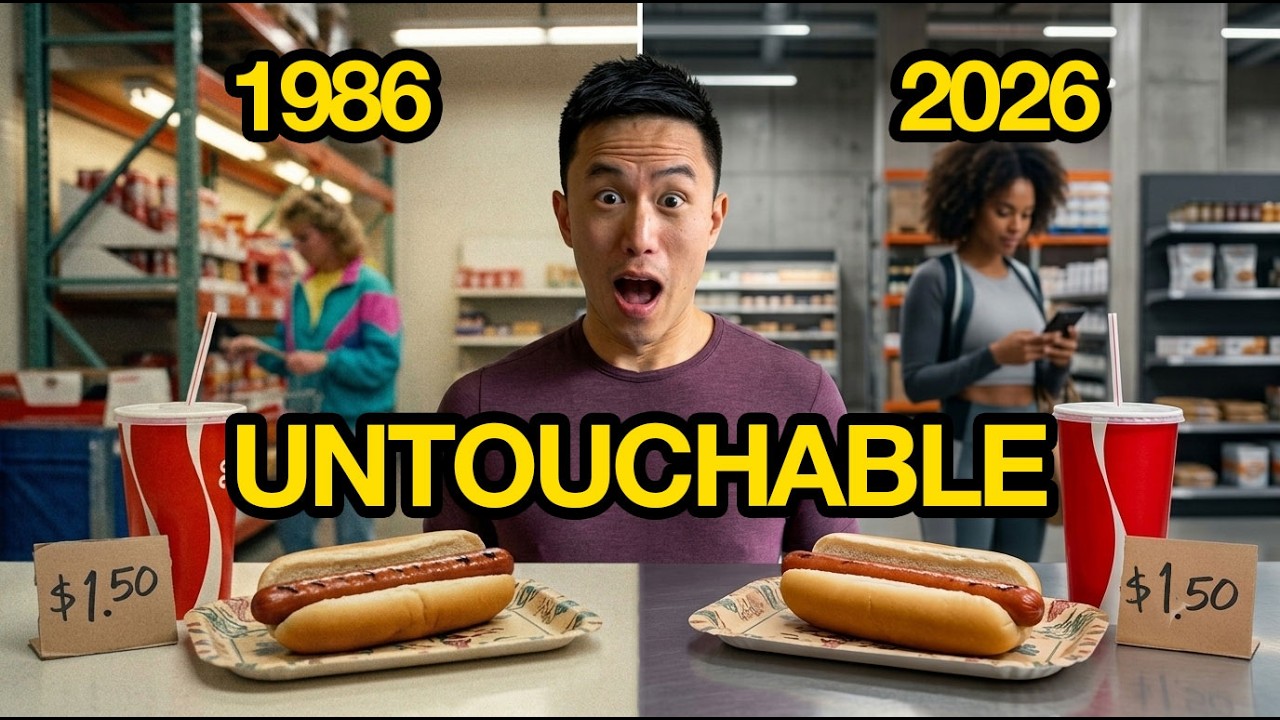
Costco has maintained a unique pricing strategy since the 1980s by selling its famous hot dog and soda combo for exactly $1.50, a price point it refuses to raise despite decades of inflation and rising ingredient costs. The company reportedly loses money on every single unit sold intentionally because the food court is not designed as a profit center but rather as an essential service to members, similar to free parking or clean bathrooms. This consistent low pricing serves as a powerful promise that Costco cares for its customers after they spend hundreds of dollars on groceries elsewhere, ensuring that their last taste in memory reinforces trust and loyalty before they leave the warehouse.
The core genius behind this strategy lies in understanding that Costco's actual product is not the food or merchandise on the shelves but rather the annual membership fee, which generates the majority of the company's operating profit. By pricing items like the hot dog to appear as a giveaway, Costco effectively markets its value proposition and encourages members to renew their subscriptions every year; approximately 90% of members choose to renew annually because they feel protected by these honest deals. Raising the price would break this narrative instantly, signaling that the company no longer stands on the side of the customer, which is why executives have threatened severe consequences for anyone suggesting a price increase instead opting to rebuild their supply chain economics internally.
This approach offers critical lessons for other businesses and restaurant owners who often mistakenly raise prices on their most popular items when facing financial pressure, not realizing that these low-margin products act as magnets or signal items rather than primary revenue drivers. When an item serves as the magnet pulling customers in, it should be priced to build trust and community goodwill while profits are generated through other high-margin goods like memberships, second visits, or additional purchases made by those drawn in by the deal. Successful operators must identify which specific menu item functions as their loss leader versus a margin maker before making any pricing decisions, ensuring that they do not confuse an asset used for brand defense with a product meant to generate immediate profit.
Ultimately, Costco's discipline demonstrates that protecting a price is sometimes more important than maximizing short-term margins on individual units if that price represents the foundation of customer trust and long-term loyalty. Instead of passing increased costs onto consumers, companies should attack their own cost structures by building in-house production or finding efficiencies to maintain those vital low prices forever. By clearly distinguishing between items that serve as proof of value for members and those designed to generate revenue, businesses can create a sustainable flywheel where the cheapest item drives traffic while other elements capture the true economic value needed to thrive.
Read the full video transcript
If you change the price, I will kill
you. Go figure it out. That's what the
CEO told the team when they suggested to
raise the [music] price. Costco has sold
the same hot dog and soda for $1.50
since 1980s. It reportedly loses money
on every single one of them on purpose
and it has protected that loss like it's
the most important number in the
company. And friends, if you're running
a restaurant, this is by far the most
misunderstood pricing decision [music]
in retail because the item that everyone
thinks is a giveaway is actually the
smartest marketing that the company has
ever ran. Hey friends, welcome back to
the receipt, the series where we take
apart the businesses behind the
restaurants that you know. I'm Wilson,
two decades in food and beverage. Built
my dessert chain 720 [music] Suites to
seven locations before it was acquired.
And I've made the mistake this entire
story is about. I've looked for cheap,
popular items on my menu, done the math,
and thought that, hey, you know what?
Basically, we're giving this away for
free. Let's just raise it a dollar.
Sometimes it was right, many [music]
times it was wrong. It quietly just
broke the one thing that made people
trust [music] our prices. And what I
want to show you is why one of the most
popular retailers on [music] Earth
guards a money losing hot dog like a
state secret. Because the hot dog was
never the product. Now, let's dive right
in. Costco opens its first warehouse
[music] in 1983. And almost from the
beginning, there is a hot dog stand
[music] out front. A quarter pound all
beef hot dog and a 20 oz soda. By 1985,
the combo is priced at $1.50. That price
has not changed ever since. Not through
inflation, not through recessions, not
through beef spiking, not through
pandemic, at $1.50 for over 40 years.
And here's the thing that you must
understand. And the food court was never
designed to be a profit center. Most
retailer treats food service as its own
business. It has its own margins.
[music]
Costco treats the food court like free
parking or like the free samples or like
the clean bathrooms. It's a service to
[music] the members, a reason for the
members to stay in the building. So, the
hot dog isn't priced to make money.
Rather, [music] it's priced to make a
promise. When you walk into a Costco
having spent $300 on groceries and you
grab a full meal for just a buck 50 on
the way to your car, the last taste in
your mouth literally is that this place
take cares [music] of you. Friends, this
is not an accident and it is actually by
design. That it is the most valuable
real estate for this entire warehouse
and it only costes them $1.50. Now, fast
forward. Cost climbs the way that cost
always climbs. Beef climbs, labor
climbs. every input that makes the hot
dog climbs for [music] the last 40
years. And at some point, someone within
the company does the obvious responsible
thing. They run the numbers and they
walk into [music] Jim Synagal, the
co-founder and longtime CEO, and they
suggest raising the price [music] to $2,
even a $1.75 just to stop the bleeding.
And Synagal's answer, if you raise the
price of the hot dog, I will kill you.
Figure [music] it out. Instead of
raising the prices, Costco went to
rebuild the entire economics around that
hot dog. They took the hot dog
production in-house. They built their
own hot dog manufacturing. [music] So
then that way they can control the cost
of the product directly. They protected
the price by [music] attacking the cost,
not the customer. So the $150 survives
not because they can't do the math, but
because they decided the price itself
was a brand asset [music] worth
defending. Hold on to that idea. A price
is an asset because that's the entire
lesson in this video. Real quick, if
you're finding any value in this, make
sure you smash that like button,
subscribe along the journey, and drop me
a comment in the section below. What's
the one item on your menu that you would
protect even if it stops making money?
Tell me honestly, so that way I know
what to break down [music] next. To
understand the $150, you have to
understand that Costco barely makes
anything selling you groceries. Costco
runs on razor thin retail margins on
[music] purpose. It marks most products
up only by a small capped amount over
the cost. The stuff on the shelves is
close to break even by design. So, where
does the profit come from? The
membership fee. The annual cart that you
buy just to be allowed to shop in there.
The membership is reportedly the
majority of Costco's operating profit.
[music] Guys, we're talking about the
majority of the entire profit. The
company's actual product is not the
food, nor the TV, nor the giant tubs of
mayonnaise. The product is the
membership. Everything inside is priced
[music] to make that membership feel
like the best $1.50, the best 60 bucks
that you have spent [music] all year.
And now the hot dog makes total sense.
Because the $150 combo is not just a
food item, it is a promise. It is a
renewal ad because every time you eat
it, it resells you on the benefit of the
membership. [music] It says out loud,
"The deal is real. We are still on your
side. Come back." Costco reportedly
renews around 90% of its members every
single year. We're talking about 90%.
That is one of the stickiest [music]
customer base in all of retail. And the
cheapest, most reliable piece of
marketing in that entire flywheel is the
hot dog that loses a few cents every
[music] single unit. The hot dog becomes
the bait. It's an honest bait because
the deal really is that good. But that's
[music] the reason why Synagol would
rather lose money on it forever than to
let anyone touch [music] the price. But
here's the trap, friends. This is where
I see operators, myself included, get it
exactly backwards. Because when money is
tight, the instinct is to raise the
price of your most popular, lowest
margin item. It feels responsible.
[music] It feels like it's going to help
out. Everybody buys it. It barely makes
any money. Let's fix that. But your most
popular, low margin item is often
[music] your signal item. It's the price
that people use to decide whether you're
fair. Raise it and you don't just make a
few cent. You quietly tell every single
regular that the deal is over. Costco
understood that the hot dog's job was
never to earn margin. Its job is to be
the proof. A $1.50 unchanged for 40
years is a promise that you [music] can
taste. It's more convincing than any ad
any loyalty app. The moment that they
raise it, their story [music] breaks. So
they would rather rebuild the entire
supply chain than to break the story.
That is a discipline that most company
do not [music] have. The genius is not
the hot dog. The genius is knowing which
number on the menu is the price and
which number is a promise and never
confusing the two. So what's the lesson
that you can actually learn from?
[music] Three things. Number one is to
know which item is your magnet. Which
item is your [music] margin. Every menu
has a magnet. The thing that tells
people to come in, mention to friends,
use to judge your prices. and it has
margin items, the stuff that quietly
pays the rent. They are almost never the
same item. Costco's magnet is the $150
hot dog. [music] The margins is a $60
membership. Map yours before you touch
the pricing. Lesson number two, price
the magnet for love, not [music] for
profit. Your signal item, this magnet,
should be priced to build trust, to be
able to give back to your community, not
to hit a margin target. You make your
money on everything else that the magnet
pulls people towards. the full cart, the
second visit, the loyalty. And I'll be
honest with you, at 720 Suites, we had
this signature item that people came in
for. It is a $2 cone that we barely
[music]
make money on. Yet, every single day, we
sell hundreds of those cones. And when
people come by the cones, they would end
[music] up buying tubs of ice cream to
bring it back to their family to eat,
which is where we make all our margins.
By identifying the cone and the tub, it
allows us to have a very strong strategy
moving forward. Number three, you must
fix the economics. Attack the costs and
not the customer. [music]
Costco didn't raise the prices. They
went and built their own hot dog plant.
When your signal item, the magnet, stops
working financially. Protect the price
by going to rebuild the cost around it.
That's [music] harder, but it is also
what's going to make the difference.
Take this as reference, friends. But
before you decide to raise prices
[music] on the thing that actually drags
and pulls all your customers in, really
try to identify, is this item going
[music] to be a loss leader, a magnet, a
thing that actually showcases to your
customer who you really are, or is this
actually a margin maker? Identify the
difference and you're going to be able
to [music] make your restaurant a profit
machine. So there you are, friends.
Costco sells a hot dog for $1.50, 50
loses money on it on purpose and
threatens to fire anyone who raises it.
All because the hot dog isn't food. It's
proof that the membership is worth it.
The magnet is the hot dog, the lost
leader. The margins is the membership
[music] and the discipline is to never
confuse the two. If you find any value
in this, make sure you guys subscribe
along the journey. Hit that like button.
So then that way it tells me [music] to
keep doing these for you. With that,
friends, we'll see you in the next one.