Contractual Defects: Part B - Duress, Undue Influence, Unconscionability
Watch on YouTubeVideo summary
This video explores three specific contractual defects: duress, undue influence, and unconscionability, using a recurring scenario involving characters named Sonia and Ahmed to illustrate each concept. Duress is defined as an illegitimate threat of harm that makes a contract voidable at the victim's option, encompassing threats against a person, their reputation, goods, or financial stability. A key distinction in economic duress lies between normal commercial pressure during negotiations and illegitimate pressure; a contract formed under economic duress typically requires proof that the threat was made in bad faith, left no reasonable alternative for the victim to resist, prompted immediate action once the pressure ceased, involved protest at the time of the threat, or occurred without independent legal advice. In the first example, Sonia threatens Ahmed with releasing an embarrassing video unless he buys her laptop, creating a duress based on harm to reputation that renders the agreement voidable because it was formed under illegitimate coercion.
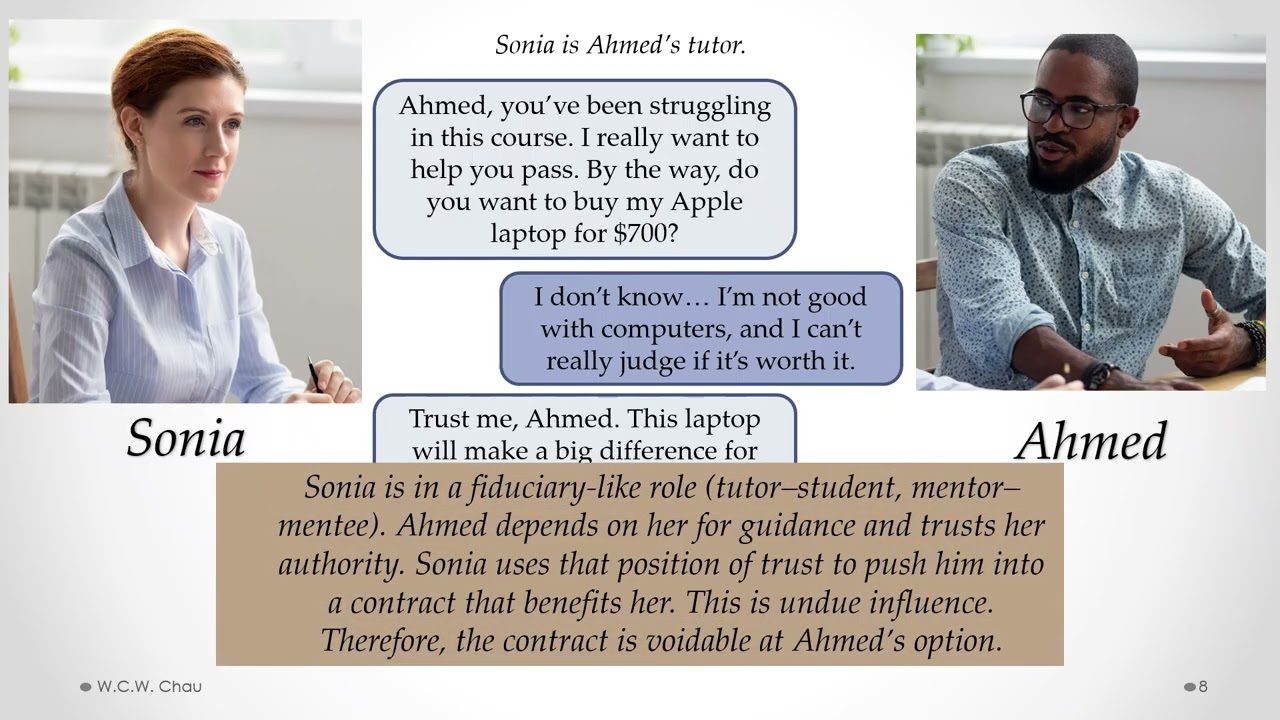
Undue influence occurs when one party is psychologically manipulated into entering a contract due to a relationship of trust or confidence known as a fiduciary relationship. To establish this defect, there must be evidence of actual influence exercised by one person over another and causation showing that this influence led directly to the creation of the contract. While influence can sometimes be presumed in relationships like lawyer-client or doctor-patient, it is also assumed when one party depends on the other for guidance, such as a student relying heavily on their tutor. Causation may similarly be presumed if the transaction appears suspicious because it offers little benefit or high risk to the weaker party, unless rebutted by evidence that the influence did not cause the agreement. In the second scenario, Sonia leverages her position as Ahmed's trusted tutor and mentor to convince him to purchase an expensive laptop he does not fully understand, exploiting his dependence on her authority to create a contract tainted by undue influence.
The third defect discussed is unconscionability, which arises when one party exploits another's weakness or vulnerability to secure an unfair deal. This presumption exists if there is a substantial inequality in bargaining power due to personal traits like naivety or situational factors such as poverty and distress, combined with terms that are substantially one-sided in favor of the stronger party. Unlike duress or undue influence which often require specific intent, unconscionability can be established even without proof that the stronger party knowingly took advantage of the weaker one; it simply requires showing an inability to protect interests and a bargain that unduly advantages one side over another. The video cites the Canadian Supreme Court case *Uber Technologies v Heller*, where a standard form contract imposed prohibitive arbitration fees on drivers, creating such a disparity between the multinational corporation's power and the individual driver's financial reality that the clause was deemed unconscionable despite no malicious intent by Uber.
In applying these principles to the final scenario involving Ahmed and Sonia, the video concludes that his desperate situation—facing an urgent assignment deadline with a broken laptop while being pressured into buying an overpriced device at $2,000—creates both inequality of bargaining power and substantially unfair terms. Because Sonia exploits this distressing circumstance where Ahmed feels he has no choice but to accept her offer, the contract is presumed unconscionable. This legal framework ensures that contracts formed under such extreme imbalances are not enforced against the vulnerable party, allowing them to seek remedies like voiding the agreement if they can demonstrate that their consent was obtained through exploitation of weakness rather than free and informed decision-making.
Read the full video transcript
This is Whan Chow. Welcome to
contractual defects part B. Duress,
undue influence, and unconscionability.
We're back with Sonia and Ahmed. Sonia
says, "Ahmed, I need some money. Do you
want to buy my Apple laptop for $700?"
And Ahmed says, "Honestly, Sonia, I
can't afford it right now."
Sonia says, "Listen carefully. If you
don't buy it, that video of you at the
party last month might accidentally get
posted online. You wouldn't want your
parents or your professor to see that,
would you?
Ahmed says, "What? That's private. You
can't do that." Fine, I'll buy it.
The contractual defect of duress is
where there is some kind of illegitimate
threat of harm that renders a contract
voidable at the victim's option. There
are a number of different types of
duress. There is duress of person which
involves a threat of harm to the party
involved in the contract or one of their
loved ones. This includes a threat of
harm to reputation.
There's duress of goods, which is a
threat to detain, damage, or destroy
goods. And also economic duress, a
threat that may cause financial harm.
Let's speak a little bit more about
economic duress. Economic duress
involves some kind of threat to cause
financial harm.
The difficulty of applying economic
duress is to discern the difference
between what is what might be considered
to be illegitimate pressure versus
normal commercial pressure. There's
always pressure, some kind of pressure
exerted in situations where parties are
negotiating and each party is trying to
get the best deal for themselves.
A contract is more likely to be
avoidable due to economic duress if
there are a number of different things.
One is there is a threat made in bad
faith. The victim could not reasonably
resist. The victim acted promptly once
pressure was removed. The victim
protested at the time of the threat if
it was practical to do so. And the
victim did not have legal advice before
succumbing to the pressure.
In this instance with Sonia and Ahmed,
there is duress of person since Sony
made a threat to harm Ahmed's reputation
by releasing the video. The contract is
voidable at Ahmed's option because it
was formed under that illegitimate
pressure.
Let's now move on to the next scenario
involving Sonia and Ahmed. In this
scenario, Sonia is now Ahmed's tutor. As
his tutor, she says, "Ahmed, you've been
struggling in this course. I really want
to help you pass. By the way, do you
want to buy my Apple laptop for $700?"
Ahmed says, "I don't know. I'm not good
with computers and I can't really judge
if it's worth it."
Sonia says, "Trust me, Ahmed. This
laptop will make a difference, a big
difference for your studies.
And Ahmed says, "Well, if you think it's
best, if it's the best thing for me,
then okay, I'll buy it."
The contractual defect of undue
influence is where someone has been
psychologically manipulated into
entering a contract.
To prove undue influence, a plaintiff
must show two things. First is
influence. Second is that that influence
causes a contract to be created.
The first requirement of influence did
one person exercise influence over
another person. Influence is assumed
where there is a fiduciary relationship
between the two parties. A fiduciary
relationship is considered to be a
relationship based on trust or
confidence such as the relationship
between a lawyer and a client, a
physician and a patient, a parent and a
minor child. The stronger party in a
fiduciary relationship is assumed to
have influenced the weaker party.
The second requirement is causation. The
stronger party's influence needs to have
actually caused the weaker party to
enter into the contract. Causation is
presumed if the transaction was
considered to be suspicious. A
transaction is suspicious if it creates
little benefit or great risk for the
weaker party. That presumption can be
rebutted by evidence that the influence
did not actually cause the other party
to enter into the contract.
In this scenario, Sonia is in a
fiduciary-like role as a tutor or mentor
to Ahmed. Ahmed depends on her for
guidance and trusts her authority. Sonia
uses that position of trust to push him
into a contract that benefits her. This
is undue influence. Therefore, the
contract is voidable at Ahmed's option.
Here's our next scenario. Sonia says,
"Ahmed, do you want to buy my Apple
laptop? I'll sell it to you for $2,000."
Ahmed says, " $2,000? That's way more
than I can afford, but my laptop just
broke yesterday and I have a major
assignment due tomorrow.
Sonia says, "Exactly. Without a laptop,
you'll probably fail that assignment.
Think about your grades." Ahmed.
Ahmed says, "I really can't fail. I
guess I don't have a choice. I'll take
it."
The contractual defect of
unconscionability is when one person
exploits another person's weakness to
create an unfair deal. Uncontionability
is presumed if we have two things.
First, a substantial inequality of
bargaining power where one person is
much stronger and the other party is
much weaker. And this may be due to
personal traits such as illiteracy,
naivity, inexperience or gullibility or
situational factors such as poverty,
depression, infatuation, distress or
drunkenness.
The second requirement to raise a
presumption of unconscibility is
substantial unfairness of terms. This is
where the transaction is substantially
one-sided in favor of the stronger
party.
Once a a presumption of
unconscionability is raised, it can be
rebutted by proof that the bargaining
process was fair, such as the weaker
party having received independent legal
advice before entering into the
contract.
The leading case in unconscionability is
the Supreme Court of Canada decision in
Uber technologies and Heler. In that
case, there was someone named David
Heler who was a driver for Uber
delivering food. To become an driver for
Uber, he had to accept a standard form
contract provided by Uber. Within that
contract was an arbitration clause that
required any disputes under that
agreement to be resolved through
mediation and arbitration in the
Netherlands. The arbitration clause also
required an upfront administrative and
filing fee of $14,500
plus the payment of any legal fees and
other costs of participating in the
dispute resolution process. Mr. Heler
earned between $400 and $600 a week
driving for Uber. Those fees under the
arbitration clause represented most of
his annual income.
The legal issue that the court examined
was whether or not that arbitration
clause was invalid on the basis of
unconscionability.
The court examined the law of
unconscionability.
It pointed out that unconscionability
requires both an inequality of
bargaining power and a resulting
improvident bargain and that an
inequality of bargaining power exists
when one party cannot adequately protect
their interests in the contracting
process and a bargain is improvident if
it unduly advantages the stronger party
or unduly disadvantages the more
vulnerable. The court also pointed out
that unconscionability can be
established without proof that the
stronger party knowingly took advantage
of the weaker party. In other words, the
stronger party does not need to
intentionally take advantage of the
weaker party.
So in applying that law to the facts of
this case, the Supreme Court found that
there was clearly inequality of
bargaining power between Uber and Mr.
Heler.
It pointed out that the arbitration
agreement was a part of a standard form
contract and that Mr. Heler was
powerless to negotiate any of its terms.
His only contractual option was to
either accept or reject that contract.
The court also pointed out that there
was a significant gulf in sophistication
between Mr. Heler as a food delivery man
in Toronto and Uber, a large
multinational corporation.
As well, the arbitration agreement
contains no information about the costs
of mediation and arbitration in the
Netherlands. A person in Mr. Heler's
position could not be expected to
appreciate the financial and legal
implications of agreeing to arbitrate
under ICC rules or under Dutch law.
The court in in determining that the
that the contract was improvident or
that the arbitration clause was
improvident uh said that the mediation
arbitration processes required $14,500
in upfront administrative fees and that
this amount is a close is close to Mr.
Heler's annual income and does not
include the potential costs of travel,
accommodation, and legal representation
or lost wages. The court noted that
these costs are disproportionate to the
size of an arbitration award that could
reasonably have been foreseen when the
contract was entered into and that the
arbitration agreement also designates
the law of the Netherlands as the
governing law and Amsterdam as the place
of the arbitration.
This gives Mr. Heler and the other Uber
drivers in Ontario the clear impression
that they have little choice but to
travel at their own expense to the
Netherlands to individually pursue
claims against Uber through mandatory
mediation arbitration in Uber's home
jurisdiction.
In this scenario,
Ahmed is under intense pressure. He has
an urgent academic deadline and a broken
laptop. Sonia exploits this desperate
circumstance to push an unfair price.
With both inequality of bargaining power
and substantially unfair terms, the
contract is presumed to be
unconscionable and may be voidable at
Ahmed's option.