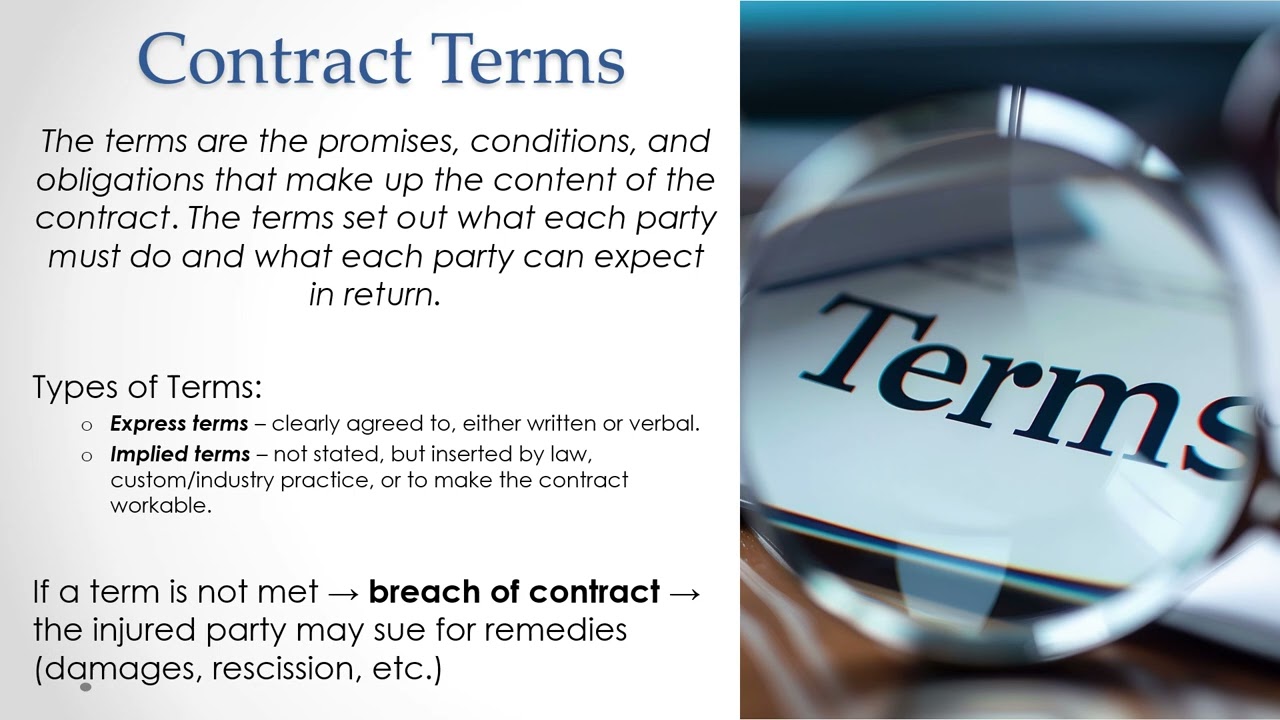
Contract Terms: Part A - Puffs, Reps. & Terms; Express & Implied Terms, Interp. of Express Terms
Watch on YouTubeVideo summary
This video lecture introduces the fundamental categories of statements made during contract negotiations, distinguishing between puffs, representations, and terms. A puff is defined as an exaggerated statement of opinion or sales talk that lacks legal effect, meaning even if it turns out to be false, no legal consequences arise. In contrast, a representation is a statement of fact intended to induce the other party into entering the contract; if this factual claim is proven false after the agreement is formed, it constitutes a misrepresentation that can lead to legal remedies such as rescission or damages. Finally, a term is a binding promise that forms part of the actual agreement, and failure to fulfill such a promise results in a breach of contract for which the injured party can sue.
The lecture further categorizes terms into express and implied types. Express terms are those explicitly agreed upon by the parties, whether written down or stated verbally, outlining specific obligations like the price and item description. Implied terms, however, are not explicitly written or spoken but are incorporated into the contract automatically through law, custom, or industry practice to ensure the contract is workable. For instance, in a sale of goods, there is an implied term that the item must be of merchantable quality and fit for its intended purpose. If these obligations are not met, they constitute a breach just like express terms, highlighting that the significance of a term lies in its enforceability regardless of how it was established.
When disputes arise regarding the meaning of express terms, courts employ specific rules of interpretation to resolve ambiguities. The primary method is the golden rule, which dictates that words should be given their plain ordinary meaning unless doing so leads to an absurd result. If the literal interpretation creates an absurdity, the court may resort to alternative approaches such as the contextual approach, which examines surrounding circumstances to determine the parties' true intentions, or the contra proferentem rule, which interprets ambiguous terms against the party who drafted the contract. These methods ensure that contracts are interpreted fairly and practically rather than strictly literally when the literal meaning would be unreasonable.
The video concludes by applying these legal principles to a practical scenario involving two students negotiating the sale of a laptop. In this case, an express term regarding delivery within 48 hours was written into the contract, but one party attempted to enforce it at an impractical time of 2:00 AM. The lecture demonstrates how the golden rule would initially allow such a time as it falls within the 48-hour window, but since this leads to an absurd result requiring delivery during unreasonable hours, the court would shift to other methods. By considering the contextual reality that both parties are students who operate during school hours and applying the contra proferentem rule because one party drafted the contract, the court would likely reject the unreasonable delivery time. This illustrates how legal interpretation balances the literal text of a contract with practical realities and fairness to resolve disputes effectively.
Read the full video transcript
Hello, this is Wayne Chow. This is a
video lecture series on contract terms.
There will be three parts. This part,
part A, we'll focus on puffs,
representations and terms, express terms
versus implied terms, and the
interpretation of express terms.
In the course of negotiating a contract,
there often will be a number of
communications back and forth between
the parties involved. Those
communications could be written or
verbal. Some of those communications may
represent significant elements that lead
to the formation of a contract,
especially an offer and acceptance. But
we could also have counter offers and
rejections of offers.
If an agreement is formed, the
significance of some other
communications that may have occurred
could also be relevant. There are three
types of categories. puffs,
representations,
and terms.
Let's go back to our friends Sonia and
Ahmed to help us understand what is a
puff versus a representation and the
term. So, Sonia is still trying to sell
her laptop to Ahmed. So, she says, "Do
you want to buy my Apple laptop for
$700?"
And Ahmed replies, "Maybe. Tell me more
about it."
And now Sonia says one of the following
statements before Ahmed accepted Sonia's
offer.
The first statement is this is the best
laptop in the world. The second it has a
brand new battery installed last week.
And the third statement I'll include a
free carrying case. So for that first
statement it would be considered a puff.
It's an exa exaggerated statement. It's
considered to be only sales talk. So
even if it turns out to be wrong, to be
false, there are no no legal
consequences attached to that. The
second statement, it has a brand new
battery installed last week. That would
likely be considered a representation,
which is a statement of fact that it
induces the other party to enter into
the contract. So that statement made
Ahmed believe that factually there was a
brand new battery in the laptop and that
was one of the things that induced him
to decide to buy the laptop. So there
are legal consequences if that statement
turns out to be false. It would be
considered a misrepresentation
with legal remedies such as recision or
the awarding of damages.
The third statement, I'll include a free
carrying case.
That would be considered a term. It
would be considered a binding promise
that is a part of the agreement that
Sonia and Ahmed have entered into. It is
a promise made by Sonia to provide the
laptop along with the carrying case in
exchange for Ahmed paying the $700
as a term. If that promise is not
performed, the other party can sue for
breach of contract.
Let's explore more detail contract
terms. Contract terms are the promises,
conditions, and obligations that make up
the content of the contract. The terms
simply set out what each party must do
and what each party can expect in
return.
There are two types of terms, express
and imply. Express terms are the ones
that are clearly agreed to. If it's a
written contract, it's actually written
in the contract. If it's a verbal
agreement, it's actually been stated and
agreed to verbally by the parties.
Implied terms are neither written nor
stated verbally, but they are a part of
the contract by way of law or custom or
industry practice or to make a contract
workable. An example of a provision that
is automatically included, let's say in
an employment contract is the common law
requirement that reasonable notice be
given on the termination of an employee.
The significance of a term is that if a
term is not met, if it's not if the
obligation is not fulfilled, it it
results in a breach of contract which
allows the injured party to sue for
remedies.
Let's go back to our friends Sonia and
Ahmed and have a careful look at the
conversation that they had that led to
the formation of their contract. Sonia
started by saying, "I'm selling my Apple
laptop for $700. Would you like to buy
it?" So, that is considered to be an
offer with the express terms identifying
the item that's being sold, which is the
Apple laptop, and the price, which is
$700.
Ahmed says, " $700 sounds a bit high. Is
it worth it?" That is considered to be
an inquiry. There's no legal effect of
making inquiry. It's just asking
questions to gather more information.
Sonia then says, "This is the best
laptop on the market. It runs lightning
fast." That's considered to be a puff.
It's only an exaggerated sales statement
and has no legal effect. Her next
statement, it has a new battery
installed last month and the hard drive
was replaced just 6 months ago. That's a
representation. It's a factual
statement. And if that statement turns
out to be false, it would be considered
a misrepresentation.
Her next statement is I'll also include
the original charger and a carrying case
in the price. So what she's doing there,
she's adding more express terms to the
offer.
And Ahmed chimes in and says, "Okay,
that's reassuring, but will it actually
work properly for my online classes?" So
that's an inquiry. There's no legal
effect. No legal effect for an inquiry.
Sonia now responds. Of course, it runs
the latest operating system and
everything works fine. So what she's
doing there, she's making a
representation. So it's another factual
statement and if that's false, it'll be
considered a misrepresentation.
But there's also now an implied
expectation that the laptop will work
for the purpose that Ahmed needs it for,
which is for online classes.
And Ahmed finally says, "All right, I'll
take it for $700." So that's the
acceptance that forms the contract.
Let's sum up our legal analysis of Sonia
and Ahmed's conversation.
There was an agreement formed based on
the offer made by Sonia and the
acceptance provided by Ahmed. The
express terms were Sonia promises to
give Ahmed the Apple laptop along with
the charger and carrying case and Ahmed
promised to pay Sonia $700.
There was an implied term in this
contract and that is that the laptop
must be of merchantable quality and fit
for ordinary use. So this is the use
specifically would be Ahmed's intended
use of using the laptop for online
classes. So this term is implied by the
sale of goods act. There was also a puff
about the laptop being the best laptop
on the market. There are also also some
representations with regard to a new
battery and hard drive and the latest
operating system.
Sometimes when we do have a contract and
we have express terms in that contract,
there still may be problems. Sometimes
the wording of those express terms may
not be entirely clear and the parties
may disagree on the meaning of a written
or even a spoken term express term in
the contract and those those
disagreements would be resolved by a
court. The question a court would ask is
how would a reasonable business person
understand those words? Now the
difficulty of that question is you know
how do you determine what is reasonable.
So the courts have provided some further
guidance. They have developed something
called the golden rule to determine what
is reasonable. Golden rule says that we
should apply the plain ordinary meaning
of the words. In other words, that
usually means you know the dictionary
meaning of the words
unless by applying the plain ordinary
meaning it leads to absurd results. So
in other words let's stick to the plain
ordinary meaning unless in the
exceptional case if it results in
absurdity then we will resort to other
methods of interpretation.
So if the results are absurd, the other
methods of interpretation are the
contextual approach which is where we
look at the surrounding circumstances to
try to figure out what the parties
intended.
The second alternative approach is a
rule called contraferentum
which says that we should interpret
ambiguous terms against the party who
drafted them.
Let's now go back to our friends Sonia
and Ahmed. Sonia again is asking Ahmed,
"Do you want to buy my laptop for $700?"
Ahmed says, "Great, I'll take it." When
can you deliver it to me?
Anytime in the next 48 hours, says
Sonia. I'll include that in the written
contract. So this time they're actually
writing up a contract, which is always a
good idea. So Sonia puts a clause in the
written contract which says delivery
will be made within 48 hours.
Then sometime later Sonia says to Ahmed
say, "Hey Ahmed, I want to come by at 2
am tomorrow to give you the laptop."
Ahmed says, "What? Can't you bring it at
a decent time during the day?"
And Sonia says, "That's the only time I
can do it. If you can't take the
delivery, the deal is canled."
Let's now apply the golden rule to what
just happened between Sonia and Ahmed.
Remember the golden rule says we use the
plain ordinary meaning of the words
unless that leads to absurd results.
The plain ordinary meaning of within 48
hours would include 3:00 a.m. the next
morning as Sonia has proposed or could
include essentially any time of Sonia's
choosing in the 48 hours after the
contract was formed.
This seems to lead to an absurd result
since it would require Ahmed to take
delivery at impractical times when he
may not be available.
So assuming that that is a absurd
result, we now look at the other the
other methods of interpretation. The
first is the contextual approach where
we look at the surrounding circumstances
to determine what the parties intentions
might have been.
One one key fact could be that the
parties involved here in this contract,
they're both students and they usually
see each other during school hours. So
that would imply that a better
interpretation would be that a
reasonable delivery time would be during
regular school hours or generally
business hours.
The other the other method of
interpretation is controp. So remember
with with that rule, we interpret
ambiguous terms in favor of the party
who did not draft the contract. In this
case, Sonia drafted the contract.
Therefore, any ambiguity in the wording
of the contract should be resolved in
Ahmed's favor. So under both of these
approaches, they seem to suggest that
that's Sonia's interpretation is not the
proper one. And that the two of them
should try to uh set a delivery time
that is practical and reasonable for
both of them.