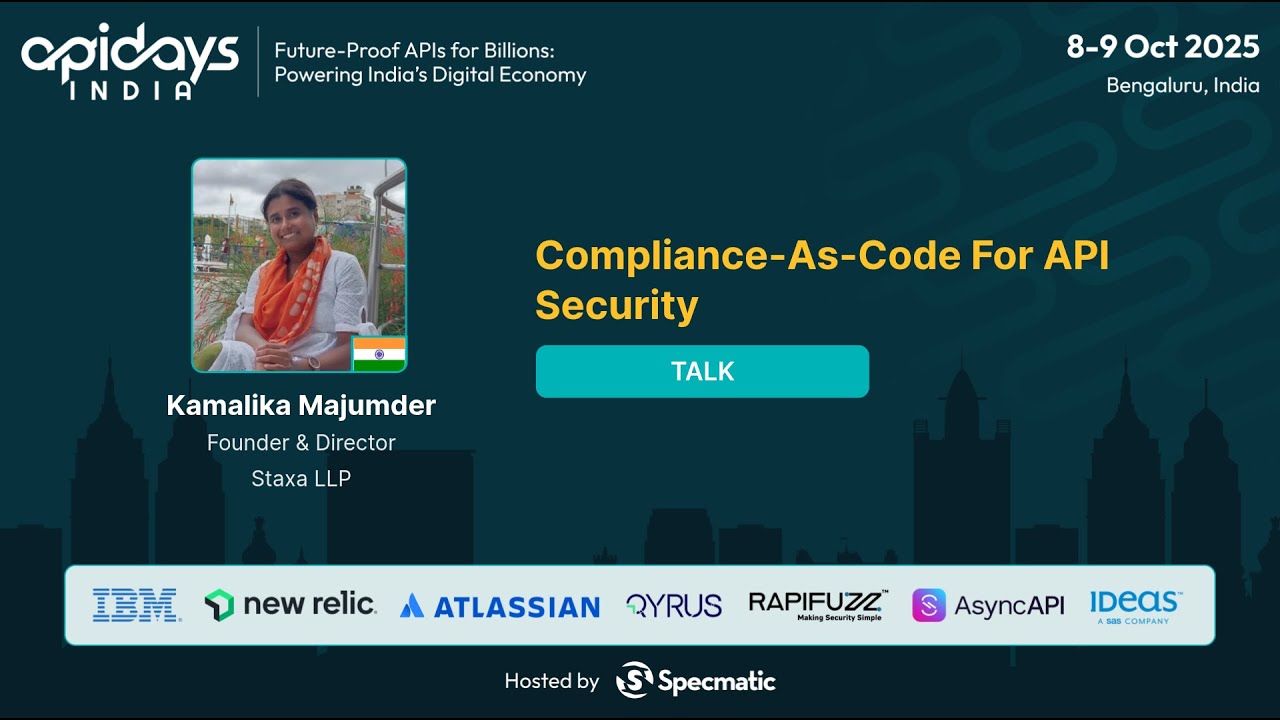
Video summary
Kamalika Majumder, an experienced DevOps consultant, introduces the concept of Compliance-as-Code as a vital strategy for securing APIs and managing data within critical sectors like banking, fintech, and healthcare. She clarifies that while frameworks such as PCI-DSS, GDPR, ISO 27001, and India's DPDP Act provide essential guidelines for protecting sensitive information like credit card details, personal identifiable information, and health records, they do not prescribe specific implementation methods. A significant challenge in traditional compliance is the gap between high-level policy documents and actual infrastructure configurations, often leaving organizations unable to provide the verifiable proof of evidence required by auditors. To bridge this divide, Majumder advocates for translating these regulatory controls directly into technical configurations using Infrastructure as Code tools, thereby replacing static documentation with dynamic, automated enforcement mechanisms.
The core solution presented involves writing compliance logic in Terraform, a tool that interacts with AWS APIs to automatically deploy and verify security settings across various environments. This approach allows organizations to codify specific requirements, such as enabling logging on Client VPNs, enforcing multi-factor authentication on root accounts, preventing public IP exposure, and securing container scanning policies for ECR buckets. By treating compliance rules as scripts or modules rather than relying on SDKs, the system can continuously monitor infrastructure and generate traceability logs without extracting sensitive data from the account. This method not only simplifies pre-audit preparation but also facilitates streamlined certification processes for multi-tenant environments and third-party vendors, ensuring that password policies, backup rules, and other security standards are consistently applied across all applications.
Although Terraform is specific to AWS, the underlying logic of Compliance-as-Code is adaptable to other platforms like Pulumi and OpenTofu, though migration to cloud providers such as GCP requires rewriting code due to differences in resource naming conventions and API arguments. The speaker emphasizes that while tools like AWS Audit Manager can call various APIs, they cannot autonomously determine necessary checks without explicit user configuration to define what the system should look for. Furthermore, the solution addresses evolving standards driven by advancements in AI by integrating continuous monitoring directly into CI/CD pipelines, ensuring real-time policy enforcement rather than relying on one-time fixes. Ultimately, this strategy transforms compliance from a bureaucratic checklist into an automated, verifiable engineering practice that ensures ongoing adherence to regulations without reinventing processes for every new application or tenant.
Read the full video transcript
Hello everyone, my name is Kamalika. I am an
independent DevOps consultant and an
infrastructure developer and I have an
industry experience of like more than 15
years. So I literally started my career
ah installing servers and networks and
fire walls. And today we're going to talk about
compliance code for API
security and this will be a 50% off it.
I will give the context and then another
50% of my income will show you some examples and demos
from real life implementations ah for
my client my own client projects
in critical sectors where I had
implemented ah civil compliances and how we did it using
ah codifying their
compliance controls into the
infrastructure. So let's begin.
First of all what are the compliances? So the
general norm in the industry or in general when you ask
people what are compliances
and why people are so skeptical when they hear the word
compliances is because ah
everybody thinks these are like 10 page
checklists ah which you should go and fulfill and ah
you know ah you will have to certify and
you know ah submit a bunch of documents and
stuff like that. But in reality compliances
are not actually that. Compliances Never
Tell You How to Do It. They will tell you what to do with
it. These are just frameworks
which will guide you towards securing
your information, your data, your
infrastructure or whatever it is. Ah, there you will rarely find any
compliance will tell
you how to implement it. From late, am
you have a late, from you are a small fintech
company.
[nasal sound]
Now you're storing credit card
data. Now compliance won't come and tell you that's okay,
compliance will only tell you that you will have to
secure your ah customer data
in such a way that it does not leak out, but it will never come
and tell you that okay, you will have to
use this protocol, that protocol,
or you know this tool, that tool. They will It's up
to you. This is to you know this is a self ah
assessment that you will have to do to comply
to the compliance first. So these are also
guidelines to secure your assets.
So globally if you look at majority of
compliances they are driven by a uniform
ah agenda to secure your identity or I a
no intellectual property or assets
whatever you call it. So Di- They give you
guidelines to follow it. Am now which
sectors and why do we need compliances
critical sectors like banks,
insurance companies, fintex companies. Ah,
offen need more than one compliances. And that's exactly the reason why I say that
compliances are just frameworks. You know, there are not any
hard and fast rules that you have to do this
and have to do that. And you
must have 50 documents, then only you
can certify. No, you can even certify
with 10 documents or you can even fail
a certification with 50 documents. And
More on Above All, Documentation Is Not
the Only Thing. And sats why, you know, in
some sectors you might need more than one
compliance. Let's say, ISO 27001 is one
ah compliance, global compliance for
information security. But when you go to the
countries like late South East Asia.
Each country will have banks which will have their own
compliances. When you come to India,
India has RBI regulations, India has
DPDP Act. So, it depends you will have to
club them together sometimes. Ah and that is
why ah the non compliance ah becomes you know you
might face safety ah penalties
if you are not complying to it especially when it comes
to the government
regulations.
Ah now some people think that it is only the
banks or you know fintech or lately
insurance and stock exchange who needs
compliances or certification. But that's not
true. Software development companies especially
the ones which are in a Sass format. And
which are exposed to the public internet
also need compliance. Because today ah
with the advent of AI you know ah we are
seeing more and more integration and ah
talking between various companies ah
providing services. So there you are
actually storing critical assets which
you have to protect. You're you're
collecting a lot of data from people. Lots
of personal data from people. You may not be a
bank. You may not be a card
industry, you may not be a payment gateway.
You may not be an insurance company, but you're
still collecting a lot of information
which you're using, and if somebody gets
hold of that data, that will, you know, bring in
a lot of complications, and
if you've seen in the recent last two to three
years the kind of compromise that you've seen which has
brought entire systems
down, airports down, banks down, these are actually not very
fancy attacks, these are very
simple, very, you know, I can say like,
ah, very simple day to day activities
which people have somehow breached and they're
able to get hold of this data, and most
hackers do that. They Do Not Go and Try to
Break a Very Fancy Authentication System. They
actually try to see very you know ah
usual human behavior and try to
find fort lines on it and then try to
get the data. So software come be it
software companies ah be it banks and be
it regulatory industries. If you are
handling human data, you know
personal information, you must at least follow the
guidelines provided by the
compliances.
[nasal sound]
So what are the baselines for these
compliances. Ah there are a number of
compliances in the world and we usually get
very confused when we are especially
for startups. When we are building an
application. We do not think about
security from day one. You Know. Day, From
Day One, We Think How Soon Can We Get Our
MBP Out? Now, unfortunately and
fortunately, getting out an
MVP can get you funding, can get you some
customers. But then you kind of forget about the
security aspect. And you think about the
security aspect when you're on
you know one or product one release and you
're on boarding customers and you know things like that.
And then on the nth day, you finally
you know your manager or whoever you are you hire a
cso and you know you don't hire a cso on
day one and security expert on day one you know ah then
you count to know okay I need to get
this approval I need to get this
license let's say oh I need this
certification. But then you know all the health
breaks are lost. And now a days ah
unfortunately what I have seen personally is that many
companies rush towards getting fast
certification. You know submit 50
documents get certification
irrespective of what is there in their
underlying infrastructure. So what
happens is and that is why you will see why does a
company like Oracle have its
IDM database been breached. Because there is
a faulty VM you know it it was attacked in
2025 early in March. They got like 5
billion user data out. It's it's really a
baseline thing right. It's you shouldn't have
, you shouldn't have faulty or unhardened systems in
your infrastructure or in your clients.
You should be able to identify it. Big
Company Like That. You have you're saying you're
having certification. So what is the
baseline for come ah compliance. Every
compliance that you see there is standardized
by one thing which is securing your
information. And they are widely
distributed into three sections. Which
is PCI, PII and PHI. PCI We
Have Heard a Lot About It. Ah which is the
card industry. If you are handling any
credit card and you know ah debit card,
any kind of card data that if if your
application is storing that data you know in a in at
rest or using that data you have
to secure that data. And that's a
mandatory thing by the governments world
wide, you know, no matter which government it is.
So, if you're developing something, where you
're building some kind of application, which you'll ask someone like.
Even if you're you're
selling like if you're a solopreneur
selling a small, quick AI app on the
internet and you're using Stripe. You
will see that ah all this ah you no payment
services. They ask you to you know check box
these things like you know I follow the PCI
guidelines and I am storing the data ah
responsibly and there is no ah breach that will
happen. Ah PII is Personal
Identifiable Information. Now earlier than late,
three years back, four years back, this
used to be a name and date of birth and you know very
minimal thing. But today even any ah
und data like email ah ah has become a
PII kind of data. So, ah and it will even keep
evolving you know, the more accessible
earlier email if you only few people used to have
email, you know because email
communication digitization was not that much.
But today email has become like ah like your
I would say identity and passport ID.
It's as critical as your passport ID.
Right? So ah it has evolved and
industries are also recognizing that even
email ID is a PII data and if you
are storing PII data you will have to make
sure that and PII data ah
specifically now a days is ah also used are ah
the governments are regulating where
you store PII data the you know the citizens
data it is it is considered as citizen data
like ah in the eastern part of the world
like India South East Asia when you go there
and you will build building application before even go
to PCI governments will tell that no matter what you do you will have to
store PII data with in the country
and we are seeing this you know India we are
seeing it recently it used to be there
for payment industries but now with the
DPDP Act will see more of that and that's why many
ah companies especially the
AI ones who are doing a Lot of data
processing they will have to do to comply with
it. Ah in Europe you have the GB GDPR
Act. So there's also more about
PII: Citizens' Information Should Not Leave the
Country. If you are using Citizen Information, you will have
to store it in these data centers. So,
data localization is an
aspect which is very closely related
to PII data, even before you know you go
to the money transaction part. So it personal
ah ination of citizens has to be localized.
Ah the other is then ah comes PHI which is
a health related information. Health care
services, insurances. Now Ah PC,
PHI and PII Kind of Are
Correlated. Sometimes PHI that is also
considered as PII data. So, if you're ah
a health ah provide, you know, kind
of health services, health care service
provider. Ah, you might have to comply with
both. Like, first of all you are giving
you have information regarding, people's
health, blood group extra, extra.
But you also have like email id and
things like that. So one important thing is that
services like logging and
monitoring right now were not considered as
critical services are like compliant, you know
services which need to be compliant but they are also been
considered as under the
umbrella of regulated because while you are
monitoring your application logging various
stuff, you know correlation ID stuff like that.
You will have that data like email IDs and
you know it's easier people have found out way to
capture the logs and breach your ah
applications and that's why am for sass a
providers like a late say splunk and am you know
neural there also when you are
going to such countries which have PCI
PII regulation you will have to take care
of that that data is to be sanitized and you
are not exposing unnecessary and everything that
lock4j capture to your thing.
So these are aspects. Now what are the
challenges of compliance? The biggest
challenge that I have personally faced while
implementing and while building
infrastructure for compliance heavy
industries is the interpretation of their
controls. You know, and I think that's the
biggest ah kind of wall between the
security ah world and the software
development world. Where ah the language that's
being used on these documents is
not interpreted correctly or it you know there is
the lack of bridge between ah
translating the controls into
configurations ah has ah created this
kind of skepticism in the compliance
world. And when you talk to auditors ah it's
very difficult. And I don't blame them because
auditors usually come from like the
generic world, right? They are not going into
the implementation as a part of it. They and that's why sometimes it is easier to
satisfy them than to just show them a policy
document. But then again auditors will come
and ask for evidence and now you don't know how
to provide the evidence. So I think the
biggest challenge there is is that you need to
convert the compliance that is there in the
document into code. And that is why you know I
picked this topic of compliance as
code. Ah and ever evolving standards.
That's the second ah I think in the recent
time I would say the second one has become ah the
you know taken first priority because ah the way
ah technology is evolving with AI.
Ah you will have to keep ah upgrading your
compliance and regulations. And ah till
date, ah I think only IO 271 has updated
the regulations in line with some aspects of
AI. Ah there are still lack of any
directions towards that. You know how to
maintain it. So you will have to take in ah you know
kind of ah ah consideration that soon
governments will start releasing
compliance ah frameworks for AI
regulation. Now when AI regulation comes in it will keep
changing because you know ah the way AI is
first you know LLM then JNAI then tomorrow there can be something else
and the way they are
integrating with our systems.
So ah technology is evolving much faster than what it was
in the cloud era. Ah, we
took a very long time to come to the cloud
and the digital transformation era, but the
AI era is moving really fast. Ah and that's why
you will see there are upgrades
happening in this compliance. Like from
PCI DSS X you know they have a new
version which was the last version expired
last year and version four is there. IO 271
October 31, 2013 version is expiring
and they have gone through a complete
reorganization of the older version to the
newer version. They have in fact reduced the
number of controls. They have not
increased it. So they've clubbed a lot of
things dev brought in a lot of um coding
related stuff ah compared to you know
earlier it was a lot of generic stuff. So
these challenges will keep coming in and ah these ah
needs a review every year. So you can't just say that I have you know
earlier you do one
certification and you're good for five
years. But today that's not the case. You know may be
soon you will have a situation and once every
quarter and you know every two quarters you will have to do
a review of ah where we are.
Like a security review of Where We Are.
So ah and these are the challenges and when I say
interpretation right for example
what does it really mean like this is a this
first statement is actually a copy of a
control ah from IO 271 2022. So the f the
first one in fact I think it is a user
device user and point device control it says
ination stood on processed and I am I am
reading it as is okay I have not
changed and it then it is that's why I have kept it in co
rotation. This is exactly what
you will do when you download the iso 271
documentation This is exactly what you will do when you know see.
Now what does it mean? How does it
map to a real life
implementation. Like, ah is it a policy,
some will say, ah like, when I went to the
vent to take the certification for
implementation, the auditor told me, yeah,
it's a policy. Hidden tell me, you know how in
my AWS infrastructure I can
implement it. He didn't tell me what should I
use VPN and should I use this that he didn't tell me anything so you just have to
secure it. Make sure it is
secure and you will have to convince them. So it is a you know how do
you prove your
implementation works. And how do you assess if
your API endpoints comply with
this kind of evolving security? Because
your applications will all be exposed
to the Internet, will all be integrated with
different third party applications and the
talking point or the end point is the
APIs. Right now that, that is kind of
your gateway. Right? Ah you know entry what
you call the not the walls. But the first point
where the request will land in. So, it can be a
valid request, it can be an ah
you know, and doesn't matter that if a
user ah from the
internet comes and users it, it can even be
your vendor's or outsourced ah application where
you're integrating. Am so,
why compliance code? And because of all
this reason, we need compliance to be
codified. And when I say codified, I don't mean
the government term of
codification. Or the auditor term of code? I
mean the software development term of
codification. You know, how do you make sure that
these controls, and one more thing,
as I said, right? Compliances are not
hard and fast rules like frameworks and
like 10 things you need to implement all of them.
No. You can implement your
application can be ah it man it can be like
only five of them is in enough for your
application. But you will have to make sure that
you have the right justification for why you
are skipping the other five. You know when you are
going for a certification you can say
okay. Ah, like in the last session, someone asked is it
mandatory to use HTTPS when
you're talking internally within the application.
No it is not. And that's exactly it. The
compliance won't say you have to use
HTTPS. Nobody will say it. But you will have to
ensure that with the using
HTTP or any other protocol there is no
ah you no kind of ah ah fancy stuff
happening with these internally. You have to make sure that
your users and your developers, whether or not you have
third party endpoint
integrations, they are also aware that this is a kind
of a risky thing. And it's not like if
you use HTTPS everything is
secure. That's also not true. Right?
People can even break into HTTPS. So
HTTPS is not enough. So that's why you have
Zero Trust policies which is not just
HTTPS which is like mutual
TLS and authentication
from container to container. There are a bunch of
things. So, it's up to us to architect
and make sure that these breaches, we are
preventing anybody to know steal our
data and steal our information that we are
storing. So, why compliance code ah ah
verifiable proof end to end
traceability. So when you have codified
them it is easy to get the evidence. You can
prove it. It is beyond just documentation
and some paper work. You have the proof, you have the
logging and you have the traceabilities. Ah
law you know, you have the data and you can do
real time monitoring. Am avoid last minute
evidence collection and this is important
for industries which have to show ah
certification. Like I Say Banks. They might they must
show certain certification. Otherwise they are
not going to get license from the
government to operate in the country.
Healthcare, banks, fintech sectors. You have to
get RBI regulation passed. I am talking about
India. Like late say if you go to
Indonesia they have something called as Ojeka
certification. So ojeka & io 27,0001 unlike compulsory
in Indonesia for
banking and fintech services. If you do not have
that certification. Ah you no valid.
Like every year they have to go through ah not a
recertification like an audit and that
process. Ah you can lose your license to
operate in the country. So that means your law you
no loss of your business. And you will see that we have seen many
startups in the recent
times that failed are being closed up because they have
failed these regulations and things like that.
So evidence collection is an important
aspect when you are going through
compliance certification. And if you have it
codified, you can just generate it. You don't have to go
and look out for it, okay. Do I
have a password policy? You don't have to go
and you no search in your systems. You can just
go in your code repository. And your
deployment pipelines and then you can see I have
the pi- password policy and this is
the configuration. It's simple and they will have
time steps and you know who has
updated and that's kind of thing. Ah
streamlining certification across
tenants. Ah I think today rarely we will see
monolithic architectures. V Mostly
C Micro Service Level Architecture. And ah we have
a lot of B to C kind of
business models. So we have a lot of
customers ah accounts that you create. So
you have a lot of multi-tendent
architecture. So when you are doing
compliance certification, you have to for the
whole organization by the way. So it's an
organization that is going through
certification. It's not your application only.
Ah, and if you're skipping it for the
organization, you have to give a very good
reason to the auditors. So if you're going to do that
you have multiple tenants. So how do
you make sure that everyone is
complying? So if you have a source
of truth where all the controls are
codified in one place, you can just create
the environments for all of them. They can be
in different environments, but it is like you know you can
deploy them multiple
times. So it's easier to streamline it across all of them.
You don't have to
reinvent the wheel every time for every
application. And also like ah continuous
integration and delivery. Ah you can deliver
policy as code for example, backups
policies, password policies, identity
management policies, you no deletion policies.
So, these are specific things that can be
codified. Ah, tasting becomes a
lot easier. When you have it as code.
And again, as I said, IO 27,0001
requires a recertification every three
years. And like every year you need an audit.
So when you have such requirements and you can't spend
months. The First Time
Investment Yes It Will Be Like From Two To
Three Months. But then again every year two three
months you can't just spend and you will
forget okay what was there
last year. Right? So it became difficult.
Ah again ah in a related version of IO 271
2022
It's not enough for only your organization
to complete. They have a very specific
control which says which ah you know
highlights third party compliance like say if you are
vendors if you have ah outsource
ah partners if you are integrating they should also come be
ISO 27 you know comply
to IO 271 and a very ah real use case that I have
faced personally is well I was
building an infrastructure for a bank
in Indonesia we were very specifically
told that all our end points have to have
mutual TLS even internally for
communication because otherwise we will not be
allowed to integrate with Visa's API. So
Visa ah you know the Visa ah the payment gateway
switching gateway. So to two they were a
different infrastructure and our API it was
a mobile banking app and they have we have
to integrate them. So they set until you
satisfy mutual mutual trust and
zero trust policy in your
infrastructure. We are not going to allow
you to integrate with our
infrastructure. So it was more you know kind
of a mandatory thing for us to get
our bank ah application ready than for them.
So like wise ah every third party vendor
like say you have outsourced some bit of
development to your some vendor services. They should also make sure that they are
not
violating any of these password
policies and deletion policies and things like that.
Ah because otherwise ah you know things
like last years crowd strike
event which happened will happen. Crowd
Strike Was Just a Vendor. Right? But ah
Microsoft got blamed all around the
world. Ah the actual you know halt was in
the cloud strikes application, and it was a
known ah vulnerability. They had this
vulnerability in Red Hat systems
earlier. But we didn't know about it because we don't
use Red Hat that much. But
Microsoft Windows is being used
worldwide. So, poor thing Microsoft gets to
blame for you know a lot, if you can blame
Microsoft for a lot of things. But in this
case it was like a there vendor did not
follow something and it got it. So, when you're ah
in this heavily integrated world,
it's a you know, the compliance has also
updated their guidelines saying that, it's not
enough that you say, oh, I'm
certified. Tell us everyone who is in
contract with you that this is also
following the same principles that you are
following.
So now ah let's go look at demo how I
codified. So I took this example. I'm
using teraph ah for codify
infrastructure and this is related to
infrastructure ah
implementation of these controls in
infrastructure. Ah I have not included anything
in the application site but you can also
use it for the application site. And
I have chosen AWS because it is the
majority of infrastructure on cloud is
on AWS. It's the top most player.
And ISO 271 because ISO 271 is like the
help of all information security
compliances. Like if you don't know where to go.
Right? You can just straight away
start from IO 271. Let's say you're a
startup, you're building some application.
You have no clue but you feel that you have to be
secure. So just ah download it. You don't need
certification from day one. Just
download the document. Ah start reading
through it. Start going through ah you know how
you can implement it. So that's why I
chose it. ah so or
and another reason is because the older
version 203 version is expiring this month
and 2022 ah will start and 2022 has gone
through a major ah reshuffle of ah controls. So
[nasal sound] what they've done is they've
actually reduced the number of
controls. The first time usually we see
ah loss and regulations will only increase the
number of to does. But what they have done is they
reduced it from 114 to 93. The reason they have
reduced is very interesting. They Have Actually Actually
Clubbed a Lot of
Controls into One Single Because They Were All
You Know Kind of Distributed All
Around the Places. So, what they have done
is, they have reorganized
[nasal sound] the
controls into four categories.
And
like they have organization, technical, ah
physical and personal. So, ah then they kind
of created it in in that zone. So
let's me
so
or so they have take controls orc
controls physical controls and people
controls sorry not personal. So tech
controls is purely technology you know
configurations, user devices and
like from user end point devices and things like
that information is very-very technical
a pure technical so like from if you are a
software development company you can
start with technical controls. Then
organization level is process related to how
your users are handling their
hardware, software, access cards
and those kinds of things. Then physical
control is how you're protecting your
security parameters entry securing
offices and you know ah controls and things like that
people controls is more around
disciplinary actions and things like that.
So this will be more like documentation
related like contractual documentation,
device level documentation but the more thing that we will be
most interested in is the
technical controls. So just okay so
and our first thing and this will are also
inspired from these
implementations that I have done an
experience in the past couple of years
[nasal sound] ISO 2701
for Fintech and Ojka as I mention Ojka is
similar to how do I say like
Ojka is a financial authority of
Indonesia it's like the RBI of India
and PCI DSS sock to now
interestingly I was doing a sock to
kind of I'm preparing ah a
startup and there they were like a
recruitment application so there were ah they were asked
to do sock to and there was an
interesting question in the sock to a
security checklist and the question was are
your data centers 27001 compliant?
So that was a question in a sock to a
certification. So, it was like it was it was a it was
a single question but
to give the answer is- you know you have to go through the entire
IO 27,000 and end to
not your application is your data center. That
means the whole AWS and they were on
AWS. So I'm like ah when I say like it's like
the mother of all compliances.
So if you have it in fact ah the EU
regulatory act the GPDR act ISO
2701
to also has a version of a they have
incorporated a GPDR act into their
controls. So they have made it kind of
implementable there.
and India's DPDP Act. Actually you
go and read it. It's just a It's just a
law. Actually it is not a framework that will give
you. So if you read it you will have to
correlate it with ISO 27001 PCI DSS
and all that and we will have to soon start doing it because the
government might notify it
this year or early next year they are very close
to it so this is how I
implemented the
compliance code for ISO 2701 ah
controls I divided it into three
sections am the top two these are like mandatory
things that I have picked up so internal
internal audit is a mandatory requirement
in the g in the document in the standard
document they say that you must have an
internal audit they don't say when or how many
times right they don't mention they say regularly
okay so you can have once a year you can have
twice a year once in two years it's up to ah
you know the number of changes that your
infrastructure has gone through. If your
infrastructure application is going through
a lot of architectural changes, you might have to do it twice
a year. For example, I was
doing it for a bank, they were
initially on AWS cloud. Ah ah so then
decided that they will move to GCP.
Because GCP were giving them 30%
discount in infrastructure. So we had to
redo it within six months. Because our entire
cloud architecture is always our
logical architecture, but the physical
architecture has changed, and it's good that we did it.
Because we found out that GCP
data centers in Indonesia where not
compliant with the DC Ah You no disaster
recovery. They Actually Did Not Have a Multi
DC Set. They just had three buildings,
three towers and three server rooms in three
of them. And there calling it availability
zones. And it was ah you know, the head just
released it six months back. So, we did
it and we could know that okay, these guys are not yet
ready. So we head to inform it
to the auditors. And then auditors told us if you do not have a
disaster
recovery centre, which is a mandatory thing
for banks. You have to make sure that some
other cloud like some may be 60 km. Away
or some place. You have a secondary site. So,
ah that came out in our internal audit when we did that.
The second is risk management. This is like
risk management is like I can say
the default document for any kind of
compliance. You know, if you go there, they will
ask for a risk register and you will have
to assess and manage risk. And there you will have to actually
identify what are the
risks that you think are critical. For
yourself. You know it doesn't matter if it's a
risk for like, say, a small consulting
company losing four hours of data is okay, but for
like, say, a health care provider or
like, a telecom provider, if they lose that
four hours of data, they won't be able to
charge their customers with that because they've lost it.
So this kind of risk it
depends on companies of all shapes and sizes in
different sectors. And the third thing is of
course a cum-control implementation. It is
also a mandatory requirement. Now it is
not mandatory to implement all 93
controls. But it is mandatory for you to tell them
why you are excluding it.
Right? So, lately, in your company,
everybody is working from home. You don't have
a physical infrastructure. So, you will have to
specify that I need
an access card or a security
guard to be securing my premises because I don't have
a premises. I am
working. But then you will have to make sure that
your devices which your other users are
using for remote connectivity are
secure. That becomes a higher priority.
So I divided it into these ah things ah these
three categories. And So This Is How It
Works If I Have To Implement It And
When I Am Codifying It. Ah NXA
controls, then risk assessment which is
part of clause 1.6.1.2.
And internal audit is part of clause 9.2.
Now, I'm going to code my modules
which I will show you how I have
built. Compliance code modules, ah
when you ah odd made all of them and ah you
no codify all of them. You can launch an
assessment and then you can generate the audit
report. And simultaneously you can also
enable thread detection. Vulnerability
scanning does those things because these are part
of those controls.
[nasal sound]
If I have to, one second.
Yeah. So like you see.
Yes. Here See Protection Against Malware
Management of Technical Vulnerabilities. These are
part of technical controls in IO
271. So when you have ah
second.
So, what I did was I started mapping
all of them with my AWS
configuration. So AWS has a tool called AWS
Audit Manager which can automate
your audit and they have not yet released a 2022
version they have one this kind of framework
for the 2013 version. So you can map all of your
So AWS Config is another service
of AWS which collects data from
all AWS resources based on their
configuration. So what it does is it
collects ah res you know information you know ah
data from ah all the ah services that
you're using using AWS Config
AWS API AWS lock trail
and then it will consolidate and map it and
put there ah and then you can group them. Ah let's say Ah this is this is
one config from
EC to client VPN connection must have
log enabled. Ok? So, EC to Client
VPN is a VPN service of AWS.
So, it must have login enabled. Now, why?
Because if login is not enabled, I will not be
able to monitor who is logging into
my system. And that is because, the ISO,
this is ISO control user and point
devices. So, user end point device
ISO control says the first one that I
said. Information stored on your user
devices which your users are accessing
must be secured. So the first step ah
is my ah devices which my users
access are all via VPN let se. Ok?
Now in order to make sure that the VPN
is secure. The first thing I have to do is a
log has to be enabled. Then VPN should not
authorize everybody. It should have a
role based access control. Monitoring
instances should have detail monitoring
enabled. There should be no public IP.
Instances should not be exposed to
public IP and like wise there are a bunch
of these policies like IM policies root
account hardware MFA must be enabled root
account MFA must be enabled all those
kinds of things because these are the ways how the
users are accessing my devices you know ah because I'm talking here about something
hosted on AWS. Now this can be different
differently. The people can be
accessing hardware devices. So, you might have to give
users access keys and
permissions and things like biometrics and things like that
depending on what kind of
system you're building. And
so okay.
Yeah.
So once you have all the findings collected then
you can have security across all your
infrastructure. So these icons I don't know how many
of you can identify these are
all AWS icons like EC2 VPC
and things like that. Now ah like ah as I said
risk management is a compulsory thing because it is
the first step that you do
in implementing any compliance. And that's kind of a
review of that sheet you will be able
to identify what you're implementing what now this I have already said
internal audit
okay this is important so for specific
API security managing outsourcing of
ah operations as I mentioned like third party
vendors third party integration points
must have to also comply to the
standards
ah integration security in supplier
relationships. That is another standard which
is specific to API security. I am
picking up examples which are relevant
to API security. There are bunches of them which are
related to application and other
kinds of security. So like processes
pro- procedures must be identified
where you are working. Like I mentioned the
use case of Visa and banks, right? Am
like wise today, ah many applications go
through UPI ah level ah integration. Now
to integrate with EPI you need to
exchange some data with them. So UPI will
expect certain compliance that you have.
Right? Ah if you're selling something online, ah even if
you're selling a course online,
if you're a you know as simple as that. And if you want
Indian users to pay via
UPI, you will have to follow it. So, you might say I'm just
selling a small course.
Why do I need to go through this? But you are
selling a small course but you are integrating
with UPI, it is collecting their data and you are
not storing it somewhere. Maybe you are not
storing it. May be you your vendor is
storing it. May be a stripe is
storing it. Somebody Else Is Storing It.
But you are still integrating with them. So,
you will have to make sure the interface is the same. Ah
ya. Ok. This is all. Ok. So I divided it into ah
five groups when I was
creating my code base. So internal audit,
risk management, network security
and let me show you. Ok. So these are the five
groups that I have divided it into. So
under internal audit
I grouped it into three parts. One part
is control implementation. The first part
is I need to at least ah ah you know install
the ah evidence collection for these controls.
First I implement it then I will see
what is failing in my infrastructure.
Right? So, ah my audit lays I show this is
using ah a WS audit manager. There is
a similar service for GCP as well where they can
audit the whole
infrastructure. So what I have done is ah
my this is a terraform I don't know how many
of you are familiar with terraform.
Terraform is an
open source infrastructure coding tool. Ah it's based it's using
DSL. So, ah it's pretty easy to get.
Ah so in terraform ah what I've done is
, I've group them into four sections.
So, my first control which is the user
end point devices. I have mapped them
into the Excel sheet that you saw.
That is actually codified here. So what
happens is when I run this it will go ahead
and so I will have all of these like say
around 34 controls you will see in
under 8.1
for to match 8.1 I have these many checks.
Again 8.2 has like all sorts of checks. So
to match make sure that all my services are
following and you no kind of measuring
what it it should these are all there so the
first section itself has around 34 odd
controls so each of these ah controls must be
checked for the conflicts. So I have all this ah
like s three come, RDS all of
them have to be checked. Weather all of them are having
you no authorization enabled, IM
enabled, password policy enabled all of
them. So I have kind of you know these are
mapping data mapping source and AWS
config will go ahead and ah
you know, assess whether it is enabled or
disabled. If disabled then it will flag it.
Ok.
Ok. So, what you actually see is something like this.
The dashboard will show you something like this
and you also have an
option for manual. For some places you need
a manual documentation to see. So for
example password policy. So you have it
implemented here. But the auditor will ask
for, okay, show me some documentation. Show me Ah
Doc Microsoft Doc You know, PDF is not
an. Doc and Excel is enough. So, you can also
upload manual stuff. And what you can
actually get ah out of a the
good thing about AWS is that am you
get a
second.
Okay, it's not coming up but anyway you can
export the document and it will show you how many of them.
Wet.
How many of the controls have failed and
how many of the controls have succeeded.
So like wise I have another one ah let's say
org level I will show you one org level
also ah policies for information
security. So every organization
must have an information security
policy. It is a formal document
actually. So here I have ah made it upload
a file. So you can put all of them under this
AWS audit manager ah you know ah
framework and then you can export a
PDF file or a doc file um let's see if it comes up okay then it is
kind of show
or right but it's still connected but anyway
I will show the document how it looks like
and another thing is your internal ah a
security officer can go and check whether it is enough or
not. Some there will be some internal
GRC team. They can go and check like that.
Like Wise lets you have a backup
policy. So you can go ahead and have a
backup policy this way.
Like this. Yeah. So this way ah when
you codify all of them. So I I divided it into
control implementation evidence
collection and cloud security posture management
risk management under risk
management I have like threat intelligence
and all sorts of things so you can
actually visit this website and check the ah
screenshots of the reports there it's
not loading connected to hotspot but it's not
loading ah
so basically like this you can get all the
data and then you can get a report like
this C IAS PCIS, AWS. So these are
some readymade framework that is
AWSS. You Can Also Amine 2022 is
a custom framework that I created for
my own application. So, you can get a
report like this. You Can Get Evidence See
The Kind of Evidence Collected on This Much.
So, it can actually be exported and it is
also saved in ST buckets. So, you
can export them in document file.
So, each and then you can have a kind of
progress like that. You know how much. If you have
specified that check list where you have
like 18 different things if 15 of them have
passed and another three of them has
failed to show you which has and then you
can go. OK, one application has missed
enabling HTTPS and things like that.
And when you have all of them. You can
deploy them through your CICD pipeline
and you know, you can also say that you are
running them regularly in your
infrastructure. It's not skipping it.
So there is an evidence here as well. So
last you get automated deployment and
audit automated testing and mostly these are all
version controlled right it is
not just bringing some document in some
folders and it makes your pre audit
preparation very easy and also the post
audit reduces. So when you're going to do it
every year, ah, this becomes very easy.
So that's it. Ah, and if you want to check
more of this, you can go to the website here
and go to the compliance code modules,
you can look it up. You can connect with me. Any
questions?
So Kamalika this is what we have understood
so far is that you know you have done a very
extensive study of 2701 and other ah
protocols as well and you have divided them into
an easy to understand, understandable
versions of what a technology person can
understand it and implement it. What
you could not understand is that out of this
code is a compliance code that you have
created, how do I go and integrate it into
my system? Like, the simplification that
you've done and if I want to run through my
code base into ah this how do I do that
integration?
Ok. So this is written in Terraform.
And it's generic for AWS
infrastructure.
Ok.
So, you can just deploy it in your
Terraform ah in your AWS
environments. So, Terraform is an
infrastructure as code tool. Let it talk to
AWS APIs.
Hmm.
Right? And ah it's like have you used the
AWS API SDKs? No?
Or it's like a script.
Or or
to simplify it's it's like a script.
So you run this audio it will install it and
it will run you ard.
Understood, so this is an SDK which can be
installed.
No, this is not an SDK. This is a code.
This is a Terrafan code.
Ok. And Terraform itself is a is a
DSL is based on a DSL language
it's an it's a tool ah you can install it
using brew install Terraform on your
laptops and you can download it get clone
son Terrafi have to connect it at the container
level or a microservice it's an overall
AWS account level
oh it it runs at an AWS account
level yeah okay okay
and it's automatically
going to check everything it has a I have one
module for container scanning also I have
one module for ECR scanning also.
So if you install it right, it will let you
configure the ECR repositories with these ah
majors as three policies and you know bucket
policies, password policies, AWS root
account policies all of them.
And it runs locally in that account, it does
not take any information out of the account.
Ah it depends. So if you want to run
locally in that account, you can run it. If you
want to have a separate account. From there
you want to know.
I'm saying let's say under scanning
part or the configuration is on account
level.
Yeah. Ok.
So you have to specify which region. Which
account like any AWS deployment
environment deployment that you do. It's the same way.
Kamalika One more question. We have recently
started using Vulkan.
Ok.
If you have heard about it.
Tried it. I have heard about it. I have
tried it.
Ok. That's something we're using for
the similar thing. Hmm.
And ah may be later I would like to connect
with you to understand the difference and also the
cost difference versus ah ah what you're
offering versus what we're paying over there if this is a
better ah you know ah option
between two we would like to start using
it.
Sure. There are other competitors of Term as well.
Because TFM was the first one. Like
AWS was the first one in the cloud.
Teracom was the first one in infrastructure
as code. And There Have Been a Lot More
Derivatives of Tafm. Late to Pulumi and you
know open tofu and things like that. So
most of them are similar but the code, the
structure idea and the logical structure
will be similar but the code will be different.
But we will have to see that sometimes Terraform
code can be exported to those, imported
to those tools as well and you can run it
internally. I'll have to see if it has any
Terraform integration.
Sure ok thank you.
Hi Kamalika am I from Audible or so thank you this was
a great presentation I could sense how
deep your knowledge was so I just want to ask for
example as a very specific
case I have a lambda running and suppose it has
an exposed API key so will this
part capture that for example because it is
running all that. Secondly since it's
Terraform I just wanted to confirm if
you were shifting to GCP or else would it be
simpler to do that because you would just
shift the regions?
Yeah. Can You Use Terraform in GCP as
Well?
But the provider is different. Correct.
So the code will be separate. Yes.
But only a few things will change, right? So the
only difference you'll see is like from here,
right? Here you have resources. The structure is the
same. Only the resource names will be
different. And
here the provider configuration will be
different. Understood.
But the code may be the arguments will be
different.
Because each API has GCP has different
APIs arguments. So, some may be the same,
some may be like names will be the same thing.
Now, some extra layer on top of it,
GCP, networking is slightly different
from AWS. It might add here and
there. But ah the once you have done it in
AWS, doing it in GCP will be
easier. You know, the reason I chose AWS
is because it is easy to get onboarded onto it.
And ah so most people use it. So I have done
similar thing on GCP as well. You
can use GCP as well. In fact the ISO
27 certification for the bank that I was saying they
actually migrated to GCP
from Alibaba Cloud to GCP. So,
Alibaba Cloud is again very similar to
AWS. They literally copied everything even
the names from AWS. Ok? So, it was
easy for us. But then we migrated to
GCP. So we had to, yes, we had to rewrite
the code, but then again, it's just like you know,
matching the provider, like, say, they there, they don't have
RDS, they call it Cloud
Sequel, so they name it differently, they call it
Compute Engine, here they call it EC2, so those kinds
of things, no answers will be there. So yes ah
for first question ah regarding
lambda. Ah I do have a check for
lambda as well. In the List That I Said,
Write These Conflicts. So, you can
actually ah
use that check for Lambda that it does not
expose API key in AWS config they have a
data mapping. So you can pre
configure it. So, give this is this part
right? You don't The only way you're going to get
paid or build in AWS is when
you run a full scale assessment for it. So,
you can run it once. Ah like, every ah night
I think it runs, if you schedule it. So that's
the time that it will ah take some you know
bill some amount. So once you have run it you know
what is not there. So it's like even
before you start your infrastructure
you can run the audit. Like, if you've done
some empy work, you can still run the audit
and then you'll know that something like this part
is missing.
In Audit Manager Only.
Hmm, these audit managers. It, it is it is
just calling different AWS of
APIs. And AWS config calls,
AWS APIs, lock traces and all
sorts of things. Whatever AWS can gather
and it will show you. But the configuration
part we have to do it. Like this we have to
tell it to go and look for it. It will not know what
to look for. So, this is the
key part. You know all these things we will have to tell it.
So that's why I could have had like even more
for them. You know, ah this was the
bare minimum that I actually said, okay,
this is enough for my application. But it may it might be more.
It might be less for other
applications also. Like there are a lot of
things actually even lambda I was ah see
lambda must be inside BPC. So that's that kind
of thing. So likewise
lambda checks are there lots of lambda
checks are available. Thank
you.
Thank you for your wonderful session. Thanks a
lot.