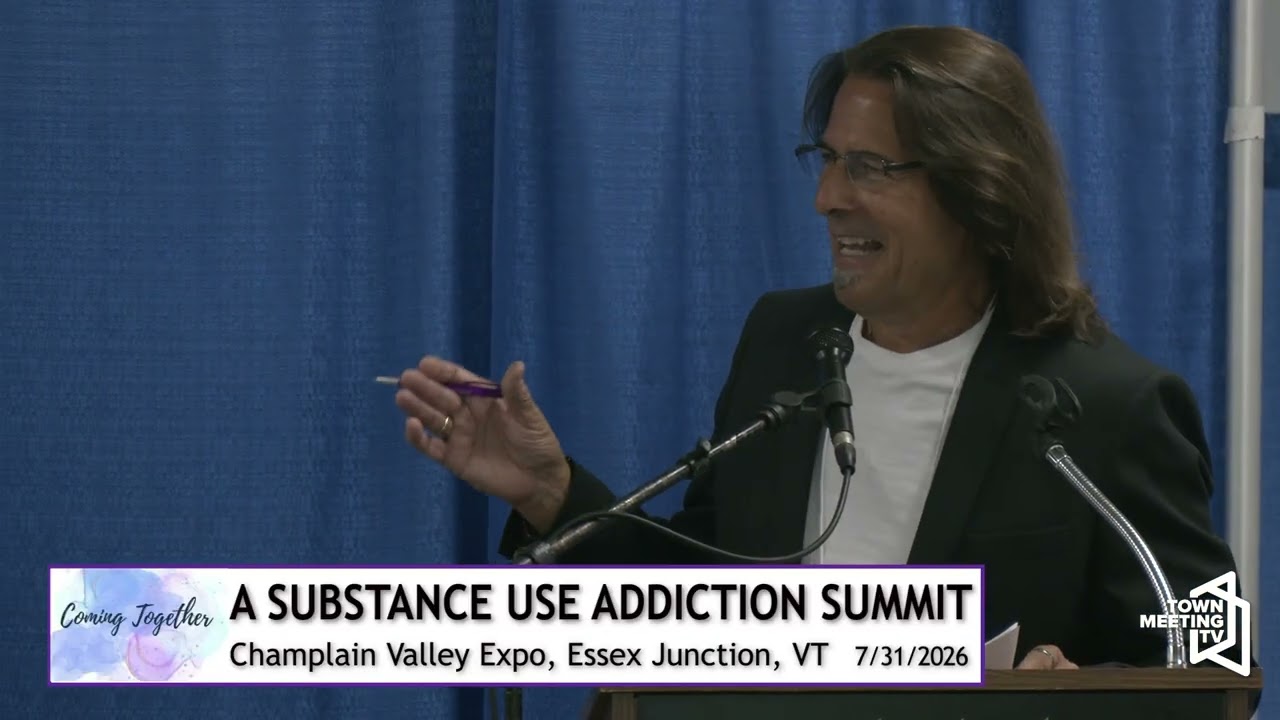
Coming Together: A Substance Use Addiction Summit - Fifth Annual Substance Use Addiction Summit
Watch on YouTubeVideo summary
The Fifth Annual Substance Use Addiction Summit, titled "Coming Together," marked a significant milestone of growth for Vermont's addiction support community, transforming from an event with low attendance five years ago into a vibrant celebration hosted by Charlie Papillo and featuring live music. The summit honored a vast array of sponsors ranging from local municipalities like Essex Junction to specialized organizations such as Turning Point Recovery, Jenna's Promise, and the Howard Center, while acknowledging volunteers who made the gathering possible. Founders Melinda White and Brad Furlin opened proceedings with inspiring stories of personal transformation; Melinda highlighted journeys from incarceration and multiple failed treatments to sustained sobriety, inviting attendees to reflect on their own recovery lengths, while Brad shared his metaphor of shepherding lives after overcoming early despair triggered by family tragedy. The event also featured a surprise appearance honoring those lost to addiction during a moment of silence accompanied by "Amazing Grace," reinforcing the central theme that community and collective effort are the antidotes to isolation caused by substance use disorders.
A major focus of the summit was on systemic advancements and data-driven strategies under the banner "We work for everyone." Dr. Rick Hildebrandt, Commissioner of Health, detailed strategic expansions including over 40 new treatment beds through McGee House and Valley Vista, a $8 million rural health transformation fund launching in 2027 to support recovery residences, and a comprehensive certification system ensuring safety across all centers. Lauren Russu presented critical overdose statistics showing a 37% decline in deaths since 2022 despite the persistence of fentanyl, cocaine, and emerging substances like gabapentin; notably, alcohol remains the leading substance of concern with ED visits for poisoning exceeding those from all other drugs combined. Judicial leaders Judge Christina Rice and Commissioner John Mirage emphasized bridging gaps between courts and treatment providers through programs like Enhanced Substance Use Disorder (ESUD) and Medication-Assisted Treatment, aiming to move individuals beyond short-term detox cycles toward long-term stability and employment, with Valley Vista reporting high success rates in helping residents secure full-time jobs.
The summit concluded by reinforcing the vital role of transparency, equity, and holistic care in building a supportive environment for recovery. Discussions highlighted shifts in demographics among veterans seeking services and efforts to embed recovery support within shelter programs to facilitate permanent housing solutions. Organizations like the Vermont Racial Justice Alliance stressed that health inequities must be addressed so that "everybody is okay until everybody is okay," while new initiatives aimed at scaling certified recovery residences from 250 beds today to approximately 400 by 2030 demonstrate a clear commitment to expanding capacity. Ultimately, the event celebrated not just statistical improvements but the powerful atmosphere created when diverse vendors, dynamic speakers, and individuals in recovery share their stories of hope, proving that vulnerability is essential for healing and that sustained progress relies on the unwavering support of an engaged community.
Read the full video transcript
Good morning everybody.
>> Yeah. Come on. [screaming]
Let's hear some noise out there. Wake up
[cheering] Junction. [applause]
I I can't believe it. By the way, my
name is Charlie Papillo and it's so
great to be here again at the fifth
annual coming together event. This is
unbelievable. I was talking with Brad uh
just as I was coming in this morning and
I noticed look at all the cars here and
and and there were people out there
directing traffic and Brad and I were
thinking back to the first summit at
Capitol Plaza in Montpielar and Brad
pointed out the numbers. There were 50
people there and what 20 on Zoom. I
think we've come a long way. What do you
say? Yeah.
>> [applause]
>> So, this is the fifth year
and looks like we're changing things up
a bit. You know, my dream always to, you
know, to be on stage and to have a have
a house band and and it looks like we're
getting that today. And we're going
electric. How about that? That's
amazing. Want to remind everyone the uh
memorial wall over here. If there's
somebody that you would like to uh
remember to please write their name down
there. uh we would hope that you would
do that. Also remember there's gonna the
breakout rooms are right over here and
that's going to be happening right after
uh this uh this summit. So uh breakout
room concession stand is open if anybody
needs coffee or or needs a needs a bite
and that's going to be open for
lunchtime as well. Um we have a lot of
lot of people here today and I'd like to
recognize some if I can see you out
there. If I don't see you, maybe the
easiest way we have any legislators here
today. Would you please stand up? Any
legislators?
I see one. I see another. My good friend
Pat Brennan back there. Thank you.
[applause]
Um I see a candidate in the second row
over here, Molly Gray. [cheering]
And first and foremost, and my apologies
for not recognizing the Abnaki Circle of
Courage with Chief Brenda Gier. You
heard them drumming here. Amazing
drumming. [applause]
Amazing.
And and I want to tell you that's just
one of the surprises that you'll see and
hear here today. Brad and Melinda always
do a great job making sure that there's
a surprise at some point. In fact, it's
such a surprise that Melinda wouldn't
even tell me. She said, "I can't tell
you." So, thanks again to everyone for
coming. Thanks to the sponsors and Brad
and Melinda can speak to this because
this event would not happen without the
support of the sponsors. So, thanks to
our gold sponsors, the city of Essex,
the town of Essex and GBIC,
our silver sponsors, Higher Ability,
Champlain Toxology, Granite Recovery, GW
Tetro, Valley Vista, Vermont Department
of Health, the Division of Substance
Use, Sevita Health. I just met somebody
from Sevita. Nice to meet you. and
Brayburn. Our bronze supporters, VAR,
Smart Recovery, Peer Recovery Center of
Addison County, Divided Sky, Lond NCSS,
Peak Outcome Partners, The New Life
Christian Church, Vapa, Santa at Stowe,
Lizz's Lasting Light, Vermont State
University, Trail Run for Recovery, Chip
Piper, and Genesis Reference Labs.
Inkind sponsors
Champlain Valley Expo, WCAX TV, CCTV,
Turning Point of Franklin County, and
Jenna's Promise.
[applause]
[cheering]
Thank you to Fawn Montaine Consulting,
Ezra Moharren and team for tech today,
and all of the volunteers that are here
with us today. Would you please stand
up, take a bow, and we'll give you a
round of applause. Come on, don't be
shy. Stand up. [applause]
[applause]
So, we're going to start things off with
the founders of this this summit and
good friends. We're going to first bring
up Melinda White, Turning Point recovery
coach, supervisor in the emergency
department.
>> [cheering]
>> She's also in long-term recovery and
known for hosting and producing the TV
show Recovery Rockstar. Yeah, she's a
rock star. It's aired through Northwest
Access TV among other hats. With a heart
for people and families struggling with
addiction, Melinda's goal in life is to
be of maximum service to God and her
fellows. Won't you please welcome
Melinda White.
[applause and cheering]
>> [applause]
>> Thank you, Charlie. I'm going to be
quick because I'm going to be coming up
later. So, this morning, I just wanted
to say thank you so much to everybody
who's here. Thank you to our sponsors,
our volunteers, to the venue. This
event, it's our fifth annual. It
continues to grow. It continues to get
more beautiful. And we're going to be
sharing about things that have gone in a
wonderful direction the last five years.
Areas that need more work that we are
committed to continue working on. And
more than anything, just celebrating
recovery. This is a big year for us. So,
a friendly reminder, if you're a person
in recovery, there are stations
throughout the building with blank
paper. If you're comfortable, write your
length of recovery in the paper. Sit
down at your chair. Wait for the queue.
You'll know when you know. Thank you for
being here, everyone.
>> [applause]
>> And it's my honor and pleasure to
introduce our next speaker, Brad Furlin.
Lifelong Vermoner. Also, I got to say, a
longtime friend. I've known Brad for we
guessed the other day, I I guess at
least 25 years. Uh Brad has been
involved in personal recovery for over
20 years. He and his daughter have a
small farm in St. Albins, where they
breed and raise sheep, have two
Norwegian elkhounds. And there is no
truth to the story that we've tried to
propagate over the last couple of years
about a penguin farm in Elmore. But if
you want to know more about it, just ask
Brad. I'm sure he'd be happy to tell you
about it. We've had a lot of laughs with
that April Fool's Day joke that we did
two years ago. Brad also has a grown-up
son and daughter-in-law who he's very
proud of. Family is Brad's top priority
in life. Won't you please welcome my
friend Brad Ferlin.
[applause]
Wow.
So, I'm very grateful to be here and
thank all of you for everything you do
to save and improve lives. This is an
amazing group of people. Many of you are
the boots on the ground who make
enormous differences every minute and
every day. You understand the real world
challenges and act with compassion and
with love.
Thanks to Charlie for uh mcing today.
He's a true friend and has supported us
all through this. And thanks to the
sponsors you see listed on posters all
around. Um we couldn't do this without
them and they were amazing. A very
special thanks once again to the
remarkable superwoman Melinda White.
[applause]
She is incredible.
Last night I went out to our barn and
tended to our sheep. I cut a pale a bail
of hay open and threw flakes or sections
down into the barn. One over here, one
over there, one close below me.
The sheep moved about munching happily.
It's fresh cut hay from fields in
Georgia, Vermont, green and delicious
for sheep. I filled two large buckets
with water, and I knew the flock would
drink the water down during the night. I
did the same routine this morning at
about 5:00 a.m.
This is in sharp contrast to about 24
years ago. I had hit a line in the sand
moment where I was drinking heavily day
and night. The tool of suicide sat
closely in my choices.
Inside me sat despair from my dad's
suicide when I was 8 years old. His
death became the music that played
within me and drinking seemed to be the
medicine or therapy as my cure.
Each autumn I took a depressive dive
towards the day he took his life. It was
the feeling of being underwater with no
sense of hope.
We find in life that there are those
things that happen that change our
course. things of great magnitude that
often we can't control and they are
powerful and they change our lives. This
is true for bad and it's true for good.
We learn that mental health and
addiction hold hands and walk the same
path. We advocate today for to view both
with close consideration as we seek
solutions for recovery.
Our summit is in the fifth year. Our
summit goals are posted about the
building and haven't changed. We are
celebrating today in cautious glory. The
ball is moving. Our summit goals are
showing promise.
You will hear today from Don Tetro, one
of our summit heroes. She and her
husband Greg turned tragedy into hope.
She is fierce and loving and makes a
difference. She taught us to separate
the addiction from the person. Tracy
Hawk, Llaya Bennett do the same. Fight,
fight, fight, never say no. Jessica Fe,
Amy Brewer, Meredith Martin, Tracy
Thomasson, Pete Andrews, Jeff Morrow,
Daniel Franklin, Lisa Lord, heroes among
us, and many more.
And recently we met Tammy Gel, amazing
mom and amazing employee of the town of
Essex.
We had a change in summit sponsorship
this year and Tammy stepped up and found
us generous support from Essex City and
the town of Essex Junction. One door
closed for us and two doors opened.
Frank Coffee and GBIC supported us with
an amazing sponsorship. The Burlington
area newspaper group, Seven Days, St.
Alvin's Messenger Paper Group, Fox
Media, WDEV, shouted our message from
the rooftops to the valleys.
You'll hear today from Commissioner of
Health Dr. Rick Hildebrandt about
progress and new trends. We are grateful
for Monica Hut, chief prevention officer
for the governor's office. She's been a
valued partner, always allowing for
great communication and working for
solutions, helping Vermont to move
towards meeting our summit goals.
Lauren Russu with the Department of
Health will show some positive trends
reflective of greater recovery efforts.
Still a lot of work to do, but it gives
us hope.
We are seeing more communication between
the legal system and law enforcement,
states attorney, judicial recovery
resources and corrections. We will hear
today from Chief Judge, Honorable
Christina Rice. She gets it and tells it
like it is. She's joined by Mark Redmond
from Spectrum, a longtime Vermont hero
for recovery.
In our summit goals, we advocate for
getting everyone into some pathway to
recovery who wants it. We also believe
that those who do continue harm, who are
arrested repeatedly, need a timeout for
themselves and for public safety. You
will hear today from Commissioner Murad
about positive changes in correction
that are growing.
Recovery and correction can change the
course of lives, offering hope, offering
new chances.
David Regal with V4, offering safe,
affordable recovery homes statewide.
And there are too many more to name.
Everyday heroes among us, offering
models at work to be shared from the tip
of the Northeast Kingdom to the borders
of Vernon and Bennington and beyond.
Five years ago, we asked, "Are our goals
possible?"
Today, we know yes, they are.
I personally was very lucky. On October
20th, 2003,
with help from many others, I started my
journey of sobriety. When I put down the
last drink, I started to look at and
empty things that were in my backpack of
destructive journey. In the backpack, I
began putting exercise and recovery
programs,
healthy eating and honesty, hiking
rather than hangovers, helping rather
than harming, finding love for myself
and love for my family, closing one door
and opening another.
I came to realize that the beautiful
start my father gave me for eight years
of my life as he held me warmly in his
arms and gave me love. These are the
miracles we know. I'm grateful for my
son, my daughter, my partner and her
daughters and all that the universe
provides.
Getting past the line in the sand.
Exchanging death for life.
Last night I was in the barn with our
sheep. We feed, we water, we tend the
soil, we find the light. It's an
exchange program filled with love. We
are all the shepherds tending our
flocks, turning bad into good, giving
new chances for life.
With this, there is hope. There is
always, always, always hope. Thank you
all for being here.
[applause]
Thank you, Brad. [applause]
Our next speaker, the chief prevention
officer for the state of Vermont, a
senior policy adviser in human services
for Governor Phil Scott. Brad and
Melinda referred to her as a champion in
Vermont and awarded her the 2025
Substance Use Addiction Summit Award.
Won't you please welcome Monica Hut.
>> [applause]
>> First, I got to say that's a lot of
wires for someone who's very
uncoordinated to get past. So, I'm
really grateful that I didn't just fall
in my face.
Good morning, everyone. It's my sincere
pleasure to be here today and to have
the opportunity to welcome you to this
annual summit event. In my role in the
governor's office, I get to see
firsthand how strongly Governor Scott
feels about recovery and our budgets and
our programs over the last few years
represent his belief and our belief in
the potential for and probability of
recovery.
Over this last five and a half years,
I've had the opportunity to learn a lot.
A lot of that learning has been totally
expected. I had to understand the
system. I had to learn about the gaps. I
had to dig in to understand what needed
to be different. But a lot of my
learning has been pretty unexpected.
It's happened in quiet conversations, in
small meetings, at barbecues, and while
taking tours at recovery and treatment
facilities.
Most of my learning, quite honestly, has
come from all of you.
One of the things that I heard really
early on that's really stayed with me
was that quote from Johan Hari where he
said the opposite of addiction is
community. Right? That highlights that
isolation can drive substance use and
addiction while social and community
connection can be truly healing. With
that quote ringing in my head, I started
to think about you all. I started to
think about the recovery community and
the people that I have met in that
community. I know because I've heard it
so many times, how important you are to
one another. What I think you don't hear
often enough is how important you all
are to the rest of us. What you teach us
every single day. For myself, there are
four things, important and impactful
things that I've learned from different
individuals in recovery that I actually
try to practice in my own life. Today,
as we celebrate all of you, the journey
that you're on, the steps that you've
taken, the work that you've done, I
thought I would tell you what you've
taught me.
The first is don't sweat the small
stuff. I get hung up a lot on all the
little things. I get buzzing with too
many details. I can't always really
separate the important from the less
important. I sometimes react when I
don't need to, and sometimes I don't
react when I should. From the people
I've met in recovery, I've learned, hey,
there's a bigger goal. There's a bigger
picture. There's something much more
important that you should be focused on.
Stay focused there and let go of the
little things. Stay present. Don't sweat
the small stuff.
The second thing I've learned is to be a
little less judgmental. You may not know
me well, but trust me, I can be a little
judgy. It's not something I'm proud of,
but it's a place I can go to when I'm
stressed or I'm upset.
Invariably, the people that I have met
who are in recovery are the least
judgmental people I know. They share
their stories. They share their
feelings. They accept you exactly where
you are and remind you that you're
exactly where you need to be. I'm
nowhere close to being that good, but
it's a goal that I strive for. It's
where I want to be and I get to see that
modeled all the time.
The third thing that I have learned and
really try to practice and to share is a
sense of reverence for my family, both
my biological family and my chosen
family. Those people who have stuck with
me, who are my biggest cheerleaders, who
hold me accountable when I'm not at my
best, but but love me anyway. I've
witnessed the way that the individuals I
know in recovery talk about their
families, the love that they have for
them, the way that they express that
love openly and honestly. I'm kind of in
awe of that genuine ability to say the
words and to feel the feelings and to
kind of share that publicly.
And finally, I have learned that
gratitude is affirming and can be so
joyful. A phrase I hear a lot in my work
and I hear a lot from individuals that I
know in the recovery community is I'm
grateful for you. I will admit that that
made me really uncomfortable when I
started hearing it. Was it like a fancy
way of saying thank you? Was it just a
little bit too much? It felt like a lot
of feeling in in a day-to-day
conversation. And then I started to kind
of realize that through all those people
that I was engaging with that that that
was actually how they saw the world,
right? That sharing that gratitude was
something that they wanted to be able to
do. It was a way of helping people to
see how important they were to you in
that moment, whether that was a big
moment or a little a moment. It was a
way of showing somebody how much they
cared about them. Because gratitude and
joy, those those go hand in hand. And
frankly, we could all use a lot more of
both.
The opposite of addiction is community.
And you as a community offer a model and
a path that all of us benefit from.
Never forget that the work you're doing,
your willingness to share that openly
and honestly, it makes us all stronger
and better. Never forget that you are
teaching us all. I am grateful for all
of you. I hope it's a good day.
>> [applause]
[applause]
>> Our next speaker was appointed
Commissioner of Health by Governor Phil
Scott and began service on October 13th,
2025.
He is honored to lead the talented team
at the Department of Health to ensure
Vermont remains among the healthiest
states in the nation. In fact, I think
we just got that recognition uh in a
poll just uh just just the other day.
Won't you please welcome Dr. Rick
Hillbrand.
[applause]
Good morning. I'm Rick Hildebrandt, the
commissioner for the Vermont Department
of Health, and it's an honor to join so
many leaders, providers, community
partners, and people with lived
experience who are working every day to
strengthen recovery in Vermont.
I want to thank Melinda and Brad for
bringing us together and each of you for
making the time to be here.
As I look around this room, I see people
dedicated to helping others and to
building stronger, healthier communities
across our state. Before we go any
further, I'd love to take a quick selfie
for our social media lead, Carly. She'll
love it.
All right. Great.
A few years ago, the health department
adopted a simple phrase. We work for
everyone. It reminds us that public
health exists to serve every Vermonter
and it connects closely with the theme
of this year's summit. I can't, but we
can. Recovery is deeply personal and
every person's path is different, but
none of us succeeds alone. Recovery is
made possible through connection,
compassion, and community, and through a
system of care that ensures support is
available when and where people need it.
That vision is central to the
department's substance use strategic
plan. And today, I'd like to share some
of the ways we are working with partners
across Vermont to make it a reality.
One priority has been strengthening the
continuum of care so that everyone can
move from treatment into longerterm
recovery with the right support at each
stage. Over the past several years, we
have worked with provider organizations
to expand access to residential
substance use treatment, which offers
the stability, structure, and time
people need before taking the next step
in recovery.
In the past two years, more than 40 new
treatment beds have opened through
recovery housing McGee House in Rutland
and Valley Vista's location in Vent.
[applause]
Those beds represent more than capacity.
They represent more Vermonters able to
begin recovery in a safe and supportive
setting. And I want to thank both
organizations for their outstanding
partnership.
Expanding treatment capacity has also
made another gap clearer. Many people
complete residential treatment ready to
move forward, but still need stable
housing and ongoing support. Vermont
simply does not have enough recovery
housing to meet that need. That's why
we're using rural health transformation
funding to expand recovery residences
across the state.
>> These safe and supportive homelike
environments allow people to continue
their recovery, strengthening community
connections and build stability. We're
moving forward with 11 grants
representing a combined investment of $8
million.
[applause]
This funding will support new
residences, expanded operations,
organizational readiness, training, and
the infrastructure needed to sustain
them with additional capacity expected
to begin operating in 2027.
But capacity is only one part of a
strong system. People must also be able
to trust the quality and safety of the
services they receive. During the last
legislative session, the health
department worked closely with the
recovery community partners on Act 103.
This law establishes a statewide system
for certification of recovery
residences, ensuring consistent
standards, stronger accountability,
improved data collection, and better
long-term oversight. More importantly,
it will help ensure that Vermonters
living in recovery residences are
receiving services in environments that
are safe, supportive, and worthy of
their trust.
We're applying that same commitment to
quality across the broader recovery
support system.
Last year, we launched certification for
recovery service organizations, and I'm
proud to share that all 12 of Vermont's
recovery centers are now certified.
>> [applause]
>> This creates a shared foundation for
quality, consistency, and accountability
across Vermont's recovery support
system.
In partnership with the Office of
Professional Regulation, we also
established certification of peer
recovery support specialists, building
on the expertise of Vermont's certified
recovery coaches. Today, 66 Vermoners
have earned that certification and are
using lived experience, hope, and
connection to help others navigate
recovery.
Alongside these investments in capacity,
quality, and workforce, innovation is
helping us make the system easier to
navigate and connect people to the right
support at the right time.
This summer, in partnership with the
Department of Corrections, State and
Local Law Enforcement, and Recovery
House, Inc., We launched Vermont's
virtual public inebriate program
screening tool statewide.
Previously, an officer encountering
someone incapacitated by substance use
could spend hours waiting for an
in-person assessment.
Now, officer officers can connect
virtually with trained recovery house
staff who conduct the screening and help
determine the safest and most
appropriate placement. One participating
agency reported reduced screening time
from approximately 2 hours to about 30
minutes.
That means quicker access to the
appropriate setting for the person in
need and more time for officers to serve
their communities. It's a practical
example of how coordination and
technology can improve care while
reducing pressure on other parts of our
system.
We're also working with the Department
of Mental Health to bring certified
community behavioral health clinics or
CCPHC's to Vermont. These clinics
integrate mental health, substance use,
and physical health care as well as
other supports.
The goal is a more accessible front door
to care where people can receive help
regardless of age, insurance status,
ability to pay, or where they live.
Rather than asking individuals and
families to navigate disconnected
systems, CCBHC's organized care around
the needs of the person.
While much of this work focuses on
connecting people with care and
supporting recovery, our responsibility
begins long before someone enters
treatment with prevention.
Investments in primary prevention are
among the most effective ways to reduce
the impact of substance use disorder on
our communities.
Our four Vermont prevention lead
organizations or VPLO's partner with
their communities to fund strategies
that respond to local needs and build on
local strengths. Our regional prevention
consultants support this work through
technical assistance, consultation, and
community engagement.
But prevention is broader than this. It
also includes the work that we do to
protect our communities from the full
range of harms substance use can cause,
especially overdose deaths.
As my colleague Lauren will discuss
shortly, Vermont has made encouraging
progress in this area. That matters and
it reflects the hard work of everyone in
this room.
Prevention also means preventing
infectious diseases such as HIV and
hepatitis C, work that our syringe
service providers carry out every day.
SSPs play an important role in our
communities by connecting people with
services and resources as they move
through their own recovery.
This work is not always easy and we do
not always agree on how or where it is
best done.
But I want to remind us that those
diverse opinions are a strength, not a
weakness. [clears throat]
They enrich our understanding. They
challenge us to listen carefully and
ultimately strengthen our response.
The same commitment to preventing harm
requires us to adapt as the drug supply
and patterns of substance use continue
to evolve.
In 2024, nearly three out of every four
overdose deaths in Vermont involve
cocaine, a dramatic increase from
previous years. BT Help, Vermont's
alcohol and drug support center, is also
receiving a growing number of calls
related to cocaine use.
In response, the health department has
partnered with experts at the University
of Vermont to expand contingency
management across the state. This
approach provides positive reinforcement
to help people make and sustain healthy
changes and has been particularly
effective for people with stimulant use
disorder. Today, 15 providers offer
contingency management at 20 locations
across Vermont.
Even as we respond to the growing impact
of stimulants, we cannot overlook the
substance that continues to affect more
Vermonters than any other, alcohol.
Alcohol remains the leading substance of
concern in Vermont and contributes to
health impacts. across every stage of
life. This year, nearly twothirds of the
more than 1500 contacts at BT Health
Link have involved people seeking help
for alcohol use.
That is why investing in campaigns such
as One Less, which explains the health
benefits of drinking less, and resources
such as Well and Wiser, which describes
how alcohol affects us differently as we
age. We also uh continue to reach young
people through prevention messages about
alcohol's effect on developing brains
and long-term health.
At the same time, we are increasing
awareness of medications for alcohol use
disorders so that providers and verters
know about treatment options that can
support long-term recovery.
When I look across all of these efforts,
expanding treatment beds, investing in
recovery housing, strengthening
certification standards, supporting
prevention, building our workforce,
embracing innovation, and responding to
evolving substitutes trends. I see
something larger than a collection of
individual programs. I see partnership.
None of this happens because of one
agency,
one organization, or one person.
It happens because treatment providers,
recovery centers, peer support
specialists, law enforcement, policy
makers, community partners, families,
and people with lived experience all
bring their strengths to the table.
That is why I can't, but we can. That's
what that truly means. And that's why we
at the health department are committed
to working for and with everyone.
Thank you for the work that you do every
day, for the compassion you bring to it,
and for coming together to make Vermont
a place where everyone has the
opportunity to recover and thrive. Thank
you.
[applause]
Our [applause]
next speaker leads a team of analysts at
the Vermont Department of Health working
with substance use data, including data
on overdoses, risk, and protective
factors and prevention efforts. Before
joining the health department, she
worked in refugee resettlement and
academia. Won't you please welcome
Lauren Resu.
[applause]
All right, good morning everybody. Thank
you for having me here. Um, so I'm going
to talk about data. I'm going to be
somewhat brief. Um, just to give you
sort of an overview of where we are
currently, what we know about overdoses.
Um, this is a very small chunk of of the
data that we have available. And I just
want to say I am sitting at a table out
there. So if you have more questions
about the data, want to talk to me more
about any of this or anything else,
please come find me um after this. I'm
happy to talk your your ear off about
our data. Um so I I'm mostly going to be
talking about overdoses here and mostly
about overdose deaths. I'm going to be
showing you numbers that are very dry,
but we we really know and we always want
to recognize that each one of these
numbers represents a person, a life, and
the lives of the people around them. So,
we never forget about that. Even when
we're doing sort of our data analysis,
anything that looks a little dry, we
know that there's humanity behind all
these numbers. We never forget that.
Uh so good news, all drug overdose
deaths have decreased by 37% since 2022.
We saw 170 deaths in 2025. So we're very
happy to see that decrease, but um you
will notice that we're still above where
we were um before COVID. So we still
have a lot more work to do. Um and
there's some concern that the this
decrease might be leveling off
nationally in Vermont. So, we're we're
still we're we're very happy with these
results, but there's still a lot more to
do. As I'm sure everybody in this room
is aware,
we get asked a lot about what substances
we're seeing that are involved in
overdose deaths. Here are um the ones
that are sort of most commonly involved
and have been most commonly involved in
the past decade. Um, interestingly in
2025, um, that you can see the number,
uh, of deaths that where, uh, fentanyl
and cocaine contributed are equal. So,
as Dr. Hilderman said, we're really
seeing more stimulant involvement in
deaths recently and mostly cocaine here
in Vermont. Um, one other thing we
really like to point out with this
particular graph is that, um, I don't
know how well you can see it, but
xylazine really dropped dramatically
from 2024 to 2025. there's a 67%
decrease um in that oneear span which is
really wonderful um for us to see and
that seems to be continuing into 2026 as
far as we can tell with dust
I see some of you taking your phone all
of this information is also available on
our website so um you can also go to our
website and find it so you don't have to
take um sort of poor uh screenshots on
your phone or come see me again after
and we can we can talk there um these
There are other substances that are of
interest either because we here in
Vermont know that they're they're um
sort of up and cominging in Vermont or
they've been part of the national
conversation. You can see that there's
not a ton of deaths related to any one
of these substances, but these are
things that we're tracking. So, Gabby
Patton, there are nine deaths in 2025.
Um orthomethyl fentanyl, which is pretty
new to Vermont and new nationally. It's
a fentanyl analog. Um we saw seven
deaths. Verizon, six deaths. Acetal
fentanyl, which is not particularly new,
but something we're tracking. Carfenel,
we're very concerned about soap and we
know it's here. Um, so we're we're
definitely keeping an eye on that one.
Metatomdine, we're not seeing a lot of
deaths related to metatomdine. There
have been none so far that we've seen in
2026, but we know it's here. Um, we know
it's affecting people. It just may not
be what is contributing to deaths, but
it's something that we are aware of and
and and looking at very closely. uh and
ketamine one death in 2025, but it's
something again nationally that's been
uh sort of on the rise. So, we're really
keeping a good eye on that.
Oh, and then uh just to point out,
right, no, we had no deaths in 2025
involving nidazines or um again keeping
an eye on it. Uh we have had two deaths
related to in 2026. They're out of state
um residents, so we're not sure what's
going on there, but again, tracking it.
And lastly, um, as Dr. Hildebrandt again
mentioned, uh, we are also very aware
that we spend a lot of time talking
about overdoses, overdose deaths, ED
visits related to overdoses. However,
um, there are far more, uh, ED visits in
Vermont related to alcohol poisoning
than any other substance, than all drugs
combined or can cannabis poisoning or
um, any of these other substance related
encounters. So there's a lot of work of
course that is happening and still needs
to happen with alcohol. Um and it's it's
something that we can't forget when
we're looking at the data and looking at
all the work that is happening. So that
is it. Um I didn't want to take up a lot
of time here but again if you want more
of this please come see me. I'm happy to
talk about any of this. So thank you
very much for all being here. [applause]
>> [applause]
>> All right, I think we're ready for a
surprise.
Melinda, would you please come up along
with Kevin Kimble? Come on up.
[applause]
[applause and cheering]
>> Uh, so my name is Melinda White. I'm a
person in long-term recovery. My
recovery date is December 28, 2011. And
all of the glory and thanks goes to God
and all the people that paved the way
for me. [applause]
And mom and husband and auntie and
family. Um, so I just want to briefly
touch on a couple of people. Uh, this
afternoon, as you saw in the agenda, we
have a breakout room called the recovery
panel breakout room. It's one of my
favorites because this is where we get
to hear miracles share their story. Um,
I asked three individuals if I could
have their permission just to touch on a
little bit to give you a flavor. So,
you'll go to the breakout room at 1:30.
Uh, so the first person I'm going to
mention is somebody that I haven't known
for extremely long. And when I first saw
him, he had a light in him that he
didn't see, but others saw. He was still
pretty skeptical about does recovery
really work? Can it work for me? He had
shared his story about how he had
destroyed his health, his family
relationships, everything due to his
substance use and eventually went to
jail and was introduced to a recovery
coach in Marble Valley. And that
recovery coach started explaining some
of the solutions and options and got
this person committed to wanting to walk
the journey. They also wanted to get off
all substances including medications.
And they ended up going to Divided Sky
for an extended time um which this
person describes as building a solid
foundation. And from Divided Sky, he
went to the Vermont Foundation of
Recovery Recovery Residence where I live
in St. Albins's, Vermont. And he started
visiting our recovery center because
there are some strict um requirements
when people live in recovery residences,
which I love because I know I needed
structure when I was new. And one of
those include that if you're not
currently employed, you need to do
volunteer hours. This person came to our
recovery center, the turning point of
Franklin County to do some volunteer
hours. Plus, he was doing his recovery
meetings. He was going to Howard Cent's
intensive outpatient program. He was
going to the restorative restorative
justice center, meeting weekly with
staff there for support. He got a
recovery coach, started meeting with
that coach regularly, got a sponsor in a
12step program. He did all the things
that are recommended and few people tend
to really kind of do. Uh, granted, I
think he did residential treatment 19
times, 16 times, more than 15 times, so
it took a little bit of time before he
was convinced to do all the right
things. But I just want to have him
stand up because this is one of my
favorite miracles I get to work with
now. Matt Dlesio.
[applause]
Another person I'm going to mention is
somebody that I had met. Whoa, I guess I
should have lifted that earlier. Uh,
somebody that I met in the emergency
department. I guess I should back up.
So, my uh employment title, my my career
is an recovery coaching supervisor in
the emergency department. So, I'm an
employee of the Turning Point of
Franklin County and I'm embedded within
the emergency department of Northwestern
Medical Center. And this individual I
met in a hospital bed. And I remember
feeling such a kind soul underneath such
a broken person. And I remember leaving
the hospital thinking, I hope that dude
lives at least a day or two because I
don't think he has more than 48 hours
looking at him. His health was
diminished. His It's like he didn't have
the glow in the light that we see when
people are in recovery. But I could feel
there was something special about him.
And then I remember about a year, year
and a half later, I was at a potluck at
the Vermont Dalton Teen Challenge
program and there's this gentleman
dressed up nicely and pouring water in
the pictures and I thanked him and he
looked really familiar, but I couldn't
place it. And then they have the guys go
up later and they start singing. And as
soon as he started singing, I was I
couldn't stop crying because I put it
together. That was the person that I
didn't know if he'd live another two
days. And there he was singing. And I am
going to ask him to wave. Randy Lefar.
>> [applause]
>> Stand up a little longer.
[applause]
Thank you.
Ry's also going to be in the recovery
breakout room. And the last person, I
don't know if I've seen her yet, but I
don't have my glasses, but I'm still
going to tell a brief overview. So,
young lady that I've known since I was
in school. She was a little bit younger
than me. Um she kind of surfaced in my
life off and on over the last probably
10ish years. Um time sometimes I'd see
her, she looked like she was going to
die any minute. Uh other times she was
running from the law warrants most of
the time that I've known her. Uh
sometimes she'd contact me from um
incarceration. And then finally it got
to a point where she was calling me from
the facility regularly and she said she
really wanted [clears throat] it this
time and I could hear the if factor and
I was really hoping that this time she
would cling on and she's clung on with
dear life and she's now at the Jenna's
promise um program which has done
wonders. She is when I saw her in person
after having seen her back in her using
days it was hard to believe it was the
same person. Um, and she's just a
glowing light. And I see something
really special in her. Tanya, are you
here?
There she is.
[applause]
Thank you.
Tanya will also be in the recovery
breakout room this afternoon. So, um,
before I jump into the next piece, I'm
going to ask my dear friend over here. I
kind of refer to Kevin as like my Lionus
blanket. You know how like if Lionus was
nervous, he'd grab his blanket and that
was his comfort. So, I have to believe
the reason that there's really been no
anxiety in my body like usual, it's cuz
I got my Lionus blanket. Um, are you
interested in saying maybe a couple
words of why you were open to doing
this? [clears throat]
>> Oh, yeah. A couple of couple of things.
Um, first and foremost, if Melinda asks
me to do something, I do it.
>> Oh, thanks.
>> Because she's a rock star.
And the other thing is it gave me a
chance to get up in front of so many
people. My wife and I went through our
family went through 18 years of
addiction with my son Jason. And I know
many of you probably are involved in
saving his life at time to time. But now
he's been sober for two years. and uh
[applause]
and he and he's working he's working on
getting his uh electrician's license and
um you know thank you thank you all so
much for what you do and it's been a
hard road and I appreciate you.
[applause]
So, the last thing I'm going to do is
have everybody, we're going to take a
moment of silence. As you know, there's
a memorial wall, and this is where we
write the name of our loved ones who
have passed due to the disease of
addiction. We're going to take a moment
to honor those names.
[clears throat]
Amazing
grace,
how sweet the sound
that saved a rich
like me.
I [screaming]
was lost,
but now
I'm found.
Was [singing] blind, but now
I
see.
>> [music]
[music]
>> Hey, Heat.
[music]
Heat. [music]
Heat.
[music]
[music] Heat.
>> [music]
[music]
>> I spent so [singing] much time
[music]
down on [singing] my knees
[music]
trying to find
the answers
some sweet relief.
[music] You hear all [singing] my
prayers,
even words I can't speak.
And I know your best
work
is done [singing and music] when I'm
weak.
When I can barely
sing, [singing]
you will be my soul
when I can barely
breathe.
You will fill my lungs.
When my [singing and music] faith is
falling to the floor, I'm standing
strong cuz of your who I'm [singing]
leaning.
Oh,
who I'm leaning [singing]
leaning
on. [music]
And I'll bring my heart for heartfelt
been through hell. Hallelu. [singing]
I'll bring my storm toss to tell story
to tell. Halleluah.
[singing and music] Wo.
God. You've been patient. God, you've
been gracious,
faithful. [singing and music]
Whatever I'm feeling or facing, I'll
bring [singing and music] my heart for
heartfelt it is well. Hallelujah.
I don't always [singing] feel it,
but that's when I need it [singing] the
most.
I'mma keep on singing
[music] till my soul [singing] catches
up with my song.
>> There's times my hands
[singing and music]
go up freely. Times that it comes.
[music]
>> Uhhuh.
>> There's days when my praise comes out
easy. [singing]
[music]
days that it takes all the strength that
I've got.
>> I'll bring my heart fought, heartfelt
through hell. Hallelujah.
>> I'll bring my [singing] storm toss, torn
s story to tell. Hallelujah.
[singing and music]
>> God, you've been patient. God, you've
been gracious, faithful. [singing]
Whatever I'm feeling or facing, I'll
bring my [singing] heart, heartfelt, it
is well. Hallelujah. [singing]
[music]
>> Hallelujah.
[singing] Hallelujah.
When I can bearing,
you will [singing] be my soul
where I can barely
[singing]
breathe.
You will fill my arms
when [singing and music] my faith is
falling to the floor. I'm standing
strong cuz of your who I'm leaning.
Oh,
I'm leaning
leaning.
[singing]
Oh,
I'm leaning
leaning.
[singing]
Oh,
[music]
amazing [music]
[singing]
grace.
How sweet
the sound
that save
a rich
like [singing] me.
I [singing]
was lost [music]
but [singing] now
I'm found.
was bright,
but now
I see.
[music]
Amazing [singing]
[music] grace,
how sweet
the s
like [singing] me. [music]
I
was lost.
[music]
And now
I see [singing]
one more time. Now
amazing [music]
grace, [singing]
how sweet
the sound
has save
me.
I once
was lost.
I see.
Give yourselves a hand. [music]
[applause]
>> [applause]
[applause]
>> I don't know, Melinda,
you you set the bar. It's going to be
tough for the speakers coming up after
this.
I told you she was a rock star, right?
Thank you, Kevin, as well.
And uh I know Guy Paige, my friend Guy
Paige and a fellow in in in radio as
well as just into radio now, but uh
journalist for many many years of course
uh in the Burlington Colchester area for
helping with that that flash mob. Now
that's not the first time you've done a
flash mob, right? So if you want to do a
flash mob, you can contact Guy and he
can he can set you up with it. Is that
right?
>> All right. And you got a radio show to
do, don't you? Noon time on WVMT. I'll
give you a plug. Why not? I'm I'm good
about that. Thank you.
Chronicle Conversations WVMT noon time
101.3 and 6:20 a.m. I should know that.
I worked there for 20 some odd years,
right?
Well, as I mentioned, uh it's going to
be tough. Uh so I I think we got the
right guy coming up here. He can handle
it. uh commissioner of the Vermont
Department of Corrections, a post that
he's held since being appointed by
Governor Phil Scott in August of 2025.
Prior to that, he spent more than two
decades in law enforcement. Lives in
Burlington with his wife Van Vonnie and
their children MacArthur and Katie
Elizabeth. Won't you please welcome the
Commissioner of the Vermont Department
of Corrections, John Mirage.
[applause]
Yeah. Yeah. That's that is very hard to
follow. Um uh good morning everyone. My
name is John Mir. I'm the commissioner
for the Vermont Department of
Corrections. Thank you, Charlie. Uh it's
a real honor to be here with all of you
and I was incredibly grateful for Brad
and Melinda's invitations. I'm grateful
to be here with all of the incredible
sponsors and the service providers.
Uh the Department of Corrections, our
responsibility is providing
court-ordered custody and supervision
with compassion and care. And a major
part of that care, our desire to provide
what Secretary Jenny Samuelson of the uh
Agency of Human Services, who's here in
the audience and who is the Secretary
over both the Department of Health and
the Department of Corrections, um calls
a community level of care. A huge part
of that community level care is
medicationass assisted treatment or MAT.
Uh this is an evidence-based approach
that combines FDA approved medications
and counseling and behavioral therapies.
And for DOC, the goal is to help
prisoners who come to us suffering from
substance abuse to help them manage
withdrawal symptoms, help them reduce
cravings, help them prevent relapse.
Vermont was the second correctional
system in the country to implement this
across the board so that anyone coming
into our custody gets screened and we've
done it for about eight years providing
the medicine part of Matt which is
mostly buprenorphine as part of
something that is now more commonly
called or medications for opioid use
disorder. of the 1,500 people that are
incarcerated in Vermont, 58% are
getting.
And that is a really striking fact. It
it highlights the degree to which
addiction can be a factor in criminal
behaviors.
But true MAT also addresses the
psychological and behavioral aspects of
addiction. And so very recently, as part
of the 14-point plan that Governor Phil
Scott created to address long-standing
public safety issues in Burlington, AHS
and DOC have launched a new enhanced
substance use disorder treatment or
ESUD. And earlier this month, I attended
a ceremony at Northwest State
Correctional Facility in Swanton where
five men were recognized as the
graduates of our first cohort of the
DOC's 12week ESUD program. And just this
past Tuesday, I attended a ceremony at
the Chittan Regional Correctional
Facility in South Burlington where our
first four women also completed this
12-week program.
Nine people is a really small number
when there are hundred there are a
hundred times more people getting
but just like moving from that silver
chip to the red chip it is a start it is
one day at a time our healthc care
provider will path describes ESUD as an
evidence-based model that is designed to
promote sustained long-term recovery
from substance use disorders and
criminal behaviors and our participants
get more than nine hours per week for 12
weeks of group sessions and one-on-one
therapy to learn coping skills and
relapse prevention strategies and tools
to replace addictive and criminal
thinking patterns. And at both
ceremonies, what was really important to
me and what really struck me was the
deep appreciation that these graduates
had for the program and for their
clinicians, the people that had helped
them get to this point. But more
importantly, the vulnerability that they
showed in talking about their journeys.
I think that vulnerability is ultimately
inextricable from recovery. I'll I'll
bet some of the folks who just came up
and did this amazing thing here uh felt
that that was kind of vulnerable too um
forgive the pun the amazing piece but uh
the guy who wrote Amazing Grace John
Newton published it in 1779
and like a lot of people before him from
St. Augustine or St. Louis or CS Lewis
after John Newton lived a pretty
proflegate and dissolate youth before a
moral awakening. His life wasn't easy
early on, although it was frequently
made more difficult by his own defiance
and his own insubordination and his just
inability to fit in.
He was a person who really only knew how
to be hard, who collected resentments
and stewed over life's vicissitudes and
let all of that get in his own way. He
turned violating norms into a point of
pride. In other words, it was sort of
the opposite of vulnerable. And it
probably won't surprise you to know that
a lot of people in DOC's custody fit
this bill, too. Angry and alienated and
aggressive.
But John Newton changed.
He was pressed into the Royal Navy, the
British Royal Navy, meaning that he was
forced into it as a punishment, almost
like a a prison, largely because he
couldn't behave in in society. And later
he sailed the Atlantic as part of the sa
the slave trade which was also a trade
that was stewed in sin and attracted
defiant and damaged and dangerous men.
But he eventually faced a storm at sea
that was so defiant that violent excuse
me so violent that defiance wasn't
enough and vulnerability was the only
answer. And he found in that moment the
grace that saved a wretch like me.
Ultimately, I think that vulnerability
is a recognition that we're all a little
bit broken, that we all need each other,
that we all need help. So, although we
live in a secular world and the First
Amendment ensures no law respecting an
establishment of religion, I think that
our system believes in that grace that
Newton described, that grace that
everybody up here just sang about. We
believe that forgiveness and redemption
and rehabilitation are possible. And we
believe that we have an obligation to
help each other. And this is true of a
recovery through a 12step program like
AA and the recognition that we all have
failings, that we all need help, that
we've all transgressed, that we all can
atone, that we all can change. It's true
of groups, incredibly important groups
that are partners for us at the DOC like
Turning Point, which notes that recovery
isn't just about stopping. It's about
rebuilding your life, your
relationships, your routines, your sense
of who you are. And all those things I
want to be true for the Department of
Corrections, too. I'm incredibly proud
to partner with groups like Turning
Point to host AA programs and to have
begun the work with those nine first
vulnerable graduates of a deeper kind of
treatment because DOC provides
court-ordered consequence. But we have
to provide it with compassion. In the
language of the Vermont statute that
guides our work, we render treatment to
offenders with the goal of achieving
their successful return and
participation as societies of the state
and community. And in so many cases,
that treatment goes beyond the high
school degrees or college courses that
we offer, although those are important,
too. and it instead addresses the
recovery and sobriety to which so many
of the attendees here in this room in
Essex have dedicated your work and your
lives. And I want to thank all of you
for that today. I want to hope that you
will continue to be partners with us as
we want to be partners with you. And I
want to thank you for the chance to
speak with you all today.
>> [applause]
>> Thank you, John.
We're going to bring two people up um
together. Uh first, uh won't you please
welcome the Chief United States District
Judge of the United States District
Court for the District of Vermont. She's
the author of the American Bar
Association's business and commercial
litigation in federal courts and a
member of the American Law Institute and
American Bar Association fellow Chief
Justice Christina Rice along with Mark
Redmond, the executive director of
Spectrum Youth and Family Services. He's
been doing that since 2003.
He's worked in the field of caring for
homeless and at risk youth for over 45
years, starting as a full-time volunteer
at Covenant House in Time Square in
1981. I've heard that story many time.
Mark lives in Essex with his wife Mary
Beth and son Liam. He's my friend. Won't
you please welcome Mark Redmond and
Chief Judge Christina Rice.
[applause]
I just told Charlie he should have said
I was 10 years old when I started 45
years ago.
Uh so the first thing uh first of all,
thank you Melinda Brad for inviting us.
First thing you should know is Judge
Rice and I are friends. We go to the
same church together. That's how we know
each other. So I'm going to call it
Chris. I'm not going to call it Judge.
and our buildings are right next to each
other on Elwood Avenue. So, this all
started with us going for lunchtime
walks and just informally saying, you
know, what are you seeing at Spectrum
and what are you seeing in the courts
and where are the similarities? So, we
didn't even start with substance abuse.
We started with mental health and we
both could see that if someone was in
mental health distress and went to the
facility out in Berlin and did well,
they were then discharged to an eight
bed facility in Middle Sex which was two
FEMA trailers wire welded together
surrounded by razor wire. So we got the
right people in the room. We knew Algo
Bay worked for the governor. Then Algo
Bay got involved and we got in to see
Governor Scott and Governor Scott
promised he would work on that and he
did. So they doubled the number of beds
and now they're in a beautiful facility
called Riverview. So then we'd go for
more walks. What else are you seeing in
Spectrum? What are you seeing in the
courts? One of the things we're seeing
is again with mental health, if someone
is in distress, they go up to the ER and
they could be there for days on end. So
we heard about what's being done in
Alama County, California and we got a
group of people all informal now. Bob
Bick from Howard Center. We got people
from the Al Gobay was still working for
the governor and we created the urgent
mental health care center which Howard
Center I'm so grateful stepped up and
runs that now. That's been a great
success.
More walks to lunch. What are you seeing
in the courts? What are you seeing at
spectrum substance abuse? If somebody,
especially if they're have use of
xylazine or fentinyl or opiates, they're
often being sent, not all the time, but
often sent for detox where they get two
or three weeks of care and then they're
seen back to the same hotels or the same
neighborhoods where they were using and
they're relapsing immediately. So, same
thing. Let's get a group of people
together. Informal. We never had a
committee title or a charter or a
website. It was informal people. Let's
get Dawn Tatro from Jennis Promise in
the room. Let's get Dave Regal in the
room from from down Foundation of
Recovery. Let's use their expertise.
Let's find out what's going on in other
states. We looked at New Hampshire where
someone could go from detox then to a
partial hospitalization program then to
a sober home. We could do it better. So
Jenny Samuelson, I give her tremendous
credit. Works, she's the secretary for
human services. She did such a great job
advocating for us. So now we have Valley
Vista and McGee House stepped up and
they created more bed, 30 beds. So now
when you leave detox, you could go for
90 days to a 30 bed facility. Have we
fixed? Yeah. Give them a shout out.
[applause]
I think this is important. There were a
number of people who said to us, "No,
no, no. You can't look at just one part
of the system. You need to look at the
whole system." Somebody does need to
look at the whole system. But our
mission was, "How can we make it better?
How can we get the right people in the
room and make things better? Have we
fixed the entire substance abuse system
of care?" No. Have we made it better?
Yes. And that's what's important and
that's what we focused on.
>> And then the last thing before Chris
goes up is there is there can be this
Vermont exceptionalism where we do it
best. No, we're the rival of the N. And
we do a lot of really good things in
Vermont in social services, substance
abuse, addiction, everything. But I feel
like we can always learn. We can always
see who else is doing things better and
how can we improve it so we can help
more and more people in Vermont. Thank
you. And I Judge Rice is going to step
right up.
[applause and cheering]
I really appreciate the opportunity to
be here. It's not often that I get to
Thank you. Um and now just lift up the
step uh to get to talk directly to the
recovery community. I have lots to say.
Um, but I thought what would be most
useful would be to tell you what I see
from a judge's perspective and why
long-term beds were so important to me
personally and to me as a judge.
Whether you believe it or not, judges
want to do a good job. They want to
believe they're not just a cog in the
criminal justice system processing cases
and people like sausage and assembly
line. You don't get into the judge of a
job without caring because you can make
a lot more money as an attorney with a
lot less of aggravation. Attorneys get
to pick their clients in cases judges do
not.
It's really hard as both a judge and a
person to see someone at their lowest
point to feel their misery, their
defeat, and for many their shame and
humiliation.
often every single bridge in that
person's life has been burnt to a crisp
and they are a real danger from
themselves and the drug trafficking
world. That's not enjoyable to see. It
weighs on you and you don't get to go
home and talk to your family and friends
and say, "This is what I saw today. Um,
this is what I heard." And it's not
because it's private. It's very much
public, but it's not the kind of thing
you share with a family member after
their own long days at work and school.
So, you keep it inside. And it's tough.
It's tough stuff.
It would be super depressing to be a
judge if you didn't get to see some of
those people turn around their entire
lives.
You see somebody get their health back
and heal inside and out. reunite with
family, go back to work, have stable
housing, have new friends and support
systems, ultimately become pro-social
members of the community. That's a
beautiful thing to witness and I am so
honored that I get to see that. So, as
both a judge and a person, that's what
gets me going back to work every day.
If you land in federal court, you are
generally in deep trouble and you are
looking at serious time. For many
people, it's an incredible wakeup call.
I can't count the number of people who
have told me that getting arrested by
the Fred feds saved their lives because
they needed someone to say, "Stop now."
I mean it. And I don't say this because
I think it's a great thing to get
arrested and put in jail. I don't
believe that at all. I'm saying it
because the people I see are usually
good people who've gotten in way over
their heads. And the vast majority of
them are highly motivated to turn things
around. If they do it, sometimes they
avoid jail entirely.
Before we the long-term beds came
online, when I sent people to treatment,
they were often gungho to go because
they had usually spent some time in jail
and they were like, I certainly don't
want to stay here. Um, and they would go
to a two-eek program and they would do
well. And we would get reports, yes,
total engaged, all tests are negative.
This is great. They're good to go.
Off they'd go and the problems would
start soon thereafter because they would
go right back to the people, places, and
things they just left. 14 days, 21 days
were just not doing it. And frequently
people would go on a bender or abscond.
We'd send out the marshalss. They'd get
picked up. They detox in jail. A truly
miserable experience. And then they
would want to go back to treatment and
we would want to let them and the whole
cycle would start over again. And we
called it wash, rinse, and repeat. And
that's what's motivated me as a person
and a judge to speak up and say this
isn't working. We need to do things
differently.
As Mark said, the long-term beds don't
solve every problem. But our our group
vowed to take real action, make real
progress. We went straight to the
governor. We told them what we thought
we were seeing and then we engaged with
every part of the recovery and treatment
community that we could find. Without
exception, people were happy to engage.
They wanted to help us. They saw the
same cracks and gaps in the recovery
continuum that we did. We had great part
partners. That includes people here who
are are here today. So my message to you
is that if you want to change something
in Vermont, you can do it. It's not out
of reach. I would encourage each of you
to roll up your sleeves and get to work.
It's been one of the most rewarding uh
experience I've ever had as a person and
a judge. And I thank you for letting me
talk to you. It's been an honor.
[applause]
Our
next speaker
is the vice president of medical and
clinical services at Valley Vista
Addiction Treatment Center.
He's driven by a deep commitment to
human- centered care, quality
improvement, and creating environments
where both patient and providers thrive.
He's passionate about mentoring
emerging health care professionals and
fostering crossf functional
collaboration to drive lasting impact.
Won't you please welcome Kevin Hamill.
[applause]
So, I brought my own fan club if you
couldn't tell.
So, um but I think first, you know,
thank you guys so much for having me
here again. Um it's an amazing group to
work with. But I do want to recognize,
you know, we were here last year. We did
not have our additional beds open. Um
we've been working with the team to get
this open, which opened on December
17th. And I know that we have some
current um people and some graduates um
that are here in the room and would love
to recognize them. So if you want to
stand up, I would love for you guys to
stand up and be recognized for the work.
[applause]
So, it's been an amazing experience to
open this program and has uh made a huge
difference in just the way that I look
at the treatment services that we have
here in Vermont. So, um you know, when I
look around the room, we have so many
people from so many different walks to
people that are in early recovery to
families that are um here that are
experiencing
um their family members in active
addiction and wondering where to turn.
And there's so many resources here for
everybody. And that's what brings us all
together today, right? Is we're all here
because we have a purpose and it's hope.
Um because if it wasn't for hope, then
none of us um would be here. The theme
of this conference is coming together.
And I can't think of a better
description of what recovery requires.
Recovery doesn't happen in isolation. It
happens when treatment providers,
recovery organizations,
employers, families, peers, state
agencies, and communities come together
around a shared goal, and that's helping
people to build better lives.
Our 3.1 program um we have the privilege
of seeing that every day. We opened the
doors on December 17th, 2025 with a goal
of having 20 patients in the first 90
days. We filled our beds in the first
two weeks.
Since December 17th, we have admitted 97
people into the program. We have Yeah.
[applause]
and we've also graduated 84 people from
the
[applause]
>> So when I share those numbers with
people, it's not to be a statistic of
what we're doing. It's to show that um
you know these are people, right? These
are mothers and fathers, sons,
daughters,
brothers and sisters. They are
individuals who decided to take a chance
on themselves and begin a new chapter of
their lives. Today, our census stands at
27 residents.
Of the people that we have, of the 27
people, we have 18 people working
full-time jobs.
And where was I? Um,
when people think about residential
treatment, they don't always picture
somebody getting up in the morning and
going to work, coming back to treatment,
attending groups, building recovery
supports, and planning for their
futures. But that's exactly what our
residents are doing. And I sometimes I
look at them and I look at what they're
balancing in a day. And they're managing
much more than probably most of us.
We've recently been given the
opportunity by Dale to increase our
licenses from 27 beds to 30 beds.
And those three additional beds might
not seem like a lot of beds, but for
three individuals looking for a place to
start recovery, those three beds mean
everything. To three families waiting
for a phone call, it means the world. It
represents hope and it represents that
their family member is able to get that
additional treatment that they need.
Those
beds are filling quickly. We have three
admissions planned next week. That will
bring us up to a census of 30.
That tells us something important,
right? There's still a need there.
Across Vermont, we have recognized the
need for additional beds. We're going to
hear from Dave soon about work that's
happening at V4. Uh, Serenity House has
two locations providing 3.1 services,
but the need is still there and we need
to to do more. We know that recovery is
much more than a bed, right? It happens
through purpose. It happens through
connection. It happens through
community.
And one of my favorite examples of how
it happens is the work that's done in
our kitchen.
The incredible meals being served every
day and prepared by our residents.
Right.
They take pride in planning these meals,
preparing the food, and serving their
peers. And what starts at making
breakfast, lunch, or dinner quickly
becomes something much more important.
It becomes responsibility. It becomes
teamwork, and it becomes confidence and
purpose. And to be honest, they
definitely can give me some cooking
lessons.
But right, that's exactly the point.
Because to these people arriving in
treatment, they carry shame, self-doubt,
and belief that they have nothing to
offer. And then they discover that they
can contribute. They can create
something. They can help others. They
can take pride in their work. Recovery
isn't just happening in counseling
sessions. It happens in that kitchen. It
happens when somebody goes to work every
day. It happens when they go to a
taekwondo lesson or a community AA
meeting. It happens every time somebody
realizes that they still have value and
purpose.
We have been fortunate to partner with
incredible organizations and community
members to um bring education, recovery
support, and outside speakers into our
program.
Through those partnerships, because no
organization can do this work alone. And
while we are incredibly proud of the
progress we've made, I'll also be the
first to tell you we need more. more
beds, more support, more community
partnerships, and more pathways to hope.
This is why we are also preparing to
expand our continuum of care even
further. In the near future, Valley
Vista will be offering wraparound
services designated specifically to
bridge the gap between residential
treatment and long-term community-based
care. These services will include
counseling, MAT, psychiatric services,
recovery groups, and support for urgent
health care needs. Because one of the
biggest challenges people face is not
getting into treatment. It's what
happens after treatment. When someone is
motivated, engaged, and ready for
recovery, we cannot afford to lose
momentum simply because they're waiting
for those services. Our goal, our goal
is simple. Keep people connected. Keep
people supported. Keep people moving
forward.
I'm going to close with this.
People often ask me what gives me hope.
And the answer is simple. I see hope
every day. I see hope when someone walks
through our doors scared but willing to
try. I see it in residents who get their
first paychecks after years of
struggling. I see it in family members
who are finally beginning to heal. I see
it in our graduates who leave treatment
believing in themselves again. And I see
it in rooms like this. rooms full of
people that show up every day to do the
right thing.
I've seen it. Our staff have seen it.
People sitting beside you today have
seen it. Recovery is possible. Thank
you. [applause]
>> Thank you. [applause]
Our
next speaker is one of VFOR's
co-founders. He serves as VFOR's
executive director and has been in
recovery since 2007.
He was a founding board member of the
Vermont Alliance for Recovery
Residences, which brought national
certification standards to Vermont.
Through his work, he continues to be a
passionate advocate for recovery and
housing solutions that support
individuals on their path to healing and
independence. Won't you please welcome
David Regal.
[applause]
>> Hi everybody. Uh, I'm here today because
of hope. And I promise you, as much as
we've heard about it, it was not
coordinated by any of us.
I believe there are three ingredients to
hope.
First,
somebody has to have enough physical and
emotional safety to be able to dream.
Second, we have to have the ability to
see a path with a reasonable outcome of
success.
Third, we have to have a belief in the
systems, in our supports, and in
ourselves
that allow us to think that we can
weather the storm and we can make it
through the ups and the downs of the
journey to finally achieve our goal.
And when one of these things is missing,
we have hopelessness.
hopelessness is a had a lot to do with
me entering inpatient treatment.
>> My name is David Regal and I am a person
in long-term recovery.
[applause]
And to me, that means that I haven't had
a mood or mindaltering substance
ingested into my body that was not
prescribed by a doctor since January
11th of 2007.
[applause]
My life was Groundhog Day.
For those of you that don't understand
that reference, after this is all done,
find somebody over the age of 40 and
they'll help you understand what it
means.
But I could not possibly
make a commitment when I was in active
substance use, which most of the time
meant that I just didn't want to wake up
the next morning feeling the way that I
woke up this morning, and keep it right.
I just could not do it day in and day
out.
I'm fortunate to come from a background
and to have a support system
that allowed me to regain hope after
inpatient treatment relatively quickly.
And that's not true for everybody who
has been through the same circumstances
that I've been through through
today. I'm filled with hope.
hope as I see Recovery Partners of
Vermont navigate a leadership change
committed to coming out the other side
stronger
than they have been going through it.
Hope
as I watch state and partners deploy
millions of dollars to strengthen our
system of care through recovery
residences.
hope
as I look out and see all of you
who are leaders in this space who are
committed to one person at a time
meeting them where they are
and helping them to achieve the life
skills and the recovery capital to be
able to dare to dream again.
It's the work that you all do. It is the
system that we are building together
that allows Vermonters like me to be
able to dare to dream again,
to be able to see a path to success
and help somebody like me to be able to
keep going when things get really hard.
I am so grateful
to be able to look out and be a part of
this community.
I am overwhelmed
with the feeling of hope and I hope that
when you all leave here today, you are
too. Thank you.
Jenna, her parents and brother
experienced firsthand emotions, trauma,
sorrow, and emptiness that so often
occur at every level of the ongoing
struggle against the opioid crisis.
So instead of succumbing to hopelessness
and despair, Greg and Dawn decided to
turn to hope. They created a community
of sober housing, treatment, and
workforce development, creating a
program that should produce revenue to
help support itself. And since then they
have partnered with Llaya Bennett and
team to open Var Certified Recovery
Residence Ben's House, a sober living
and
a sober living and workforce development
program situated on 11 acres of open
fields, gardens, and vast frontage on
the pristine Derby Pond. Won't you
please welcome Don Tetro.
>> [screaming]
>> Wow, I can't believe how much this has
grown. Um, I'm Jenna's mom and Jenna's
promise was born from the greatest loss
of our family's life.
the loss of Jenna to addiction to a
fatal overdose. After losing Jenna, I
knew we had to do something different.
We couldn't simply treat addiction and
then some send someone back out. The
same circumstances that contributed to
their struggles.
What makes Jenna's Promise different is
that we look at the whole person. We
provide safe housing, trauma treatment,
health and wellness, education, and
workforce development.
But more importantly, we help people
believe in themselves.
We help them rebuild relationships.
We re they reconnect with their families
and they find meaningful work and they
create a life they truly want to live.
We meet people where they're at with
compassion and love and accountability.
And then we walk beside them to rebuild
their lives.
I believe that's why Jenna's promise
works because recovery isn't just about
stopping the use of drugs or alcohol.
It's about giving people the tools and
support and the opportunity to rebuild a
meaningful life.
I truly believe that if Jenna was here
today,
this would be exactly what she would
want.
And I see so many partners
that have helped us make Jennis
successful.
And um I look at Judge Rice and Mark,
Commissioner Monica,
it is connection and we all work
together. And like Judge Rice said, I
can tell you 100% of the women that have
come to Jennis said going to corrections
saved their life.
And
it just broke a cycle. and
joining with this force uh we have been
able to get 3.1s into the state and um
that's only the beginning. We have so
much more to do and um and now
now we have Ben's house and what an
amazing thing to have. We have men that
can go into the same treatment that
women do at Jenna's promise. But it's
something so different.
Like we can take, how many times have
you seen a husband or a wife or spouse,
one gets better, the other doesn't. They
both fail.
We can take husbands and wives or
spouses, significant others, and we can
treat them both. we can rebuild
families. That's something so unique
that not many people have right now. We
have a husband and wife um situation and
it is so amazing to see them build a
family back. Um,
[applause]
but you know, it's just it wouldn't
happen without, you know, we find
someone comes and calls and needs help
and then we call either Chad or Kevin
and they get them into treatment and
then the process starts. It's about
making all those connections till we
finally get people that can stand on
their own. And um I'm just really
grateful to be part of this community
and all these partners because um we
truly do make a difference together. I
have one other thing. Um I've been part
of this um intro to light
into light program. This project began
uh when a mother lost her son. In her
grief, she didn't want him to be
remembered only for how he died. She
wanted him to be remembered for who he
was in the life. From hope into light
was created.
It honors the lives and people's people
we have lost by sharing photographs and
their personal stories. These stories
show who they were, their families,
their dreams, their struggles, and the
people who loved them. This exhibit can
be displayed in any community, school,
organization,
and other places where people can pause,
look into their faces, and hear their
stories. This project is in in front
when you walk in today. And um Daniel
Franklin, you can see him. And uh
[applause] you can [cheering]
you can arrange to have this exhibit
come to your recovery place or a
hospital or corrections or whatever. It
gives so much help or hope. Um
we cannot change what happened to them
but we can make sure that they are not
forgotten.
Thank you guys. Thank you.
>> [applause]
[applause]
>> Quick reminder, we've got the breakout
rooms. Those are going to be opening up
shortly. And lunch is available, of
course, right here at the concession
stands. And as I speak, I'm sure uh Brad
and Melinda have a few closing words to
say, and they're probably going to give
themselves a couple of days off and
start working on the sixth annual.
>> Yeah. Yeah. All right. Go for it. Let's
give him a big hand and give yourselves
a big round of applause for [cheering]
being here today. Come on. [applause]
So, we just we're not going to take long
because we know it's time to close out.
First, we want to say thank you again to
all of our sponsors, everybody who
attended, all of the help, all of the
volunteers. Um, I'm also going to So, we
have an award. grad and I started giving
out an annual award to uh people that
are that just shine in a way that we
know is a critical part of the
foundation that keeps movement happening
in the recovery community. So, a couple
years ago, we had honored Laura Alman
with WCAX because she was stepping up to
the plate to do a recovery series in the
state of Vermont and help us to really
get out in the media, not only that we
know there's problems, but solutions and
stories and people getting to see the
miracles of people that are in recovery.
We've also honored Monica Hut because
she has been with us since the beginning
with being that cheerleader and being
that strength that we need to know that
we're doing something great. So, we have
a third recipient. Before I do that, and
I didn't tell Brad I'm going to do this
to, but there's one person I want to
thank, and I know she'll probably slap
me. I might even lose my job, but I'm
going to thank my boss because quite
honestly, I would not have the self-care
and the health I have if it wasn't for
Karen. So, Karen, thank you.
[applause]
[laughter]
That's my mom. Thank
her mother, but she listens to Karen.
Um, so now to back up on the annual
award, this is a person Brad and I
talked about it and just a person that I
don't even know if she realized how much
she was on our radar before we
connected. And I have to say for me the
tipping point of selecting this person
for me personally was that I was talking
to an individual in the emergency
department in a bed. He was in the
psychiatric area on a lockdown waiting
to go to Bradleboro retreat. He had
never been to any residential treatment
program for mental health or substance
use because he basically spent his life
in incarcerated.
He had grown up in various uh foster
homes, had not good experiences, and
just never had somebody to believe in
him and the hope in the idea that maybe
he could have a different life. And he
was supposed to be serving many more
years than he did. And yet here he was.
And of all the people he said to me who
saved my life was Judge Rice. So Judge
Rice, you're going to be our award
recipient. [applause]
>> [applause]
>> So, the fifth annual addiction summit
presented to Honorable Christina Rice,
chief judge of the United States
District Court for the District of
Vermont, with appreciation for your
compassion, empathy, integrity, and
courage. You matter and make a
difference. Gratefully Melinda White,
Brad Pearllin.
[applause]
I'm really honored. Uh this is a labor
of love. Uh I love people and I get the
love back and you wouldn't think that
would be something that I would find in
my walk of life. Uh but it keeps me
going. Um, and it is one person at a
time saying, "I believe you. I know you
can do it. Let's turn this around
together." So, thank you.
[applause]
So, one last quick announcement. We
unfortunately had somebody who there's a
lot of people that were sick um couldn't
make it today and one of them was going
to be our first breakout room. Um, so
Chief Getel is not able to be here, but
our first breakout room will be at 1:30,
the recovery panel breakout room. And
then there's a schedule. Just make sure
you look on the doors because it might
be breakout room number four, but
there's no door number four. So just
check on to see the actual physical
location. Brad
>> and just want you've heard her name, but
Secretary Samuelson want to recognize
again. Um, she's been amazing and part
of all the putting the puzzle pieces
together. if you want to stand
secretary.
[applause]
>> So, and uh Monica Hut said the word
grateful and we are so grateful for all
of you for doing everything that you do.
And there was an old boy scout campfire
song that we sang and I'm not going to
sing this because
uh but it's we're all together again.
We're here. We're here. We're all
together again. We're here. We don't
know when we'll be together again. We're
all together again. We're here. Thank
you all.
[applause]
43.
>> Okay.
All right.
Thank you.
Go down.
Yes, please.
Hello.
>> Um,
>> so you guys
trip
across the street to
Great. How are you?
>> There pick up.
>> Give you a schedule.
>> Thank you.
>> Hi there. How are you? Great. How are
you doing?
>> Good. Good.
>> Well, I looked at it.
>> Yeah. Excellent.
Officials
didn't have politicians today.
Secretary,
>> she's here.
>> Commissioner,
Commissioner of Health and
How are we going?
So we we have a a
might do like a remembrance month where
we do remember
and just you know I'll reach out
That's great.
>> Cool, man. Thank you.
>> Thank you.
Heat.
Heat. Heat.
Heat.
Heat. Heat.
They come around with their baby
carriages.
What? Um,
where are you?
>> I don't My words are not widening me
today. Where are you running? What are
>> Well, I'm in Springfield, but I do that.
Yeah.
Hi.
You're going around doing everybody's
table. That's awesome. Nice to see you.
I don't know your name to be involved in
procedure
for many
people that work before
different
that's the
swing for a little bit like stay for a
week just like honestly
>> like do you have any scholars
>> seriously can I
I'll come
to I I know I got two little ones and a
little bit higher.
>> I have three little ones, so we can do
it.
>> We can do it.
>> It's crazy. After two, I was like, "No
way."
>> Actually, the third was the easiest way
for you.
>> You have four.
>> I said, "No, I said I'll travel for
you."
>> I don't have any good on you, man.
That's horrifying.
>> You look that way. You look so
refreshed.
music.
>> I think too that even
I know that's okay.
You want to smooth some stuff?
He wants to hang out.
Sorry.
Heat. Heat.
his talk is so much different.
So, um, but like he's just been like
it's so because he's so organized and
then I like take them like to the like I
was talking about to take them there to
go meet the folks like Yeah. Um,
smile.
Too
much function.
Thank you.
Hi, how are you?
>> Hi, I'm Brad Furlin, co-chair and
co-founder of the what is now the fifth
annual substance use addiction summit.
One of our goals is uh more awareness
with our legislative
representatives and lo and behold,
here's Senator Thomas Chitten at the
summit joining us. Uh so, a lot of
opportunity here today to uh learn about
uh recovery and all the pathways that
people can improve their life,
corrections. We honored uh Christina
Rice uh Judge Rice uh today because she
really gets it. She's helped create um
not only uh a good judicial system but
beds for people who who need recovery.
>> Um thanks for organizing this Brad. Uh
in the legislature we really have to
vote on everything and it's important to
understand issues that we're not
familiar with from our daytime or day
lives. Uh so coming here and talking to
experts that have a lot to say about
what we could be doing better in the
state has been been a great opportunity.
So thanks thanks for all that you do to
organize this.
>> Yeah. Well, I appreciate you being here
and other legislators. I know that
there's been some candidates for office
and uh a lot of lot of incumbents, so
we're happy about that. I will say um in
closing, we're this is our fifth year of
the substance use addiction summit,
Melinda White and myself as co-chairs,
and we're really feeling like the ball
is moving in the right direction with
recovery. And uh we just hope that uh if
people need help, they remember one very
important thing. There is always hope.
Always, always, always reach out and uh
it's there.
>> Just got here and several other places
before
a few minutes to stop.
last name of one of our uh Department of
Corrections Commission Commissioners was
>> Oh,
>> I'm not sure. Yeah, I'm not sure if
there's any relation.
We're like 5 minutes from here.
She's like, "I don't know what
>> and all of those things."
>> Yeah. Feel free to take a card or
brochure or whatever and share the info.
>> Take take anything you want. This all
has like our name on it, so if you
forget
>> Yeah. You'll always remember.
All
right.
Yes.
all the old guys are all perfect and
we're able to come down and be talking
to our
>> Yeah, we that's part of what we do is we
go to
>> that great
nostalgia.
>> Thank you. Thank you.
Wait a minute.
I know when we did the room
like down here like
>> Andrew. That's that's that's cool to
say.
>> That's cool to say, but at the end of
the day, when you put when you put
executive orders or resolutions in
place, it provides the community the
transparency that they need so they
fully understand.
>> And you're welcome to go ahead and take
one of those. Um,
>> I keep one in my truck.
>> Yeah.
>> Bad idea. We got a uh a kit
Is there someone under?
>> Yeah.
>> The facilities that it we intend to roll
it out in uh it's going to get rolled
out as a CF too. So southern we're just
waiting to hire the person that they
have identified as a clinician. Like I
said, I know I know the basis of it.
>> And I can look you up. His name is Mark
Douglas. I know he's on right now.
>> Yes.
>> Where's my name? I'll jot it down when I
get back to my
>> Okay. Um Yeah, he he's uh
pretty carefully.
>> I
called my husband after meeting with
her.
She managed to like and I just said,
"Hun,
>> you're doing recovery coaching."
I said,
have
the poster guy who ran.
>> Oh, that's the other. Yeah, I know this
chip. Yeah, I had him on when I was on
WD. I had him on
his first run. Um and I think he's he
keeps going, doesn't he?
>> Yeah.
Thank you.
>> Hi. How are you?
>> Doing well, thank you.
>> I'm Andrea. It's nice to meet you.
asking us um September.
>> So, I'm going to send an email out. I've
got a number of employers who like
similar to you like we definitely want
to do it. You know, it's like tricky to
get all of everything set up and get it
on the agenda.
years old.
But yeah, I can see my heart
and um
certainly
for
people
come down from other centers and I feel
like your center or come down from
community
>> and I feel like trying to navigate that
is something that
>> reach out to Yeah.
>> 8th and 9th.
[ __ ]
>> August.
There it is. There it is.
He's
a mental health officer, but I had uh
permanently medically retired and so
going back into the uniform wasn't
possible. And then we found all these
other kind of avenues where we could
continue to serve the population.
Thank you. Thank you for stopping by.
>> All right, my husband.
I'm
sure
that's really
And you had this idea that um you know
people would
like
to so a lot of the um they initially
served were veterans the war. Um but
yeah,
we have now
a little bit stubborn like
you didn't get any of that, did you?
>> I didn't. No, but she did.
We're going to probably right now
it is
Oh, I'm going to get some food now.
>> Oh, this is um
Oh, nice to meet you. I'm Sarah.
>> Sarah's going to be on the hood.
It's nice to meet you. Nice to meet you.
I just
>> Hi. How are you?
>> Hello.
>> Hi.
Oh,
I can only imagine
somebody.
>> How much overlap you have?
>> Really? See
Great. Stay here just for a second.
This will help my appetite. See this?
You guys are fantastic.
>> Yeah. So, formerly Turning Point
Madison, right? And so Chip Piper, who's
the founder, he's standing over there in
an orange shirt on too, but he he's on
the board of directors.
>> I'm playing on Saturday.
>> Yes, ma'am.
>> I hated it.
today.
So Mike,
but he's like our admission guy. So if
you ever have any questions,
you can just contact him, call him and
say, "Here's this scenario and help you
get
I'm assuming some kind of process.
So here
is
a newsletter
about my coffee in there.
Thank you for doing this. This is great.
education,
cell phones, um or clothing.
So things will make it easier to receive
somebody.
>> Yeah. Yeah. Just refer them to the
emergency department. You just have to
be checked in as a patient um to be like
initiative into the program, but as soon
as you're in the ER, we can help you
with or help them with
I work for you. I like that.
Wonderful.
I feel like that's something that we
just
>> Okay.
We've got a great resource. So we have
the family.org which is supported um by
the department of mental health
resource guide.
This is a great thing, right?
I have my work in.
>> Hey, how are you?
He'll still get no
interest.
>> It's that receipt that happened at the
um cooking thing, too.
Can I have my food? [laughter]
>> Sorry.
There you go.
>> They need it.
Yeah, he I know like our team leader did
bring it up. She said, "Oh yeah, someone
reached out to us and said that they're
interested in coming to talk about their
programming." So I did a lot about years
a lot.
You got the car.
>> Hello. How you doing?
>> Probably a good
>> We're inspired now. We're a pregnancy
resource center.
>> Thank you.
>> There. I do care. I don't care if you're
in the room, but I care that you are.
>> To guide pages churches,
>> I'm going to be honest.
Let me know anything.
>> Yeah. Yeah. And I I just say testimony
is
>> Oh, yeah.
Ladies and gentlemen, thank you for
a lot of fun.
and that's what keeps our our patients
safe.
You guys,
>> it was great meeting you all. Nice
seeing you, too.
Hey, Dr. B. Look up. Smile.
>> Hi. [laughter]
>> Sorry. How you like it? Passive
aggressive.
Hi there. I'm Amy.
I'm all right. How are you?
Hi, we're here with CS Committee on
Temporary Shelter. We are happy to be
here today participating in this event.
Um, we support uh substancefree shelter
spaces and we support recovery and folks
really getting a chance to get into
permanent housing. We're also happy to
be sitting next to our partners at
Turning Point who are now embedded in
our shelter programs and in our daytime
dropin. So, this event is important to
us. We are working to create a recovery
environment in the day station and in
the C's way station.
>> Hi, my name is Jessica Fe. I am here
with Champlne Toxicology Lab at the
coming together summit. We're very
excited to be here. Uh here is Rick from
Valley Vista.
>> Hi, good afternoon. My name is Rick
Dphano. I'm the chief operating officer
and co-owner of Valley Vista. Happy to
be at this event. Fifth year. wonderful
event getting bigger every year.
Certainly thanks to Melinda and her crew
to put this wonderful opportunity in
front of all of us. Thank you.
>> She's going to do it too. There we go.
>> Hi, I'm Andrea Bac with Champlain
Toxicology Lab. I'm the lab operations
manager. We're here today at Coming
Together learning about all the
wonderful organizations and support
that's out there for folks.
>> Good morning. My name is Terry Barnabas.
I'm a physician. I'm the owner of
Champlain Toxicology Lab. And uh we're
really happy to be here for this amazing
event supporting the community and uh
proud to be a sponsor of this event and
uh can't wait for next year.
>> It's the fifth annual coming together
substance use addiction summit and I was
just looking at the agenda and I am so
glad to be here. So glad to be here at
the summit itself. Here it is. um the
annual coming together coming together
summit. It's um you know it's it it's
really important that the Vermont racial
justice alliance is here at the summit.
The reason why is is everything that
we've been doing it's been all about you
know how do we get after these uh this
whole idea of health equity. Uh we know
that there are inequities across all
systems of state government. We've
already established that. Uh we also
understand that they're manifesting
themselves with uh substance misuse and
prevention programming as well as mental
health programming. So yeah, we want to
be here because everybody is not okay
until everybody is okay. So thanks a lot
for uh joining us here at the summit. We
we're having a great time today. Uh what
an amazing group of folks who are here.
Uh thank you for supporting the Vermont
Racial Justice Alliance. We'll see you
at First African Landing Day. My name is
Dave Regal and I work for Vermont
Foundational Recovery and I'm here with
Liz Sanderson with the Vermont Alliance
for Recovery Residences. We're
incredibly excited to be able to share
and talk about the state's initiative
and priority to scale certified recovery
residences in the state of Vermont. Uh
we're looking at about 250 currently
certified recovery residences and with
the investment of the rural healthc care
transformation funding the state's goal
is to move up to about 400 certified
recovery residence beds by 2030. It's
going to be a huge endeavor. Uh many
organizations are involved. We couldn't
be happier to be um lead organizations
in the project. uh and just really
excited to see where the substance use
disorder system of care goes as we move
forward.
>> Oh my god,
>> all these vendors.
This is an amazing event and um I was
here when they first started it and I
can't believe how it's grown and um
unbelievable
to see the connection cuz one person
can't do it alone but as a group we do
amazing things together and that's why
this state is making so many changes
because of all the partners that we work
with.
I have to say this is the fifth annual
substance use addiction summit and it
has been the best. We have had so much
fun. There has been a wonderful
attendance. The speakers were dynamite.
The attendance and the people in
recovery that were holding up their
signs to share their stories. It was
just breathtaking to see all those
miracles in one room at the same time
celebrating their recovery. We're
blessed for all of the booth
organizations that have showed up, for
the wonderful speakers we had, and we're
so excited to see this going. I believe
it's going to last until the the end of
time.