Video summary
Miriam Greenberg, a sociology professor at UC Santa Cruz and co-director of the Center for Critical Urban and Environmental Studies, explores the convergence of three major crises: the housing epidemic, climate change, and the pandemic. Her work documents how these forces interact to create "interface disasters," where sequential events like fires, bomb cyclones, landslides, and flooding compound existing risks in uneven landscapes. This intersection highlights a critical gap between urban studies literature on displacement and fire ecology research regarding the Wildland-Urban Interface (WUI), revealing that while affluent amenity migrants drive expansion into these zones, they are often joined by those displaced from unaffordable cities. Consequently, housing acts as both a cause and a casualty of fire, exacerbating risks through rural gentrification, habitat fragmentation, and the erosion of indigenous land stewardship capabilities.
The presentation emphasizes that pre-existing inequalities in risk landscapes lead to inequitable redevelopment and recovery, disproportionately affecting renters and unhoused populations who face forced moves due to a lack of rent control. Greenberg introduces an "urban interface studies" framework to address the relational geographies between urban and rural areas, stressing their co-constitution and the entanglement of housing and climate crises. This approach seeks to bridge siloed fields by analyzing the drivers, demographics, and dynamics of WUI growth to foster equity and disaster resilience, specifically through projects like "WUI Research for Resilience." The discussion also touches on the disparity in access to prescribed burning, noting that while fire is ecologically significant, development pressures and climate change have altered ecosystems, leaving wealthy homeowners with private mitigation options while low-income communities remain vulnerable.
To address these complex challenges, Greenberg advocates for holding open political questions regarding rupture and redevelopment during crisis moments and building coalitions across urban-rural divides to advance housing and land justice. She details the political dynamics of rent control battles, where student-led groups faced opposition from developers and large landlords, illustrating the concept of "asset class politics." Furthermore, she points out regional governance issues such as growth boundaries that permit sprawl despite zoning laws with exclusionary histories, which further entrench inequality. Ultimately, her work calls for a holistic understanding of how housing crises fuel climate risks and vice versa, urging a shift toward collaborative strategies that can mitigate megafires and ensure justice for all communities facing these converging threats.
Read the full video transcript
So, hello everyone, and thank you for
joining us today for the last LIPS
lecture of the spring semester.
Uh my name is Andrea. I'm a PhD student
here at Columbia's Urban Planning
Program, and will be moderating the
session along with my co-organizer,
Rosella Ferro.
Uh with these sessions, we aim to have
the safest space for the learning
community here at GSAPP, a space where
we can also learn and engage in
meaningful discussions about urban
issues, and we can come together to
recompose different perspectives with
others today in our society.
So, about this series, we feature urban
scholars working and theorizing at the
intersection of various disciplines,
including history, sociology, geography,
architecture, and more.
And thanks so much to everyone for
coming to this last session.
Uh we hope you enjoy the conversations,
and that this continues to be a space
where we can collectively learn from
each other.
Speaking today is Miriam Greenberg,
professor of sociology at the University
of California, Santa Cruz, and
co-director of the Center for Critical
Urban and Environmental Studies.
After the presentation, we will have
time for a Q&A. Uh we will start the Q&A
around 1:00 to 1:15 p.m., so that we
have enough time for everyone's
questions.
Uh I will be coordinating Q&A with
attention to diversity and inclusion.
So, if you have already had a chance to
ask a question, please allow others to
so before asking another one. So, we
return to introduce our speaker today.
Ms. Greenberg holds a PhD in sociology
from the City University of New York
Graduate Center, and is the author of In
New York, How City in Crisis Was Sold to
the World, and co-author of Crisis
Cities: Disaster and Redevelopment in
New York and New Orleans, and co-editor
of The City Is the Factory: Solidarities
and Spatial Tactics in the New Urban
Age.
Ms. Greenberg has undertaken a series of
engaged, collaborative, public-facing
research projects exploring urban and
environmental justice issues in
California, including most recently as
PI on
WUI research for resilience exploring
the relationship between urban housing
crisis and the growth of the wildland
urban interface.
In today's talk, Miriam will focus on
how two especially distinct phenomena,
like the worsening household crisis in
cities and climate disasters in urban
hinterlands,
increasingly and are dialectically
related. We just welcoming Miriam.
>> Thank you so much. It's really an honor
to be here with you all. Thank you
Daniela and to Rosalia and to Kean for
organizing this event. Um yeah, I'm
amazed that uh
this has been, you know, an ongoing
series that you all get to have lunch
and hear speakers from all over the
country and the world and I'm very um
fortunate to get to be one of them.
Um and look forward to your questions
and thinking with you about your work
and as it may relate to what I'm going
to be talking about in California, which
I think is also
uh relevant in in various ways uh in New
York um and elsewhere. So, without
further ado,
uh let's see if my
Oh, there we go. Okay. I think that I'm
going to organize things pretty
basically between how I arrived at this
project,
what I found,
my framework and findings uh from the
project, you know, what I found sort of
on the ground that required the project,
and then the project itself, and then
next steps.
Uh and as uh Daniela mentioned, um I
have two previous projects, the first of
which book projects, that this kind of
grows out of thinking about urban crises
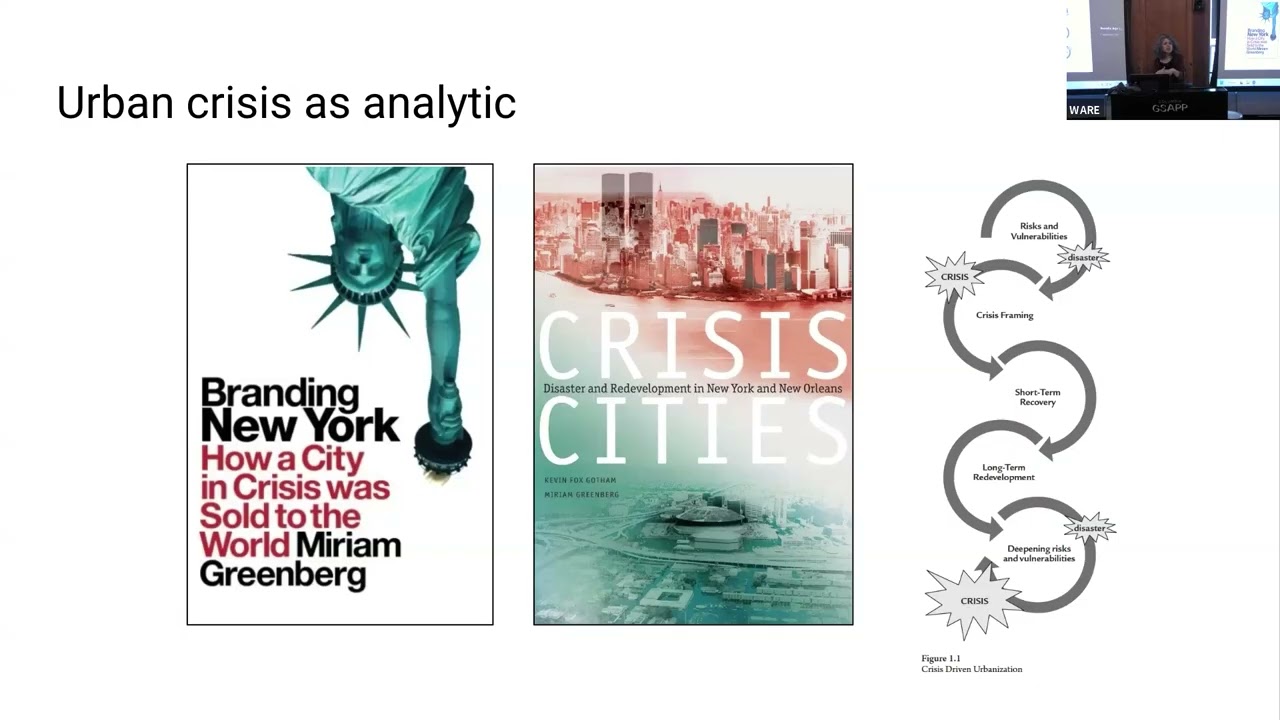
and analytic um the first of which was
my dissertation at CUNY Graduate Center,
um Branding New York: How City in Crisis
Was Sold to the World, um that really
looked at the fiscal crisis of the 1970s
and the role that the crisis itself
played in both
dividing the city, fracturing it along
multiple political and cultural lines,
but also bringing together new forms of
political and cultural coalition
to on the one hand create,
uh, a brand for the city that we might
recognize in a lot of the ways in which
the city was marketed through I love New
York campaigns and other campaigns at
the time, as well as to restructure the
city under kind of new forms of
neoliberal governance. While at the same
time new forms of symbolically oriented
resistance were arising at that time,
um, and there was this kind of reaction
going on between the two forms of
coalition,
um, including those who were involved a
lot in hip hop and graffiti, for
instance, and those involved in the
branding. Um, and then, uh, I was
interested in broadening out my approach
to thinking about urban crisis
by doing a comparative project with my
colleague Kevin Fox Gotham
after the events of 9/11 in New York and
with the events of Katrina, Hurricane
Katrina, in New Orleans. And this
comparative project kind of required me
to think a little more broadly and
theoretically about crisis uh, as an
analytic
and,
um, in doing so to draw on different
kinds of crisis theory. I was very much
influenced by, for instance
the work of Antonio Gramsci and Stuart
Hall and others who are cultural
theorists who think a lot about how
crisis creates a potential rupture in a
larger historical conjuncture.
Um, and how we might use these moments,
uh, in a very open-ended fashion to
intervene in what is going on on the
ground and how many people rush in to do
so. And there's a lot of indeterminacy
in those moments. They could end up
driving people in a variety of
directions. Um and what happens when we
think about that not only kind of
politically in the abstract, but also
spatially? And so, I kind of developed
this idea with Kevin of crisis-driven
urbanization. Um and this notion that a
series of events can um
land upon already existing landscapes of
uh of un- uneven landscapes of risk and
resilience. Some people facing more
risk, some people more resilient, and
having more vulnerabilities.
There's all kinds of impacts of the way
in which the crisis itself, the you
know, the events are framed, whether
that's 9/11 or Hurricane Katrina. And I
should note that when we were working on
this project, a lot of people thought it
was crazy that we would compare these
two events since one was a man-made
disaster and the other was a quote
natural disaster, but this was part of
our kind of approach to think more
broadly about an event and an an
event-based analysis. Uh so, that event,
whatever its origins, lands on that
landscape. And then, as a result,
different
groups politically enter, and there are
short- and long-term processes of
recovery and redevelopment. And
depending on what happens in that space,
uh over the course of this
redevelopment, you might find yourself
either replicating or intervening and
mitigating the already existing
inequalities that existed in that space.
And what we found in the case of both
New New York and New Orleans is that
while there had been uneven development
prior to the events, in the aftermath,
based on the interventions that
occurred, there was uneven
redevelopment, um which led to an
exacerbation of the conditions and the
potential for greater crisis in the
future.
So, that I just raised that because
um that kind of framework of this kind
of process and the notion of crisis as
an analytic has stayed with me even
after I moved to Northern California.
When I left New York and returned
actually to my homeland where I'm from
Northern California. I'm from the Bay
Area
and returned I was teaching actually at
Pratt Institute and took a job
in sociology at UC Santa Cruz.
And I was an urban sociologist entering
a space where a lot of people thought
there was no need for urban sociology.
A lot of people were like why would you
study cities here? We don't really have
cities here.
And this notion that
this was a space unlike perhaps you know
the LA school in Los Angeles in
California in general. There hasn't been
a long tradition like there has been in
New York, in Chicago, to some degree in
in Southern cities in the US
of these kind of city schools that you
know people really have used the space
to analyze
and to develop theory from similarly to
the you know to to approaches to
postcolonial urban theory and and
looking at others other urban spaces
beyond you know the the United States.
Northern California
has not kind of used the city as a as an
analytic in the same kind of a way. On
the other hand being someone who's kind
of obsessed with wherever I am and also
being from this place I really kind of
dove deep very quickly in trying to
understand what some of the ways of
understanding urbanization were and
recognize that
in some ways it was helpful for me to
get out of New York City
to think about not so much discrete and
bounded metropolises
but processes of urbanization which was
already an ongoing framework that was
emerging
in urban studies to think about
urbanization as a process much more so
and this draws from the work of people
like Henri Lefebvre and others, but to
think of urbanization as a process much
more so than a kind of bounded container
of a place. And certainly when you
thought of it that way,
um
Northern California, uh like most
places, lent itself to this. And
particularly the housing crisis that
California in general was facing, uh
especially Santa Cruz, where I was
going, uh which has
uh by many measures the worst housing
crisis in the United States.
Uh the you know, the greatest disparity
in average income and housing costs.
And a lot of other issues surrounding
housing, which have been driving people
into outlying areas, processes of
displacement. And there were a number of
projects that were going on at Berkeley,
uh in Oakland and San Francisco, uh in
the North Bay of the Bay Area. And then,
you know, we started at at Santa Cruz
thinking about the dynamics of this
displacement. Okay.
Um and this expanding urban area
throughout the broader greater Bay Area
region. And in doing that,
um created an urban studies focus that
really integrated urban and
environmental studies um from the
beginning because while urban studies
was not a focus in Northern California,
environmental studies was very developed
and focus on sustainability and urban
sustainability was was was was quite um
sophisticated in the region. And
actually the region had been since the
1960s and 70s a kind of destination for
people wanting to study urban
sustainability. However,
without thinking about housing
particularly or at least the cost of
housing. You know, thinking about the
design of housing
uh and the integration of housing within
an urban plan, but far and from a
planning perspective, but far less in
terms of actual issues of housing crisis
or equity or affordability. And so,
CUES, um the Center for Critical Urban
and Environmental Studies,
um in its earlier formation was very
much interested in bringing these things
together and thinking about organization
as a process and the housing crisis kind
of as a as a central force in that.
Um one of the first projects we did and
this is something that was a uh a
project that um used a method that we
call community initiated student engaged
research and that means partnering with
community-based organizations in our
region
and also working with large cohorts of
students to do the research and usually
students who have a lot of experience
themselves with the issues that we're
studying. So the students draw on their
own knowledge, their own backgrounds and
experiences
in partnership with the community
organizations with whom we um
co-construct the research questions. Um
and really the housing crisis is uh
something front and center of all of our
partners and these were partners
in community services, in labor, um the
Monterey Bay Central Labor Council and
um you know, groups that were focused,
whatever their focus might be and often
it was not housing, housing was
affecting their reality in all kinds of
ways and so students um
you know, partnered and participated in
a lot of things on the ground also
because they were facing a housing
crisis um in a profound way as many of
you may be familiar with in New York
City and how that affects your studies
and how that affects your life on on
every level and so and many of them came
from families and situations of housing
crisis in California, you know, 90% of
our of our students are from California
and California has the top five cities
um up and down the coast. Santa Cruz is
the most extreme but the greater Bay
Area, Los Angeles has housing crises on
par with with Santa Cruz and of course
much larger populations.
So they had brought with them a lot of
experience and this is this is one of
the reports that we did from it. The
project was called No Place Like Home
and it looked at a number of impacts of
the housing crisis, um um you know, rent
burden,
uh
overcrowding,
first moves and displacement, and uh
major problems with housing.
Um and I'm just showing a slide here
from our from our map from our survey.
We did a large-scale survey of renters,
2,000 renters in our region.
Um and this one was about forced moves.
Um and we don't have rent control or
rent board, and so we can't actually
track to the same degree people's
evictions and displacement in a formal
way,
but we are able to interview and survey
people, and renters are often
undercounted in in standard census um
document, you know, documentation.
Um so we did an intensive purposive
sampling of renters to find out, you
know, how many people were were being
forced to move, um and and also living
under these other conditions, and found
50% in our region experienced forced
moves. And this is a map that shows the
central coast of California, and you see
Santa Cruz and the uh this is the county
of Santa Cruz with the mid part of the
county and the south part of the county
in in Watsonville, and and differences
of experience across all of the
different metrics um of impacts of the
housing crisis. And then we also looked
at it demographically in terms of
impacts um
along lines of income and race and age.
Uh so the point here really is that, you
know, we were um
using this I'm going to call it scissor,
community initiated student engaged
research, scissor uh approach to
understand
something that was affecting all of us
in all kinds of ways. And the image on
the cover of our report is one of our
students um who was, you know, and it
was we, you know, she offered to use
this image of herself in transitional
housing situation living in the woods
outside of our campus. Um and you can
see with all of her belongings not
really there for camping purposes. Um
and many many of our students living in
garages, living in uh cars and and other
kinds of things while they're
transitioning and trying to find other
forms of housing.
Um and at the time, and this is a kind
of also a
uh interesting indication of like what
happens over the course of one's
research, we weren't really thinking
about the physical material environment
in which the student was living in an
environmental sense. And the impact of
her presence in that environment. We
were just thinking about the fact, oh my
god, so many of the people that we were
both surveying and interviewing, you
were interviewing a number of people and
in some cases following up with people
over a period of time in those
interviews
um were being displaced to this wider
region, even beyond this little map. And
you can see in this little map, it's
just the county, you know. And you can
see
we had other studies that looked at, you
know, within the county people being
pushed, you know, it from North County
to South County, and that was going on.
But we weren't really looking so much at
the kinds of mountains.
Sure about these
mountains, where a lot of people were
also being pushed, or beyond Watsonville
into the kind of hills and little lying
valleys, river valleys, um of
neighboring counties.
Okay. And I point that out um just to
say that yes, we were looking
nonetheless at
how housing crisis and displacement were
affecting exurbanization generally, with
exurbanization
not thought about in environmental
terms.
Okay.
So then, what happens in 2020? So that
report came out in 2021, and in the
midst of editing that report
one of the the largest fires in our
region's history occurs.
Um and this is called the CZU Lightning
Complex fire. Uh and this fire was was
not a singular event. It was part of a
year in which the largest fires on his
in on record sent with and with these
records having been kept since the 1930s
and there's evidence that there might
have been
other kinds of evidence for earlier
kinds of fires that we might compare it
to but in any case um since the 1930s
since records have been kept on fires
uh in the state of California
this year broke every record on on the
books um and there were fires up and
down the coast and into the interior um
and I could say a number of things and I
don't know you know the degree to which
folks are studying um fire ecology or
have any any experience of that in urban
planning um but it is to say that fire
is
an endemic part of this landscape it's a
Mediterranean landscape
it's a naturally occurring event all
kinds of historical conditions have
contributed to the fact that fire um is
more extreme
in this moment
connect with climate change but do not
only include climate change so uh native
Californians historically used fire as a
means of agriculture uh as a means of
habitat restoration of particularly
significant um culturally significant
plants um propagating a space for
animals to hunt as well as to mitigate
catastrophic wildfire and with
colonialism uh
in the 18th and 19th centuries
uh by the Spanish uh the Mexicans and
ultimately the Americans
native traditions and means of land
stewardship were uh
largely not entirely and it depends on
where in the state eradicated uh as
native Californians particularly in the
mid and southern part of the state were
were put on to um
into uh missions and ultimately off of
their lands and their lands were stolen
and used for ranching and farming and
other things, which itself has an effect
on on
ecology of fire.
But what it what I will say there was,
you know, a shift in what's called a
fire regime.
However, climate change clearly played a
role and something else was playing a
role that was very significant, which
was the increasing amount of housing
that was entering these areas.
Uh and I wrote an article at the time
after having learned, and I think I'm
going to actually
I'm going to turn here. Well, I want to
just point to this image on the right.
This image on the right from an article
that I wrote
Seeking Shelter: How Housing and Urban
Exclusion Shape Exurban Disaster
was really thinking in a special issue
on disaster that was about climate
disaster as well as COVID, the COVID
pandemic, which of course was also
happening on April.
So, we were going out when this massive
fire was happening. And some of you may
be familiar with the fires that happen
in Canada and you had to experience the
the air the conditions of the air. With
multiple masks. We had masks for COVID.
We had particulate matter masks for the
fires.
And it was crazy. And we could hardly
breathe.
And the air was this color. And you can
see, and this is actually an image taken
from a windshield.
It's kind of a dramatization, but it's
like particulate matter that's falling
from
on top of
a housing crisis.
This idea of the concatenation, the
convergence of crisis, some people refer
to as a kind of a polycrisis,
uh of, you know, an epidemic, pandemic,
uh
a climate-related crisis, and of a
housing crisis. And this question of
whether there was any connection between
these things. You know, what is going on
with the housing crisis? What is going
on with the climate crisis?
Knowing that so many of our former
students, our own students, so many of
our neighbors were being pushed into
these areas where they had lost homes,
belongings, faced incredible risk as a
result of this fire.
And that is when we learned about the
idea of the wildlands urban interface.
Has anyone ever heard of the wildlands
urban interface? Great.
Okay, two people.
I was just presenting at the AG and the
whole room had heard about the wildlands
urban interface, but mostly
that's a that's a record for urban
studies folks. Um, and certainly urban
not urban planners I should say on the
West Coast. If you were to be doing a
planning program in California, you
would be learning about the wildlands
urban interface.
Um, how did you learn about the
wildlands urban interface?
In Southern California. Mhm.
Yes, okay. It's remarkable how site how
siloed our studies of this are and I'll
talk about that more in a moment. But
it's a fascinating concept.
It is I think of a very dialectical
concept. I note here that
it's the idea that housing is both a
cause and casualty of fire. And unlike
other climate hazards like flooding and
sea level rise where housing plays a
huge role and don't get me wrong and we
can study the the dialectical
interaction of housing development and
other kinds of climate hazards. However,
when it comes to the fire regime which
depends upon this kind of material
presence of different forms of fuel
uh in order to kick into action, the
presence of different kinds of housing
plays a direct role in altering this
this fire regime. And you can see that
occurring across different levels of
density of housing into undeveloped
areas. Okay, so this is the continuum of
wild land to urban density. And there's
different terms used for different types
of of Louie. And now in California, we
all talk about the Louie. It's just like
standard language. And particularly
people living in in the Louie as I do,
we talk about this all the time. And
there's interface Louie and intermix
Louie. In particular, interface Louie is
alongside of wildlands areas and
intermix Louie is when it's intertwined,
intermixed inside of woodlands and other
kinds of undeveloped vegetation
otherwise undeveloped vegetation.
Okay.
So, I put here discovering the Louie
because clearly there had been a massive
amount of literature and research on
this. And for urbanists, we were
discovering it. None of my colleagues
had ever heard of this. On the other
hand, the folks studying the Louie had
never heard of any of the work we were
doing on exurbanization, urban
displacement,
peri-urbanization, and all of the other
frameworks that were coming um from, you
know, the urban social sciences. And
that was actually one of the the foci of
my article in Sociologica was the the
the num- the proliferation of different
literatures on the idea of an interface
that were coming at it from a variety of
angles. You might think of it as the
blind men and the interface. Everyone is
describing the same kind of geography
from different fields and angles as a
result, different kind of
epistemological perspectives as a result
of their field. Meanwhile, we're dealing
with a similar kind of a material
geography. Um and political ecology. And
I'll talk more about that. So, I wanted
to now get into this problem and uh
of of siloing.
We tried to figure out,
you know, is there a relationship then,
since there was no literature on this,
between these phenomena that we'd been
studying? We've been studying the
housing crisis. Now we're looking at
this issue of the Louie. And in
particular, I should say
the scholars on the WUI are really
interested in the fact that the WUI
not only exists,
but as I'm sure you study in in Southern
California
and others would would see if you start
looking at these literatures,
the main focus is on its growth.
The growth of the WUI is the fastest
form of housing development in this
country right now.
Uh and in California, we lead the United
States in this development. Okay? And
this has been going on
since at least according to the
literature on this, and a lot of this
comes out of labs um in different
universities in the country, in
particular the University of Wisconsin
and the Silvis Lab has done really
important uh research on this.
Uh
a number of a number of uh
fire ecologists, including um someone
named
Radloff, and one of my colleagues, um
Alexandra Syphard.
It's been growing since the 1990s at a
at a very large rate around the country,
particularly in the West.
Uh and it's been growing in in both
interface and intermix areas,
particularly interface areas.
And this is coincident
with, on the one hand, the rise of these
megafires. Okay? So, the period that I
talked about with 2020
was, you know,
uh you know, 20 to 30 years in,
some of the megafires started a bit
earlier, to the growth of the WUI, and
so people started to theorize within,
you know, fire ecology and planning, the
role of housing in driving megafires in
California.
That this was really independent of
climate change, the growth of the WUI,
again, absent these these, you know,
conditions of longer summers and hotter
summers, was really the main major cause
of these fires.
But this is not only coincident with
climate change and mega fires, this
period of WUI growth is also coincident
with the exponential increase in the
housing crisis.
And there was nothing that was really
linking these frameworks. And so this is
just an early map that I did with a
graduate student um looking at
a certain measure of the housing crisis
using data from the out of reach reports
from the National Low Income Housing
Coalition. I don't know if anyone's ever
seen these reports and New York is often
in the top 10 generally in the top 10 as
well of you know how much it would how
many jobs you need to work in order to
afford um a two-bedroom apartment in New
York City and what that's called the
housing wage.
And unfortunately, you know, again, our
metro areas on the coast of California
are
have since the late 90s, since these
reports have been done, been in the top
10 of these housing wage um rankings.
And Santa Cruz actually is the number
one least affordable according to this
report. So we kind of mapped
these um out of reach areas with growth
of the WUI and saw that there was
certainly an overlap going on.
Yeah, as I mentioned, there is a gap in
the literature, massive gap in the
literature,
um and there's a common sense
unfortunately that has prevailed and the
WUI has become it's all over the media.
It's, you know, reporters are talking
about it, the public is talking about
it, it's common it's a kind of common
knowledge and common sense. But often
when you see images of it,
you see the Kardashians.
You see very affluent people in the
Malibu and you know, we can think about
the Palisades fire. We um this is an
image here um from
the you know, the the aftermath of
Malibu and indeed it is very true that
some of the most expensive real estate
in the United States is affected is in
the WUI, right? Is in these beautiful
pristine
you know, a mountainous and coastal
areas
and is in fact is impacted massively by
fire
and has been repeatedly over the last
decades and a very famous essay was
written by Mike Davis. I don't know if
folks are familiar with Mike Davis here.
The case for letting Malibu burn that
was actually an argument for letting
this traditional indigenous
ecosystem return to Malibu.
Ending massive you know, wealth
disparity in housing that was also
associated with urban fires in Los
Angeles that weren't getting addressed
while all of the resources were going to
fighting fires
for the wealthy in the Malibu Hills.
And that is a real thing. It's it's a
it's a real thing that that occurs and
one of and is hugely endangering
firefighters in California. The fire
front is constantly expanding.
Another of my colleagues is an
epidemiologist who looks at the impact
of this on firefighters who are now
confronting not only wildland toxins but
all of these housing toxins. So it's a
massive issue to have to defend these
homes but those homes we think are not
only wealthy homes.
And so we had to confront a common sense
that people are moving to these areas to
live close to nature. People are amenity
migrants. They're primarily affluent
moving into those kinds of areas. We
also had to confront a methodological
challenge which is true for not only
wooie research but rural research in
general and I'm sure this is relevant
for you all as you think about urban
planning and how you kind of use metrics
and analytics that transcend just an
urban space into a into a peri-urban and
rural space.
And you know, census data for instance
is designed much more effectively at the
urban scale when we think about blocks
and block groups and tracks
and the kind of density that you need to
do all kinds of analyses, right, of
demographics, for instance, much harder
at the urban scale at the rural scale,
excuse me. As a result of which there's
generally understood within rural
sociol- rural sociology and other kinds
of rural
social sciences to be a kind of
invisibility of rural communities.
Um and as a result, there's also a
prevalence of case studies like of
Malibu, like of the Oakland Hills in
California, which led to a hypothesis of
um
rather than a WUI and affluence
interface, an urban affluence interface
in that was based on a very affluent
community in the Oakland Hills, again,
absent all kinds of other things
happening throughout the state of
California on that map I just showed
earlier.
Um and then, of course, there's the
siloing of literatures that we are
already um clear about in this room, um
critical urban geography of
displacement, theories of racial
banishment, the asset economy, which
creates all kinds of asset divides, um
is very distinct and not used and
referenced by fire ecologists on land
use and WUI growth,
and even within this burgeoning
political ecology of wildfire, um some
of like like by Mike Davis, um and those
who are looking at this affluence
interface.
So, the goal of the project has really
been to bridge literatures
um
in order to think about housing and
climate in a com- in a combined way with
in the context of WUI growth. And in
doing that, needing to contend also with
urban nature binaries, that is often
kind of undergirding a lot of our a lot
of our field. Um and there are there's a
long history of work and continuing to
this day that tries to transcend those
urban nature binaries theoretically and
and analytically so that we can do this
kind of empirical work. We can't do this
applied empirical work without
frameworks that allow us to understand
these relationships.
Uh and that includes within planning
approaches.
Um I would say urban and regional
planning and the work of Patrick Geddes
was an early an early um argument for
this and maybe some of you are familiar
with that that kind of work that thinks
about the city within a continuum of
urbanization and within a rural context.
Um but interestingly a lot of planners
didn't pick that up later, you know,
they kind of segmented and segregated
themselves into kind of urban planners
and sometimes urban and regional
planners. I would say um there was a a
real move in the 1990s and 2000s with
the work for instance of Karen Chapple
um to think about housing and
transit-oriented development and to
recognize that a lot of the, you know,
in the critical sustainability work that
we were doing that a lot of these
sustainable urban interventions were
driving up housing costs. I think you
heard um from uh folks who study
environmental gentrification um here um
and uh that, you know, as a result of
that gentrification and the lack of
housing present in transit-oriented
development, it actually worsened the
carbon footprint of larger regions by
driving people out to areas that don't
have transit, necessitating car travel,
um and so on and so forth. So, that kind
of work was really interesting to us,
the kind of contradictions
um of equity-deficient
urban sustainability [snorts]
planning. Um and then critical urban
approaches like urban political ecology,
hugely important that really thinks
about political ecology and the politics
of
of the ecology that we and and the
environment and the ways in which humans
shape that environment and vice versa,
and urbanization within that. Um also
urban environmental cultural studies
going back to people like Raymond
Williams, um urban environmental
anthropology and landscape studies,
historical approaches, um environmental
history, uh urban ecological
conjunctural analysis, and finally
nature-based um nature natural
science-based approaches. And this was
something that we discovered in the
midst of doing this work because we are
also siloed in our own work. Um the NSF
has a program in the dynamics of
integrated socio-environmental systems,
for instance.
Um
And um excuse me, and woo-wee research
itself.
And I just wanted to highlight that
actually the stuff that I'm working on
right now. And sorry to give this
litany, but just to say that there's all
of these ways in which
these fields interact with one another.
I'm currently really thinking a lot
around urban ecological conjunctural
analysis. Um and the talk today is is
really drawing more on that.
And the work of Farhana Sultana actually
is a is a contemporary
uh version of this trying to think about
how do we bring conjunctural analysis
and this question of rupture and crisis
into dialogue with
um urban ecology.
Which is often not done.
So, along these lines,
we created this project. Okay. So, um
and I
um
will talk about this, and uh I realize
we're starting a little late, so I'll go
a little quickly. Um but this is called
the Wildland Urban Interface
Research for Resilience, Addressing
California's Climate, Conservation, and
Housing Crises. Um it was a is a
3-year-long project that has been
interdisciplinary, mixed methods, using
scissor approaches.
Um it has support from the state of
California. We did not get NSF funding
um despite trying a couple of times, but
we did get um support from the state of
California, and from the UC, and and and
a number of other foundations. Um we
have a multiple uh we have multiple
community research partners in recovery
and resilience, labor, conservation, and
indigenous land stewardship and housing.
Um and we have um a focus on what we
call the three D's, drivers,
demographics, and dynamics of the WUI
growth.
And I'm just going to quickly say I'm
not going to go through all of this. Um
this is just a slide that shows a few of
the projects we're actually doing in
within this larger what we call WUI
Equity Atlas.
Um
and
uh new methods for an urban political
ecology of wildfire. So, you know, um
I'm happy to go into detail later about
a number of the different things that
students and community partners are are
taking this project in the direction of.
But it is to say to highlight in yellow
there the drivers, demographics, and
socio-environmental dynamics
have really been the focus.
What is driving the growth of the WUI?
Who is there?
And what happens when they're there?
What are the socio-environmental
dynamics of of the presence there? And
given the fact that we have this
assumption about this, you know,
high-income growth,
um and based on our hypothesis that
actually it's much more complicated
because of the housing crisis, and that
there's a combination of both
affordability and amenity migration to
these areas,
this led to a second hypothesis that
there's increasing inequality in the
WUI,
and that that inequality itself has
ecological as well as social effects.
Creates all kinds of socio-environmental
dynamics, this increasing inequality in
the WUI.
So,
um
one example of this
is, you know, and we we focus on this I
mentioned in this previous slide at
multiple scales. We've done stuff very
local in Santa Cruz. This is a
four-county scale of analysis. We've
done California-wide research. We also
have a study that's looking at
California in comparison to the United
States.
Um
but this is an example I think that best
um
conveys some of the possibilities of the
scissor research because it's where you
can physically go.
Um and again, scissor research
depends on students' own experiences and
many of our students are from this
region. Um and we also partnered with a
lot of organizations from this region
uh and then constructed a project to try
to do purposive sampling of people
living in these areas because not only
were many of them renters, which are
hard to reach as I mentioned before, but
they're living in areas that are very
hard to reach. And so one of our one of
our metrics was via the survey,
large-scale survey of Louie residents,
um as well as interviews um
uh and other kind of engaged research
projects in different sites throughout
the region that also try to
sample from different types of Louie,
which are kind of color-coded here.
Um and this led to a new Louie growth
hypothesis.
Uh so this is kind of the amalgamation
of all the stuff I've been talking about
in a sense.
Um and I'm showing this image. I'm going
to go into depth into these little
pieces of it, but just to say that
it was the kind of result of a lot of
our
um convenings in community feedback
sessions and kind of reflections based
on preliminary findings from our survey
and other
studies about what these dynamics
involved, um how you could have a
housing crisis that could lead to
displacement that could lead to
socio-environmental impacts that could
exacerbate climate uh climate hazards as
well as disasters
in the aftermath of which, based on
pre-existing uh inequalities and the
inequalities um
that were generated by the disaster,
leading to potentially uneven
redevelopment and displacement, which
could potentially exacerbate the housing
crisis itself. And this um
this was um
first articulated in this article here
as a kind of hypothesis.
From PNAS
um a couple years ago.
And I thought I would
after giving the overview of this kind
of go through step by step because I
think this gets at that question of
conjunctural analysis
and really the moments. Like what does
it mean to focus in a conjuncture on
what leads to a rupture and potential
crisis
and what follows and succeeds from it.
And how can you kind of do research as
[snorts] well as intervention that is
attentive to those moments?
The space as well as time and that takes
seriously these different these
different uh
potential moments of shift and change
and these events that are occurring
within them.
And so for instance, the housing crisis
itself could be thought of as a kind of
a moment
um
in which we're seeing and I realize that
it's and by the way, I should mention
that we take a lot of these materials to
our we we create them with community
partners and we take them to community
meetings and kind of have people reflect
on these experiences.
Um and this includes, you know, people
living um often informally, people have
having um a lack of access to adequate
housing.
Drawing on the um assets economy
literature, really thinking not only
about increasing displacement and
unaffordability, but also increasing
housing wealth that's being generated at
the same time.
And so one of the things we're
suspecting that we're seeing and we're
finding in our region is that some of
the most affluent people are moving to
these areas and some of the least
affluent, right? And a lot of groups in
between, but certainly we're seeing both
you know, both of those things occurring
um
as a result of the housing prices.
And we can think about that as a crisis.
It's a crisis for most people. For some
people it's actually a a boon if they
already own housing and the value of
their housing is skyrocketing, right? As
an asset is growing. So, for some people
the the crisis is not experienced as a
crisis, right? But we're calling it a
crisis cuz I think for the majority of
people
that's what it is.
Um and then this leads to displacement
to and growth of the WUI along these
different lines,
different forms of wealth and inequality
to moving into these areas. Um and this
in turn has an impact on
uh increasing housing costs in the WUI
itself.
Um so, there's a kind of rural
gentrification that's occurring as well
as
through this. Um and a potential loss of
rural land, land that's getting
converted into housing, which we're
seeing massively in our region.
Um and this in turn as you know, as I
noted because of the inequality that's
moving into these areas
has a huge impact on people's ability to
steward the land. So, native peoples and
and uh native tribes in our in our
region, it's the Amah Mutsun Tribal Band
and Land Trust have had much more
difficulty accessing and stewarding
their lands as well as rural communities
and long-standing um communities that
really know what to do in these spaces
because they've been doing it for for
generations and generations having
sometimes more challenge and sometimes
more access to resources. Like it can it
can actually be complicated in order to
do the kinds of mitigations that are
required to prevent catastrophic
wildfire and other kinds of hazards. On
the other hand, as a result of the WUIs
interacting in these spaces with the
fire regime, the scale and scope of the
hazards and the disasters have increased
to such a degree that even people with
massive amounts of knowledge and
experience
do not have the capacity to contend with
these fires on these mega fires. Um
so that is is kind of addressing some of
the socio-environmental impacts. Of
course, it's also increasing the commute
shed, which was a previous kind of piece
of research in California. There's been
a lot of stuff on
um increasing extreme commuting and
commute sheds. That's also associated
with um regrowth. A colleague of mine
runs what's called the Puma project at
Santa Cruz studies mountain lions in the
Santa Cruz mountains. Um it's it's
fragmenting habitat from for wildlife
um and having impacts on their ability
to reproduce um and creating bottleneck
uh populations and potential um
endangerment and extinct extinction of
certain animals in our region as well.
Um anyway, in the context of uh
climate crisis, this, as we can imagine,
can lead to disaster. Um we call these
WUI and climate-related disasters.
Sometimes we refer to them as interface
disasters. Um these are disasters that
are overdetermined, you know, as uh as
Stuart Hall and others would say, by
this confluence of events. Um so it's
not just a rupture, but it's it's really
creating this kind of a crisis. Um and
we in our region, because of the
location, are dealing with not only
fire,
but also um extreme storms, um bomb
cyclones, which I understand were um
experienced here um
a little while ago, and uh
landslides, um and flooding um in
different in different parts of our
region. So I didn't want to only talk
about fire. And some places have all of
those things kind of on top of one
another and related to one another. So
when you have a fire followed by a bomb
cyclone, followed it can precipitate a
landslide and flooding, and they can be
related to one another.
And then again, in the context of
pre-existing uneven landscapes of risk
and resilience, we see uneven
redevelopment and recovery
depending also on the intervention that
occurs and how equitable that
intervention is and how wide-ranging and
the communities that are not even
accessed and and recognized, many of
whom are living uh or renters in the
area, now increasing numbers of renters,
increasing numbers of unhoused people,
you know, who's getting access to to
these resources and the potential for uh
this to
return to the urban housing crisis
itself. Um and so just thinking about
this in terms of these critical moments
for intervention, pre-disaster
landscape, the moment of rupture and
potential crisis, and the post-disaster
possibilities that emerge.
Um and, you know, again, we have brought
this to
we have brought this to a lot of our
meetings, this framework, and thinking
about, you know, people kind of engaging
with what what is going on for you based
on where you're living in this region
and what could happen if a lot of these
you know, these
pressures identified in this diagram
were relieved, you know, and imagining a
kind of a blank slate of our region,
um what would it mean if if we were able
to build affordable dense
and safe housing in urban areas, if
those who would have been living and
desire to live and to maintain uh and
steward lands in the hinterlands, as we
call them from the urban perspective, in
rural areas, um in ancestral lands for
native tribes,
were able to to remain in those spaces
as well and to train those who want to
live and and know how to steward those
lands. What if we were able to maintain
this kind of a balance? And those are a
lot of the kinds of conversations and
that has led a lot to new kinds of
coalitions and alliance building across
the urban-rural divide.
Um and that relates to really the final
slide,
which is um what does this mean for
uh
urban studies,
uh planning, and politics?
And we're thinking of this in terms of
urban interface studies. You know, we
can think about urban and regional
studies, urban and regional planning. I
think the interface helps us think about
where these places
uh come together and interact, and what
happens when we focus on those spaces
opens up all kinds of possibilities.
Um one is recognizing what we call the
relational geographies between the urban
and the rural.
They are co-constituting and co-creating
one another
and have to be thought of together. And
the entanglement as well of housing and
climate crisis. These things are also um
interacting, specifically the role of
housing prices in both the origins and
outcomes of climate disaster.
Um and
secondly, holding open the fundamentally
political questions of rupture and
redevelopment. You know, that moment in
the uh of crisis in in that previous
slide
is an is a place that in which many
things get are possible. Many things you
know, can can enter, many things can
exit, uh many coalitions can form,
uh and how are we dealing, especially as
we're as we're facing this concatenation
and compounding of crisis,
uh much more in much more complex ways
and much more rapidly following one up
uh
after the other. How are we dealing in
these kinds of moments and thinking
analytically and coalitionally and
collectively and politically about um
questions of redevelopment?
Um
and finally, this involves building
partnerships around
uh housing. I would you know, in our
region, but I think it it's relevant
elsewhere, housing and land justice in
the face of climate change, bridging uh
what we think about as the right to the
city and who has a right to
safe and affordable housing in urban
areas,
uh equitable recovery in the aftermath
of all kinds of different disaster, and
uh indigenous and rural land
stewardship. How can we think these
things together and build coalitions
across these kinds of divides?
So, I'm going to leave it there. I'm
going to leave it there. Thank you very
much for your participation.
I'm coming ahead, you guys.
Uh big question.
Um so,
uh
it definitely I mean, so, and are you
are you working on things the way that
you did in New Orleans
or
Yeah.
But yeah, yeah, yeah, okay.
Yeah, um and I actually just um
was thinking about this in New Orleans,
um
the there was a um
a wonderful conference that happened um
a couple of months ago called multiplied
displacements that was looking at
the question of climate migration and
housing displacement and how do we think
together? Um and often when we think
about climate migration
we think about I I'm literature and you
know, did a big
literature and it's very um segmented
between global north and south um and a
lot of the climate migration literature
is in the global south and a lot of the
stuff that I'm talking about here could
be thought of as um
Um agree
uh particularly in the aftermath
after
but
there's often more of a urban focus, um
right? And I think something
Uh placement from home. What happens
when we
So, that that's one quick thought that I
have, but in terms of the previous
uh
that I am
New York in New Orleans,
um
definitely
kind of qualities
feel me
that was the fact that as with Laura and
I have
After this
earth condition
maybe
I could have
another colleague of mine
our place
that
I didn't have another point I
wait a lot of this week sorry
I mean I don't
the non-existent
I don't know but you do the work
I don't
know
sorry
I can
that get it
I get
actually the baby qualities
people
really thinking of this interaction
about the
during post disaster mode that happens
in
mitigate
I get
I think
>> Control burns? Mhm.
Um so, it's a great question and many of
our partners are involved in prescribed
burning. We partner with the
Prescribed Burn Association of the
Central Coast and I've gone on a lot of
burns and I've learned a lot about
burning
um and I have a few different things to
say. I think one um
I don't know if folks are familiar with
the idea of prescribed burning, um also
known as cultural burning,
um which involves um you know, a form of
fire mitigation by keeping the fuel load
down, particularly if for vegetation.
We're not talking about prescribed
burning of homes, for instance, um but
prescribed burning of of wildlands. Um
and wildland is a problematic concept,
which I could talk more about,
[laughter] but um natural vegetation.
Um one of my, you know, dear colleagues
on this project, his name is Alexandra
Syphard, who's a fire ecologist and was
really, um,
very much at the forefront of thinking
about land use
independent of climate change as a
driver of,
uh, megafire. Um,
she has a background in in in, you know,
on the ecological side and she and her
colleague have done a really important
map and project on, uh, what's called,
um,
fire return intervals and one of the
ways in which fire is really significant
for ecosystems
in terms of the fire regime has to do
with its intensity, its scale, and its
return. How long between fires.
I've learned all of this in the last few
years.
And
when you have too frequent fire, it's a
big problem for ecosystems.
You can have what's called type
conversion where the ecosystem can
transform from one to the next cuz this
is constantly getting burned and the
seed stock doesn't have a chance to
re-germinate re-re-develop and
germinate. And if it's too long,
you can have a situation I think that
you're suggesting where things the fuel
load builds up and builds up uh, and you
can have such a massive fire that can
wipe out species as well.
Um, and they created this amazing map
that looks at and color codes according
to the fire return interval
pre-colonization
and post-colonization
and allows you to see
um, where fire has returned too
frequently and where fire has returned
not frequently enough and where it's the
sweet spot and it's perfect. Um, and you
can look at that across the different
fire regimes of California and you and
they've done this around the world.
Um, and one of their arguments, um, has
been as a kind of response to a massive
and really welcome movement that's
called good fire, the good fire
movement, trying to bring fire back to
the land. But fire isn't actually
effective everywhere.
And in some cases, and they're doing
this in Southern California, they
they're doing outside of San Diego,
outside of LA,
where there's been so much new
development,
and in the context of climate change and
the Santa Ana winds and all the rest of
it, this massive type conversion
of ecosystem and the loss of what's
called chaparral, which is a really
important ecosystem that was incredibly
important also for native, is continues
to be important for native tribes and
others in our in in in terms of
biodiversity.
So, they were interested, and Alexandra
was interested in coming to our region
because we've actually had such little
massive fire,
and she saw similar kinds of development
and saw us becoming the next Southern
California. And in fact, that is the
that is the worry. We had a a big fire
in the Santa Cruz Mountains that I
showed you, the CZU, and the next in the
southern part of our region where a lot
of development's going is where we're
really concerned that it could burn. And
so, we're using these maps
to figure out where are the ideal spots
to burn. We created a model that
combines those maps
with where do you actually have access
to do burns, and what is the situation
in terms of, you know, income
vulnerability, housing vulnerability.
And often what we find is that big
homeowners, let's say,
these big homes, like the Kardashians or
whatever you can imagine, just just a
just a visual,
can afford to hire their own burn bosses
and have their own fires in their own
backyards. Um, and these low-income
communities that are moving into these
areas, and I could have shown you a
whole bunch of pictures with San Diego
third of land,
um,
about the kind of morphology and
typology of the housing in these areas,
and we're talking about mobile home
parks. We're talking about people living
in older in kind of housing in forested
lands that were developed for um
for you know summer rentals
and are these kind of very thin little
houses and and kind of lean-tos and and
shocks. We're talking about people
living in
new sprawling kind of developments often
that do not have
you know kind of commuter suburbs that
are that are low income suburbs.
In the area with that is most endangered
for the next fire and those folks don't
necessarily have access to prescribed
burning and so there has been a measure
passed to try to raise funds in the
county and we're trying to use this
model to direct
prescribed burning
to the places that need it
have access and where it won't actually
devastating environmental impacts.
Um
in terms of
national and state lands
in
California actually the state lands are
quite well governed and I think there is
this issue now at the federal level
which we could have a longer
conversation about you know because of
the cuts to funding in general for the
for managing of of federal lands
um
some argue in with the interest of
ultimately privatizing.
Um
all kinds of arguments about why this is
important.
Um so really I think
state lands and these lands where local
communities are able to do what we're
describing are places where prescribed
fire could happen.
Um federal lands are
question right now. Yeah.
Due to this current administration.
That was a long answer. Yeah.
>> And you know, uh
You know,
I think that um
that
a colleague of mine um
collaborated on on some of a lot of this
work um Hillary Angelo is doing work on
the land. The land. You know,
um and there is
question of the
Okay, question of
And
And region, I should say, did all of
those things
well, um and it's
the uh
Sure.
Uh that's right.
Um
I
I uh
those fires were caused by
Uh it's
happening.
I did
Here.
Thank you.
It's fine.
oil extraction, but other form
tion
mining.
So, what that means
for
I guess
Folks have thoughts on that.
I mean
That's a great question, too.
Um
Well, there's different scales of
government governance.
And you know, when you talk about growth
boundaries. So,
one of the projects that we're doing is
a kind of county by county comparison.
Um and we're interested in I mean, on
the
Uh if I were to go back here
um on the question of woolly growth
itself
I think one of the Oh, it's not working
anymore. That's good.
Um
that first
the slice
as the woolly is growing, one of the
points there is what are the kind of
supply side, not only demand driven
obviously, what are the conditions under
which
varies
by
by county
And we happen to be in a in a region
where Monterey County, our the county
that's my campus is in
Monterey County, San
San Benito
town.
So, the kind of sprawling development
kind of the form of
the cities with that form
though
people have gotten around those
boundaries
ways particularly the very high income
and the very low income.
People are living in poverty.
And people are buying mountain tops and
doing the same often without insurance.
Like
other things that happen beyond income.
Um so, some of this is governed at the
county level and there's all these
questions about thinking about that more
regionally. So, that's beginning to be a
conversation I think um very much so and
there are these
governments.
Um and that's been going on since the
'90s and there's a lot of work in the
field about kind of regional governance
and that's being really catalyzed I
think now in this
megafire and
and so you're seeing you know, we have
this office of response, recovery, and
resilience that's created this network
and they're trying and they're using
this to try to be in the way
animals.
They are the squirrels.
But even so, there's the question of
state
and unlike
and maybe you all have read books like
planning in the USA and
or sorry, zoned in the USA zoned they um
they um
but um it's a great book by a planner
who I believe from
India.
Um in any case who came to the United
States as a planner and was like, what
is going on with zoning?
This idea of single
Um and the idea of segregation is
um where you have
areas for commerce and you have
residence uh
and you have massive sprawling suburbs
and everything else, but you know, so
and it is to say that zoning
varies state by state.
And zoning law has often been used uh
for all kinds of other political
purposes, social purposes, including
exclusionary zoning and racial exclusion
in this country.
Um and so it has its history and roots,
a history of of segregation and
socio-spatial inequality and maintaining
equality.
So, that is a larger conversation about
how, you know, the
the who we develop
that is so hard
to densify in urban areas.
Turns out
low density
um
explains a lot about why it's been even
in areas that have growth boundaries.
being out into these areas.
Um and so now, at least in the state of
California,
there's an effort to kind of function
more and develop this.
I uh in other parts of the country,
varies based on who has control over
where housing goes, you know.
Yeah.
>> Well, I mean, our campus has this long
history of environmental work. They're
really excited about the project and we
were one of the
projects that got state funding
than any other campus
long history.
And
um
the other project one farm workers,
which is a really important one. Also
near this really good one.
So,
they
uh another has to do with ground water.
You know, there's all kinds of issues.
But, um so, they have been very
supportive. Um and I should say by the
way that
the office of president
was the
oversees
that
our opening
this
governor spoke and
California as like this bullwark against
what's going on. It's
elevate our green economy and
environmental
for balance
see obviously to what's going on.
Get in the state funding.
Um
but uh from this dynamics of the
creative social
Um but but the state of California was
very interested in it and actually
interested in it, you know, given that
they're uh they want to fund things. So,
the project
Um so, that was great. I think you're
point about the previous project
um which was not so much about the
environment
um as it was about the crisis itself
particularly
including students.
Our campus was very supportive. I think
the community
was not
there with created a lot of
I wrote a little piece about this
idea
in community engaged research and
what do you know community engaged
research in in very
broad times and very
just times when communities put in
quotes are pitted against one another.
So that the land board had home owners
at the time
was
and it's something that I've referred to
another work as asset class politics.
There's a kind of class politics based
on
or lack thereof and
So
home owner and not all home owners
not all home owners
not all landlords but many
organized in opposition
to
what happened in between.
And many of the students in our project
and and other students on our campus
formed an organization called students
uniting.
And recognized that they were basically
in the same situation as area rent.
And they supported rent control which
had been tried and failed in Santa Cruz
in the teens.
And it is a huge source of income for
people in our community rents
and a group formed called Santa Cruz
United that was supported by over a
dollar.
The rent control campaign raised around
close to $70,000.
The anti-rent control campaign raised
over a million dollars.
Um
very short amount of time.
The California Apartment Association
California Apartment Association
attorney the National Apartment
Association
and other big um
uh
housing and developers and
uh
to ultimately overwhelm us. And in the
midst of that very massive battle that
happened in our
um which the town was blanketed
with signs for and against this rent
control measure.
Um and this also is occurring in the
context
statewide effort
uh overturn a law that is a redemption
law that makes local rent control more
powerful. There was a statewide measure
for a Costa-Hawkins for the
Costa-Hawkins and then there was a
The one is about 10 minutes.
I'm going to take advantage of the
But we got the most funding for the
opposition.
Anyways, um that led to some of the
people trying to
uh writing and trying to criminalize
against them.
Trying to get students
which who had won scholarships and
they're amazing.
Who had done incredible uh you know
kinds of
projects for their senior
who had you know presented in town.
Trying to get the fellowship
Trying to that they could write to
colleges to prevent
I mean it's mean stuff.
I don't know.
This case I mentioned to you was
divisive.
Um so I wrote about that in that piece
um and it and it also meant that I as a
tenant probably you know
or less
this and some
at least my
I do think
that's it.
Yes.
Is it not anything
Um, yeah.
>> [clears throat]
>> and careful.
I think like wildfire
What's wildfire