Video summary
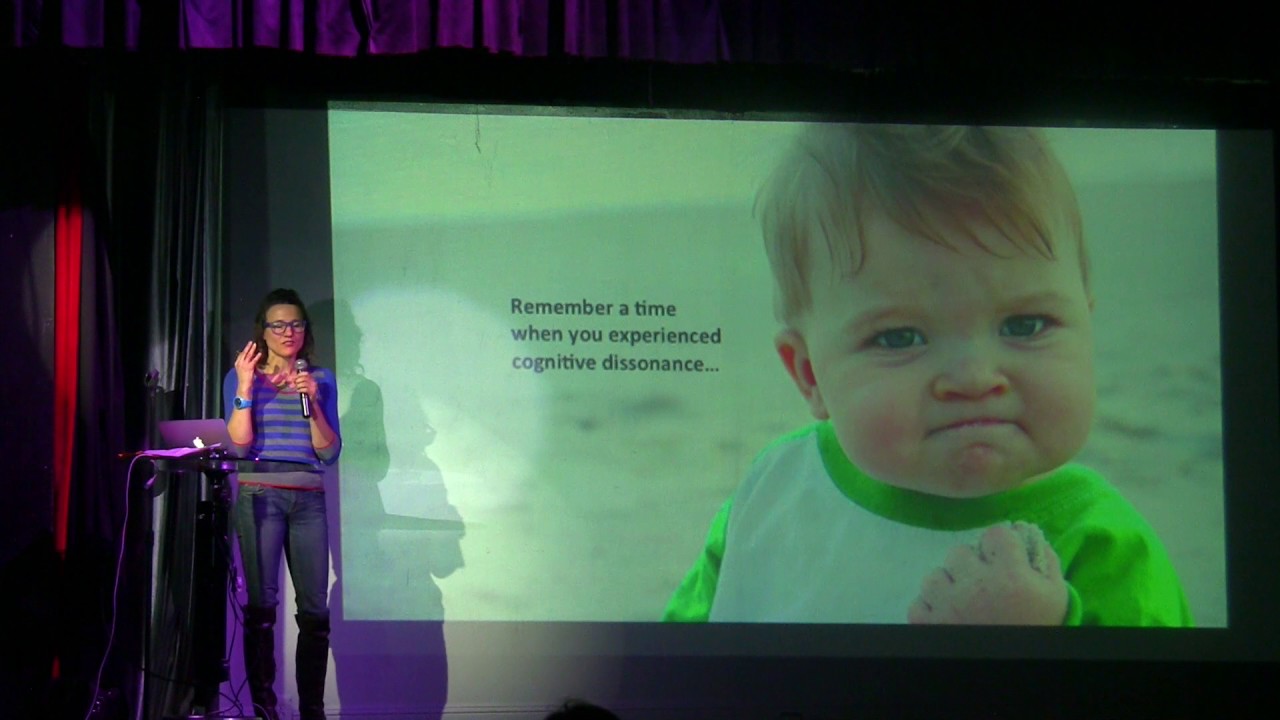
Cognitive dissonance is defined as the physical and mental discomfort experienced when holding two conflicting beliefs or pieces of information simultaneously. This state arises because the human brain, which naturally seeks safety and stability, dislikes change and conflict. To resolve this tension, the mind attempts to restore balance by either rejecting new information or justifying existing behaviors, often leading to irrationalization where individuals create alternative facts to make their actions feel acceptable. The intensity of this dissonance is directly proportional to how strongly a person holds their initial beliefs; the more deeply ingrained a self-concept or belief is, the harder it becomes to accept contradictory evidence without engaging in defensive psychological mechanisms.
To illustrate how the brain resolves this conflict, the speaker draws parallels between human behavior and biological survival strategies, such as a virus that disables a rat's fear response to ensure its own replication within a predator. Similarly, humans employ five primary strategies to eliminate cognitive dissonance: avoidance, where one refuses to deal with uncomfortable truths; distortion, which involves twisting facts or relying on "alternative facts"; confirmation bias, the tendency to seek out news sources and people that reinforce existing views; reassurance, found in surrounding oneself with like-minded individuals; and revaluation, a process akin to the fable of the fox and the sour grapes where one devalues an unattainable goal. These strategies allow individuals to maintain their self-image even when faced with evidence that proves them wrong, as seen in historical experiments where cult members refused to admit they were duped after a predicted apocalypse failed to occur.
Overcoming cognitive dissonance requires becoming a critical thinker and engaging in metacognition, which is the practice of thinking about one's own thinking process. The speaker suggests that by physically locating the sensation of tension caused by dissonance, often felt in the gut or heart region, individuals can label the feeling and recognize it before reacting automatically. Learning to manage this involves moving through four stages of competence: starting with unconscious incompetence where one is unaware of their biases, progressing to conscious incompetence where they understand the issue but cannot yet change it, then to conscious competence where they actively choose to resist dissonance, and finally to unconscious competence where the ability to bypass these feelings becomes second nature. This journey is not easy, especially for deeply held beliefs, but starting with smaller, less controversial issues can help build the necessary confidence to tackle more complex challenges later.
Research indicates that personality traits also play a significant role in how easily one can overcome cognitive dissonance, with extroverts generally finding it easier than introverts. Studies suggest that introverts may be more susceptible to groupthink and adopting the opinions of their social circle rather than relying on independent analysis, making them more vulnerable to the effects of dissonance. While there is a fifty-fifty chance regarding whether an individual leans toward introversion or extroversion, the ultimate ability to confront these internal conflicts remains a personal choice. By acknowledging the mechanisms at play and practicing awareness, individuals can gradually dismantle the barriers that prevent them from accepting reality, ultimately leading to a more examined and authentic life free from the paralysis of conflicting beliefs.
Read the full video transcript
alright what's for dinner right um yeah
hi nerds um I hope you had some lovely
bites earlier I don't think there were
too many brains in there but um so I'm
going to talk about cognitive dissonance
tonight what's feeding your inner zombie
and it works so I want to start off with
a little disclaimer I am NOT a brain
scientist um ooh hello volume I i work
for Kaiser Permanente and I want to also
say that these slides and all the
content in this deck are my thoughts and
feelings and pinions have nothing to do
with the company they work for but what
I do for Kaiser i work in one of their
innovation groups and I work on a lot of
innovation projects that have to do with
behavior change and encouraging people
to take on healthier habits for example
so that's my twitter handles and we're
talking all kinds of tweety stuff
tonight if you want to tweet this that
would be awesome um
so I didn't actually realize that there
was going to be a cheat sheet
distributed earlier tonight I was hoping
that maybe I'd be able to catch somebody
in the audience that wouldn't know how
to define cog no distance but so for the
people that didn't look at the sheet um
do you have an idea of really what
cognitive dissonance is there anybody
that wants to shot at shouted out
truthiness
sort
of truthiness so so let me just give you
a little picture of what cognitive
dissonance actually is so the definition
is when you hold two conflicting
cognitions at the same time so this has
to do with any time that you're of two
minds right so you know that you should
be eating the broccoli but damn doesn't
that cook you look good so it's that you
know is that conflict that you're having
that you know you know what you should
be doing you know you're actively you
know engaged with that but you have this
other conflicting piece of information
that's going against your core beliefs
and what that actually does is it
creates a physical discomfort in your
body and and what your body ends up
doing your brains ends up doing is it's
trying to balance that out right because
it doesn't like having conflicting ideas
it wants to be safe it wants to be
content and ultimately really your brain
doesn't like change it's very very sort
of self-sustaining and self protecting
this technique is very similar to what a
virus called tak so plasma Gandhi does
to rats so what it does is it hacks into
the rats brains and it turns off their
fear response so these rats go up to
cats and like hey dude what's up and you
know of course what happens the cats are
like hey this is easy lunch and the cats
eat the mice well why the hell would a
virus want to kill its host well because
the virus actually replicates in the
cat's gut so the virus also has this
sort of self self
in this sort of initiating
self-sustaining you know intrinsic need
inside of the two and so that's what
your brain is doing is trying to protect
itself and the more um the stronger the
feelings are that you hold initially so
those initial feelings of like what you
are your self concept or your belief the
stronger those are the stronger the
cognitive dissonance is going to be
which is why we end up with these guys
right
it's like what the hell is going on here
guys well it's because the brain is
going through all of these different
processes
and different ways to come up with to
like justify and eliminate that
cognitive dissonance it wants to feel
secure so they come up with alternative
facts to make them feel better but
this goes both ways right you also have
the Bernie Bros out there kind of doing
the same thing right so that so these
really really strongly held feelings
these really deeply held self-concepts
it's like nobody wants to hear the
conflicting information
so who came up with this stuff you know
I didn't make this up so the cognitive
dissonance theory has been evolving for
a number of years we've been a lot of
studies but this guy Leon Festinger was
really the one that sort of coined the
term and he is this wonderful quote so
humans are not a rational animal but a
rationalizing animal so you know they're
always coming up with reasons why what
they're doing is okay it's better or is
not as you know it's not as bad and he
did a really interesting experiment in
the late 50s Hina's grad students
infiltrated this doomsday cult and it
was great and he was a Stanford
professor so you know this happened like
in Berkeley or something so
so it was december 21st 1956 the world
was supposed to end the aliens were to
come in and rescue all of these doomsday
cultists and so festinger found out
about this or his grass news found out
about this and so they were there in the
room with them when the clock ticked
over and nothing happened and so that's
what they wanted to do they wanted to
observe what happened when people who
have incredibly strong feelings about
something are suddenly approved
completely wrong and what was
interesting is that the people these
these doom days cultists were like dude
I was just here for the ride I knew that
wasn't gonna happen like they came off
like they came up with justifications
and then actually what was even more
interesting is some of them reconfirm
saying you know what the aliens didn't
do it on purpose like they couldn't just
justify it with like oh man I've been
totally duped by this so they didn't
want to have any of that like sitting on
their their cognitive dissonance would
not allow them to like give up that
initial like deeply held I'm
construction because a lot of these
people have like giving up jobs you know
and sold sold all their property and
stuff like that so they were very
invested in this in this concept and so
that was just one of one of the
experiments that we're done over the
years that to you know help establish
this theory cognitive dissonance theory
and so you know it's it's it's something
that's very difficult to overcome
because your brain is like that animal
part of your brain that's like I don't
like change at all i don't like negative
change and it you know i don't want to
be confronted with these challenges so
the question is like what can you do to
overcome it and really comes down to
being critical
thinkers you know we don't like doing
that in America anymore it's kind of a
thing of the past but it's really it's
what's preventing us from from
confronting our cognitive dissonance and
you
know Socrates has this awesome quote I
love it it's like an unexamined life is
just not worth living so it's like
really take a critical look at how
you're thinking is this sort of that's
where this metacognition comes in it's
like thinking about thinking so really
paying attention to how you're thinking
about things what you're thinking about
things how you're deciding to do or not
to do things so
here
are some of the strategies just that you
can help become more aware of it and
we're going to do a little exercise to
to you know really further along this
experience so there there are five main
dissidents removal strategies that your
brain engages in whatever you're
confronted with cognitive dissonance oh
it's like that you know oh my gosh I'm
being confronted with it with something
that you know goes against what i
believe so the first one is avoidance
it's like no way that is so not true not
going to deal with it the second one is
distortion so alternative facts heard
that before right that's another big one
so confirmation is when you read news
that agrees with what you agree with
right so keep going to Fox News and
feeding yourself the same stuff over and
over again to confirm what you believe
reassurances
you just hang out with people that have
the same thoughts and feelings that you
do again that's very similar to the
confirmation and then revaluation which
is this the classic Aesop fable of the
you know the Fox it's like look at those
wonderful grapes up there but they're so
high up in can't get them therefore they
must be sour so
that's when you change the valuation of
the thing and then that way that
balances out your cognitive dissonance
so those are the strategies that almost
everybody has engaged in at some point
and what
I want you to do then is with that sort
of in the back of your mind sort of
close your eyes and imagine a time that
you were experiencing cognitive
dissonance and it could be something as
simple as when you're having that
conflict of whether or not you wanted to
eat the cookie er the broccoli or you
know when you're puffing the cigarette
and you know it's going to kill you you
know this is all that that conflict so
imagine that feeling in your body you
know where where is it where is that
tension in your body and for cognitive
dissonance most people it's really it's
in the the gut region or in the heart
region so if you sort of bring bring up
that feeling sort of feel into it and
and then what I want you to do is is
maybe think of a few other instances
where you experience cognitive
dissonance and this could be something a
little bit more extreme like in the
political world you know maybe there's
something in the political world the
cause cognitive dissonance for you as
like oh I can feel the whole room
getting a little more tense to bring up
the the political pneus of it but the
thing is is like where you're feeling
cognitive dissonance is usually in the
same place in your body and how you're
experiencing it is very very similar so
regardless of what strategy are using
you're still are having that sense that
feeling and so if you can start to tag
that feeling and label it you can
recognize it when it comes up again and
then when you're in the middle of the
moment you're like that's just cognitive
dissonance you know now I have a choice
rather than directly engaging in one of
these you know strategies to just
dissipate the attention
that you have in your body
but it's not easy I mean clearly this is
not something that you just kind of
flipped the switch and you're like ah
cognitive dissonance that's just
something of the past there's sort of
four stages that anybody that learns
anything goes through so you have the
first stage which is what most people
are in when it comes to cognitive
distance which is this unconscious and
competence like you have no idea that
you're doing it at all but once you
start learning like what it actually
means what cognitive distance means
where it exists in your body how you can
feel into it then you can sort of at
least be conscious when you're doing it
and not able to change it so you're
getting a little bit closer you know you
have to be able aware of the problem for
you can change the problem and then as
you build a little bit more confidence
you develop this conscious competence
where it's like okay now I'm feeling it
and I'm going to make that effort to not
eat the cookies because I know better
and so you're starting to overcome it
and then ultimately you're really going
to become great at it you can just
completely you know bypass that feeling
in your body and you become
unconsciously
competent it becomes second nature
you've like overcome these feelings
entirely so the
problem is that like I said before the
more strongly you hold those initial
feelings the harder it is to make that
switch so just you know start on the
easy stuff first you know don't try to
go for like the really hard political
stuff and don't think you're going to be
able to do this to or for somebody else
either you know it's really one of those
things where you have to kind of start
at your you know at the inside and work
your way out but there is a little bit
of hope for all of the extroverts out
there of which I think they're what like
four in this office the
extrovert there's research done in 2009
that actually show that extra verse have
a much much easier time overcoming
cognitive dissonance than introverts do
and the research showed that the
introverts actually were more
susceptible aid to the consciousness and
then we're also more susceptible to
taking on the thoughts of the opinions
of the group rather than the people that
were extroverts so that's kind of
something to think about you it's like
an added added layer of complexity but
this is some data from 2009 just about
the general population about fifty
percent are introverts but fifty percent
to varying degrees are extrovert so you
kind of have a fifty-fifty chance on
whether or not this is going to be
extremely difficult for you to overcome
or if it's just going to be moderately
difficult for you to overcome but
ultimately it's a choice right and it's
your choice so
that's what it that's all i have for day