Video summary
Citizen science is defined as scientific work undertaken by members of the general public, often collaborating with professional scientists or institutions to address research questions. While the formal term was added to dictionaries only recently in 2014, the practice dates back centuries, evolving from early large-scale efforts like William Whewell's global tide studies and John James Audubon's bird counts to modern digital platforms. Historically, discoveries were made by amateur enthusiasts before science became a paid profession, with figures like Charles Darwin conducting research without formal degrees but funded by personal wealth. The concept was later refined in the mid-20th century by Alan Irwin in the UK and Rick Bonney in the US, who helped establish it as a distinct scientific discipline aimed at bridging the gap between public participation and institutional science.
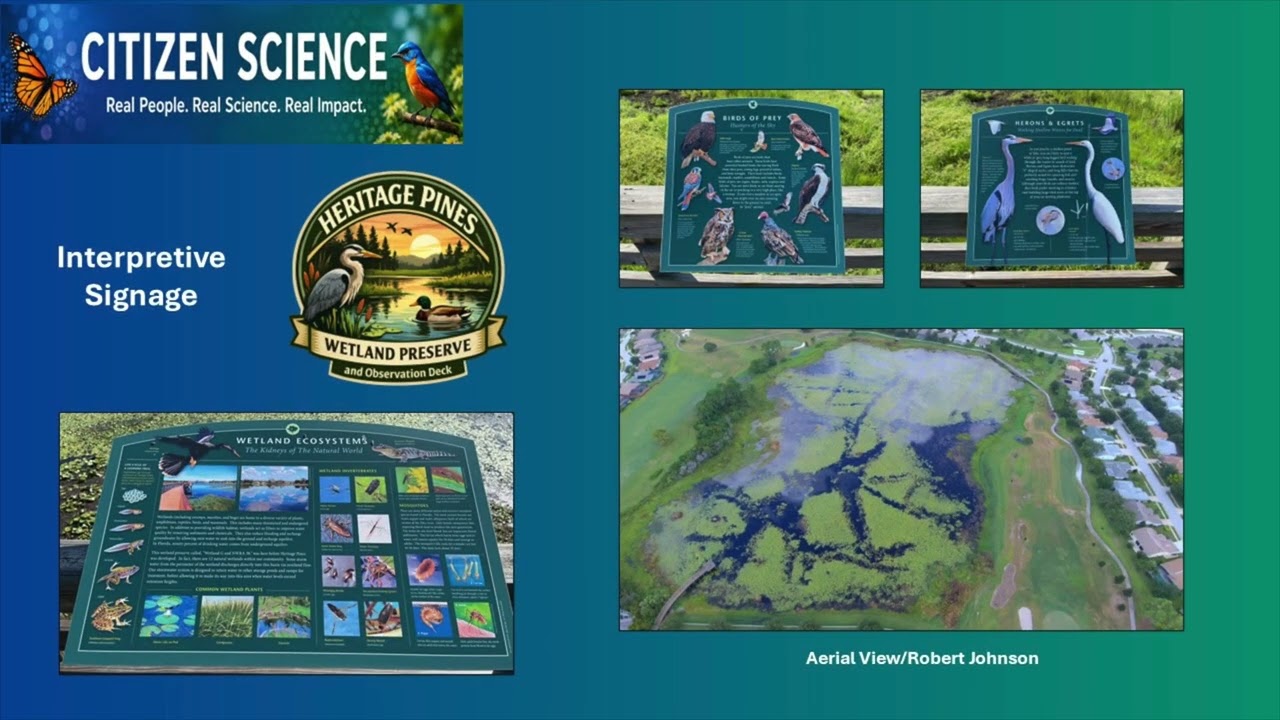
The speaker details several specific projects she has led both professionally and during her retirement to illustrate these concepts. In Florida, she organized initiatives such as the Tampa Bay Beach Buddies Shoreline Cleanup Program, which engaged over 2,000 participants annually in collecting trash data along shorelines for five years. She also developed integrated curriculum programs like Wild and Wonderful Tampa Bay Habitat, distributed to thousands of teachers across three counties to teach students about bird sightings and invasive species through interactive posters and lesson plans. In her retirement, she manages the Heritage Pines Community Bluebird Trail, utilizing innovative technology like an endoscopic borescope attached to a cell phone to photograph birds inside boxes without disturbing them, while also designing interpretive signage for local wetlands and parks to educate residents about native ecosystems and wildlife history.
Beyond real-world applications, the speaker explores how citizen science has expanded into virtual environments within Second Life, creating immersive educational experiences that mirror reality. She describes projects such as Immersion Island in Bonaire, where users could virtually explore coral reefs, and a Caribbean University project focused on offshore wind energy education. Another notable initiative was Citizen Science Bay in Pensacola, which involved installing water quality monitoring instruments on residents' docks along the bayou to track environmental data digitally. These virtual projects often served as demonstrations for digital twin technologies or ways to engage international audiences through live streams featuring experts like Franco Lodado, proving that meaningful scientific collaboration can occur regardless of physical location.
For those interested in joining these efforts today, there are numerous accessible tools and platforms available without needing advanced technical skills. The speaker recommends apps such as Merlin Bird ID for identifying birds by sound or sight, eBird for logging sightings to help with global conservation, iNaturalist for cataloging plants and fungi, and Zooniverse for finding existing research projects in one's local area. Other engaging activities include becoming a storm spotter through Weather Ready Nation, participating in geocaching hunts that encourage leaving tokens related to specific topics like fossils or native flora, and using world weather maps to monitor climate patterns globally. The overarching message is that anyone can contribute to science by defining simple research questions, following step-by-step data collection instructions, utilizing established online platforms, and sharing results with the broader community to foster a deeper connection with nature.
Read the full video transcript
Heat.
Hi everybody. Um, thanks for coming to
the science circle today. I'm Hope
Butterbush Esparanza freeze in Second
Life.
In case anybody wondered, when I joined
Second Life, we could not choose our
last names. So, I choose one that was
familiar to me. Freeze.
Um, my career has taken me from school
library media specialist to district
curriculum supervisor to college and
university instructor and administrator.
I am not a scientist, but I am a science
enthusiast and a designer of
environmental education programs.
My job at the University of South
Florida College of Marine Science led me
to environmental science education.
Today, um, I'm going to talk about
citizen science, uh, programs that I've
created in Second Life and in real life
for my job and those I've done in my
retirement.
I'm going to explain what citizen
science is, the concepts and the
programs, and tell you how you can get
involved in citizen science projects.
Then we're going to try out some
programs you can use here in Second Life
and at home where you're located.
The term citizen science was added to
the Oxford English dictionary only in
2014 and they describe it as scientific
work undertaken by members of the
general public often in collaboration
with or under the direction of
professional scientists and scientific
institutions. Although I say that that's
not always the case because I've created
some on my own.
Early largecale crowdsourced projects
included William Wewell's, if that's how
you say his name, massive 1835
global title study.
He relied on thousands of international
sailors and local observers and it was
known as the great tide experience
experiment, sorry. Um, he wanted to
unify tidal data and and turn it into
tide tables.
The first true example of modern citizen
science was launched by Wells Cook and
he was uh considered the father of
cooperative study of bird migration in
America. He was an American
ornithologist.
He reached out to amateur birding
enthusiasts to collect information on
bird migration and this was 1881 and 82.
This program evolved into the US
Geological Surveys North American bird
phenology program and that was ran from
1881 to 1970.
Before science became a paid profession
and in the 19th century discoveries were
largely made by gentlemen amateurs like
Charles Darwin.
Charles never held a formal science
position nor did he have a science
degree. He used his wealth to fund his
travels and experiments. While the
concept of everyday people participating
as in research as old as science itself,
the formal term citizen science
originated independently in the mid
1900s.
First by Alan Irw from the United
Kingdom. He thought he created the term
citizen science. He was at the
University of Manchester. He authored
several books and papers. He was chair
of the Royal Danish Academy of Science
and Letters and dean at universities.
His goal was to build a bridge between
the public doing some research and
scientific institutions.
Also in the 90s, Rick Bonnie in the
United States created thought he created
the term citizen science. He said he was
unaware of Irwin's work. Um Rick was at
the Cornell Lab of Ornithology, but he
helps establish the term as a formal
scientific discipline.
There have been many many formal citizen
science projects and National Autobon
Society launched theirs in uh 1900 with
the Christmas bird count. Um it was the
first formal citizen wildlife census.
It's now the annual great backyard bird
count sponsored by Cornell and the next
one is next year in February and you can
participate in that one.
In the 1980s um MIT launched um a a
citizen science project. They recruited
volunteers to monitor acid rain levels
uh where citizens tested the water for
pH and alkalinity levels and then
reported back to MIT.
The rise of the internet and smartphones
did a modern expansion of citizen
science transformed it into a global
crowdsourced phenomenon, allowing the
public to upload photos of plants and
log insect counts or count birds and a
variety of other types of research.
They lo uh loaded them up to or sorry
uploaded them to specialized databases
that you can find on the internet.
My citizens pro uh science projects um
the first three at the university, the
last three in my retirement and I'm
going to go over those quickly.
The first one I created was the Tampa
Bay Beach Buddies Shoreline Cleanup
Program. This was funded by the Tampa
Bay Estuary Program, Penllis County
Schools,
Penllis County Millennium Celebration,
and distributed to public schools in
three Florida counties. We had over
2,000 participants each year for about 5
years. They collected the trash along
the shoreline. They recorded the pounds
and the types of trash and turned that
information into the keep beautiful
organizations in the three counties in
Florida. In 2000 and 2001, we had a camp
out teachin for this program and uh we
got together on a weekend at one of the
local national parks and uh we developed
environmental science education
programs, lots of fun activities for the
students to um to do. They came with
their parents, their grandparents,
uh their teachers and general public. We
won an environmental program award from
Keep Hillsboro. Beautiful for this one.
My next one was Wild and Wonderful Tampa
Bay Habitat is where it's at. This was
an integrated curriculum program for
middle school and high school students.
It was distributed to 5,000 classroom
teachers in three counties in Florida,
funded again by the Tampa Bay Estuary
Program, and it introduced citizen
science activities to students and
teachers and their parents and
grandparents. Uh, and we did uh bird and
wildlife sightings and invasive invasive
plant species.
This was also a giant poster that
teachers could post in their classroom.
And on the back of the poster, it had um
lesson plans.
In my retirement, I've worked on the
Heritage Pines Community Bluebird Trail
here in Florida. This was established by
our first resident here. His name was
Herb Elliot in 1999.
And he installed Ubird boxes along the
edge of our golf course. There were
about 20 of them at the time. We have
our our numbers vary depending on on the
number of birds that we have. Um the
picture that you see is my bluebird
monitoring partner Bob Johnson who is a
amateur photographer. And normally when
you check the bird boxes you have to
open the the front where the portal is
and the birds don't like that at all.
So, uh, being a great photographer, Bob
came up with this invention called an
endoscopic boroscope,
uh, that was attached to a cell phone,
and he would put the camera through the
portal of the bird box and snap a
picture, and he could get in and out of
that area in about 3 seconds. Uh, that
way he we didn't disturb the birds very
much. We collect this information in
February, March through July, August
each year. Uh we had some funding from
the Florida Bluebird Society and of
course Heritage Pines chipped in to help
pay for the supplies.
What you see on the pole, that metal
piece on the pole is is to keep out
snakes and squirrels and critters out of
the bird boxes because critters love
bird eggs and little flat fledglings. Um
we uh collect this data. We have about
five uh volunteers right now uh and
report that information to the Florida
Bluebird Society, the Cornell Lab of
Ornithology, and we participate in the
Great American Bird Count.
My next project is interpretive signage.
What you see in the lower picture is an
aerial view of our wetland preserve. And
on the lower left corner, you can barely
see it, but there's an observation deck
that goes out over the um wetland
preserve.
And so I developed these interpretive
signs with the they're manufactured by a
professional sign company called Pulse
Designs. And they have interpretive
signage all around the country in
historic areas, national parks, and
places like mine. So, I designed the the
the signs to so so our residents can
understand what they're looking at and
what kind of birds and animals are out
there on the wetland. We have uh this
one is the big one is uh on the lower
left is uh all about the wetland
ecosystem. Then we've got birds of prey
and herrings and egrets. We also have
another one that discusses the Florida
bluebirds and the bluebird trail.
My latest sign is in our little uh park
called Gazebo Park and it it gives the
history of the park and all the plants
that are that are there. This is a
little teaching park where um
uh
do I have rights to the graphics? Yes,
Beth. Yes. Um,
this is a little teaching park and we
have volunteers who are who do workshops
and tell our residents about the the
plants and uh residents can take cutings
and can take bulbs from the different
flowering plants and uh they this is a
park where you can come and sit down in
the gazebo or other benches and just
listen to nature. It's just a beautiful
little park. I also help recruit
volunteers. We have about five
volunteers now who work in the park
along with our commons ground um staff
that for Heritage Pines.
Um
I've had a couple projects in Second
Life, actually three, uh four maybe. Um,
the first one was with Noah on Second
Earth called Immersion Island. Uh, this
was about 2008 to 12 kind of in there. I
lost track of time. It was called uh
Dive Bonaire National Marine Park. It
was it the real place is in the
Netherlands, Lesser Antilles. And I used
the Noah's Bonaire 2008 exploring a
coral reef project.
Dolly Wavewriter was an um a visitor
there quite often and he wrote this.
When I first came to Second Life, I
traveled around to see various real life
places which were important to me. More
than the rest, Esparanza's Bonire held
true to me as far as corresponding to my
real world experience. Bonire was a
uniquely eco-friendly real life space
and I really appreciated Dolly writing
that. And basically it was a underwater
you could explore underwater to check
out the coral reef that was made there.
And um it was just I thought a lot of
fun. You could uh go on adventures down
there. And uh started out as an
educational program but that didn't go
off too well. It was really hard to get
educators to do things back then. And so
I turned it into a citizen science
project.
The next one was uh Caribbean University
at Barlo Vento about 2012 2013 maybe 14.
This was going to be wind energy
education in the Caribbean. And I had a
sponsor of the US Department of State,
Organization of American States with
partners, the University of South
Florida College of Marine Science where
I worked at the time, James Madison
University in with their wind energy
program and University of West Indies
and Anton DMP in the in the uh West
Indies. this program didn't quite get
off the ground as an educational
project. Um
uh so I turned that one into a citizen
science project as well. Uh what I had
there was a um wind farm, offshore wind
farm with a control booth that you could
come in and um
and uh learn how to um learn all about
wind energy. Sorry, I get distracted by
these IMs.
Um, so, uh, because that one again
didn't turn out too well for the
education side. It was a great, um,
citizen science project.
The last one I was involved with in
Second Life is Citizen Science Bay by
Utahar
and it's in Pensacola, Florida, and it
was created by my colleague David
Freeze, who you heard speak a couple of
weeks ago. Is David here? I didn't see
if he came in or not. No, I guess he
didn't make it. I was going to ask him
to do a little update. Anyway, this was
an intelligent waterways project that he
called. It was about water testing along
the bayou. And he uh uh recruited
citizens in Pensacola to have uh
instruments installed on their deck
along the or their dock along the bayou
and uh the residents would monitor the
water quality and report back to to him.
We also created a a digital twin project
here in Second Life, which was um
basically uh a short-lived program
because it was just really a
demonstration project for people that
David knew outside of Second Life. But
we did have an internationally renowned
speaker, Franco Lodado, who was um known
for his uh biomimicry in industrial
designs. He showed us how nature is used
in indust industrial designs.
Um, oh, thanks D. Appreciate that. Um,
so we uh we had that one speaker uh and
we had 12 people attend in Second Life
and 12 people outside of Second Life
watching on the live stream. And
basically David wanted to demonstrate
what a digital twin project looked like
because his audience was interested in
that. But this project is ongoing. David
is still working on this project and
it's also with the city of Pensacola.
Now you're probably wondering how you
can become a citizen science scientist,
right? Of course you want to do that.
Well, you can design your own project.
First, you need to define a scientific
research question. But before you go
about designing your own project, do a
search to see if there are any existing
projects already on that topic. Don't
reinvent the wheel because there's so
many wonderful projects out there that
you can join. But if you do want to
create your own, keep it simple. do a
stepby-step instructions to collect the
data that you want to collect. Um, use
established platforms to host your
project. There's tons of of u programs
on the internet that you can uh uh tap
into. And you want to plan how you share
your results. You want to identify your
volunteers. You want to train your
volunteers. You want a data management
plan. Check the quality of the data.
Where are you going to store that data
and analyze everything? Then give your
volunteers feedback. Tell them the
importance of your project and tell them
how they're doing when they work with
you.
Now, here's a project that you can get
involved with right now. This is
basically designed for middle school and
high school students, but I think it can
be adapted for 55 plus active retirees.
It's sponsored by this Discovery
Engineering Company
and it connects people
to engineering opportunities across the
United States. Um, it benefits native
plants, animals, and of course people.
It gets people out into the environment.
It could restore habitats like this one
or any in your neck of the woods.
There's a URL they'll ur there for you
to um copy and paste into your browser.
If you're into birds, um Cornell Lab of
Ornithology has this EIRD app that you
can download to your cell phone or
tablet, smartphone. Um it's the world's
largest biodiversity and birding
database
and it tracks what they call your
personal life list. Basically, it it
creates a list of the birds that you
hear outside your window or door or
wherever you're listening.
And you can upload your bird sightings
to help with their global conservation
efforts. And you can download that app
at this uh website.
Cornell also has the Merlin Bird ID app.
This is the one I use. I like this one
uh best. Um it's um a database of birds
and bird identifications. And basically
after you download the app on both of
these um there is a microphone that you
can turn on or you can snap a photograph
and it'll identify the bird for you. The
difference between these two apps is
that the EIRD app is a global tracking
tool that lets you log your bird
sightings to help scientists monitor
wildlife.
The Merlin bird ID is a smart
identification guide designed to help
you figure out what bird you're looking
at or hearing. So, I use this
practically every day. I just love, you
know, holding it up to the window or
going outside and and uh turning on the
microphone and identify the birds that
I'm hearing. Um, now I'm starting to be
able to recognize the bird songs.
Um, I naturalist is a great app uh that
identifies plants and animals. I've used
this to identify plants, particularly in
our little gazebo park. We also have
another park called Paleo Park. That's a
whole another story. It's an ancient
sinkhole. But anyway, this one will
identify plants and animals and fungi
and a whole lot more. And you can add to
a living atlas of life on Earth. This
was originally created in 2008
by three students at UC Berkeley School
of Information. It was their master's
final project. Brilliant. Now it's a
nonprofit organization. It's still going
strong. And I've used this one as well.
I love this one to to identify plants.
If you want to get involved in something
that's already gone going, log into
Zuniverse. It's the world's largest
platform for peoplepowered research. It
connects professional researchers with
millions of volunteers worldwide and you
can find pls in your own location or if
you're going on vacation, you can find
one wherever you're going. It
facilitates real results from
impractical or otherwise impossible
research. It has led to new discoveries,
policies, impacts, and research
publications.
uh and you can find it at this uh
website.
Um if you want to be a storm spotter or
climate observer, you Noah has this
weather ready nation program that you
can get um involved with uh in your area
and uh you can log into that and see
what's going on in other parts of the
world.
Geocaching is a really fun activity.
I've done it. I've created some uh it's
just so much fun. You can adapt this to
a citizen science program, which I have
done here in my community. This is a
global outdoor treasure hunting game. It
uses GPS coordinates to locate hidden
containers. And the containers always
have a log book where you write your
name and where you're from and give your
observations of the location. And then
they want you to take an a a a token out
of the container and put one in. So, if
you're in a location that's talking
about fossils or really anything,
they'll have something in that container
that's um pertains to the topic and they
want you to take a token with you, but
they want you to put one in. So, you
could put in a bird feather or a rock or
something that you bring with you. Um it
could be something that uh that is uh
native to your area. So it could be
almost anything. So citizens travel to
remote locations all around the world to
do this geocaching and you can look at
what's around your location. The US
Geological Survey uses it to engage
public in data collection and you can
download this program or look at this
program at that URL.
So now let's explore. we're going to use
the rest of the time to explore some of
the the programs and apps. Um, I've got
on my display up here, I've got three
four things on the table. One of them is
a microscope. And if somebody has never
looked under a microscope, you can come
up here, click on the slide, and look to
see what's under the microscope. The one
right next to it with the screen is a
world weather map and you can click on
that map and find what the weather is
any place in the world in your location
or any place else. The next one uh takes
you out to the I naturalist website and
the last one uh takes you to the Merlin
ID bird ID website. on the screen there
is a video that talks about citizen
science
and um you can watch that by clicking on
on the screen. Um what what I also would
like you to do is to download the Merlin
Bird ID app to your cell phone or
tablet. You can do that now and then go
to your window or your door and start
recording the bird sounds that you hear.
Or if you can't do that, you can open a
bird a web browser and search YouTube
for birds in your area or anywhere else
and turn on your microphone and it'll
start identifying the birds for you. And
then, excuse me, come back and type in
chat what you've observed and what you
think of the app, your name and
location, and drop it on a note card,
too. You can do that and drop it in the
bird box. And then I have a little gift
for you when you're finished with that.